
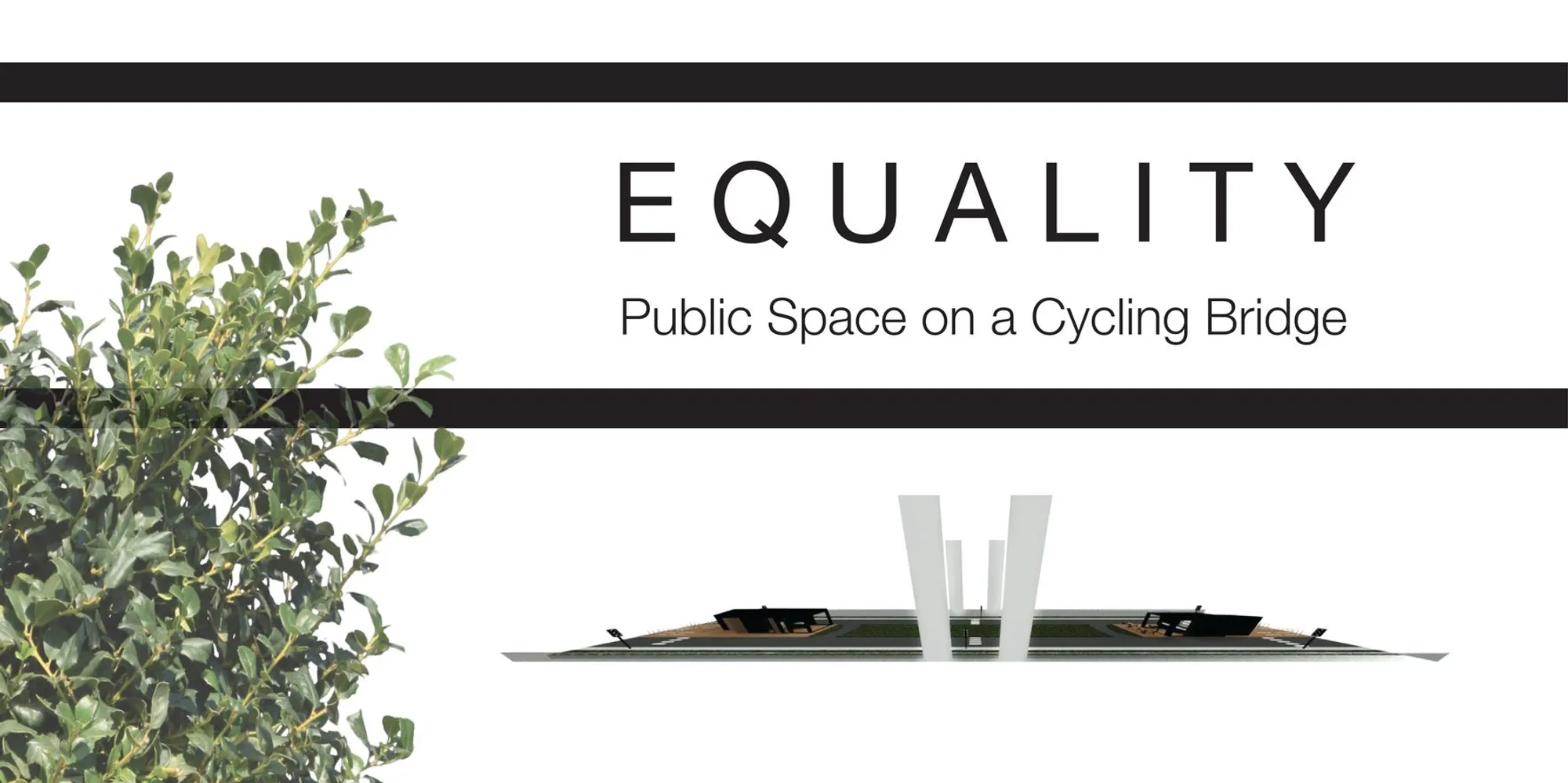
Equality: A Cycling Bridge That Becomes an Elevated Urban Oasis in Denmark
Linda Leišavniece reimagines the cycling bridge as a public park, café, and inclusive gathering space suspended above the waterfront.


What if a bridge refused to be just a bridge? Equality, a conceptual cycling bridge designed by Linda Leišavniece, takes Denmark's most foundational societal principle and builds it into timber, glass, and green space suspended above water. The structure is part mobility corridor, part micro-park, part service hub: a hybrid public platform where cyclists, pedestrians, and people with disabilities share space on genuinely equal terms. Rather than treating transit as something to endure between destinations, the project turns the crossing itself into the destination.
Rooted in Denmark's cultural commitment to equality, the project translates that value into clean vertical planes, balanced spatial divisions, and inclusive amenities accessible to all users. A streamlined cycling route cuts through the center of the bridge, regulated by cycle-friendly traffic lights during peak hours, while flanking zones unfold into sculptural seating, lush planting beds, shaded rest areas, and a fully serviced café pavilion. Natural materials like wood and grass merge with LED-embedded pathways and smart fabrics that respond to light and movement, creating a calming yet technologically literate environment.
A Black Pavilion on a Timber Deck
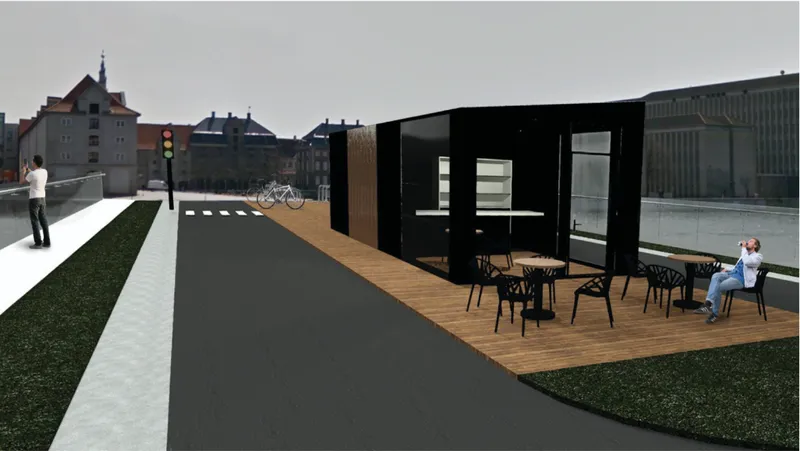
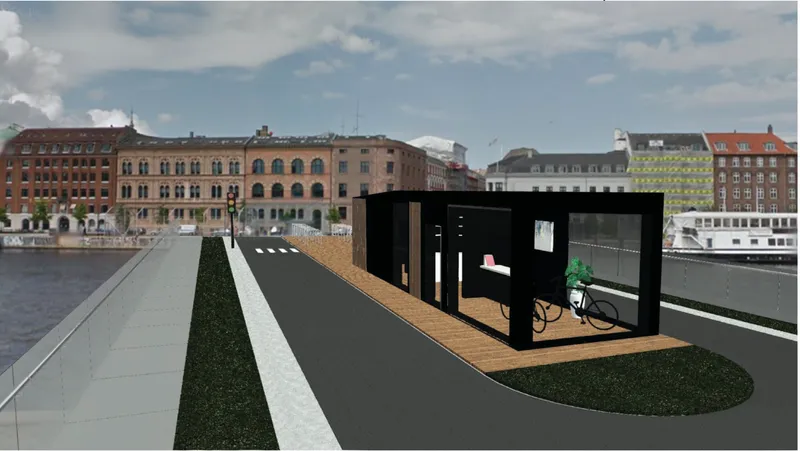
The café and service pavilion anchors the bridge's public programme. A sleek black modular volume sits on a generous timber deck, its glass walls opening views across the harbor and the boats moored below. The building houses a public café, bicycle rental and repair services, universally accessible washrooms, and indoor seating with panoramic urban views. Wooden decking wraps around the structure to create relaxed outdoor hangout zones that flow seamlessly into the cycling path. The contrast between the dark pavilion shell and the warm timber platform gives the space a composed, deliberate character, signaling that this is a place worth lingering, not just passing through.
Landscape as Infrastructure: The Axonometric View
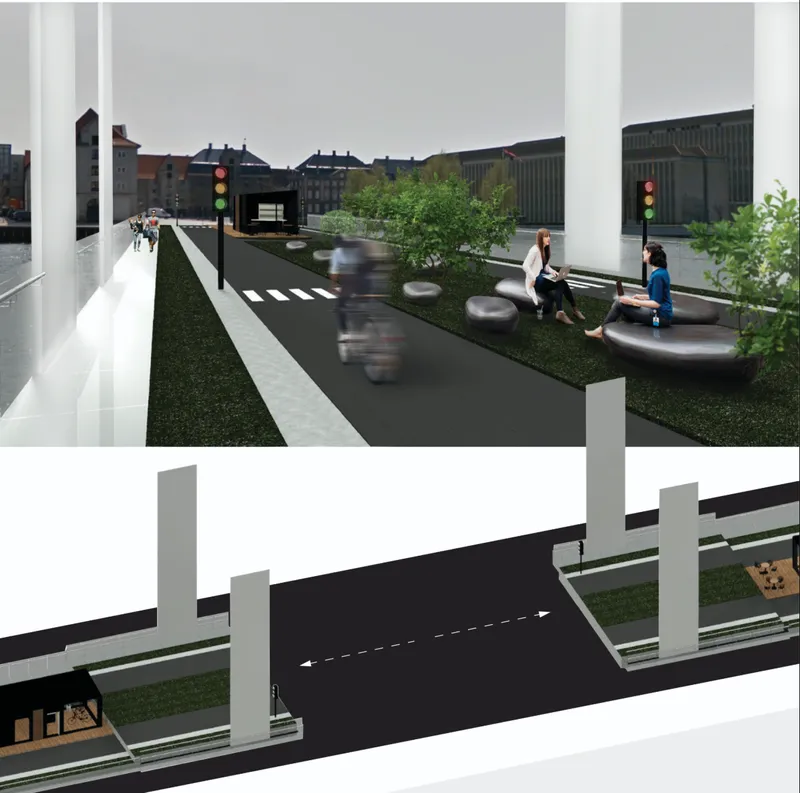
Pulled back into an axonometric rendering, the full spatial logic of Equality becomes legible. The bridge is organized into distinct yet interconnected zones: the cycling pathway running through the center, a public oasis zone populated with sculptural seating stones and curated plantings, and the pavilion complex with its surrounding timber deck. Trees dot the landscaped plaza, providing shade beside structural fins. The drawing reveals how the project negotiates between movement and stillness, channeling cyclists efficiently while carving out pockets of calm for reading, meeting, or simply watching the water. Artificial turf and durable natural materials keep maintenance low, a practical concession that reinforces the project's sustainability ambitions.
Inside the Pavilion: Glass Walls, Timber Floors, and a Parked Bicycle
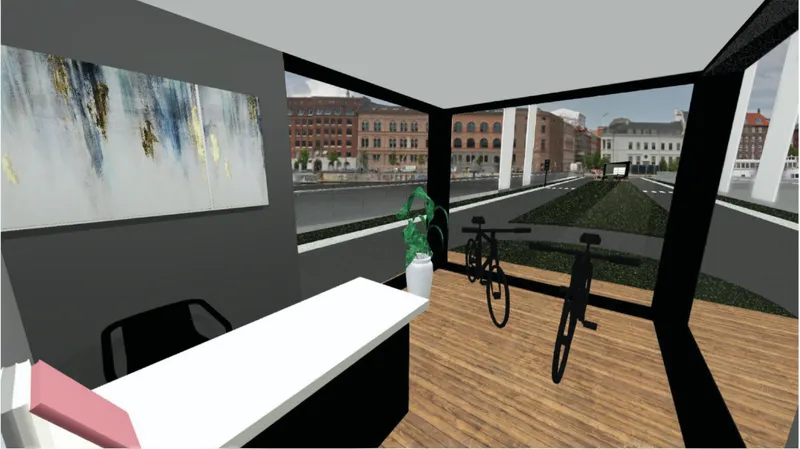
The interior rendering makes a quiet but effective argument: a bicycle parked casually inside the glass-walled workspace confirms that cycling culture is not accommodated here as an afterthought but embedded as a first principle. Timber flooring runs wall to wall, continuous with the decking outside, dissolving the boundary between interior and exterior. Floor-to-ceiling glazing pulls the harbor landscape into the room, ensuring that even the functional spaces of the pavilion participate in the bridge's broader sensory experience. Energy-efficient solutions integrated into the pavilion's systems support the project's commitment to sustainability without compromising spatial warmth.
Universal Accessibility Down to the Bathroom Detail
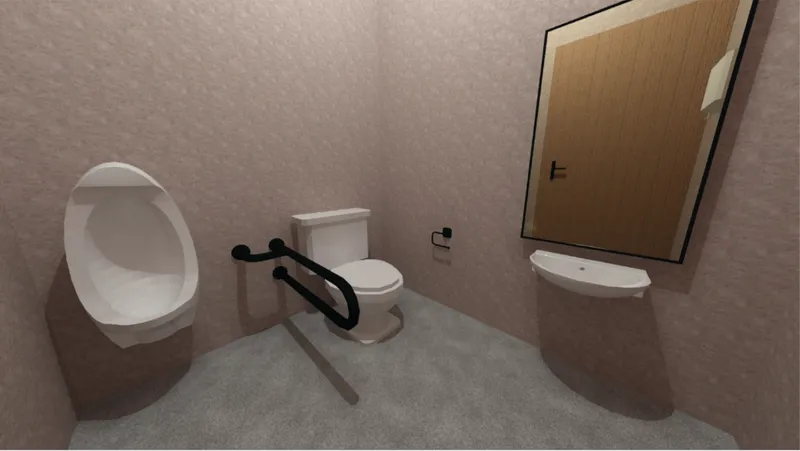
Equality earns its name in the details that most projects overlook. The rendered bathroom interior shows a wall-mounted toilet, urinal, sink, and grab bar set against pink concrete walls. It is a restroom designed for universal accessibility, not as a regulatory checkbox but as a spatial expression of the project's core thesis. All circulation routes, entrances, and restrooms across the bridge follow the same inclusive logic. When a project named after equality dedicates the same care to its washrooms as to its harbor-facing café seating, the concept stops being rhetorical and starts being architectural.
Why This Project Matters
Bridges remain some of the most symbolically loaded structures in any city. They connect separated communities, frame skylines, and often become the images by which cities are known. Equality recognizes this symbolic weight and uses it deliberately, encoding Denmark's defining societal value into every spatial decision: from the balanced division between cyclists and pedestrians, to the universally accessible restrooms, to the green oasis zones that treat rest and reflection as equal to efficient transit.
Linda Leišavniece's project also makes a practical case for hybrid infrastructure. By layering a café, bike services, curated landscape, and smart technology onto what could have been a simple crossing, the design demonstrates that urban mobility structures can generate public life rather than merely facilitate movement. The bridge promotes cycling as a zero-emission transit mode while offering reasons to stop mid-crossing and stay. That dual purpose, movement and pause held in productive tension, is what gives Equality its strength as both a concept and a potential urban landmark.
View the Full Project
About the Designers
Designer: Linda Leišavniece
Enter a Design Competition on uni.xyz
uni.xyz runs architecture and design competitions year-round that reward proposals with spatial conviction and real site intelligence.
Project credits: Equality by Linda Leišavniece.



Popular Articles
Popular articles from the community


AL-JANNAH: Sustainable Architecture and Permaculture for Afghan Widows
AL-JANNAH uses sustainable architecture and permaculture to create resilient oasis of housing, learning, work and renewal for Afghan widows.

Co-life: Sustainable Architecture for Age-Friendly Community Living
Co-life reimagines sustainable architecture for seniors through courtyards, rammed earth, shared gardens, and spaces designed for belonging.

The Musturak Paradise: Senior Living Architecture for a Connected Future in Temara, Morocco
The Musturak Paradise reimagines senior living architecture in Temara via private homes, social spaces, culture, community, and shared care.

Conexión: Biophilic Design Reimagines High-Rise Living in Hong Kong
Conexión reimagines high-rise living in Hong Kong through biophilic design, green facades, shared spaces, daylight, water and nature within.

Similar Reads
You might also enjoy these articles
The Musturak Paradise: Senior Living Architecture for a Connected Future in Temara, Morocco
The Musturak Paradise reimagines senior living architecture in Temara via private homes, social spaces, culture, community, and shared care.

The Leaf Center: Cultural Center Architecture for Social Integration in Amsterdam
Cultural center architecture becomes a bridge at The Leaf Center, connecting international students with Amsterdam through art and exchange.
Conexión: Biophilic Design Reimagines High-Rise Living in Hong Kong
Conexión reimagines high-rise living in Hong Kong through biophilic design, green facades, shared spaces, daylight, water and nature within.

Wander to Wonder: Modular Playground Design for Children in Kutupalong Refugee Camp
Wander to Wonder uses modular playground design to create flexible, imaginative play spaces for children in Kutupalong refugee camp.

Explore Cycling Bridge Competitions
Discover active competitions in this discipline



Challenge to reimagine the Iron Throne


Photograph architecture without architects


Illustrate the lost glory of Angkor Wat - Render Challenge


Design challenge to reuse E-waste
Comments (0)
Please login or sign up to add comments
No comments yet. Be the first to comment!