
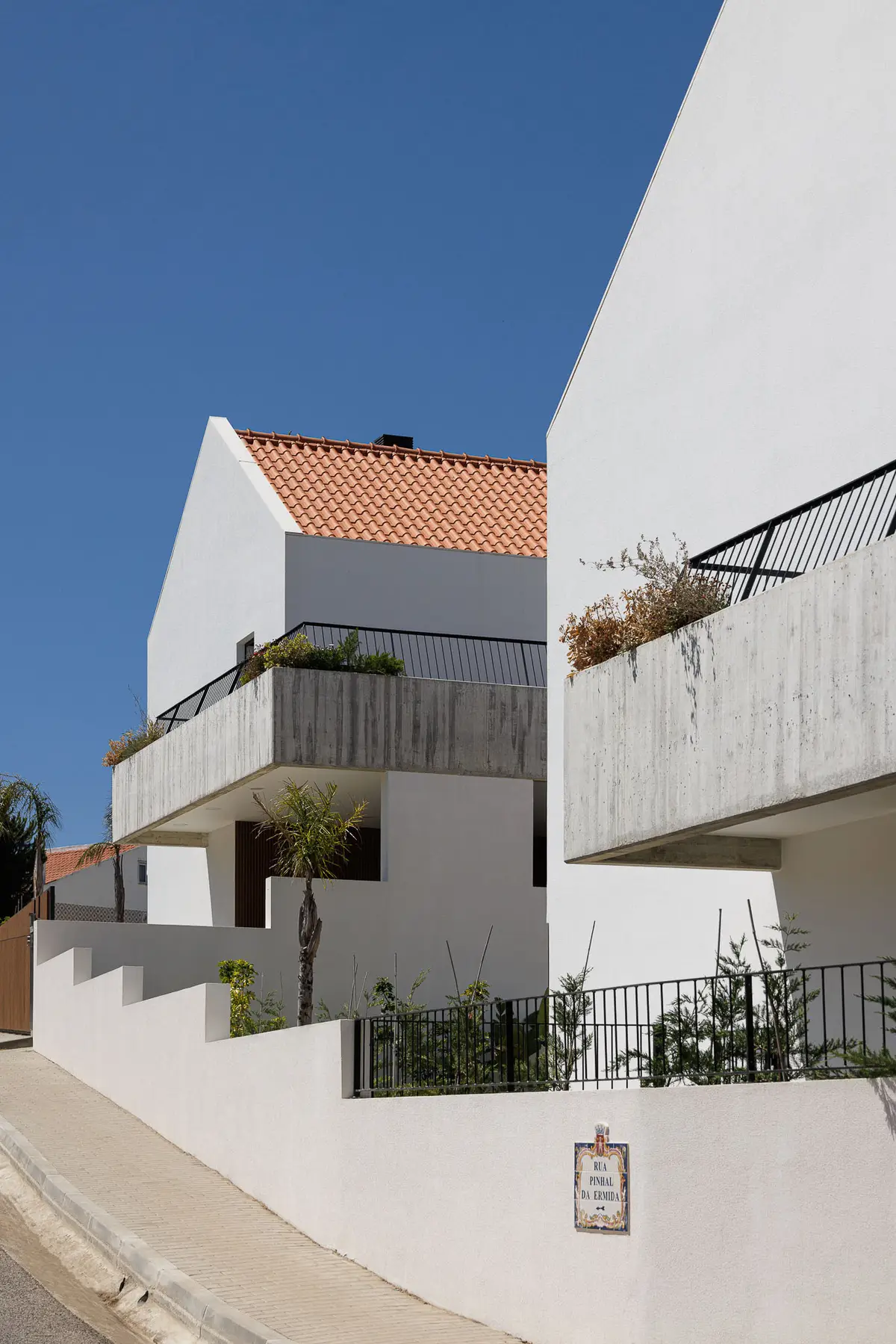
Esquissos Splits a Sintra Hillside into Three Houses That Disappear into Their Landscape
Three isolated white gabled volumes in Sintra, Portugal step down a slope, using concrete terraces and timber to blur the line between house and garden.


The twin dwelling is a familiar format in Portuguese suburban development: two mirrored units sharing a party wall, occupying a plot with maximum efficiency. Esquissos - Arquitectura e Consultoria, led by architect Marco Ligeiro, chose to reject that template entirely for this site in Sintra. BD Houses instead distributes 580 square meters across three isolated volumes, each one a gabled form rendered in white plaster and capped with terracotta clay tiles. The result looks, at first glance, like a cluster of traditional Portuguese houses. Look closer, and the cantilevered concrete balconies, board-formed retaining walls, and planted terraces tell a different story.
What makes this project genuinely interesting is the slab strategy. Rather than building retaining walls that fight the hillside, the architects use concrete platforms as vegetable terraces that step down the slope, creating a graduated relationship between street level and the private interiors below. The houses rise from the landscape rather than sitting on top of it. Each volume gets its own exterior space, its own privacy, and its own negotiation with the grade. It is a strategy that turns a constraint (a sloping, trapezoidal lot) into the project's primary spatial asset.
Three Volumes, One Neighborhood
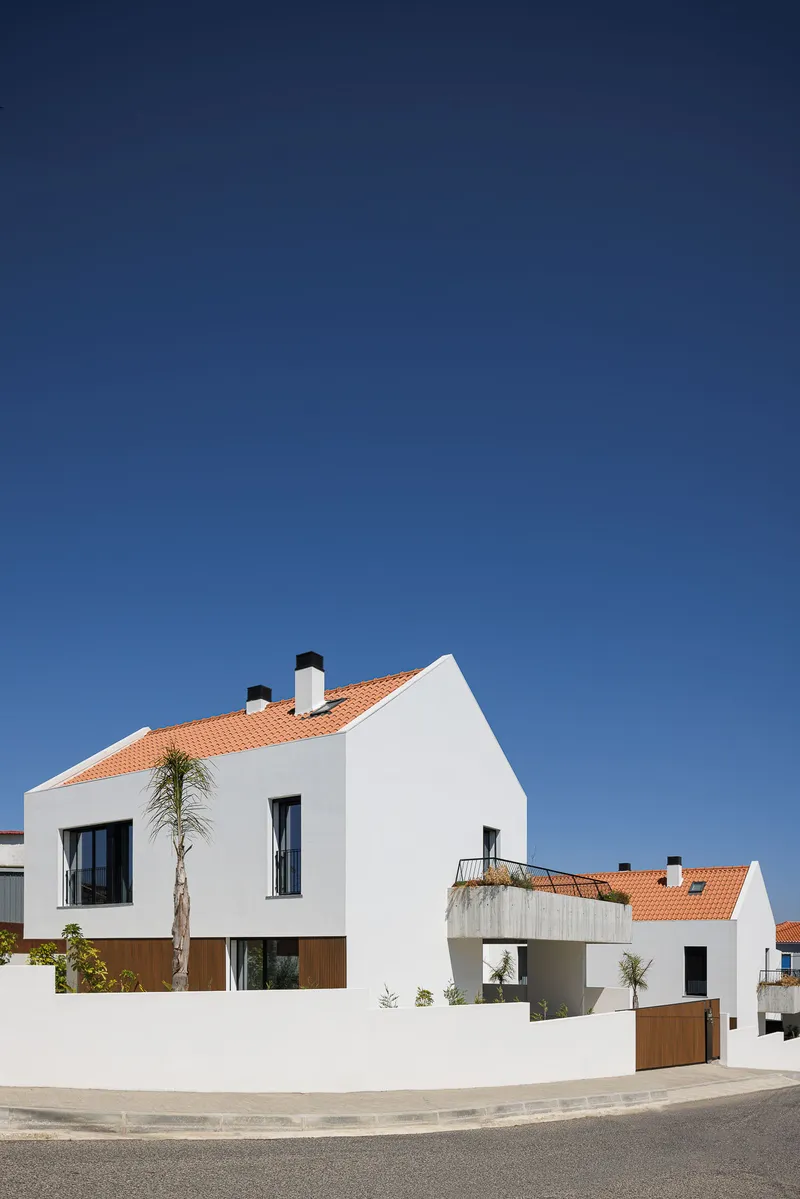
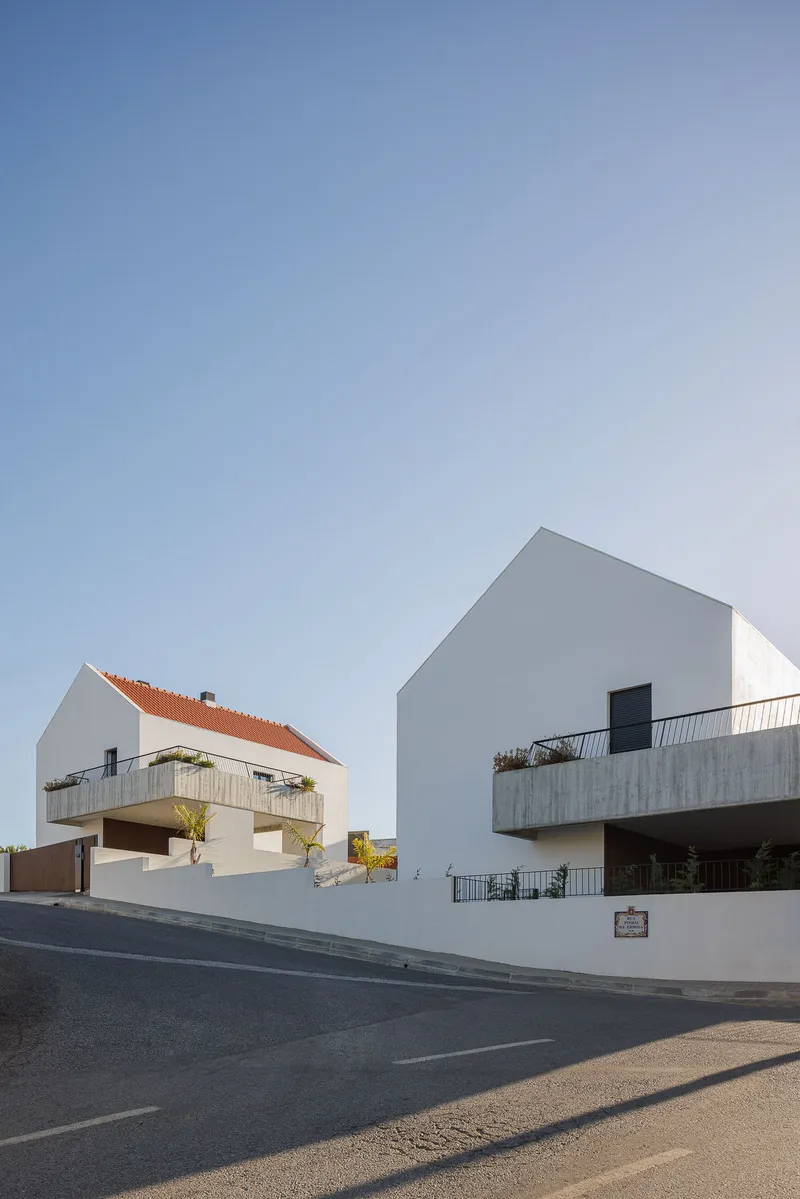
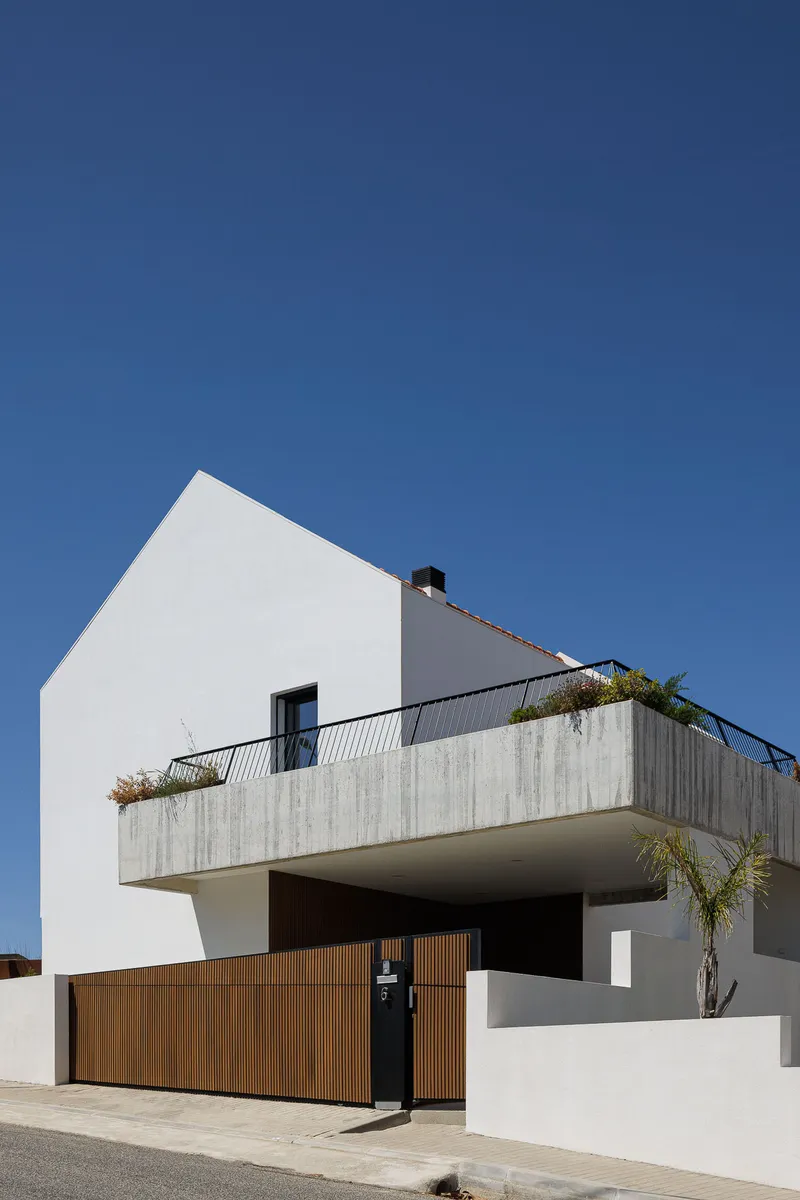
From the street, BD Houses reads as a cohesive composition rather than three separate buildings. The white plaster, terracotta roofs, and simple gabled profiles echo the material language of the surrounding area. Esquissos was deliberate about this: the geometry and materiality were chosen to maintain concordance with existing houses in the neighborhood, avoiding the common suburban trap of a shiny new development that looks transplanted from another city.
But uniformity is not the same as monotony. Each volume presents a slightly different face to the public realm. One projects a heavy concrete balcony over a recessed carport. Another foregrounds a vertical timber slatted gate that shields the ground floor from view. The third opens more generously toward the shared courtyard between them. The discipline of a simple palette, used with variation, gives the grouping its character.
Concrete as Landscape Infrastructure
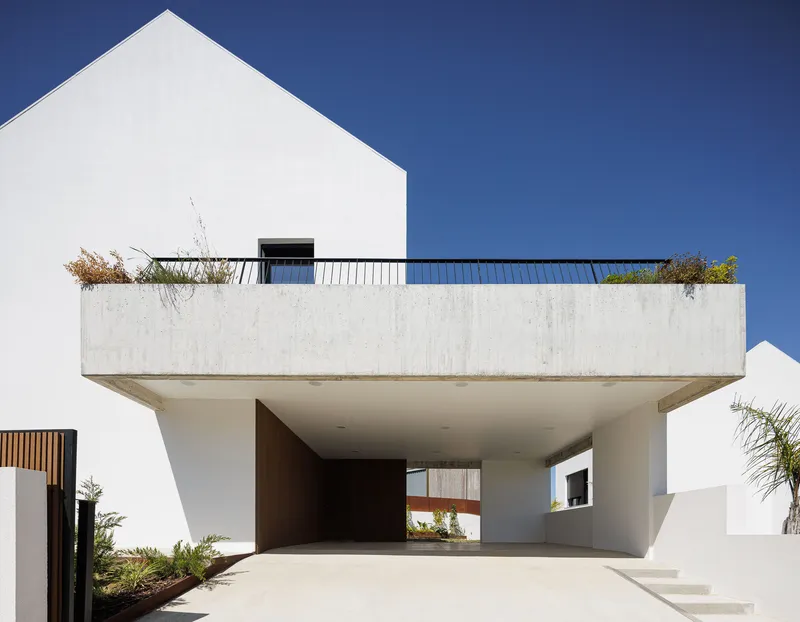
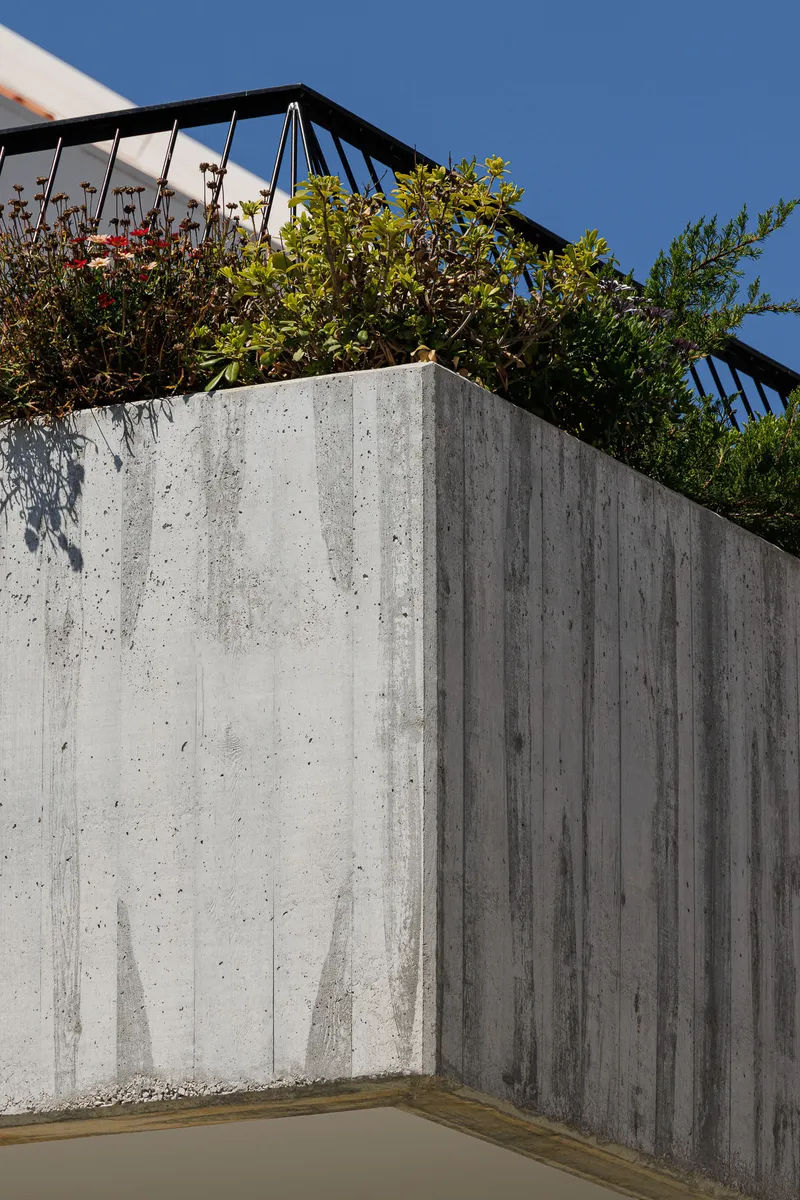
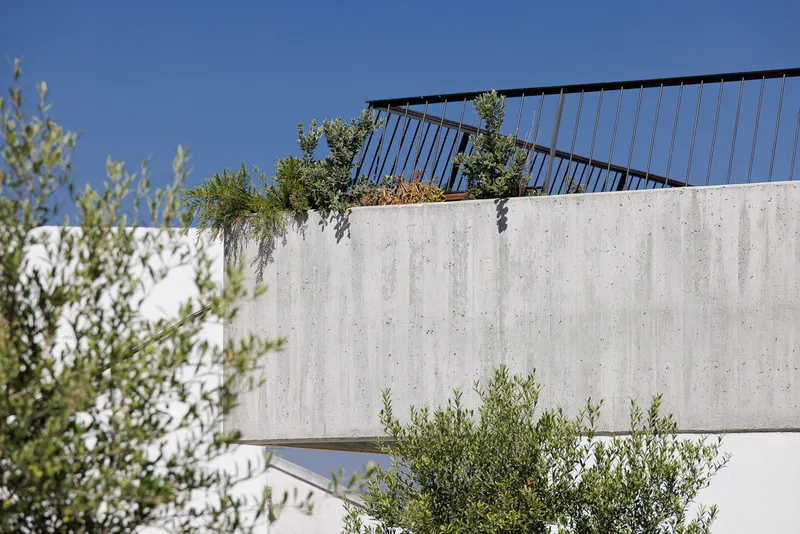
The board-formed concrete is the material doing the most architectural work here. It appears as cantilevered balconies, planted terraces, and retaining walls, always mediating between the built volume above and the garden or carport below. The board markings left in the formwork give these elements a tactile roughness that contrasts sharply with the smooth white render above.
Crucially, these concrete elements are not decorative. They are the mechanism through which the houses negotiate the sloped site. Planted edges grow over the parapets, metal trellises support climbing vegetation, and the terraces themselves function as gardens. Over time, this infrastructure will soften further as the planting matures. The distinction between architecture and landscape is already blurring.
Timber Cladding and the Ground Plane
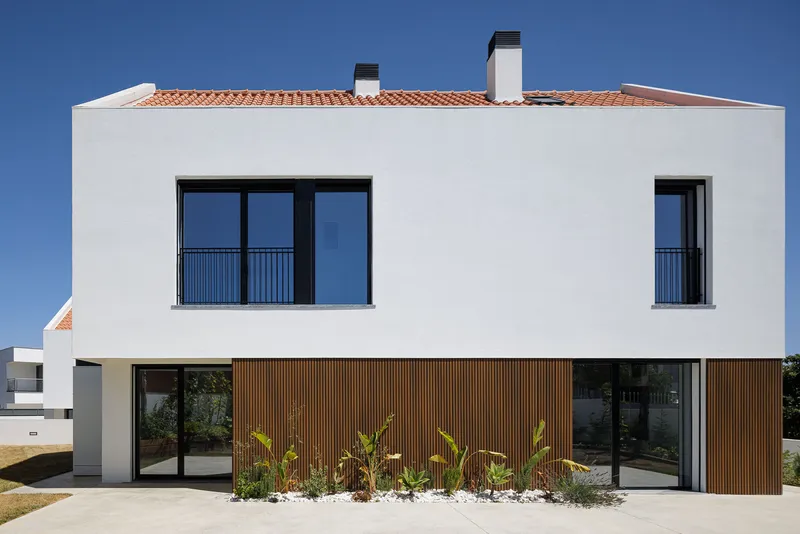
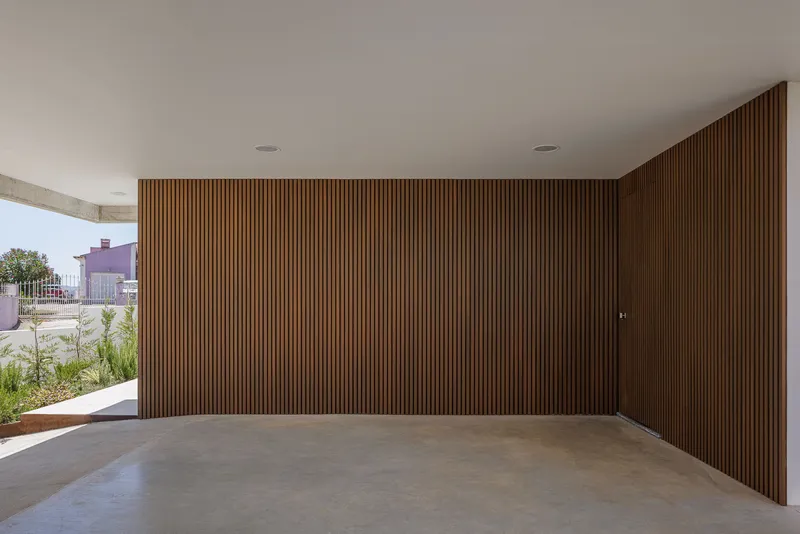
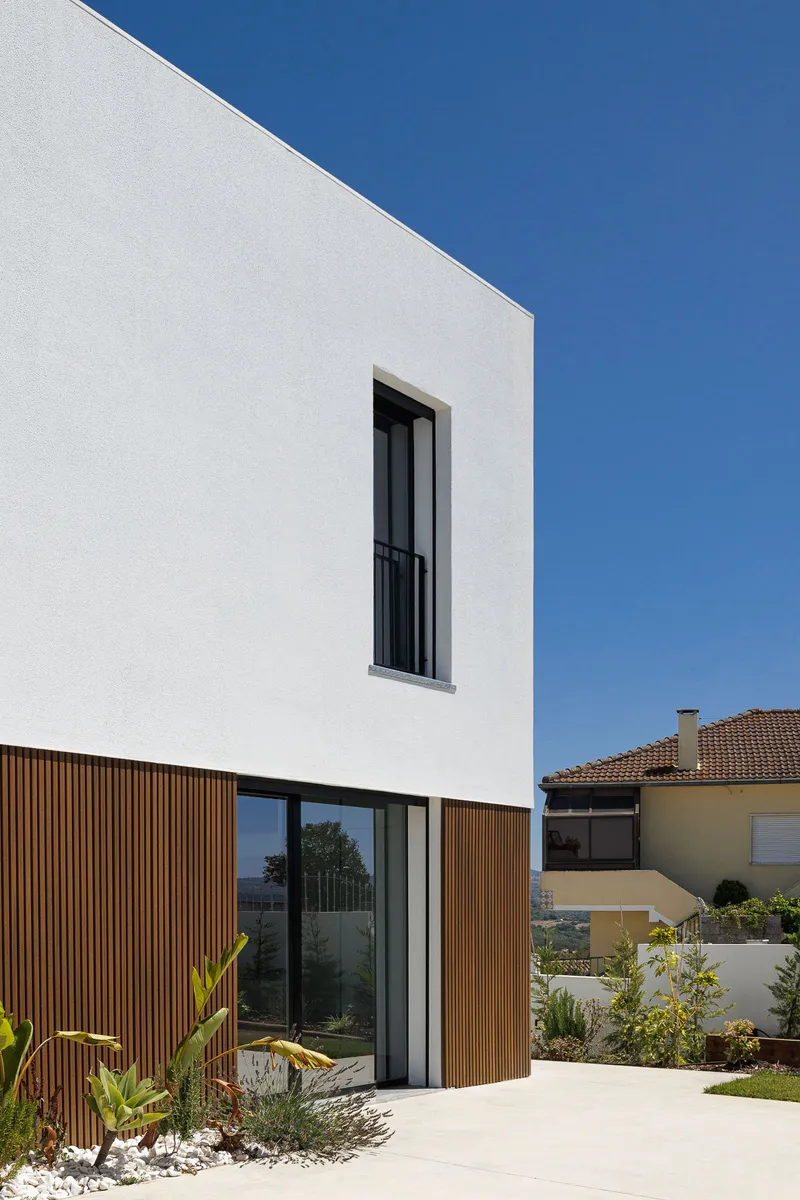
At ground level, the white plaster gives way to vertical timber slat cladding. This shift does two things. Practically, it marks the semi-private zone of carports, storage, and entries, distinguishing it from the living spaces above. Visually, it introduces warmth and texture at the scale where you encounter the building up close: touching a gate, parking a car, stepping through a threshold.
The covered carport, with its polished concrete floor and timber screen wall, is a particularly considered space. It feels more like a sheltered courtyard than a parking bay. Landscape architect Team Garden extended planting right up to these ground-level zones, so that even the most utilitarian moments of the house are framed by greenery.
Between the Volumes
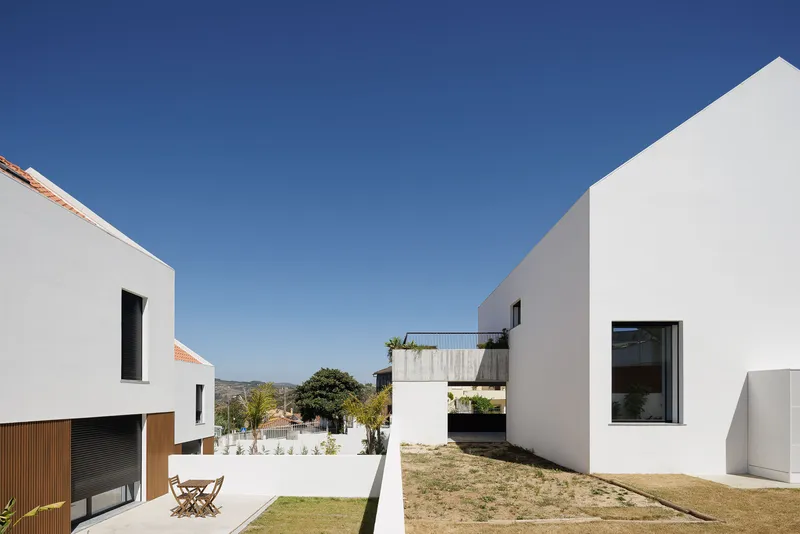
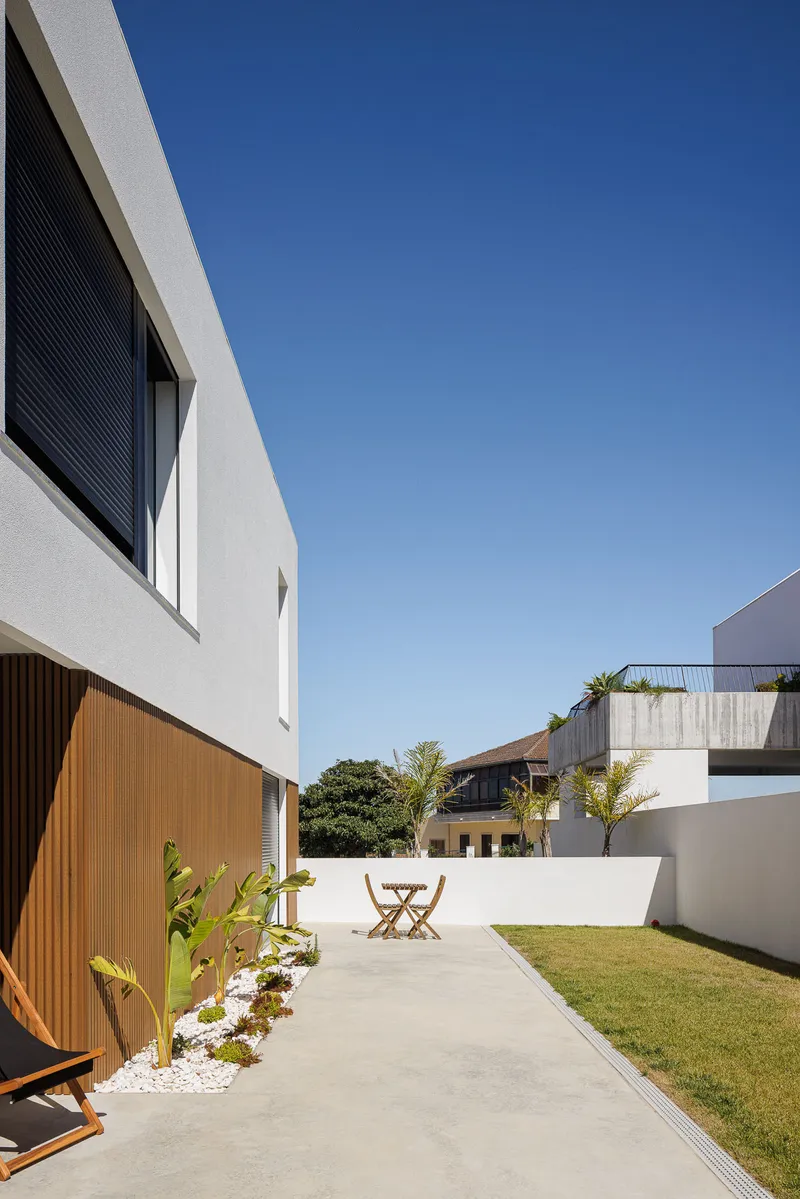
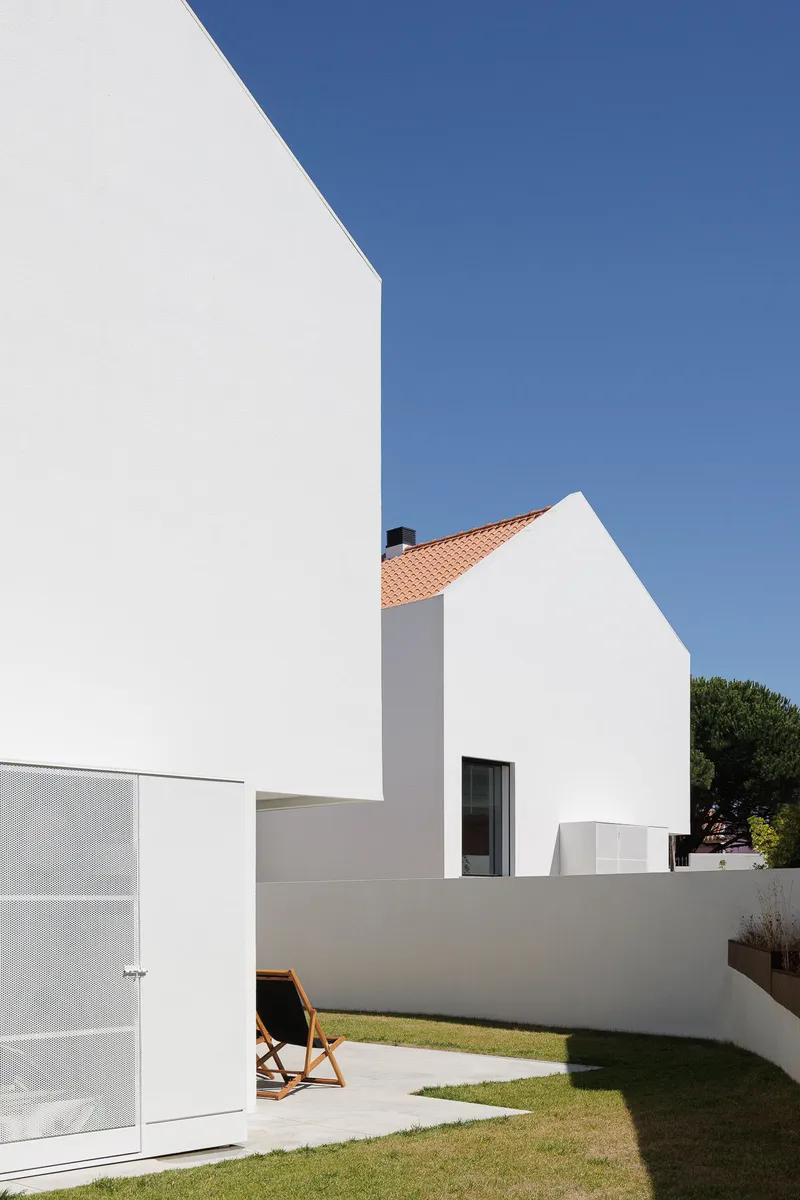
The spaces between the three houses are as carefully designed as the interiors. A shared courtyard with lawn and a simple wooden table occupies the gap between two of the gabled forms, creating an outdoor room defined by white walls and sky. Private patios are enclosed by curving rendered walls and low perimeter barriers, offering each unit a distinct exterior territory.
Privacy was clearly a driving concern. The decision to build three separate volumes rather than a terrace or semi-detached pair means that each house controls its own light, its own views, and its own outdoor space. No shared party walls, no compromised orientations. The extra cost of three independent structures is justified by the quality of life this separation provides.
Light-Filled Interiors
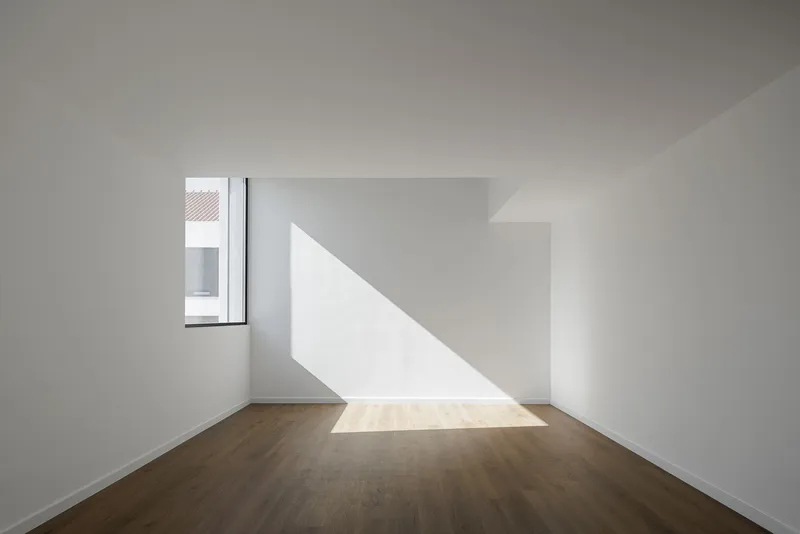
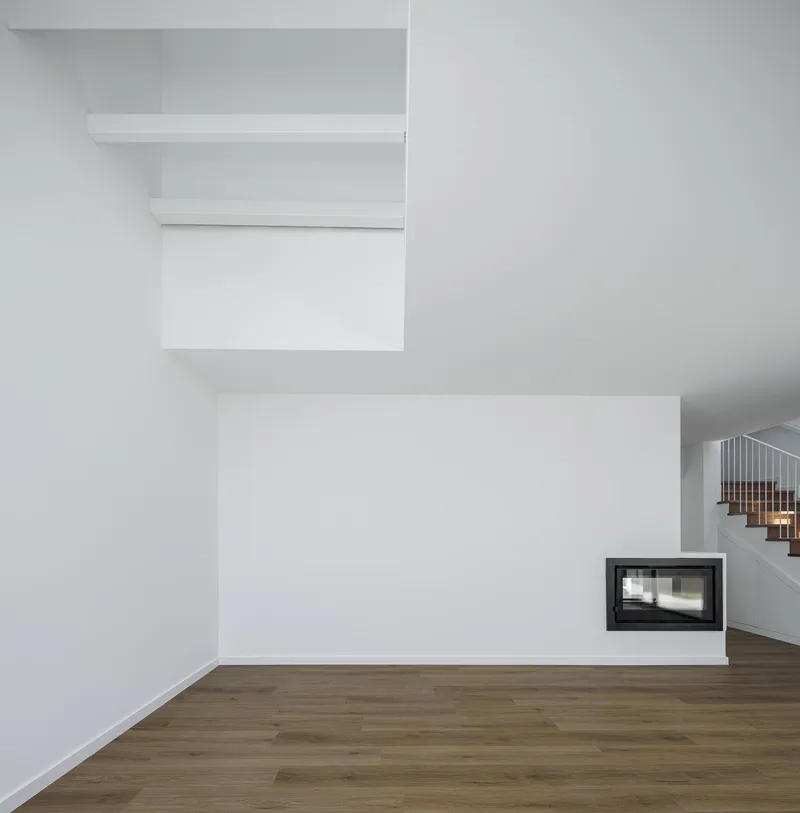
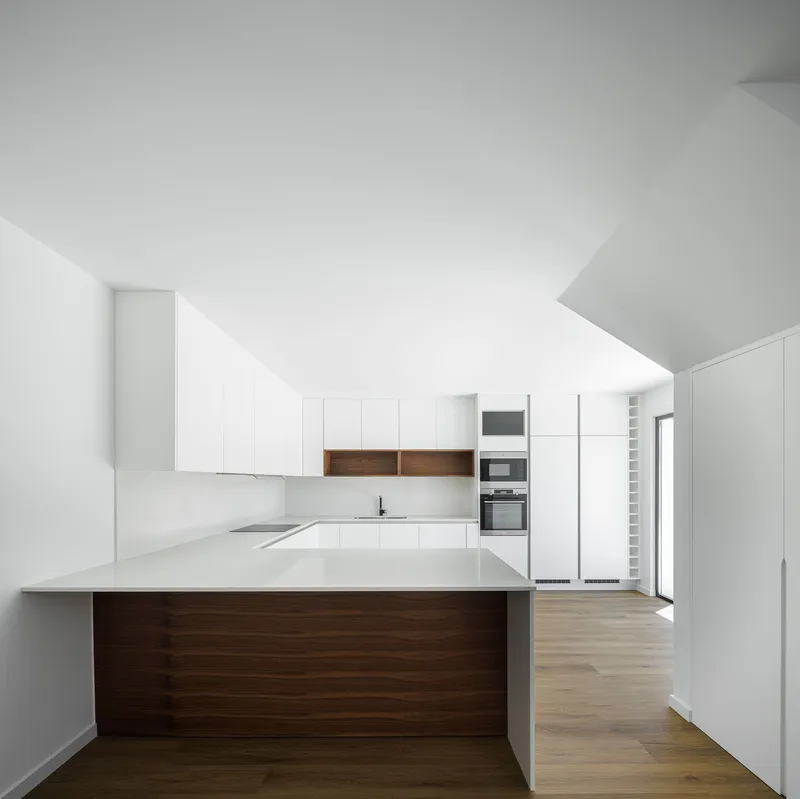
Inside, the houses are pared back. White walls, light oak flooring, and the occasional walnut accent (a kitchen island, a vanity base) create a neutral envelope that foregrounds natural light. The gabled roof forms generate sloped ceilings on the upper levels, and the architects exploited this geometry with carefully placed corner windows and narrow skylights that cut diagonal shafts of sunlight across otherwise minimal rooms.
The kitchens are clean and functional, with white cabinetry and generous ceiling height under the pitched roof. A recessed fireplace insert anchors the living space on the ground floor, visible from both sides of the open-plan room. There is nothing ostentatious about these interiors. The quality comes from proportion, light, and material restraint.
The Staircase as Spatial Engine
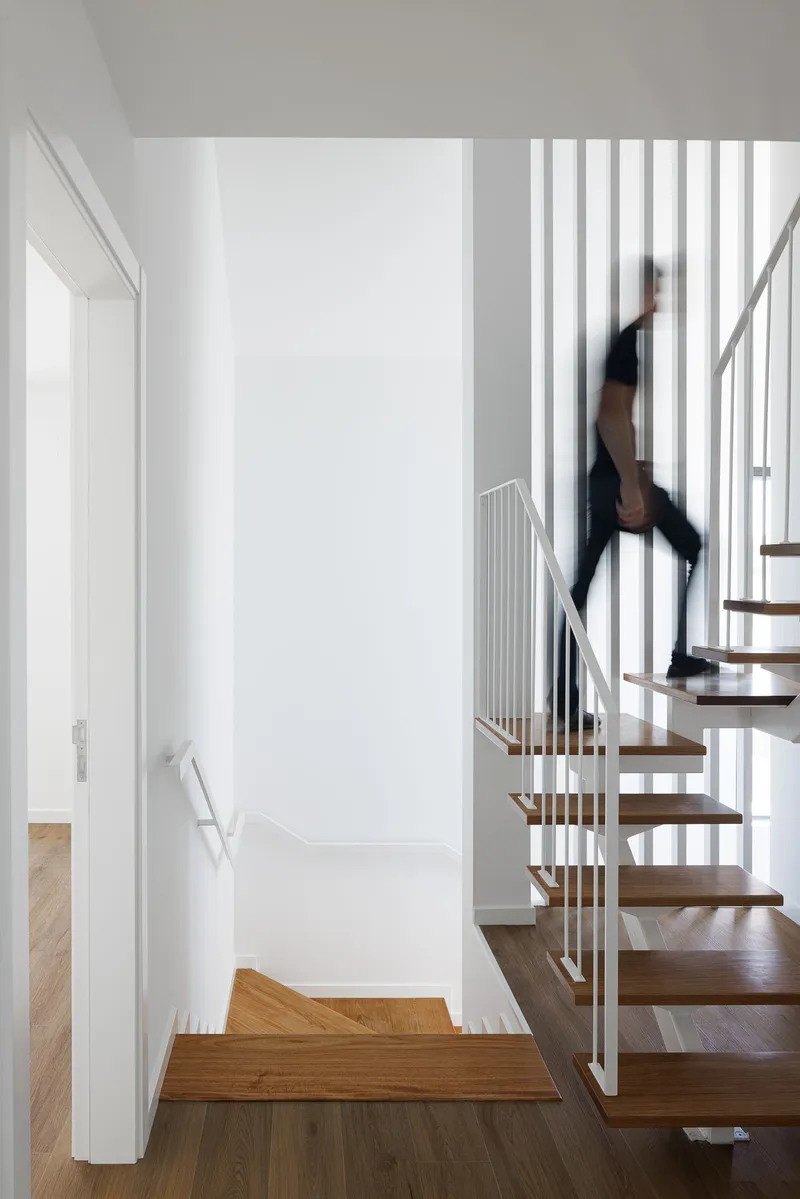
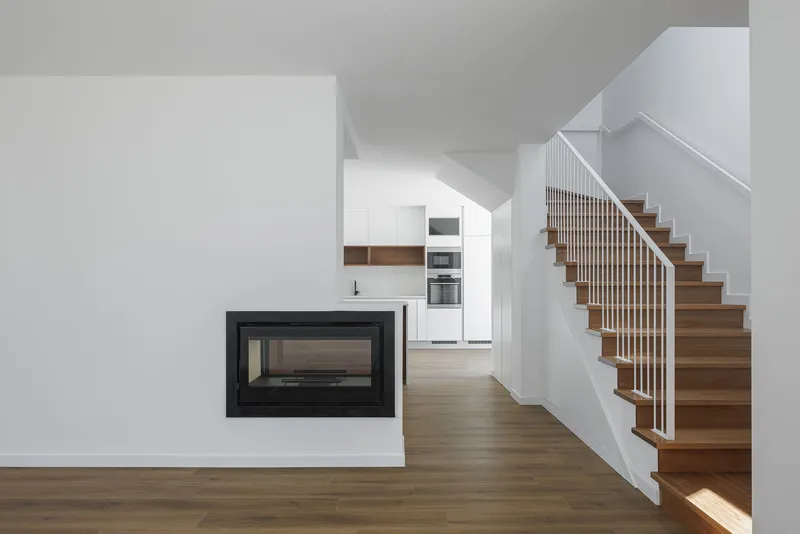
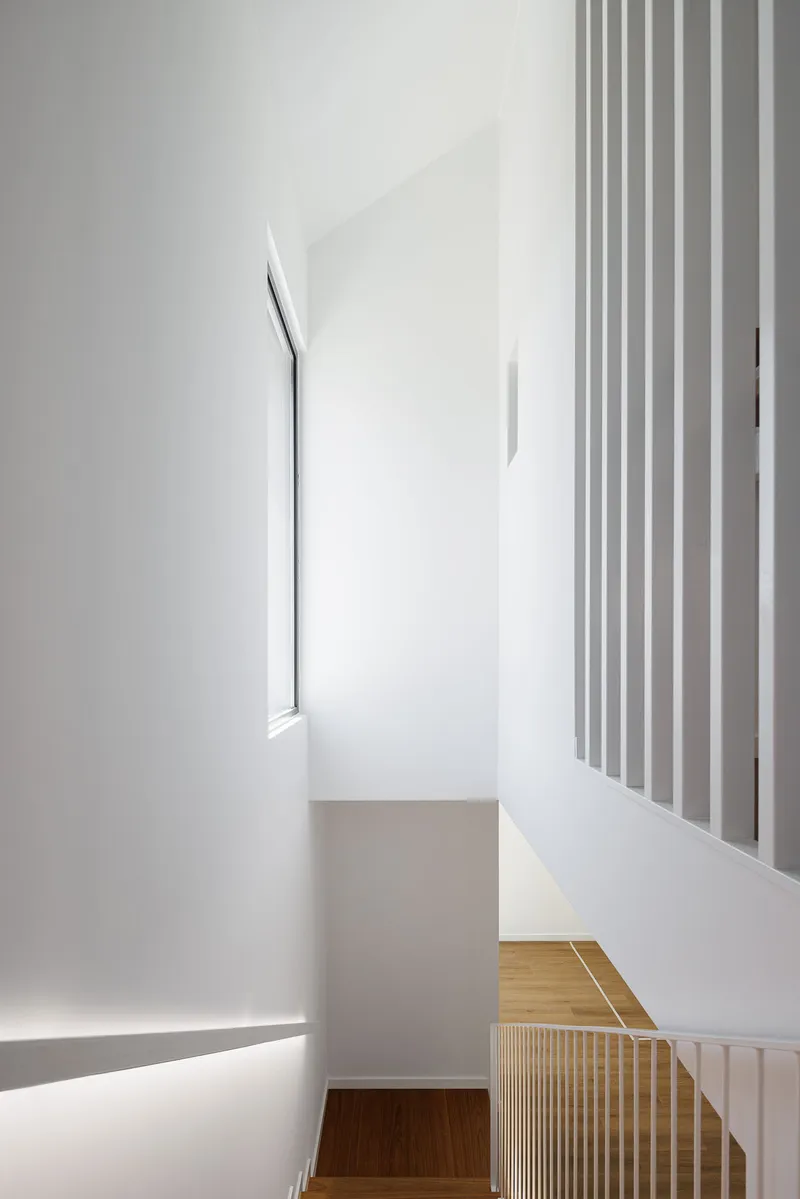
Each house organizes around a central open-tread staircase with timber treads and white steel vertical balusters. These stairs do more than connect floors: they act as light wells and spatial dividers, allowing views through and across the section. From the upper landing, a narrow skylight runs along the ceiling, washing the vertical screen with diffused light and creating a luminous core at the center of the plan.
The detailing is consistent and well executed. The balustrade panels use closely spaced vertical bars that filter light while maintaining transparency, and the steel frames are painted white to disappear against the walls. It is the kind of element that could easily become heavy-handed, but here the proportions keep it light.
Upper Levels and Circulation
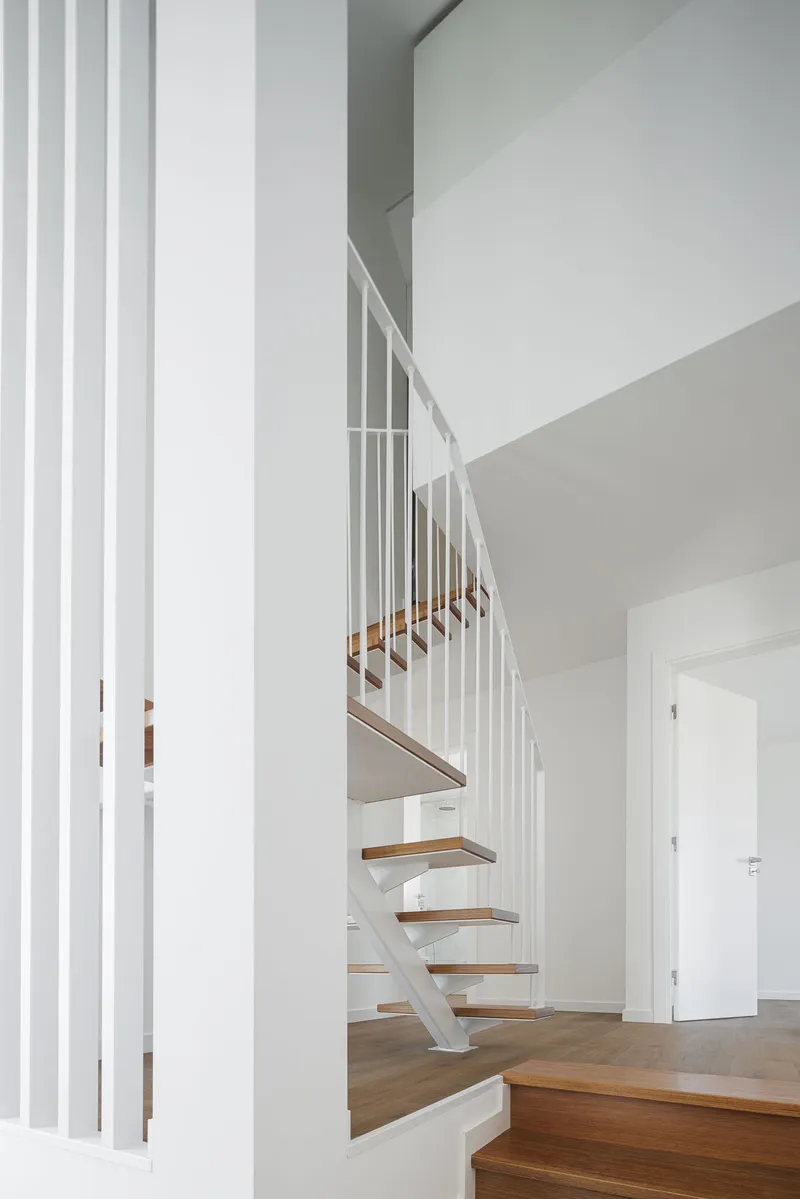
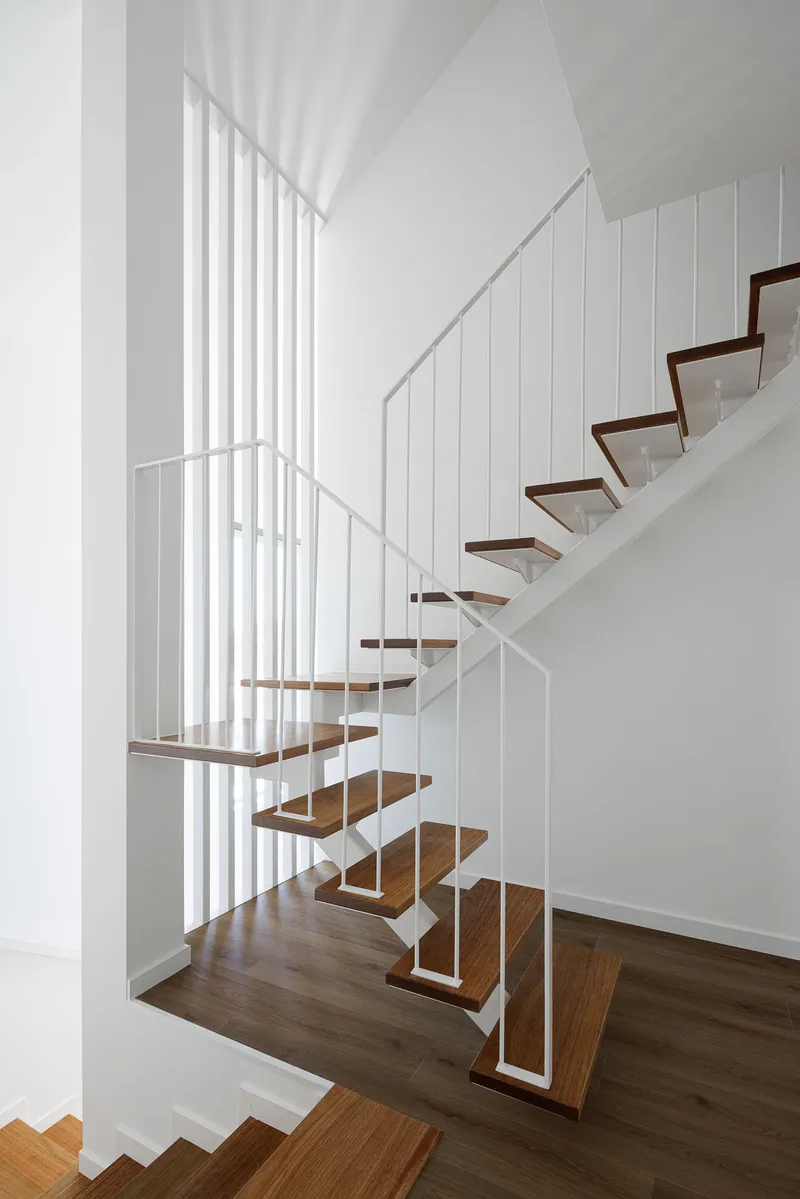
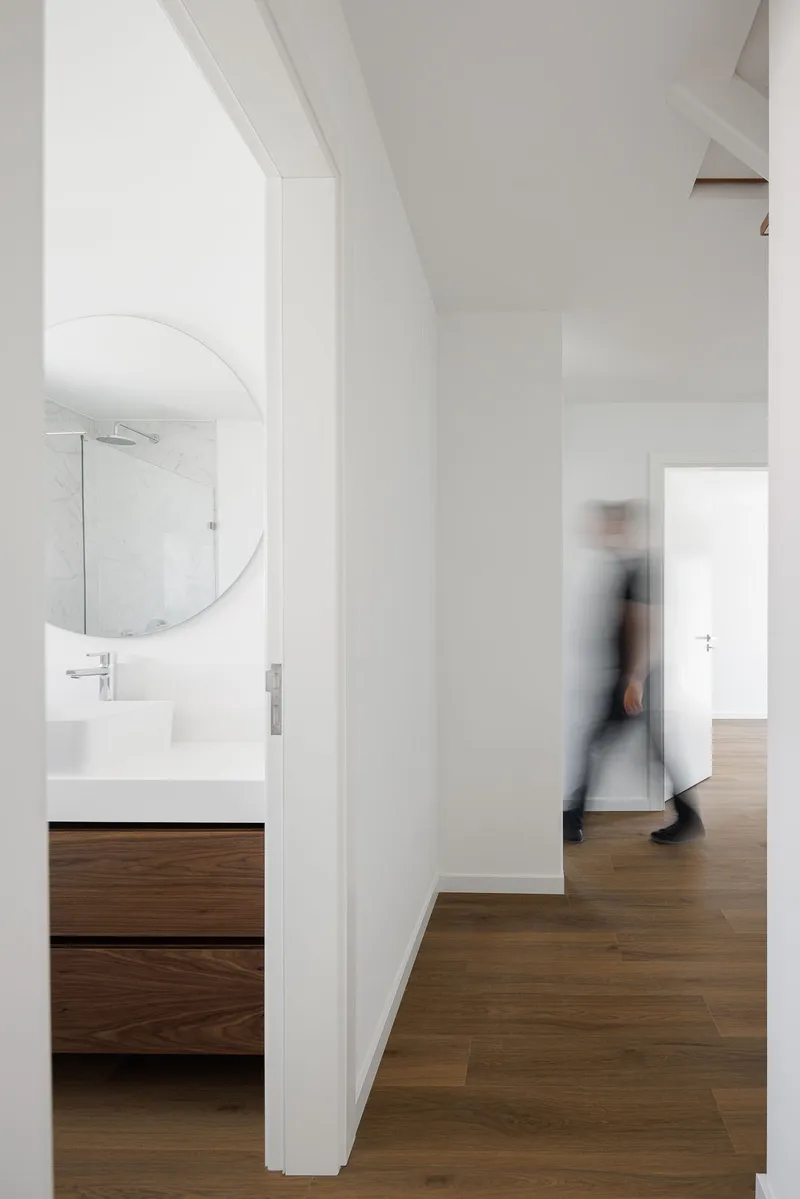
The upper floors contain bedrooms and bathrooms arranged along a compact hallway. A blurred figure passing a walnut vanity base captures the domestic scale of these corridors: they are narrow, efficient, and warmed by the timber detailing at the edges. The stair arrives at a landing that overlooks the living space below through the vertical screen, maintaining the vertical connection between public and private zones.
Plans and Drawings
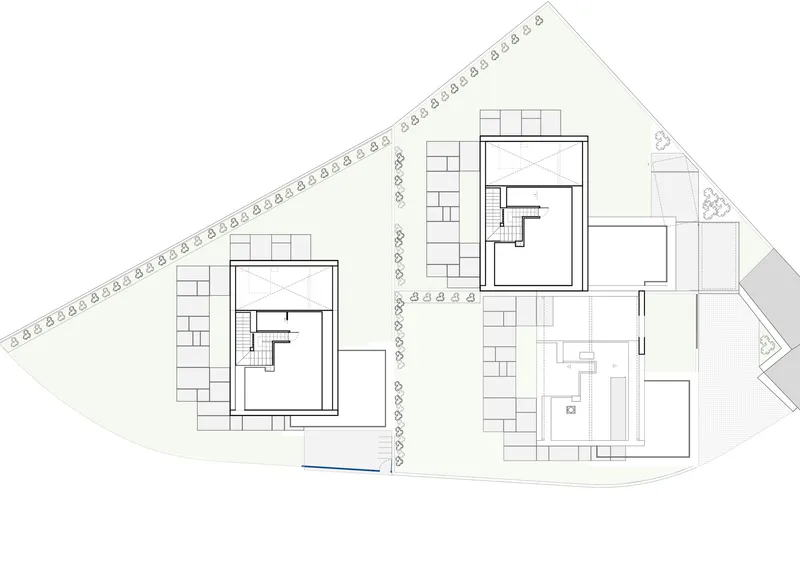
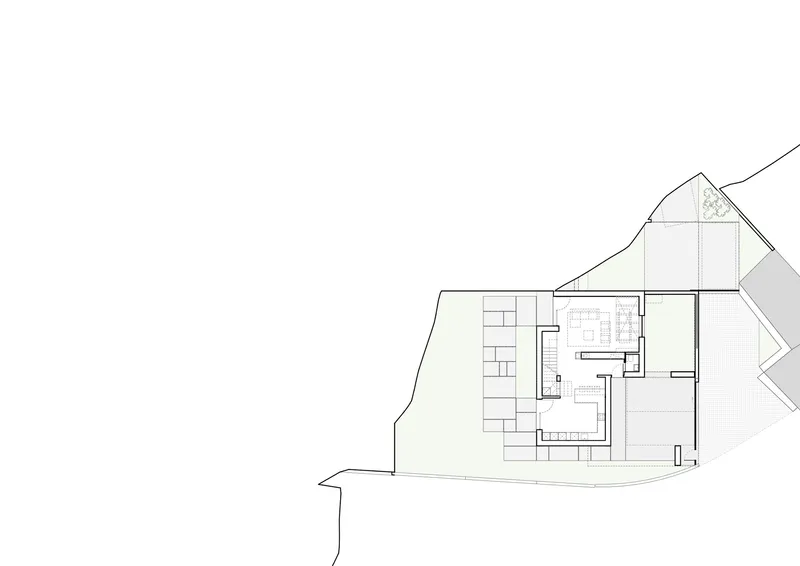
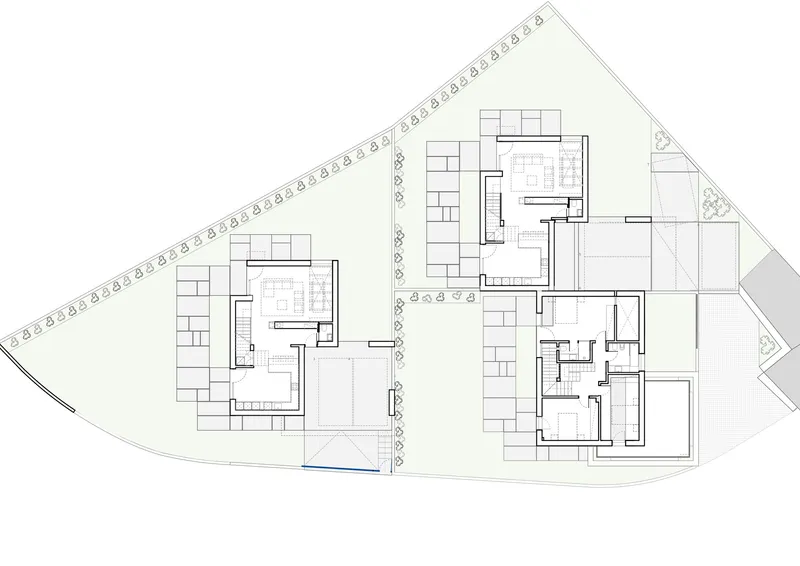
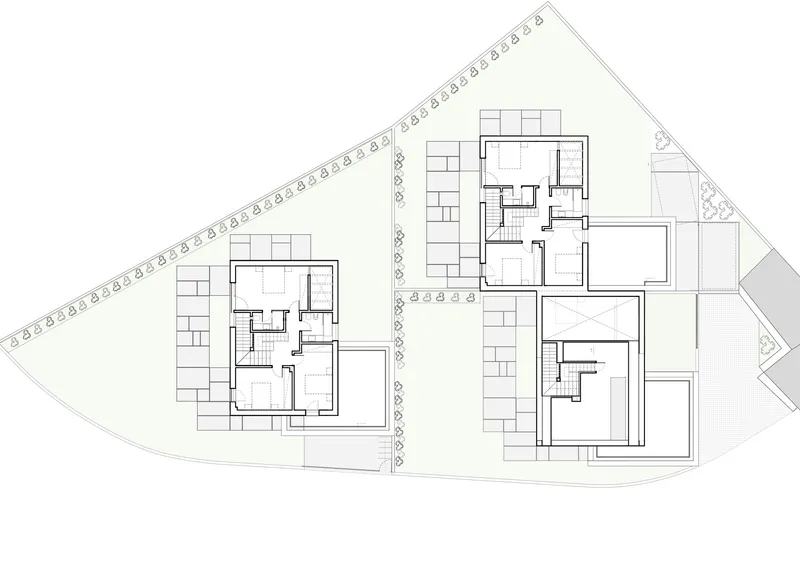
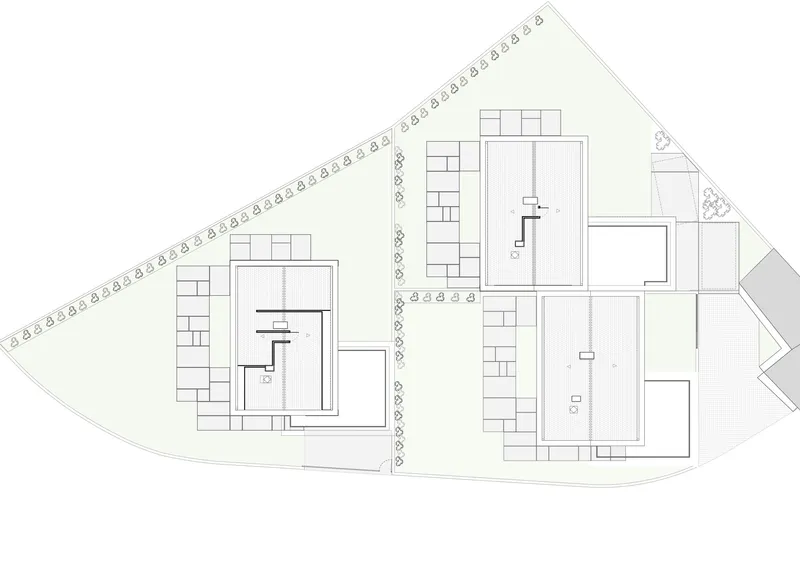
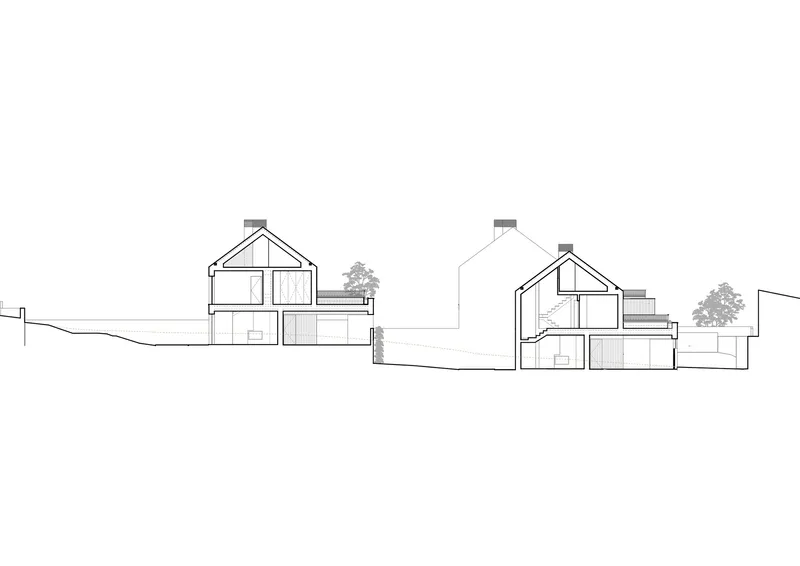
The site plans reveal the full strategy: three footprints arranged on a sloping trapezoidal lot, with a central access road dividing two volumes from one. The floor plans show a repeated unit type with central staircases and rooms organized around the stair core, while the section drawing confirms how the houses step down the hillside, each one shifted in elevation to follow the terrain. The pitched roofs, read together in section, create a rhythmic silhouette that mirrors the topography beneath.
Why This Project Matters
BD Houses is a quiet rejection of the default suburban housing model. By splitting a program that would typically produce a pair of semi-detached units into three independent volumes, Esquissos prioritized something that is easy to talk about but hard to deliver: genuine privacy, genuine outdoor space, and genuine integration with a sloping site. The concrete terrace strategy turns structure into landscape, and the disciplined material palette ensures the cluster reads as part of Sintra rather than an intrusion upon it.
In a market where housing developments tend to maximize floor area at the expense of everything else, this project demonstrates that restraint and generosity can coexist. The houses are not large, the materials are not exotic, and the forms are deliberately ordinary. What is extraordinary is the care with which ordinary decisions have been made: how a carport becomes a courtyard, how a retaining wall becomes a garden, how three small houses on a hillside become a neighborhood.
BD Houses, designed by Esquissos - Arquitectura e Consultoria (lead architect Marco Ligeiro), Sintra, Portugal. 580 m², completed 2022. Photography by Ivo Tavares Studio.
About the Studio
Share Your Own Work on uni.xyz
If projects like this are the kind of work you want to make, uni.xyz is a place to publish your own, find collaborators, and enter design competitions.


Popular Articles
Popular articles from the community

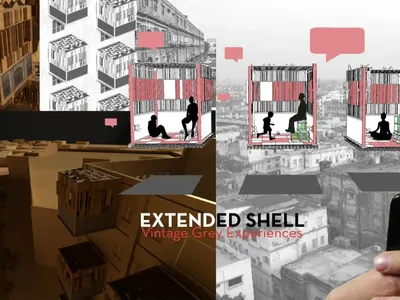
Extended Shell: Retrofitting Kolkata's Balconies as Living Urban Thresholds
A modular retrofit system recovers the social and environmental intelligence of Kolkata's historic verandas for contemporary Park Street residents.

The Amber Palace Opera: A Geological Fiction Surfaces on Tallinn's Baltic Waterfront
Pierre Brillard reimagines a Baltic legend as a public landscape, opera house, and waterfront promenade rooted in Tallinn's coastal identity.

Manzana Morphosis: Stretching Barcelona's Grid into a Living Landscape for 2050
A radical reworking of the Eixample manzana turns density into a tool for generous public space, vertical ecology, and environmental performance.

Cloaked Colonization: A Mobile Underwater Habitat That Moves Like a Fish
Micah Abaya's shortlisted EHC Pacific entry reimagines ocean settlement as a dispersed network of self-sustaining architectural organisms.

Similar Reads
You might also enjoy these articles

Pixel Gardens: One Repeated Module Stacked Into a Terraced Social Housing Tower for Famagusta
Salem Bader's shortlisted housing tower builds a vertical neighbourhood from one repeated module, offsetting units to carve terraces, light and air.

Bao Huynh Watercolor Atelier: A Serene Art Retreat in Hội An
Bao Huynh Watercolor Atelier in Hội An blends multifunctional art spaces, sustainable design, local materials, and family-friendly living in a serene environment.

Atelier Macri Concept Store Interior Design by CASE-REAL
Atelier Macri store features a "ko" counter, walnut wood details, cork displays, blending retail, gallery, and seamless customer experiences.

Manuel Vargas Izquierdo Stadium and High-Performance Sports Center: Architectural Excellence in Jalpa de Méndez
The Manuel Vargas Izquierdo Stadium blends sustainable design, inclusive sports facilities, and cultural-inspired architecture, revitalizing Jalpa de Méndez’s public spaces.

Explore Ai Generated Competitions
Discover active competitions in this discipline

Challenge to reimagine the Iron Throne

Photograph architecture without architects

Illustrate the lost glory of Angkor Wat - Render Challenge

Design challenge to reuse E-waste
Comments (0)
Please login or sign up to add comments
No comments yet. Be the first to comment!