
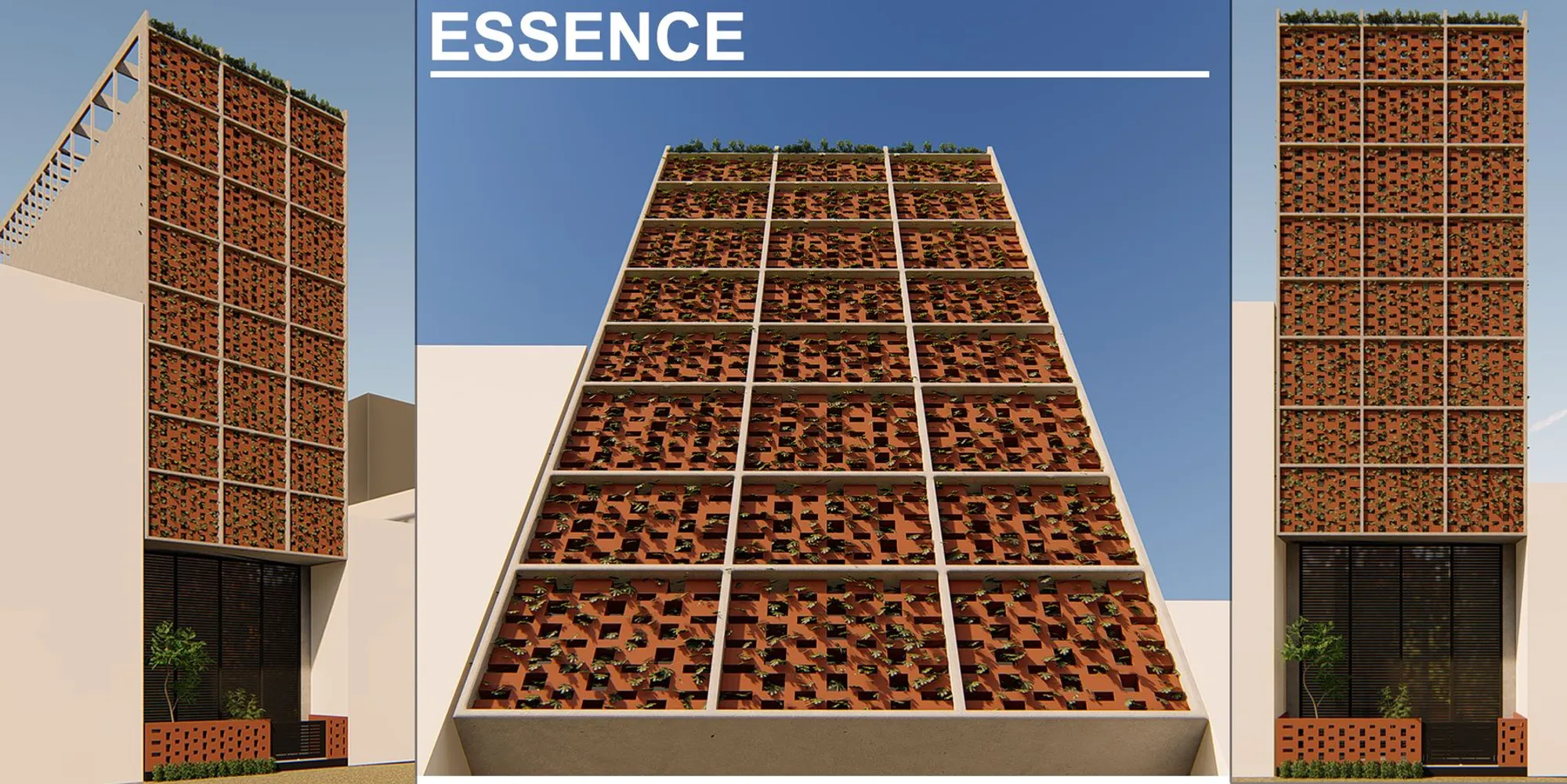
Essence: Low-Cost Climate-Responsive Housing for Gurgaon's Urban Families
A compact courtyard house for three generations that uses brick jaalis, wind scoops, and mezzanine floors to maximize livability on a tight urban plot.


In a city where land prices climb faster than buildings can rise, fitting three generations into a single compact plot demands more than clever floor planning. It demands an architecture that treats climate, culture, and cost as design inputs rather than afterthoughts. Essence does exactly that: a low-cost courtyard house in Gurgaon that channels passive cooling through brick jaalis and wind scoops, stacks living areas on mezzanine levels, and organizes every room around a central void that pulls daylight and air deep into the plan.
Designed by Ankit Kashyap and published on uni.xyz, Essence addresses a scenario playing out across India's satellite cities: a middle-class family of six, spanning grandparents, parents, and children, needs a home that is affordable to build, cheap to run, and generous enough to support both privacy and togetherness. Gurgaon's composite climate zone, with its punishing summers and variable monsoons, sets the performance bar. The project responds with a kit of vernacular strategies, from perforated brick screens to deciduous plantations, assembled into a coherent modern house.
A Perforated Facade That Breathes
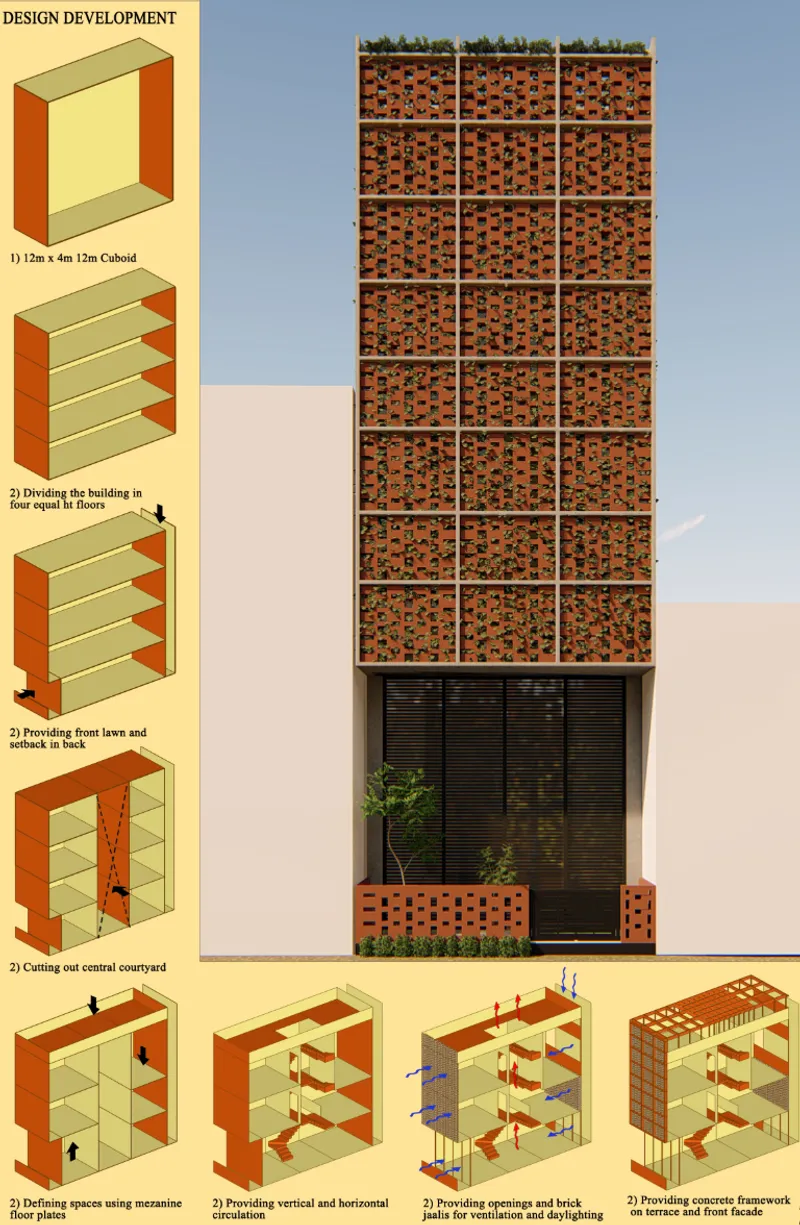
The annotated diagram above traces the development of Essence's most recognizable element: a perforated brick screen facade wrapping the street-facing elevation. This is not decorative brickwork for its own sake. The jaali pattern is calibrated to filter harsh western sun while allowing cross-ventilation to reach interior rooms. The diagram also maps the evolution of the central courtyard strategy, showing how the void at the heart of the plan was shaped iteratively to maximize daylighting and stack-effect ventilation. By exposing this design logic, Kashyap makes a persuasive case that the final form is a direct consequence of environmental analysis rather than aesthetic preference.
Ventilation Flows and Vertical Organization Around the Courtyard

The sectional and axonometric drawing lays bare how passive systems operate through the building. Horizontal louvers along the facade regulate solar gain while doubling as channels for rainwater harvesting. Wind scoops at the upper levels catch prevailing breezes and direct them downward through the courtyard, creating a cooling chimney effect that reduces dependence on mechanical air conditioning. The section also reveals how mezzanine floors exploit the building's vertical dimension: by inserting half-levels, Kashyap effectively gains additional usable area without expanding the footprint. Bedrooms with attached toilets sit on the quieter upper registers, while the kitchen and dining area, described as the heart of the home, anchor the ground level adjacent to the courtyard.
Green walls and deciduous plantations are strategically placed along the courtyard perimeter. In summer, the foliage provides shade and evaporative cooling; in winter, bare branches allow sunlight to penetrate deeper into living spaces. It is a simple, time-tested strategy executed with precision in a contemporary context. The drawing communicates something important: every cubic meter of this house is working, either as living space or as environmental infrastructure.
Brick, Concrete, and the Texture of Affordable Living

The composite rendering brings together exterior and interior views, revealing how exposed brickwork and concrete define the material palette throughout. There are no applied finishes trying to look expensive. The honesty of the materials keeps construction costs low, leverages locally available labor skilled in brick masonry, and produces a textured, tactile interior that ages well. The perforated brick screen, seen from the inside, transforms sunlight into shifting patterns across the family lounge, a shared space designed to foster interaction across generations. Interior views show compact but considered rooms where natural light enters from multiple directions, eliminating the dark corridor problem common in dense urban housing.
Kashyap's material choices reflect a broader argument: that sustainable architecture in India does not require imported technologies or premium budgets. Simple geometry, local brick, passive ventilation, and thoughtful spatial planning can produce a home that is simultaneously economical and aspirational. The rendering makes this tangible, showing spaces that feel open and lived-in despite the constraints of the plot.
Three Generations, One Plan
The user profile driving Essence is specific and revealing. A family of six across three generations needs spaces that toggle between communal and private modes throughout the day. The courtyard functions as the social regulator: it connects the family lounge, kitchen, and dining zone on the ground level while visually linking them to the bedrooms above. Grandparents can sit in the courtyard and remain part of household life without navigating stairs; children can retreat to mezzanine study areas that feel separate without being isolated. This is architecture shaped by the rhythms of Indian family life, not imported typologies.
Why This Project Matters
Essence matters because it refuses to treat affordability and sustainability as competing priorities. Too often, low-cost housing in Indian cities defaults to minimum-spec apartments that ignore climate, culture, and the complex social dynamics of multigenerational families. Kashyap's design demonstrates that a disciplined approach to passive systems, local materials, and vertical space optimization can deliver comfort and dignity on a tight budget. The strategies deployed here, from brick jaalis to rainwater-harvesting louvers, are replicable across Gurgaon and similar composite-climate cities.
What elevates the project beyond a technical exercise is its cultural grounding. The courtyard, the exposed brick, the hierarchy of shared and private spaces: these are not nostalgic gestures but functional responses drawn from vernacular intelligence and adapted to a contemporary urban condition. As Indian cities continue to densify, projects like Essence offer a scalable template for housing that works with climate and community rather than against them.
View the Full Project
About the Designers
Designer: Ankit Kashyap
Enter a Design Competition on uni.xyz
uni.xyz runs architecture and design competitions year-round that reward proposals with spatial conviction and real site intelligence.
Project credits: Essence by Ankit Kashyap.



Popular Articles
Popular articles from the community


The Ocean Hive: Sustainable Architecture for a Self-Sufficient Civilization at Sea
The Ocean Hive imagines sustainable architecture at sea, where modular habitats, algae, wave power and ocean waste sustain a growing colony.

The Earth Pod: 3D Printed Homes for Resilient Refugee Communities
The Earth Pod reimagines refugee housing through 3D printed homes made from clay, combining resilience, self-sufficiency, and rapid shelter.

The Musturak Paradise: Senior Living Architecture for a Connected Future in Temara, Morocco
The Musturak Paradise reimagines senior living architecture in Temara via private homes, social spaces, culture, community, and shared care.

Riyadh For All: Intergenerational Urban Design for Active Aging in Rabat
Riyadh For All reimagines urban design in Rabat with intergenerational co-living, adaptive courtyards, and Moroccan cultural exchange today.


Similar Reads
You might also enjoy these articles

Bao Huynh Watercolor Atelier: A Serene Art Retreat in Hội An
Bao Huynh Watercolor Atelier in Hội An blends multifunctional art spaces, sustainable design, local materials, and family-friendly living in a serene environment.

Atelier Macri Concept Store Interior Design by CASE-REAL
Atelier Macri store features a "ko" counter, walnut wood details, cork displays, blending retail, gallery, and seamless customer experiences.

Manuel Vargas Izquierdo Stadium and High-Performance Sports Center: Architectural Excellence in Jalpa de Méndez
The Manuel Vargas Izquierdo Stadium blends sustainable design, inclusive sports facilities, and cultural-inspired architecture, revitalizing Jalpa de Méndez’s public spaces.

KAKR Buluh Awar Hall: Revitalizing Community and Ecology Through Bamboo Architecture
Community built bamboo hall revitalizes Buluh Awar village, empowering youth, restoring ecology, celebrating vernacular craftsmanship through sustainable architecture and culture.


Explore Interior Design Competitions
Discover active competitions in this discipline


Challenge to design luxury tourism on rails


VR headsets Storefront design competition

Designing a staircase for a client


Design challenge to reuse E-waste
Comments (0)
Please login or sign up to add comments
No comments yet. Be the first to comment!