
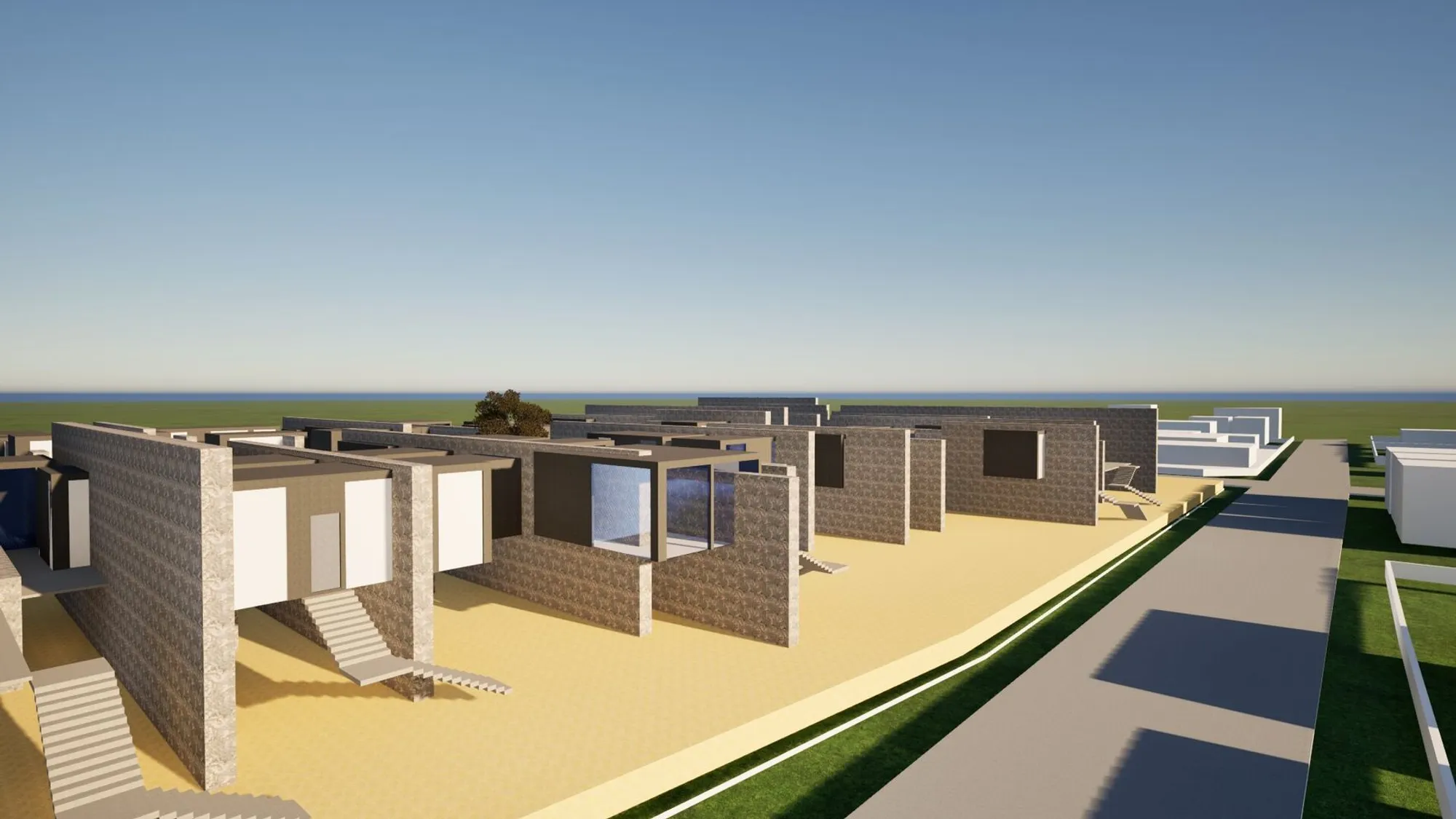
ESSENCE: Dissolving the Line Between City and Countryside Through Shared Living
A shortlisted Live Green entry uses modular housing, regional stone, and layered public space to rebuild community from the ground up.


What happens when architecture stops drawing lines between private and public, urban and rural, individual and collective? ESSENCE proposes an answer: a sustainable housing complex organized around spatial encounters rather than spatial separation. The project treats every alley, courtyard, and threshold as a potential site of human connection, building a micro-community system where spontaneous interaction is not a happy accident but a structural premise.
Designed by Tuba Altuntop and Ekin Kiricioglu, ESSENCE was shortlisted in the Live Green competition. The entry positions architecture as a social catalyst, one that integrates different modes of living while drawing on local materiality and climate-responsive strategies. Rather than optimizing for density alone, the designers pursue a balance between privacy and communal engagement, treating the built environment as a living entity that evolves with its inhabitants.
Terraced Stone Walls Frame a Shared Ground
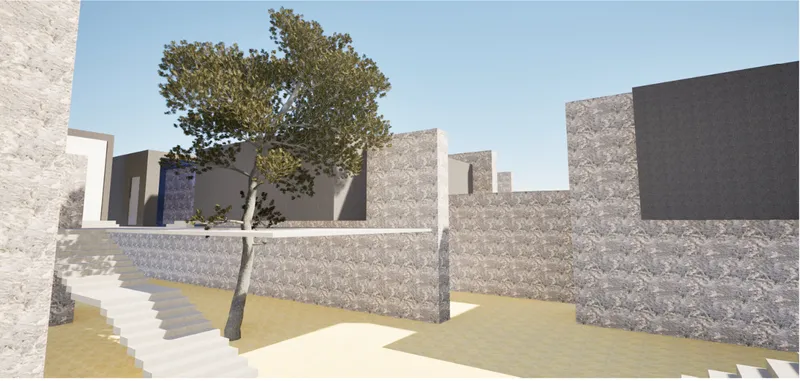
The rendered courtyard view immediately establishes the project's material identity: textured regional stone walls step across a sandy ground plane, with a single tree anchoring the composition. The palette is deliberately restrained. There are no glossy panels or imported cladding systems. Instead, the vernacular material choice roots the architecture in its specific geography while keeping the environmental footprint minimal. The terracing creates a rhythm of semi-enclosed outdoor rooms, spaces that feel neither fully private nor entirely exposed. That ambiguity is the point. These transitional zones are where the designers expect community life to take hold, turning leftover space into active social ground.
Sectional Logic: Massing That Breathes
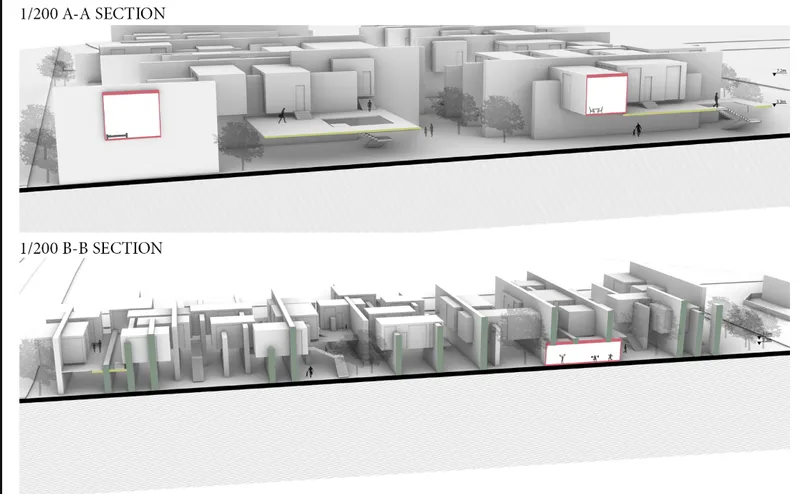
The section drawings reveal how the housing blocks are massed in relation to one another and to the landscape. Human figures and trees are scaled into the drawing, grounding the abstraction in lived experience. What stands out is the deliberate variation in block height and setback. The sections show gaps and voids between volumes, allowing light and air to penetrate deep into the complex. These openings are not merely functional; they serve as visual and physical corridors that connect residents to each other and to the surrounding context. The massing avoids the monotony of a uniform slab, instead creating a topographic quality that echoes the terraced courtyard below.
A Dense Linear Arrangement Within the Street Grid
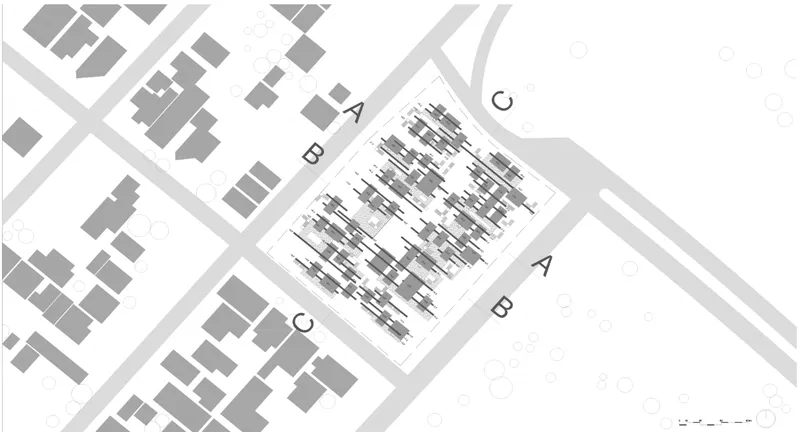
The site plan positions the housing complex as a dense linear figure embedded within an existing street grid. The arrangement is compact but porous, allowing pedestrian movement to thread through the development rather than around it. This is a critical decision: the project refuses to become an enclave. By aligning its primary axis with the surrounding urban fabric, ESSENCE invites the neighborhood in, dissolving the hard perimeter that so many housing projects default to. The density reads as intentional, not oppressive, because the open spaces and courtyards visible in the plan act as pressure valves within an otherwise tight configuration.
Modular Plans Layer Privacy and Community Across Levels
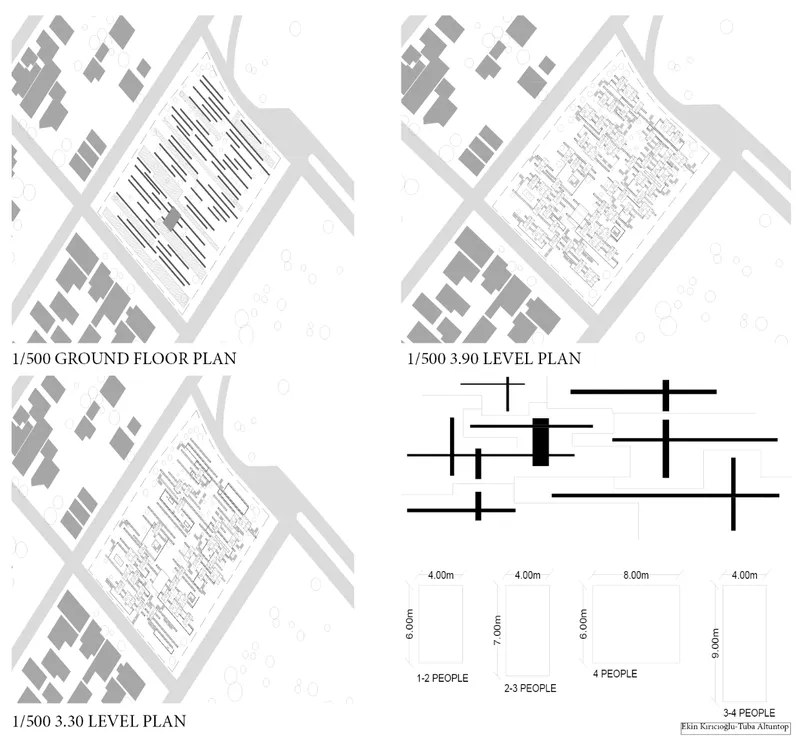
The multi-level plan drawings, developed at 1/500 and 1/200 scales, expose the modular logic at the heart of the project. Units designed for one to four occupants interlock within a shared network of open and semi-open spaces. An accompanying diagram maps occupancy densities per unit, showing that the designers thought carefully about how different household sizes coexist within the same structural framework. The result is a system where a single resident and a family of four can live side by side without one mode of living dominating the other.
This layering of private dwelling and collective space is handled with precision. The plans show a gradual gradient from interior rooms to shared corridors to open courtyards, so the transition from solitude to sociability is never abrupt. It is architecture that understands the human need for both retreat and encounter, and calibrates its thresholds accordingly.
Why This Project Matters
ESSENCE makes a straightforward argument that is surprisingly rare in sustainable housing discourse: green architecture is not just about materials and energy systems, it is about how people live together. The project's commitment to social inclusion, cultural continuity, and spatial generosity positions it as more than a technical exercise in low-impact construction. It is a proposal for a different kind of urban life, one that reintegrates marginalized groups, nurtures shared belonging, and treats the built environment as a framework for social equilibrium.
Altuntop and Kiricioglu demonstrate a mature understanding of what community architecture can be when it starts from human values rather than unit counts. The modular planning, the vernacular materiality, and the careful orchestration of public and private thresholds all point toward an architecture that earns its density through design quality, not just quantity. In a competition landscape where sustainability often reduces to a checklist, ESSENCE reminds us that the most enduring green strategy is one that people actually want to inhabit.
View the Full Project
About the Designers
Designers: Tuba Altuntop, Ekin Kiricioglu
Enter a Design Competition on uni.xyz
uni.xyz runs architecture and design competitions year-round that reward proposals with spatial conviction and real site intelligence.
Project credits: ESSENCE by Tuba Altuntop, Ekin Kiricioglu Live Green (uni.xyz).




Popular Articles
Popular articles from the community


Co-life: Sustainable Architecture for Age-Friendly Community Living
Co-life reimagines sustainable architecture for seniors through courtyards, rammed earth, shared gardens, and spaces designed for belonging.

Play: Fragments of Their World
Familiar architecture becomes modular playground design, creating safe spaces where displaced children can learn, connect, imagine and play.

Conexión: Biophilic Design Reimagines High-Rise Living in Hong Kong
Conexión reimagines high-rise living in Hong Kong through biophilic design, green facades, shared spaces, daylight, water and nature within.

Co-Life: Senior Housing Design That Reconnects Older Adults With the City
Co-Life reimagines senior housing design through healing gardens, shared streets, workshops, and a sustainable community across generations.


Similar Reads
You might also enjoy these articles

Lunar Spiral: Space Architecture Shaped by the Mathematics of the Universe
Lunar Spiral reimagines space architecture through Fibonacci geometry, lunar regolith, levitating habitats, and self-sustaining Moon living.
The Main Dream: Modular Architecture for Play, Learning, and Community
A modular playground turns recycled plastic into adaptable spaces where refugee children can play, build, learn, and reconnect.
Play: Fragments of Their World
Familiar architecture becomes modular playground design, creating safe spaces where displaced children can learn, connect, imagine and play.

Wadi Rum Observatory: Desert Architecture Designed for the Night Sky
Wadi Rum Observatory turns desert architecture into a quiet instrument for astronomy, hiding research spaces under Jordan's starlit terrain.


Explore Community Architecture Competitions
Discover active competitions in this discipline



Challenge to reimagine the Iron Throne


Photograph architecture without architects


Illustrate the lost glory of Angkor Wat - Render Challenge


Design challenge to reuse E-waste
Comments (0)
Please login or sign up to add comments
No comments yet. Be the first to comment!