
Estudio Bulla Invents a Forest of 2,500 River Alders for a Museum Campus Outside Buenos Aires
At Malba Puertos in Escobar, three outdoor gallery rooms thread through a planted grove that doubles as a living ecological laboratory.


How do you build a museum in a place that has no city yet? At Puertos, a 2,500-hectare development rising on the wetlands of Escobar in the Province of Buenos Aires, Estudio Bulla answered that question by planting a forest first. Malba Forest is a 615 m² landscape intervention that wraps the new Malba Puertos museum complex in a grove of 2,500 alisos de río (Tessaria integrifolia), native river alders that were already colonizing the site in ruderal patches before any architect set foot on it. Rather than clearing those pioneer trees, the team studied them, propagated them, and organized them into a 150-meter vegetal frieze that defines three outdoor exhibition galleries.
The result is not ornamental planting. It is a calibrated act of ecological staging, conceived by Leandro Chiappa and executed through a dual process of design and field research. Two nurseries were established on site. Scientists, soil specialists, and consultants in agronomy, urban forestry, and continental aquatic ecology monitored the alders biweekly, measuring growth under different stimuli and cataloguing the terrain in what the team calls an atlas of tech soils. The forest is pragmatic infrastructure: it regulates humidity, frames views, provides shade, and gives the museum six rooms instead of three, half of them open to the sky.
Threading Through the Canopy
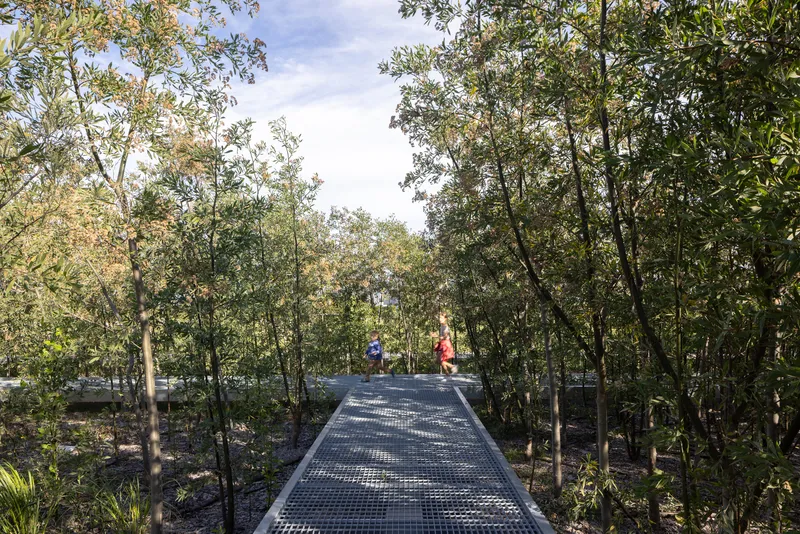
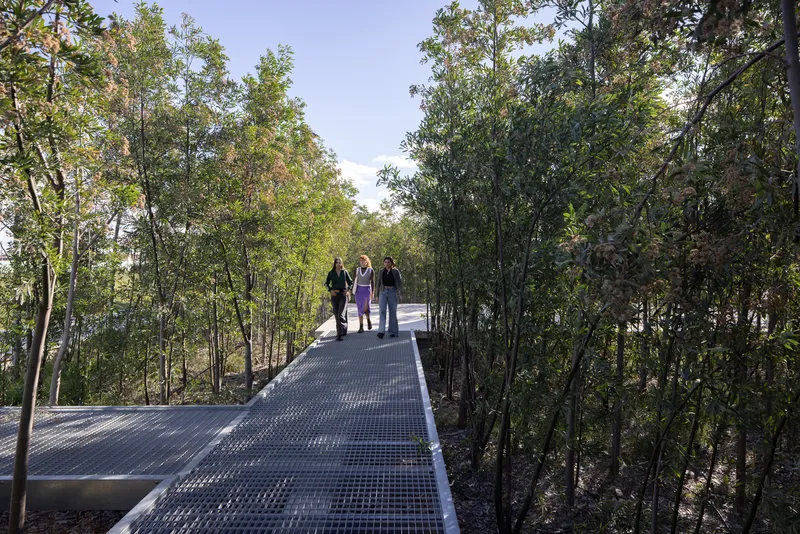
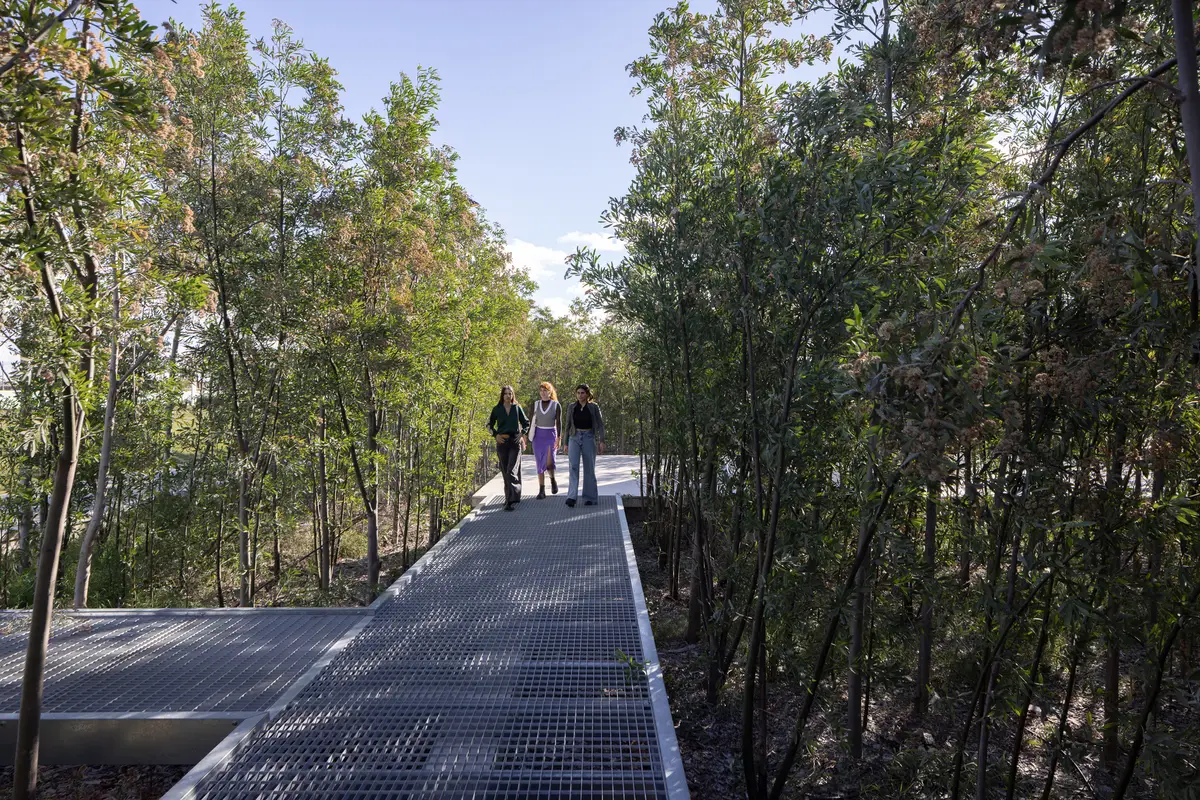
The primary spatial experience of Malba Forest is peripatetic. Perforated metal walkways lift visitors off the ground and thread them through the alder canopy at a height where the tree crowns filter sunlight into a shifting mosaic. The grating is open enough to let rain and leaf litter pass through, keeping the forest floor beneath it ecologically continuous rather than sealed. It is a detail that signals Bulla's priorities: the trees are not decoration for the path; the path is a guest in the trees.
At ground level, the metal mesh reads as almost immaterial, a grid suspended in dappled light. From above, the walkways register as precise incisions through the woodland. The effect is that visitors oscillate between immersion and orientation, never quite sure whether they are inside an artwork, a park, or a piece of infrastructure. That ambiguity is the project's greatest asset.
The Elevated Boardwalk as Gallery Wall
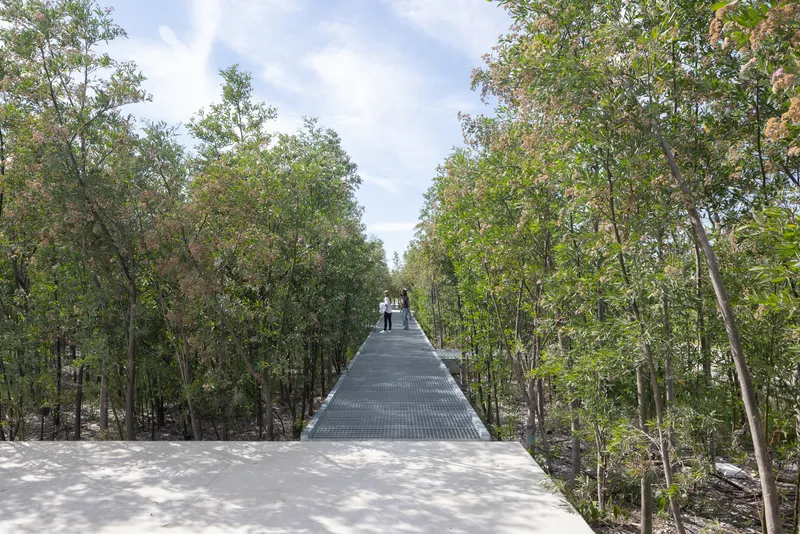
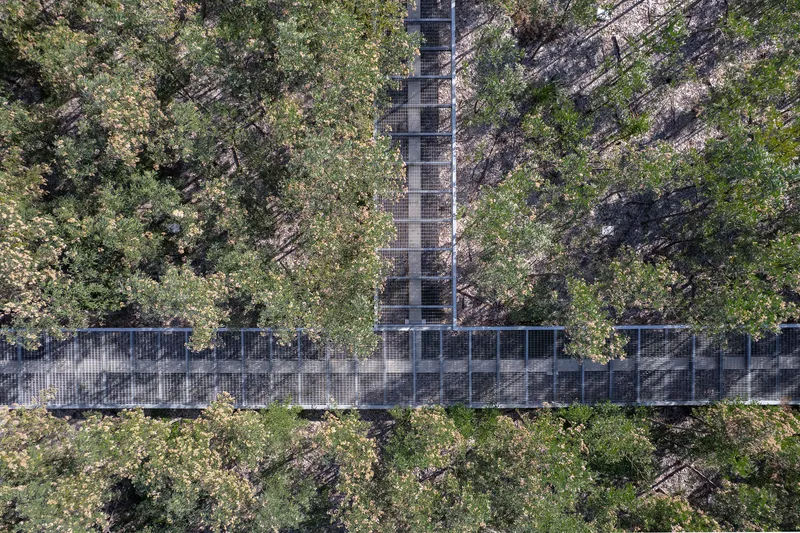
The three outdoor galleries are not rooms in any conventional sense. They are defined by the density and spacing of the alders, by changes in elevation, and by the choreography of the raised boardwalk itself. Where the walkway climbs, the canopy becomes the ceiling. Where it descends toward clearings, the sky opens up and the grove recedes to become a green wall. Bulla treats planting distance the way a traditional architect treats partition thickness: as the variable that controls enclosure, transparency, and sequence.
An aerial perspective reveals how the boardwalk crosses a forested ravine, stitching together zones of the campus that would otherwise feel disconnected. The infrastructure is legible from the air as a single strong line, but at eye level it dissolves into the landscape. That scalar duality, precise in plan yet soft in experience, is hard to achieve and rarer still in landscape projects tethered to institutional programs.
Ground Plane and Water
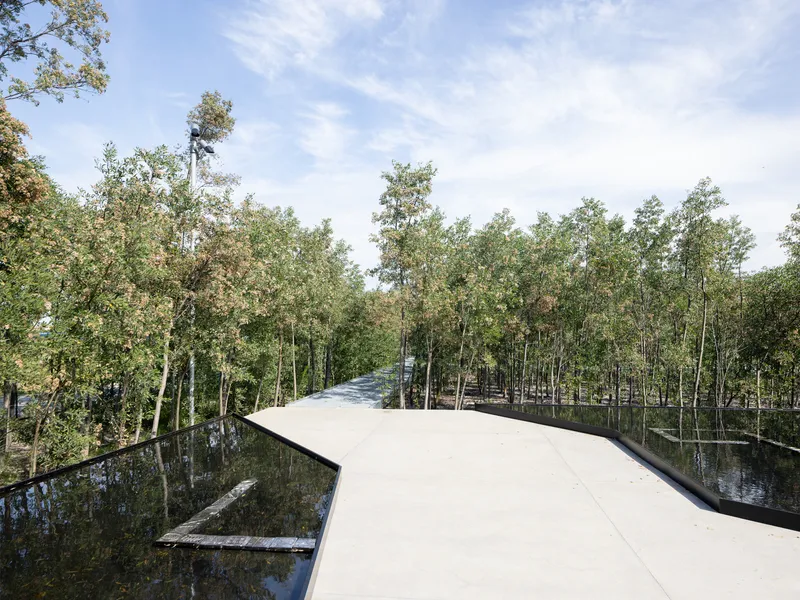
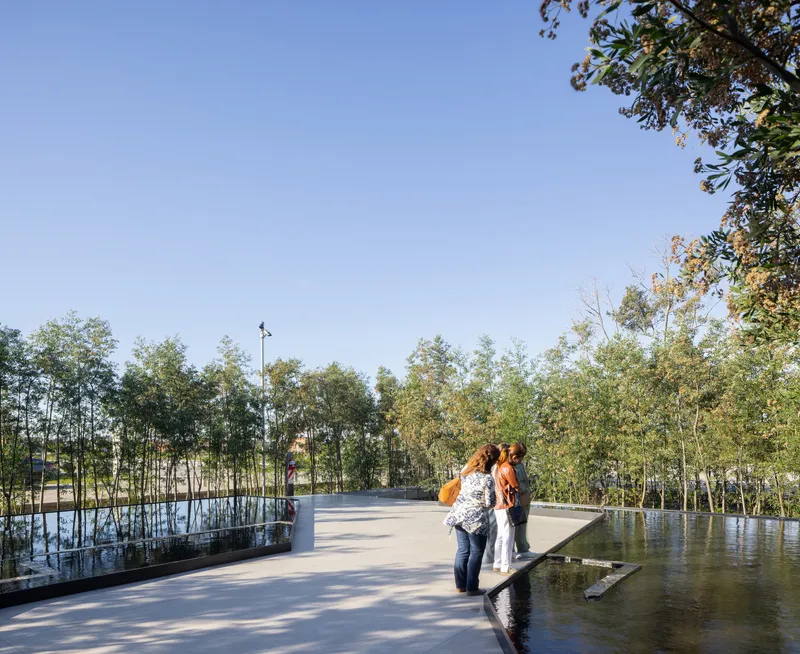
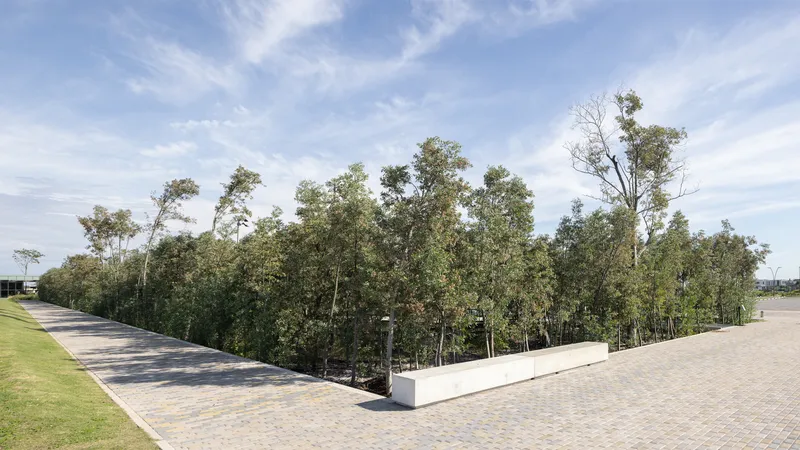
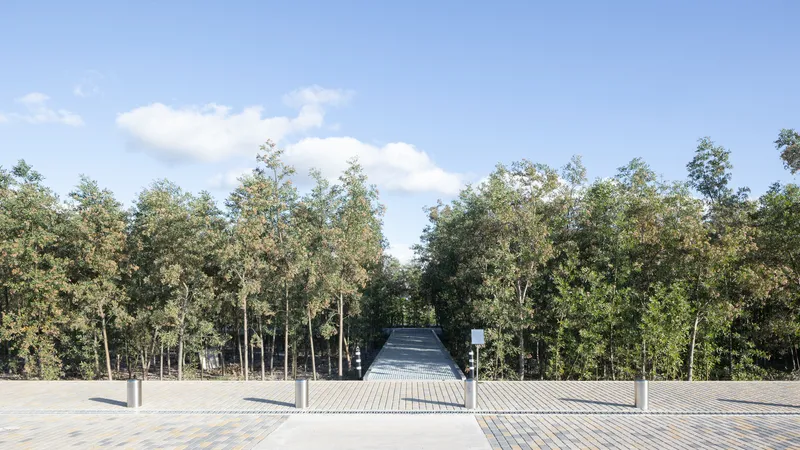
Where the forest gives way to the museum building, the material palette shifts to white concrete platforms and reflecting pools. These are not mere ornamental mirrors. The adjacent infrastructure includes parterres designed to regulate humidity and tanks for rainwater reuse, making the water features part of a working hydrological system. The young alders planted along the pool edges will eventually shade and cool these surfaces, tightening the feedback loop between tree growth and microclimate management.
The edge condition where paved plaza meets sunken woodland is handled with restraint. There is no decorative railing, no heroic retaining wall. The grade simply drops, and the trees begin. It is a threshold that trusts the landscape to hold its own authority next to cast concrete, and it does.
Building and Canopy in Dialogue
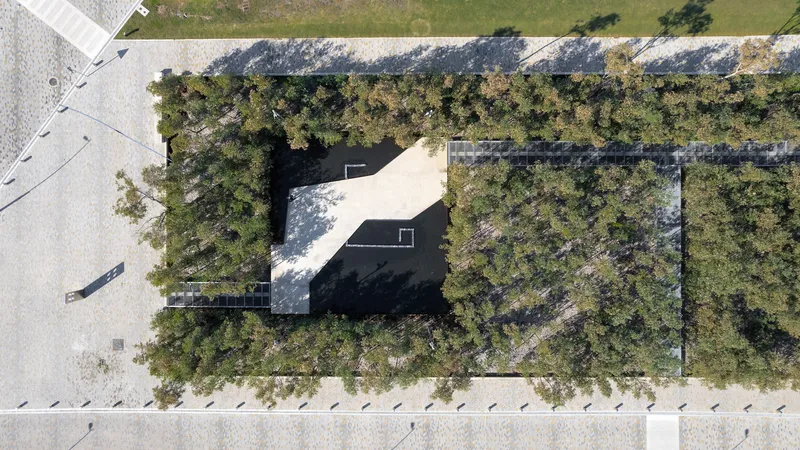
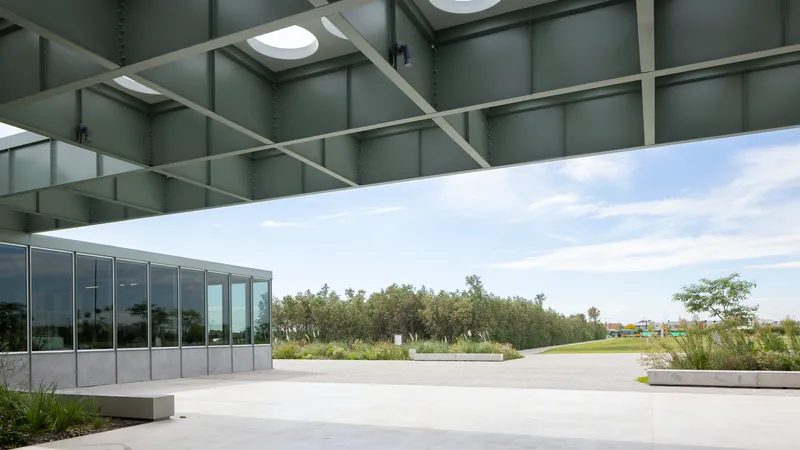
The museum building itself sits under a large roof of approximately 2,500 m², constructed from a grid of full-web steel beams crowned by translucent domes. From overhead, the perforated roof reads as a geometric counterpart to the organic canopy around it. Estudio Bulla seems to have tuned the building's porosity, its skylights, its covered terraces, to rhyme with the dappled light passing through the alders. The green steel canopy over the terrace echoes the tone of the foliage beyond. It is a restrained move, but it prevents the architecture from feeling alien to the forest it inhabits.
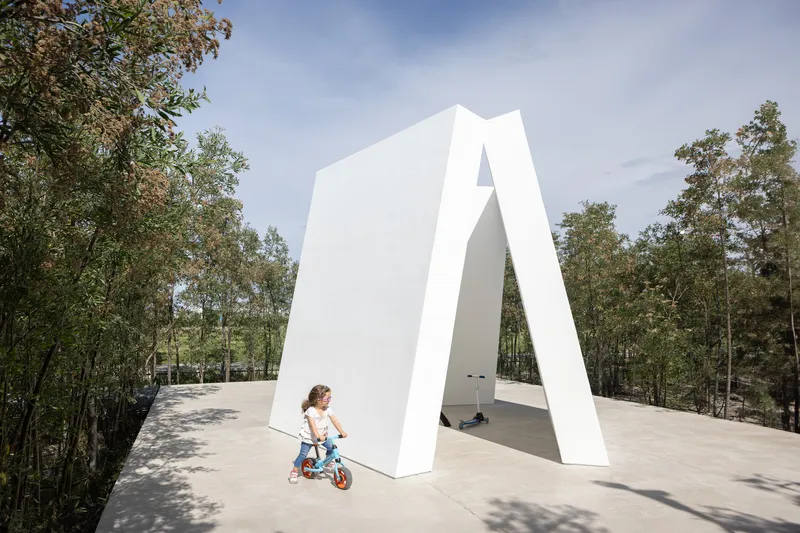
A white angular portal frames a view from the building zone straight through to the woodland. The frame is childishly simple in form but effective: it crops the forest into a picture, then releases you into it. The child on a bicycle rolling through the portal in one photograph captures the spirit of the place better than any rendering could. The forest is not a museum annex. It is a neighborhood.
Suburban Landscape as Experiment
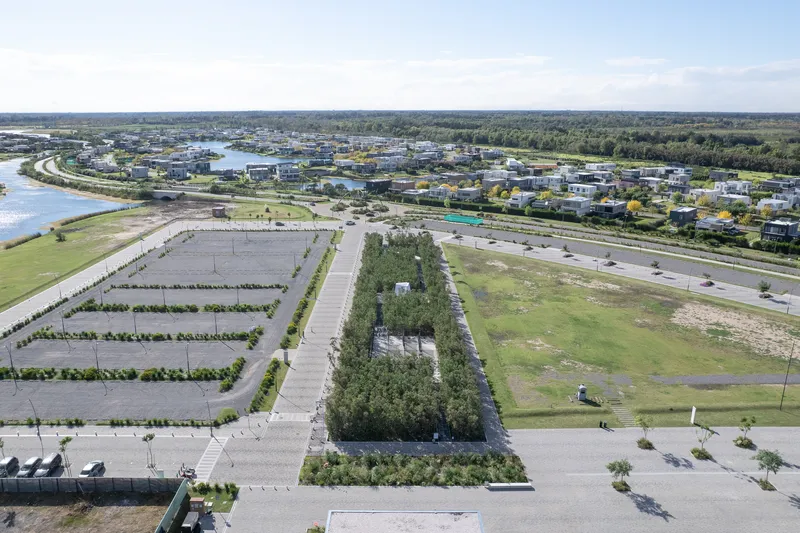
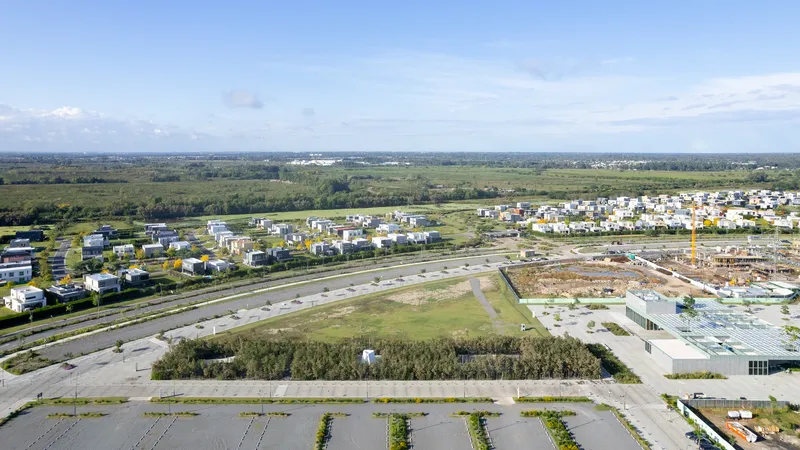
Zoom out and the context becomes stark. Puertos is a new city under construction, visible in aerial photographs as a patchwork of planted medians, paved lots, scattered housing, and raw construction zones stretching toward a suburban waterfront. The Malba Forest does not pretend this context is pastoral. Instead, it operates as what the team describes as a pragmatic laboratory for rethinking atmospheric life in harmony with people and ecology. The planted rows of alders visible from the air are not landscaping gestures. They are test plots.
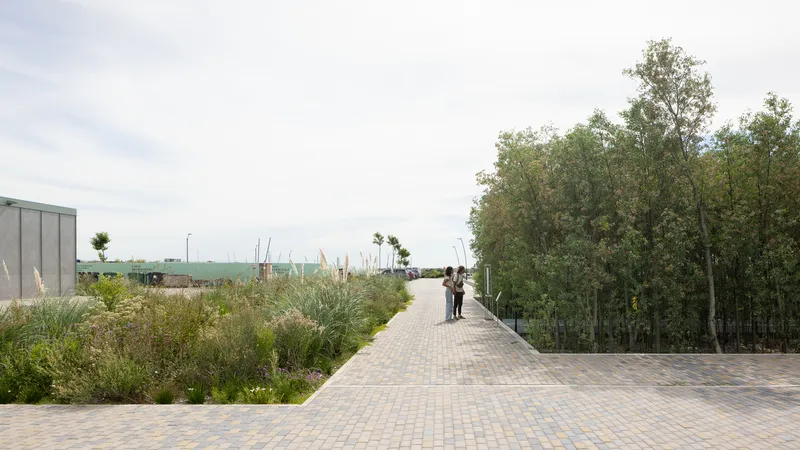
The brick-paved terraces and tall grasses bordering the forest's edges mediate between the wildness of the grove and the rawness of the developing city. Two figures walking a terrace toward the distant woods could be visitors or residents; the boundary is deliberately unclear. Bulla is betting that cultural infrastructure and ecological infrastructure can be the same thing, and that a forest planted today will shape the identity of an entire district for decades.
Into the Grove
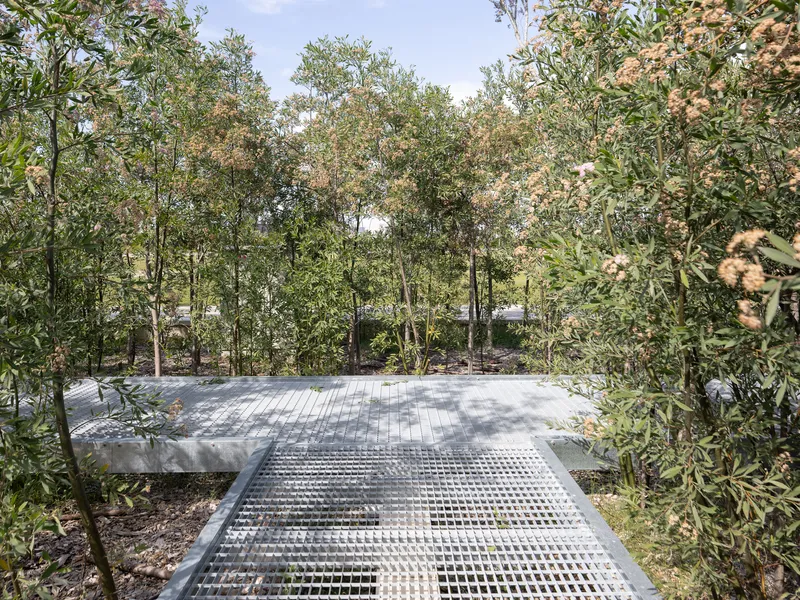
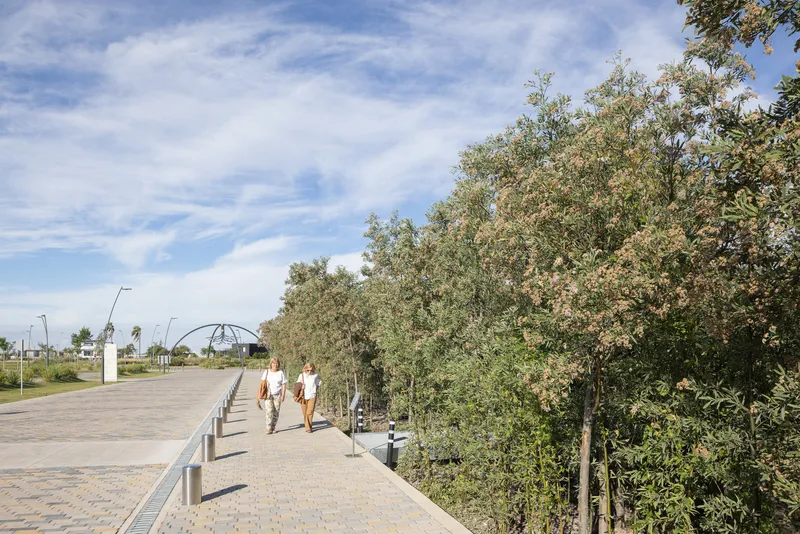
At its most intimate, the project is simply a walk among young trees. Metal grate platforms extend into woodland clearings carpeted with leaf litter and saplings. Pedestrian promenades run alongside the dense canopy, their metal railings and low planters acting as the thinnest possible dividing line between human circulation and forest floor. The species, Tessaria integrifolia, is not a trophy tree. It is a fast-growing pioneer, the kind of plant that ecologists call a colonizer. That choice carries meaning: the forest will change, mature, and eventually give way to successor species. The design accounts for impermanence.
Plans and Drawings
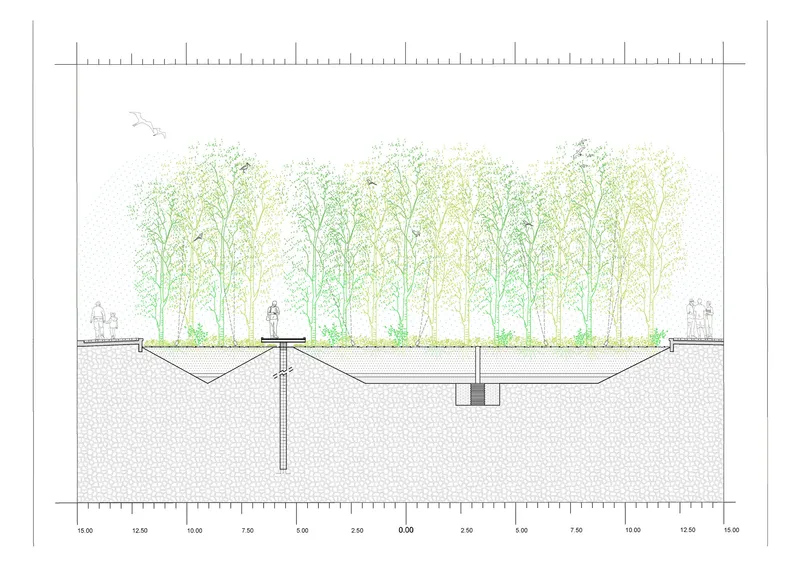
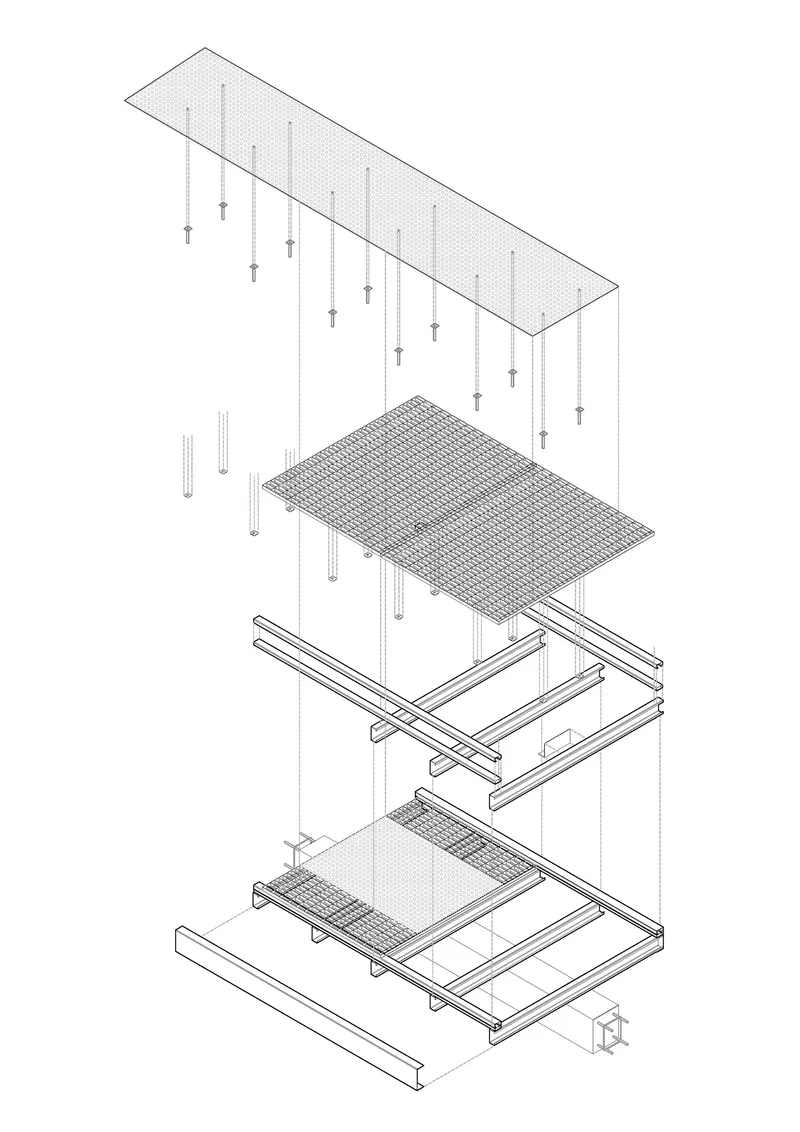
The section drawing reveals the project's true engineering. Beneath the perforated metal decking lies an excavated chamber with central drainage channels designed to manage water flow while accommodating root systems. The trees are not planted on top of structure; the structure is shaped around the biology of the trees. The exploded axonometric breaks the assembly into its constituent layers: roof, beams, columns, and decking. Each layer has a specific environmental role, from shading to ventilation to water collection.
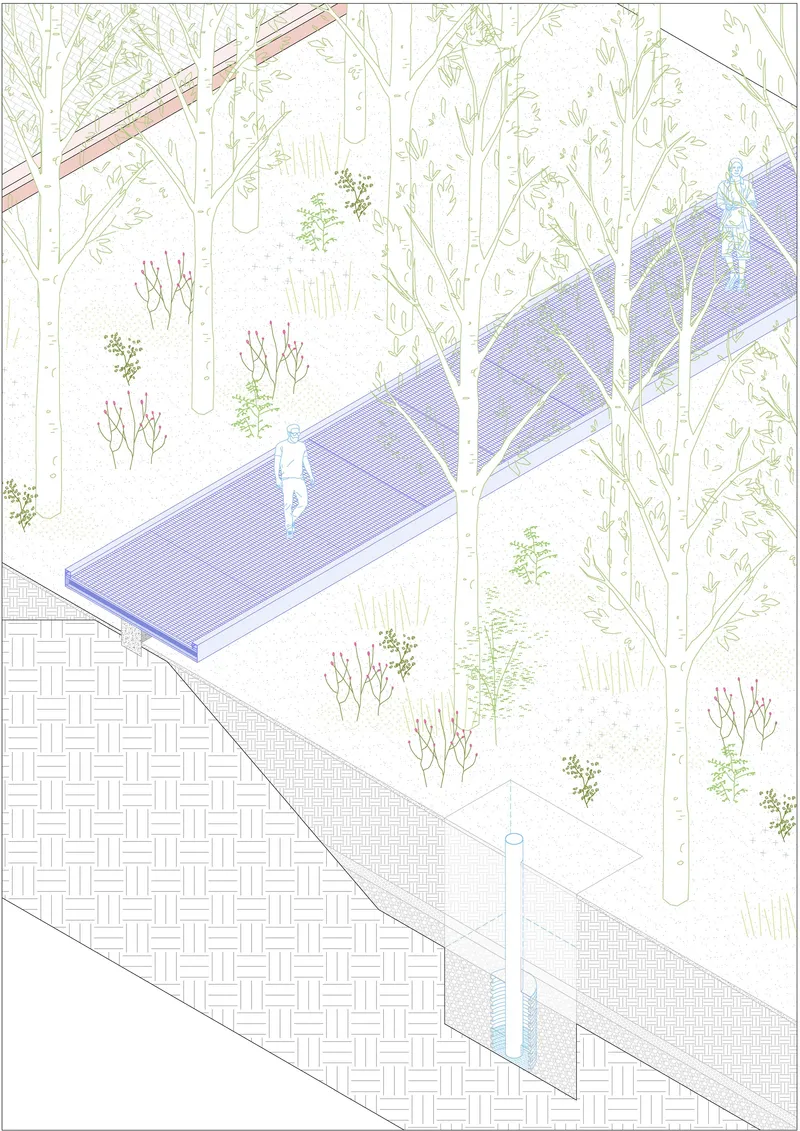
A second axonometric shows the raised pathway threading through a planted courtyard, making legible the spatial relationship between hard infrastructure and the scatter pattern of tree placement. The drawings confirm what the photographs suggest: nothing about the planting is casual. Every alder was positioned according to data gathered in the field nurseries, informed by biweekly observation cycles and the expertise of consultants including agronomists Héctor Svartz and Eduardo Haene, urban trees specialist Carlos Anaya, and continental aquatic ecologist Juan José Neiff.
Why This Project Matters
Malba Forest matters because it treats landscape architecture not as the garnish around a building but as the building's reason for existing. The museum gets three additional rooms because the forest creates them. The new city of Puertos gets an identity because someone decided that 2,500 native alders, monitored, catalogued, and composed with scientific rigor, could do what master plans alone cannot: make a place feel real before it is finished.
Estudio Bulla's approach, conducting parallel tracks of design and ecological research, nursery cultivation and spatial composition, is a model worth studying. In an era when sustainability is too often invoked as a branding exercise, this project puts the evidence in the ground, literally. The forest will grow, shift, and eventually become something its designers cannot fully predict. That willingness to cede control to ecology, while still holding firm on spatial clarity and cultural ambition, is what separates genuine landscape architecture from planting trees and calling it a day.
Malba Forest by Estudio Bulla. Lead architects: Ana García Ricci, Lucía Ardissone, Ignacio Fleurquin, Griselda Balian, Gerardo Raffo, Felicitas Argibay Tomé, Gimena Tarzia, Francisco García Legassa, Juan Ignacio González Santamaría, Ayelén Pérez Unzaga. Puertos, Escobar, Province of Buenos Aires, Argentina. 615 m². Completed 2024. Photographs by Fernando Schapochnik.
About the Studio
Share Your Own Work on uni.xyz
If projects like this are the kind of work you want to make, uni.xyz is a place to publish your own, find collaborators, and enter design competitions.


Popular Articles
Popular articles from the community


Little Red Riding Hood: Architectural Design as a Journey Through Fear, Light, and Storytelling
Little Red Riding Hood reimagines the fairy tale through architectural design shaped by fear, light, scale, memory, uncertainty, and choice.

The Musturak Paradise: Senior Living Architecture for a Connected Future in Temara, Morocco
The Musturak Paradise reimagines senior living architecture in Temara via private homes, social spaces, culture, community, and shared care.

Co-life: Sustainable Architecture for Age-Friendly Community Living
Co-life reimagines sustainable architecture for seniors through courtyards, rammed earth, shared gardens, and spaces designed for belonging.

Conexión: Biophilic Design Reimagines High-Rise Living in Hong Kong
Conexión reimagines high-rise living in Hong Kong through biophilic design, green facades, shared spaces, daylight, water and nature within.

Similar Reads
You might also enjoy these articles

Bao Huynh Watercolor Atelier: A Serene Art Retreat in Hội An
Bao Huynh Watercolor Atelier in Hội An blends multifunctional art spaces, sustainable design, local materials, and family-friendly living in a serene environment.

Atelier Macri Concept Store Interior Design by CASE-REAL
Atelier Macri store features a "ko" counter, walnut wood details, cork displays, blending retail, gallery, and seamless customer experiences.

Manuel Vargas Izquierdo Stadium and High-Performance Sports Center: Architectural Excellence in Jalpa de Méndez
The Manuel Vargas Izquierdo Stadium blends sustainable design, inclusive sports facilities, and cultural-inspired architecture, revitalizing Jalpa de Méndez’s public spaces.
KAKR Buluh Awar Hall: Revitalizing Community and Ecology Through Bamboo Architecture
Community built bamboo hall revitalizes Buluh Awar village, empowering youth, restoring ecology, celebrating vernacular craftsmanship through sustainable architecture and culture.

Explore Natural Forest Competitions
Discover active competitions in this discipline

Challenge to design public laboratory

Bring back Drive In's
Comments (0)
Please login or sign up to add comments
No comments yet. Be the first to comment!