

Estudio Focaccia Prieto Packs Three Steel-Frame Duplexes into a Trapezoidal Lot in Villa Elisa
A trio of corrugated metal volumes alternate full and void along a Buenos Aires railway corridor, turning constraints into character.


An elongated, trapezoidal corner lot wedged between the Buenos Aires–La Plata highway access and the Roca railway tracks is not the obvious site for a housing investment. But Estudio Focaccia Prieto, led by Clara Focaccia and Juan Manuel Prieto, read the constraints as opportunities. Their response is Villa Elisa Duplex: three identical two-story units plus a commercial store, all wrapped in blind and microperforated corrugated metal, organized as paired volumes with private patios and independent entrances that read as a single, rhythmic urban wall.
What makes the project interesting is how seriously it takes the economics of a tight site without defaulting to a monotonous row. The volume is divided into two modules per unit, and a scissors-shaped roof offset creates a dynamic street face of shifting heights. From the front, you get syncopation. From the rear, the roofline smooths into continuity. It is a project born from an investment spreadsheet, but it looks and feels like something designed from first principles about light, air, and adaptable living.
Corrugated Metal as Urban Identity
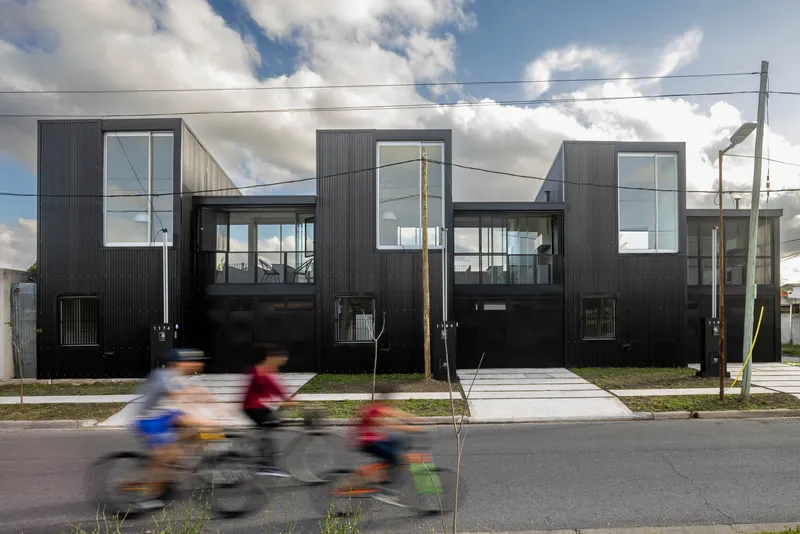
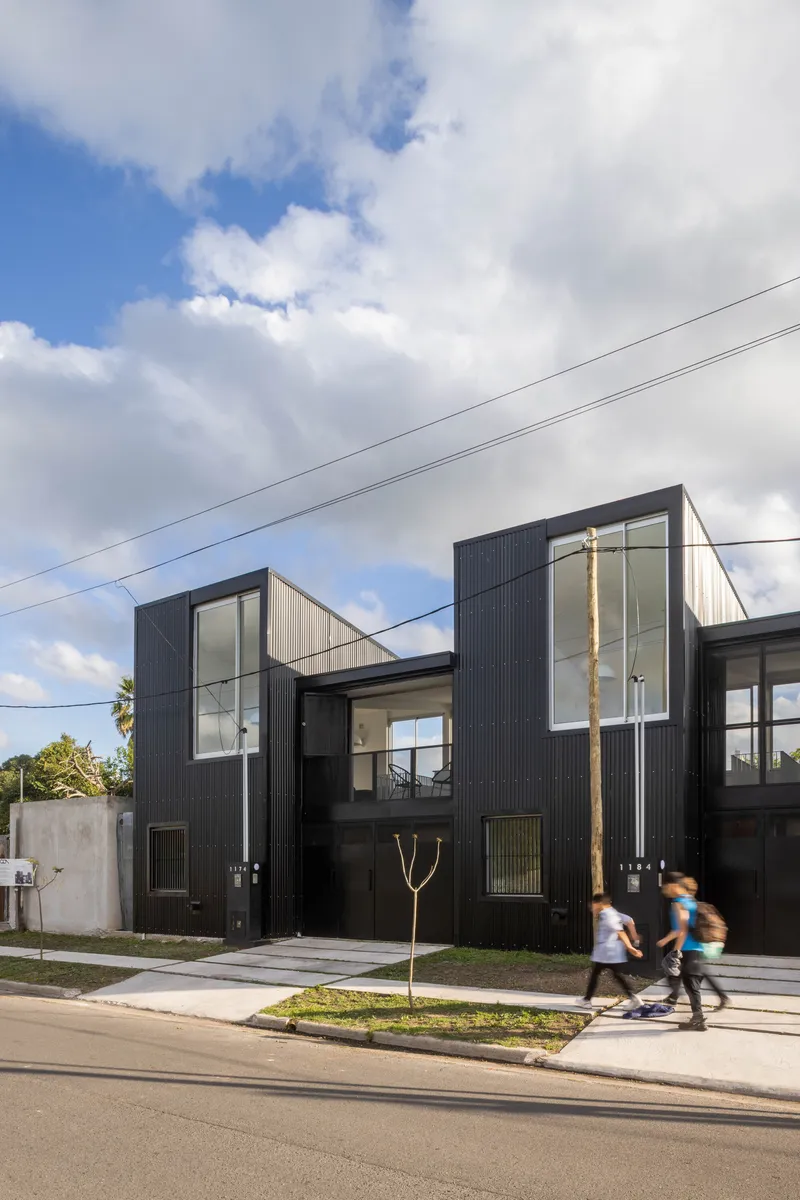
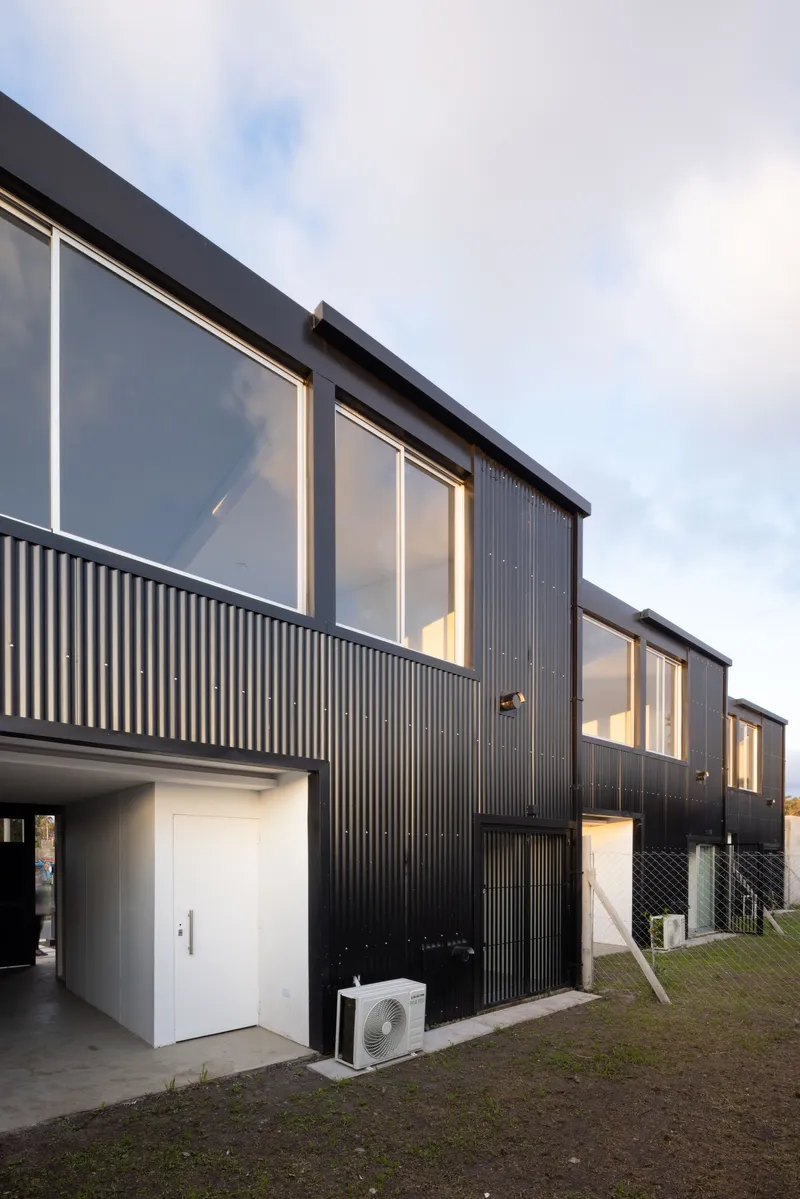
The street elevation is almost entirely corrugated sheet metal, a material that codes industrial in most contexts but here operates as something closer to a tailored skin. Blind panels wrap the living rooms and bedrooms, sealing them from the noise of the railway and the highway. The dark finish absorbs the suburban backdrop of power lines and rail infrastructure rather than fighting it. These are houses that look like they belong beside train tracks, which is a much harder trick to pull off than making them look like they wish they were somewhere else.
Tall vertical windows are cut surgically into the cladding, framing views upward and outward while keeping ground-floor exposure to a minimum. The repetition of three bays gives the complex civic presence on a street that otherwise has none.
The Mobile Facade and Threshold Logic
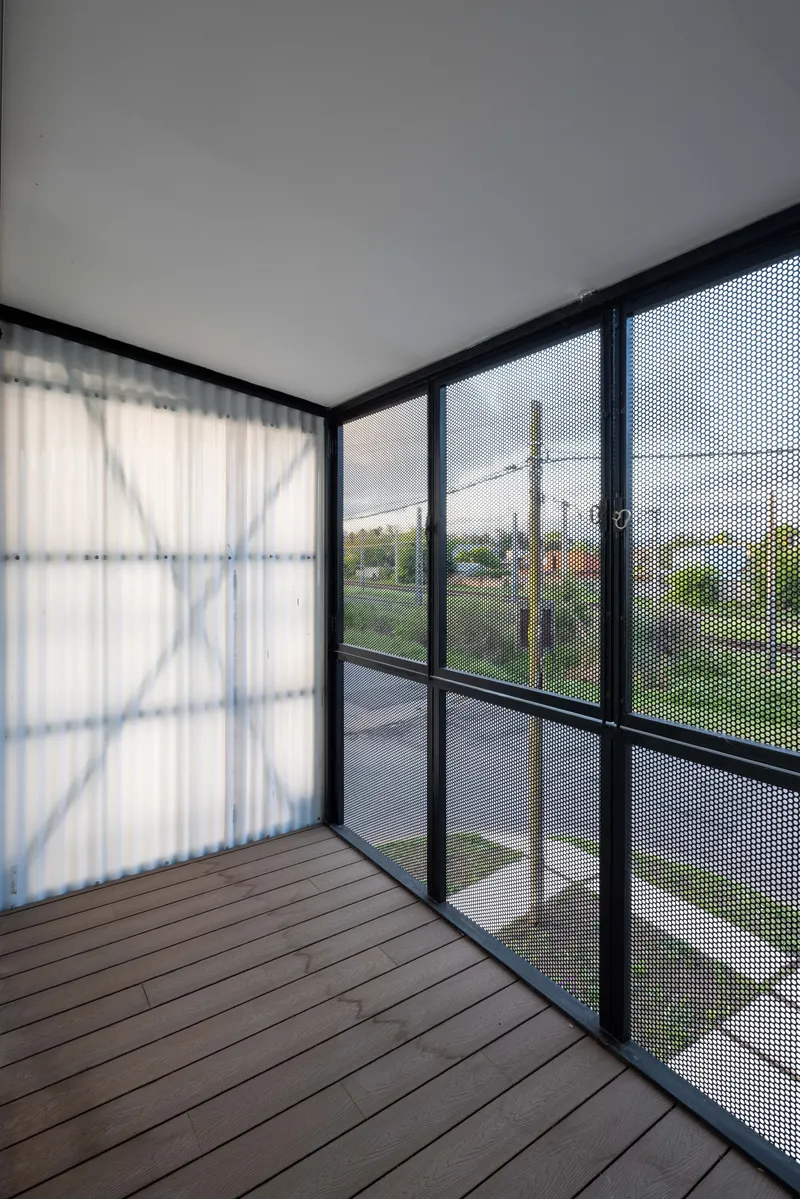
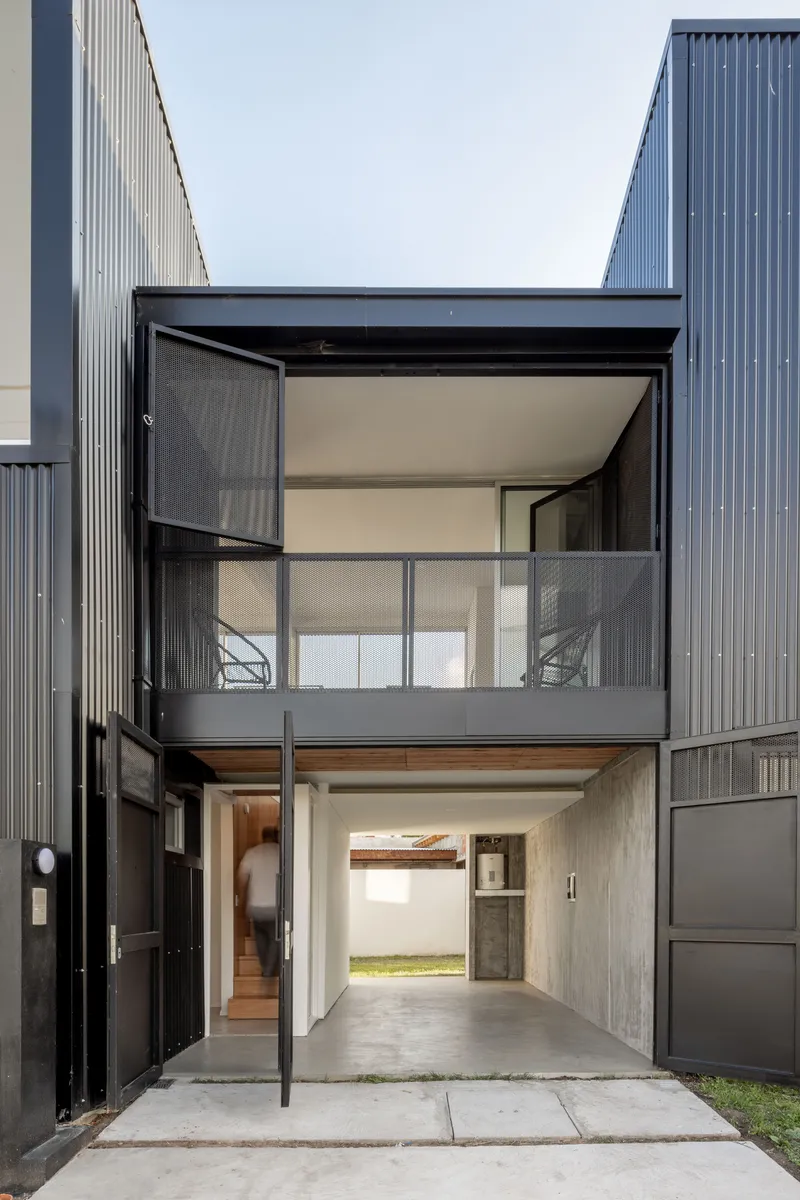
Where the blind panels protect, the microperforated screens perform. Mounted on mobile frames at the garage level and upper terraces, they allow residents to hide or reveal the patios and balconies depending on use. When the entrance gates open fully, the space between the street's green and the interior patio's green collapses into a single connected threshold. It is a simple mechanism, but it transforms the relationship between public and private with one gesture.
The entry courtyards, with their pivoting metal doors and concrete paving, feel like airlocks: compressed, shadowed, and intentional. From here, a distributor hall with a staircase routes residents upward to the social floor or sideways to the ground-level bedrooms. The garage, notably, doubles as a barbecue area when the car is removed, a pragmatic flexibility that speaks to how people in the Buenos Aires periphery actually use their homes.
Living Upstairs, Sleeping Below
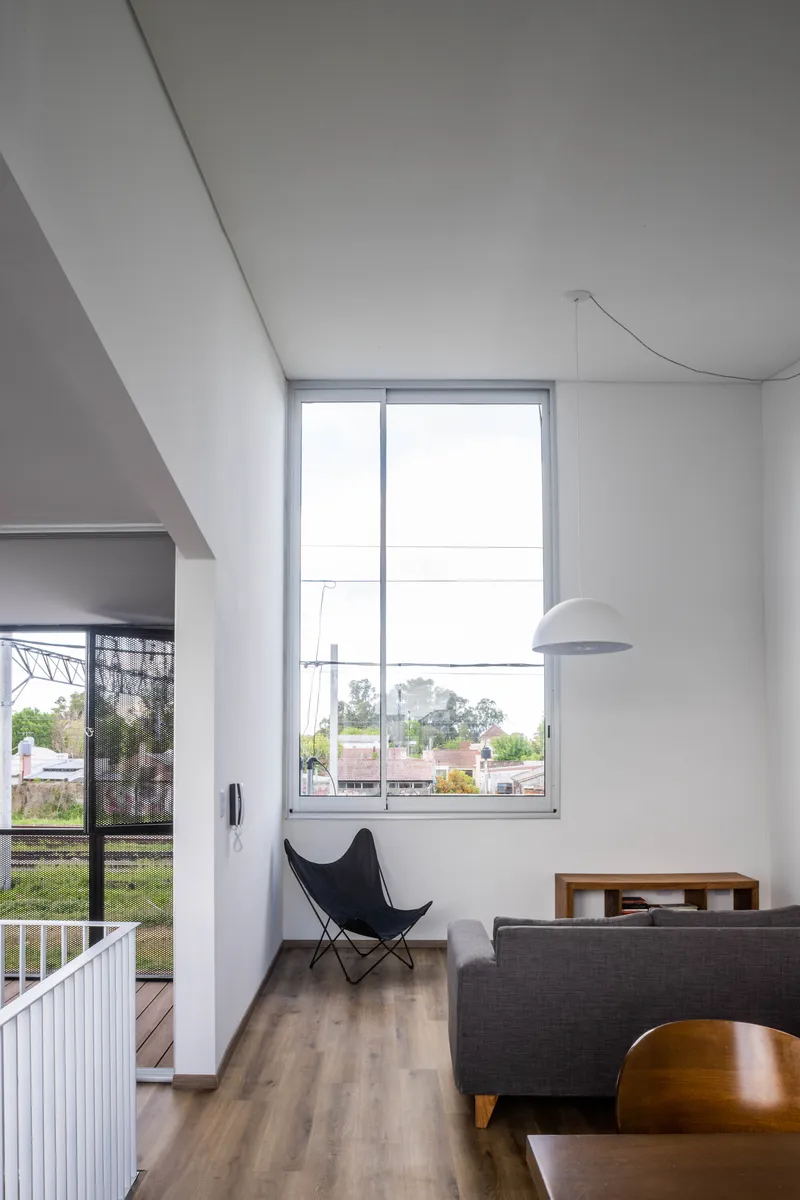
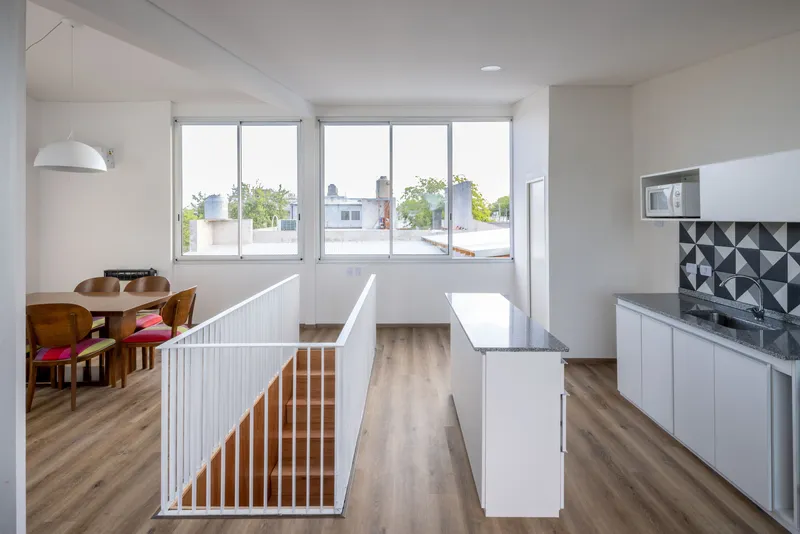
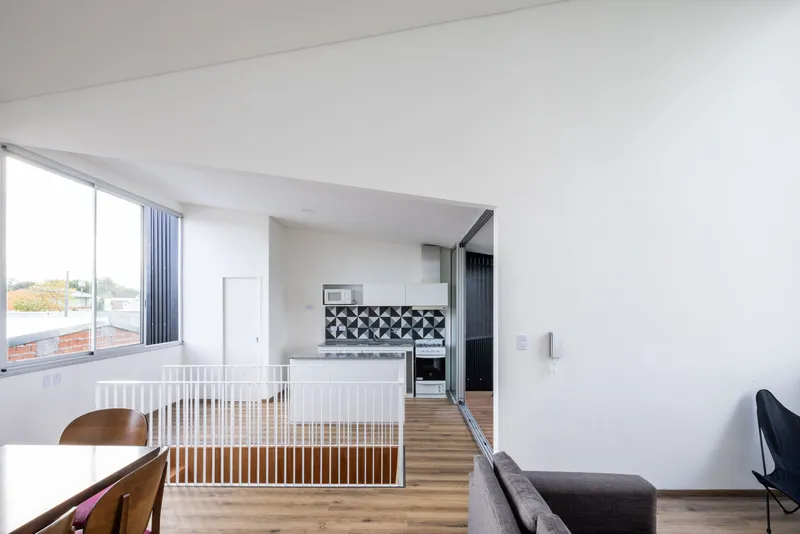
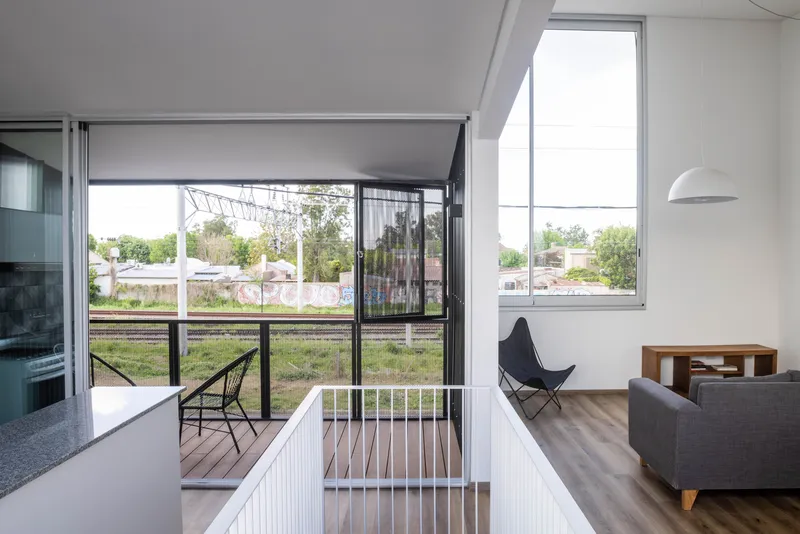
The program inverts the conventional duplex arrangement. Bedrooms sit on the ground floor: a smaller room facing the street that can flex into a dressing room or study, and a master bedroom opening onto the rear patio. The social level, with living room, kitchen, and dining, occupies the first floor around a semi-covered terrace treated as one continuous space. The logic is straightforward. The upper floor captures the views toward the Barrio Jardín neighborhood and its dense vegetation canopy, while the lower floor retreats into the quieter, more private zone.
The scissors-shaped roof slopes from just over two meters at its lowest edge to four meters at the living room's peak, creating a double-height volume that makes the compact plan feel generous. The architects note the roof geometry could accommodate a small light mezzanine in the future, an intelligent reservation of volume for later adaptation.
Interior Warmth Against the Metal Shell

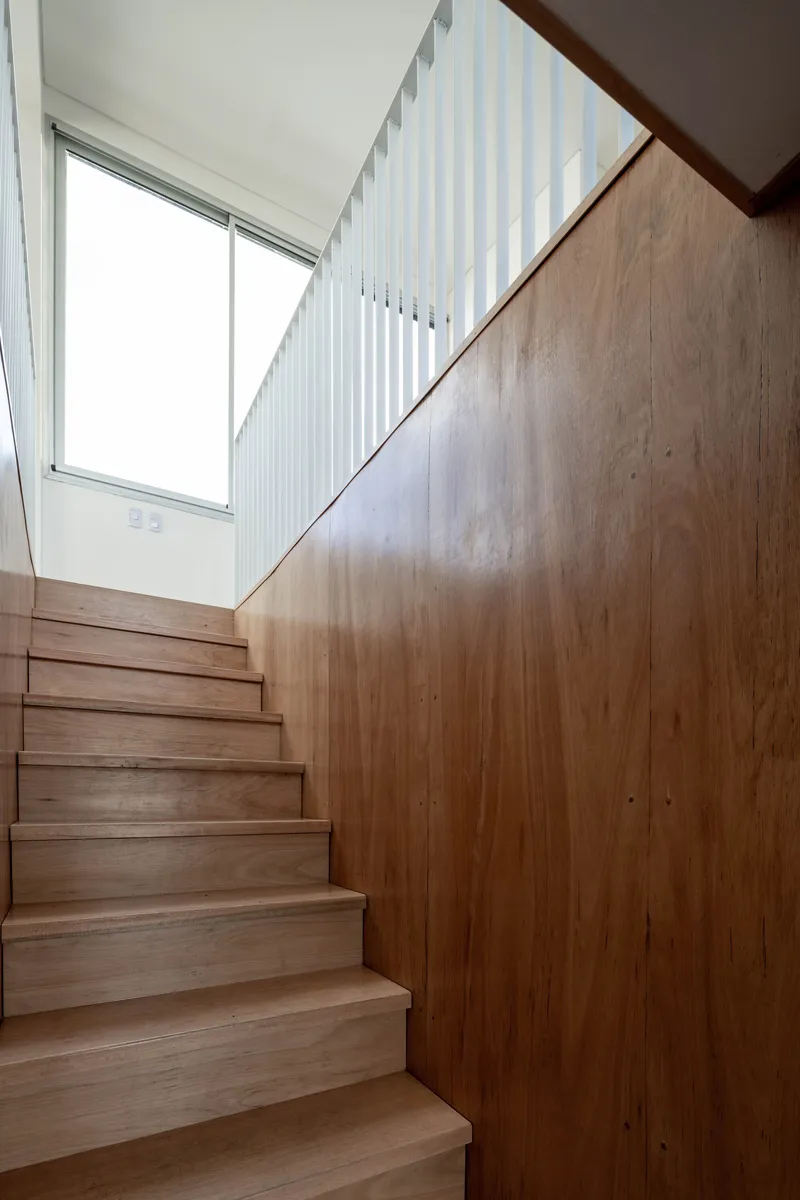
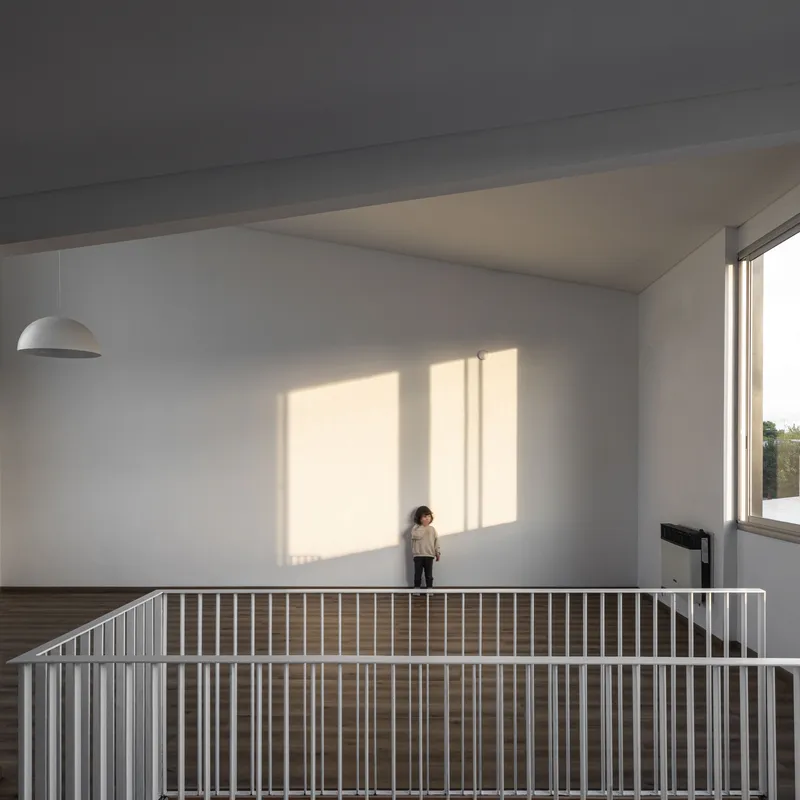
Inside, the material register shifts entirely. White walls, timber staircases, vertical slatted screens, and geometric tile backsplashes counter the severity of the exterior envelope. The stair guard, a rhythmic run of white vertical slats, doubles as a light filter and spatial divider, creating partial transparency between the kitchen zone and the circulation core. Clerestory windows above the stairwell pull daylight deep into the section.
The effect is of a hard shell protecting a warm, luminous interior. It is a contrast that works because it is consistent: every interior surface is light, every exterior surface is dark, and the threshold moments, the perforated screens, the tall windows, mediate between the two.
Railway Adjacency as Context

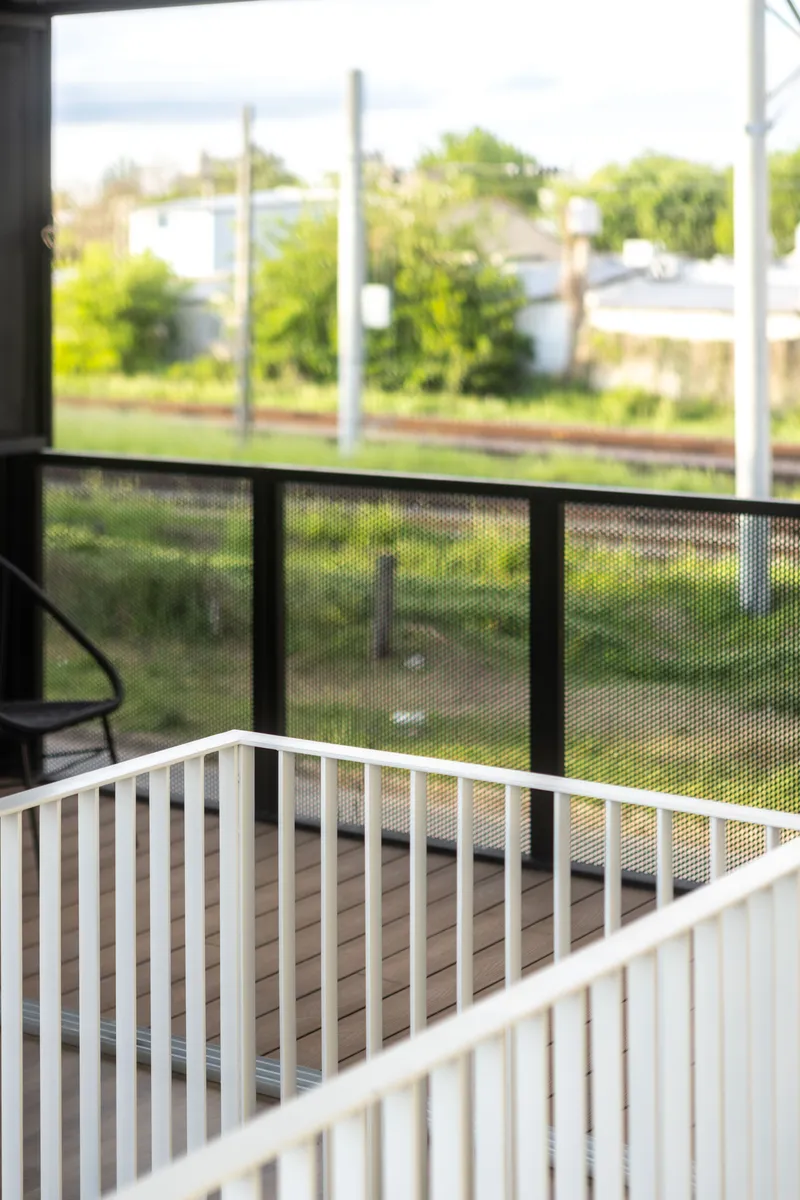
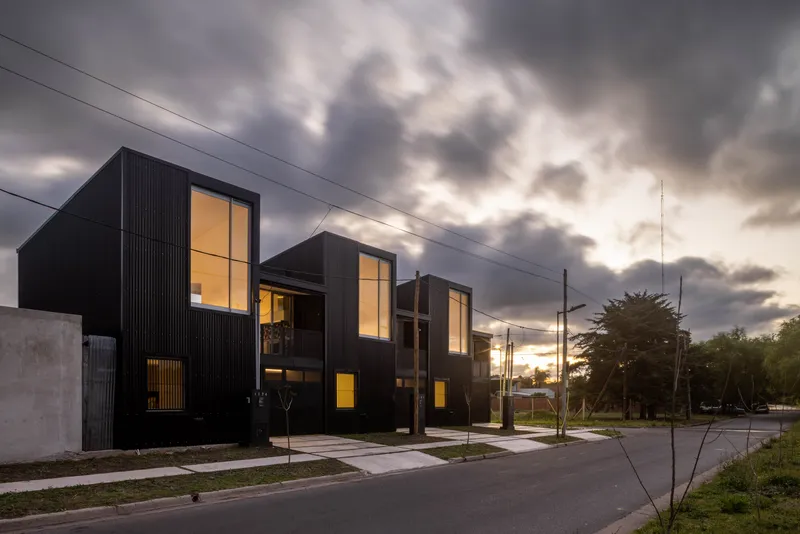
At dusk, the project reveals itself most fully. The illuminated interiors glow behind the tall glazed panels, turning the railway-side elevation into a lantern wall. From the upper balcony, looking out through mesh railings over the rail corridor and its catenary wires, the building acknowledges its infrastructure context rather than apologizing for it. The vegetation along the tracks, combined with the landscape project by Carol Gallo featuring jasmine, lagerstroemia, and gramilla in the rear patios, softens the edges without pretending the railway is not there.
Aerial Legibility

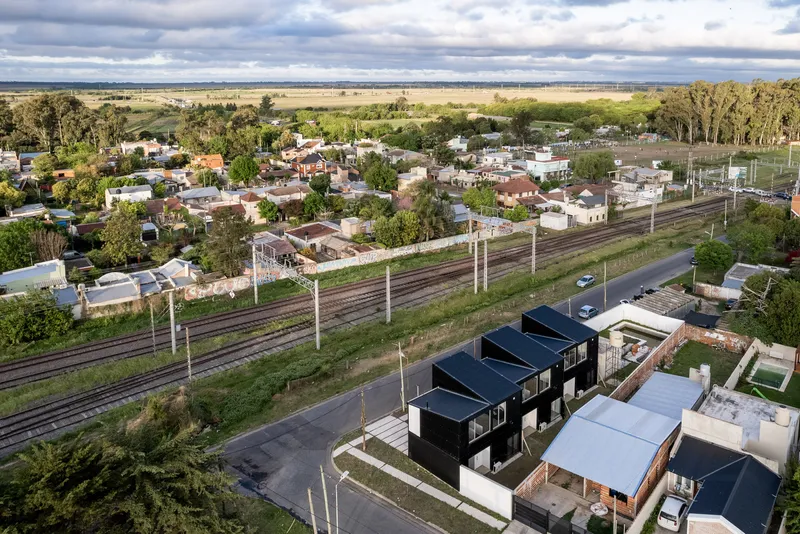
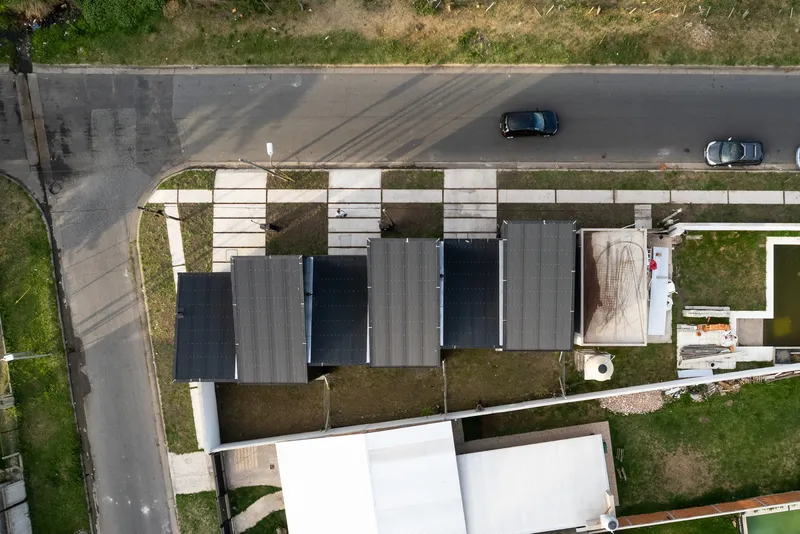
From above, the project's strategy becomes diagrammatic. The stepped arrangement of four units, three residential duplexes and one store, fills the trapezoidal lot with a clear alternation of built volume and courtyard void. The dark corrugated roofs read as a single bar, slotted with open-air cuts that bring light and ventilation to the patios below. The railway tracks run parallel, a few meters away, and the surrounding residential fabric of Villa Elisa spreads loosely on all sides. The density the project achieves is notable for a suburb that still thinks in detached houses and front yards.
Plans and Drawings
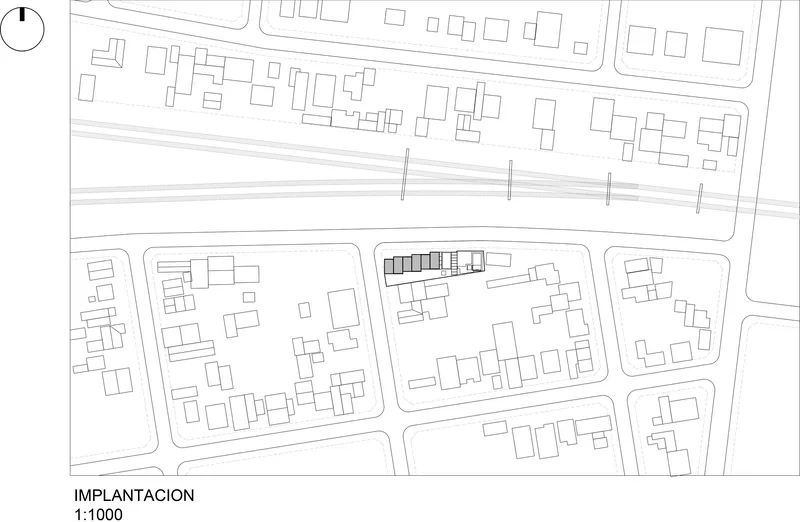

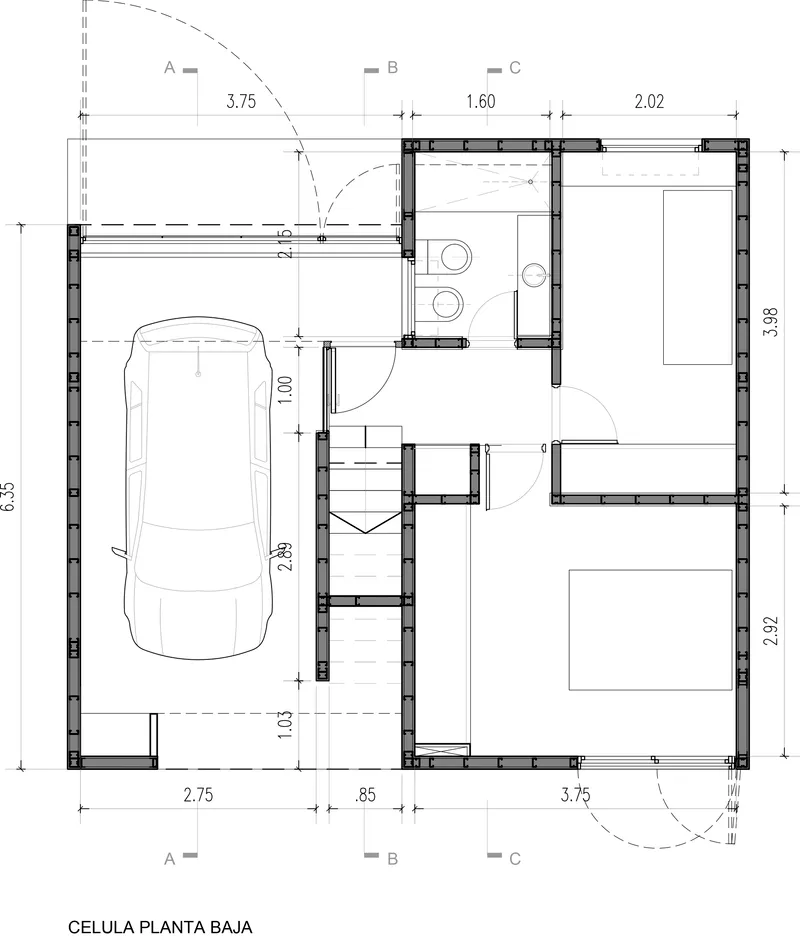
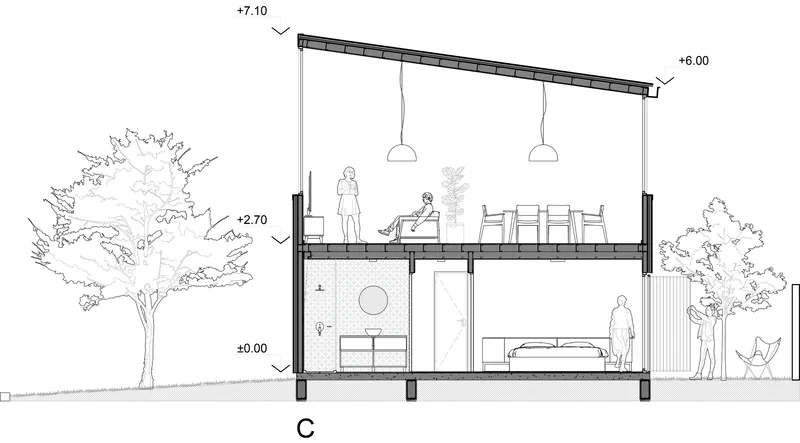

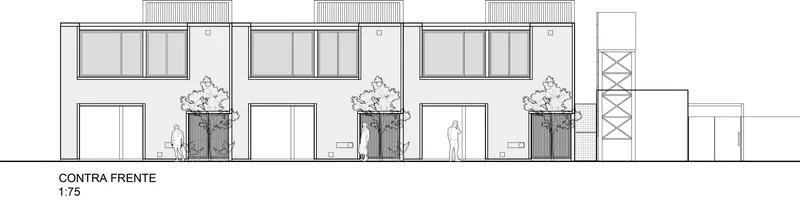

The site plan reveals the project's urban intelligence: three attached units oriented along the lot's long axis, with the rail corridor defining one edge and the street the other. The axonometric phasing diagrams show how the volumetric strategy was developed incrementally, splitting a single bar into paired modules with courtyard intervals. The section confirms the asymmetric roof pitch, with the high point at the living room and the low point compressing the service zones. The ground floor plan demonstrates the tight efficiency of the steel-frame system: carport, bathroom core, bedroom, and patio packed into a disciplined footprint.
Why This Project Matters
Villa Elisa Duplex is a reminder that the most productive site for architecture is often the least glamorous one. A trapezoidal lot beside a railway, shaped by an investment analysis and zoning ordinance, becomes the occasion for a project with real spatial intelligence. The steel-frame construction keeps the build lean and fast. The mobile facades give residents agency over their own enclosure. The inverted section puts communal life where the views and light are best. None of this is revolutionary, but all of it is precise.
For architects working in the expanding periphery of Buenos Aires and cities like it, this project offers a model. It proves that speculative housing on a marginal site does not have to surrender design ambition. When the structure is disciplined, the materials are honest, and the section is carefully tuned, even a slot beside the railway can become a place worth living.
Villa Elisa Duplex by Estudio Focaccia Prieto (Arq. Clara Focaccia, Arq. Juan Manuel Prieto). Villa Elisa, Argentina. 259 m². 2022. Photography by Luis Barandarian.
About the Studio
Share Your Own Work on uni.xyz
If projects like this are the kind of work you want to make, uni.xyz is a place to publish your own, find collaborators, and enter design competitions.


Popular Articles
Popular articles from the community

Cloaked Colonization: A Mobile Underwater Habitat That Moves Like a Fish
Micah Abaya's shortlisted EHC Pacific entry reimagines ocean settlement as a dispersed network of self-sustaining architectural organisms.
Temporary Home for Dogs: A Reversed Zoo Rethinks Animal Shelter Architecture
In Bucharest, a sinuous corridor and freed landscape flip the logic of containment, designing a shelter that works to make itself unnecessary.
Faces of the Soviet Avant-Garde: Turning Moscow's Street Names into an Open-Air Museum
A network of sculptural installations across a Moscow residential district transforms forgotten architect names into spatial encounters with cultural memor

The Amber Palace Opera: A Geological Fiction Surfaces on Tallinn's Baltic Waterfront
Pierre Brillard reimagines a Baltic legend as a public landscape, opera house, and waterfront promenade rooted in Tallinn's coastal identity.

Similar Reads
You might also enjoy these articles

Pixel Gardens: One Repeated Module Stacked Into a Terraced Social Housing Tower for Famagusta
Salem Bader's shortlisted housing tower builds a vertical neighbourhood from one repeated module, offsetting units to carve terraces, light and air.

Bao Huynh Watercolor Atelier: A Serene Art Retreat in Hội An
Bao Huynh Watercolor Atelier in Hội An blends multifunctional art spaces, sustainable design, local materials, and family-friendly living in a serene environment.

Atelier Macri Concept Store Interior Design by CASE-REAL
Atelier Macri store features a "ko" counter, walnut wood details, cork displays, blending retail, gallery, and seamless customer experiences.

Manuel Vargas Izquierdo Stadium and High-Performance Sports Center: Architectural Excellence in Jalpa de Méndez
The Manuel Vargas Izquierdo Stadium blends sustainable design, inclusive sports facilities, and cultural-inspired architecture, revitalizing Jalpa de Méndez’s public spaces.

Explore Villa Competitions
Discover active competitions in this discipline

Challenge to design mud housing for contemporary communities

Challenge to reimagine the Iron Throne

Photograph architecture without architects

Illustrate the lost glory of Angkor Wat - Render Challenge
Comments (0)
Please login or sign up to add comments
No comments yet. Be the first to comment!