
Estúdio OLO Peels Back Layers of a 60 m² São Paulo Apartment to Reveal Its Concrete Bones
A compact renovation in São Paulo lets exposed structure, glass block slots, and sage green cabinetry rewrite a small apartment's story.


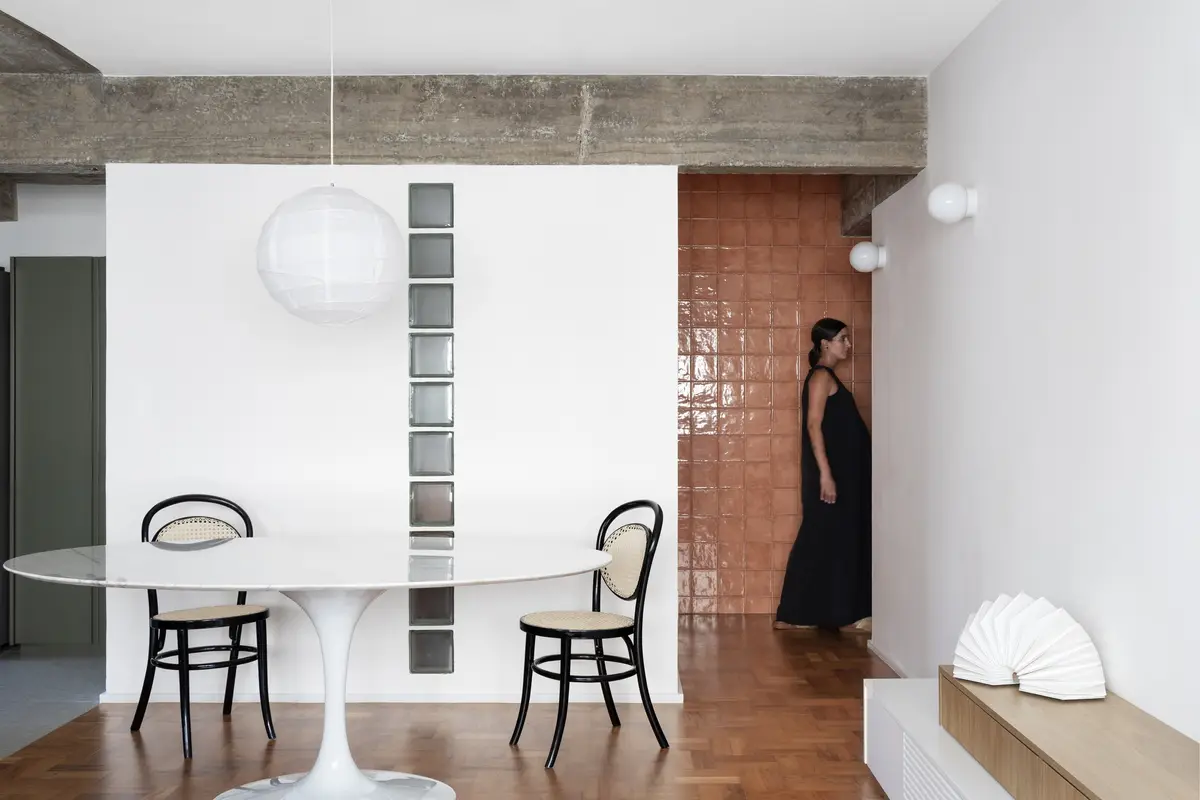
Renovation in a dense São Paulo apartment block rarely gets the space to breathe. At 60 square meters, the Araruama Apartment designed by Estúdio OLO is the kind of project where every centimeter carries an argument: strip back or cover up, expose or conceal. Led by architects Beatriz Guedes and Francine Jubran, the studio chose to do both simultaneously, peeling away decades of plaster to uncover raw concrete beams and columns while inserting clean white planes and carefully tinted cabinetry that frame those rough surfaces like artifacts.
What makes this project worth studying is its refusal to pick a single register. It is neither a brutalist reveal nor a minimalist white box. The concrete stays honestly gray, the kitchen turns sage green, a bathroom wall erupts in a pink crane mural, and a vertical slot of glass blocks filters light through a partition that could have been a dead wall. The apartment reads as a conversation between the building's original mid-century skeleton and a contemporary layer that respects it without fetishizing it.
Concrete as Character
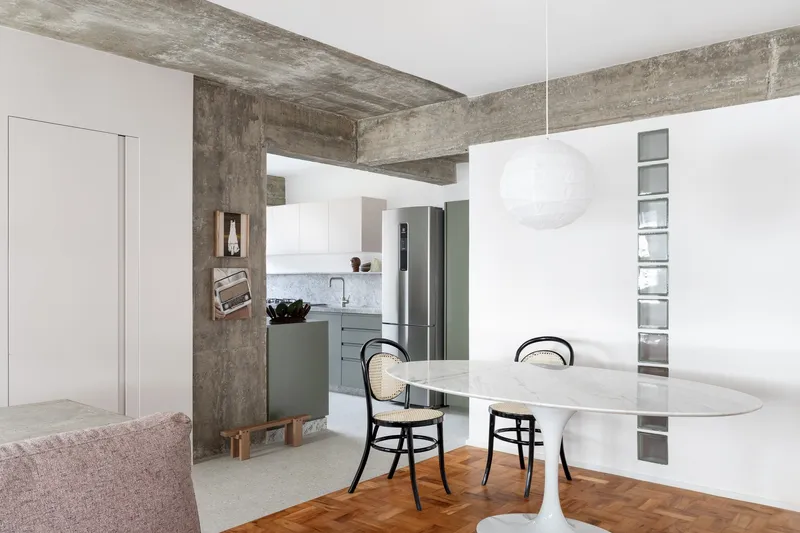
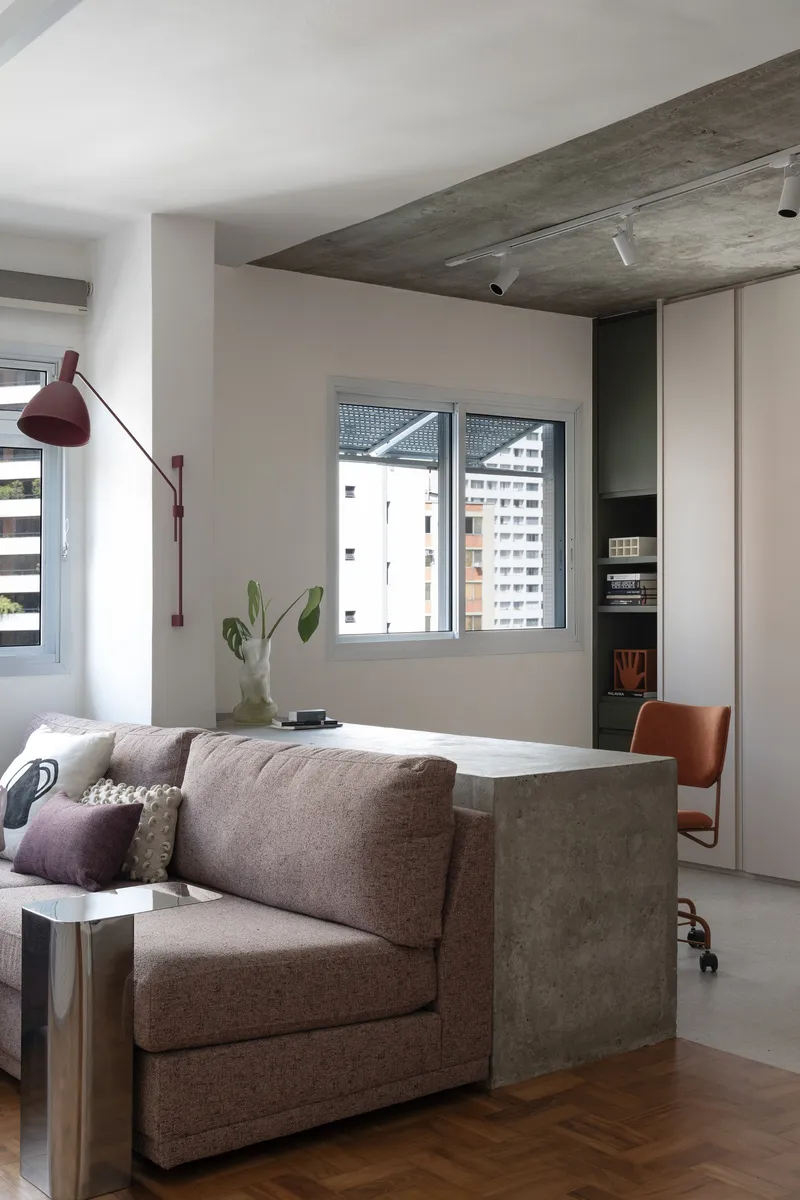
The decision to expose the apartment's concrete structure is not merely aesthetic. In a 60 m² plan, dropping a false ceiling would cost precious headroom. By stripping the slab back to its beams, Estúdio OLO gains visual height and introduces a rhythm of parallel ribs that organize the open plan without additional walls. The beams become a kind of ceiling grid that subtly distinguishes kitchen from dining from living.
A terracotta brick accent wall in the living area offers tonal warmth against all that gray, while concrete columns are left unapologetically bare at their edges, their formwork marks legible. The architects treat these surfaces as found objects: they clean them, they light them, and they step aside.
The Glass Block Slot and Partition Logic
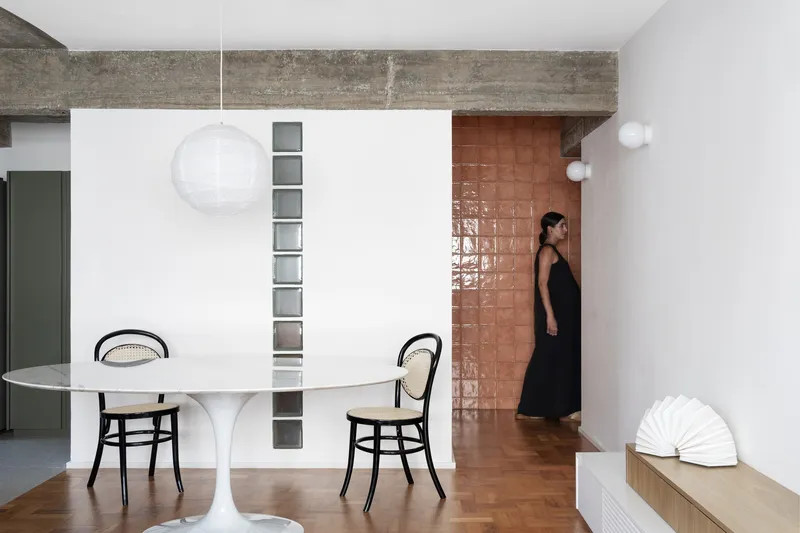
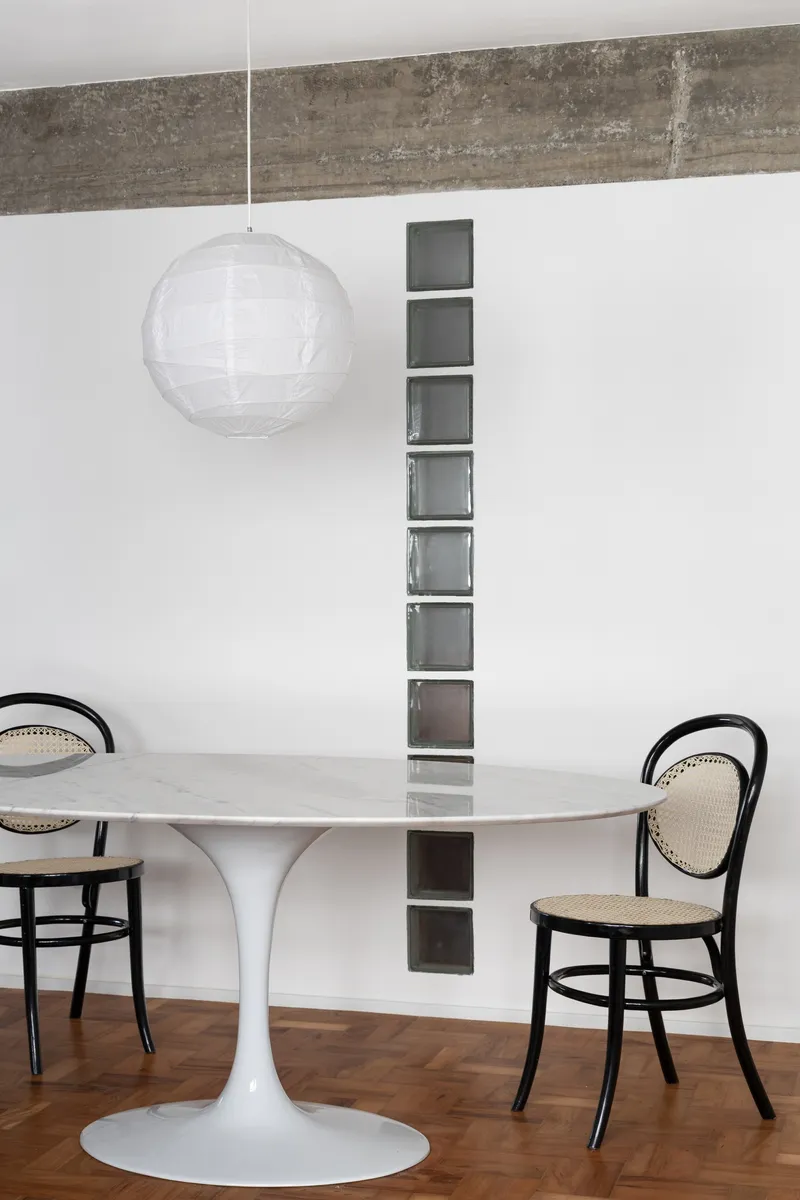
One of the sharpest moves in the apartment is a floor-to-ceiling white partition wall scored with a narrow vertical channel of glass blocks. It separates the entrance zone from the dining area without killing the light path between them. The slot is too narrow to see through clearly, which preserves privacy, but wide enough to telegraph movement and time of day. It is a detail that earns its keep twice: as light device and as spatial signal.
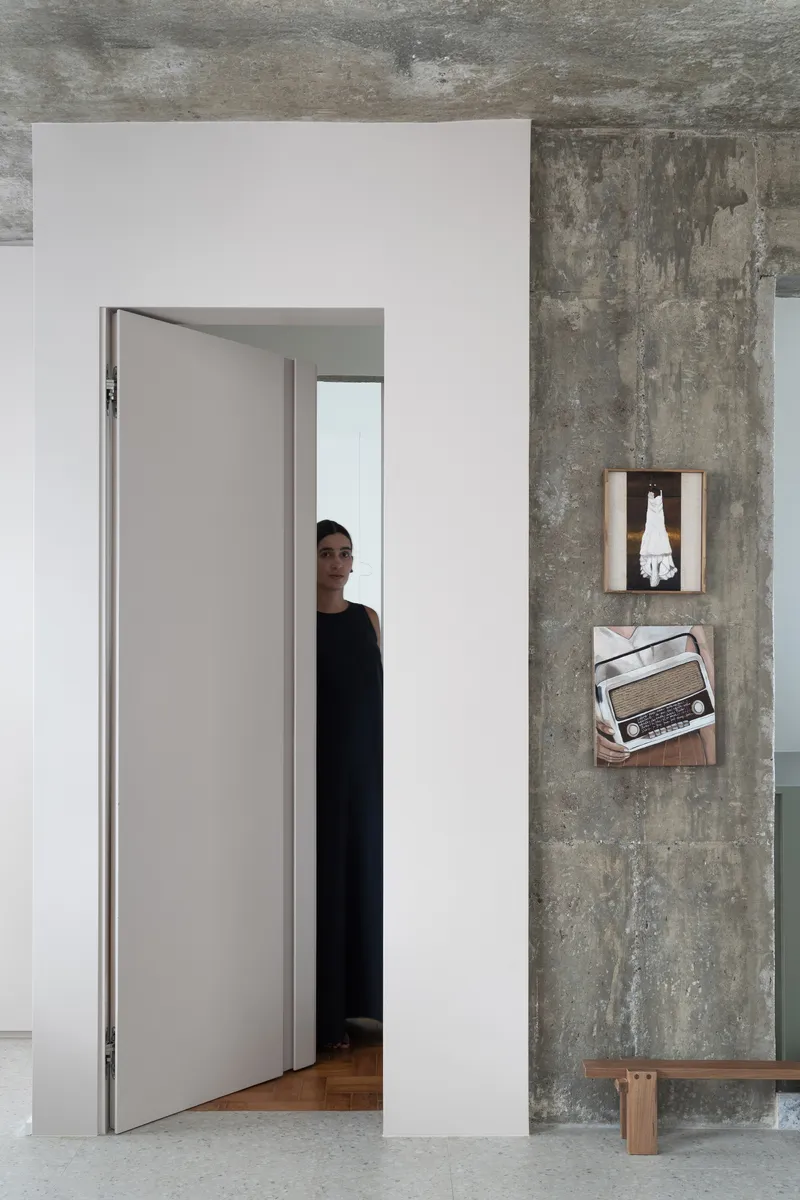
Elsewhere, doorways are cut cleanly through white plaster planes that abut exposed concrete overhead, making each threshold a little composition of smooth and rough. A pocket door beside a shelf holding a vintage radio shows how the architects use flush hardware to keep wall surfaces continuous, treating the plan as a sequence of sliding and fixed planes rather than a corridor with rooms hanging off it.
A Kitchen in Sage and Marble
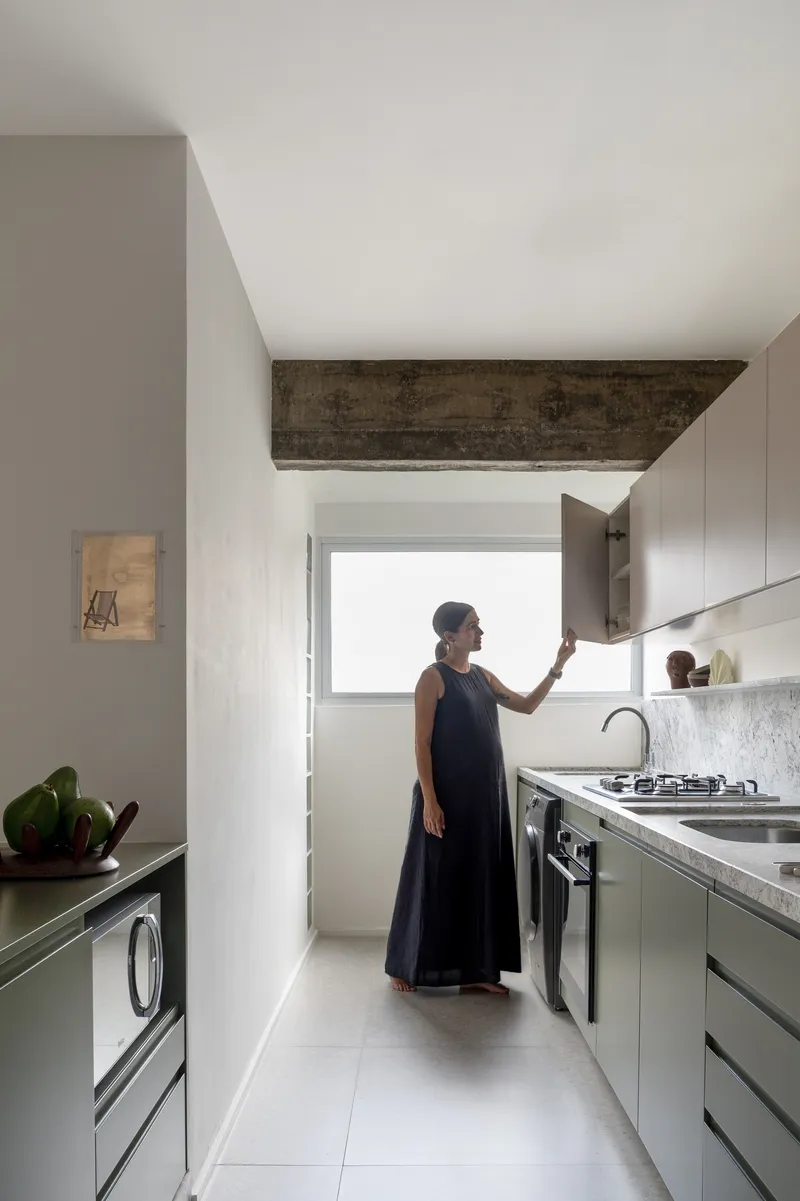
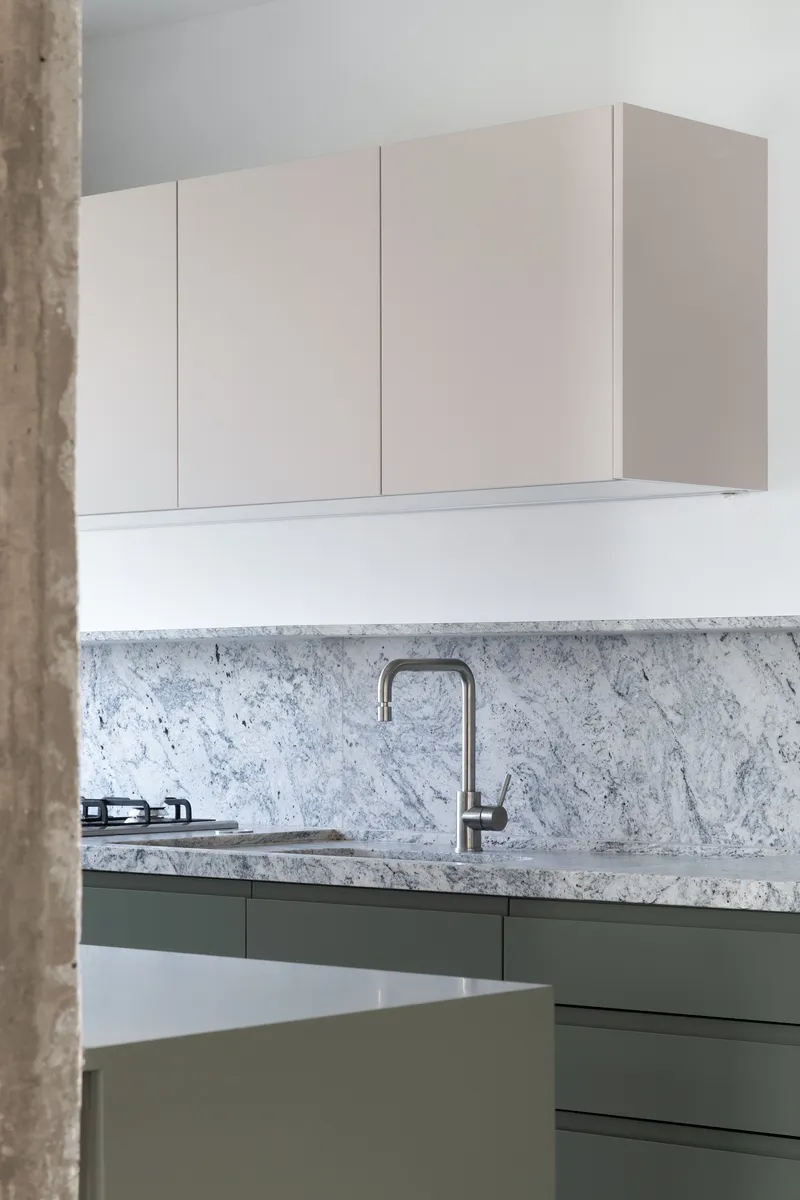
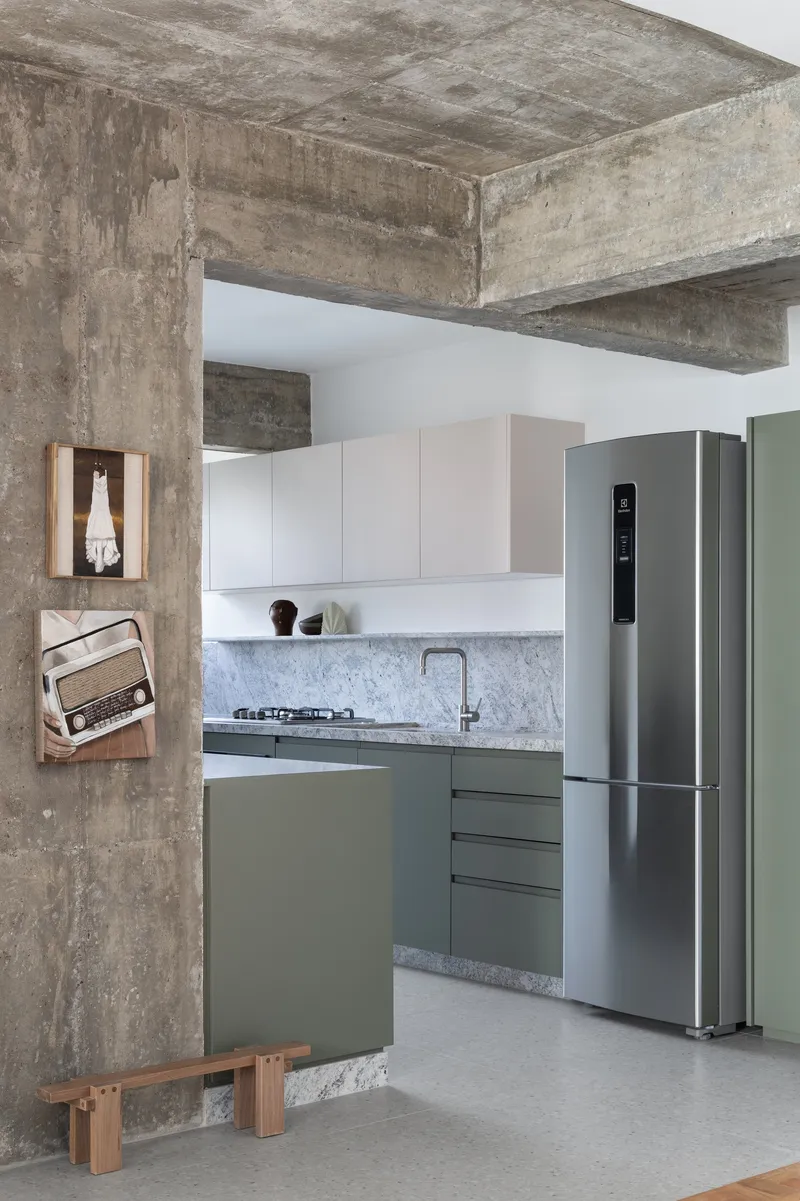
The galley kitchen sits beneath one of the exposed beams and stretches between two concrete columns, which act as natural bookends. Sage green lower cabinets paired with a white marble backsplash give the space a color identity distinct from the rest of the apartment. It is a deliberate tonal shift: you know you have entered the kitchen not because of a door but because the palette changes.
Upper cabinets in white recede against the ceiling, while the marble counter wraps up the wall just enough to catch splashes without dominating the view. A stainless steel refrigerator and simple steel faucet keep the hardware honest. Nothing here shouts, but the proportions are tight and the color choice is confident enough to anchor the entire open plan.
Bedroom and Private Quarters
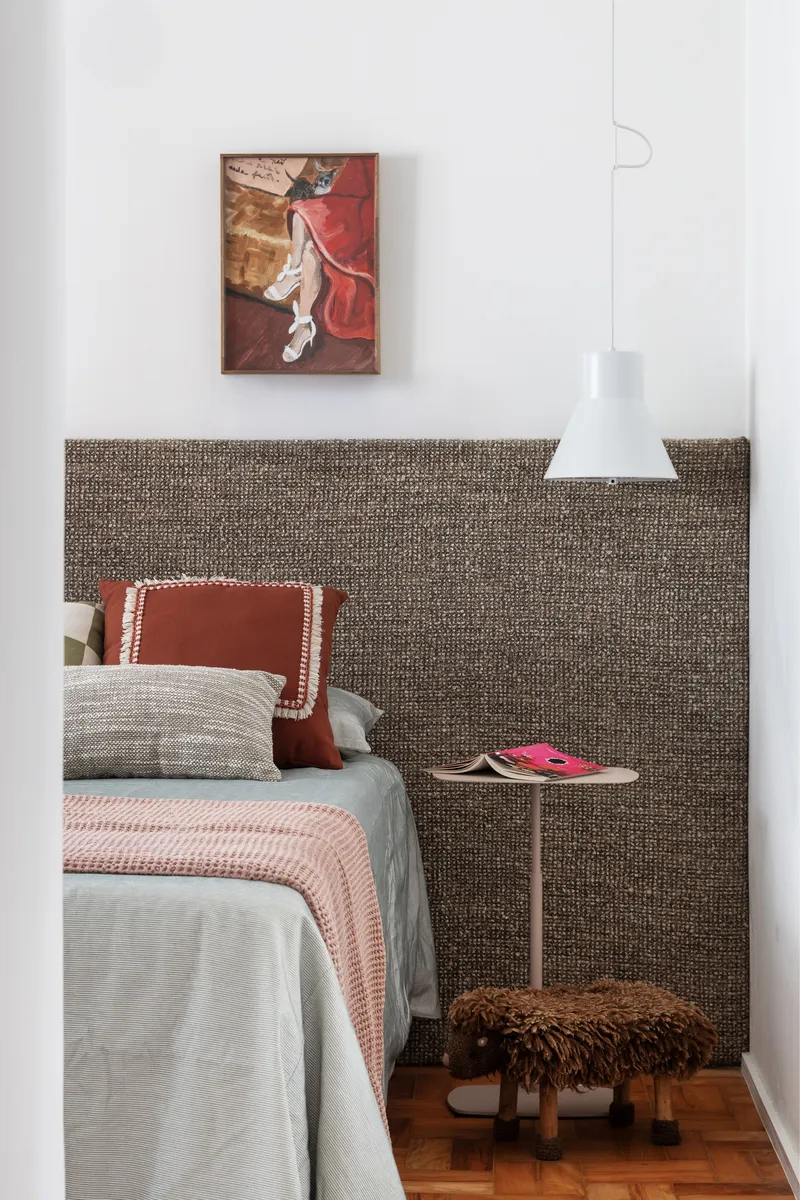
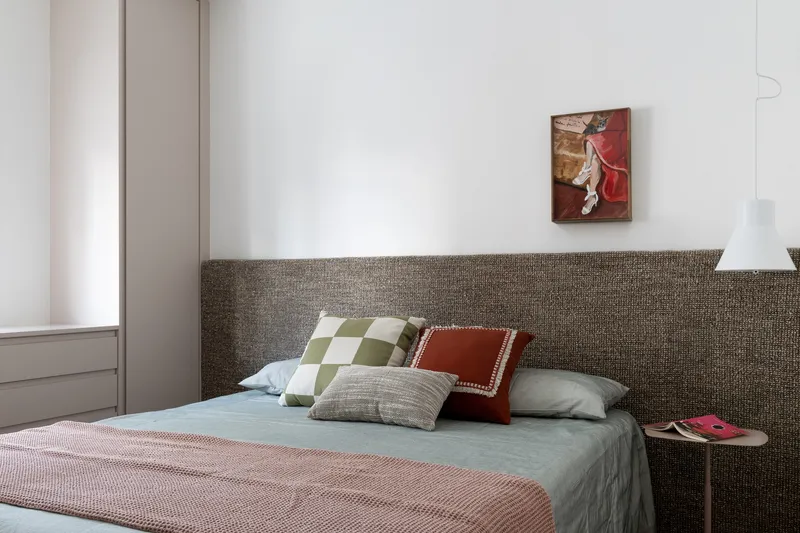
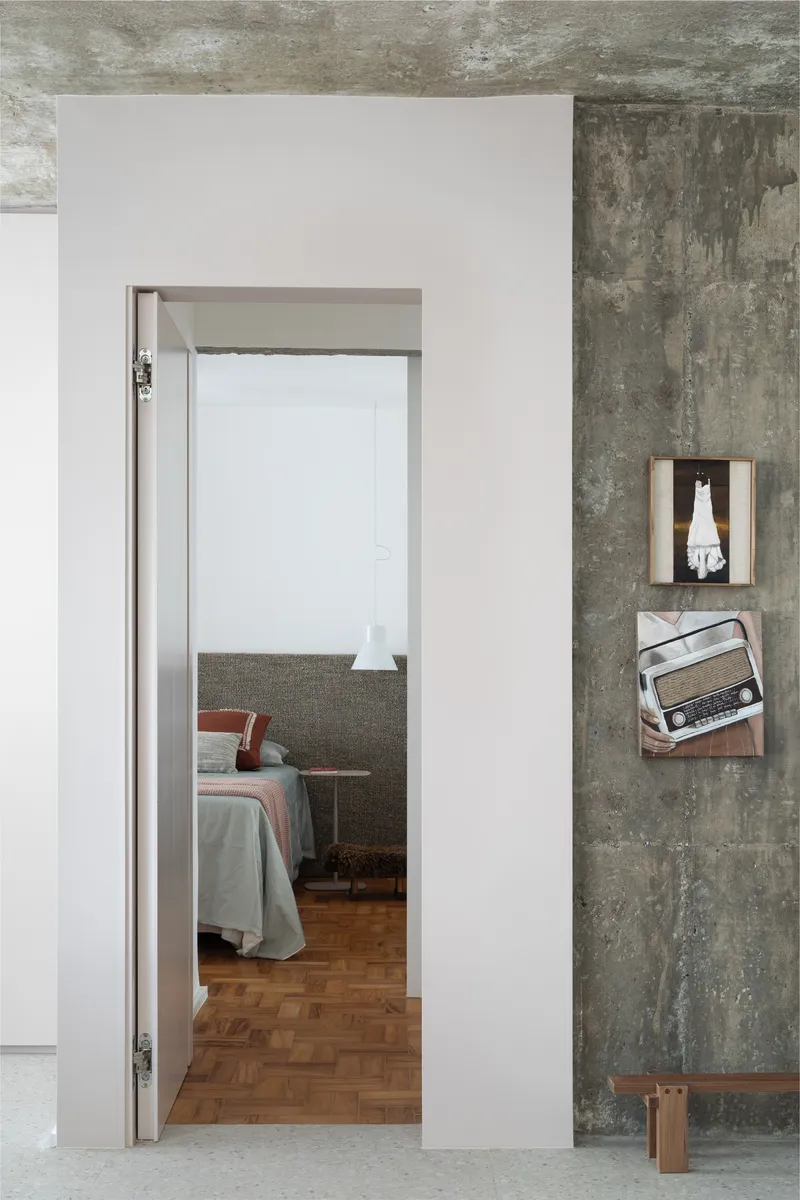
The bedroom retreats from the exposed concrete language of the public spaces. A woven textile headboard panel and a textured wall behind the bed introduce softness, absorbing sound and lowering the visual temperature. Original parquet flooring, visible through the doorway, ties the private zone back to the building's history without requiring any new material.
A painting hung above the bed and a pendant light beside it suggest that the architects trusted the residents to finish the room with personal objects. The architecture provides the frame: warm flooring, a tactile wall surface, and a threshold that reads as a deliberate crossing from concrete to cloth.
Furniture and Detail Moments
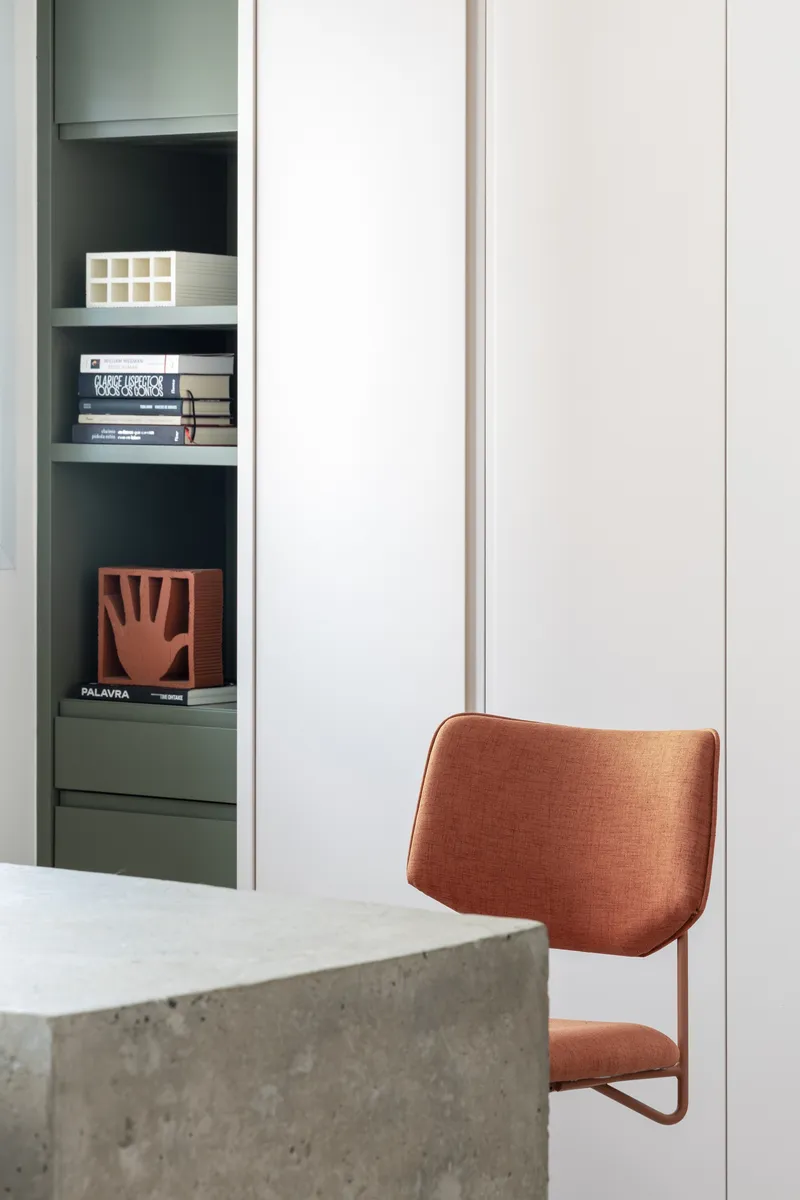
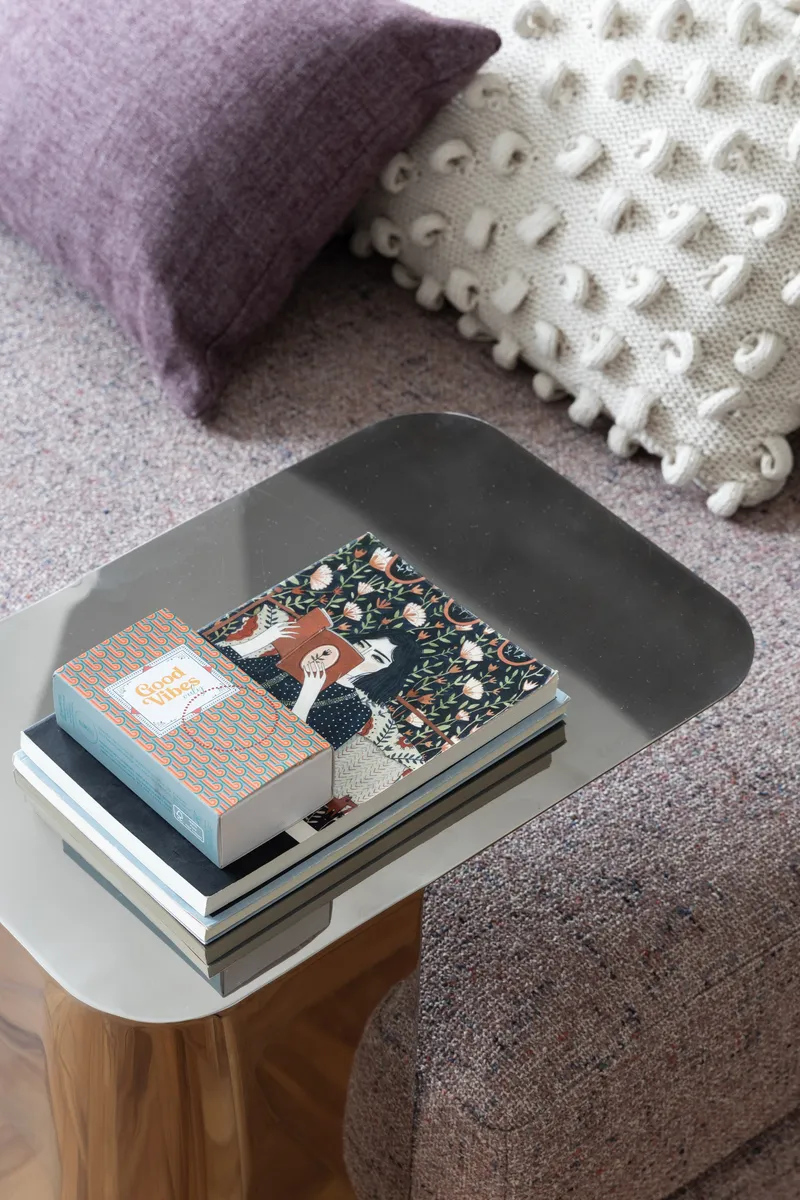
A built-in shelving unit with a green-painted interior sits beside a concrete column edge, turning a structural leftover into a display niche. The green is darker than the kitchen's sage, creating a family of related tones across the apartment rather than one flat color. Nearby, a curved gray side table on timber legs holds a stack of books next to textured cushions, a vignette that shows how the furniture was selected to echo the apartment's material contrasts: smooth and rough, curved and rectilinear.
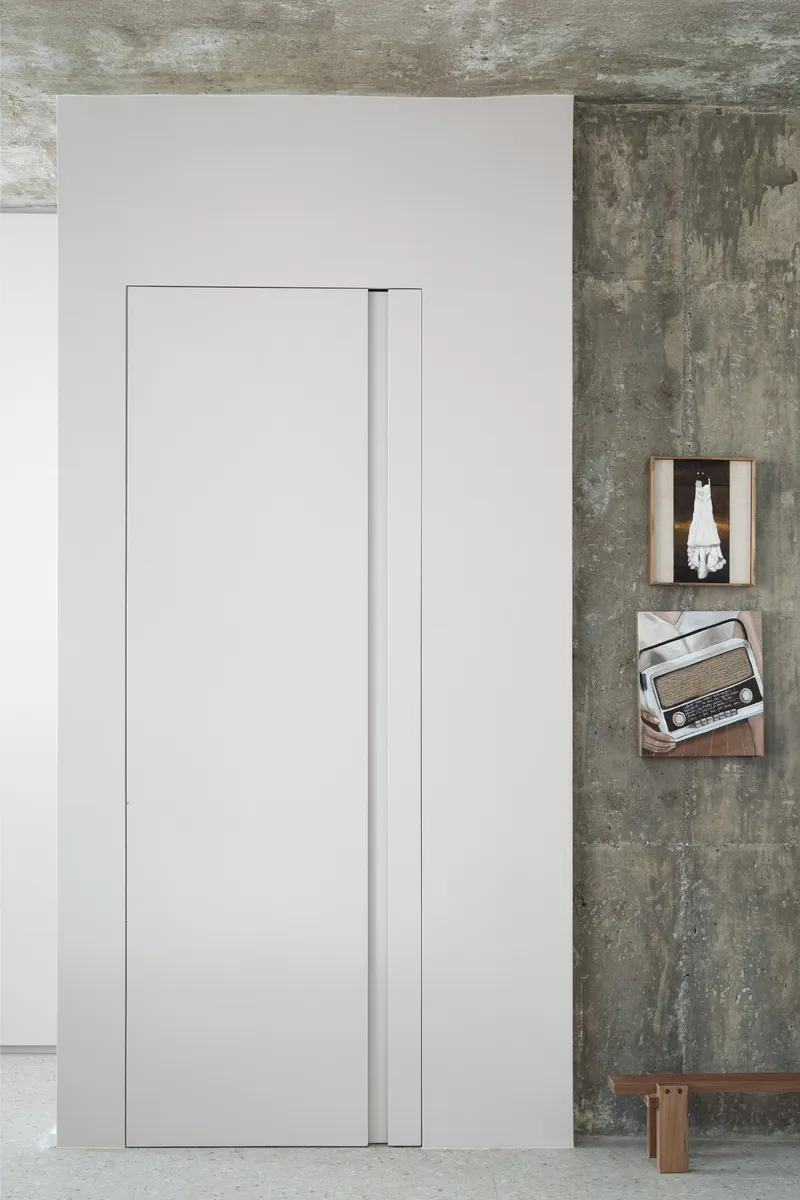
A flush pocket door beside wooden shelves and a vintage radio is one of those details that rewards a second look. The door panel, when closed, becomes indistinguishable from the adjacent wall. When open, it reveals the depth of the wall cavity. It is a quiet demonstration that in a small apartment, the hardware has to be as considered as the structure.
Color and Personality in the Bathroom
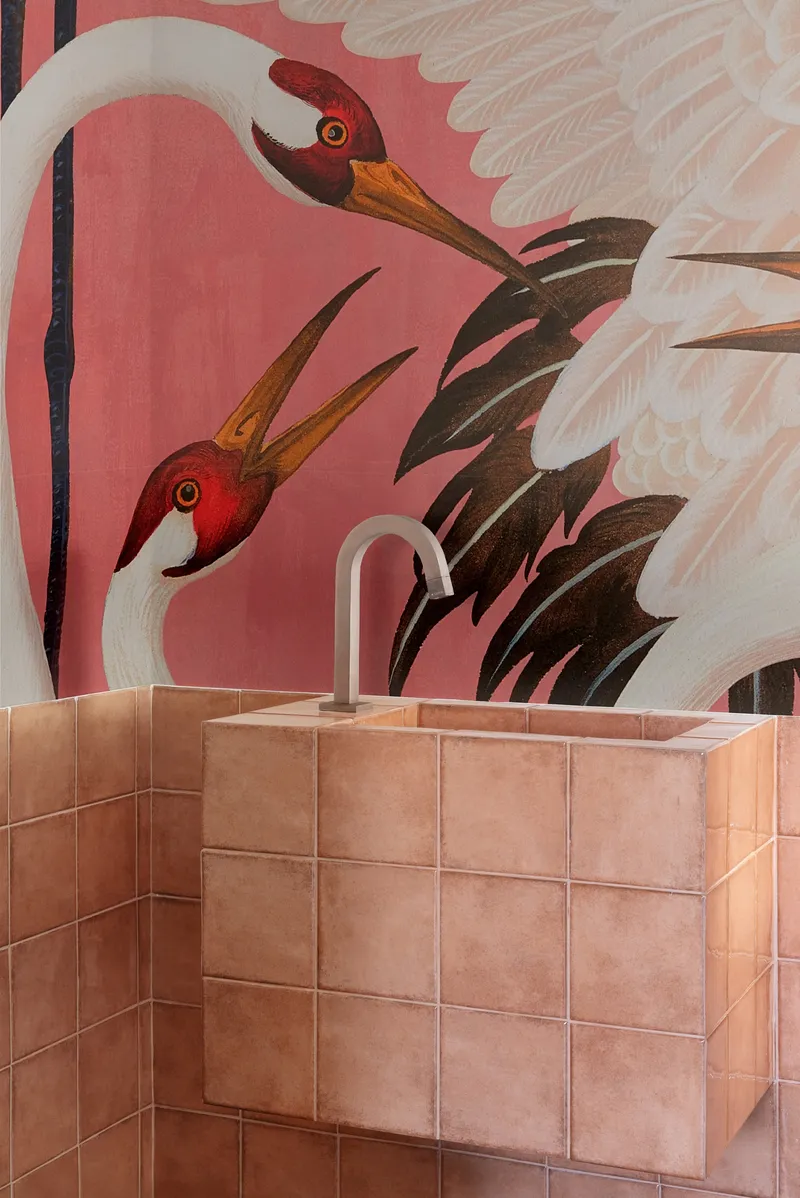
The bathroom takes the biggest chromatic risk: a pink mural of cranes and feathers wraps the wall behind a tiled vanity basin. After an apartment of concrete grays and muted greens, this burst of illustrative color feels intentional rather than arbitrary. It signals that the private spaces belong to the inhabitants, not to the structural logic of the building. A curved faucet and simple basin keep the fixtures restrained, letting the mural do the talking.
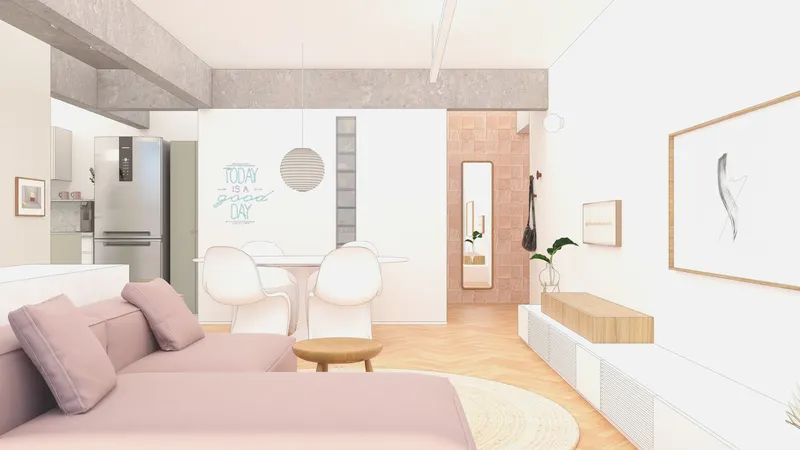
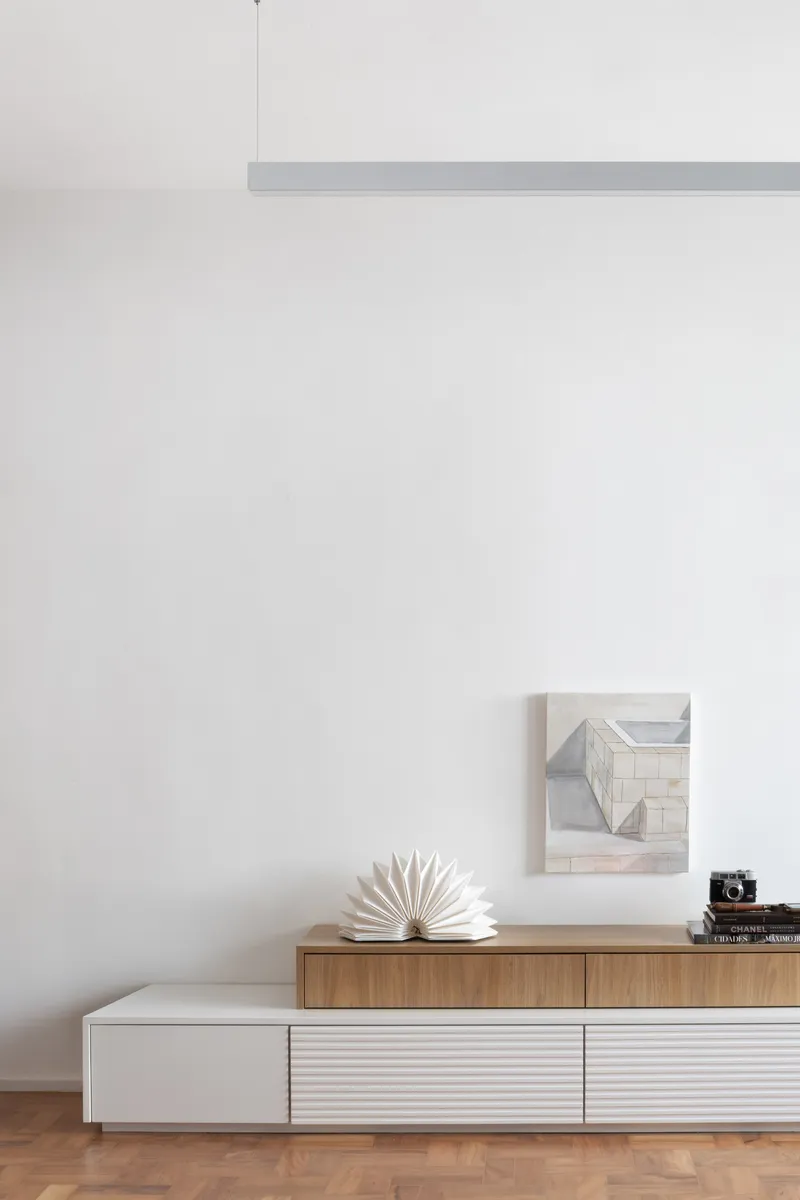
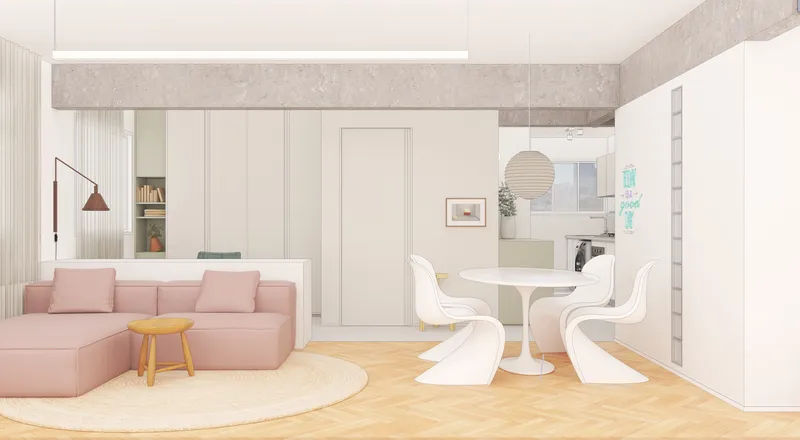
In the living area, a pink sofa anchors an alternate view of the open plan, tying back to the bathroom's palette and proving that the color choices are coordinated across the apartment. A low storage unit with timber and white panels beneath a pendant light rounds out the entry sequence, offering landing space without bulk.
Plans and Drawings
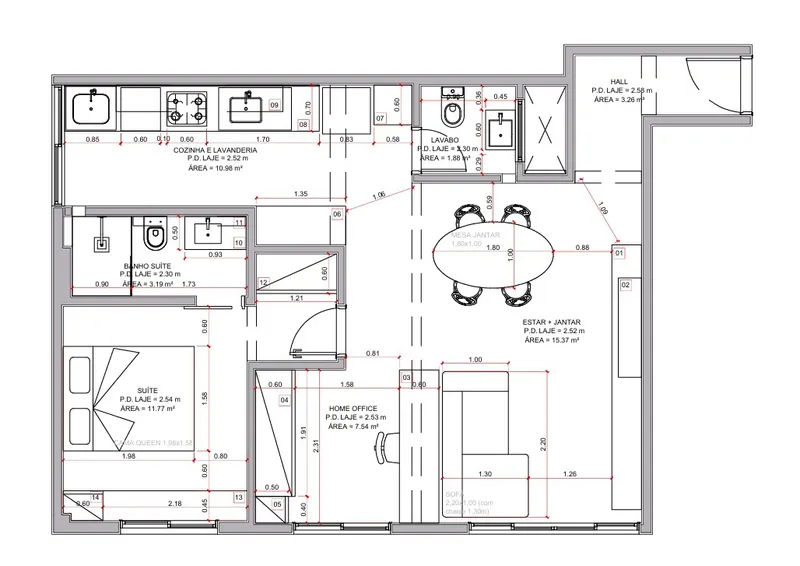
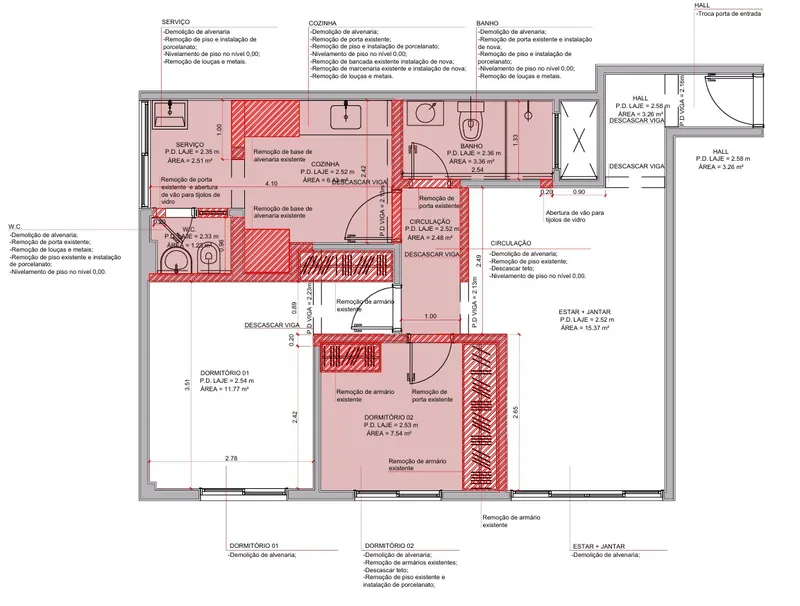
The floor plan confirms what the photos suggest: the apartment is organized as a single L-shaped public zone wrapping around a compact suite and two bathrooms. Red highlights on the annotated demolition plan show just how many walls were removed to achieve the open layout. Nearly every non-structural partition was stripped out, which explains how a 60 m² footprint can feel generous. The kitchen, dining, and living areas flow into one another under the exposed beam grid, while the bedroom is reached through a single threshold that makes the transition feel intentional rather than leftover.
Why This Project Matters
Small apartment renovations in São Paulo are a genre unto themselves, and many default to one of two modes: the total white-out that erases the building's memory, or the loft conversion that romanticizes every crack. Estúdio OLO's Araruama Apartment does neither. It selectively reveals the concrete frame, then layers color, texture, and precise joinery on top of it. The result is an apartment that feels older and newer than its actual age, because both timelines are legible at once.
For designers working at this scale, the project offers a transferable lesson: structure is not just something to hide or celebrate. It is a spatial tool. The beams define zones, the columns frame the kitchen, and the slab gives the ceiling its rhythm. When you let the building participate in the design rather than treating it as a constraint, 60 square meters can hold a lot more story than the number suggests.
Araruama Apartment by Estúdio OLO (Beatriz Guedes, Francine Jubran). São Paulo, Brazil. 60 m². Completed 2025. Photography by Bia Nauiack.
About the Studio
Estúdio OLO
Official website of Estúdio OLO, one of the studios behind this project.
estudioolo.com.brShare Your Own Work on uni.xyz
If projects like this are the kind of work you want to make, uni.xyz is a place to publish your own, find collaborators, and enter design competitions.


Popular Articles
Popular articles from the community


Hill & Cross Opera: Sculptural Opera House Architecture Shaped by Tallinn’s Landscape and Identity
Hill & Cross Opera reimagines opera house architecture in Tallinn through its sculptural hill, civic plaza, glass wave and a luminous cross.

The Musturak Paradise: Senior Living Architecture for a Connected Future in Temara, Morocco
The Musturak Paradise reimagines senior living architecture in Temara via private homes, social spaces, culture, community, and shared care.

The Ocean Hive: Sustainable Architecture for a Self-Sufficient Civilization at Sea
The Ocean Hive imagines sustainable architecture at sea, where modular habitats, algae, wave power and ocean waste sustain a growing colony.

Co-Life: Senior Housing Design That Reconnects Older Adults With the City
Co-Life reimagines senior housing design through healing gardens, shared streets, workshops, and a sustainable community across generations.

Similar Reads
You might also enjoy these articles

Bao Huynh Watercolor Atelier: A Serene Art Retreat in Hội An
Bao Huynh Watercolor Atelier in Hội An blends multifunctional art spaces, sustainable design, local materials, and family-friendly living in a serene environment.

Atelier Macri Concept Store Interior Design by CASE-REAL
Atelier Macri store features a "ko" counter, walnut wood details, cork displays, blending retail, gallery, and seamless customer experiences.

Manuel Vargas Izquierdo Stadium and High-Performance Sports Center: Architectural Excellence in Jalpa de Méndez
The Manuel Vargas Izquierdo Stadium blends sustainable design, inclusive sports facilities, and cultural-inspired architecture, revitalizing Jalpa de Méndez’s public spaces.

KAKR Buluh Awar Hall: Revitalizing Community and Ecology Through Bamboo Architecture
Community built bamboo hall revitalizes Buluh Awar village, empowering youth, restoring ecology, celebrating vernacular craftsmanship through sustainable architecture and culture.

Explore Apartment Competitions
Discover active competitions in this discipline

Challenge to design luxury tourism on rails

VR headsets Storefront design competition

Designing a staircase for a client
Comments (0)
Please login or sign up to add comments
No comments yet. Be the first to comment!