

Everlasting Paradise for Human
A history of ideas for human beings, a way of reading the history of architecture

1 The course of history, a history of ideas
When mankind mastered the use of tools and formed the most rudimentary civilizations, the first primitive forms of architecture for human habitation were created. People created the spaces formed by those entities built out of raw materials, as living homes used by the birth of intelligent civilizations. For a long time, architecture itself served only as a dwelling for human beings, and at that time it did not have the meaning given to the word 'architecture'.
"A bicycle shed is a building, Lincoln Cathedral is a piece of architecture."
-Nicholas Pevsner
When mankind was gathered in settlements, the birth of the state was accompanied by the opening of the curtain on the history of human architecture. The stages of development in ancient Egypt and the different forms in which the pyramids evolved indicate the birth of human class consciousness and different patterns of belief. The process of human construction was imbued with a sense of faith and the history of architecture was thus born.
During the flourishing Classical period, the architectural styles developed in Ancient Greece and Rome set the tone for the subsequent development of architecture, and theories relating to architecture began to be developed. Although they are the earliest gems in the history of architecture, each has its distinctive character. Ancient Greek architecture valued the relationship between architecture and nature: the natural geography of Greece was varied, each place had a local god, sacred places corresponded to the gods, and architecture valued the spirit of place (Genius Loci). The similarities and differences between ancient Greek and Roman architecture lie in their different modes of government, with the republican city-state's promotion of freedom and equality leading to an architectural emphasis on a harmonious relationship with nature, and the imperial system's establishment of a high degree of order in the form of monarchical worship leading to two very different feelings of architectural space.
The chaos that followed the fall of the Western Roman Empire led to the rapid development of religious consciousness in the Middle Ages, with suffering people placing their hopes in sacred imagery. Christian architecture moved away from the early catacombs and the Church took advantage of the situation, while the beginning of a truly Western European civilization saw holy places on the pilgrimage route Churches were built. People began to build cities of God, and a period of architectural history dominated by divinity began. The vaulting technique allowed the walls to withstand greater pressure, making the building taller and more visually powerful, while the interior became brighter due to the increased height and use of glass. At a time of religious fervor, when people wanted to be close to God, these tall and bright buildings were well received, and the style of architecture was reduced to serving the ideas of the Church.
During the Renaissance, people went through the process of popularising religion for all - learning to think - awakening - reflecting on religion-independent thinking -growing up, the pursuit of knowledge and science began, and architecture began to lean away from the divinity of the Middle Ages towards humanity. The same period saw the emergence of capitalism. The Renaissance movement, based on the idea of 'humanism', is a whole cultural movement, including architecture, painting, sculpture, literature, music, and all other fields of art. During this period architecture was considered a mathematical science that embodied the order of the universe. The beauty of architecture was based on the harmonious proportion of its parts, latent in the laws of nature. 17th century scientific and intellectual changes: the discovery of the New World and the heliocentric theory impacted Renaissance interpretations of the order of the universe and the relationship between man and God. A new intellectual environment emerged: the freedom of autonomous thought in science, a concern with the practical application of knowledge, the
The monarchism of Rene Descartes and the political monarchism of the 17th century led to a new order in French architecture, a monumental shaping of space that had not existed in the past. Under Louis XIV, the rulers and architects wanted to develop their style of architectural form, inherited from the classical French, and then to make this style the supreme style to influence the world.
In the mid-18th century, with the strengthening of the bourgeois revolutionary consciousness, the intellectuals of Europe launched an ideological and cultural movement against the feudal monarchy and its ideology. The core of Enlightenment architectural thought was the critical reason, reflecting on classical architecture, the Renaissance, and Classicism. However, Enlightenment architecture was not dominant at the time and academic classicism remained strong, with 18th and 19th-century architecture being dominated by French rationalism and the British empirical (as reflected in the Picturesque style) tradition.
A new conception of history was born during this period and architecture was receiving influences from different fields, such as the birth of Romantic architecture, which was initially active in the literary field, where a sense of style allowed architects to think rationally and evoke memories of home and country. nationalism and the battle of styles the rise of the modern city, new building types, and urban spaces originated after the French Revolution, from the rule of the monarchy to the emerging bourgeoisie, social structures changed and the objects served by architecture changed. New materials and structural engineering gave rise to new architectural styles, new schools of thought emerged and the crisis of historicism opened a new chapter in the new architectural movement. After modern architecture, the emancipation of the individual and the state that accompanied the bourgeoisie gave rise to new schools of thought, such as Expressionism, which aimed to create the great cities of the future, where new technologies were essential; Futurism, which proposed that "history is binding mankind to development"; Constructivism and Stylism, and so on.
The history of architecture is a parallel process to the development of theory, and over the millennia it has not only been influenced and influenced by other fields, but also by the dominant ideas of mankind at the time. Throughout the ages mankind has progressed and reflected, critiquing previous 'misconceptions', all of which are encapsulated in architecture. Just as the history of architecture is a history of criticism, a history of constantly changing human ideas.
2 The modern history of architecture,Multi-genre collaboration
Much of my insight into the history of modern architecture has benefited from the influence of the Italian Manfredo Tafuri. Ideology guided a series of experimental explorations in architecture that, even if they seemed commonplace at the time, were a significant step in the that time. In Towards an Ideological Critique of Architecture Tafuri declares that "the architectural culture of the eighteenth and nineteenth centuries played a largely destructive role about the mainstream of critical thought throughout the Enlightenment." The technology of architectural production was far from matching the bourgeois ideology and liberal economic system, and the development of architectural typology and style seemed to be in trouble. Experimental attempts by architects, such as Ledoux and Dillon, tried to resolve the contradictions with representation and typology. The unresolved crisis ended up reducing architecture once again to a politicized tool, and ideology began to take control of its direction.
According to Tafuri, the ideology of architecture was destined to become a formal utopia, both at the level of art and the level of urban form, as it sought to reconstruct the whole of the human world through an idealized formal synthesis, conquering chaos with order. Underneath the capitalist manipulation of architectural forms is a microcosm of liberal capitalism, such as Ledoux's saltworks plan, in which the laws of economics play a predominantly dominant role, paired with penitentiary education and labor rehabilitation. What emerges here is the principle of universal utilitarianism advocated by the bourgeois thinkers of the Enlightenment, through which a realistic 'utilitarian society' emerges. The economic stimulus of the capitalist period had an essential impact on the ideology of the masses, on the architectural forms of urban space. The winds of the modernist movement blew a new association between capitalist economic consumption and popular culture, producing a specific type of architecture whose ultimate aim was not to serve the public ideology but to act as a facet of the urban ideology, and thus the linguistic revolution of modern art made its appearance.
In a historical moment full of contradictions and conflicts, when architecture was struggling to find the right style and form, and when architecture was at a loss as to where to go, other fields intervened to mitigate this crisis and offer their solutions to the historical process of architecture. Whereas the stylists were looking for order and rejecting chaos, Dadaism emphasized the embrace of chaos. Architecture thus intervened, absorbing and overcoming all the claims of the historical avant-garde, as it could provide the real answer to the claims of Cubism, Futurism, Dadaism, Stylism, and the various Constructivist claims. In each particular cultural context, emerging schools of thought and art were drawn on timely to lay out a colorful history of architectural development.
3 Homeopathic architecture - an architectural model born of ideas
In the Soviet Union in the 1920s, the Bolsheviks accelerated the disintegration of the family to build a communist society, a situation that was first revealed in architecture. To solve the housing shortage in crowded cities, the Bolsheviks forced wealthy families to share their flats with the urban poor - a policy known as 'uplotnenie' (sand mixing). This policy was a campaign to create a collective way of life. The Bolsheviks believed that forcing people to live in shared flats would make them more communist in their basic thinking and behavior. From the mid-1920s onwards, new housing designs took this transformation as their starting point. The most radical Soviet architects, such as the Constructivists of the Union of Contemporary Architects, proposed the creation of 'communal houses' in which all private spheres were abolished. These included the shared use of all property, including underwear, the use of cooking and child-rearing chores by teams, cooking and child-rearing chores by teams, sleeping in large dormitories for each gender, and private rooms for sexual intercourse. Such houses were rarely built and were only popularised in utopian imaginaries and futuristic novels such as Eugene Zamyatin's We (1920), but the creation of this building design is an expression of a break with past thinking and a rejection of critical capitalism and a good example of how the history of architecture is a history of ideas dominated by human consciousness.
Conclusion
Architecture, as a place of shelter for human beings, has undergone iteration after iteration, using the changes in human thought as a blueprint and the ever-advancing level of technology as a brush to realize their design drawings. The history of architecture is a history of mankind, and architecture is one of the direct manifestations of the changes in human civilization, a constant place where people are happy to build the paradise what they need, a place where their dreams can be realized.
References (2)
Studies &Architecture&Culture
Publisher: Tongji University Press
Vol. 9787560867076
The Whisperers: Private Life In Stalin's Russia
Publisher: Guangxi Normal University Press
Vol. 9787549558087

Popular Articles
Popular articles from the community


Opera on the Sea: Driftwood Logic Shapes a Timber Opera House on Estonia's Coast
Trevor Orgill's opera house translates the entangled drift of floating timber into a civic building where wood, water, and music converge.

Opera by the Sea Estonia: Three Shells Dissolving Architecture into Tallinn's Coastline
A winning opera house proposal replaces monumental form with interconnected shells that blur the boundary between building, park and Baltic Sea.
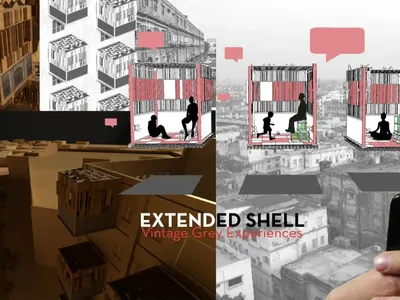
Extended Shell: Retrofitting Kolkata's Balconies as Living Urban Thresholds
A modular retrofit system recovers the social and environmental intelligence of Kolkata's historic verandas for contemporary Park Street residents.

Temporary Home for Dogs: A Reversed Zoo Rethinks Animal Shelter Architecture
In Bucharest, a sinuous corridor and freed landscape flip the logic of containment, designing a shelter that works to make itself unnecessary.

Similar Reads
You might also enjoy these articles

Shakur's House: Exposed Brick as an Interior Organiser in a 168 m² Mashhad Residence
Brick moves indoors in this Mashhad residence, where masonry walls, glass partitions and teal planes sequence a compact home without closing it off.

Day and Night Park: A Time-Based Urban Newsstand in Beijing
A temporary urban newsstand in Beijing blending travel, light, and reading through poetic colors, compact form, and community-focused design.

Modernist Patio Renovation in El Masnou, Barcelona by Oliver Segura Arquitectura + Cebrià Arquitectura
Modernist patio renovation blending tradition and innovation with a movable pool, leveled floors, and Catalan materials in El Masnou.

Alto Residencial Coop: Cooperative Housing Development in Santiago de Compostela by Carbajo Barrios Arquitectos
A linear cooperative housing complex blending white volumes and perforated metal façades, enhancing community living, natural light, privacy, and urban integration.


Comments (0)
Please login or sign up to add comments
No comments yet. Be the first to comment!