

Expansion of STUDIO SCRIPT OFFICE by Studio Script
Compact office expansion reuses former Beijing factory, introducing greenery, flexible mezzanine spaces, and warm plywood contrasts within an adaptive studio.


Located within a historic Beijing hutong, the Expansion of STUDIO SCRIPT OFFICE is a compact yet highly adaptive office interior renovation that reflects the evolving nature of creative workspaces in China’s urban renewal context. Designed by Studio Script, the 36-square-meter project transforms part of a former state-owned machine tool workshop into a flexible, light-filled architectural studio that balances history, greenery, and contemporary work culture.


Urban Renewal and Incremental Growth
The project sits within a former factory compound that has been redeveloped into a creative industrial park, blending office, cultural, and commercial functions. As part of this transformation, the original open workshop was subdivided into standardized units measuring 4.2 meters by 8.5 meters, intended for small creative businesses.
Studio Script initially occupied a single unit. As the practice expanded, it gradually rented adjacent spaces: resulting in multiple cycles of expansion, contraction, and renovation. This layered history is still legible in the space today, particularly in the east and west partition walls, which form a collage of exposed red brick and light steel keel structures, embodying the studio’s evolving footprint.

Light, Scale, and Spatial Reconfiguration
Each unit features a generous south-facing window measuring 2.9 meters wide and 2.3 meters high, overlooking a mature Ailanthus tree. In spring and summer, greenery visually floods the interior, creating a strong connection between indoor workspace and outdoor nature.
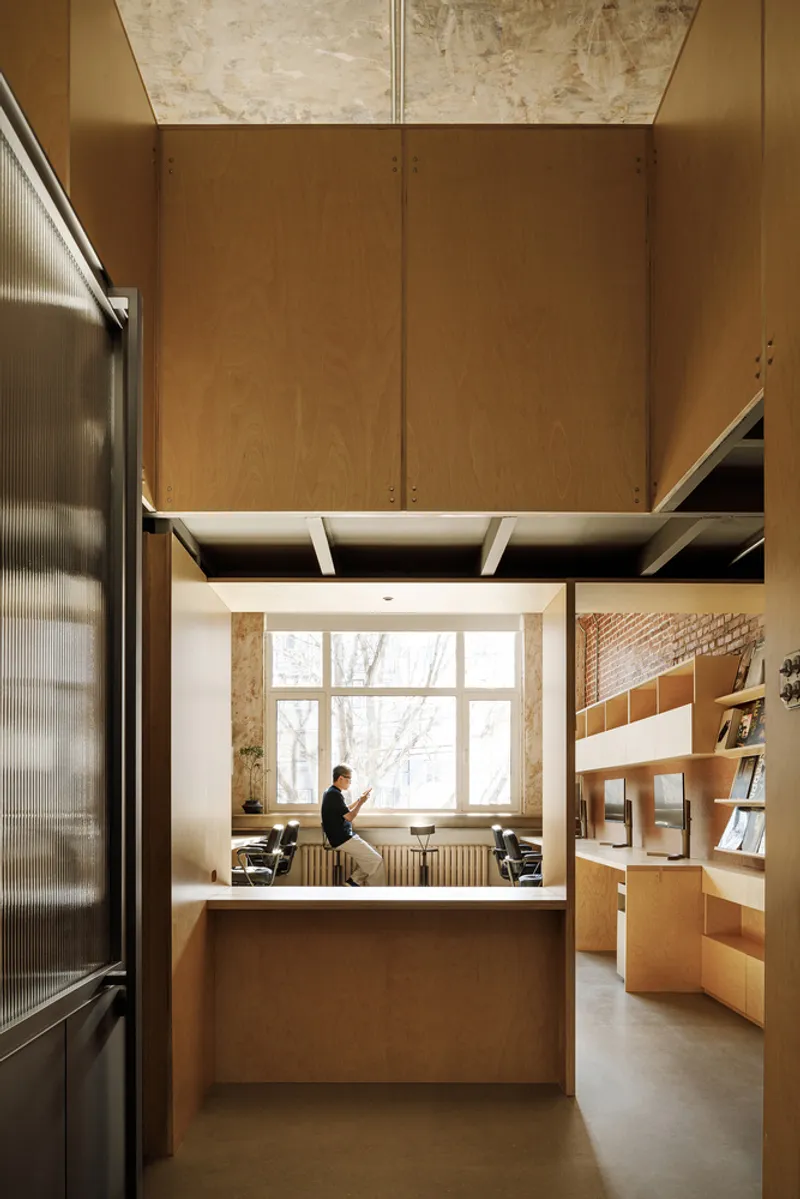
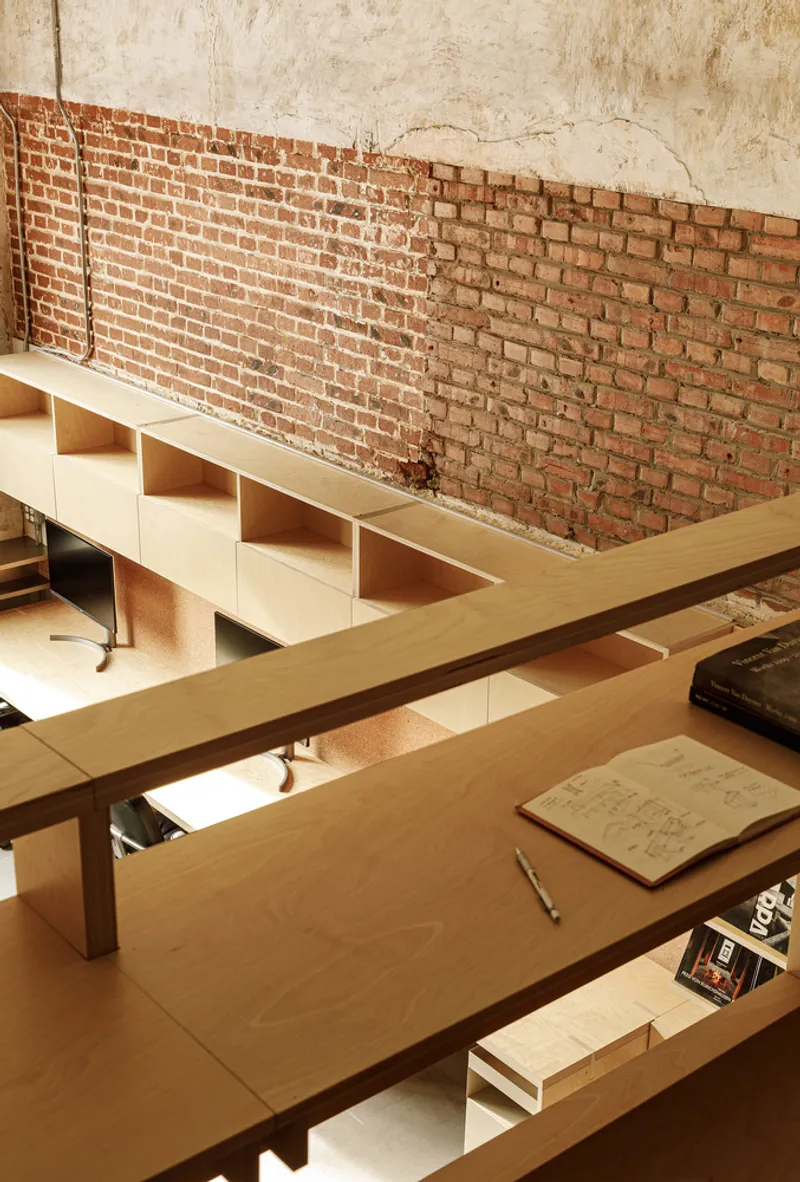
With a total interior height of 4.4 meters, the space originally included a nearly seven-meter-long mezzanine constructed by a previous tenant. This structure compressed both levels and limited spatial quality. The design team removed two-thirds of the mezzanine, retaining only a compact portion near the entrance.
This retained mezzanine now accommodates essential service functions, including a water bar, coat storage, material display, refrigerator, and 3D printing facilities. By consolidating utilities beneath the mezzanine, the south-facing area was liberated into a double-height open office, enhancing daylight penetration and spatial comfort.

Green Visual Corridor and Interior Landscape
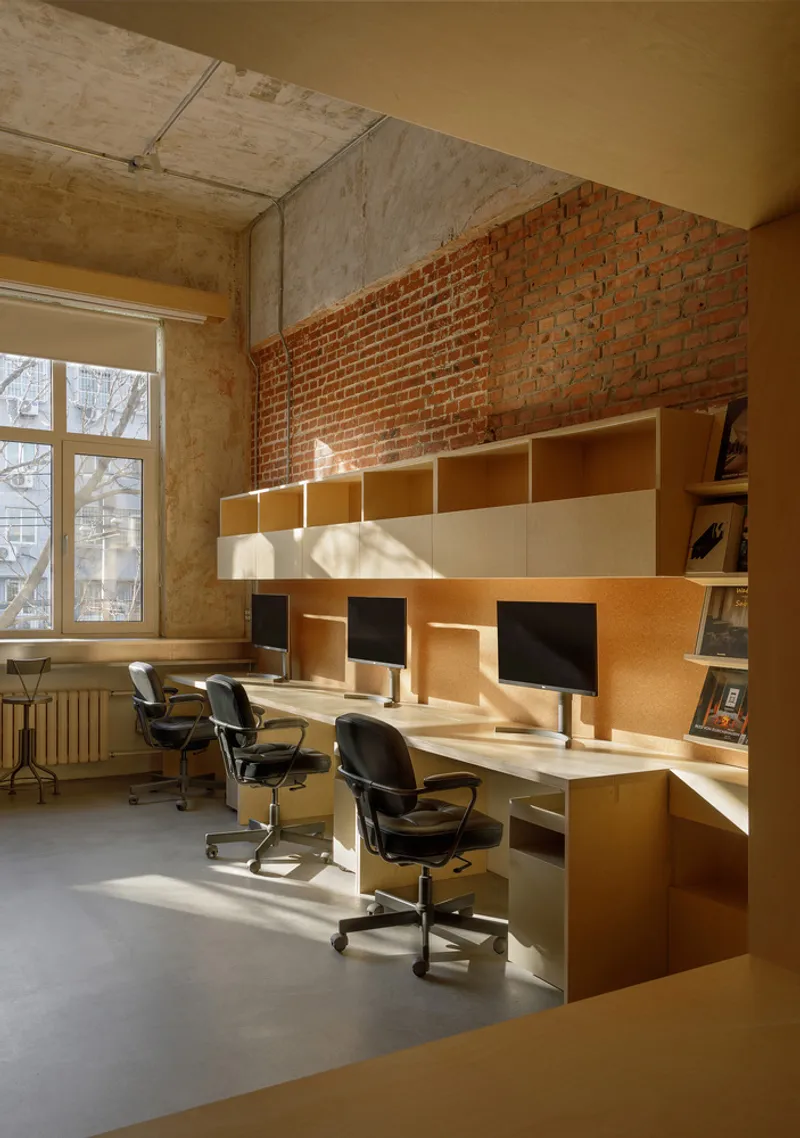
A central design strategy was to draw exterior greenery deep into the interior. Workstations are arranged along the east and west walls, deliberately leaving a visual corridor through the center of the office. This green axis extends from the outdoor tree canopy, through framed interior views between service and working zones, and continues toward the entrance via textured glass panels.
As a result, greenery permeates not only the workspace but also the circulation corridor, ensuring that anyone entering or passing by the office experiences a strong sense of nature, an increasingly valued quality in dense urban office interiors.


Scripted Spaces and Flexible Office Scenarios
True to its name, Studio Script approached the project by choreographing a series of activity “scripts” within the compact footprint. The space adapts fluidly to different modes of use:
- During focused work hours, designers sit back-to-back at individual desks
- For discussions, seating shifts to face one another
- Important announcements are delivered from the mezzanine, with colleagues gathered below
- Lectures and presentations utilize a projection screen that descends from the window area
- Leisure moments include watching films, informal conversations, or tea breaks at the window-side bar or on the mezzanine
By carefully shaping spatial relationships rather than fixed furniture layouts, the design supports a wide range of office behaviors, encouraging collaboration, learning, and rest within a single flexible environment.

Material Contrast and Architectural Memory
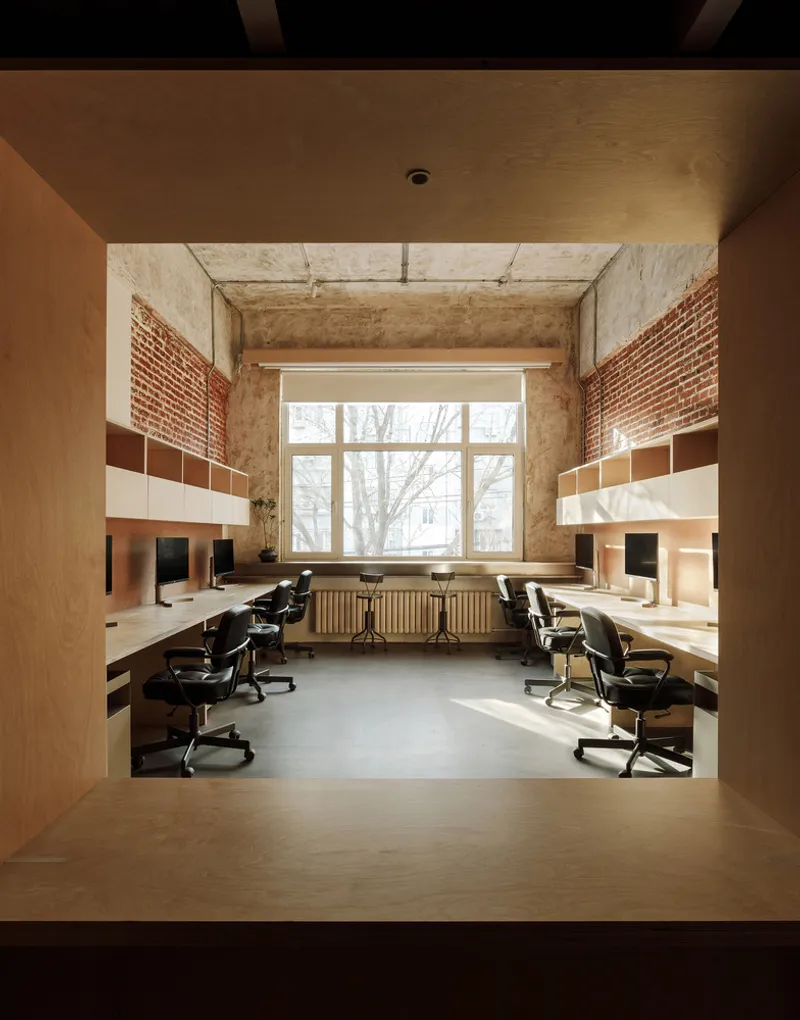
Preserving the industrial memory of the site was a key design principle. Exposed red brick walls and rough concrete surfaces retain the physical traces of the former factory, grounding the project in its historical context.
In contrast, new insertions are constructed from birch plywood, assembled through interlocking and riveting techniques. The warmth and precision of the wood elements counterbalance the heaviness of the original structure, while their lightweight and reversible construction logic emphasizes adaptability over permanence.
This dialogue between old and new creates a workspace that feels both raw and refined, offering a relaxed yet stimulating atmosphere for architectural production.

A Compact Model for Creative Workspaces
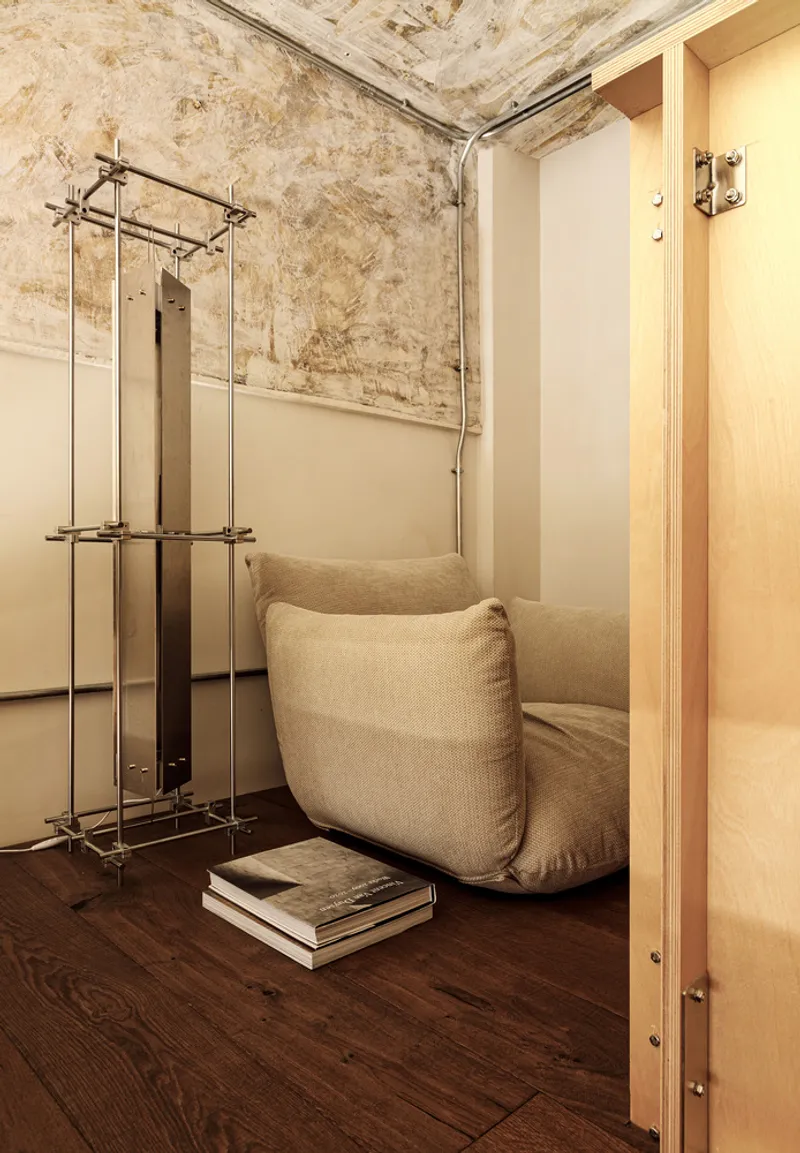
Despite its small scale, the Expansion of STUDIO SCRIPT OFFICE demonstrates how thoughtful office interior design can respond to growth, change, and urban transformation. By integrating natural light, greenery, flexible programming, and material storytelling, Studio Script has crafted a vibrant architectural studio that reflects contemporary modes of working while honoring the site’s industrial past.

All photographs are works of
Liming Fang


Popular Articles
Popular articles from the community

Manzana Morphosis: Stretching Barcelona's Grid into a Living Landscape for 2050
A radical reworking of the Eixample manzana turns density into a tool for generous public space, vertical ecology, and environmental performance.

The Amber Palace Opera: A Geological Fiction Surfaces on Tallinn's Baltic Waterfront
Pierre Brillard reimagines a Baltic legend as a public landscape, opera house, and waterfront promenade rooted in Tallinn's coastal identity.

Cloaked Colonization: A Mobile Underwater Habitat That Moves Like a Fish
Micah Abaya's shortlisted EHC Pacific entry reimagines ocean settlement as a dispersed network of self-sustaining architectural organisms.
Opera by the Sea Estonia: Three Shells Dissolving Architecture into Tallinn's Coastline
A winning opera house proposal replaces monumental form with interconnected shells that blur the boundary between building, park and Baltic Sea.

Similar Reads
You might also enjoy these articles


Hodi-Mandai Geram
Project Function: Preservation and revitalization of the Intangible heritage and socio-spatial identity of the Hodi by Housing, Cultural Memory Center, Sacred Grove, landscape, local tourism economy


Olio Towers: A Mid-Rise for Performers That Fuses Housing, Rehearsal, and Stage
Located blocks from Houston's Theater District, this modular tower stacks living units around a central performance atrium.

Oasis: Modular Green Housing Carved into Dhaka's Urban Fabric
A shortlisted Plugin Housing entry reclaims unauthorized settlements in Dhaka with stepped concrete volumes, green roofs, and ventilation-driven design.

Black Hole: A Floating Megastructure for the Post-Physical Era
Emiliano Mazzarotto envisions a spherical, self-scaling arena where e-sports, digital hotels, and holographic stadiums replace traditional public space.

Explore Chinese Small Scale Architecture Competitions
Discover active competitions in this discipline

Challenge to design luxury tourism on rails

Challenge to reimagine the Iron Throne

Photograph architecture without architects

VR headsets Storefront design competition
Comments (0)
Please login or sign up to add comments
No comments yet. Be the first to comment!