

feld72 and Agence MW Fragment a Strasbourg School into Three Timber Volumes Rooted in Nature
A glue-free solid wood campus on a remediated industrial site bridges Strasbourg's urban edge and its nature park.


Before construction began, this parcel on the banks of the Muhlbach river in Strasbourg was a contaminated lot that once held storage warehouses and utility vehicle parking. Significant soil decontamination preceded every timber column. That backstory matters because the Educational Ensemble Jean Mentelin, completed in 2024 by Vienna-based feld72 and Strasbourg's Agence MW, is not simply a school. It is an act of ecological repair: a 6,330 m² campus that replaces polluted ground with vegetable gardens, biotopes, and wildflower meadows, all anchored by three glue-free solid wood buildings that keep their scale deliberately modest.
What makes the project genuinely interesting is how stubbornly it refuses to read as a single institutional block. The architects split the program, which includes a kindergarten, an elementary school of eighteen classrooms, a cafeteria, a gymnasium, and a two-storey library, across three distinct volumes of varying height. Transparent bridges stitch the buildings together while allowing sightlines and passages to the surrounding landscape. The result is a campus that feels more like a small neighborhood than a school, giving children a spatial richness that monolithic plans rarely achieve.
Three Volumes, One Clear Logic
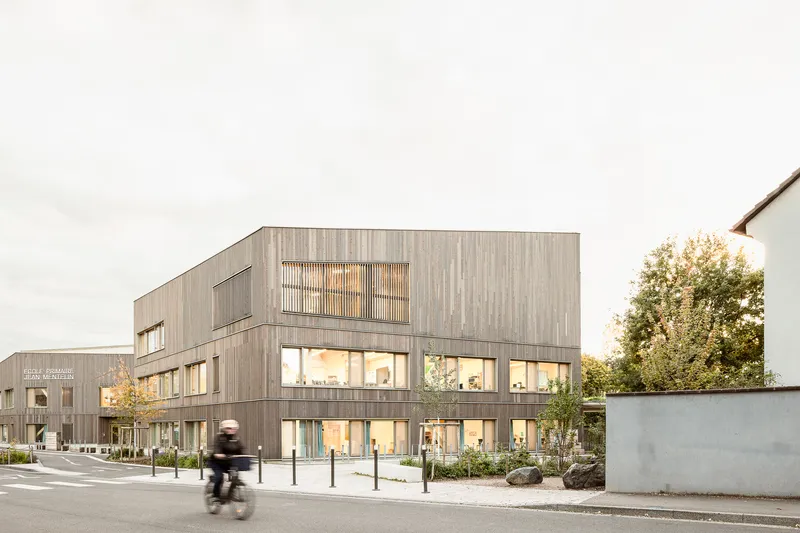
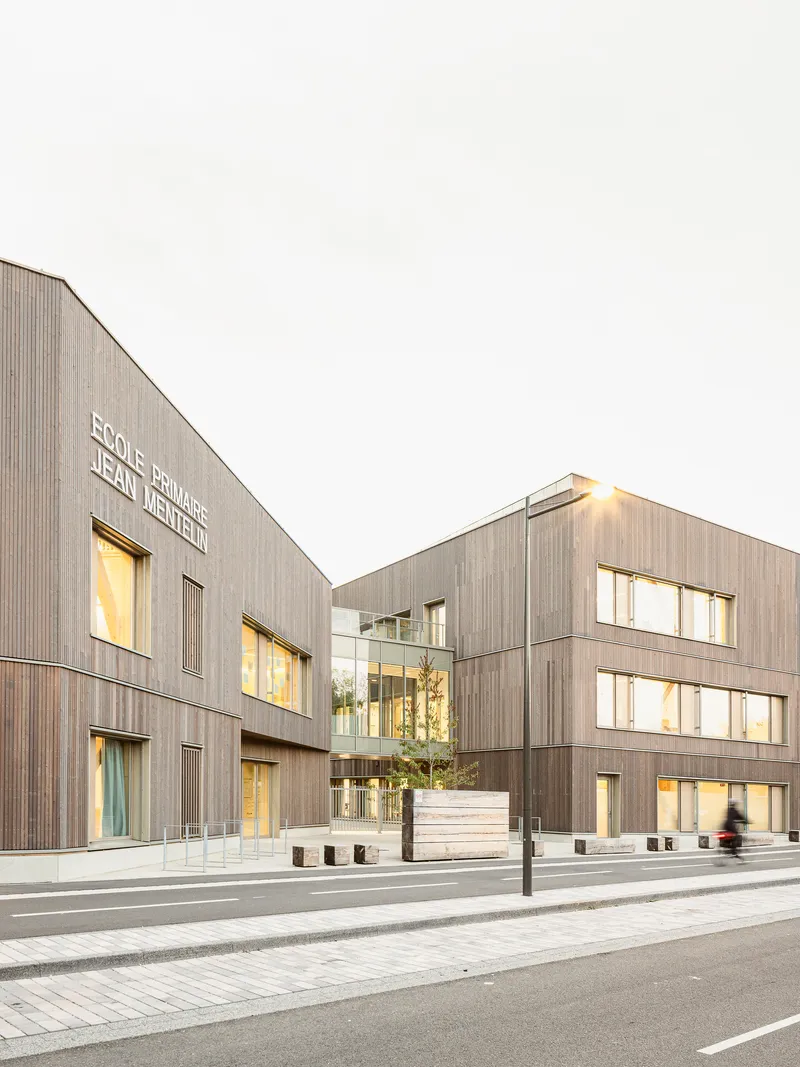
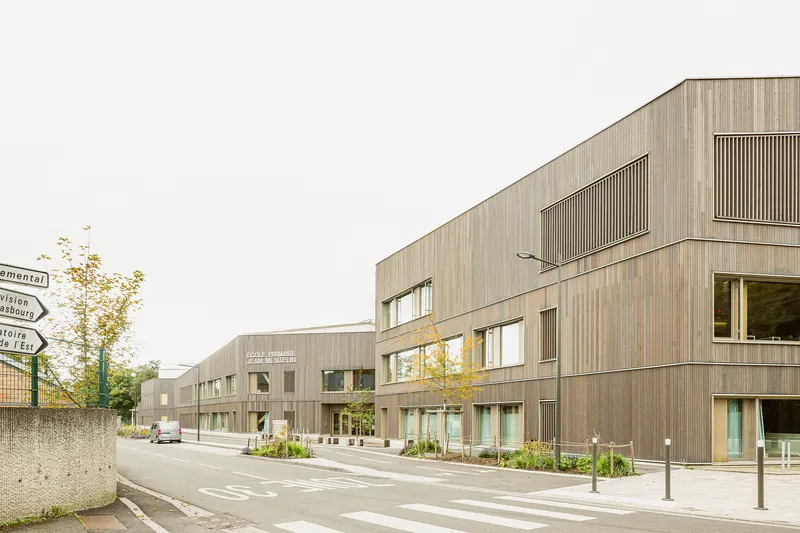
Seen from the street at dusk, the three buildings register as a family of related forms rather than a single mass. Each volume is clad in vertical timber boards that will silver uniformly with age, but their footprints angle away from one another to carve out generous courtyards and planted interstices. The varying roof heights prevent any single elevation from dominating, keeping the ensemble at a comfortable, almost residential scale despite housing hundreds of students.
The fragmentation also serves orientation. Parents, staff, and children can immediately identify which building they need. Kindergarteners have their own volume; older students circulate through a separate wing. The library, as the shared heart, occupies a position legible from every courtyard. It is a plan that trusts geometry over signage.
Timber Without Compromise
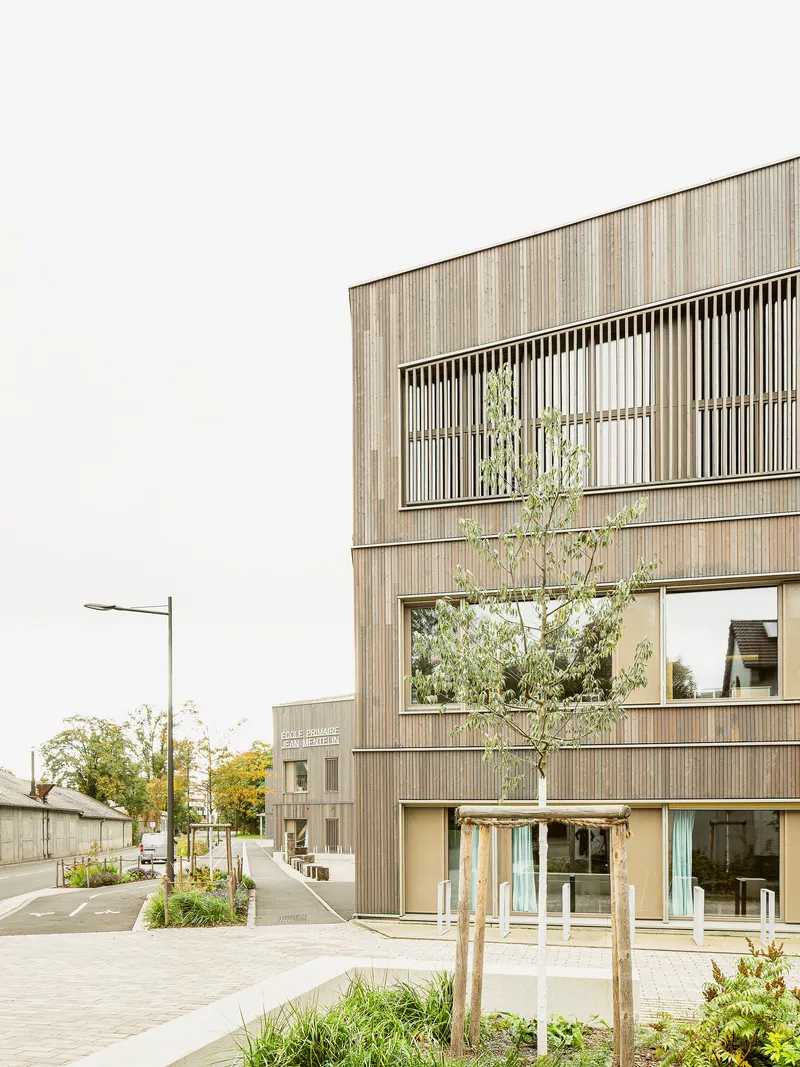
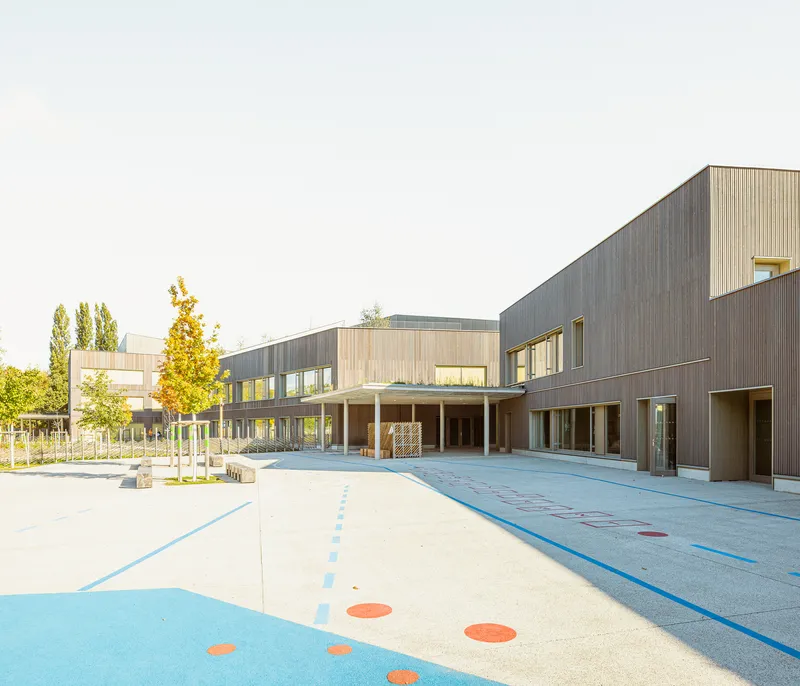
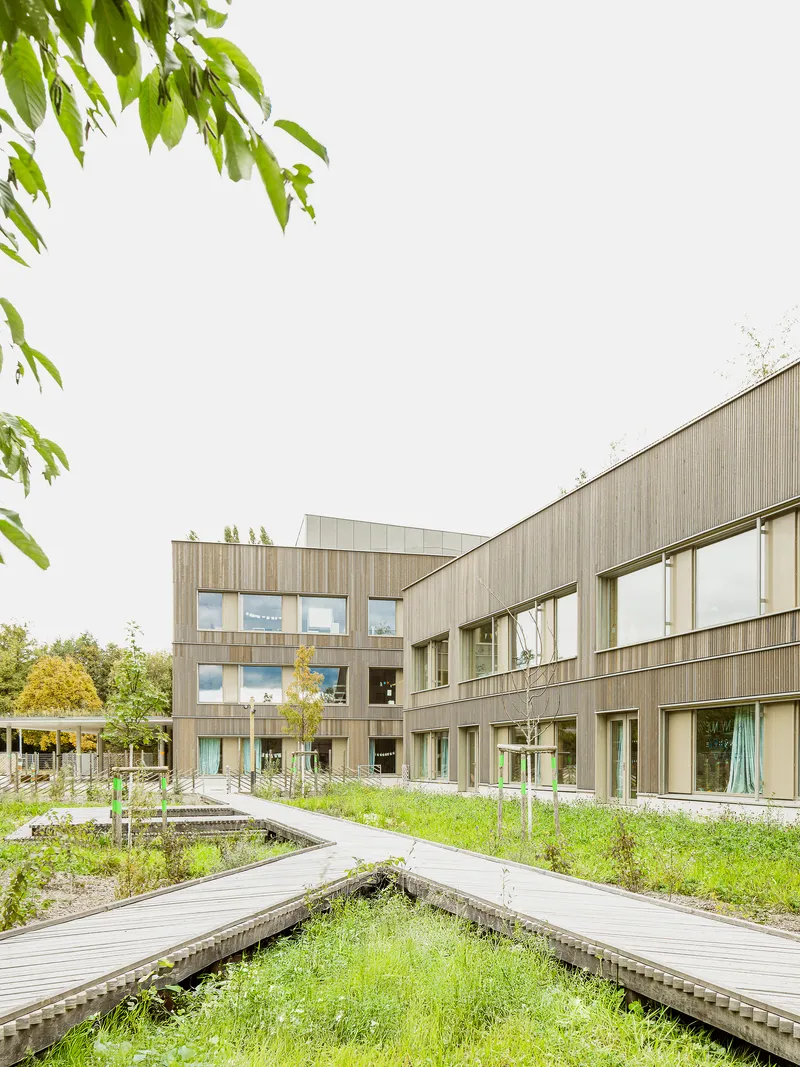
The decision to build in glue-free solid wood is not a marketing gesture. Solid timber walls provide thermal mass that moderates indoor temperatures, a significant advantage in Strasbourg's continental climate, which swings from bitter winters to warm summers. The facade's vertical louvers are not merely decorative: on the upper floors they shade classroom glazing, reducing solar gain without blocking views of the adjacent nature park.
At ground level, the timber cladding meets boardwalks that weave through planted grasses and wildflowers, blurring the boundary between building and landscape. The project achieved RT 2012 minus 50 percent passive label certification, a target that demanded careful coordination between the solid wood envelope, green roofs, and rooftop solar installations. That the building looks warm and inviting rather than technically austere is a testament to the architects' material confidence.
Interiors Built for Children, Not for Photographs
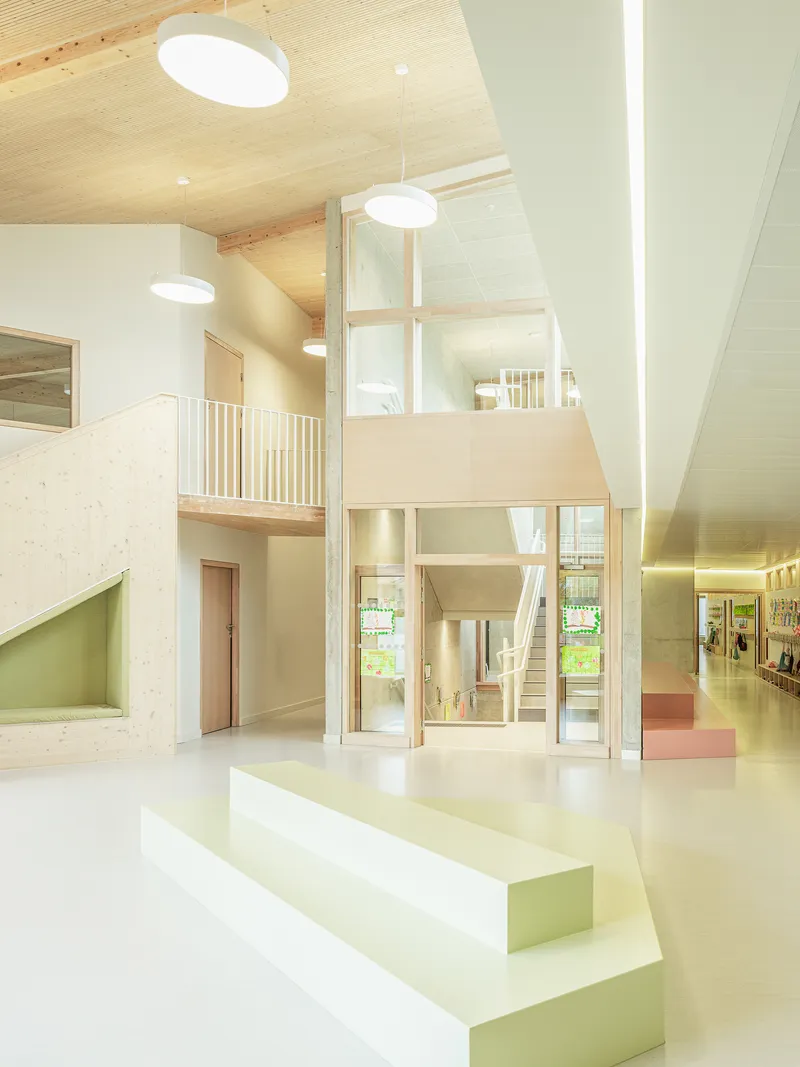
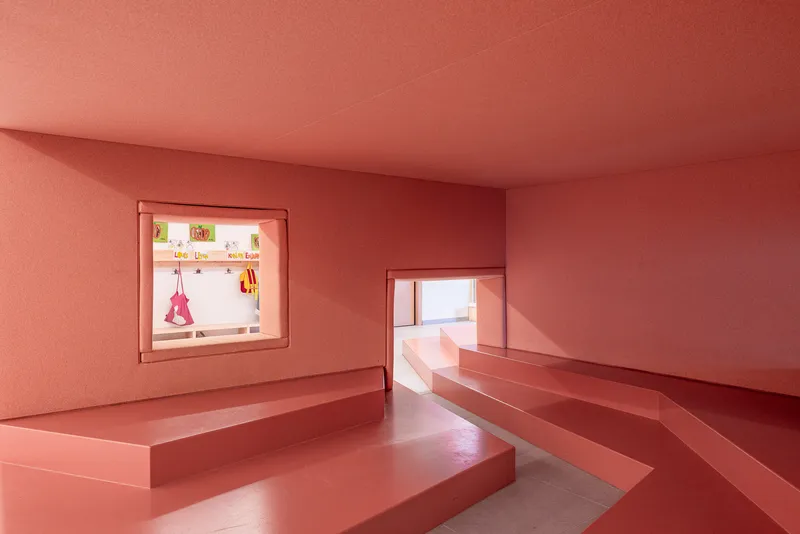
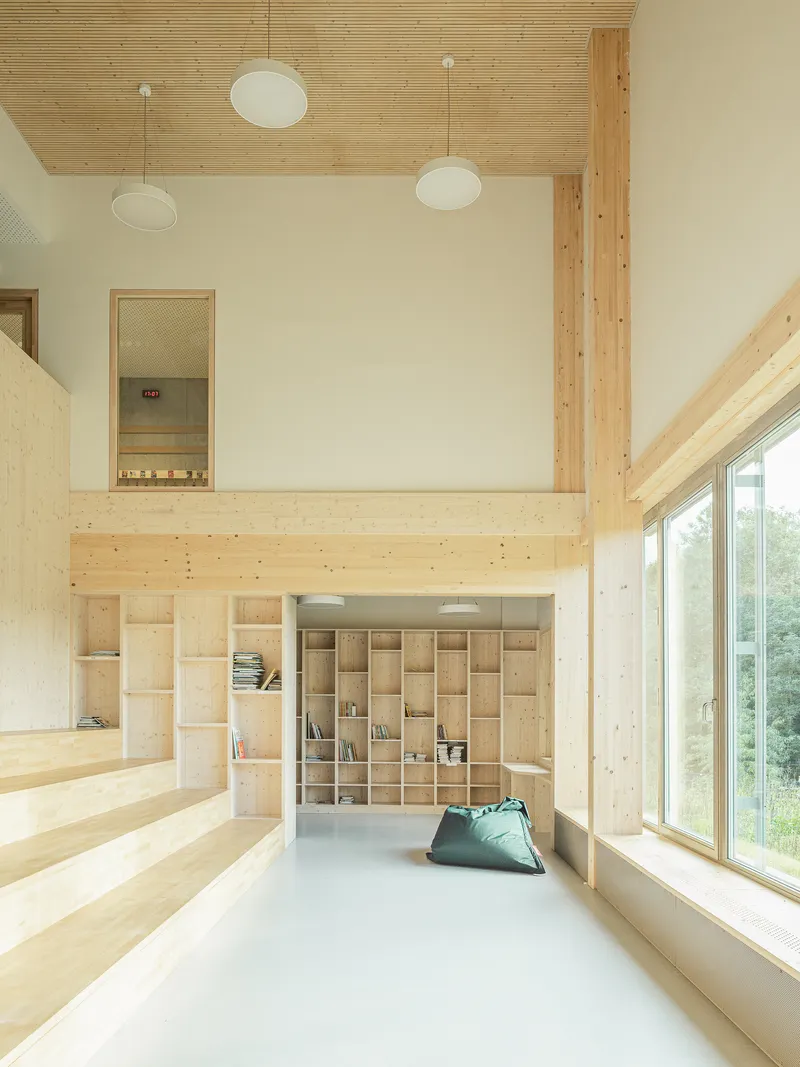
Step inside and the palette shifts. Pale greens, corals, and natural wood tones replace the uniform exterior. The double-height library space features stepped platforms that function as seating, gathering stairs, and informal reading zones, a spatial generosity that trusts children to choose how they occupy a room. Across the hall, a coral-pink room with built-in stepped seating offers a counterpoint: intimate, enclosed, and clearly sized for smaller bodies.
Reading nooks tucked beneath mezzanine levels use grid shelving to create pocket spaces where a single child can sit with a cushion and a book. These are not leftover areas. They are designed with the same care as the main rooms, recognizing that a school must accommodate solitude as well as sociability. The timber structure remains exposed throughout, giving every ceiling a rhythm of beams and slats that children can count, touch, and understand.
Classrooms Open to the Landscape
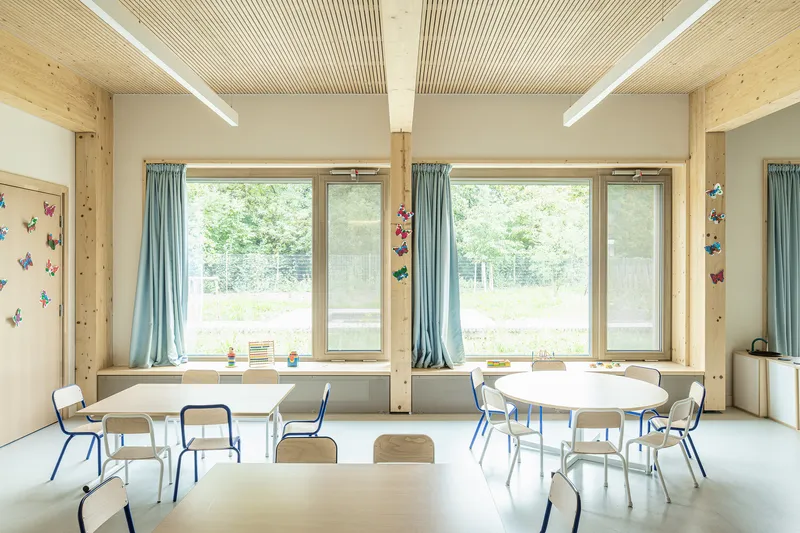
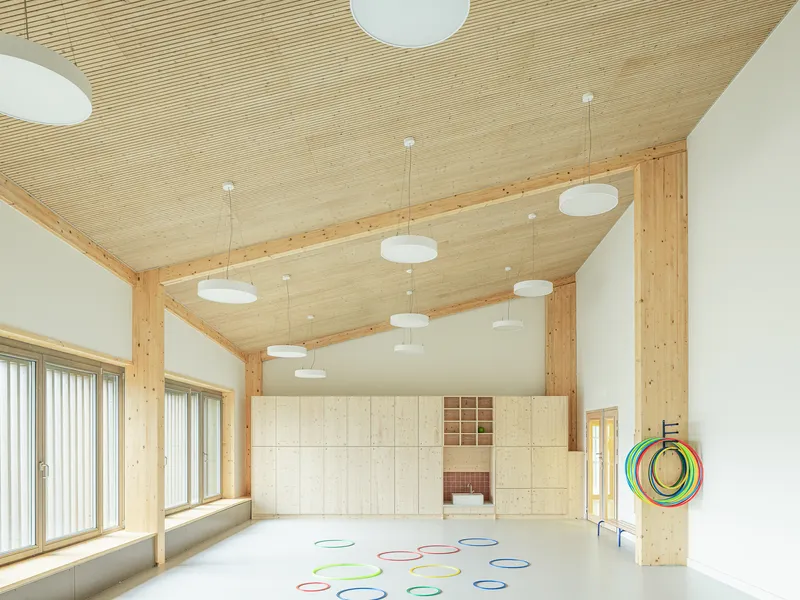
The classrooms themselves are bright, calm, and deliberately oriented toward the green edges of the site. Large windows in the elementary wing frame views of poplar trees and the Muhlbach, transforming the landscape into a teaching aid. Ribbed timber ceilings and exposed beams provide acoustic absorption without suspended panels, keeping the rooms visually honest about their construction.
In the kindergarten spaces, the scale drops further. Pendant lights hang low, furniture is round and clustered, and colorful play objects on the floor signal that these rooms belong to their inhabitants. The architecture does not try to impose adult order on five-year-olds; it simply provides a warm, daylit shell and gets out of the way.
The Roof as a Fifth Facade and a Classroom
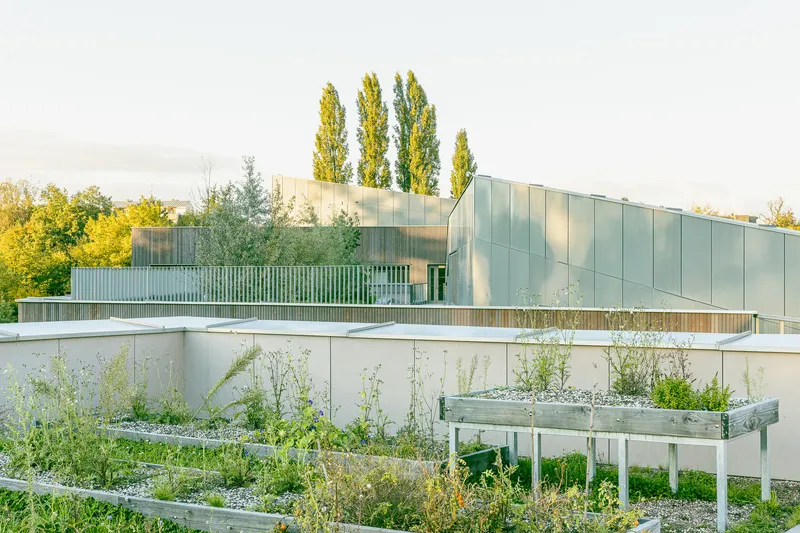
The most radical pedagogical move may be on top of the buildings. Accessible green roofs host vegetable gardens, a greenhouse, a nature observation post, and even a small planted woodland. The architects calculated that the ground area consumed by the building footprints is largely restored on these rooftops, a net-zero land use equation that is rare for a public school. Stormwater management systems are left visible on purpose, serving as teaching tools for staff to explain the water cycle.
Small houses perched on the rooftops contain technical rooms, giving the skyline a playful, village-like silhouette. From the rooftop gardens, children look out over the poplars toward Strasbourg's Urban Natural Park. It is an unusual vantage point for a primary school student, and that is precisely the point: the building insists that the city and its ecology are not separate subjects.
Plans and Drawings
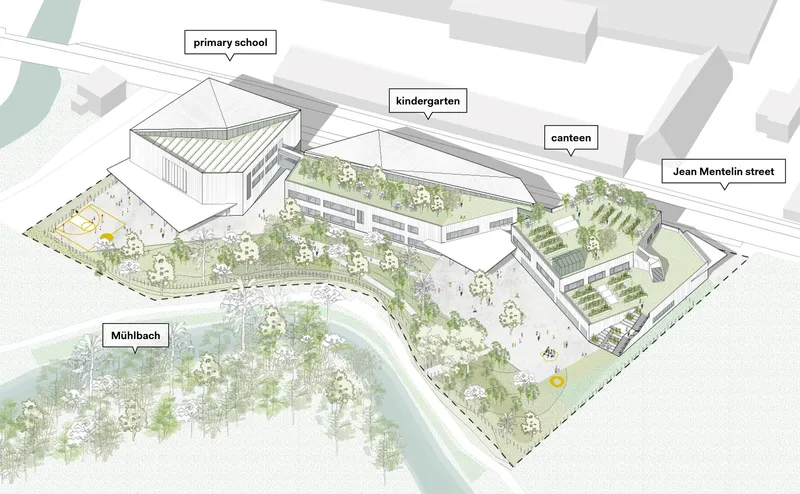
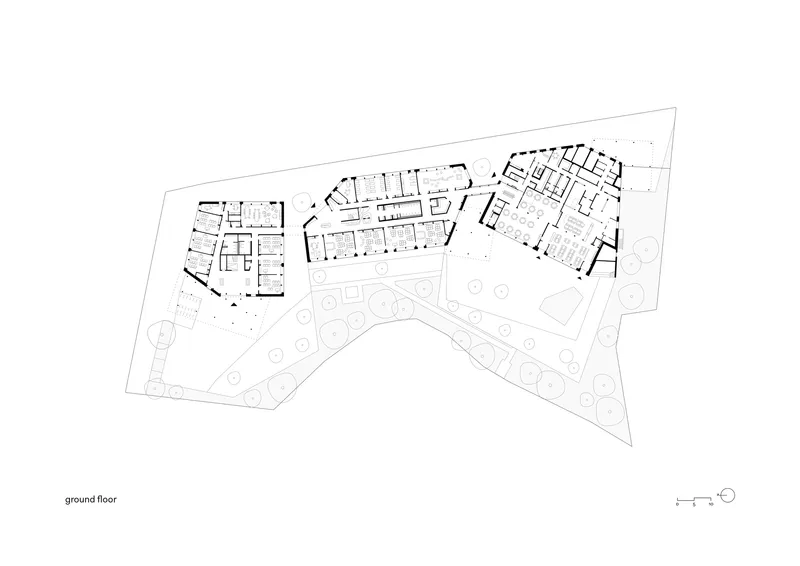
The axonometric drawing reveals the full site strategy: three angled wings arranged around a generous central courtyard, with tree-lined pathways leading down to the waterfront. Each wing is offset just enough to create secondary outdoor spaces, including biotopes and educational gardens, that would vanish in a simpler footprint. The ground floor plan shows how circulation corridors wrap the perimeter, keeping classroom cores quiet while the bridges between buildings act as social thresholds.
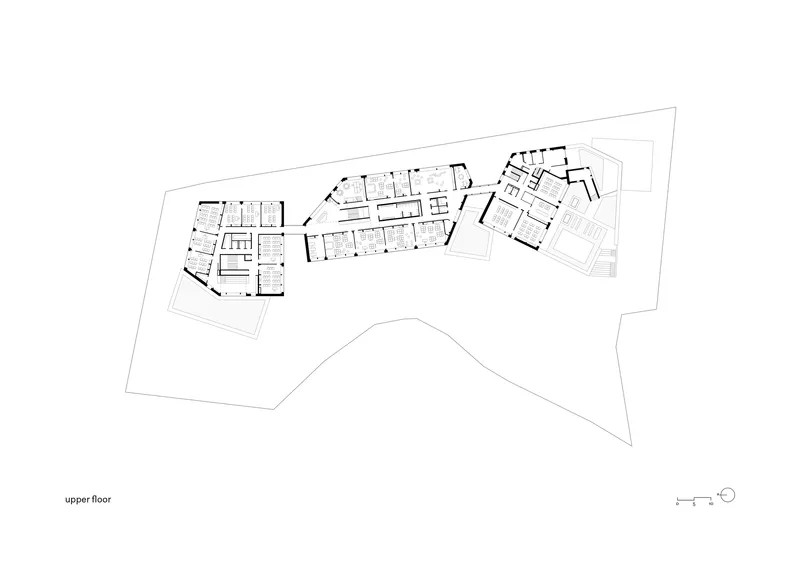
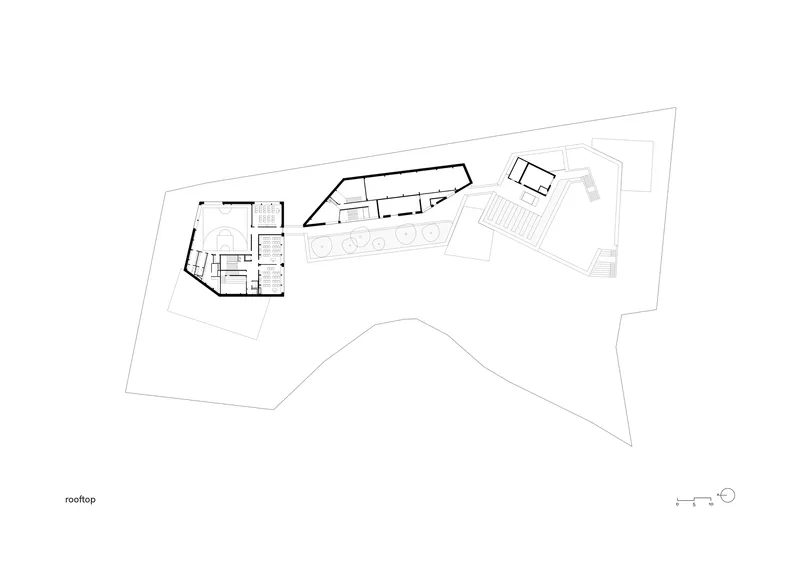
The rooftop plan is particularly telling. Hatched areas indicate planted zones, while an angular auditorium-style seating area on one wing suggests outdoor teaching space. The upper floor plan confirms that every classroom has at least two exposures, a detail that sounds basic but requires the kind of disciplined massing that fragmented volumes make possible.
Why This Project Matters
Educational Ensemble Jean Mentelin demonstrates that ecological ambition and spatial generosity are not competing goals. The project decontaminated a polluted industrial site, built a passive-certified campus in glue-free solid timber, restored its footprint as rooftop habitat, and still delivered rooms that feel playful, warm, and scaled to children. It did all of this on a public budget in a mid-sized French city, which makes it a credible model rather than an exceptional outlier.
The collaboration between feld72 and Agence MW, with landscape design by Atelier Roberta, produced a campus that treats the edge between city and nature as an opportunity rather than a problem. By fragmenting the building into three volumes connected by bridges, the architects gave every room a view, every courtyard a purpose, and every child a reason to look outside. In an era when school design too often defaults to compact efficiency, Jean Mentelin insists that children deserve more space, not less, and proves it can be done responsibly.
Educational Ensemble Jean Mentelin, designed by feld72 and Agence MW with landscape design by Atelier Roberta. Strasbourg, France. 6,330 m². Completed 2024. Photography by tschinkersten fotografie.
About the Studio
Share Your Own Work on uni.xyz
If projects like this are the kind of work you want to make, uni.xyz is a place to publish your own, find collaborators, and enter design competitions.


Popular Articles
Popular articles from the community


The Amber Palace Opera: A Geological Fiction Surfaces on Tallinn's Baltic Waterfront
Pierre Brillard reimagines a Baltic legend as a public landscape, opera house, and waterfront promenade rooted in Tallinn's coastal identity.

Opera on the Sea: Driftwood Logic Shapes a Timber Opera House on Estonia's Coast
Trevor Orgill's opera house translates the entangled drift of floating timber into a civic building where wood, water, and music converge.

Cloaked Colonization: A Mobile Underwater Habitat That Moves Like a Fish
Micah Abaya's shortlisted EHC Pacific entry reimagines ocean settlement as a dispersed network of self-sustaining architectural organisms.

Temporary Home for Dogs: A Reversed Zoo Rethinks Animal Shelter Architecture
In Bucharest, a sinuous corridor and freed landscape flip the logic of containment, designing a shelter that works to make itself unnecessary.

Similar Reads
You might also enjoy these articles

Pixel Gardens: One Repeated Module Stacked Into a Terraced Social Housing Tower for Famagusta
Salem Bader's shortlisted housing tower builds a vertical neighbourhood from one repeated module, offsetting units to carve terraces, light and air.

Bao Huynh Watercolor Atelier: A Serene Art Retreat in Hội An
Bao Huynh Watercolor Atelier in Hội An blends multifunctional art spaces, sustainable design, local materials, and family-friendly living in a serene environment.

Atelier Macri Concept Store Interior Design by CASE-REAL
Atelier Macri store features a "ko" counter, walnut wood details, cork displays, blending retail, gallery, and seamless customer experiences.

Manuel Vargas Izquierdo Stadium and High-Performance Sports Center: Architectural Excellence in Jalpa de Méndez
The Manuel Vargas Izquierdo Stadium blends sustainable design, inclusive sports facilities, and cultural-inspired architecture, revitalizing Jalpa de Méndez’s public spaces.

Explore Educatorium Competitions
Discover active competitions in this discipline

Challenge to design a barrier free sports center

Challenge to design an outdoor ice-rink and park

Challenge to design public laboratory
Comments (0)
Please login or sign up to add comments
No comments yet. Be the first to comment!