
Felix Brinkhege Rebuilds a Royal Estate in Bremen as Seven Houses Disguised as Farm Buildings
On the floodplains of the tidal Wümme river, new concrete houses clad in carbonized wood and peat-fired brick echo the agricultural past of a historic park


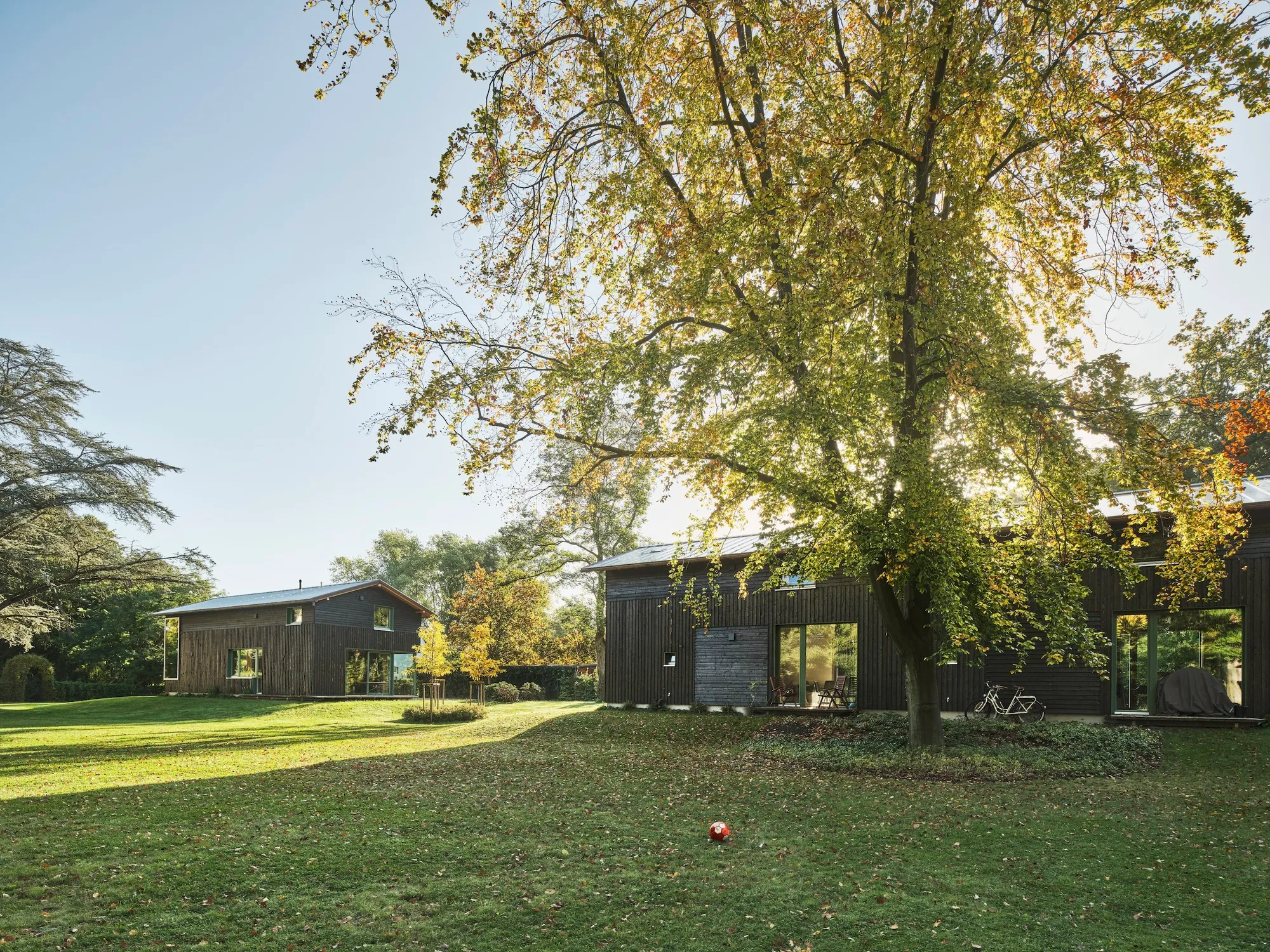
For half a century, Wümmehof in Bremen was the private estate of the grandson of Germany's last emperor. Its park, designed by Friedrich Gildemeister in 1909, and its main house, by Fritz Schumacher, survive as Grade A listed structures. But the agricultural buildings that once gave the property its farmstead character, the horse stables, hay barns, and sheds, had long since disappeared. Felix Brinkhege was asked not to build a housing development on this charged ground but to resurrect the compound's agrarian identity. The result is seven dwelling units distributed across a double house and two detached houses, each positioned precisely where a former agricultural structure once stood.
What makes the project genuinely interesting is the refusal to treat context as scenography. Brinkhege did not design houses that look like barns in a decorative sense. He adopted the farm typology as a spatial and material discipline: prefabricated concrete structures clad in carbonized timber and handmade clinker brick, set on dwelling mounds connected by a dyke to protect against the seasonal flooding of the tidal Wümme. The 10,000 square meter park remains a shared garden, and the boathouse still gives access to the river. The architecture does not reference its setting; it participates in it.
Two Cladding Languages, One Rural Vocabulary
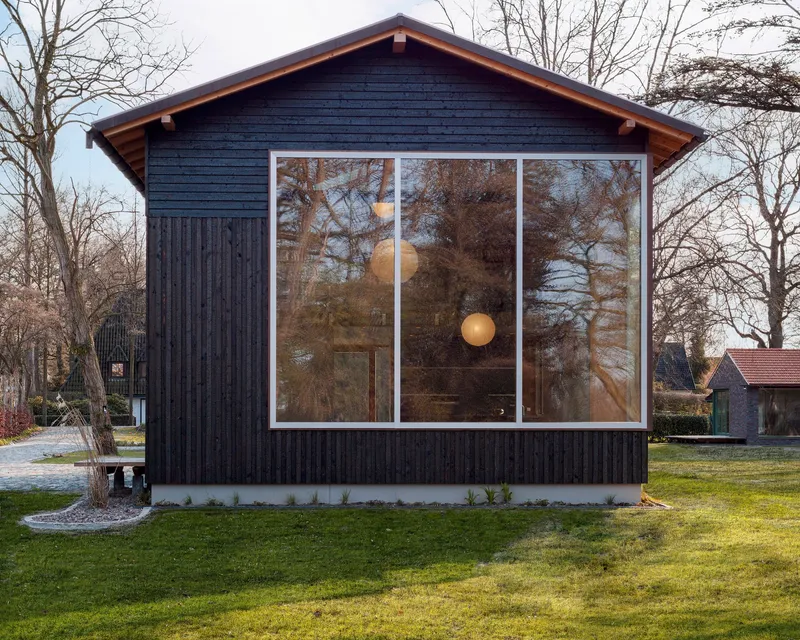
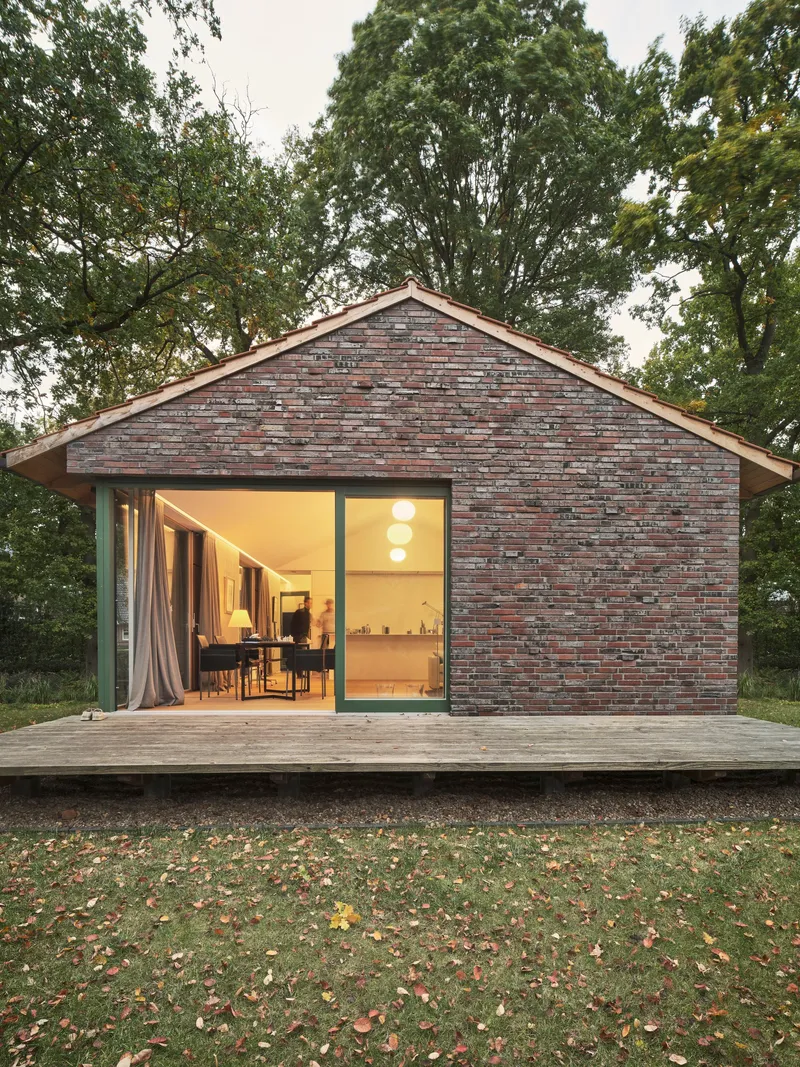
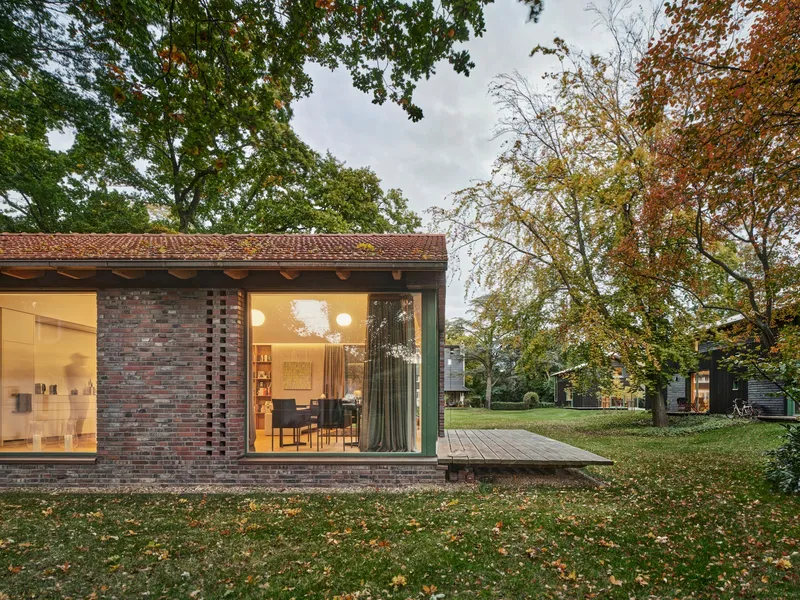
Brinkhege splits the project's exterior identity between two distinct material systems. The stable houses wear facades of carbonized timber, blackened through a technique rooted in the local peat cutter tradition rather than the Japanese shou sugi ban process to which it is often compared. The shed house, by contrast, is wrapped in peat-fired clinker bricks made at a nearby brickyard, each batch fired at a different temperature to produce tonal variation across the wall surface. Both materials are weather-resistant, require minimal maintenance, and carry a direct connection to the region's craft economy.
The perforated brick facade of the shed house, visible at dusk with light seeping through its corner glazing, reads as a fundamentally different building than the charred timber gables. Yet both share the same pitched silhouette, the same restrained window proportions, and the same standing seam aluminum roofing left untreated to patinate. The coherence is typological, not cosmetic.
Gabled Forms Scattered Across a Historic Park
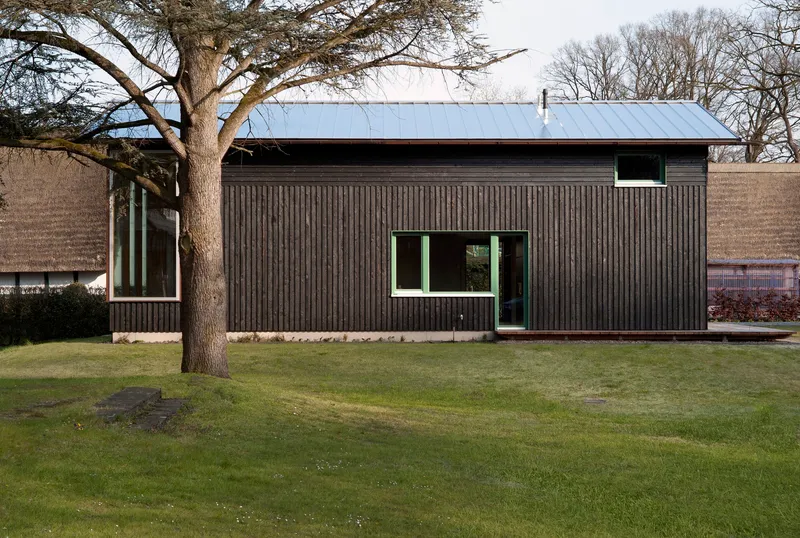
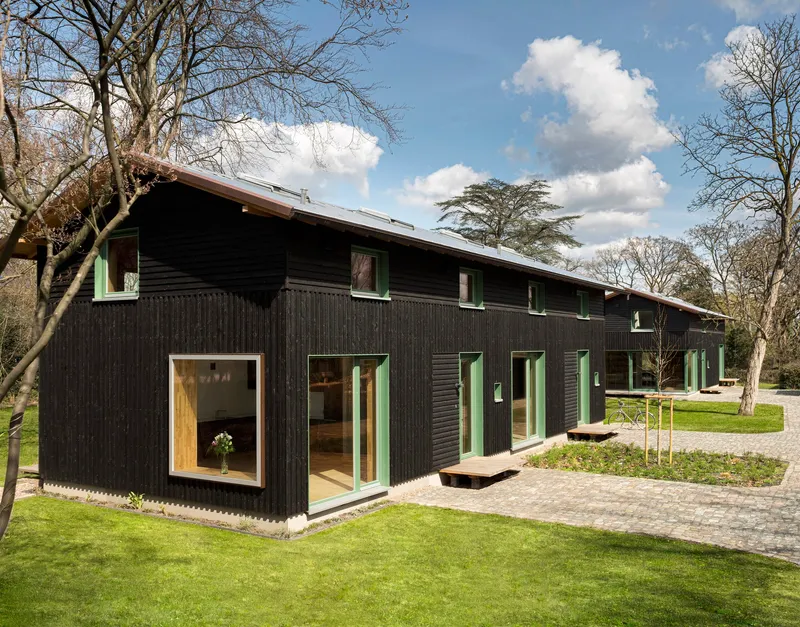
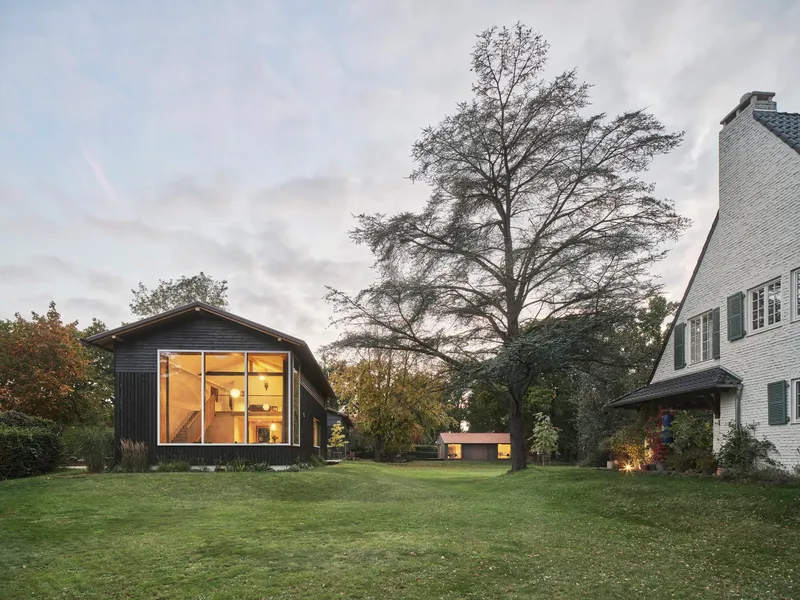
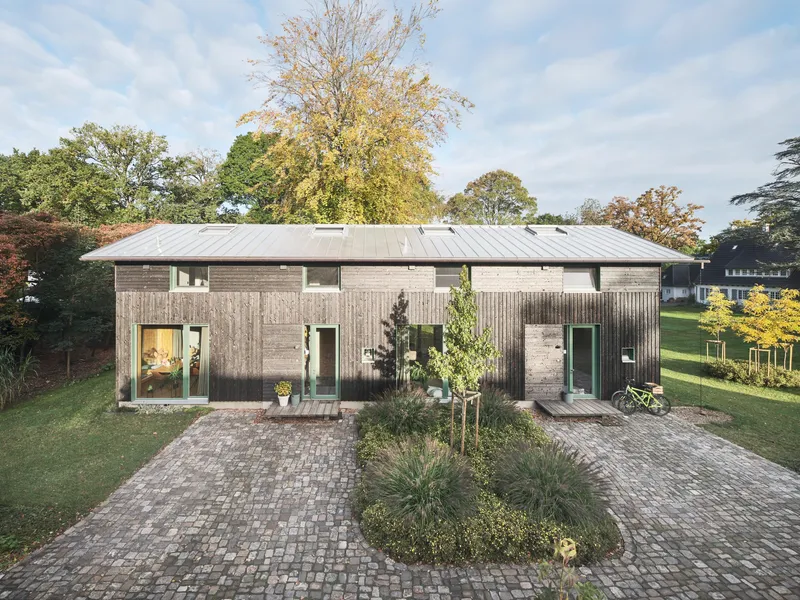
Seen from across the lawn, the new buildings read as a loose cluster of agricultural outbuildings rather than a planned residential enclave. The spacing is deliberate: each house occupies the footprint of a structure that once existed on the property, so their arrangement follows the pragmatic logic of a working farm rather than the geometric order of a housing scheme. Mature deciduous trees frame the volumes and reinforce the impression that the buildings have been here for a long time.
The corrugated timber cladding and simple gabled forms avoid any signal of domesticity. There are no balconies projecting into the garden, no garage doors, no front lawns bounded by hedges. The cobblestone courtyard at the entrance of one unit could belong to a stable. The strategy is convincing because it is sustained across every detail: the roof pitch, the window scale, the absence of suburban infrastructure.
Raw Concrete and Oak Inside the Barns
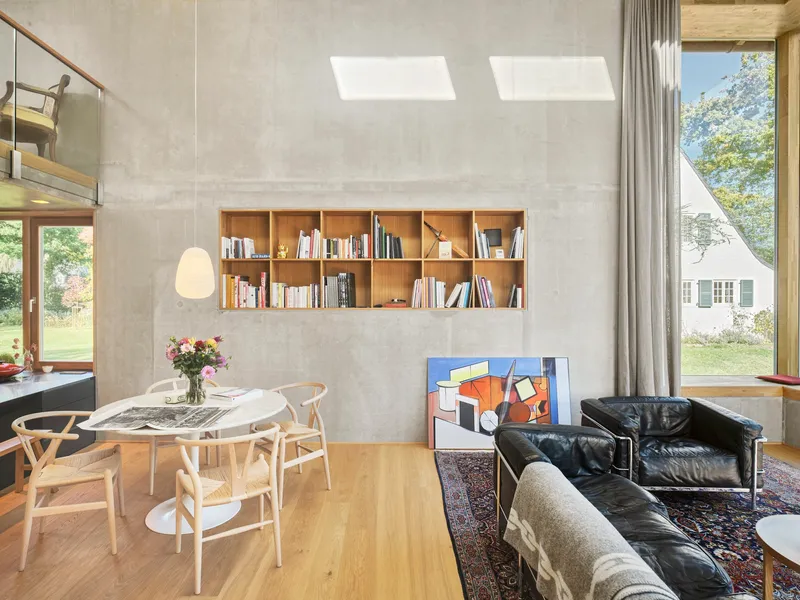
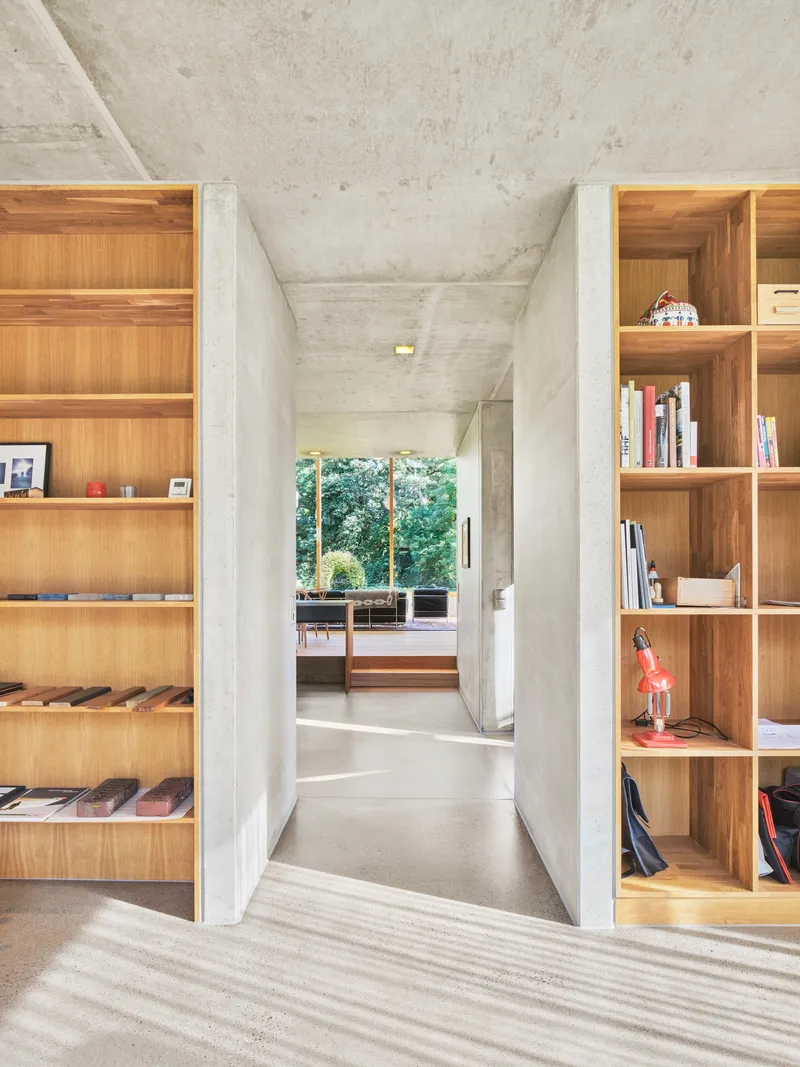
The interiors are deliberately unfinished in tone. Prefabricated concrete walls and ceilings, cast against aluminum beds and left exposed, form the primary interior surface. Brinkhege lines the window openings and storage niches with oak panels, creating warm pockets within the cool, mineral envelope. The dining area of one unit sits beneath twin rectangular skylights that wash the recessed timber bookshelf wall in natural light, a sequence of materials, concrete to oak to glass, that repeats throughout the project.
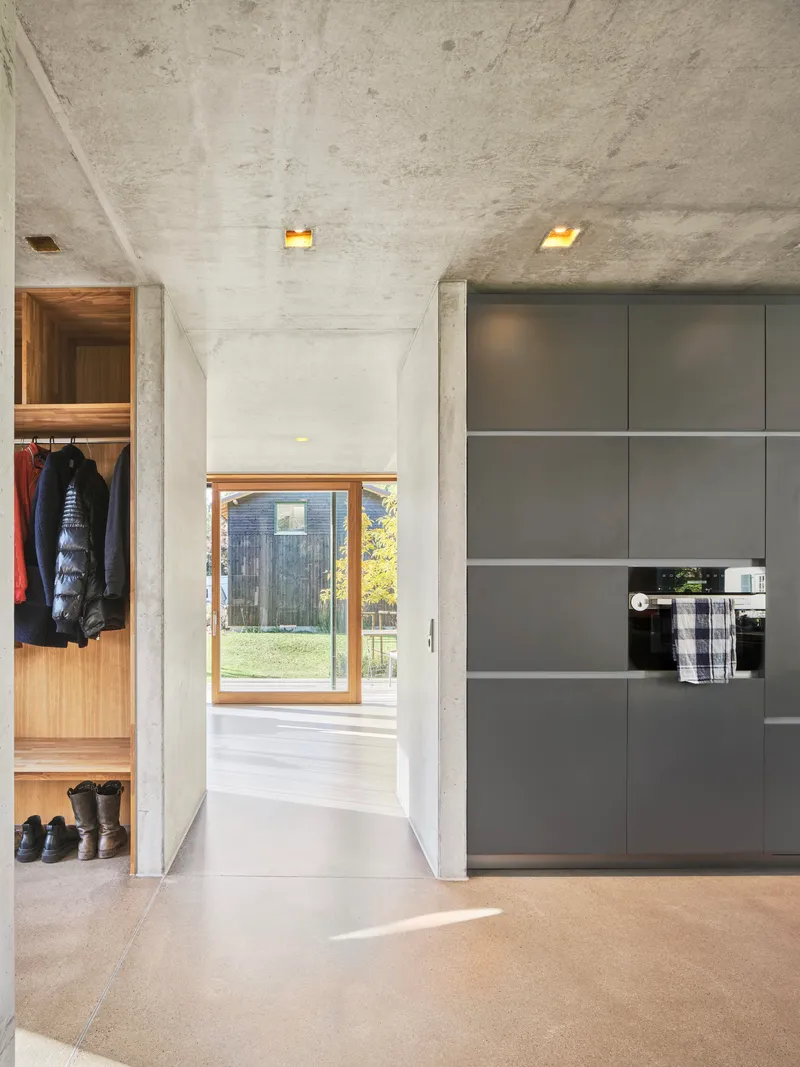
The kitchens continue this logic. Gray cabinetry sits below exposed concrete ceilings, with recessed skylights providing task lighting during the day. The palette is limited: polished concrete screed on the floor, oak where you touch, concrete everywhere else. It is austere without being punishing, a quality that comes from the careful proportioning of openings rather than the application of finishes.
Split Levels and Double Heights Under the Pitch
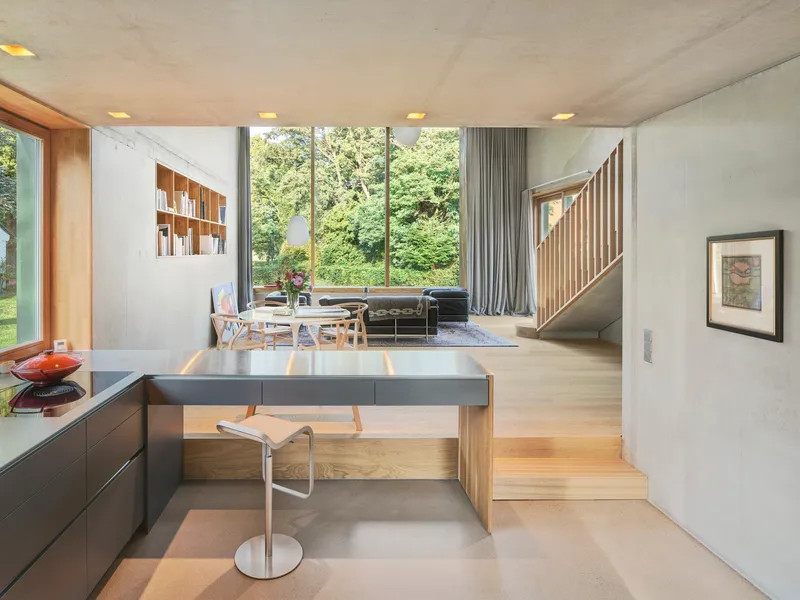
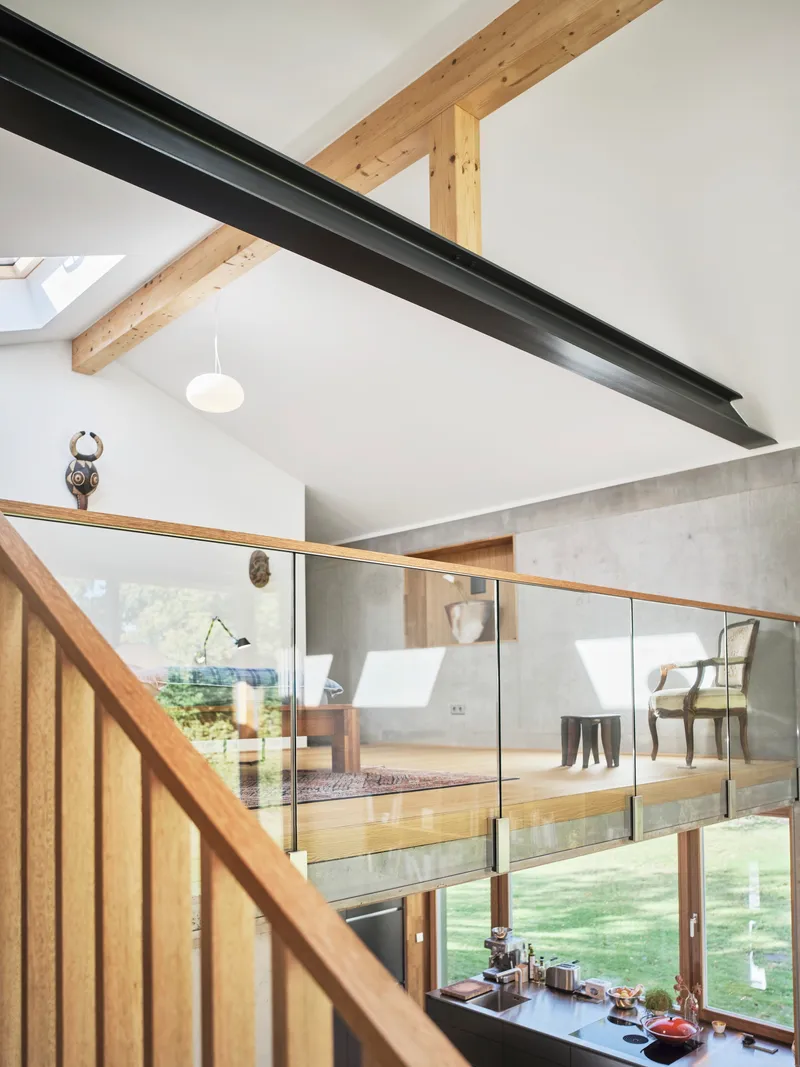
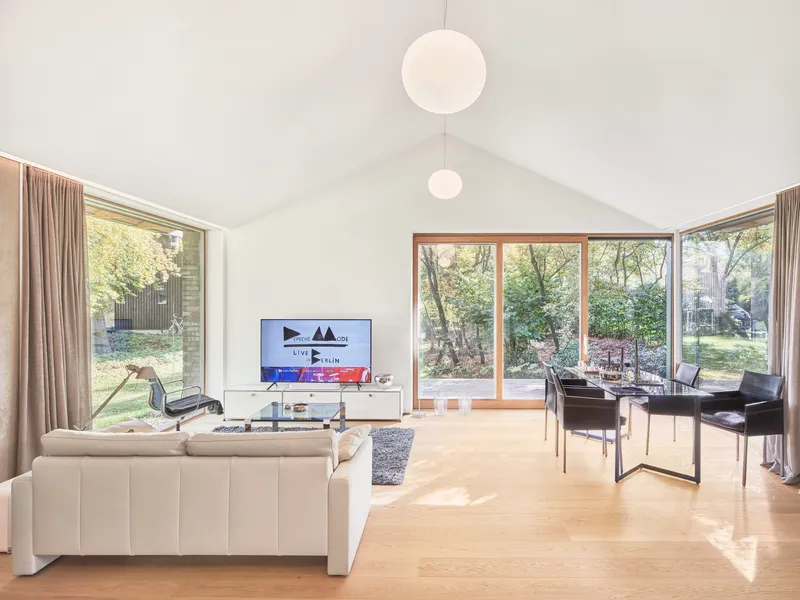
The pitched roof form is not a cap placed on top of rectangular rooms. Brinkhege uses the full volume of the gable, creating double-height living spaces, mezzanine sleeping areas, and split-level sections connected by timber-slatted staircases. In one unit, the kitchen island sits a half-level below the upper living area, with the staircase acting as both circulation and spatial divider. In another, a glass balustrade at the mezzanine level lets you look down through exposed timber rafters into the main living space.
The vaulted living space with its glazed doors opening onto the garden is the most generous of these interiors, its ceiling rising to the full ridge height. The prefabricated concrete structure makes these long free spans possible without interior columns, so the open plans feel genuinely uninterrupted. Individual units range from 125 to 200 square meters, but the sectional variety makes even the smaller ones feel spatially rich.
Framing the Floodplain
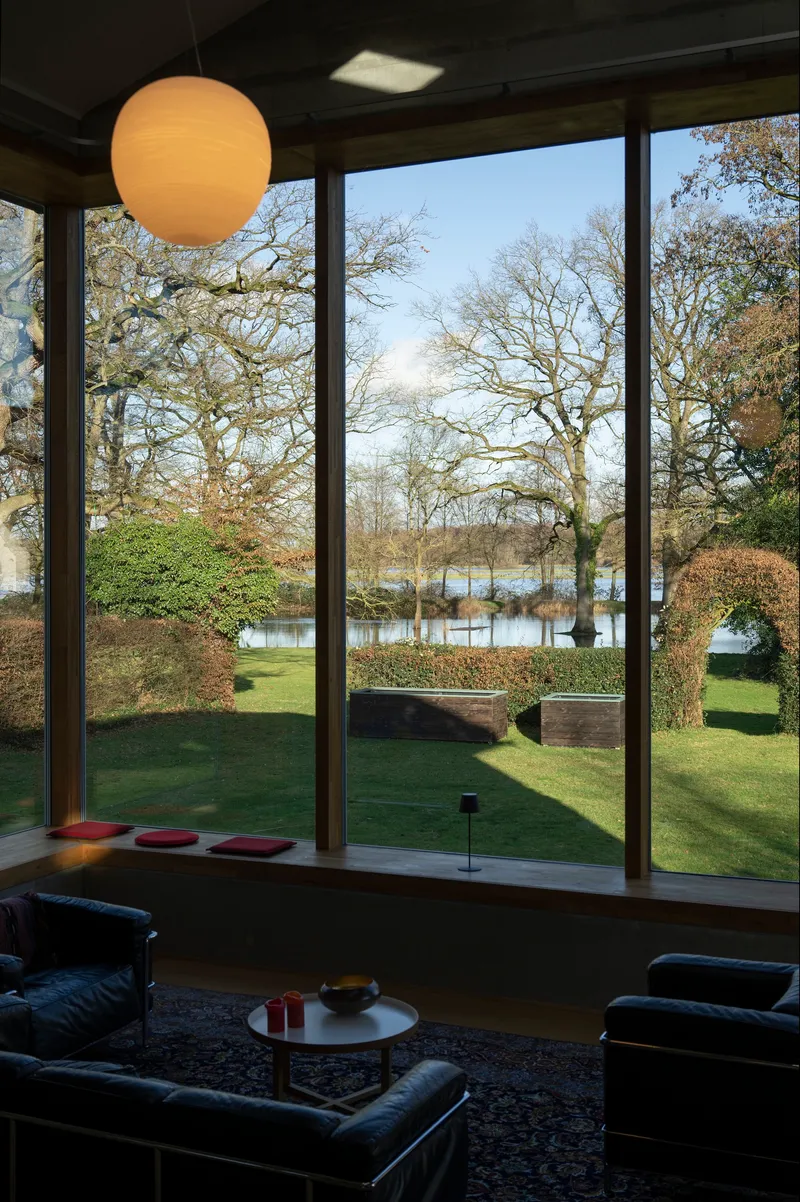
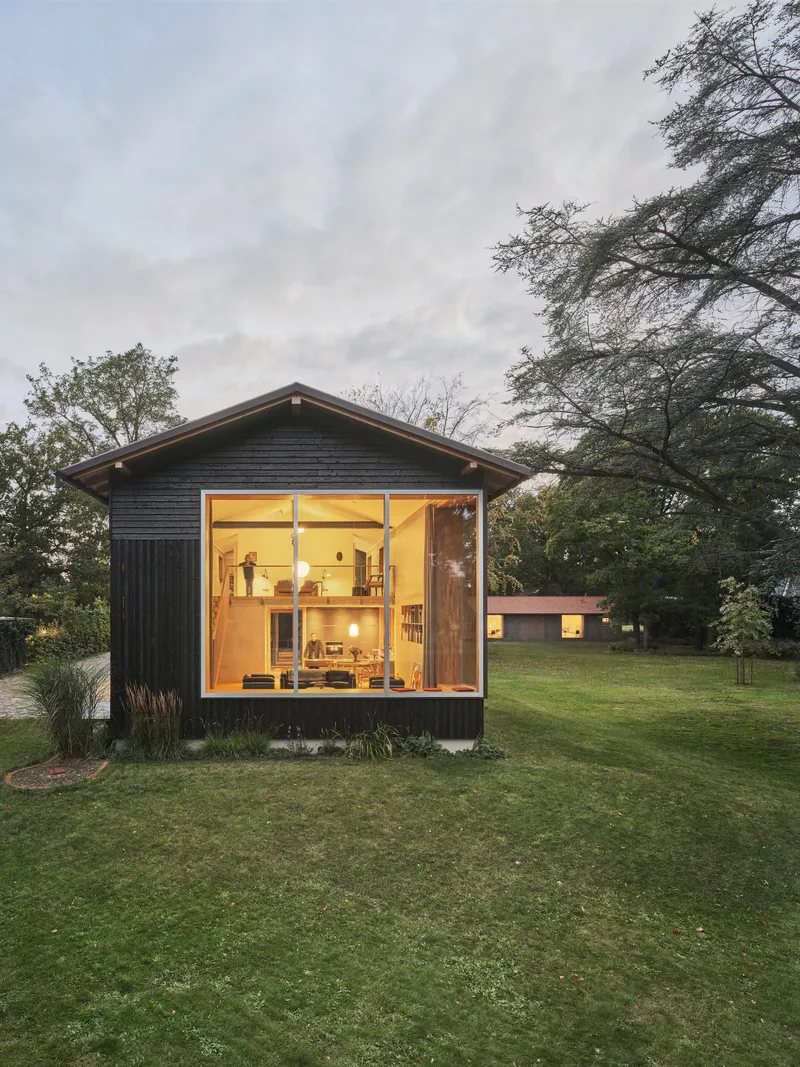
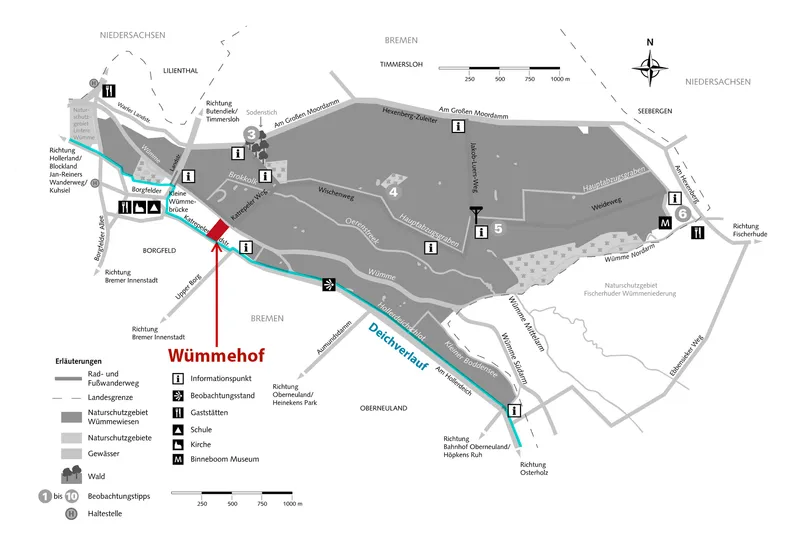
The Wümme is a tidal river that seasonally expands its size a hundredfold. Living next to it is a negotiation, not a privilege. Each house sits on a small dwelling mound linked to a dyke, a flood protection strategy borrowed directly from the region's agricultural heritage. The floor-to-ceiling windows that frame the river and its winter tree line are not panoramic gestures; they are precise openings cut into thick concrete walls, positioning the landscape as something to be watched carefully.
At dusk, the gabled studio volume with its full-height glazing becomes a lantern against the darkening tree canopy. The planted cobblestone courtyard at another entrance glows under recessed light. These moments of illumination reveal the interiors without exposing them, maintaining the opaque, barn-like character of the facades even when the houses are clearly occupied.
Detail: Window and Eave
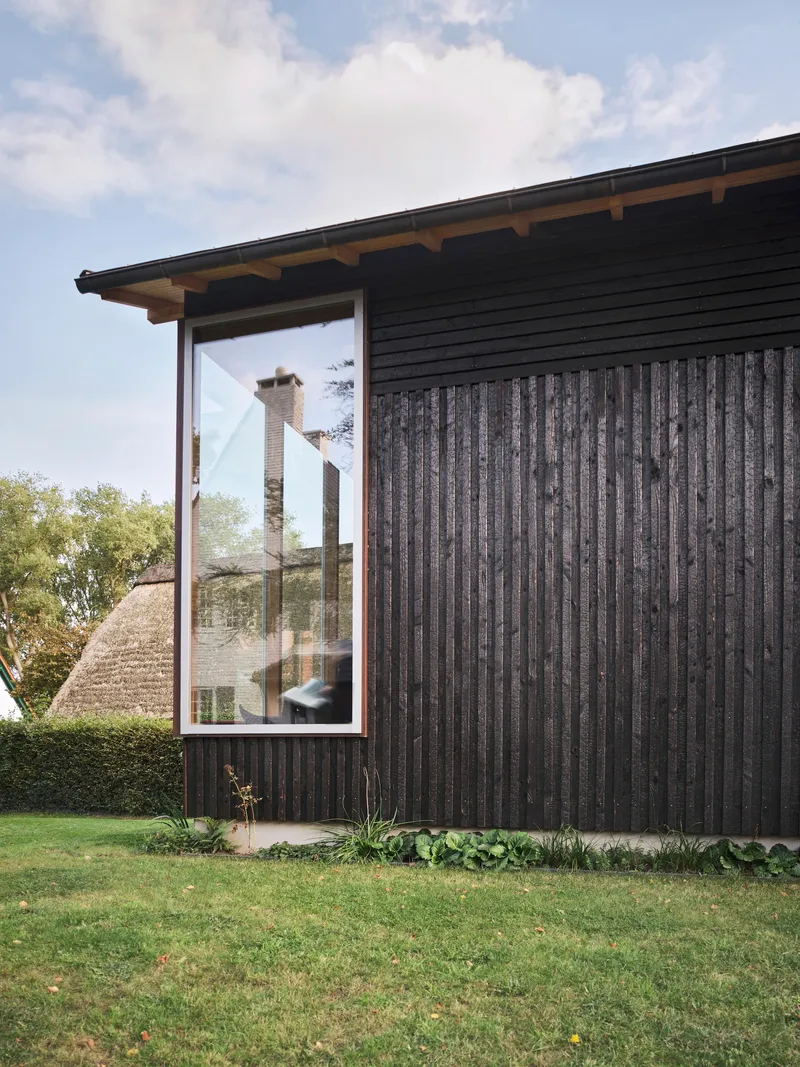
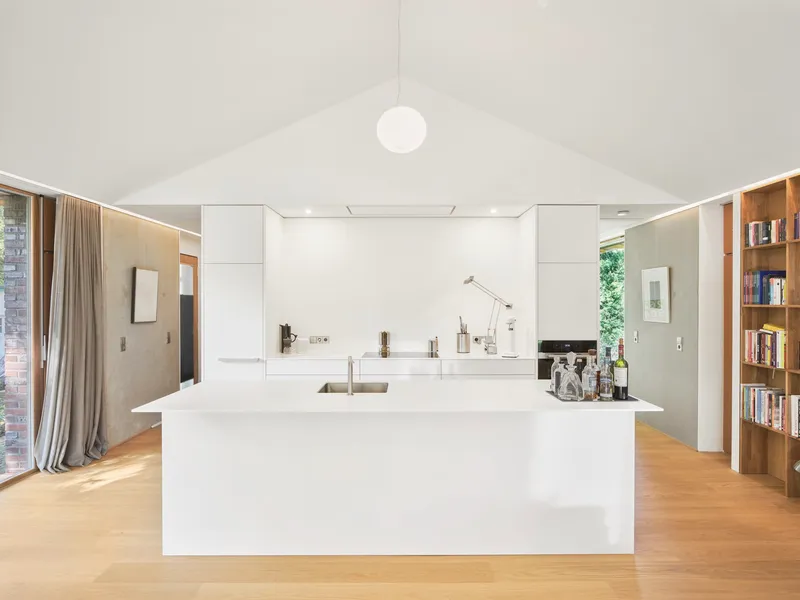
A projecting window punches through the charred timber cladding with a clean white frame, its depth revealing the wall's thickness. The eave overhang above is minimal, just enough to protect the joint between roof and wall. Inside, a white kitchen island under a vaulted ceiling receives a single spherical pendant light, while a continuous perimeter slot detail marks the transition from wall to ceiling. These are small moves, but they establish the project's tectonic honesty: every joint, every threshold, every material change is articulated rather than concealed.
Plans and Drawings
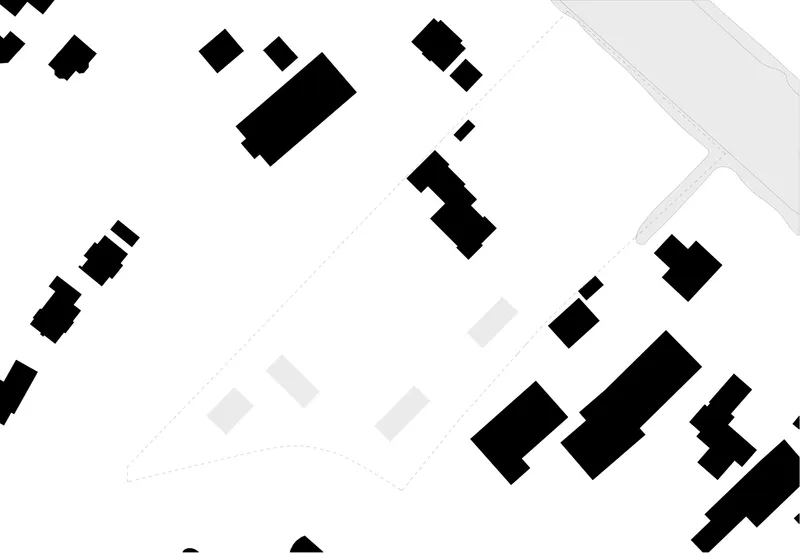
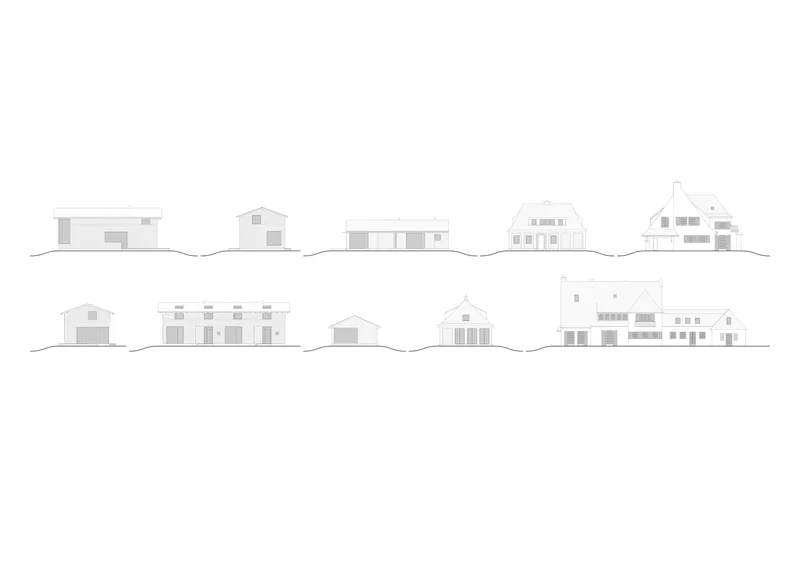
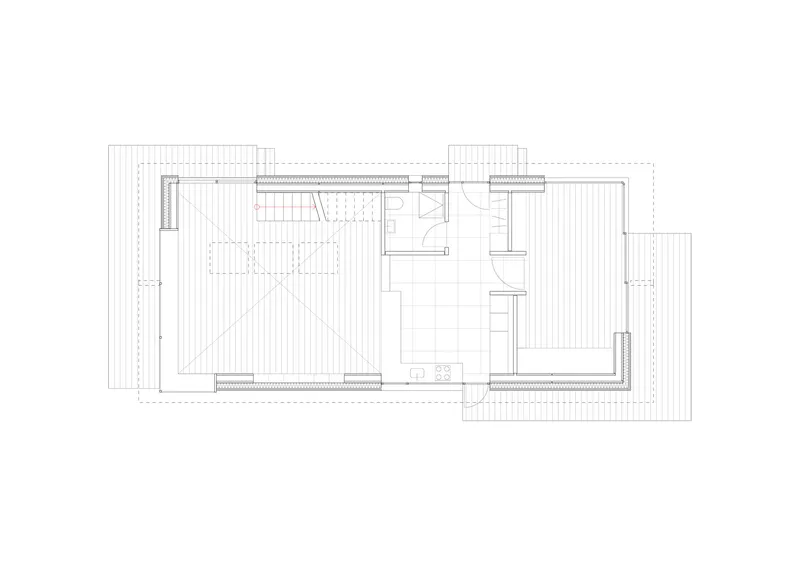
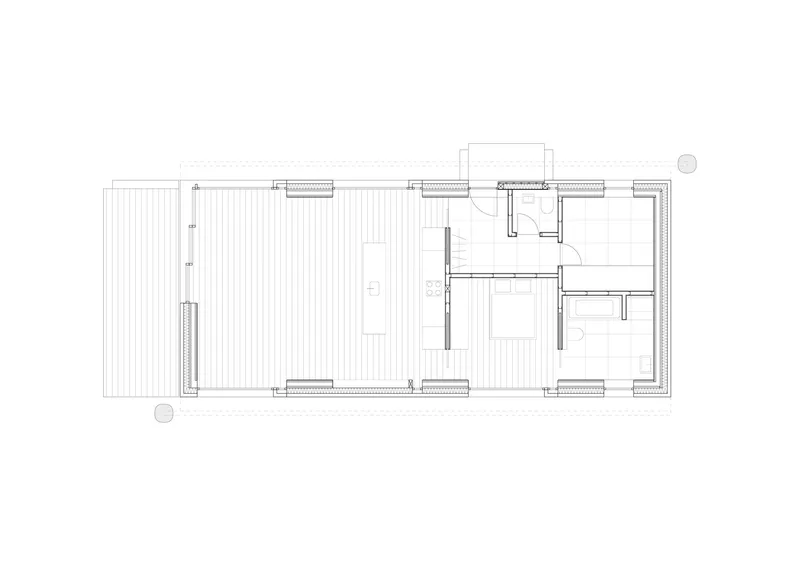
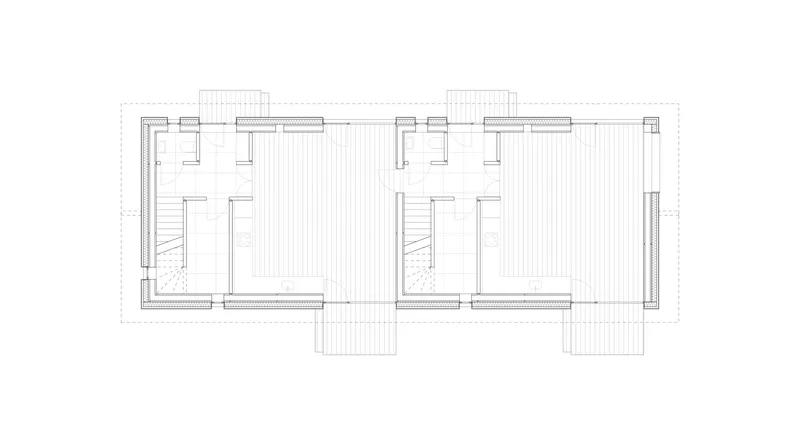
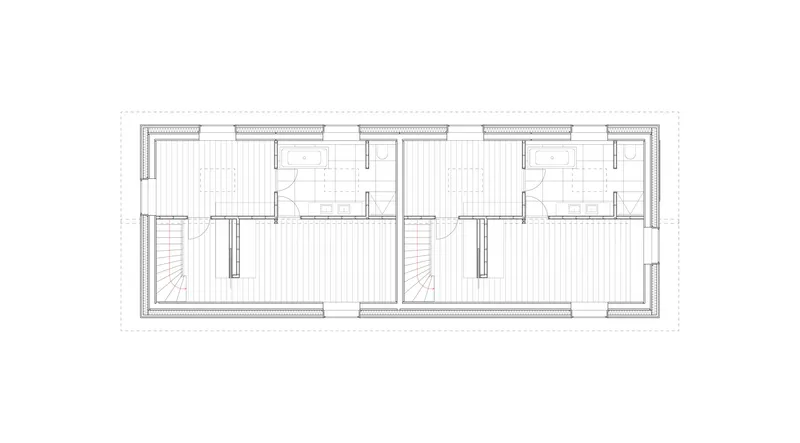
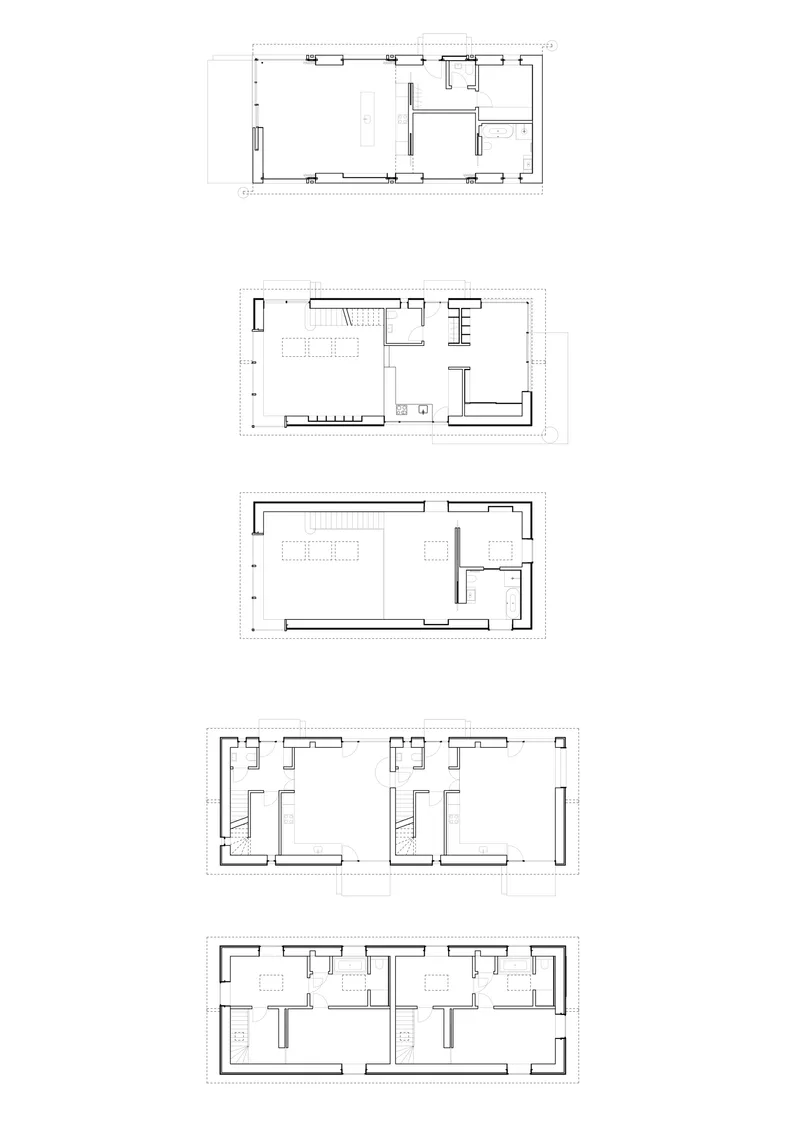
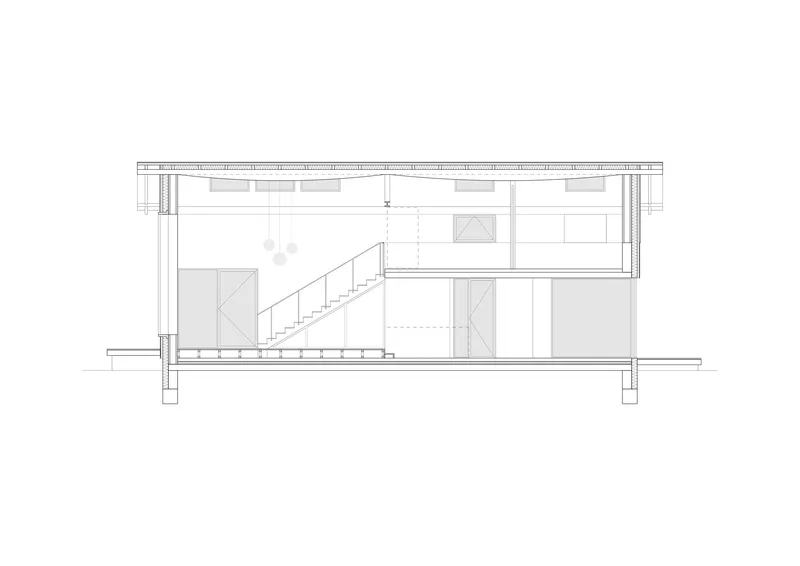
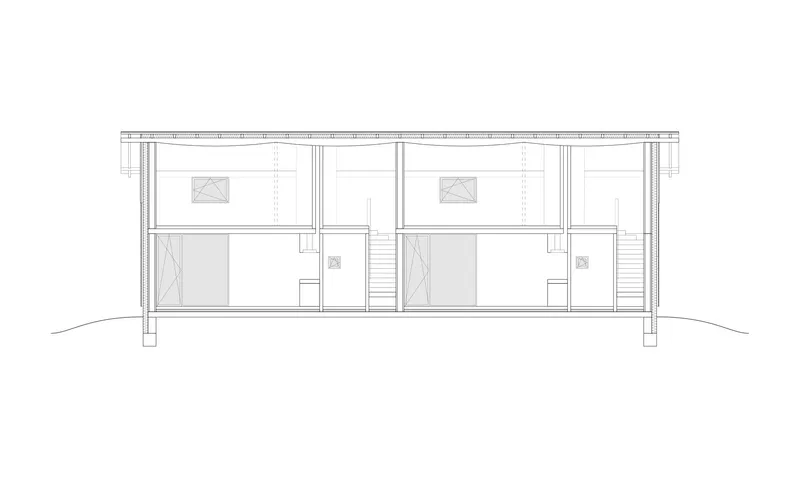
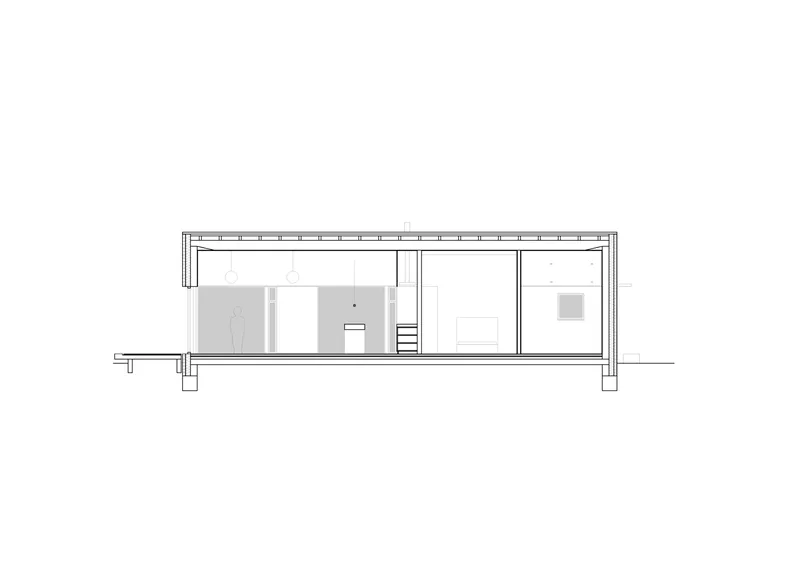
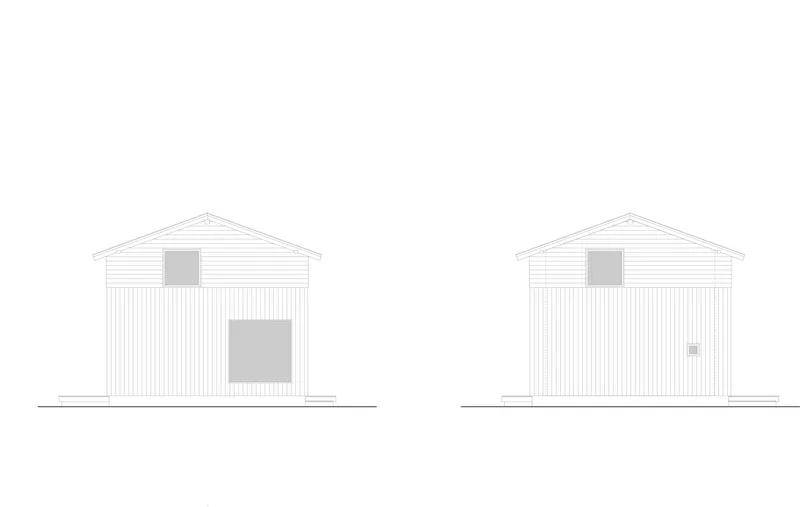
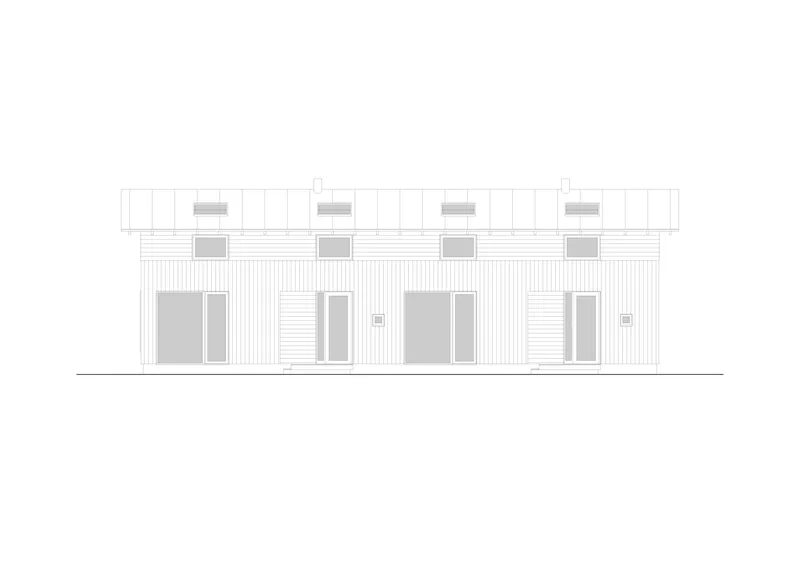
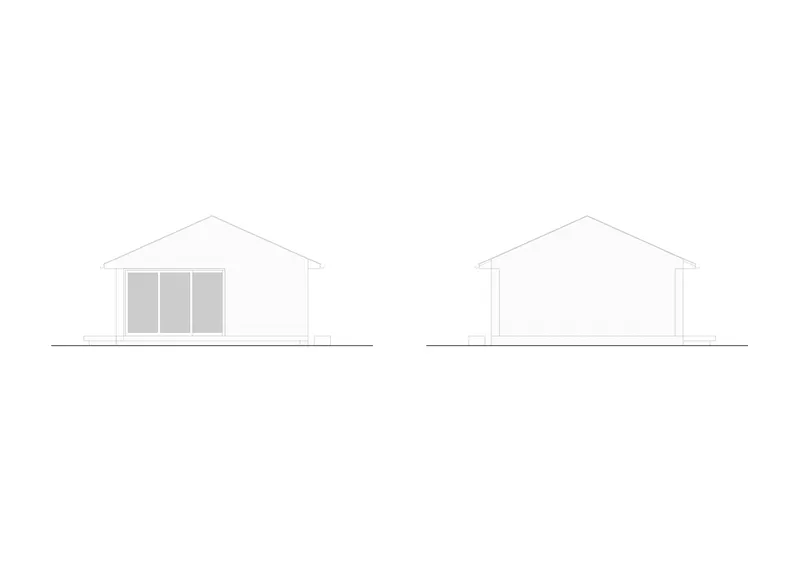
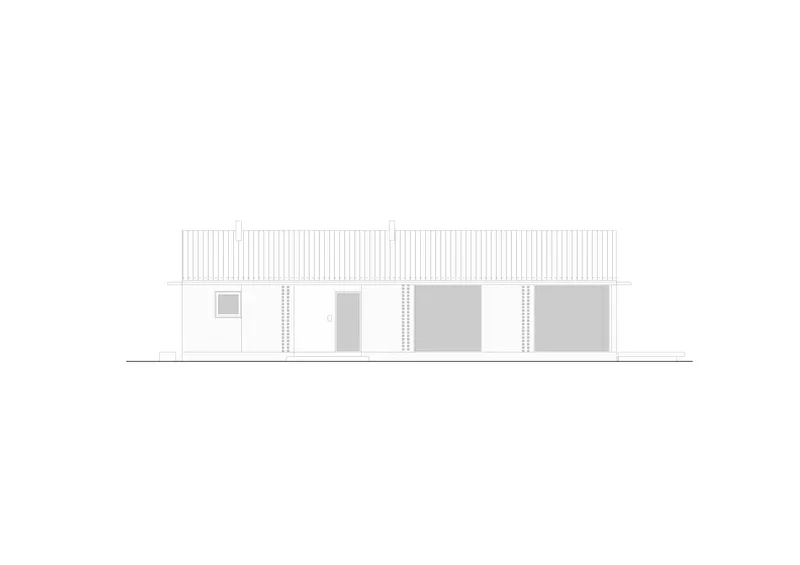
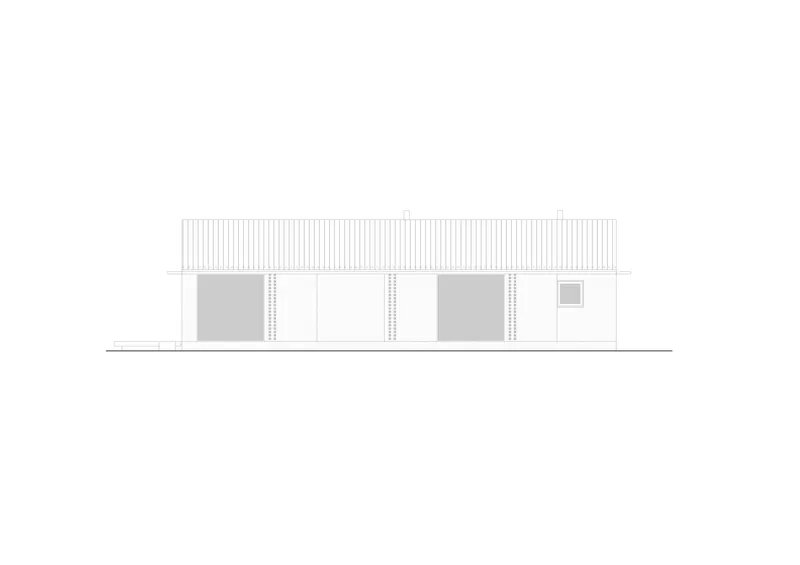
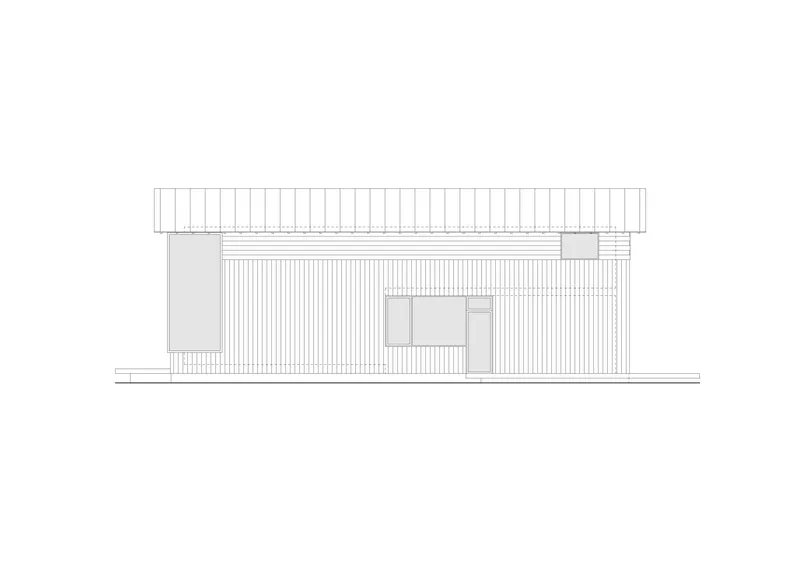
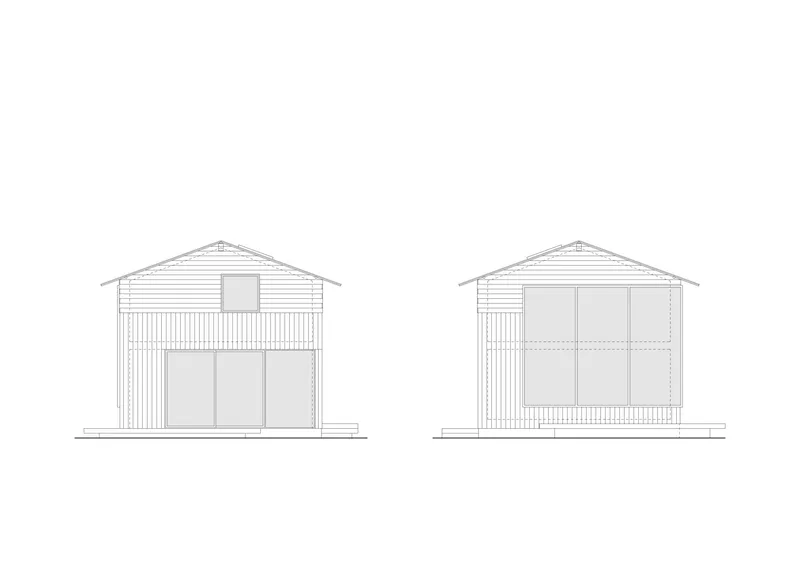
The site plans confirm the scattered placement of the new buildings among existing structures, reproducing the layout of a working farmstead rather than imposing a new order. The floor plans show compact, efficient units organized around central staircases, with bathrooms clustered to keep plumbing runs short. The double house plan reveals mirrored units flanking a central circulation zone, a strategy that minimizes shared walls while maximizing privacy. The sections are the most revealing drawings: they show how the full gable volume is exploited, with mezzanines and storage tucked under the roof pitch, and double-height spaces opening where the program demands generosity.
The elevation drawings lay out the full range of facade treatments: horizontal siding with square window openings, vertical siding with recessed bays, and the corrugated roof profiles that unify the ensemble. Read together, the elevations make it clear that each house has its own character while belonging to a single family of forms. The variation in window groupings and cladding direction is enough to distinguish the units without breaking the typological discipline.
Why This Project Matters
Wümmehof demonstrates that density on a sensitive historic site does not require either mimicry or provocation. Brinkhege's decision to position new buildings at the exact locations of lost agricultural structures is more than a planning conceit; it produces an arrangement that feels inevitable rather than designed. The farm typology, adopted honestly through material and form, gives the project a coherence that a more self-consciously architectural approach would have destroyed. These houses belong to their site in a way that most infill housing does not.
The use of locally sourced, regionally specific materials, carbonized wood from the peat cutter tradition, bricks fired in a nearby kiln, is not nostalgia. It is a construction strategy that produces durability, reduces transport, and connects the new buildings to the craft economy of their region. In a discipline increasingly drawn to universal material palettes and global supply chains, Wümmehof is a quiet argument for specificity. Seven houses, 565 square meters, a 10,000 square meter shared garden, and a tidal river that reminds you, every season, that the land was here first.
Wümmehof Houses by Felix Brinkhege, Bremen, Germany. 565 m², completed 2016. Photography by Felix Brinkhege, Caspar Sessler, and Ranil Beyer.
About the Studio
Share Your Own Work on uni.xyz
If projects like this are the kind of work you want to make, uni.xyz is a place to publish your own, find collaborators, and enter design competitions.




Popular Articles
Popular articles from the community


Play: Fragments of Their World
Familiar architecture becomes modular playground design, creating safe spaces where displaced children can learn, connect, imagine and play.

Riyadh For All: Intergenerational Urban Design for Active Aging in Rabat
Riyadh For All reimagines urban design in Rabat with intergenerational co-living, adaptive courtyards, and Moroccan cultural exchange today.

Lunar Spiral: Space Architecture Shaped by the Mathematics of the Universe
Lunar Spiral reimagines space architecture through Fibonacci geometry, lunar regolith, levitating habitats, and self-sustaining Moon living.

Co-life: Sustainable Architecture for Age-Friendly Community Living
Co-life reimagines sustainable architecture for seniors through courtyards, rammed earth, shared gardens, and spaces designed for belonging.

Similar Reads
You might also enjoy these articles

Bao Huynh Watercolor Atelier: A Serene Art Retreat in Hội An
Bao Huynh Watercolor Atelier in Hội An blends multifunctional art spaces, sustainable design, local materials, and family-friendly living in a serene environment.

Atelier Macri Concept Store Interior Design by CASE-REAL
Atelier Macri store features a "ko" counter, walnut wood details, cork displays, blending retail, gallery, and seamless customer experiences.

Manuel Vargas Izquierdo Stadium and High-Performance Sports Center: Architectural Excellence in Jalpa de Méndez
The Manuel Vargas Izquierdo Stadium blends sustainable design, inclusive sports facilities, and cultural-inspired architecture, revitalizing Jalpa de Méndez’s public spaces.

KAKR Buluh Awar Hall: Revitalizing Community and Ecology Through Bamboo Architecture
Community built bamboo hall revitalizes Buluh Awar village, empowering youth, restoring ecology, celebrating vernacular craftsmanship through sustainable architecture and culture.


Explore Architecture Competitions
Discover active competitions in this discipline



Challenge to reimagine the Iron Throne


Photograph architecture without architects


Illustrate the lost glory of Angkor Wat - Render Challenge


Design challenge to reuse E-waste
Comments (0)
Please login or sign up to add comments
No comments yet. Be the first to comment!