
FELT Architecture and Oskar Architecten Frame a Chapel with an L-Shaped Arts Campus in Asse
Kunst-As stitches together a fragmented Belgian town center with raw concrete, pastel tiles, and generous spaces for creative work.


Town centers in small Belgian municipalities have a tendency to accumulate cultural programs without a plan: a library here, a community hall there, a chapel nobody quite knows what to do with. In Asse, a municipality of around 35,000 just northwest of Brussels, that pattern has been reversed. The new Arts Campus, called Kunst-As, designed by FELT architecture & design and Oskar architecten, does not sit passively alongside its neighbors. Its L-shaped volume completes a city block, frames a protected heritage chapel, and turns what was once a neglected void into a courtyard that organizes circulation between the building, the street, and the adjacent library and cultural centre.
What makes Kunst-As genuinely interesting is the clarity of its dual ambition. It wants to be both a robust workshop, full of rehearsal rooms and ateliers where mess is welcome, and a civic connector, threading people through covered galleries and generous landings that double as informal exhibition space. The building does not resolve this tension by hiding one role behind the other. Instead, lead architects Karel Verstraeten and Jasper Stevens let the raw structural logic of the interior coexist with a carefully tuned exterior that shifts register depending on which direction it faces.
Two Faces of the Same Block


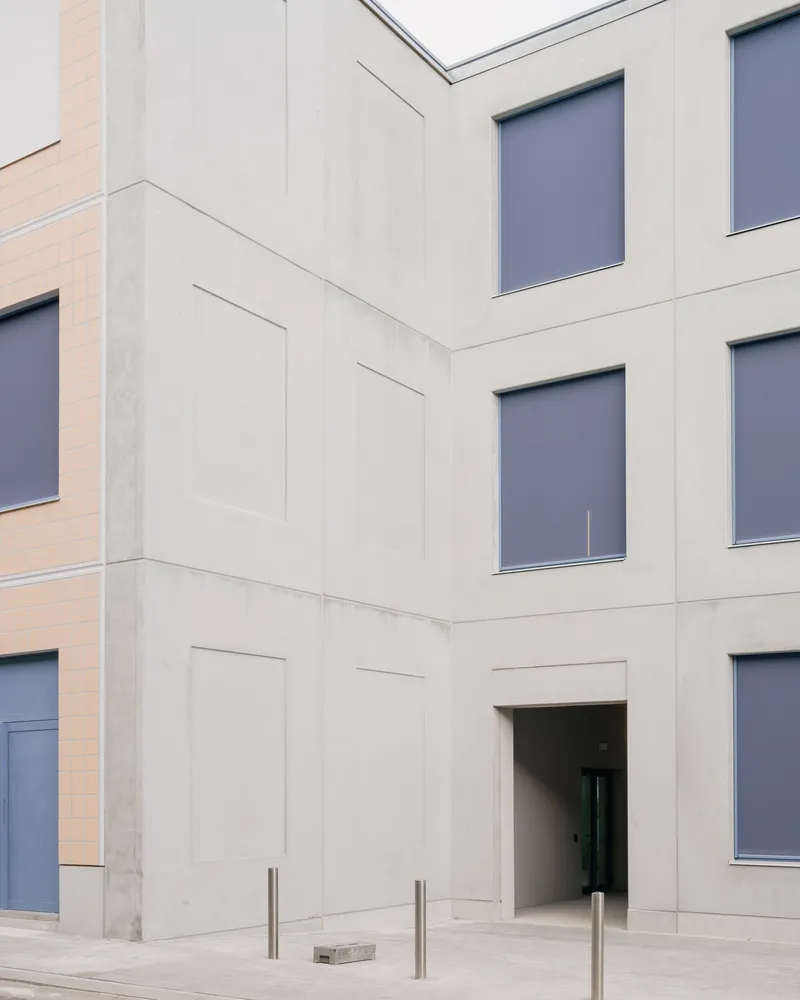
The dual facade strategy is the single most legible decision on the project. Along the street, the building adopts a tighter rhythm of openings and a warm, pastel-toned palette of ceramic tiles that picks up the colors of neighboring houses. Peach brick, soft pinks, and translucent backlit panels give it an almost domestic approachability. Walk around the corner, and the tone shifts entirely: calm, square precast concrete elements face the inner court with a repetitive, almost monastic regularity.
Neither facade pretends to be neutral. The street side is sociable, nodding to its context with a specificity that avoids pastiche. The courtyard side is quieter, disciplined, letting the heritage chapel remain the visual focus. The deep reveals on both elevations catch shadows that change throughout the day, giving the surfaces a material depth that photographs only partially convey.
The Courtyard as Urban Room
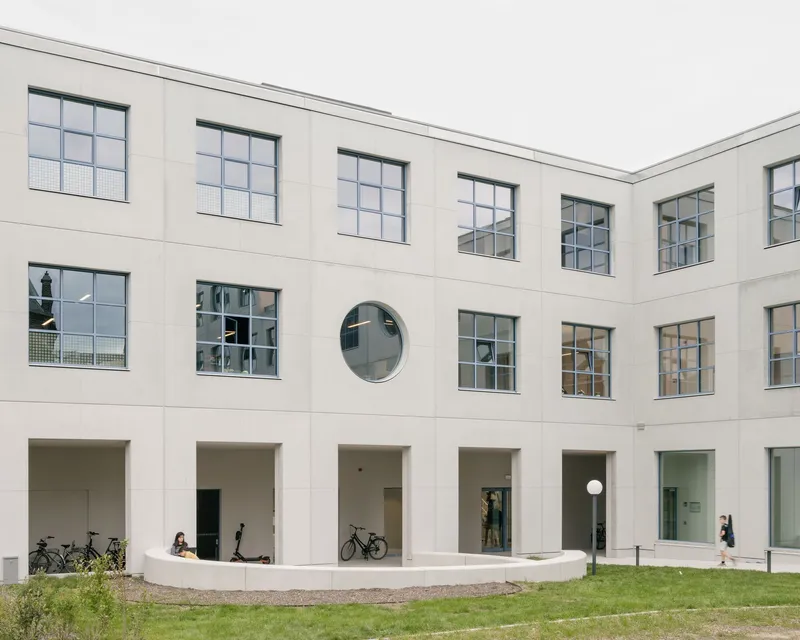


The inner courtyard is the hinge of the entire scheme. A small setback at the outer corner creates a forecourt that marks the public entrance and connects the street to what the architects describe as a revived cloister garden. Inside the block, the courtyard is generous enough to feel genuinely public: bicycles lean against columns, students sit on a circular plinth, and the gridded white facade wraps around three sides with a porthole punctuation that gives scale and rhythm.
The round openings are worth noting. They appear on the courtyard elevation, in classrooms, in corridors, and in the dance studio. At first they read as playful, almost whimsical, but their consistency suggests something more deliberate: they frame specific views, particularly of the chapel's brick tower and roof, anchoring the new building's identity to its heritage neighbor.
Circulation as Exhibition


Two parallel circulation routes branch from a central foyer, and neither is treated as mere corridor. The main staircase, with its white balustrades and terrazzo treads, is scaled like a small theater. When the building is full, as the images of gathered children suggest, these spaces become places of congregation, not just passage. Wide landings, transparent vitrines, and exhibition walls line the routes, turning the act of moving through the building into a sequence of encounters with work in progress.
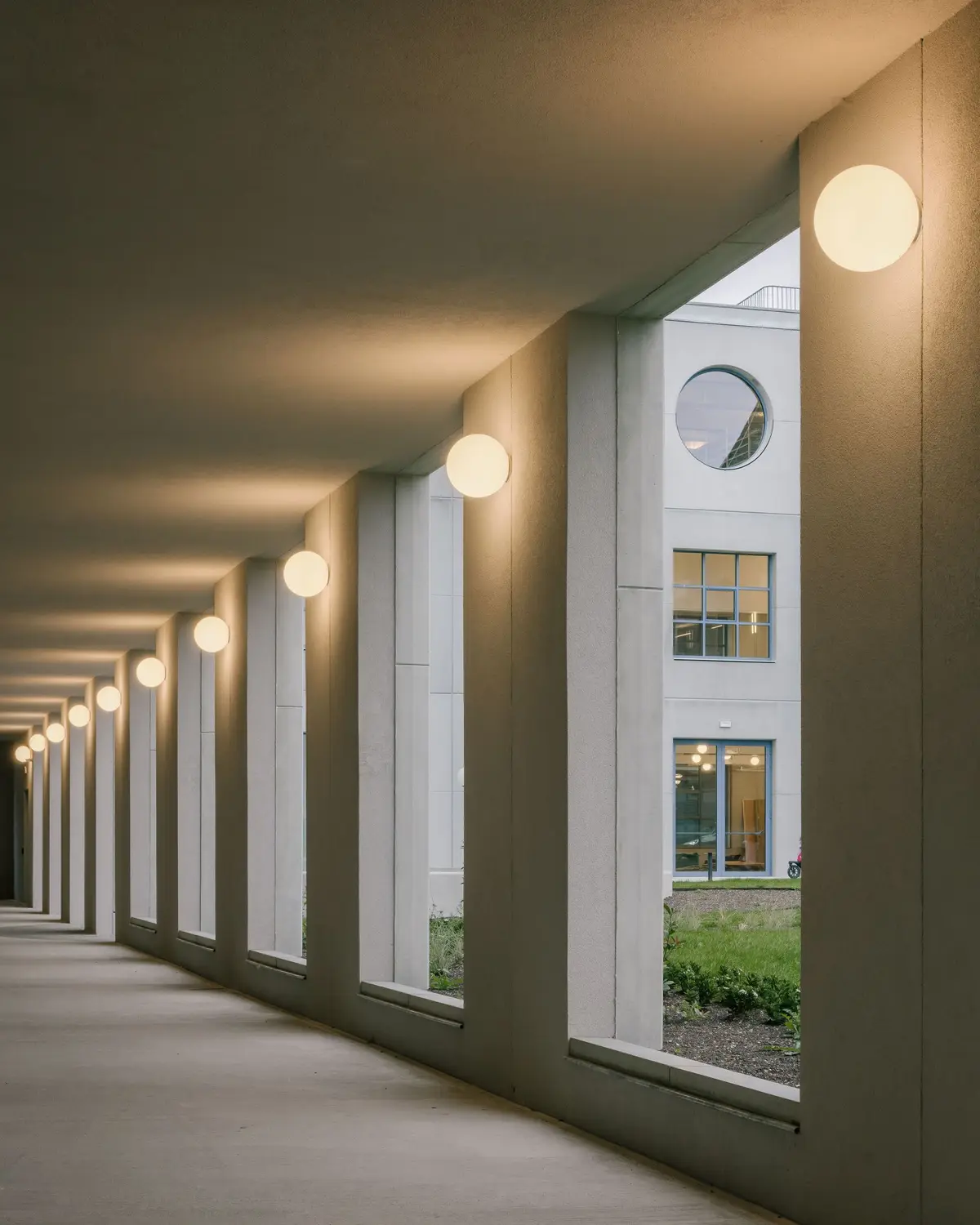
A covered gallery extends along the courtyard edge, leading visitors past a colonnade of repeating concrete columns fitted with spherical pendant lights. At dusk, these lights turn the gallery into a lantern visible from the street, signaling the building's public role even when the ateliers are quiet. The connection to the neighboring library and cultural centre happens along this path, making the entire cultural cluster navigable under cover.
Rooms Built for Making


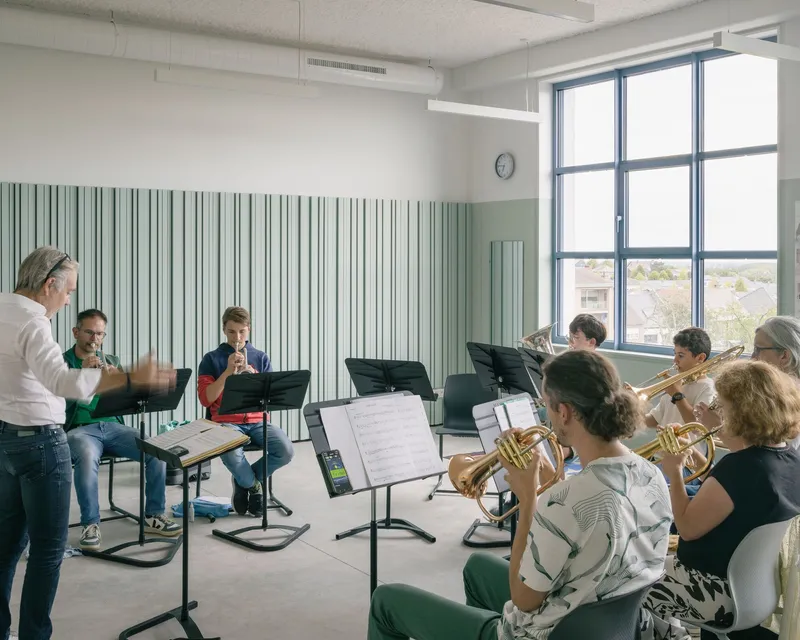
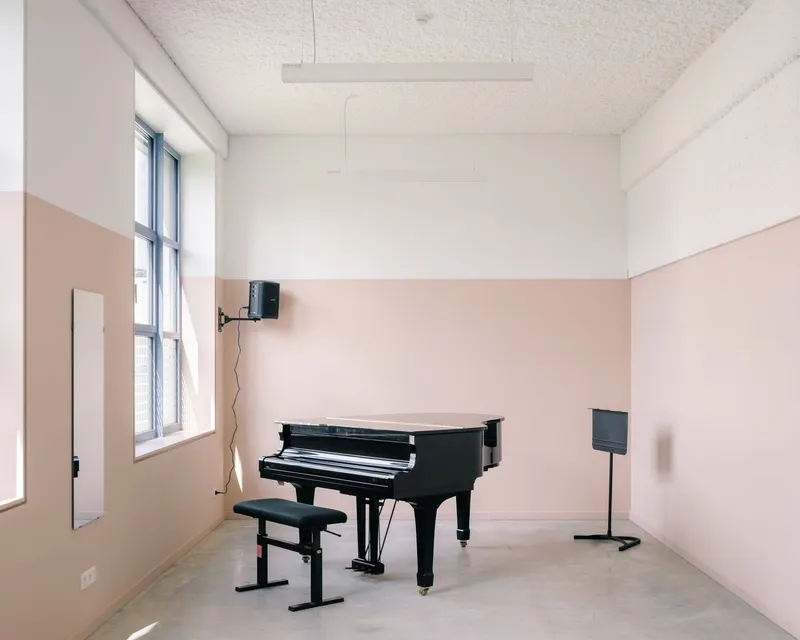
The teaching and rehearsal rooms are where the raw materiality of the project becomes most evident. Exposed concrete ceilings are left unfinished. Walls receive only the treatment their program demands: peach wainscoting in a music room to manage acoustics, striped green panels in an ensemble rehearsal space, a mirrored wall and wooden barre in the dance studio. Nothing is decorative for its own sake. The circular window in the classroom that frames the chapel roof is the one moment of architectural generosity in an otherwise utilitarian room, and it works precisely because of the restraint around it.
This is a building that celebrates the workshop nature of arts education. Creative process is prioritized over polished finishes. A grand piano sits in daylight that washes across simple walls. Musicians rehearse in a circle on stackable chairs. The architecture provides the volume, the light, and the acoustic envelope, then gets out of the way.
The Colonnade and the Threshold

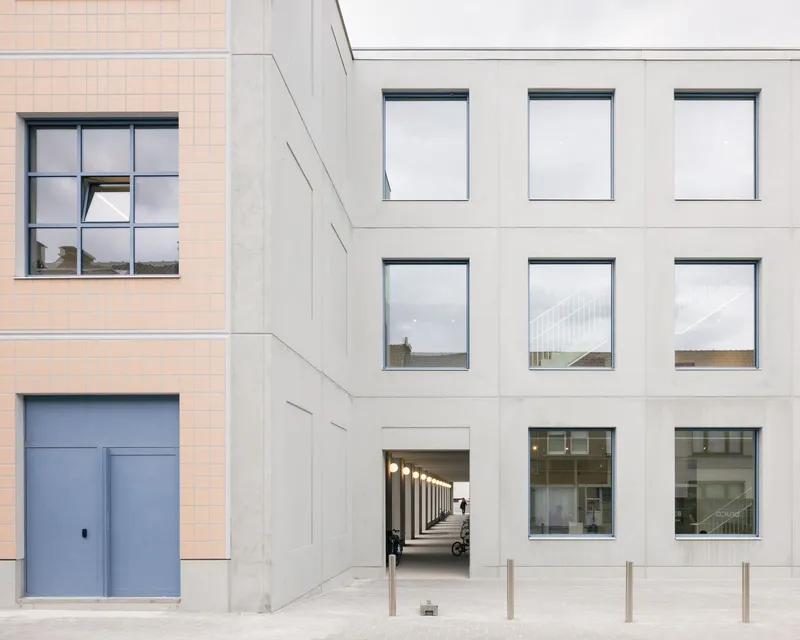
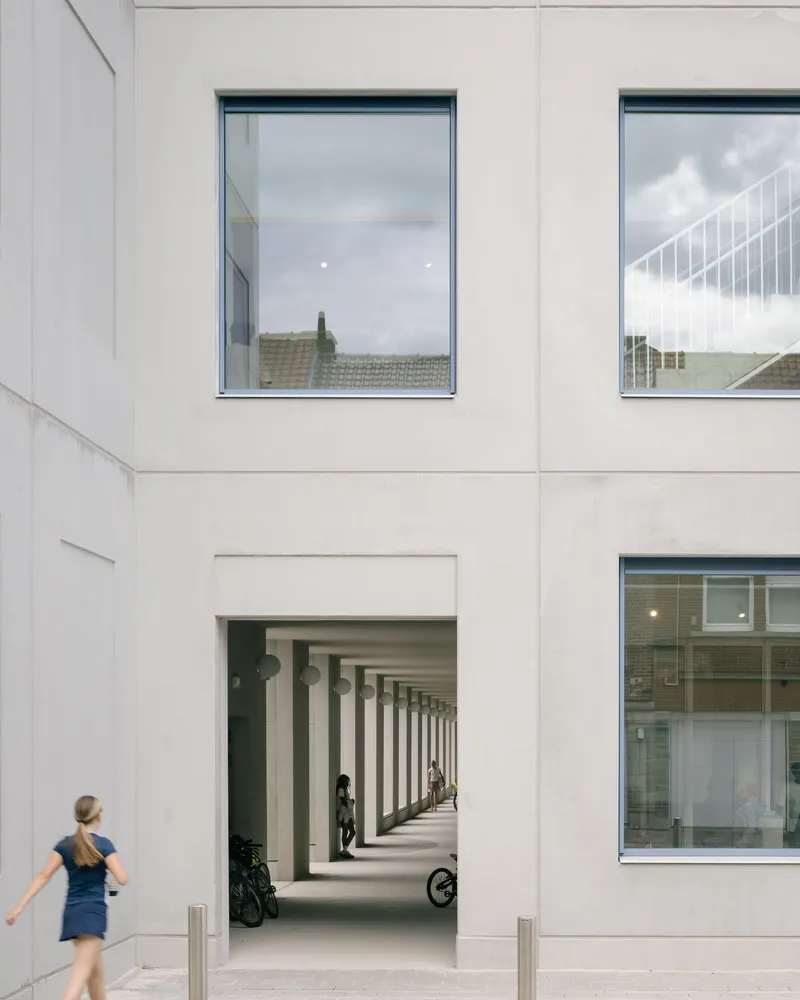
The covered colonnade is one of the project's strongest spatial moments. Its repeating concrete columns and pendant lights create a rhythm that is simultaneously civic and intimate. It functions as a threshold between the courtyard and the interior, but also as a connective tissue linking the arts campus to the broader cultural cluster. The passage between the pale brick and white rendered facades, visible from the street, invites entry without overselling itself.
What distinguishes this colonnade from similar moves in institutional architecture is its proportional generosity. It is wide enough to pause in, not just walk through. Combined with the forecourt and cloister garden, it offers a gradient of public and semi-public space that is rare in buildings of this type and scale.
Plans and Drawings


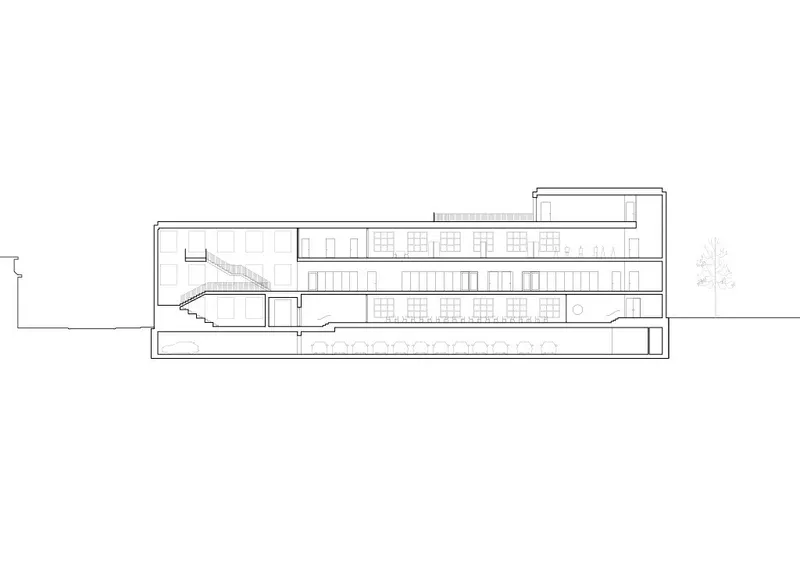
The site plan reveals the precision of the L-shaped insertion. The building completes the block perimeter while carving out the courtyard around the existing chapel, which sits at the heart of the composition. The floor plans show two wings organized around the central foyer, with rooms of varying scale distributed along the parallel circulation spines. Larger rehearsal and ensemble spaces occupy the ground and lower floors, while ateliers and classrooms stack above.
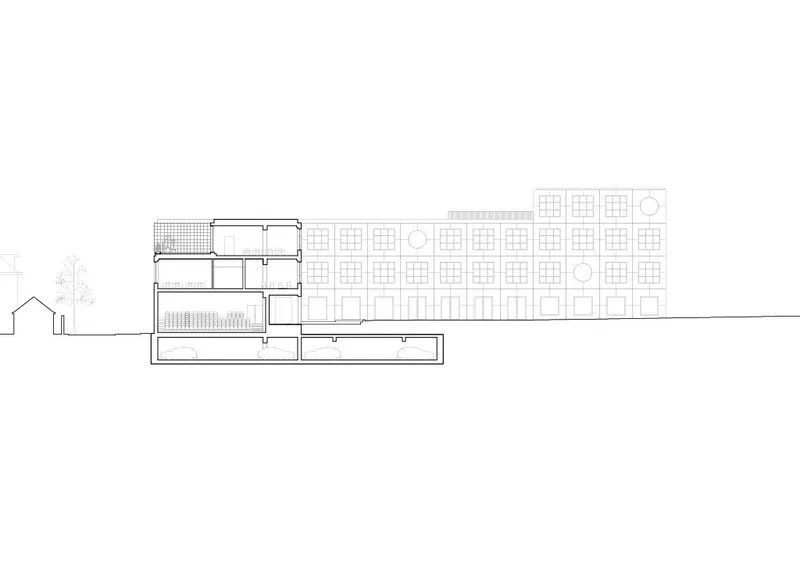
The sections are revealing. A basement level extends beneath the courtyard, gaining depth that the street elevation does not hint at. The gridded upper volume reads as a single expressive move, but the section shows it sitting atop a more complex, multi-level base that negotiates grade changes and accommodates the larger program spaces. The relationship between the new building's roofline and the adjacent houses and chapel is carefully calibrated: tall enough to hold its own, but restrained enough not to dominate.
Why This Project Matters
Kunst-As matters because it treats a small municipality's cultural ambitions with the same spatial intelligence usually reserved for institutions in major cities. The building does not overperform. It does not announce itself with a signature gesture or a swooping roof. Instead, it does the harder work of stitching a fragmented block back together, negotiating between heritage and new construction, and creating generous shared spaces within a budget that clearly demanded economy in finishes. The result is a building that feels permanent in the best sense: it looks like it has always been part of the block, even as it fundamentally transforms how the block functions.
For architects working on cultural and educational programs in European town centers, Kunst-As offers a compelling model. It demonstrates that an arts building can be simultaneously robust and refined, that raw concrete and pastel tile can coexist without irony, and that the most powerful architectural move is sometimes not the building itself but the space it leaves open. The courtyard, the colonnade, the forecourt: these are the moments that will define how Asse uses this building for decades. FELT architecture & design and Oskar architecten have understood that an arts campus is not a monument. It is a piece of infrastructure for creative life, and it is most successful when it makes room for the unpredictable things that happen inside it.
Kunst-As Art Center, designed by FELT architecture & design and Oskar architecten. Lead architects: Karel Verstraeten and Jasper Stevens. Located in Asse, Belgium. 7,688 m². Completed in 2025. Photography by Stijn Bollaert.
About the Studio
Share Your Own Work on uni.xyz
If projects like this are the kind of work you want to make, uni.xyz is a place to publish your own, find collaborators, and enter design competitions.


Popular Articles
Popular articles from the community


Singing Woman: An Opera House That Performs Before the Curtain Rises
Ovidiu Cristian Pavel's conceptual opera house translates Estonia's choral identity into a sculpted waterfront landmark facing the Baltic Sea.

Manzana Morphosis: Stretching Barcelona's Grid into a Living Landscape for 2050
A radical reworking of the Eixample manzana turns density into a tool for generous public space, vertical ecology, and environmental performance.

Opera on the Sea: Driftwood Logic Shapes a Timber Opera House on Estonia's Coast
Trevor Orgill's opera house translates the entangled drift of floating timber into a civic building where wood, water, and music converge.

Aquadapt: An Underwater Habitat That Rewrites Its Rooms by the Hour
Curved modules ring the seabed while one shell shifts from breakfast room to cinema, farm and football pitch as residents' needs change.

Similar Reads
You might also enjoy these articles

LAVA Architecten Gives Vocational Education a Sawtooth-Roofed Face on a Mechelen School Campus
In Mechelen, Belgium, a 2,053 m² STEM school on a 6×6 m grid turns workshops and classrooms into rooms that can be rearranged as teaching changes.

KEMA Studio Turns a Derelict Marvila Attic into a 60 m² Lighthouse Apartment Above Lisbon
In Lisbon's Marvila district, a rebuilt roof, four skylights and two plywood volumes turn an unlivable attic into a bright home facing the Tagus.

Pixel Gardens: One Repeated Module Stacked Into a Terraced Social Housing Tower for Famagusta
Salem Bader's shortlisted housing tower builds a vertical neighbourhood from one repeated module, offsetting units to carve terraces, light and air.

Bao Huynh Watercolor Atelier: A Serene Art Retreat in Hội An
Bao Huynh Watercolor Atelier in Hội An blends multifunctional art spaces, sustainable design, local materials, and family-friendly living in a serene environment.

Comments (0)
Please login or sign up to add comments
No comments yet. Be the first to comment!