
FGR Architects Folds Concrete and Glass into a Mediterranean Courtyard House in Melbourne
In Cremorne, a five-bedroom home wraps layered concrete volumes around a central courtyard, pool, and garden to create privacy and calm.


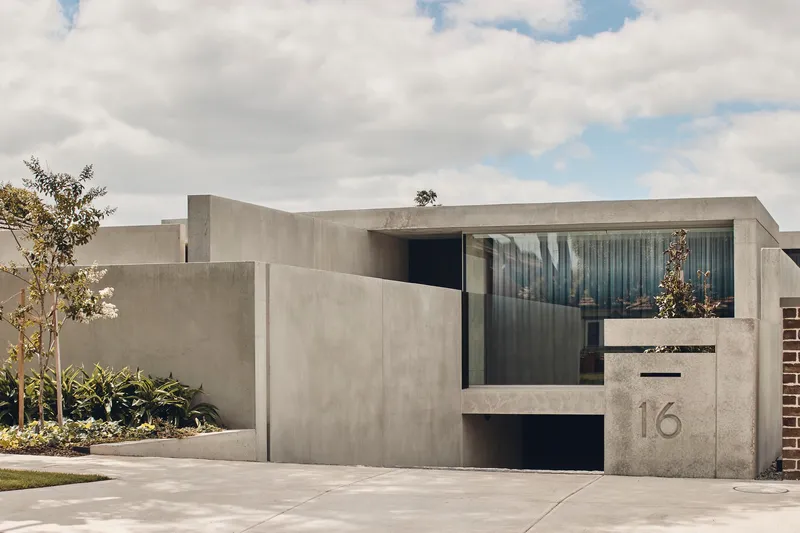
From the street, the Courtyard House by FGR Architects reveals almost nothing. Burnished concrete walls rise like a monolithic screen, punctuated only by a recessed entry portal and a few horizontal glazing slots. A large spreading tree anchors the facade, casting shadows across surfaces that look more like land art than suburban housing. The restraint is deliberate: this is a house that thrives on external privacy and internal experience, channeling everything inward toward a central courtyard with a swimming pool at its heart.
What makes the project genuinely interesting is the way it transplants the classic Mediterranean courtyard model into a Melbourne context without nostalgia or pastiche. The five-bedroom home is organized as a series of concertinaed volumes, each layer stepping in plan and section to create pockets of light, ventilation, and garden. Principal living spaces radiate outward from the courtyard. Bedrooms without direct garden access get their own adjoining interior courtyards. The result is a house where every room has a relationship with landscape, even when that landscape is only a sliver of sky framed by concrete.
A Fortress Face on the Street
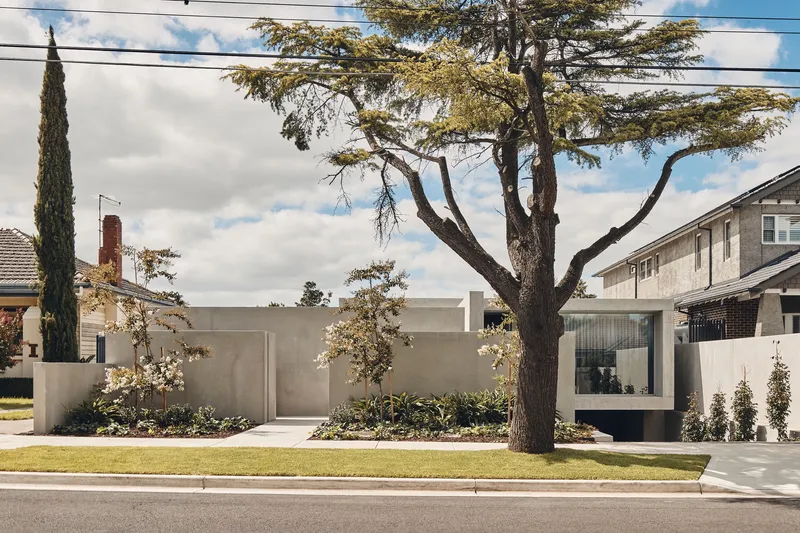
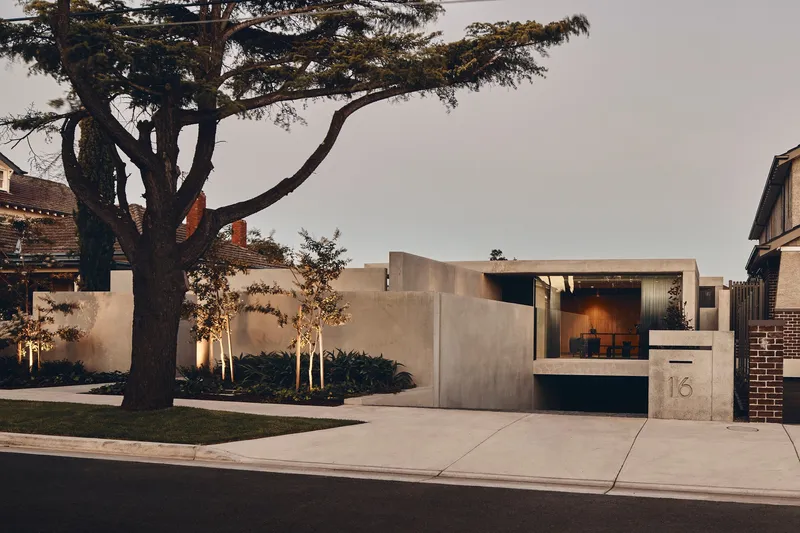
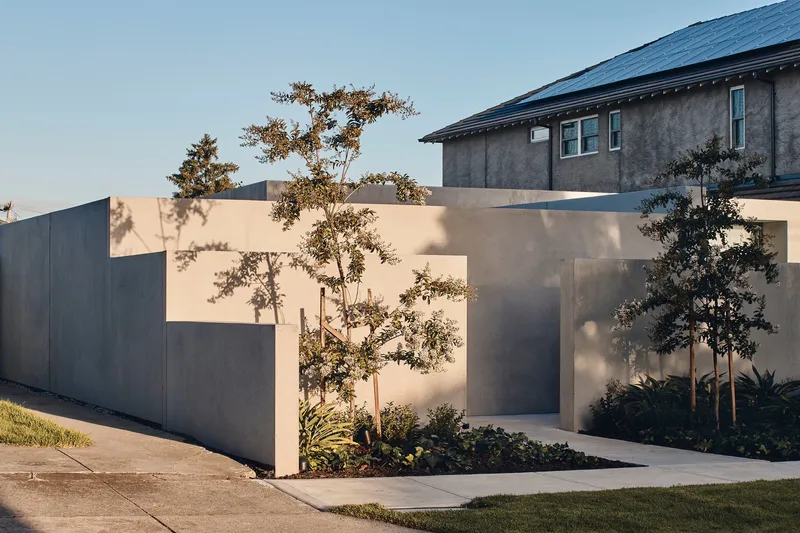
The street elevation operates as a buffer zone. High, monolithic concrete walls run nearly unbroken across the site frontage, their creamy burnished finish taking on a warm luminosity under direct sun and a cooler, sculptural weight at dusk. The facade is deliberately understated, almost minimalist in its refusal to signal domestic life. What it does signal is material conviction: these are not rendered blockwork walls pretending to be concrete. They are the structure, the finish, and the architectural idea all at once.
A narrow pedestrian path and a ramp leading to basement parking are the only cuts in this wall. Planted beds and mature trees soften the mass at ground level without undermining the clarity of the composition. The house reads as a sequence of layered volumes from the corner, each offset just enough to register as distinct while maintaining a single material language.
Threshold and Procession

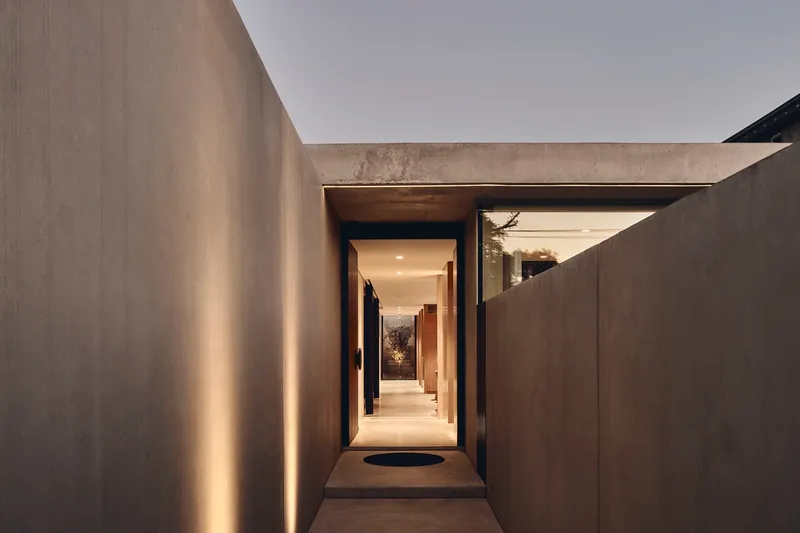
The entry sequence is the hinge of the whole design. A recessed portal cut through the concrete wall, marked by a cast address number and a horizontal band of glazing, compresses the visitor before releasing them into an interior corridor lined with concrete and timber. Flowering trees frame the passage on the exterior side, while vertical lighting slots introduce a twilight glow on the other.
It is a genuinely processional experience, a slow decompression from public to private. The corridor narrows, the materials shift, and the planted courtyard beyond comes into view like a reward for patience. FGR Architects understand that a house of this type depends on the threshold doing real psychological work, and they invest heavily in it.
Concrete Walls and Sky

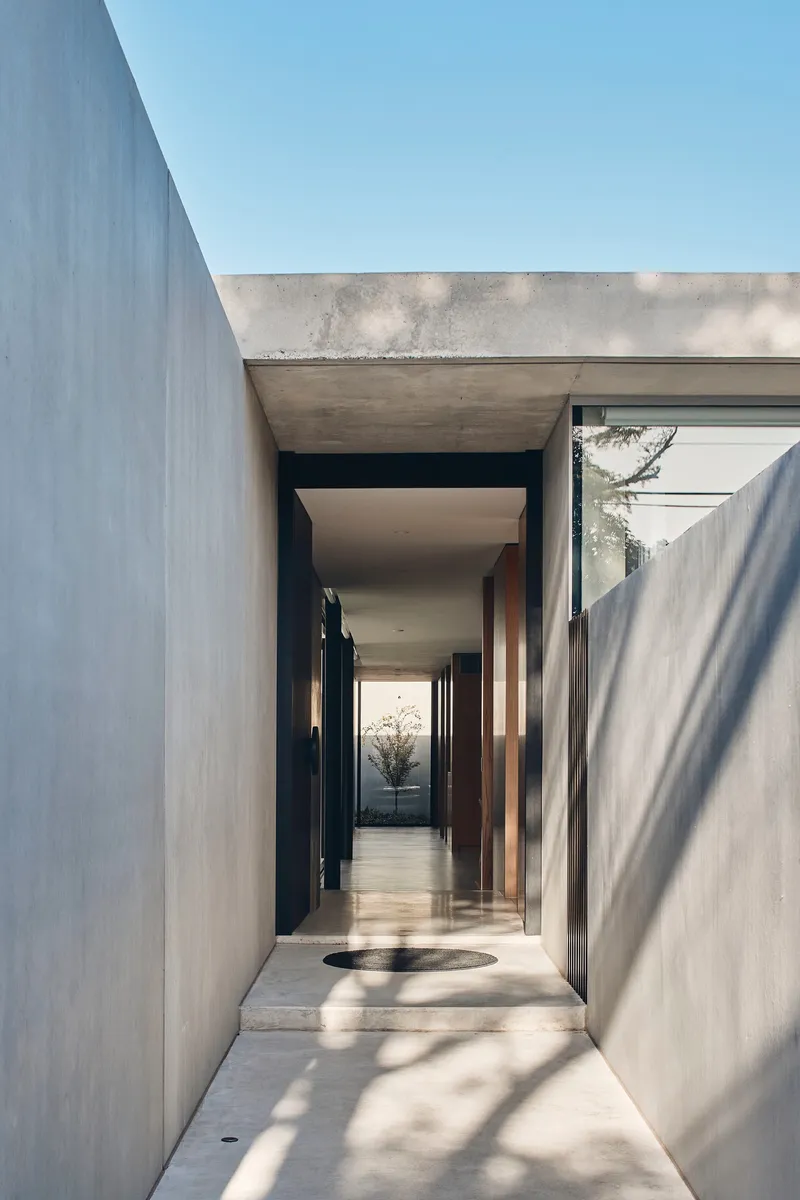
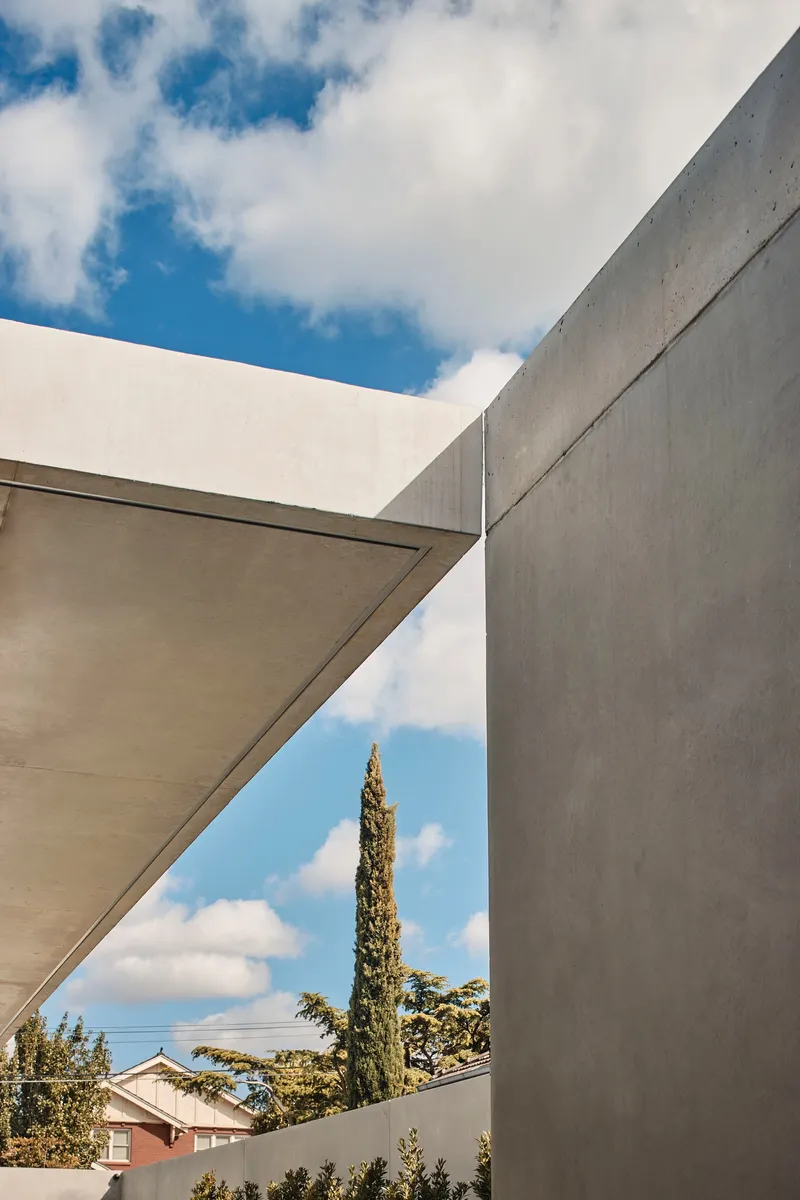
Between the volumes, the house creates framed views upward: a cantilevered overhang slicing the sky, a lone cypress rising between concrete planes, tree shadows tracking across surfaces as the day moves. These interstitial moments are where the architecture comes alive. The burnished concrete, flowing continuously from interior to exterior, takes on an almost luminous quality when set against blue sky or backlit by morning sun.
The entry corridor captures this effect most clearly. Concrete walls on both sides guide the eye to a planted courtyard framed at the far end, with timber ceiling lining adding warmth overhead. The layering of hard and soft, mass and void, is calibrated carefully. Nothing here is accidental.
The Courtyard as Oasis
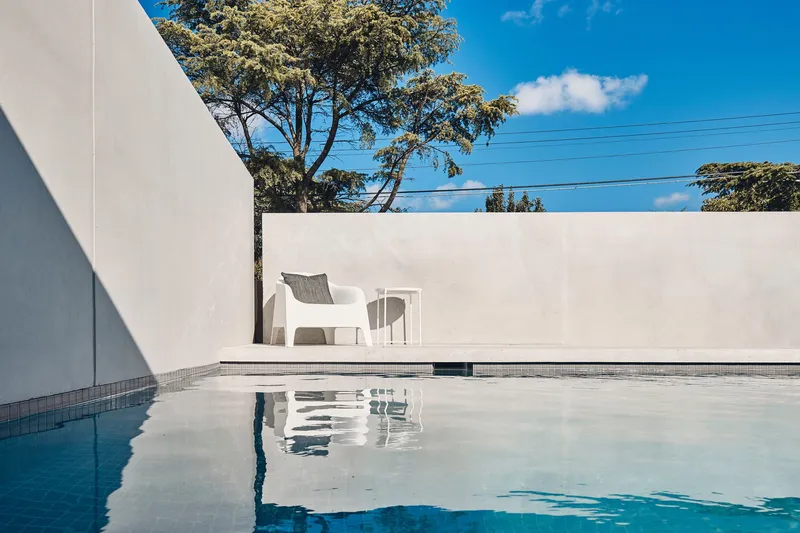
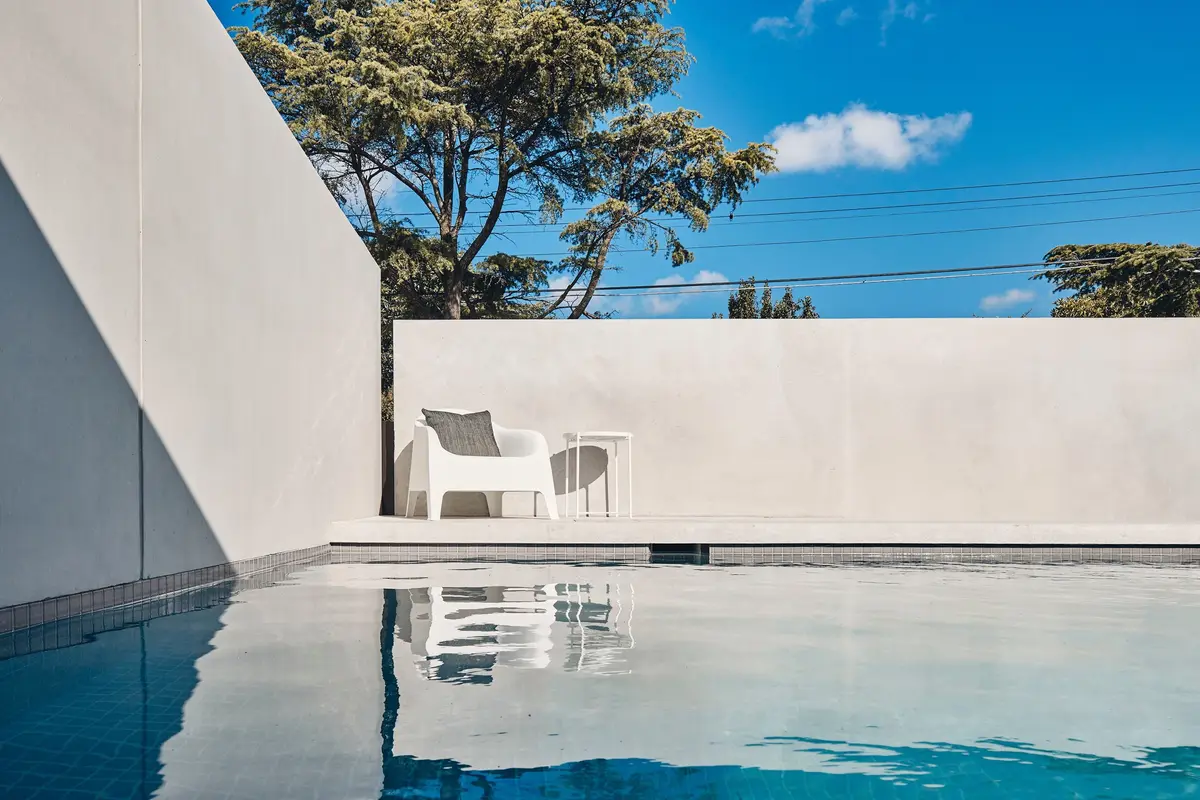
The swimming pool terrace is the climactic space. Still water reflects concrete walls and white chairs under open sky, creating a scene of almost theatrical calm. Water is the focus of the courtyard, treated as a wellspring around which the house organizes itself. A large concrete canopy shelters the adjacent outdoor cooking area and paved terrace, extending the living zones out from the interior without breaking the sense of enclosure.
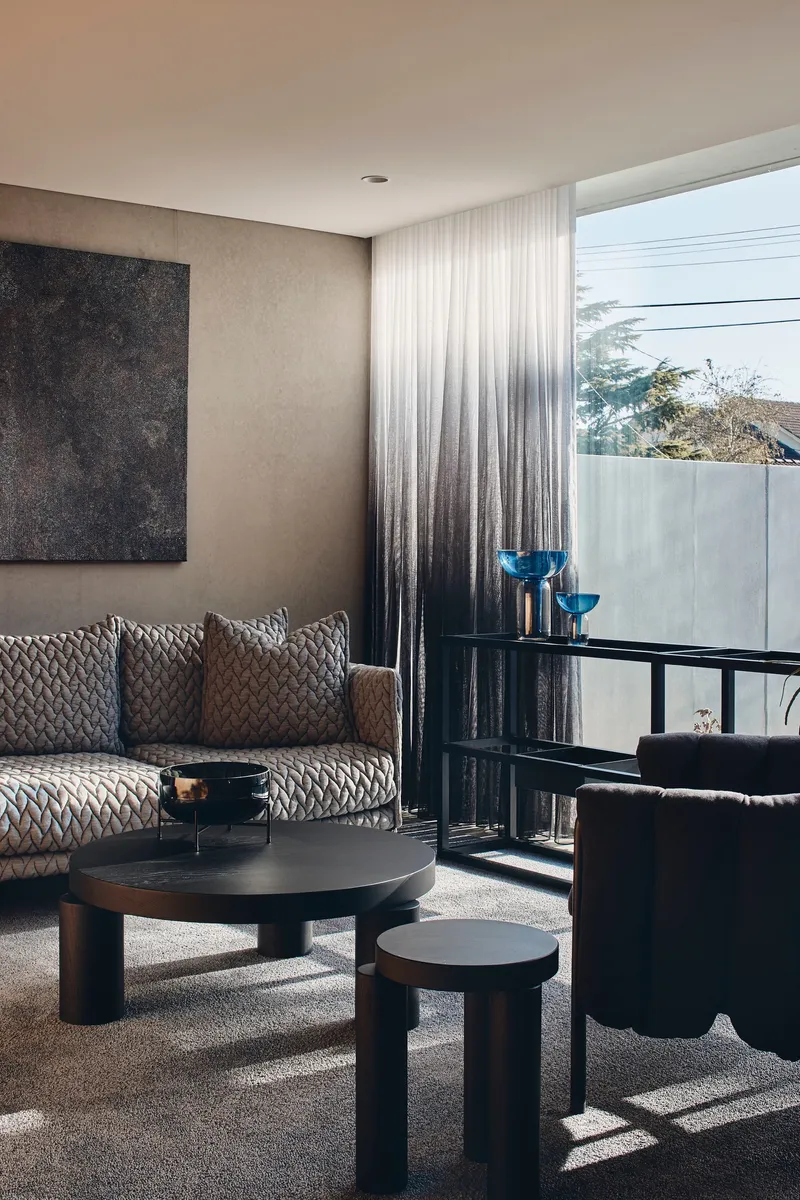
From the living room, floor-to-ceiling glass walls look out onto the courtyard landscape, trees, and the far concrete perimeter wall. Gradient curtains can filter the view or seal it entirely. The house is designed to open wide in mild weather and close down when Melbourne's climate turns harsh, optimizing thermal performance through sliding glass walls and concrete overhangs that provide shade and shelter.
Timber, Stone, and the Interior Palette
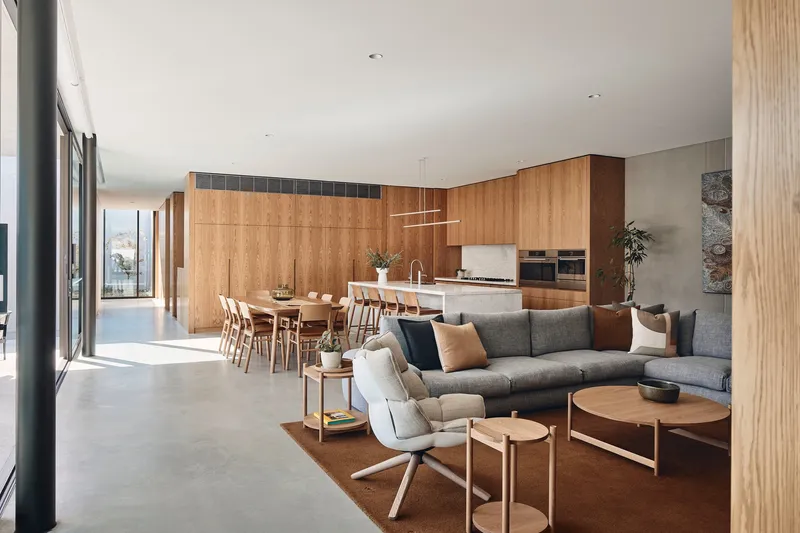
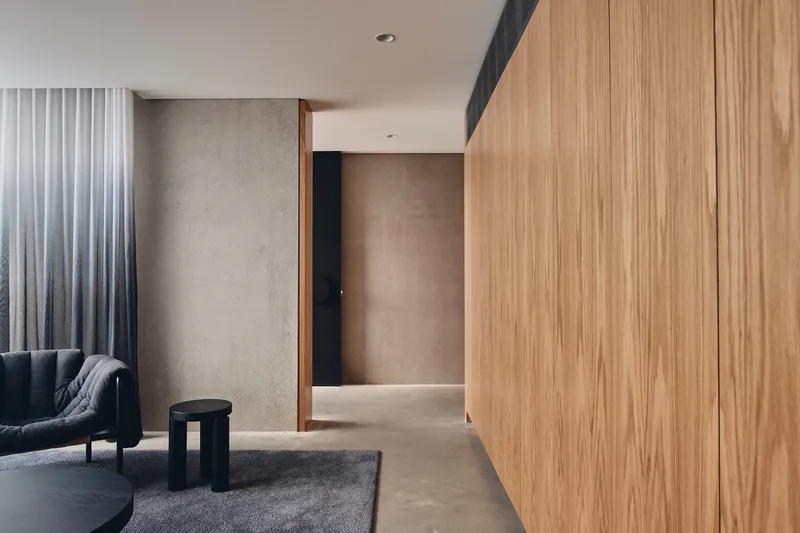
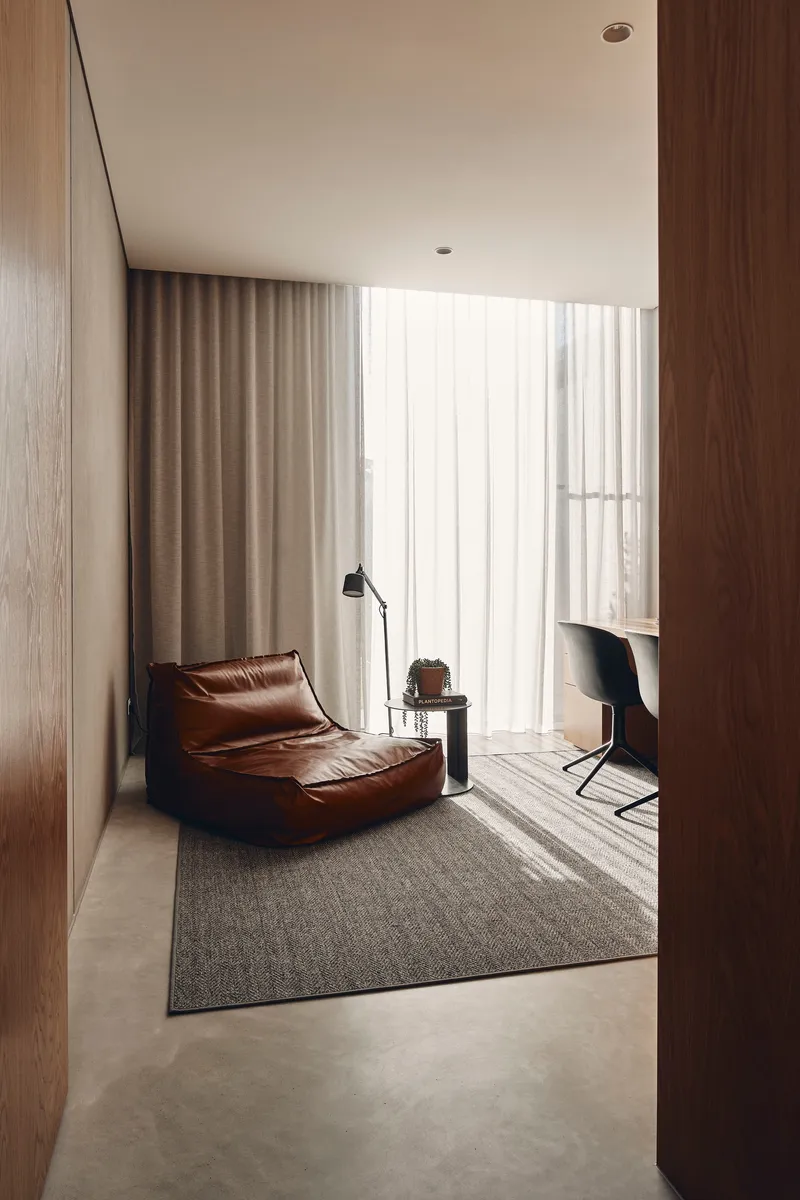
Inside, polished concrete floors and matte concrete walls form the backdrop, but the warmth comes from American oak joinery and timber-clad corridors. The open-plan living, kitchen, and dining area unfolds under a white ceiling, with timber cabinetry providing domestic scale against the monolithic shell. The material palette is deliberately restrained: concrete, stone, oak, and fine steel windows. No competing gestures.
The formal living room, set to the right of the entrance, cantilevers over the driveway and is architecturally distinct from the main body of the house. Its grey curtains, leather lounge, and bespoke glass apertures give it a quieter, more contemplative character. Stone appears in the bathrooms, kitchen, and laundry, grounding the service spaces with a heavier materiality that complements the concrete without mimicking it.
The Staircase as Joinery Object
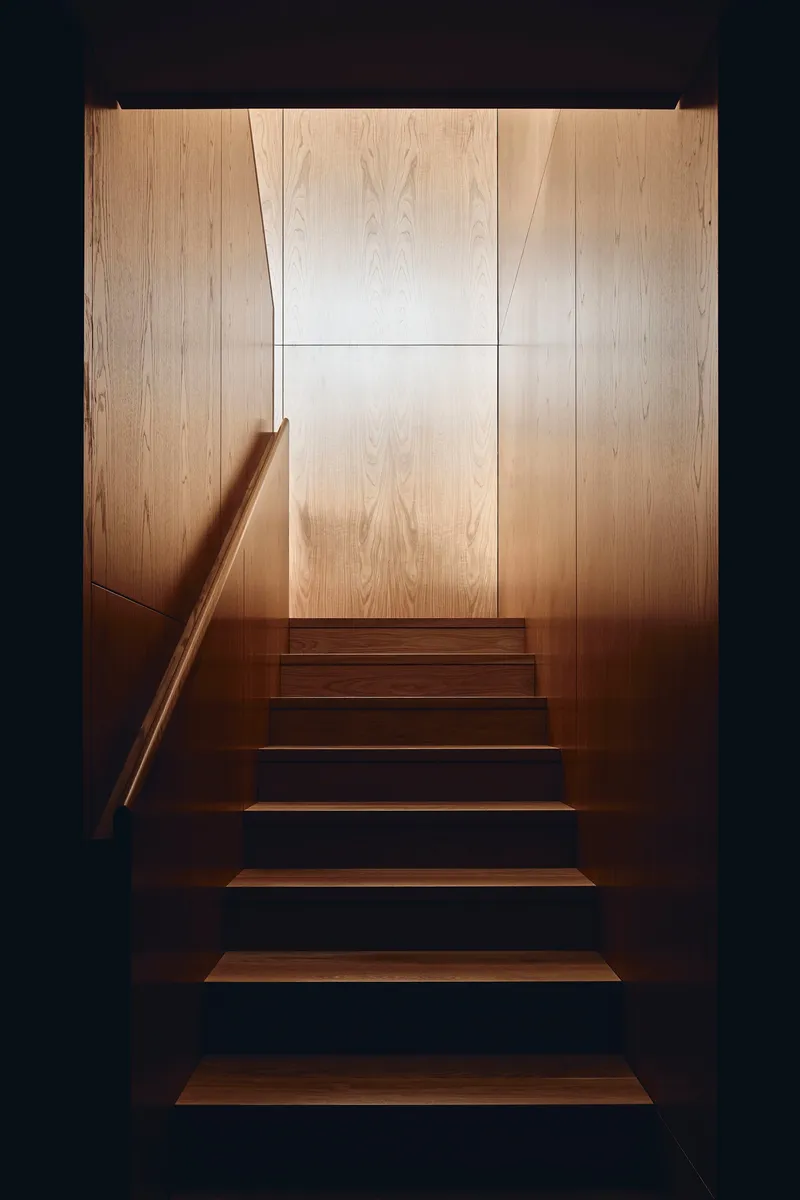
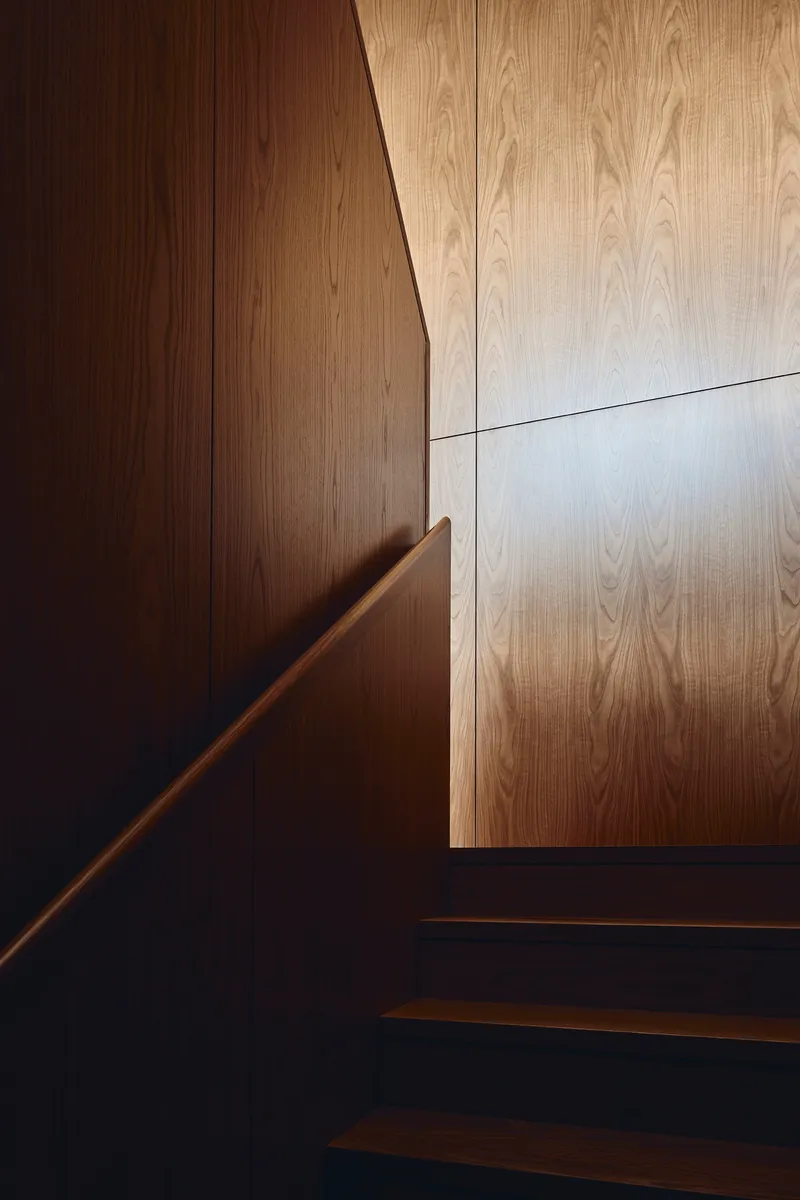
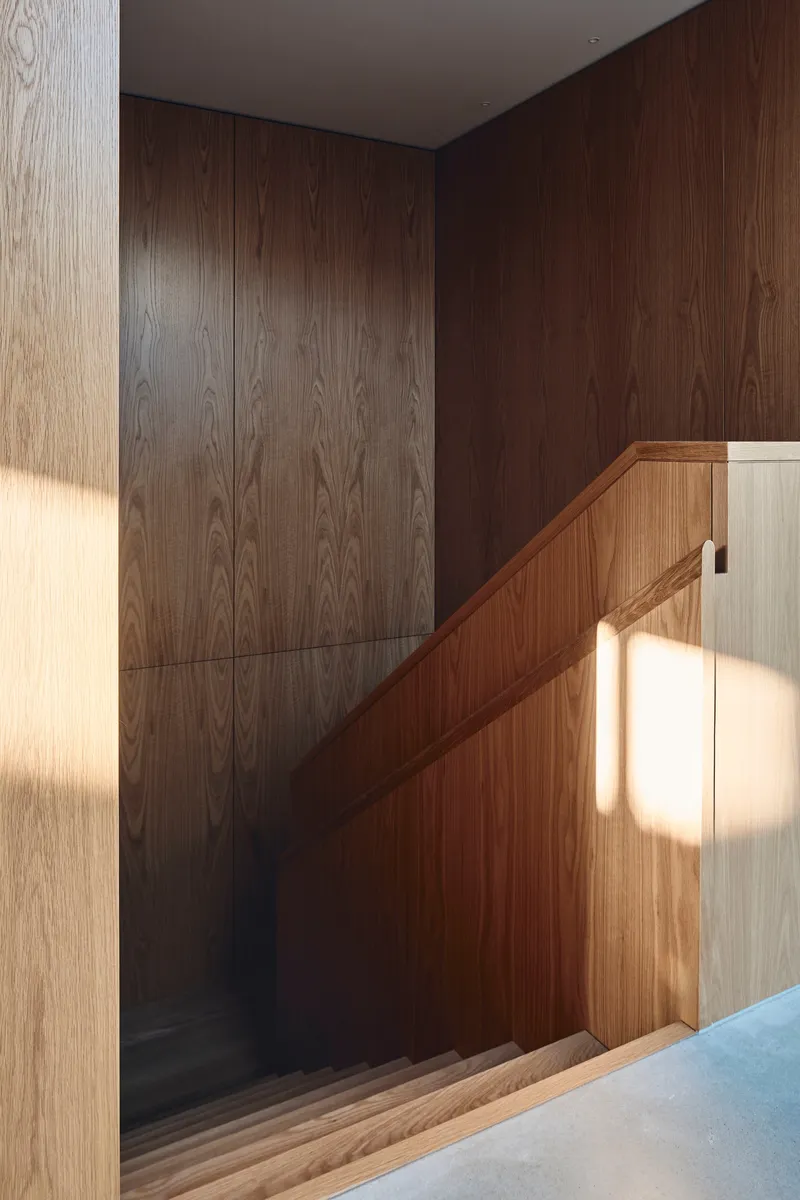
The cantilevered timber staircase deserves its own discussion. Blonde wood panels wrap the stairwell in two tones, with sunlight casting sharp diagonal shadows across the balustrade. The handrail meets the wall paneling at a precise junction that speaks to the level of craft FGR Architects demanded from their builders. Treads appear to float from the wall, illuminated from above to emphasize their weightlessness against the surrounding oak.
It is a moment of refined joinery set against the house's larger language of raw concrete mass. That contrast, between the heavy and the light, the rough and the polished, runs through the entire project and gives it its tension.
Bespoke Apertures and Light
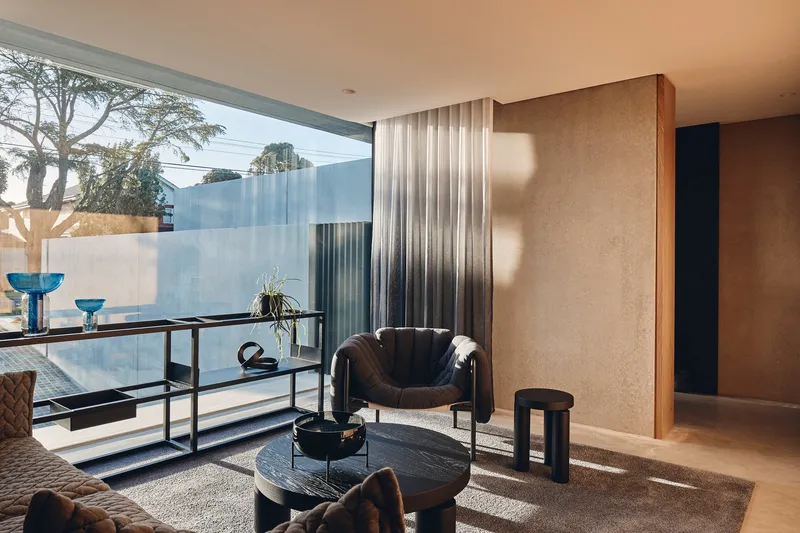
Throughout the house, bespoke glass apertures deliver what FGR Architects describe as prismatic delight. A corner window with a metal console table and glassware overlooks frosted courtyard walls in afternoon light, catching refracted sun in a way that feels both incidental and carefully staged. These moments accumulate across the plan: a vertical slot here, a horizontal strip there, each one calibrated to control privacy while admitting specific qualities of light at specific times of day.
The strategy supports the house's passive solar ambitions. Natural ventilation moves through the layered volumes, and the courtyard acts as a thermal moderator, absorbing and releasing heat through the concrete mass. The fine steel window frames are deliberately slender, maximizing glass area without introducing the visual bulk of heavier aluminum systems.
Plans and Drawings
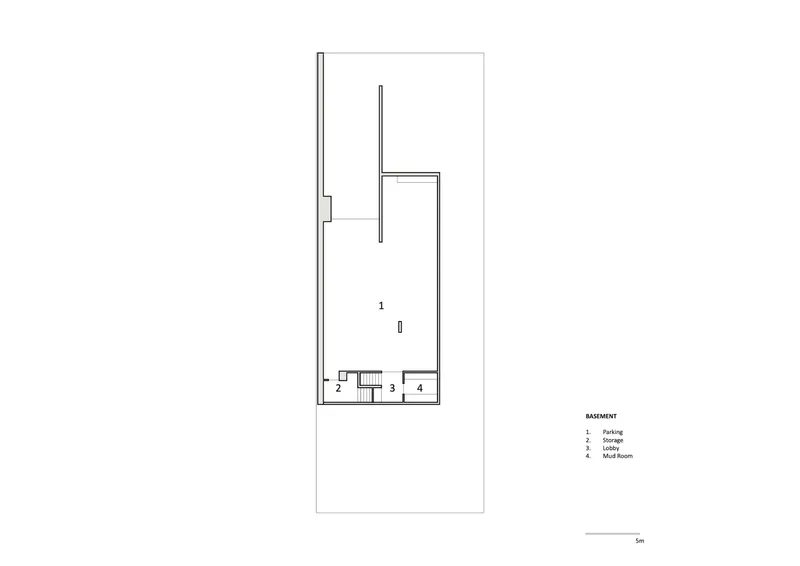
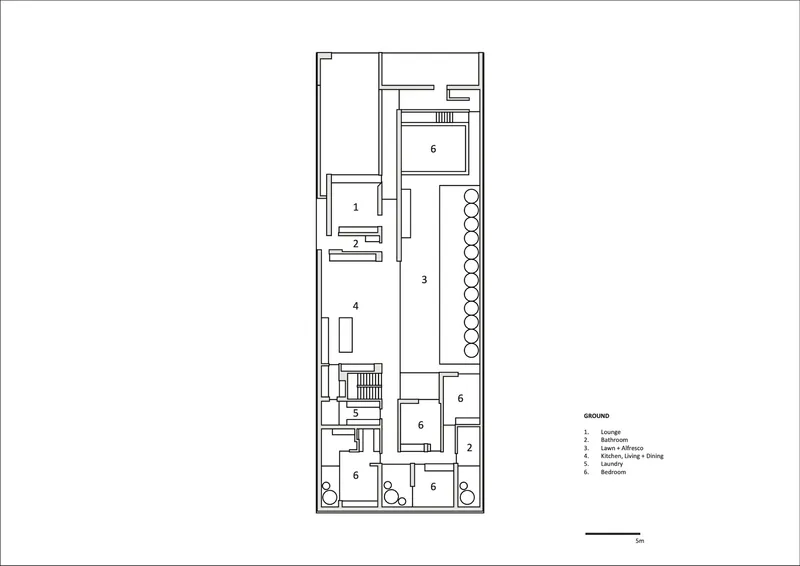
The ground floor plan reveals the full logic of the courtyard organization. The lounge, kitchen, and dining room wrap around the central staircase, with multiple bedrooms arranged along the perimeter. Each bedroom either faces the garden directly or opens onto its own interior courtyard, ensuring that no room is purely internal. The basement plan shows a parking area with storage and utility rooms, accessed via the ramp cut through the front concrete wall.
Reading the plans alongside the photographs, the concertina strategy becomes clear. The volumes are not simply stacked or extruded; they fold and offset in plan, creating pockets of outdoor space between them. The narrow entrance path at the front is legible as a deliberate compression point, setting up the spatial release of the courtyard beyond.
Why This Project Matters
The Courtyard House succeeds because it commits fully to a single idea: that a suburban home can turn its back on the street and create an interior world of genuine spatial richness. FGR Architects have not invented a new typology here. The Mediterranean courtyard model is ancient. But the execution, the burnished concrete that flows seamlessly from exterior to interior, the layered volumes that create private micro-gardens for every room, the passive environmental strategy embedded in the plan, lifts it well above the typical Melbourne luxury residence.
What we find most compelling is the discipline. In a market where residential architecture often defaults to spectacle, this house finds its drama in procession, in the threshold, in the way light hits a polished concrete floor through a narrow aperture at three in the afternoon. It is architecture that rewards living in, not just looking at.
Courtyard House by FGR Architects, Cremorne, Australia, 2022. Photography by Peter Bennetts.
About the Studio
Share Your Own Work on uni.xyz
If projects like this are the kind of work you want to make, uni.xyz is a place to publish your own, find collaborators, and enter design competitions.


Popular Articles
Popular articles from the community


Co-life: Sustainable Architecture for Age-Friendly Community Living
Co-life reimagines sustainable architecture for seniors through courtyards, rammed earth, shared gardens, and spaces designed for belonging.

Play: Fragments of Their World
Familiar architecture becomes modular playground design, creating safe spaces where displaced children can learn, connect, imagine and play.

Little Red Riding Hood: Architectural Design as a Journey Through Fear, Light, and Storytelling
Little Red Riding Hood reimagines the fairy tale through architectural design shaped by fear, light, scale, memory, uncertainty, and choice.

The Ocean Hive: Sustainable Architecture for a Self-Sufficient Civilization at Sea
The Ocean Hive imagines sustainable architecture at sea, where modular habitats, algae, wave power and ocean waste sustain a growing colony.

Similar Reads
You might also enjoy these articles

Bao Huynh Watercolor Atelier: A Serene Art Retreat in Hội An
Bao Huynh Watercolor Atelier in Hội An blends multifunctional art spaces, sustainable design, local materials, and family-friendly living in a serene environment.

Atelier Macri Concept Store Interior Design by CASE-REAL
Atelier Macri store features a "ko" counter, walnut wood details, cork displays, blending retail, gallery, and seamless customer experiences.

Manuel Vargas Izquierdo Stadium and High-Performance Sports Center: Architectural Excellence in Jalpa de Méndez
The Manuel Vargas Izquierdo Stadium blends sustainable design, inclusive sports facilities, and cultural-inspired architecture, revitalizing Jalpa de Méndez’s public spaces.

KAKR Buluh Awar Hall: Revitalizing Community and Ecology Through Bamboo Architecture
Community built bamboo hall revitalizes Buluh Awar village, empowering youth, restoring ecology, celebrating vernacular craftsmanship through sustainable architecture and culture.

Explore Courtyard Competitions
Discover active competitions in this discipline

Challenge to design a barrier free sports center

Challenge to design an outdoor ice-rink and park

Challenge to design mud housing for contemporary communities
Comments (0)
Please login or sign up to add comments
No comments yet. Be the first to comment!