![[FLEXIBILITY]?: A Timber Housing Module That Lets the Kitchen Move and the Building Grow](https://img.uni.xyz/eyJidWNrZXQiOiJ1bmktYmxvZyIsImtleSI6IjQ0L2QzYTg0NjdlLThkMjAtNDhjNi05N2E1LTZhNjZlMDIzODdiYS91bmllZGl0b3JpYWwyMDI2LTAyLTIyVDE2LTA1LTQ0LTMwODExOC5qcGciLCJlZGl0cyI6eyJyZXNpemUiOnsid2lkdGgiOjY0fSwianBlZyI6eyJxdWFsaXR5IjoxMH0sIndlYnAiOnsicXVhbGl0eSI6MTB9LCJmbGF0dGVuIjpmYWxzZSwibm9ybWFsaXNlIjpmYWxzZX19)
![[FLEXIBILITY]?: A Timber Housing Module That Lets the Kitchen Move and the Building Grow](https://img.uni.xyz/eyJidWNrZXQiOiJ1bmktYmxvZyIsImtleSI6IjQ0L2QzYTg0NjdlLThkMjAtNDhjNi05N2E1LTZhNjZlMDIzODdiYS91bmllZGl0b3JpYWwyMDI2LTAyLTIyVDE2LTA1LTQ0LTMwODExOC5qcGciLCJlZGl0cyI6eyJyZXNpemUiOnsid2lkdGgiOjEyMDAsImZpdCI6Imluc2lkZSJ9LCJqcGVnIjp7InF1YWxpdHkiOjcyfSwid2VicCI6eyJxdWFsaXR5Ijo3Mn0sImZsYXR0ZW4iOmZhbHNlLCJub3JtYWxpc2UiOmZhbHNlfX0=)
[FLEXIBILITY]?: A Timber Housing Module That Lets the Kitchen Move and the Building Grow
A 5m x 7m cross-laminated timber module and a movable kitchen-bathroom core let homes in Seoul's Yeouido District reshape themselves over time.


Most apartments are frozen at the moment of handover. The walls, the plumbing, and the kitchen all lock in one idea of how a household lives, and every later change becomes a renovation. [FLEXIBILITY]? starts from the opposite premise. It treats the home as a system that keeps negotiating with its occupants. The question mark in the title is deliberate: flexibility here is something to test across scales, from where the sink sits to how many floors a block eventually reaches.
Designed by Eun Kim and D. Tarantella, the proposal sits in Yeouido District in western Seoul, one of the city's main financial and redevelopment hubs, inside a zone capped at a 250% floor-area ratio. Rather than reaching that density with repetitive apartment slabs, the designers build it from a single repeatable unit: a 5m x 7m base module, pre-assembled from cross-laminated timber panels and trucked to site for installation.
A Gridded Tower Built From One 5m x 7m Timber Cell
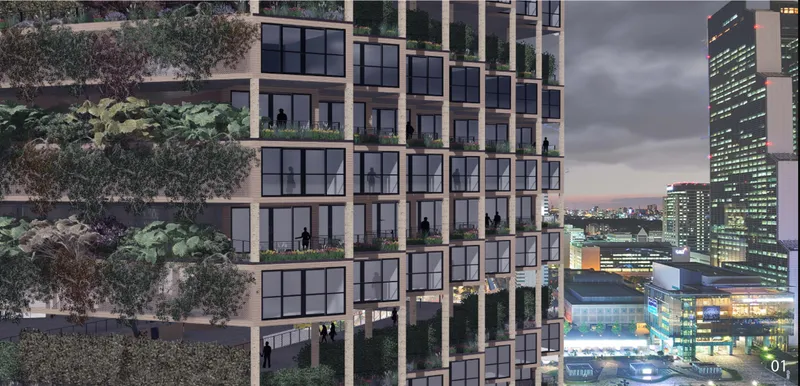
The evening rendering shows the result of that logic: a gridded residential block whose rhythm comes straight from the module, with planted terraces breaking up the façade and lit windows hinting at different interiors behind an even frame. Against the illuminated towers of the Yeouido skyline, the building reads as a quieter, more porous neighbour. Its texture comes from occupation rather than from a sculpted envelope.
Prefabricating in cross-laminated timber is more than a sustainability gesture. It is the condition that makes the rest of the project work. A module that arrives finished can be added, stacked, or recombined without rebuilding the whole, so the grid becomes a framework that can hold single units, shared units, and duplexes without changing its structural language.
The Mobile Service Unit Turns the Plan Into a Variable
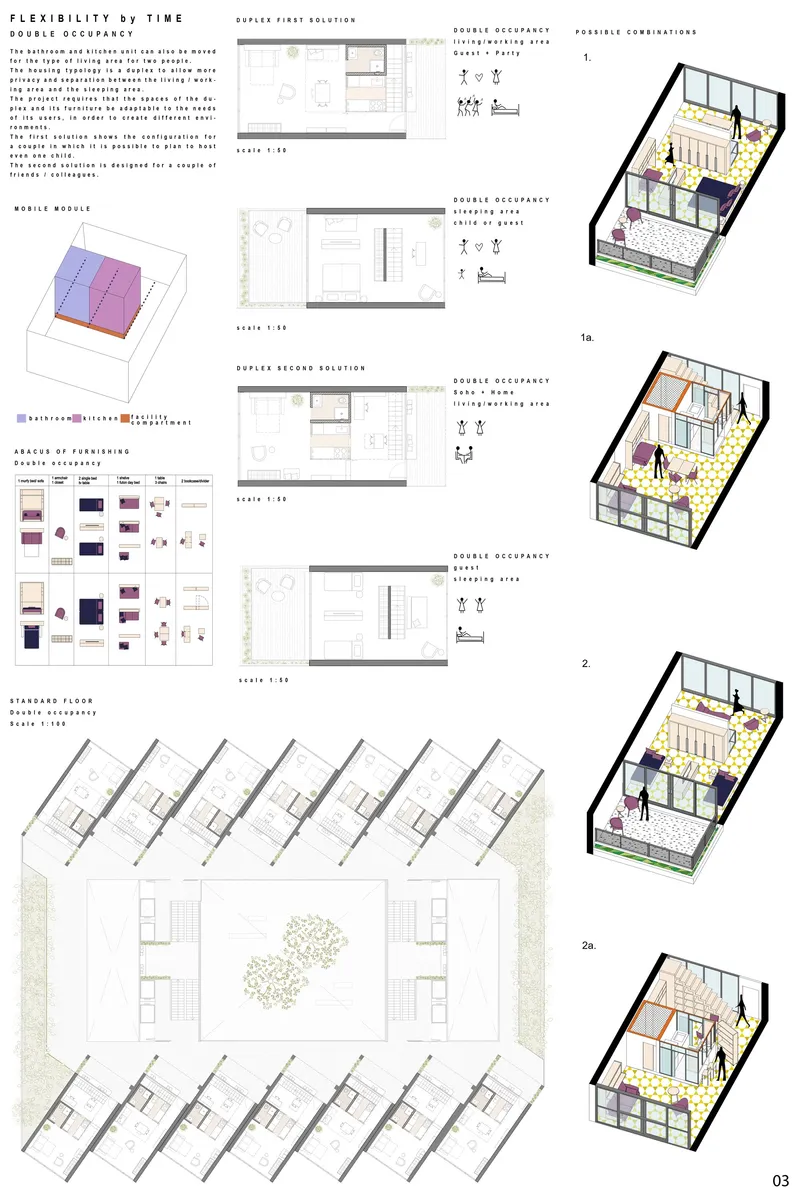
The sharpest idea in the project is on this presentation board. Kitchen and bathroom infrastructure are gathered into a compact mobile service unit instead of being fixed into the floor plate. Service connections hidden beneath the module let that core move without complex reconstruction, and everything around it is redefined with adaptable furniture and sliding partitions. In the single-occupancy layouts, the furniture responds to the orientation and position of the mobile core, so one room can shift between social, working, and private modes.
The double-occupancy studies push this vertically. Two duplex solutions use layering across levels to give each occupant more privacy while keeping the interior open and connected. Set beside the standard floor plan arranged around a central courtyard, these variations show that the designers have thought about the unit and the building together. Wet areas are usually the most rigid part of any housing plan. Making them movable is a small technical decision with large spatial consequences, especially in dense cities where every square metre has to serve more than one purpose.
Communal Layers Stacked Between Private Floors
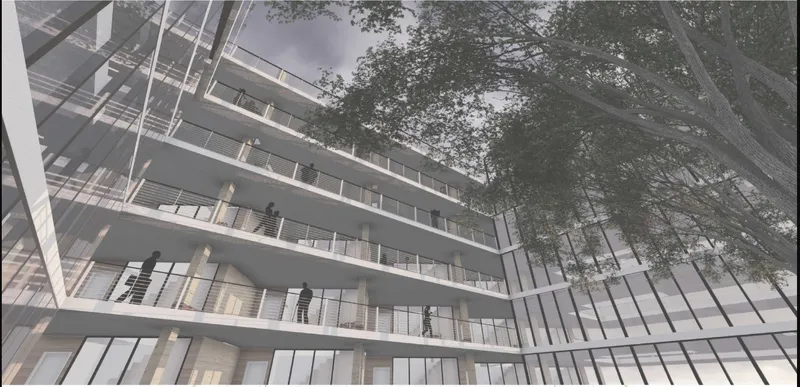
The upward view of stacked balconies, framed by a large tree canopy, shows the project's environmental intent from the street. Terraces, climbing greenery, communal corridors, and shared platforms are built into circulation and the façade itself. The planting tempers the building's climate and softens its edges, and the designers treat it as part of how people move through the block, not as decoration.
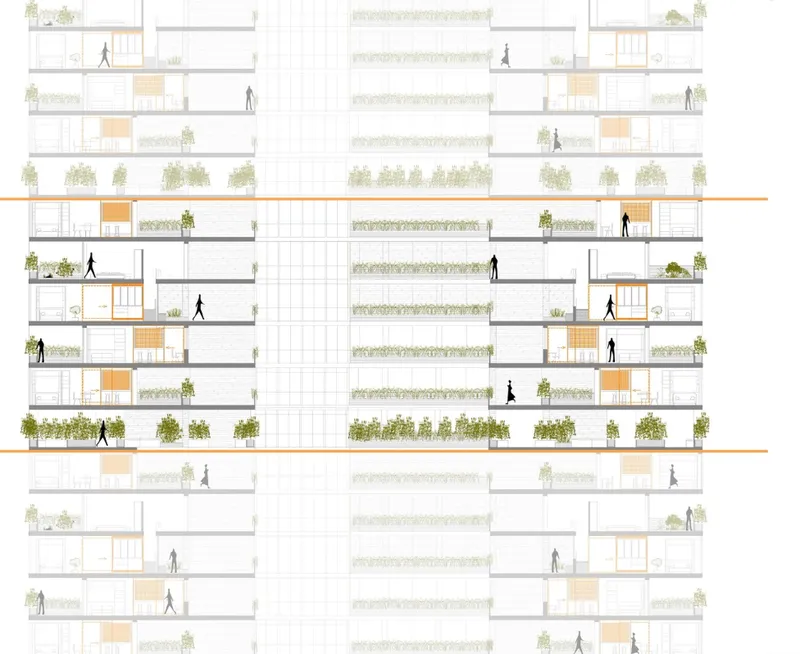
The section makes the social strategy legible. Communal spaces are distributed vertically through the building instead of being pushed to the ground floor or the roof, and the highlighted levels mark where the stack opens up to shared use. The orange-framed partitions running through the apartments point back to the interior flexibility, while the planted terraces interrupt the usual monotony of identical floors. This is where the plug-in timeline earns its credibility: a building expected to grow and change in phases needs shared spaces that can absorb those shifts, and here they sit at several heights.
A Timber Gallery Where the Corridor Becomes a Street
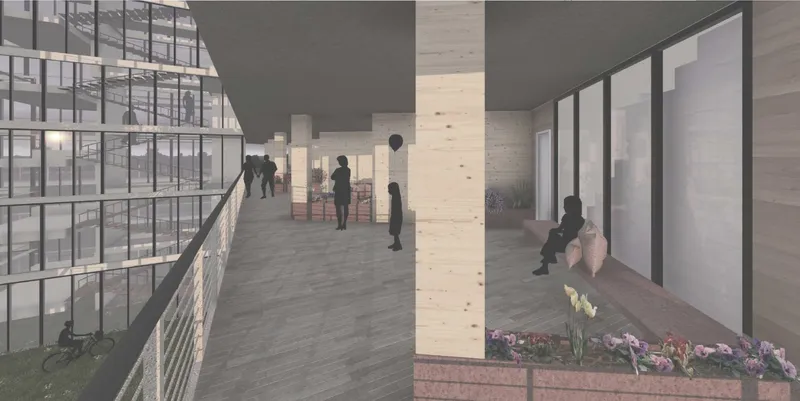
The final rendering slows to the scale of everyday life: a covered gallery lined with timber columns, a bench, a planter, residents in silhouette, and a cyclist passing on the grass beyond the railing. The corridor is wide enough to linger in, which is the point. Circulation becomes a social room where neighbours meet on the way to somewhere else.
For a district associated with finance and redevelopment, this is a pointed image. Yeouido's skyline is defined by towers that keep the street at a distance. The proposal argues that a residential model can meet the same density targets and still put community and adaptability ahead of repetition.
Why This Project Matters
Flexible housing is often promised and rarely delivered, because the hard parts of a building, its structure and its services, stay fixed while only the furniture moves. [FLEXIBILITY]? goes after those hard parts directly. A prefabricated 5m x 7m timber module handles growth at the urban scale, and a relocatable kitchen-bathroom core handles change inside each home. Together they make adaptability a structural property rather than a marketing claim.
Kim and Tarantella also understand that flexibility without shared space just produces more efficient isolation. The vertically distributed communal platforms, planted terraces, and generous galleries give the system a social backbone that can accommodate whatever the individual units become. For fast-changing districts like Yeouido, that pairing of a movable core and a fixed commitment to community is a model worth taking seriously.
View the Full Project
About the Designers
Designers: Eun Kim, D. Tarantella
Enter a Design Competition on uni.xyz
uni.xyz runs architecture and design competitions year-round that reward proposals with spatial conviction and real site intelligence.
Project credits: [FLEXIBILITY]? by Eun Kim, D. Tarantella.


Popular Articles
Popular articles from the community


FCC Arquitectura Expands a Portuguese Granite House with a Board-Marked Concrete Wing
In Portugal, JV House pairs a cleaned-up whitewashed and granite dwelling with a timber-shuttered concrete extension, courtyards and a garden pool.


Aquadapt: An Underwater Habitat That Rewrites Its Rooms by the Hour
Curved modules ring the seabed while one shell shifts from breakfast room to cinema, farm and football pitch as residents' needs change.

Singing Woman: An Opera House That Performs Before the Curtain Rises
Ovidiu Cristian Pavel's conceptual opera house translates Estonia's choral identity into a sculpted waterfront landmark facing the Baltic Sea.

graciastudio Turns a Viewless Tijuana Lot Inward Around a Courtyard of Concrete, Timber and Trees
In Tijuana, Jorge Gracia's GA2 House stacks a timber-clad private floor over exposed concrete and replaces a missing view with a planted interior patio.

Similar Reads
You might also enjoy these articles
Healing Façade: A Modular Chapel System That Restores Ethiopia's Sacred Forests
Winner of the Eco-Chapel competition, this circular timber façade collects water from air to rebuild soil and reforest degraded Ethiopian landscapes.
Kaffeebühnen: Where Coffee Shop Architecture Becomes a Civic Stage in Vienna
A linear sequence of timber boxes, transparent shells, and open yards turns the Viennese café tradition into a public performance space.
Eco Chapel: A Modular Forest Pavilion That Grows Like the Landscape It Protects
Hexagonal timber modules weave through existing trees, turning a chapel into a living system for prayer, education, and reforestation.


Urban Forest: A Vertical Ecosystem for 5,000 Workers in Singapore's Changi Business Park
Radially stacked pods and layered green decks turn a 7-acre plot into 47 acres of ecological workspace projected for 2040.

Explore Architecture Competitions
Discover active competitions in this discipline

Design a brochure to showcase the effects of the technosphere

Challenge to illustrate ‘A tale of Two Cities’

Deconstructivism - Illustration Design Challenge

Challenge to reimagine the Iron Throne
Comments (0)
Please login or sign up to add comments
No comments yet. Be the first to comment!