
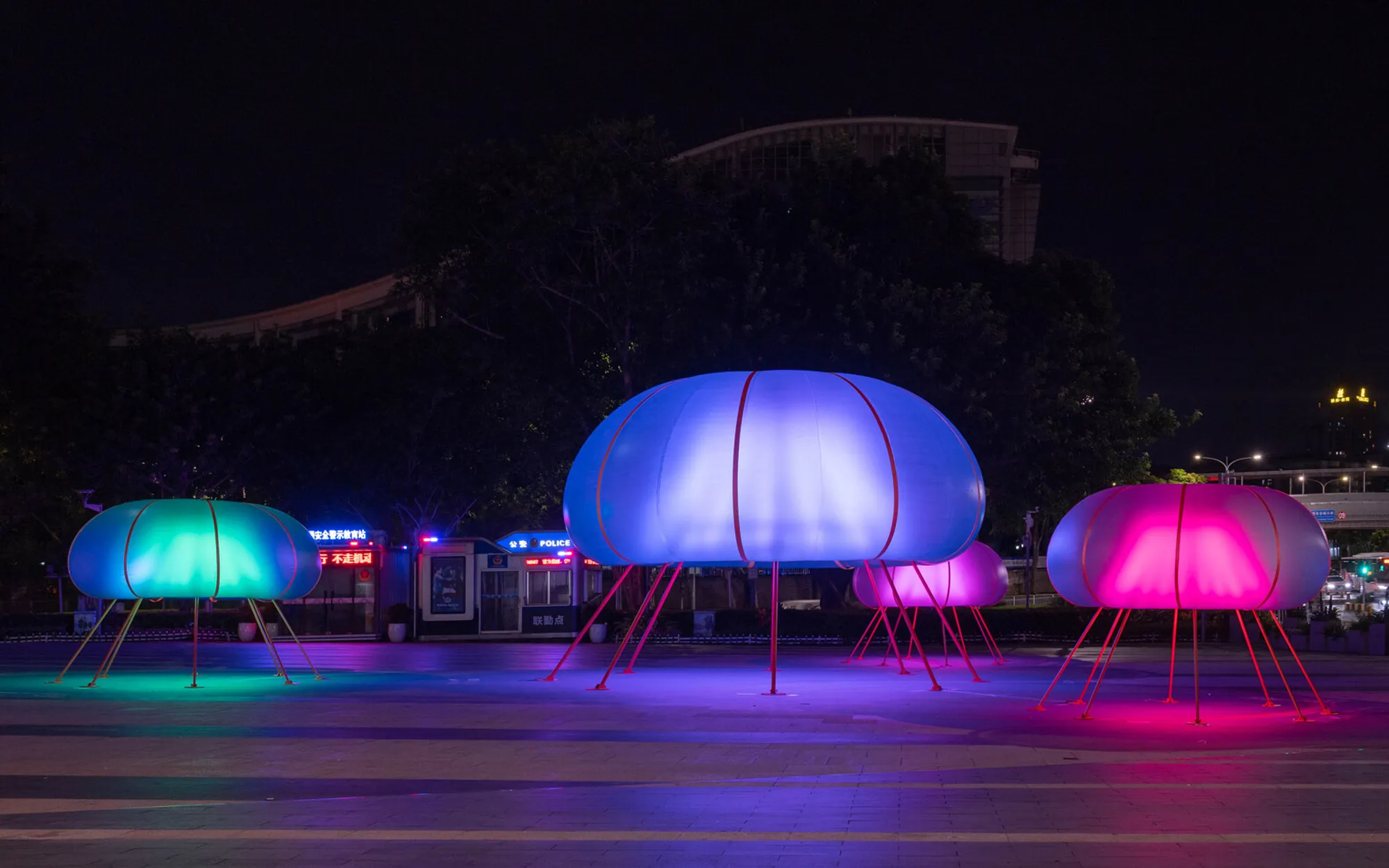
Floating Pavilion by Daxing Jizi Design: A Dreamlike Urban Oasis in Shenzhen
Floating Pavilion by Daxing Jizi Design is a glowing, jellyfish-inspired installation transforming urban space into a surreal, interactive experience.


A Luminous Intervention in the Urban Fabric
Unveiled during the 3rd Public Urban Festival “Let’s Gala” in Shenzhen, the Floating Pavilion by Daxing Jizi Design is a captivating spatial installation that transforms a bustling city plaza into an ethereal nighttime landscape. Located in the heart of Longgang District, this luminous pavilion reimagines the role of public space through immersive lighting design, biomorphic forms, and community interaction.
Floating gently above the concrete surroundings, this installation invites visitors into a serene and poetic world — a respite from the chaos of daily life. The project is not only an architectural achievement but also a reflection on how art, design, and light can reshape urban experiences.
Conceptual Narrative: Inspired by the Jellyfish
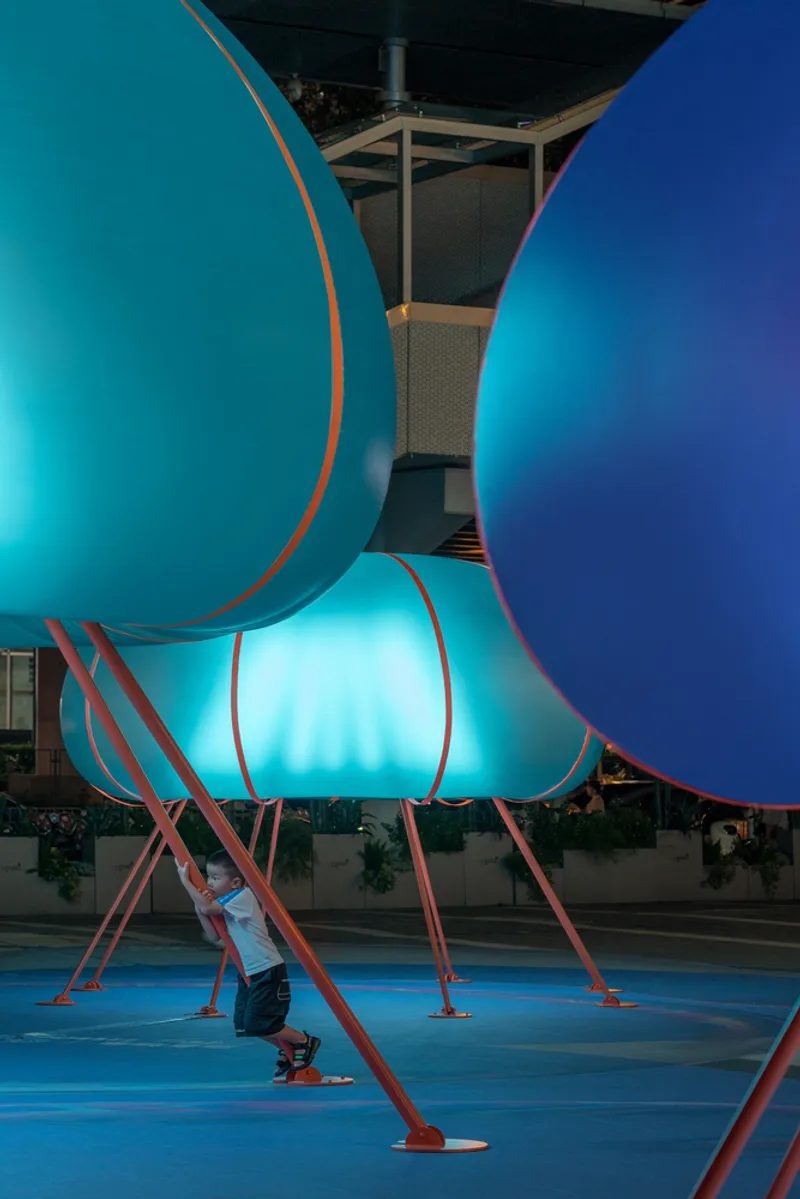
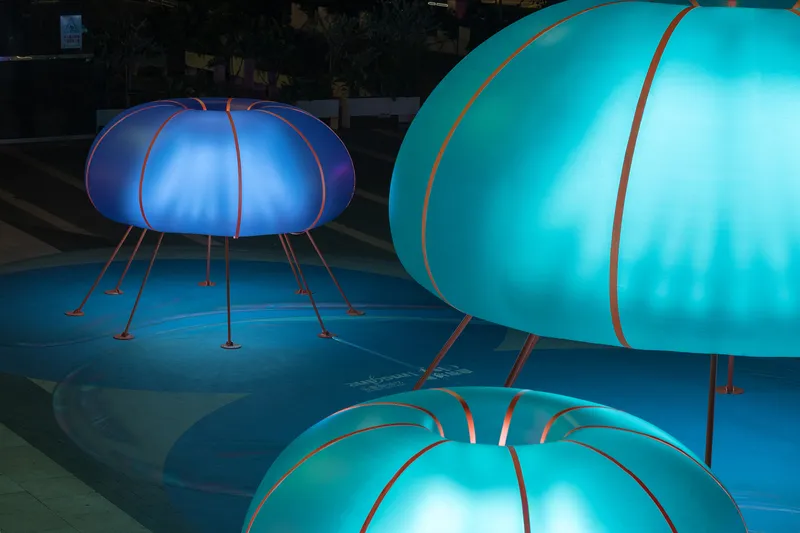
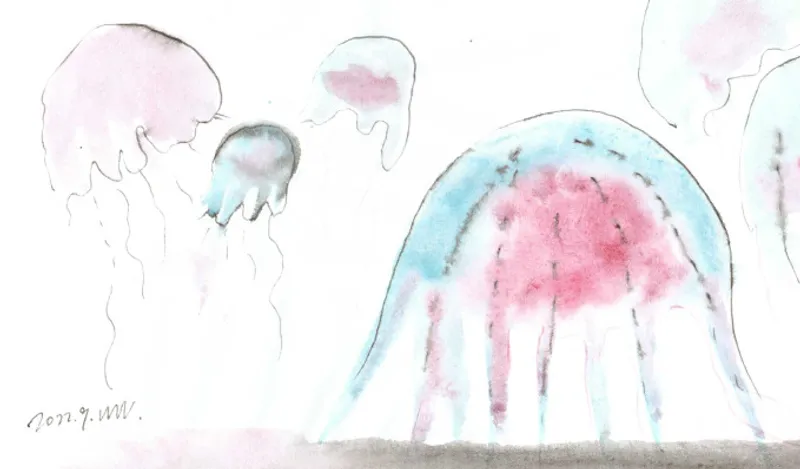
Drawing its aesthetic and conceptual inspiration from deep-sea jellyfish, the Floating Pavilion channels the surreal beauty and motion of marine plankton. Its translucent, umbrella-like domes seem to hover effortlessly, their flowing curves and glowing hues recalling the quiet elegance of underwater life. This bio-inspired form is a metaphor for freedom and imagination, creating a dreamlike, “floating” mental space within the bustling city.
But the pavilion goes beyond imitation. It explores the delicate boundary between abstraction and realism, using architecture as a tool for emotional and sensory resonance. The installation serves as a medium for urban reflection, encouraging visitors to reconnect with nature, community, and themselves.
Spatial Design: Creating a Fantasy of Light
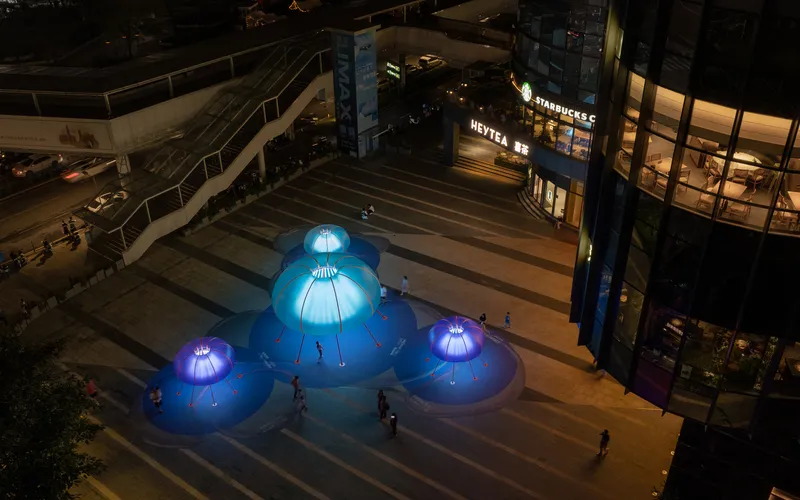
The pavilion is composed of a “1+3” layout — one large central pavilion (7 meters in diameter, 5.5 meters high) surrounded by three medium-sized structures (3.5 meters diameter, 2.5 meters high). This composition forms a visually dynamic matrix that becomes a beacon of light in the plaza.
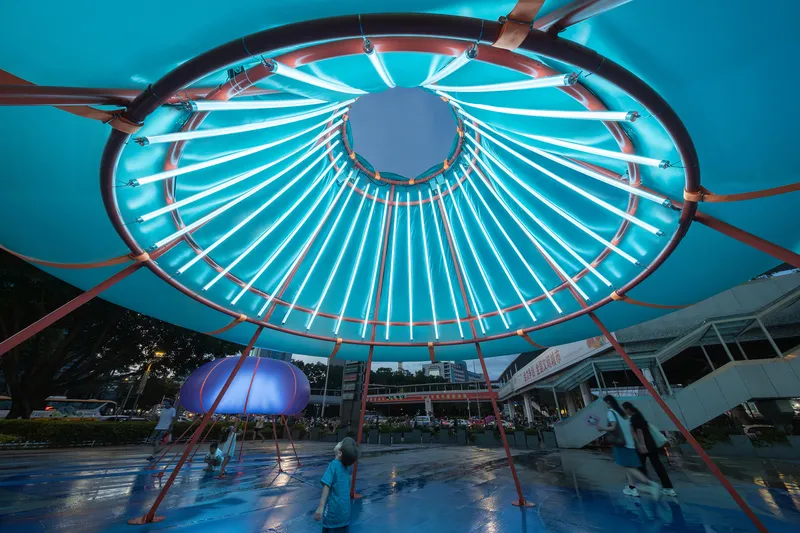
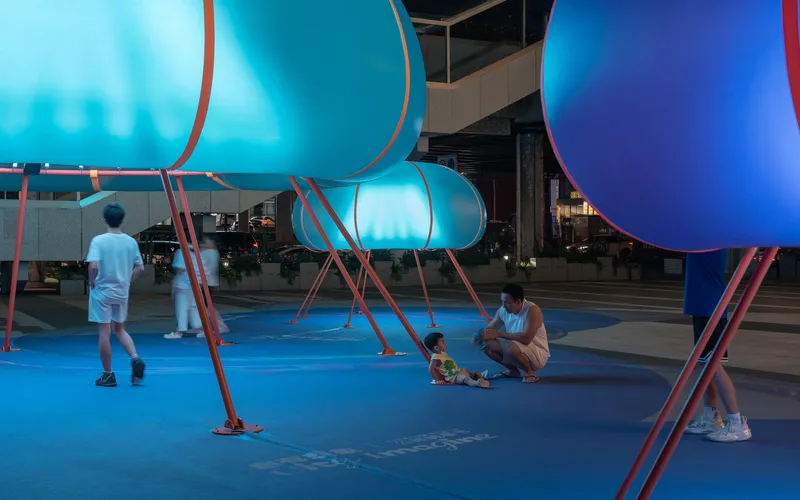
Each pavilion is constructed using a metal frame and translucent inflatable film, a material chosen for its durability, sunshade properties, and water resistance — essential qualities for Shenzhen’s unpredictable summer weather. The film surfaces are inspired by natural pigments, featuring gradients of green, purple, and yellow.
A full-spectrum RGB lighting system programmed with a 6-second breathing cycle synchronizes with both human respiration and the rhythm of jellyfish movement, creating a gentle, meditative glow that shifts continuously. This rhythmic lighting transforms the urban square into a living installation, inviting people to slow down, reflect, and engage.
Interaction & Community Impact
Far more than a visual statement, the Floating Pavilion offers an inclusive space for spontaneous social encounters. The immersive environment encourages visitors of all ages to enter, explore, rest, and reflect. Visitors can step inside the glowing jellyfish structures, look up into the glowing canopy, and become part of the installation itself.
Originally, the design proposed small-scale “jellyfish loungers” filled with luminescent liquid as public seating elements. While these were not realized due to site management constraints, the idea signals the architects' intent to integrate public furniture into their installations — enhancing functionality without compromising artistic integrity.
In its realized form, the pavilion offers a rare space of deceleration in a fast-paced city, supporting community cohesion and emotional connection. As the day cools into evening, locals gather around the pavilions, drawn to the soft light, soothing forms, and the shared ambiance of a reimagined public square.
Technical Innovation & Material Strategy
The Floating Pavilion’s thoughtful material palette and structural flexibility underscore its design intelligence. The bright orange straps supporting the film surfaces are not only visually striking, but also function as a dynamic system that adapts to environmental stresses. In extreme conditions like typhoons, the inflatable structures can be safely deflated and secured to the frame — a crucial safety feature for temporary urban installations.
Architectural Reflection: A Middle Ground Between Art and Life
At its core, the Floating Pavilion is an exploration of what public installations can offer in the era of digital distraction and urban monotony. According to Daxing Jizi Design, their work lies at the intersection of architectural “hardware” and the emotional “software” of artistic experience.
By using light as a medium and nature as inspiration, the firm fosters connections — between people, places, and ideas. Their installations aim to create intimate middle grounds within the city — spaces that feel approachable, meaningful, and full of quiet possibility.
As the lights breathe and shift, and the jellyfish-like forms pulse against the night sky, the Floating Pavilion becomes a living organism — a public gesture toward unity, emotion, and creative urbanism.
All Photographs are works of Chao Zhang



Popular Articles
Popular articles from the community


Lunar Spiral: Space Architecture Shaped by the Mathematics of the Universe
Lunar Spiral reimagines space architecture through Fibonacci geometry, lunar regolith, levitating habitats, and self-sustaining Moon living.

Hill & Cross Opera: Sculptural Opera House Architecture Shaped by Tallinn’s Landscape and Identity
Hill & Cross Opera reimagines opera house architecture in Tallinn through its sculptural hill, civic plaza, glass wave and a luminous cross.

The Ocean Hive: Sustainable Architecture for a Self-Sufficient Civilization at Sea
The Ocean Hive imagines sustainable architecture at sea, where modular habitats, algae, wave power and ocean waste sustain a growing colony.

Conexión: Biophilic Design Reimagines High-Rise Living in Hong Kong
Conexión reimagines high-rise living in Hong Kong through biophilic design, green facades, shared spaces, daylight, water and nature within.


Similar Reads
You might also enjoy these articles


Hodi-Mandai Geram
Project Function: Preservation and revitalization of the Intangible heritage and socio-spatial identity of the Hodi by Housing, Cultural Memory Center, Sacred Grove, landscape, local tourism economy


Olio Towers: A Mid-Rise for Performers That Fuses Housing, Rehearsal, and Stage
Located blocks from Houston's Theater District, this modular tower stacks living units around a central performance atrium.

Oasis: Modular Green Housing Carved into Dhaka's Urban Fabric
A shortlisted Plugin Housing entry reclaims unauthorized settlements in Dhaka with stepped concrete volumes, green roofs, and ventilation-driven design.

Black Hole: A Floating Megastructure for the Post-Physical Era
Emiliano Mazzarotto envisions a spherical, self-scaling arena where e-sports, digital hotels, and holographic stadiums replace traditional public space.


Explore Floating City Competitions
Discover active competitions in this discipline



Challenge to design a portable theatre

Challenge to design a portable music platform


Challenge to design an open learning module for the elderly


Challenge to reimagine the Iron Throne
Comments (0)
Please login or sign up to add comments
No comments yet. Be the first to comment!