
ARQUITECTURA-G and Sam Chermayeff Office Turn Steel Plates into a Paper Model for FLOS Amsterdam
A 400-square-meter showroom on Amsterdam's waterfront folds welded steel into a luminous stage for one of lighting's most storied brands.


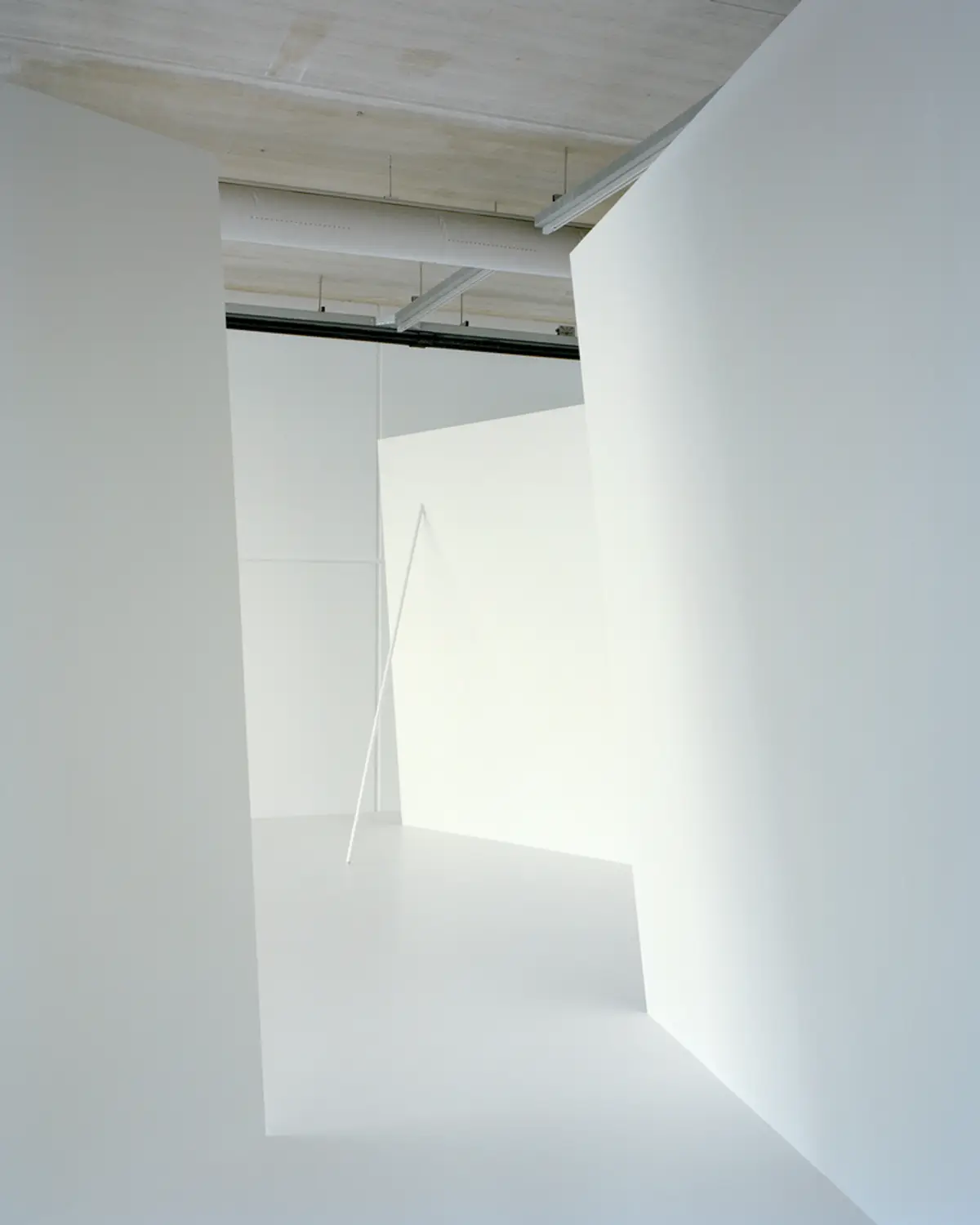
Take a sheet of paper, fold it so it stands on its own weight, and let light fall across its creased surfaces. Now scale that gesture up to 400 square meters, swap the paper for 6mm welded steel plate, and place the whole thing on the third floor of an industrial building overlooking open water on the outskirts of Amsterdam. That is essentially what ARQUITECTURA-G and Sam Chermayeff Office have done for FLOS, the Italian lighting house founded in 1962. The result is a showroom that treats architecture itself as the primary lighting instrument: every wall, fold, and gap exists to catch, redirect, or frame light.
What makes the project genuinely interesting is not that it displays FLOS products, but how completely it subordinates architecture to the behavior of light. The satin-white steel surfaces lean against the existing concrete structure and against each other, bending subtly under their own weight. Nothing is concealed. The raw waffle slab ceiling, the mechanical ducts, the concrete columns all remain visible above and behind a landscape of folded planes. The steel is simultaneously solid and fragile, opaque and reflective. It is architecture reduced to a single material operation, and that operation is calibrated entirely around luminance.
Industrial Shell, Luminous Insert
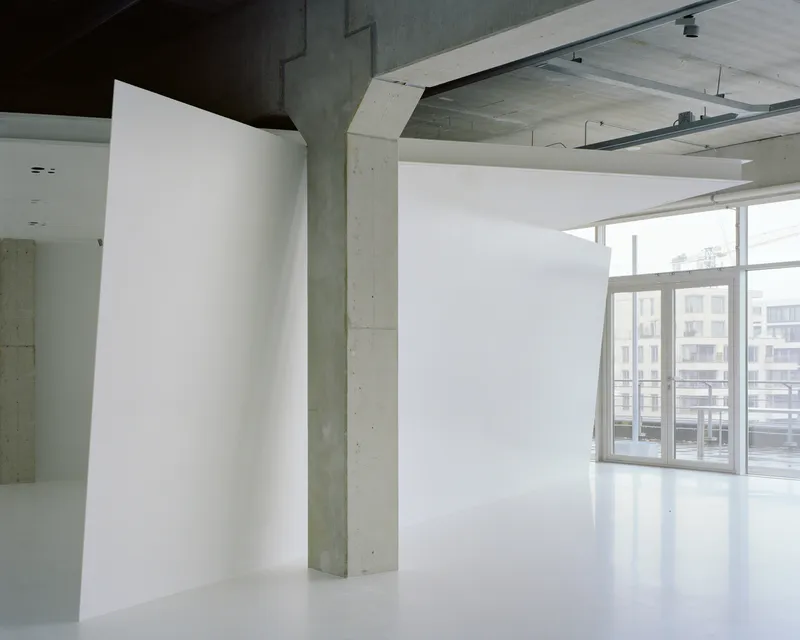
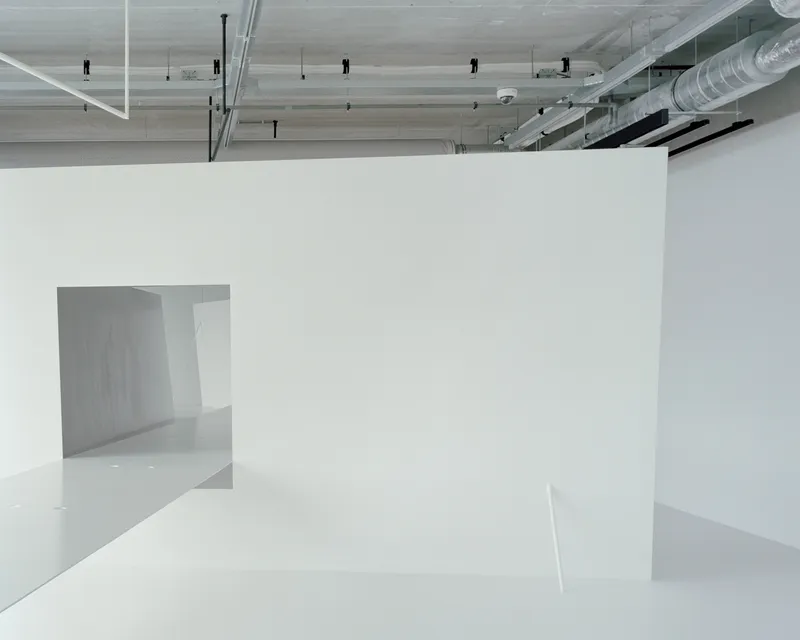
The existing building provides everything the design refuses to replicate: mass, roughness, a visible structural logic. The exposed concrete waffle slab and its deep coffers absorb light where the steel reflects it. Mechanical ducts and ceiling panels remain unapologetically present overhead. Against this backdrop, the white partitions read as a distinct spatial layer, an interior within an interior. The contrast is precise rather than theatrical. Where concrete absorbs, steel redirects. Where the slab is heavy and gridded, the partitions are angular and free-standing.
Structural engineer Bollinger Grohmann worked with the design teams to ensure the steel plates could lean against the concrete without conventional fixings or framing. The plates were welded on site by contractor ErtlundZull, a process that gave each seam and joint a handmade clarity. Structural honesty here is not just an aesthetic posture; it is the mechanism by which the surfaces stay upright.
Folded Steel as Spatial Divider
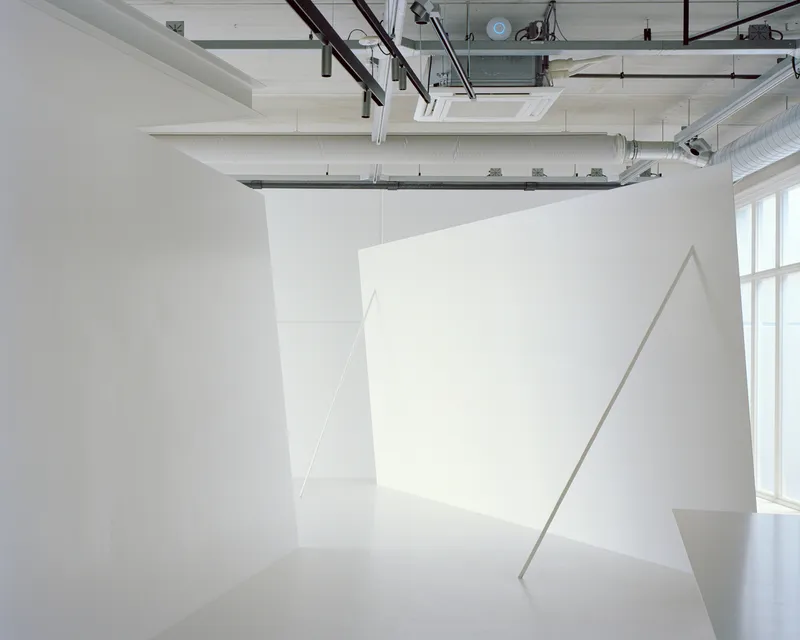
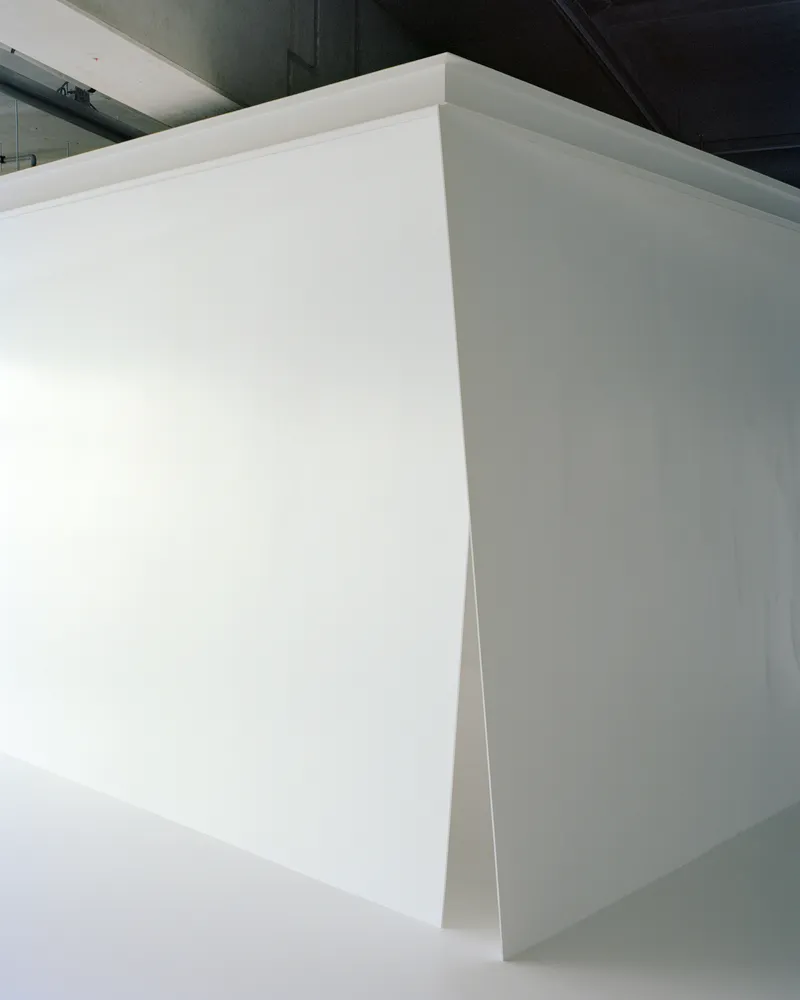
The open plan is subdivided not by rooms but by angles. White steel plates stand free of the floor in some places, touch the ceiling in others, and always create sharp, clean junctions where they meet. The close-up of a corner joint reveals the precision of the welding: two planes converge without trim, sealant, or cover strips. The satin-white finish reads as matte at oblique angles and gently reflective head-on, which means the same wall changes character as you walk past it.
The description of the project as "a paper model come to life" is unusually accurate. Paper models hold themselves up through geometry, not fasteners. Here, the steel does the same. It folds, it leans, it rests against the concrete. The thinness of 6mm plate, visible at every exposed edge, reinforces the sensation that these walls could be peeled away and refolded at will.
Light as Protagonist
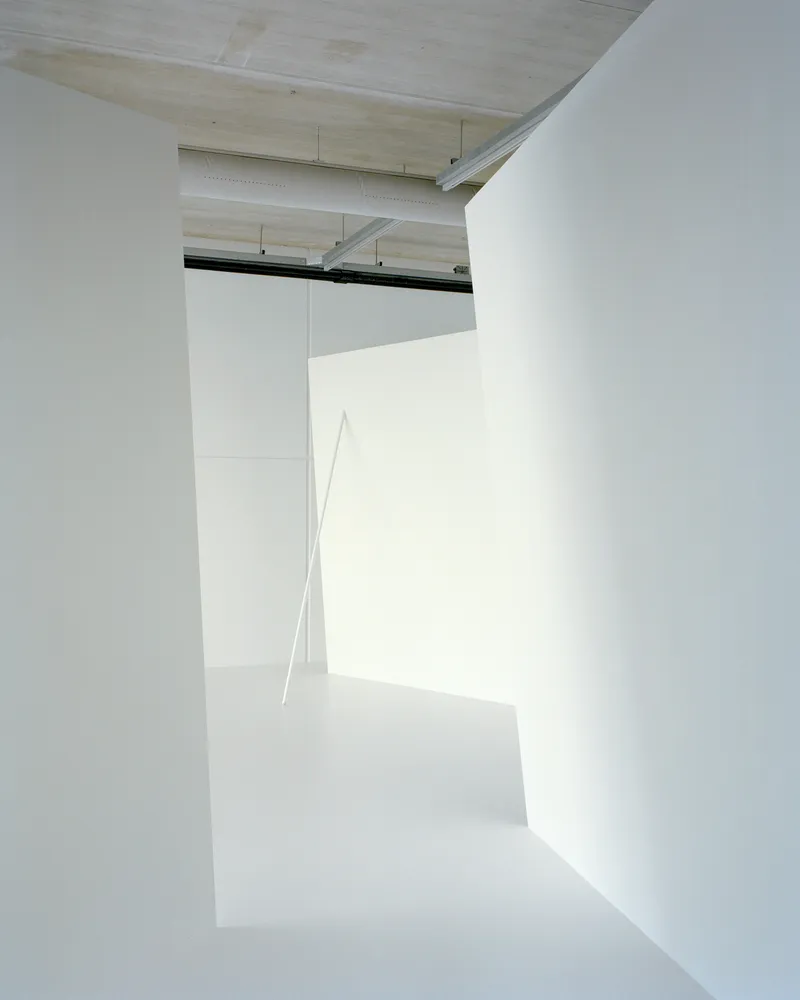
The narrow passage between two angled partitions captures this project's central idea in a single image. A thin diagonal beam of sunlight enters from an unseen opening and rakes across the white steel. Because the surfaces are satin rather than gloss, the light spreads softly along the plane instead of bouncing off in a hard reflection. The gap between the walls becomes a controlled aperture, admitting daylight the way a slit window does in a chapel.
For a lighting brand showroom, the decision to give natural light such prominence is counterintuitive and smart. FLOS luminaires are displayed across the space, but they operate in dialogue with daylight rather than in opposition to it. The satin-white steel amplifies both sources equally, so the showroom shifts mood throughout the day. Morning light off the adjacent water, afternoon warmth through the industrial glazing, and the FLOS fixtures taking over as evening arrives: the architecture registers all of it.
A Hybrid Program Around an Eleven-Meter Table
The program is deliberately ambiguous. Living room, office, meeting space, and kitchen coexist without hard boundaries. At the center sits a darker, triangular zone anchored by an eleven-meter table that doubles as a kitchen counter and communal workspace. The scale of that table, longer than many apartments, signals that this is not a conventional retail environment. It is a place where conversations happen, where meals are shared alongside product presentations, where the line between hospitality and commerce dissolves.
The angular partitions define these zones without enclosing them. You can see through gaps between walls, catch glimpses of adjacent functions, and always remain aware of the larger volume. It is an open plan that manages to feel intimate in specific pockets while remaining generous as a whole.
Plans and Drawings
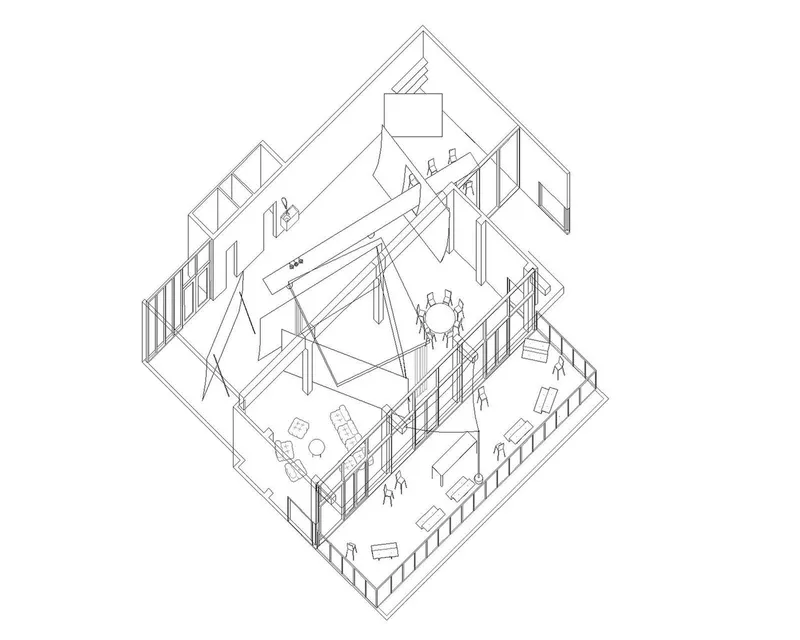
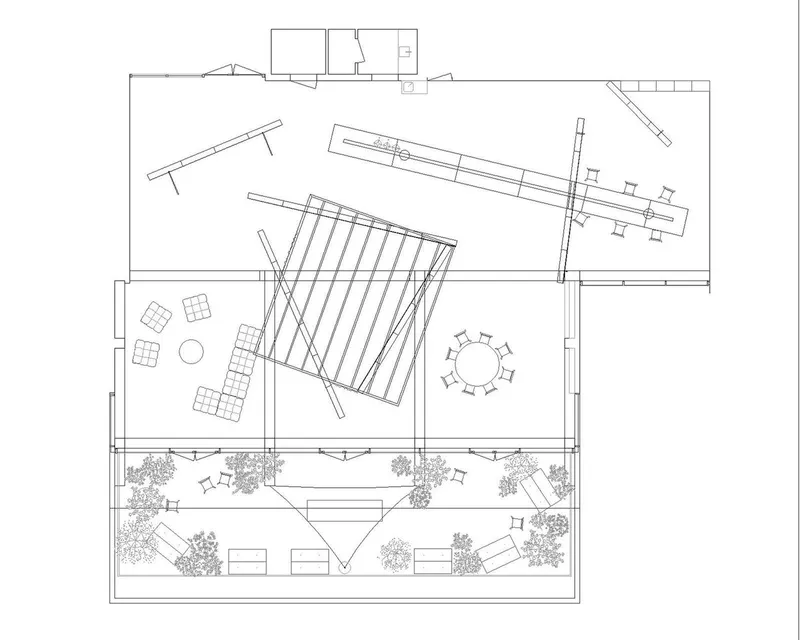
The axonometric drawing reveals the spatial logic most clearly. The angled partitions are scattered across the floor plate like origami fragments, creating corridors, alcoves, and open areas without ever forming closed rooms. Seated figures at various scales give a sense of how the partitions relate to the body: some tower overhead, others sit just above eye level, and the gaps between them frame carefully composed views.
The floor plan confirms how few moves are actually at work. A central stairwell provides vertical circulation, and a landscaped courtyard below grounds the building in its site. Within the showroom itself, the entire spatial complexity comes from the placement and angle of perhaps a dozen steel plates. There is no hidden geometry, no parametric trickery. The plan could be sketched on a napkin, yet the resulting space is anything but simple.
Why This Project Matters
Brand showrooms tend to fall into two traps: either the architecture overpowers the product, or the space recedes into generic neutrality. ARQUITECTURA-G and Sam Chermayeff Office sidestep both by making the architecture and the product share the same medium. Light is not decoration here; it is structure, atmosphere, and merchandise simultaneously. The welded steel surfaces exist to receive and transform light, which is exactly what FLOS sells. The alignment between architectural strategy and brand identity is total, and it is achieved without logos, graphics, or signage.
The project also makes a quiet argument for material economy. One material, one finish, one structural principle. The entire interior is legible in seconds, but the experience of moving through it is varied and unpredictable because of how light changes across those identical surfaces. In a discipline prone to material excess and programmatic complexity, this showroom demonstrates that a single, well-considered operation can generate richness far beyond its means.
FLOS Amsterdam Showroom, designed by ARQUITECTURA-G and Sam Chermayeff Office. Amsterdam, The Netherlands. 400 m². Completed 2023. Structural engineering by Bollinger Grohmann. Contractor: ErtlundZull. Photography by Maxime Delvaux.
About the Studio
Share Your Own Work on uni.xyz
If projects like this are the kind of work you want to make, uni.xyz is a place to publish your own, find collaborators, and enter design competitions.


Popular Articles
Popular articles from the community


Opera on the Sea: Driftwood Logic Shapes a Timber Opera House on Estonia's Coast
Trevor Orgill's opera house translates the entangled drift of floating timber into a civic building where wood, water, and music converge.


David Ortega Stacks a Two-Story Mexico City Penthouse Around a Steel Stair and a Pergola-Shaded Roof Terrace
In Colonia Roma, a 300 m² penthouse uses oak joinery, a planted steel stair and a slatted roof pergola to make a new-build apartment feel like a house.

ETEH Reworks the Shared Spaces of São Domingos School in Brazil Around Timber, Color and Hanging Plants
At São Domingos School in Brazil, 436 m² of hall, refectory and library are recast with timber joinery, a yellow and blue code and trailing greenery.

Cube Design Draws an Ecological Corridor Between Two Shenzhen Hills with the Nankai Building
Beside Shenzhen's container docks, the Nankai Building pairs stacked balconies with a climbing green screen to connect two hillsides across its height.

Similar Reads
You might also enjoy these articles


Hodi-Mandai Geram
Project Function: Preservation and revitalization of the Intangible heritage and socio-spatial identity of the Hodi by Housing, Cultural Memory Center, Sacred Grove, landscape, local tourism economy


Olio Towers: A Mid-Rise for Performers That Fuses Housing, Rehearsal, and Stage
Located blocks from Houston's Theater District, this modular tower stacks living units around a central performance atrium.

Oasis: Modular Green Housing Carved into Dhaka's Urban Fabric
A shortlisted Plugin Housing entry reclaims unauthorized settlements in Dhaka with stepped concrete volumes, green roofs, and ventilation-driven design.

Black Hole: A Floating Megastructure for the Post-Physical Era
Emiliano Mazzarotto envisions a spherical, self-scaling arena where e-sports, digital hotels, and holographic stadiums replace traditional public space.

Explore Luminaire Competitions
Discover active competitions in this discipline

Challenge to reimagine the Iron Throne

Photograph architecture without architects

Illustrate the lost glory of Angkor Wat - Render Challenge

Design challenge to reuse E-waste
Comments (0)
Please login or sign up to add comments
No comments yet. Be the first to comment!