

A Forest in the House by Equipo de Arquitectura
In San Bernardino, Paraguay, Equipo de Arquitectura builds a home that refuses to remove a single tree, letting the forest dictate every architectural move


Most houses built in forested sites claim to respect nature. They clear a patch, plant a few token saplings, and call it contextual. A Forest in the House in San Bernardino, Paraguay, does something categorically different. Equipo de Arquitectura has designed a 260 square meter residence where the forest is not the backdrop but the organizing principle: concrete roof planes hover, split, and puncture themselves to accommodate existing trees, and the plan bends around trunks rather than asking them to move.
The result is a home where you are never entirely indoors and never entirely outdoors. Water, canopy, and concrete operate as a continuous spatial system. It is not a house with a garden. It is a garden that tolerates a house, and that inversion makes all the difference.
A Roof That Defers to the Canopy


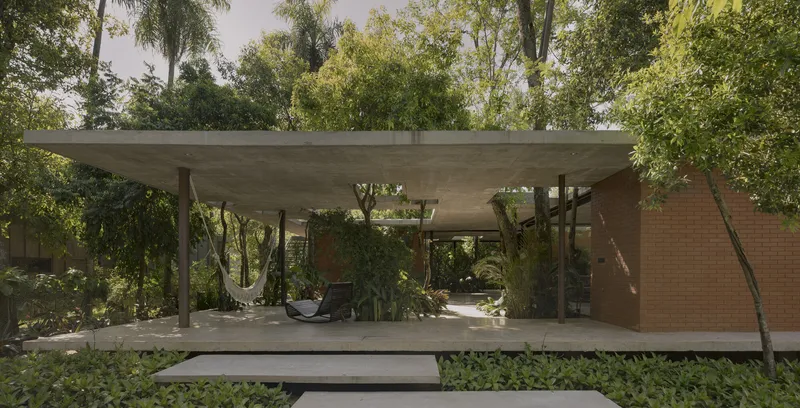
Seen from above, the house barely registers. The concrete roof planes read as fragments scattered among the crowns of mature trees, more like a series of landing pads than a conventional domestic roof. There is no dominant form, no singular gesture competing with the forest for visual primacy. The architecture disperses itself.
At ground level, the effect translates into a floating canopy supported by slender columns, a deliberate thinning of structure so that sightlines travel uninterrupted into the vegetation. The roof is not a shelter imposed on the site; it is a datum line that measures your position relative to the trees.
The Water Courtyard as Organizational Core


The house organizes itself around a central water courtyard, a curved reflecting pool that winds through tropical plantings and beneath concrete beams. It is not a decorative feature. It is the spatial hinge that separates living volumes while keeping them visually and climatically connected. Water cools the air, reflects dappled light onto the exposed concrete soffits, and introduces a sound layer that masks the domestic.
Stepping stones cross the pool in a deliberate choreography, forcing you to slow down and navigate around vegetation rather than through it. The curved geometry of the pool feels organic, as though it preceded the architecture and the concrete simply found positions around its edges.
Living Between Inside and Out


The dining area, the living spaces, and the open terraces share a single spatial continuum. Glass walls dissolve the boundary between conditioned rooms and the water garden, so that a meal at the dining table is also a meal in the forest. The section does the heavy lifting here: by keeping the roof plane continuous across inside and outside zones, Equipo de Arquitectura eliminates the threshold that typically announces you are leaving the house.
Palm trunks punch through the concrete slab overhead, reinforcing the idea that the building envelope is porous, negotiable, secondary to the biological fact of the trees. The architecture does not frame nature like a picture. It lets nature occupy the frame.
Terrace Life Under Dappled Light

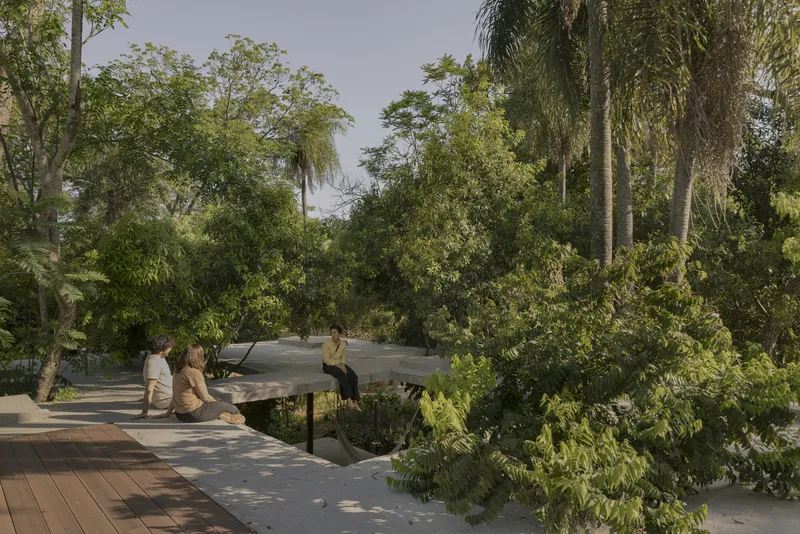

Hammocks slung beneath cantilevered concrete, people seated on terraces where tree shade and slab shade overlap: the photographs by Federico Cairoli consistently show inhabited space. That matters. Too many architecture publications present houses as pristine, emptied objects. Here, the terraces make sense only when occupied, because they are calibrated to the act of resting under a canopy.
The cantilevered overhangs are generous enough to shelter from rain but shallow enough to admit indirect light. The interplay between the hard geometric edge of concrete and the irregular shadow patterns of foliage creates a surface quality on floors and walls that changes by the hour. It is passive environmental design made visible and pleasurable.
Trees as Structure, Trees as Ornament

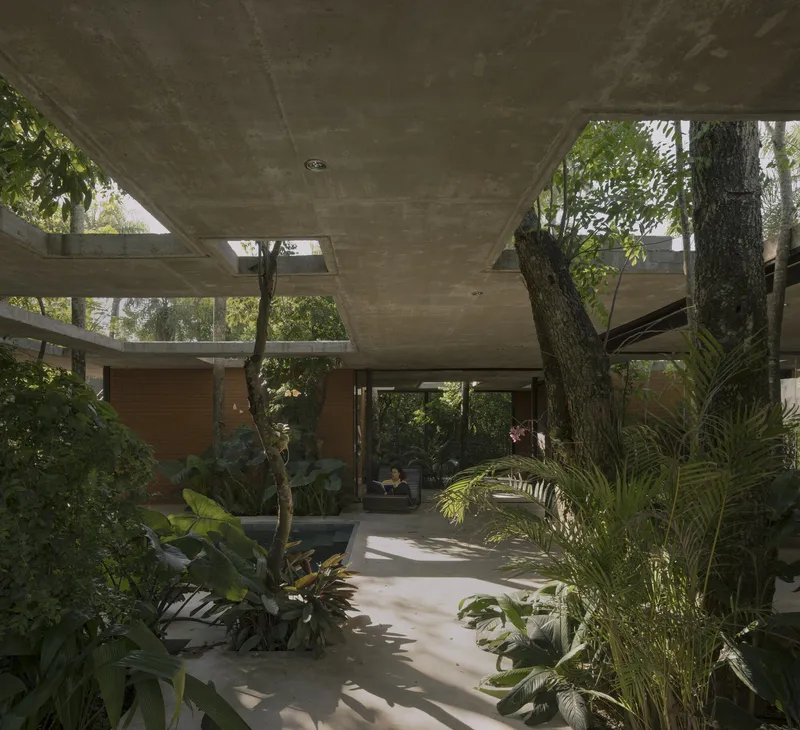
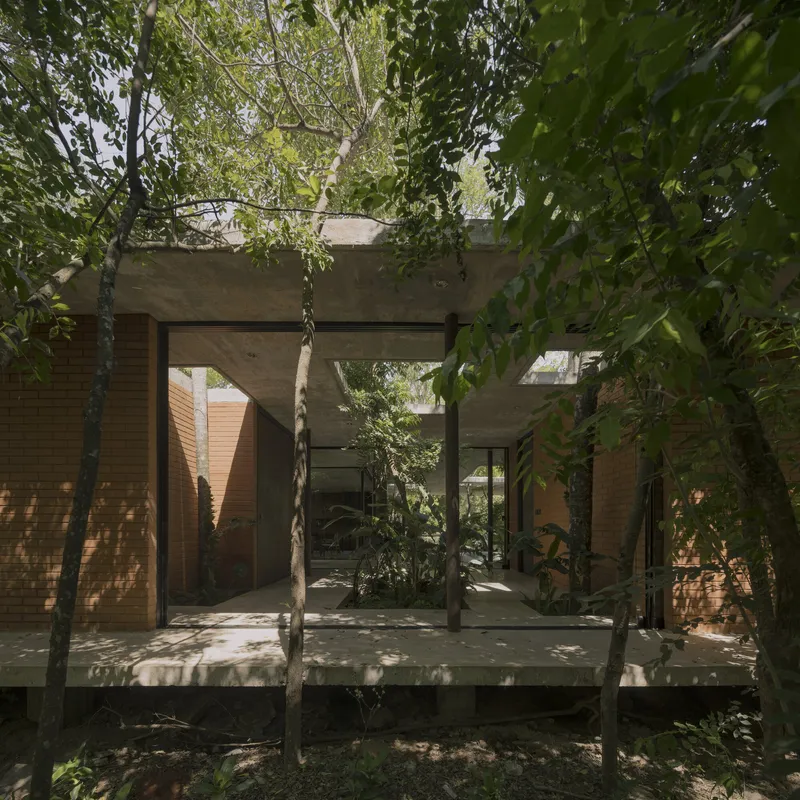
In several moments throughout the house, tree trunks rise directly through openings cut in the concrete slab, becoming columns in their own right. These are not accidental encounters. The openings are precise, edged with care, turned into skylights that bring both light and rain to the plantings below. The tree is simultaneously a structural metaphor and a literal participant in the section.
Timber cladding on select volumes echoes the materiality of the surrounding forest, creating a warm counterpoint to the exposed concrete. But it is the raw trunks, untouched and growing, that do the real work of ornamentation. No applied detail could compete with the texture of bark against board-formed concrete.
Private Rooms Open to the Landscape

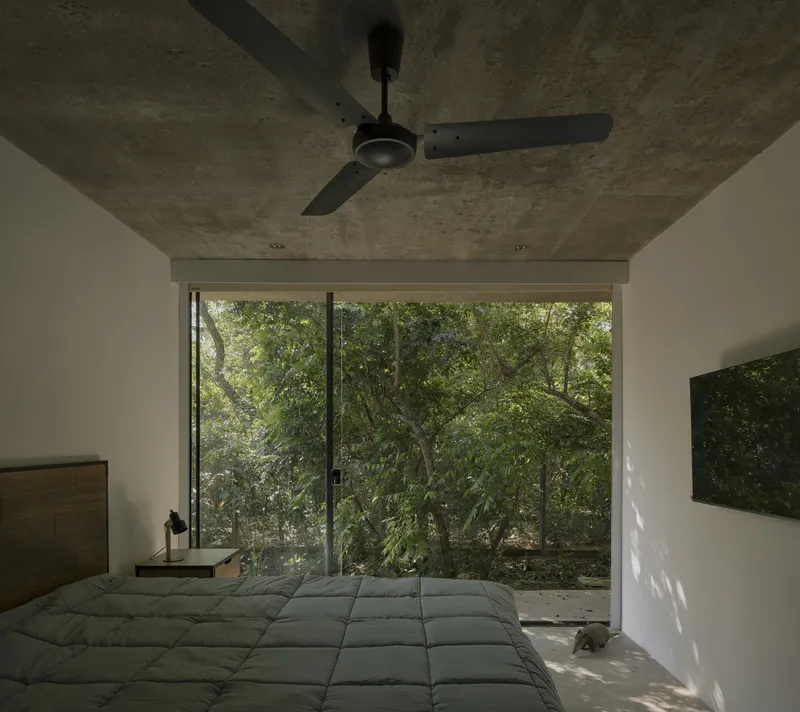

The bedrooms and living room maintain the same logic of transparency. Full height glazing opens onto the forested landscape, turning every private moment into a negotiation with the site. A person reading on a sofa looks past the pool and into the trees. A bedroom with an exposed concrete ceiling and ceiling fan faces nothing but green. Privacy comes from distance and vegetation, not from walls.
A steel staircase ascends through the canopy, offering a vertical experience that the rest of the house deliberately avoids. Climbing past concrete slabs and into the foliage, you gain the one vantage point where the forest becomes legible as a whole rather than as individual trunks. It is a smart inversion: the house stays low and immersed, but gives you one escape route into the sky.
The Street Edge

From the street, the house presents as a single story pavilion, its concrete roof floating above a timber clad volume that sits modestly among the trees. There is no monumental facade, no gate, no boundary wall asserting territory. The building simply begins where the trees thin out enough to allow it, and even then it defers. The public face is quiet, almost reluctant, which only intensifies the spatial richness you discover once inside.
Plans and Drawings


The site plan confirms what the photographs suggest: two rectangular volumes are positioned to create a central void occupied by the pool and its surrounding vegetation. Trees are drawn with the same weight and precision as walls, indicating their status as co-equal elements in the design. The sections reveal how flat roofed pavilions step with the terrain, maintaining a low profile while creating sunken courtyards that bring the ground plane into dialogue with water and planting.
The sectional drawings are especially telling. They show how the two linked pavilions achieve spatial variety through modest means: shifts in floor level, variations in ceiling height, and the strategic placement of glazed connections that frame specific trees. The architecture reads as an infrastructure for coexistence rather than a container for program.
Why This Project Matters
A Forest in the House matters because it treats the preservation of existing trees not as a constraint to be managed but as the generative idea of the entire project. Every plan decision, every structural move, every material choice flows from the premise that the forest was there first and the house must find a way to join it. In a moment when sustainability is often reduced to energy metrics and certification logos, this project offers a more fundamental lesson: build less, keep more, and let the site do the heavy lifting.
Equipo de Arquitectura, based in Asunción, continues to build a body of work rooted in the specific climatic and cultural conditions of Paraguay. With this house, they demonstrate that radical environmental ambition does not require technological spectacle. It requires restraint, precision, and a willingness to let trees win the argument. That is a position worth paying attention to.
A Forest in the House by Equipo de Arquitectura, San Bernardino, Paraguay. 260 m², completed 2025. Photography by Federico Cairoli.
About the Studio
Share Your Own Work on uni.xyz
If projects like this are the kind of work you want to make, uni.xyz is a place to publish your own, find collaborators, and enter design competitions.


Popular Articles
Popular articles from the community

Temporary Home for Dogs: A Reversed Zoo Rethinks Animal Shelter Architecture
In Bucharest, a sinuous corridor and freed landscape flip the logic of containment, designing a shelter that works to make itself unnecessary.

Opera on the Sea: Driftwood Logic Shapes a Timber Opera House on Estonia's Coast
Trevor Orgill's opera house translates the entangled drift of floating timber into a civic building where wood, water, and music converge.
Opera by the Sea Estonia: Three Shells Dissolving Architecture into Tallinn's Coastline
A winning opera house proposal replaces monumental form with interconnected shells that blur the boundary between building, park and Baltic Sea.

Manzana Morphosis: Stretching Barcelona's Grid into a Living Landscape for 2050
A radical reworking of the Eixample manzana turns density into a tool for generous public space, vertical ecology, and environmental performance.

Similar Reads
You might also enjoy these articles

Bao Huynh Watercolor Atelier: A Serene Art Retreat in Hội An
Bao Huynh Watercolor Atelier in Hội An blends multifunctional art spaces, sustainable design, local materials, and family-friendly living in a serene environment.

Atelier Macri Concept Store Interior Design by CASE-REAL
Atelier Macri store features a "ko" counter, walnut wood details, cork displays, blending retail, gallery, and seamless customer experiences.

Manuel Vargas Izquierdo Stadium and High-Performance Sports Center: Architectural Excellence in Jalpa de Méndez
The Manuel Vargas Izquierdo Stadium blends sustainable design, inclusive sports facilities, and cultural-inspired architecture, revitalizing Jalpa de Méndez’s public spaces.

KAKR Buluh Awar Hall: Revitalizing Community and Ecology Through Bamboo Architecture
Community built bamboo hall revitalizes Buluh Awar village, empowering youth, restoring ecology, celebrating vernacular craftsmanship through sustainable architecture and culture.


Comments (0)
Please login or sign up to add comments
No comments yet. Be the first to comment!