

Foster + Partners Wraps a Luxembourg Office Complex in a 1.35m-Deep Self-Shading Concrete Grid
ICÔNE transforms a former steelworks district in Belval with a daylit atrium, 450 plants, and thermally activated slabs.


Belval was once home to the Arbed steelworks, one of Europe's largest, which operated from 1911 until 1997. The site's transformation into a mixed-use urban quarter combining research, education, and commerce has been one of Luxembourg's most ambitious renewal efforts. Foster + Partners completed ICÔNE here in 2023: an 18,800 square metre office complex that takes the industrial memory of its surroundings and reinterprets it through a robust concrete structural grid. The building sits directly across from a preserved blast furnace, and the design never lets you forget that lineage.
What makes ICÔNE worth studying is not just the facade, though the facade is the story. The 1.35 metre depth of the concrete grid acts as a passive solar screen, eliminating the need for external louvers or blinds on the south, east, and west elevations. Behind that grid, two six-storey office wings flank a 24 metre wide atrium that resolves a grade change between the Porte de France to the west and the Place de l'Académie to the east. The result is a building where the formal exterior and the fluid interior feel like two distinct architectural propositions held together by one structural idea.
The Gridded Facade and Its Industrial Echo
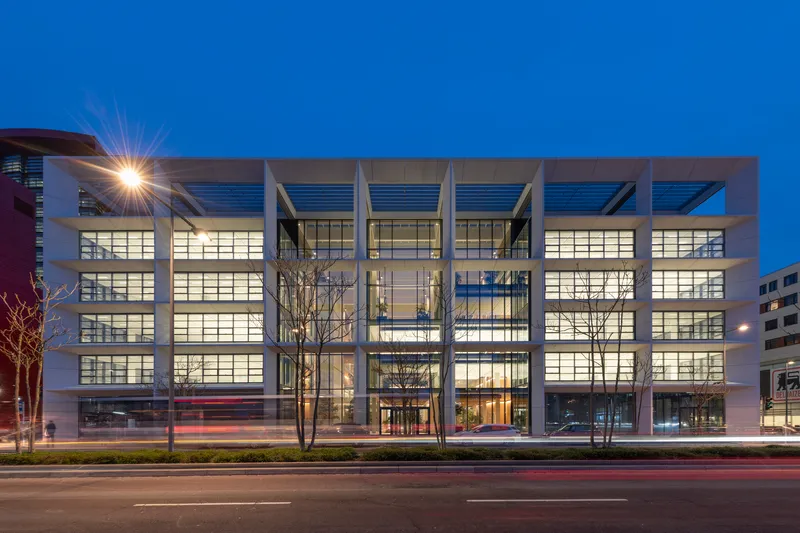
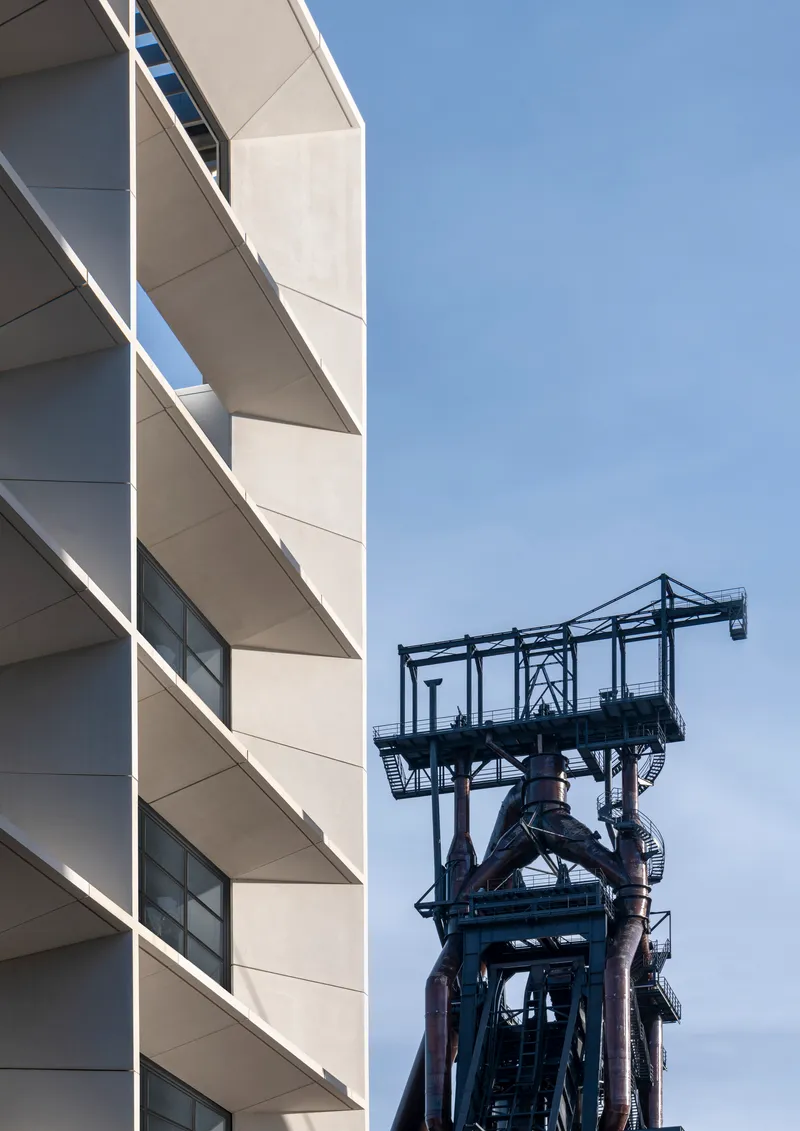
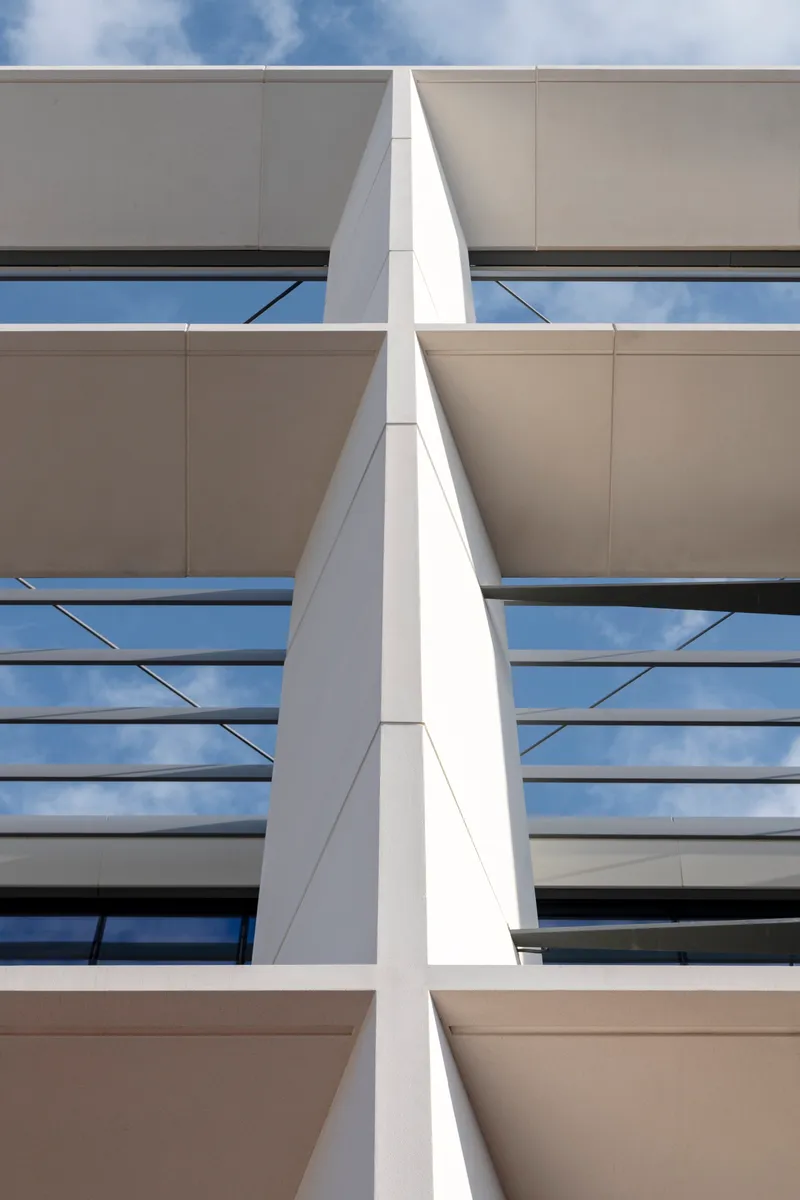
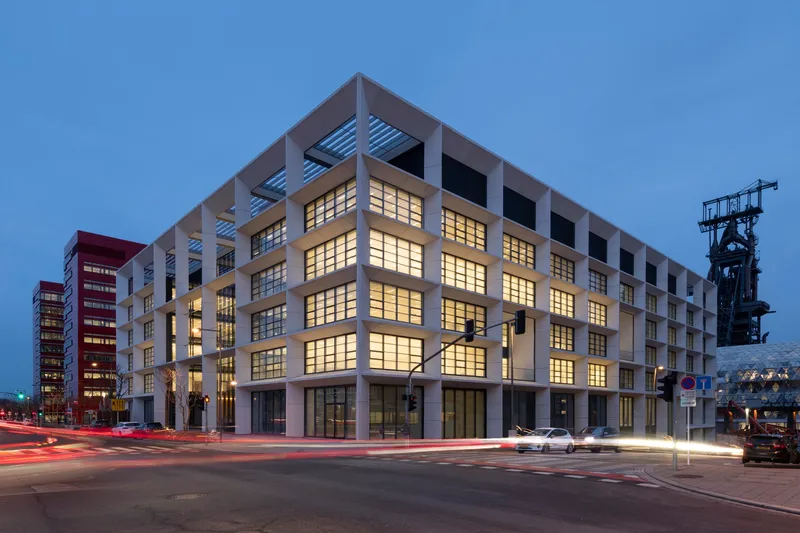
The facade is both structure and environmental system. Concrete columns rise unrestricted through all four levels, with projecting beams forming a deep grid that shades the fully glazed office interiors. The depth of the grid, 1.35 metres, is calibrated to control solar gain without sacrificing daylight. It is a straightforward idea executed with real discipline. The recessed joints between in-situ and precast concrete elements give the elevation a legible rhythm, and the same steel formwork was used for both casting methods to ensure visual continuity.
Context matters here. The preserved blast furnace headframe, visible in several views, is not just a scenic backdrop. It is the reason this building looks the way it does. The heavy structural expression, the exposed concrete, the deliberate heft: all of it reads as a conversation with the steelworks heritage. The building at dusk, with its illuminated glazing set deep behind the concrete frame, makes the connection explicit. ICÔNE wears its structure on its surface, much the way the industrial buildings that preceded it did.
A 24-Metre Atrium That Resolves the Site
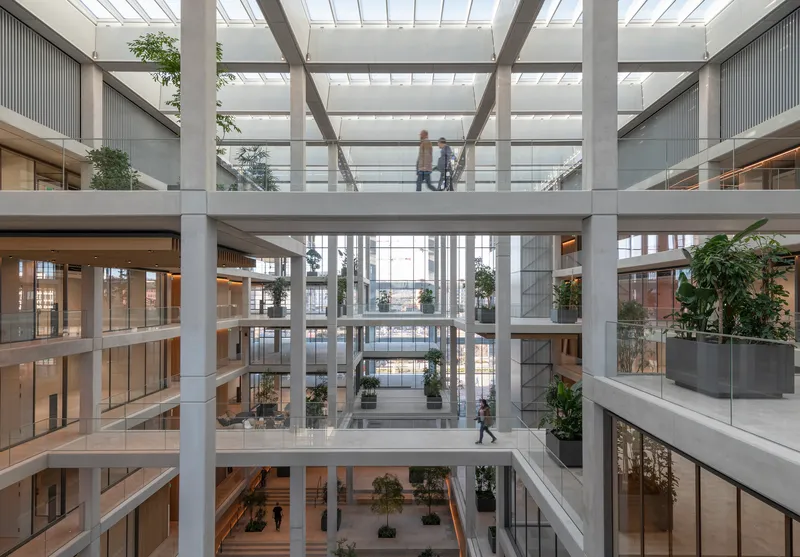
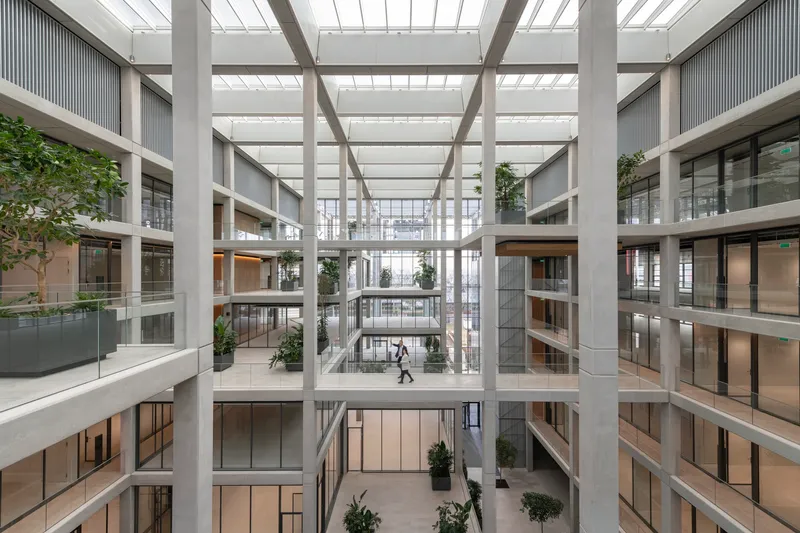
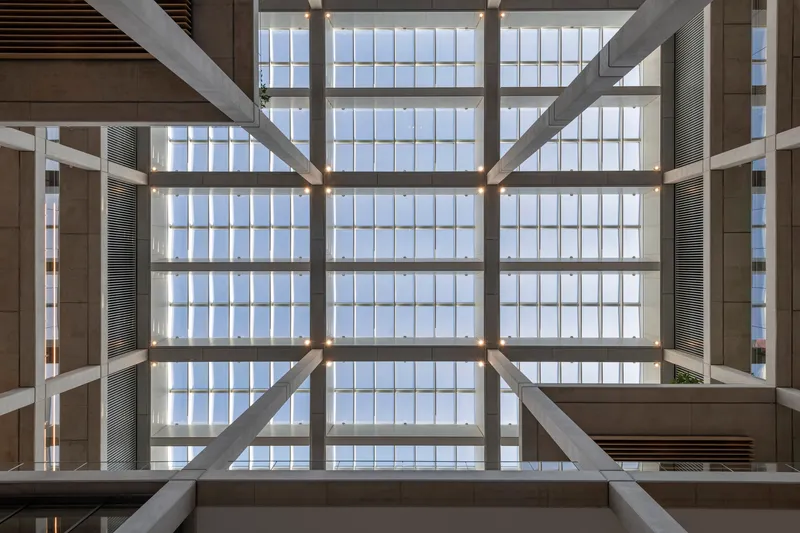
The central atrium is the organizational engine. At 24 metres wide, it is wider than many office floor plates, and it dominates the interior experience. The two 16 metre office wings are subordinate to it, which is a genuine inversion of the typical commercial building hierarchy where the atrium is a leftover gap between rentable zones. Here, the shared space is the primary space.
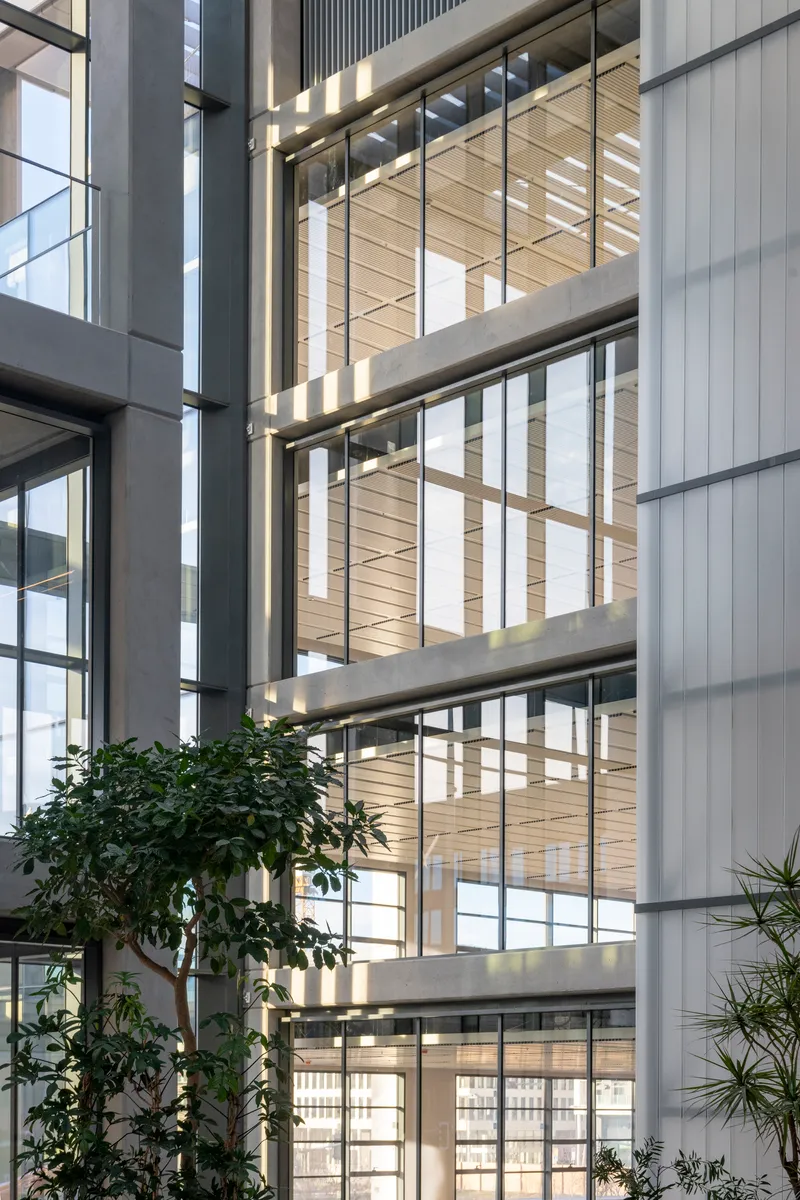
The atrium also does practical site work. The grade change between the street on one side and the plaza on the other is absorbed through a series of stepped terraces, meaning the building acts as a piece of urban infrastructure as much as an office. Concrete bridges span the void at multiple levels, and a gridded glass skylight washes the entire volume with diffused daylight. Looking straight up through the concrete beams to the ceiling reveals the structural logic at its most legible: every element is doing two jobs, holding the building up and letting light in.
Timber, Greenery, and Acoustic Calibration
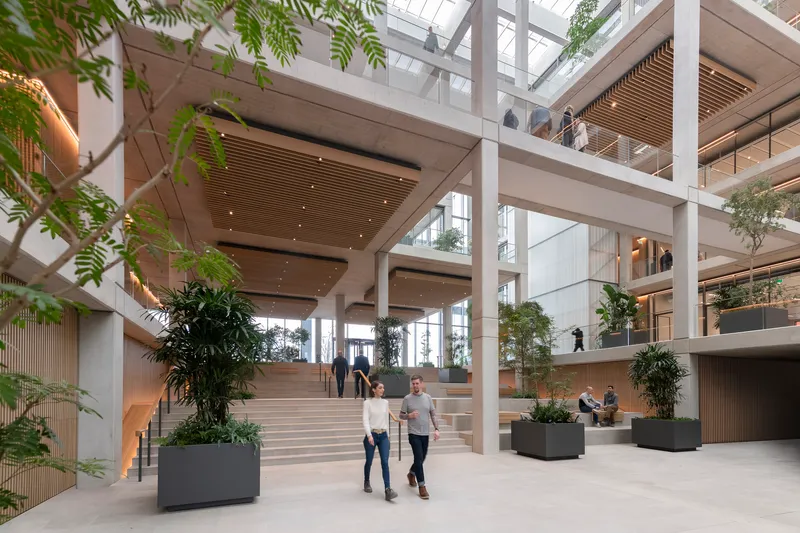
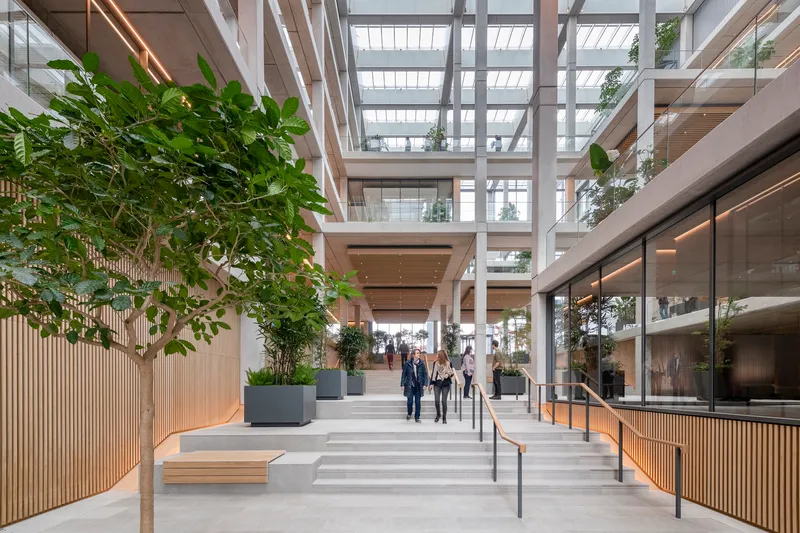
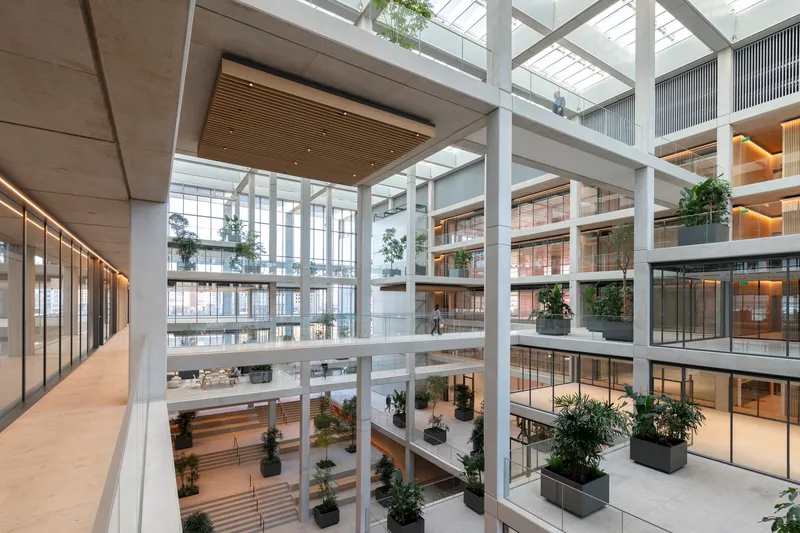
If the exterior is concrete and glass, the interior counterpoint is timber and plants. Wood cladding lines ceiling panels and stairwell walls, micro-perforated in several places to reduce acoustic reverberation. The contrast between the hard concrete frame and the warm timber surfaces is deliberate and effective. It makes the atrium feel inhabitable rather than monumental.
More than 450 plants are distributed throughout the building, in planted containers on tiered levels and along wide staircases that double as seating. The greenery is not decorative. It is part of the building's strategy for making a deep, wide atrium feel like a series of distinct social spaces rather than a single void. Communal landscaped terraces at higher levels provide breakout areas that are visible from the atrium below, reinforcing the sense that you are inside a small vertical neighborhood rather than a conventional office block.
Stacked Balconies and Vertical Circulation
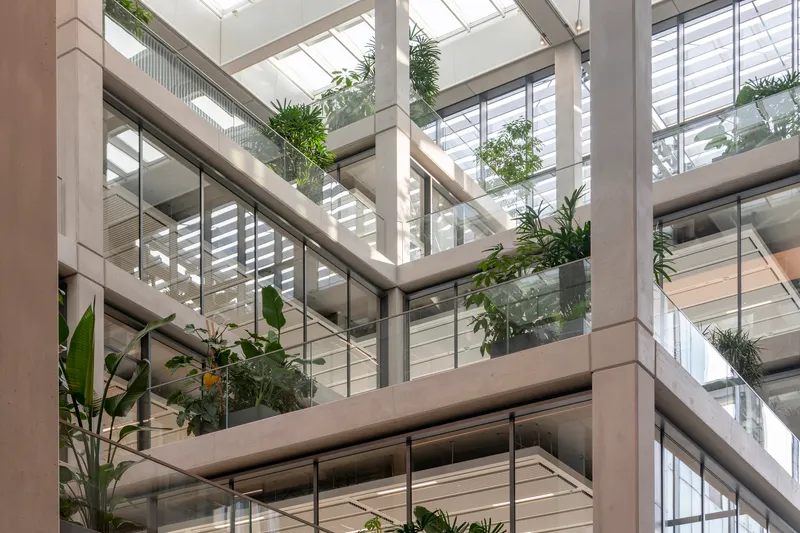
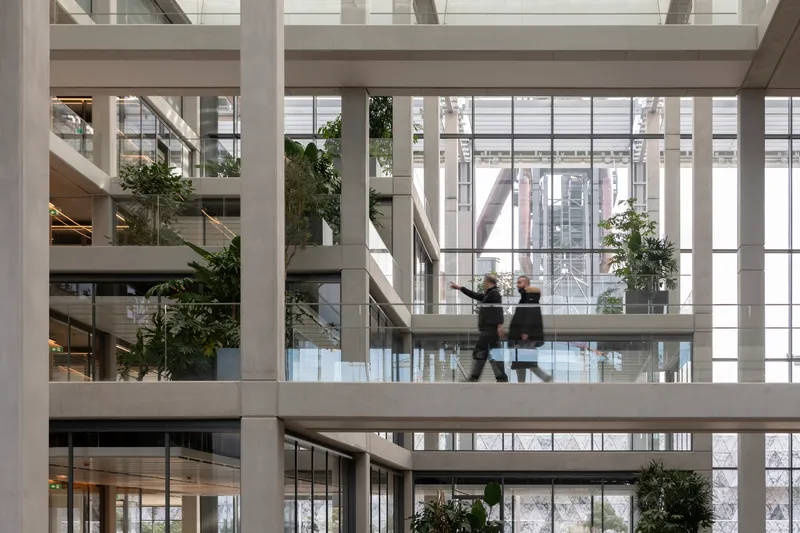
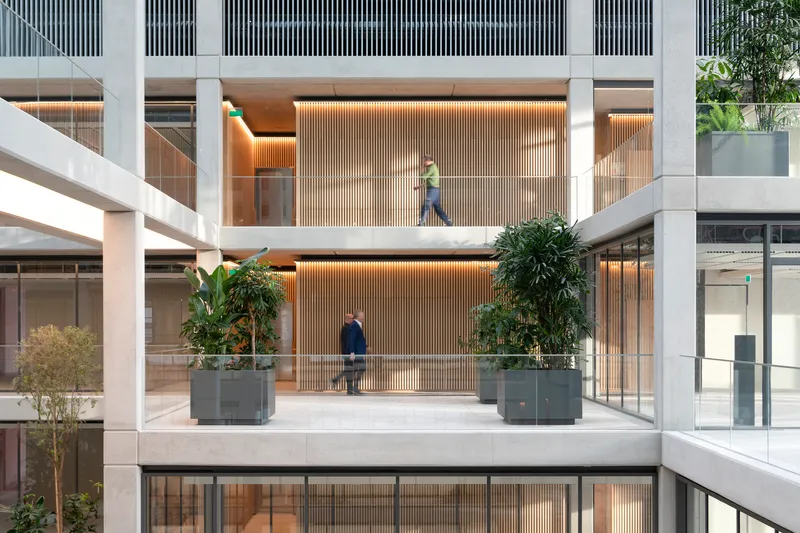
The stacked balconies overlooking the atrium give the interior its distinctive section. Glass railings, vertical timber slats, and planted containers create layers of visual depth on every level. People are always visible in motion, crossing bridges, ascending stairs, leaning against railings. The building is designed to make collaboration visible, which is a strong argument for the open atrium typology over the hermetically sealed floor plate.
The 3,000 square metres of co-working space and the capacity for 1,235 workstations suggest a building designed for density without claustrophobia. The column-free office floors, made possible by the load-bearing facade, give tenants genuine flexibility. It is a rare case where the structural ambition of the exterior directly enables the programmatic ambition of the interior.
Thermally Activated Slabs and Passive Strategy
The climate strategy leans heavily on the thermal mass of the exposed concrete. Floor slabs are thermally activated, with chilled or heated water circulated through embedded plastic pipes. The slabs remain exposed on the interior, doing acoustic and thermal work simultaneously. Green roofs collect rainwater for non-potable reuse, and the building is connected to a district heating system. The target is a BREEAM Excellent rating, and the project has achieved WELL Building Standard certification.
The construction details reinforce the environmental logic. Half-shell void formers in the central area of some slabs reduce embodied carbon and weight. Floor slabs were cast on ply formwork with chevroned details created by painted ply beads, giving the concrete a textured finish that registers as craft rather than expediency. Limestone aggregate was sourced from the site itself for all visual concrete. It is a building that takes its material seriously at every scale.
Plans and Drawings
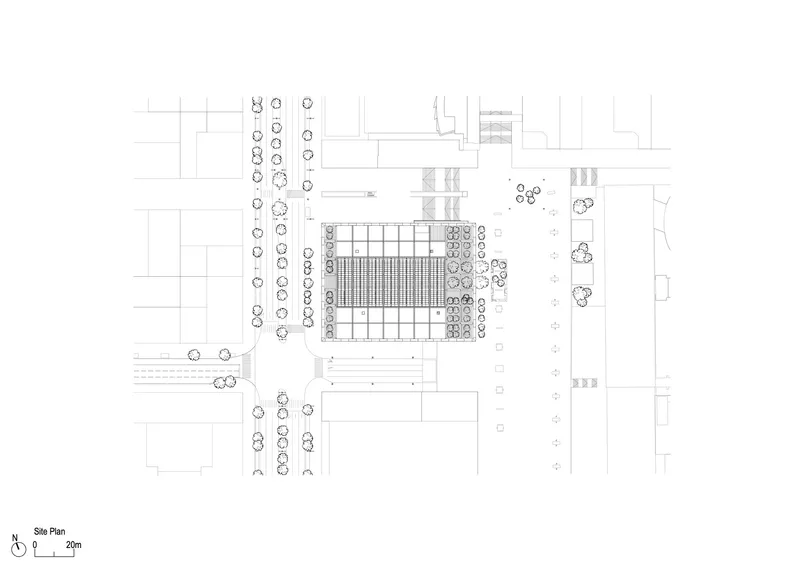
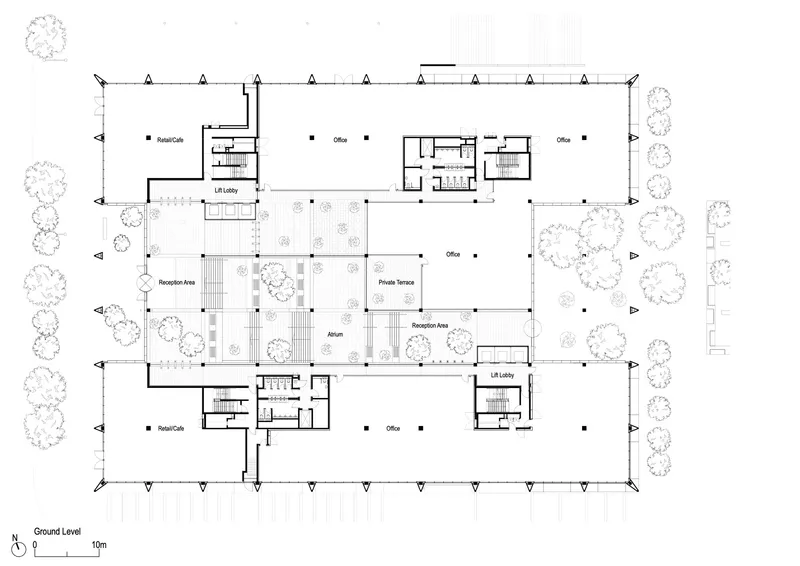
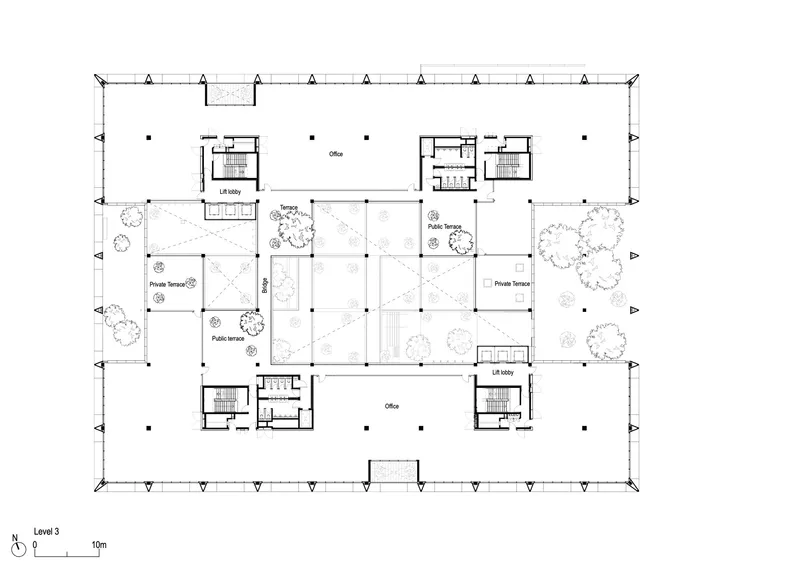
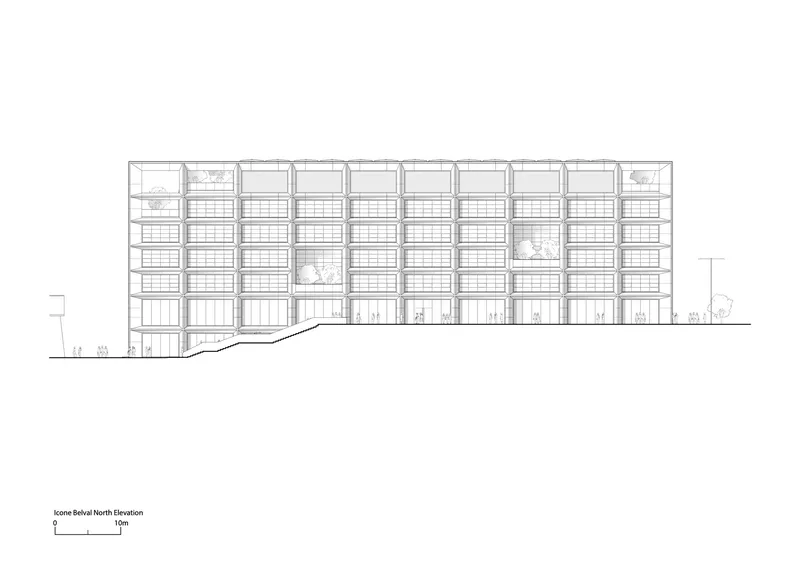
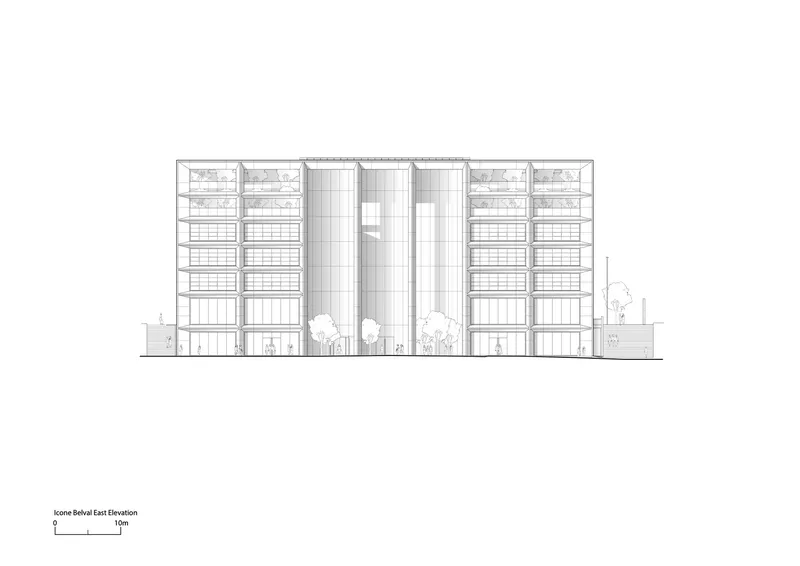
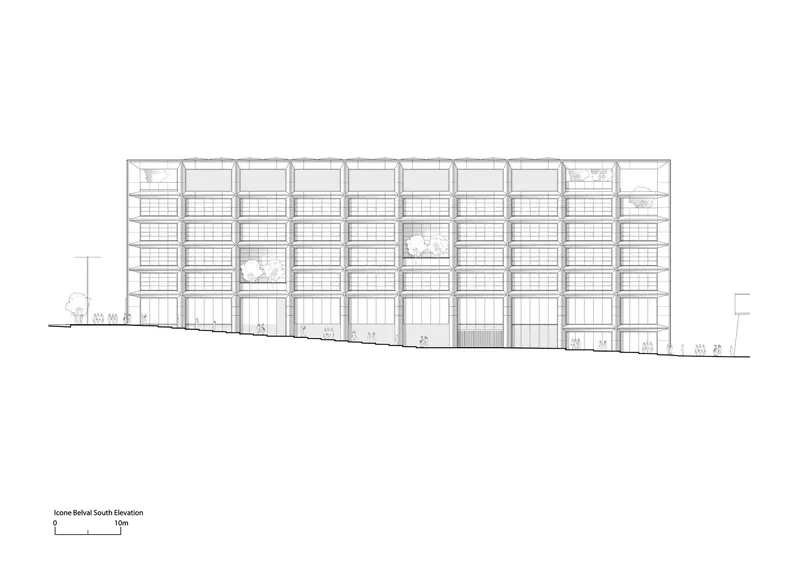
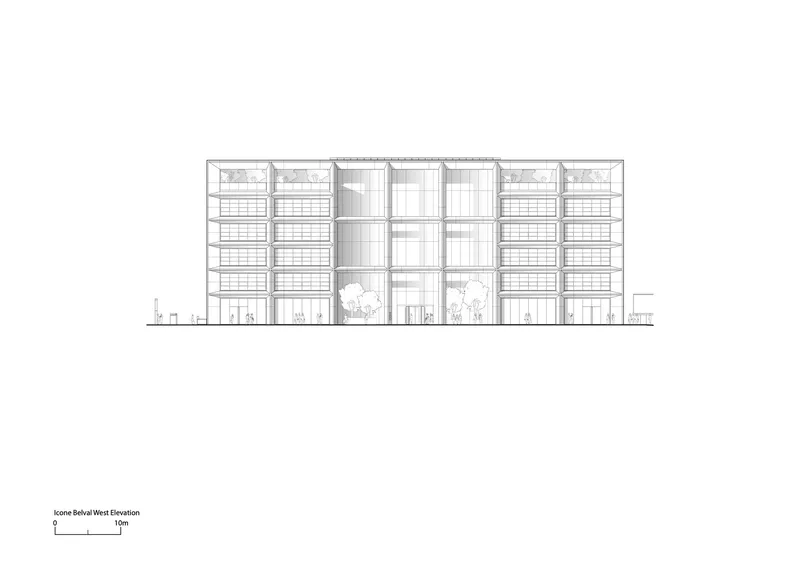
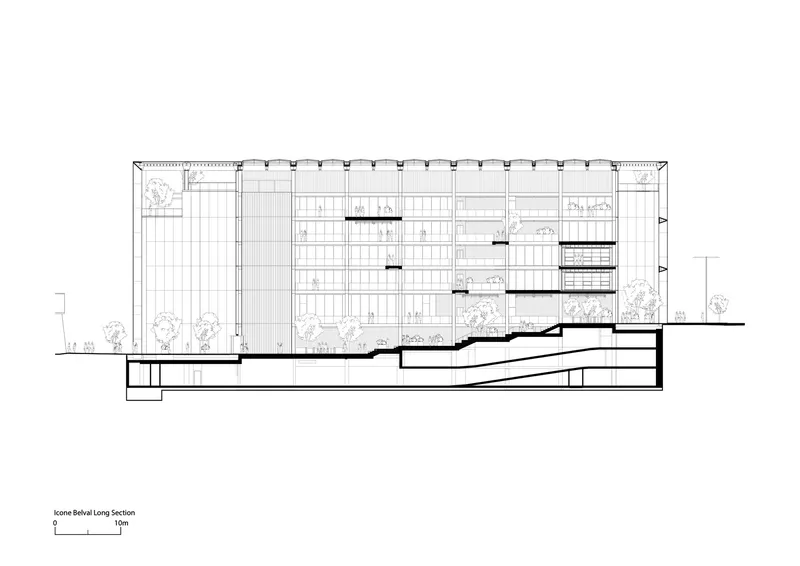
The site plan confirms what the photographs suggest: a rectangular footprint with the atrium running its full length, flanked by two office wings with corner circulation cores. The ground floor plan shows shops and restaurants along the street edge, with the atrium operating as a semi-public passage between the two urban frontages. The section drawings are the most revealing, showing how the stepped terraces negotiate the grade change and how the gridded facade wraps continuously over the roof, extending the structural expression into a fifth elevation.
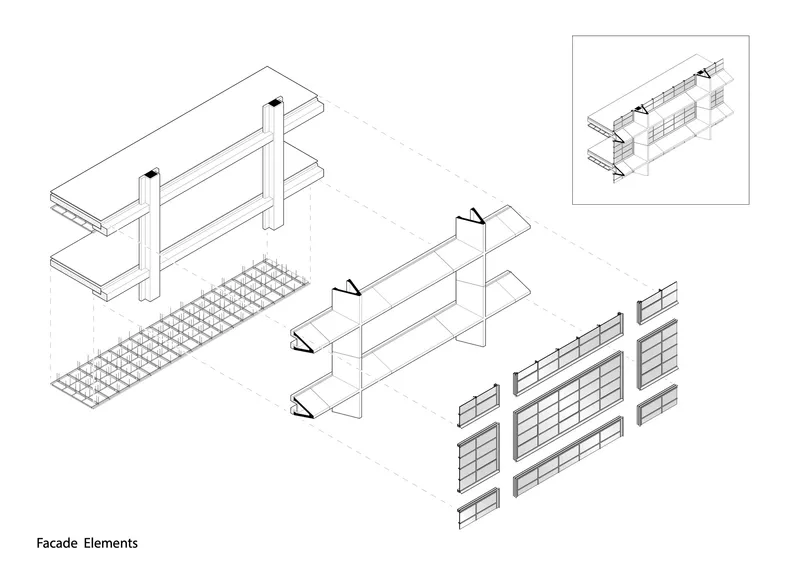
The exploded axonometric of the facade assembly is particularly instructive. It breaks down the relationship between slabs, columns, perforated aluminium roof cassettes, and the glazing system. What reads as a monolithic concrete frame on the exterior is actually a carefully layered assembly of in-situ and precast elements, metal joinery, and acoustic insulation. The isometric floor plans at the bottom of the drawing set show the gridded structural layout at two levels, making clear how the facade carries the loads that would otherwise require interior columns.
Why This Project Matters
ICÔNE is a serious attempt to make a commercial office building do more than provide leasable floor area. The self-shading facade, the thermally activated slabs, the column-free interiors, the 24 metre atrium that doubles as urban infrastructure: each of these could be the defining move of a lesser project. Here they are integrated into a single structural and environmental proposition. The building argues that sustainability, flexibility, and civic ambition are not competing goals but consequences of the same design logic.
It also argues for the value of site specificity. Belval's industrial past is not treated as nostalgia or decoration but as a genuine design driver. The heavy concrete grid, the exposed structure, the views framed toward the blast furnace: these choices make sense only in this location. In an era when office buildings are often interchangeable between cities and continents, ICÔNE is a building that could not credibly exist anywhere else. That alone makes it worth attention.
ICÔNE Collaborative Office Complex by Foster + Partners, Belval, Luxembourg, Luxembourg. 18,800 m². Completed 2023. Photography by Nigel Young.
About the Studio
Share Your Own Work on uni.xyz
If projects like this are the kind of work you want to make, uni.xyz is a place to publish your own, find collaborators, and enter design competitions.


Popular Articles
Popular articles from the community


Opera by the Sea Estonia: Three Shells Dissolving Architecture into Tallinn's Coastline
A winning opera house proposal replaces monumental form with interconnected shells that blur the boundary between building, park and Baltic Sea.
Tsunami Convergenics: Turning Catastrophic Ocean Forces into Underwater Housing Infrastructure
A speculative underwater settlement off the coast of Onagawa, Japan, treats tsunamis and typhoons as energy sources rather than threats.

Temporary Home for Dogs: A Reversed Zoo Rethinks Animal Shelter Architecture
In Bucharest, a sinuous corridor and freed landscape flip the logic of containment, designing a shelter that works to make itself unnecessary.

Opera on the Sea: Driftwood Logic Shapes a Timber Opera House on Estonia's Coast
Trevor Orgill's opera house translates the entangled drift of floating timber into a civic building where wood, water, and music converge.

Similar Reads
You might also enjoy these articles

Pixel Gardens: One Repeated Module Stacked Into a Terraced Social Housing Tower for Famagusta
Salem Bader's shortlisted housing tower builds a vertical neighbourhood from one repeated module, offsetting units to carve terraces, light and air.

Bao Huynh Watercolor Atelier: A Serene Art Retreat in Hội An
Bao Huynh Watercolor Atelier in Hội An blends multifunctional art spaces, sustainable design, local materials, and family-friendly living in a serene environment.

Atelier Macri Concept Store Interior Design by CASE-REAL
Atelier Macri store features a "ko" counter, walnut wood details, cork displays, blending retail, gallery, and seamless customer experiences.

Manuel Vargas Izquierdo Stadium and High-Performance Sports Center: Architectural Excellence in Jalpa de Méndez
The Manuel Vargas Izquierdo Stadium blends sustainable design, inclusive sports facilities, and cultural-inspired architecture, revitalizing Jalpa de Méndez’s public spaces.

Comments (0)
Please login or sign up to add comments
No comments yet. Be the first to comment!