

Fragmentos Converts a Porto Factory into a Housing Complex Anchored by Its Own Chimney
A former building materials factory in Porto's Bonfim neighborhood becomes 16 apartments and a student residence without losing its industrial memory.


Adaptive reuse projects often face a binary choice: preserve the old at the expense of livability, or gut everything and paste on a nostalgic facade. Fragmentos sidesteps that trap at the António Granjo Mixed Use Complex in Porto's Bonfim neighborhood, where a cluster of early twentieth century factory buildings has been folded into a 10,520 square meter residential program that genuinely reads as both new and inherited. The move is not cosmetic. Sixteen apartments and a student residence occupy volumes whose generous industrial ceiling heights allowed the architects to stack two full residential floors plus a roof-integrated level, all while retaining the sawtooth profiles, the terracotta tile roofscapes, and a tall brick chimney that now serves as pure sculptural anchor.
What makes this project worth studying is the rigor with which it choreographs circulation against the grain of its inherited fabric. Where the factory once operated as three isolated volumes, Fragmentos stitches them together through a network of courtyards, exterior staircases, and access galleries that give the complex the social density of a small neighborhood. Orange steel stairs zigzag across white stucco facades. Stone salvaged from the site reappears as courtyard walls. Existing orange, beech, and poplar trees remain in place, forcing the architecture to negotiate rather than dictate. The result is a place that feels both familiar to Porto's layered urban texture and unmistakably contemporary.
Industrial Roofscape as Identity
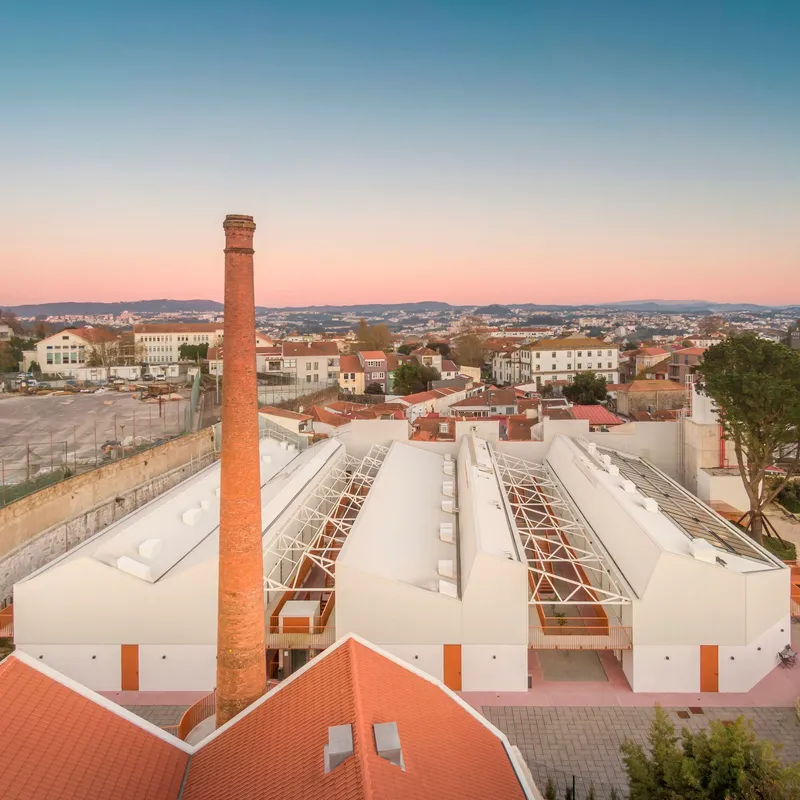


Seen from above, the complex announces its origins immediately. Parallel sawtooth roofs with glazed clerestory sections sit alongside terracotta-tiled gabled volumes, creating a roofscape that reads as an index of the site's industrial past. The brick chimney punctuates this composition with vertical force, a landmark visible from surrounding streets and a deliberate decision by the architects to recover and retain the element rather than demolish it.
The intelligence here is in how the roof forms do double duty. They are not preserved as museum pieces; those generous industrial ceiling heights are the structural premise for the residential program below. The sawtooth profile that once lit a factory floor now brings daylight into upper-level apartments, demonstrating that adaptive reuse works best when the old logic and the new use share a functional alignment.
Orange Steel and White Stucco
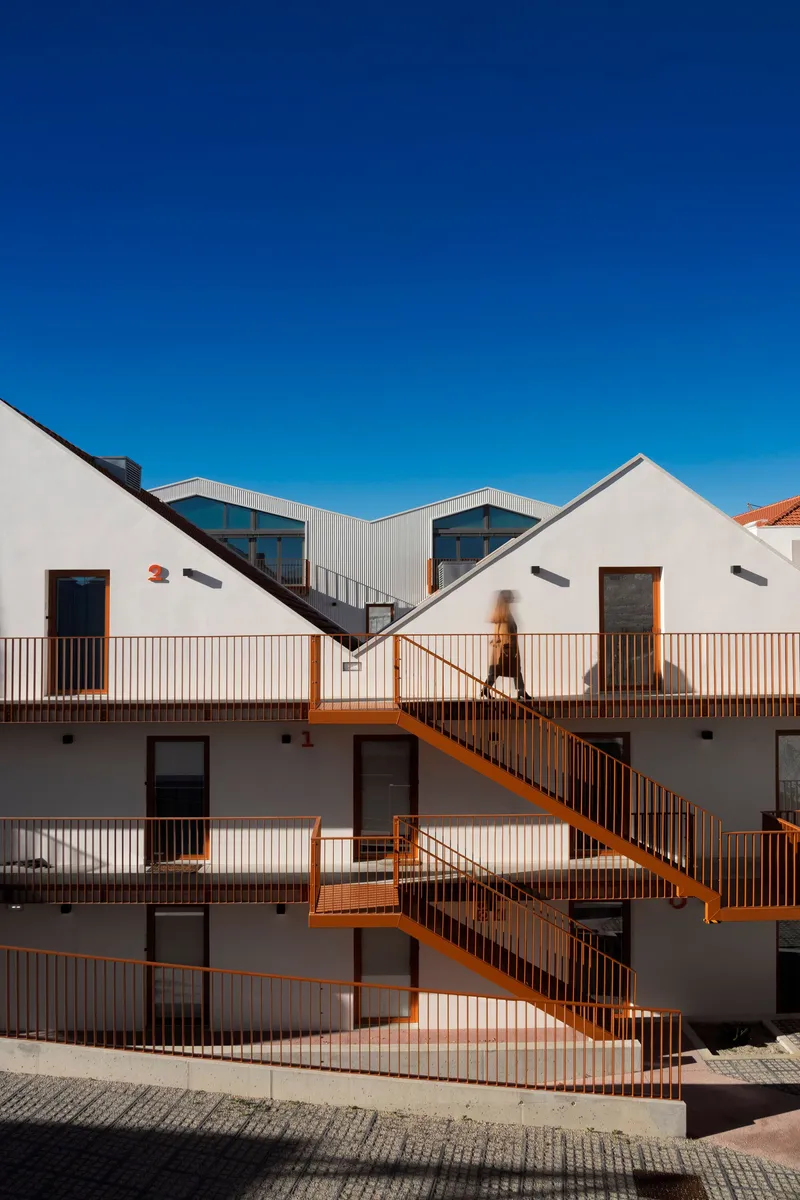

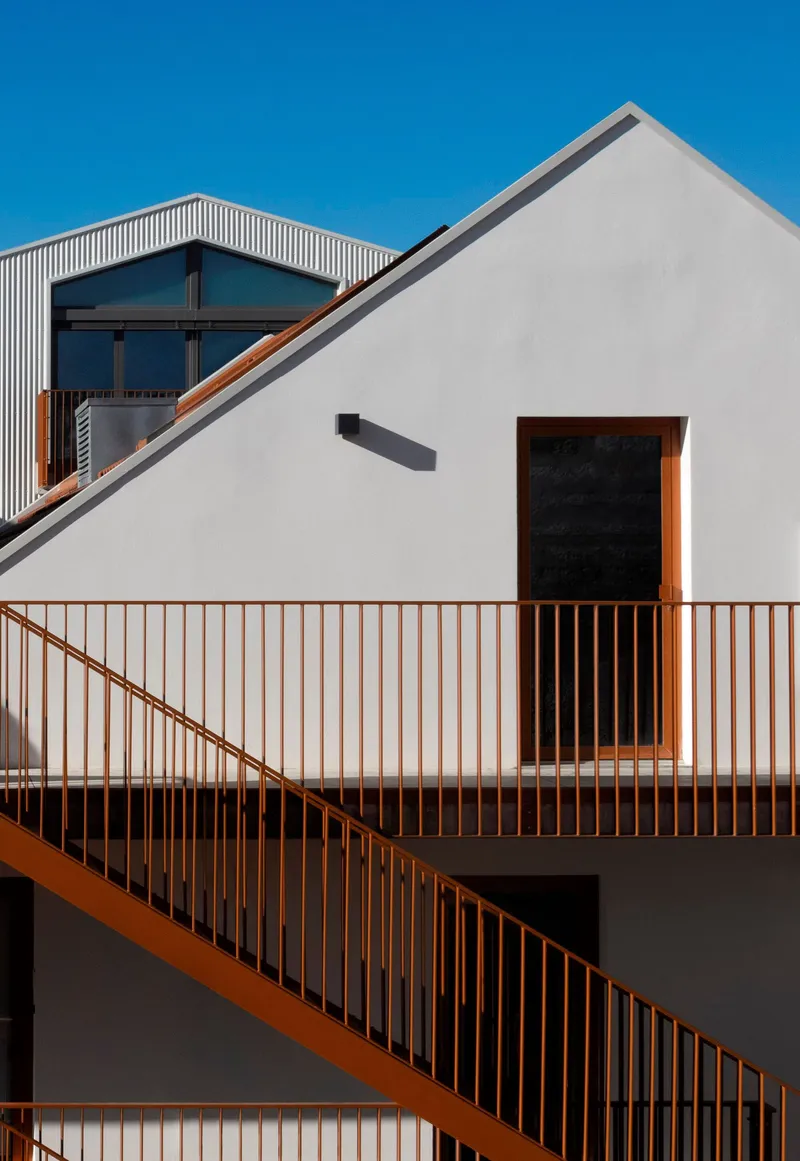
The most visually striking intervention is the system of terracotta-colored steel staircases that wrap, zigzag, and ascend across the white rendered facades of the courtyard interiors. These are not decorative gestures. They are the primary circulation infrastructure for the student residence, connecting tiered access galleries and linking volumes that were previously isolated. The color, a warm orange that echoes the terracotta roof tiles, binds old material to new steel in a way that feels deliberate rather than arbitrary.
One staircase curves around the base of the retained chimney, and this single detail captures the entire design philosophy: new structure wrapping inherited structure, neither dominating, both legible. The timber-railed balconies that appear alongside the steel stairs introduce a softer domestic register, signaling the shift from shared circulation to private dwelling.
Courtyards That Do the Heavy Lifting


The introduction of open courtyards between the formerly isolated volumes is the spatial strategy that makes everything else possible. These courtyards bring natural light deep into the plan, provide outdoor common areas with paved surfaces and retained trees, and create the social threshold between public entry and private dwelling. They are not leftover space; they are the connective tissue of the project.
Inside one courtyard, exposed white timber trusses span overhead while a planted tree grows through the ground plane, a collision of scales and registers that feels specific to this site. The diagonal steel staircases that traverse the courtyard walls function as both structure and spectacle, turning daily movement into something visible and communal. For a student residence, this kind of activated shared space is essential.
Street Frontage and Urban Memory

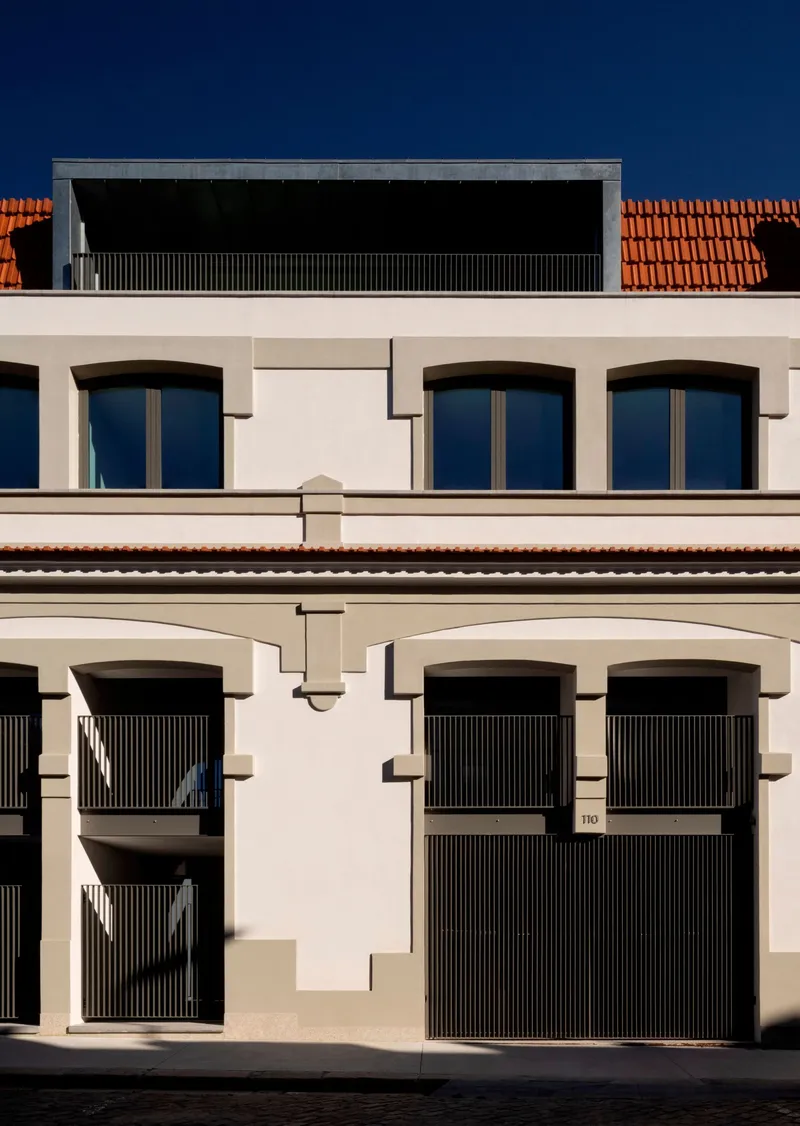
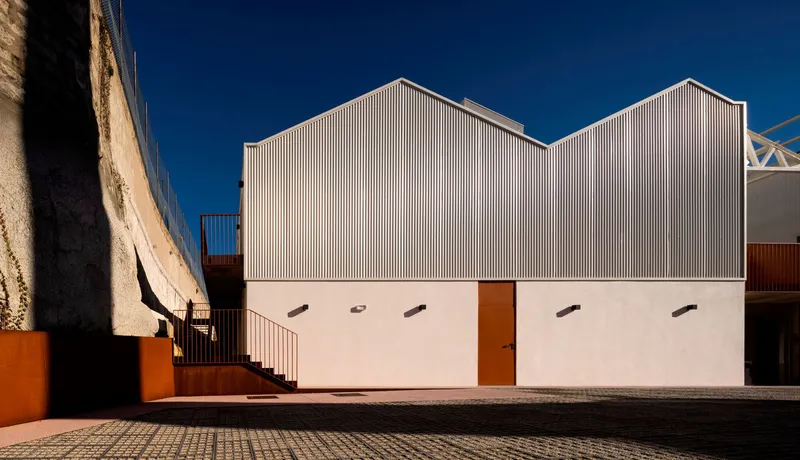
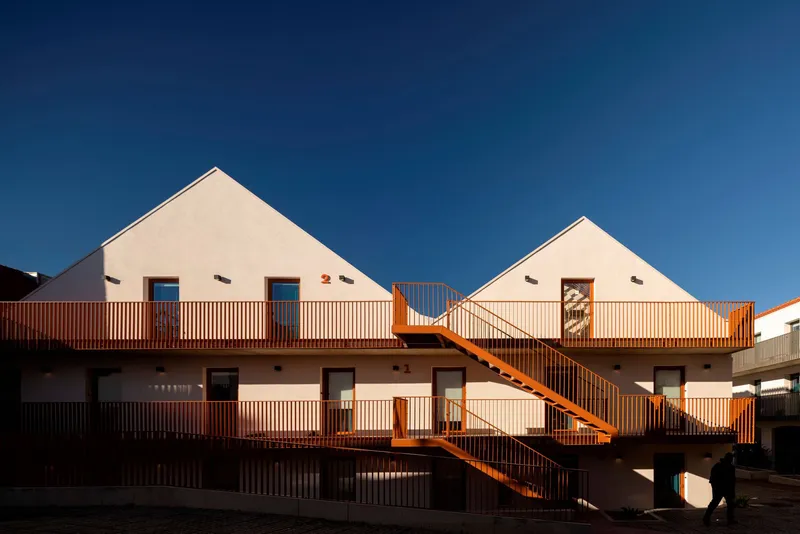
Along Rua António Granjo, the complex presents a layered facade that negotiates between the scale of the street and the depth of the block behind it. Arched openings in rendered masonry recall the original factory architecture, while corrugated metal screening and a recessed zinc-clad penthouse volume signal the new residential program. The original facade elements were carefully recovered, and where recovery was impossible, constructive details were reproduced to maintain continuity.
The twin gabled volumes with vertical metal cladding above a white rendered base read as the most overtly contemporary face of the project. Yet they are calibrated to the proportions and rhythm of Porto's low-rise residential fabric. The sixteen apartments address the street as domestic urban frontage, while the student residence unfolds behind and within, accessed from the same main entrance but expanding into the interior of the block. It is a clever sectional trick that maximizes density without overwhelming the neighborhood.
The View from Above


Aerial views reveal the true scale of the intervention and its relationship to Porto's tight urban grain. The corrugated metal roofs with their central courtyard sit amid a sea of terracotta-tiled residential blocks, blending in through material kinship while asserting difference through geometry. Cantilevered balconies and terraced roofscapes extend the living space upward, taking advantage of views across the city.
The project achieved energy performance level A, which in a complex of this density and heritage sensitivity is no small accomplishment. The courtyards are not just spatial amenities; they are environmental devices, channeling daylight and ventilation to units that would otherwise be deep-plan and underlit. Passive design here is embedded in the parti rather than bolted on.
Compact Living Inside the Warehouses


Inside the student residence units, exposed cross-laminated timber ceilings and integrated kitchenette niches produce rooms that are compact but materially rich. Plywood ceilings and clean sight lines between sleeping and cooking areas make efficient use of the volume available. The warmth of the timber palette stands in contrast to the steel and stucco exterior, creating a clear distinction between communal and private registers.
The dark metal screens and timber-railed balconies visible from outside provide solar control and privacy while maintaining visual connection to the courtyard life below. These are not luxury apartments; they are well-considered units for a specific program, and the restraint is appropriate.
The Chimney at Dusk


At golden hour, the brick chimney casts a long shadow across the terracotta roofscape and the complex reveals its full atmospheric range. The retained chimney is not functional, but its presence does real work: it orients visitors, anchors the composition, and insists on the site's industrial history in a way that no plaque or signage could. It is the most economical preservation gesture possible, and the most effective.
Plans and Drawings

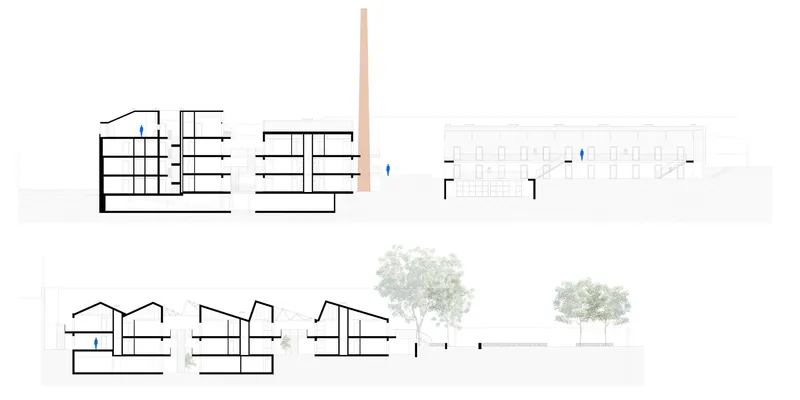

The site plan makes legible what the photographs only imply: the angular building footprints create a series of interlocking courtyards and tree-lined public spaces that draw the city into the block's interior. Sections show how the multi-level volumes, with their pitched roofs and varied floor-to-floor heights, exploit the generous industrial sections to accommodate residential density. The street elevation drawing confirms the careful calibration between the three-story streetfront presence and the surrounding Porto context.
Why This Project Matters
The António Granjo Complex matters because it treats adaptive reuse not as a stylistic choice but as an urbanistic one. By stitching three isolated factory volumes into a single mixed-use community, Fragmentos generates a piece of city that is denser, more socially complex, and better connected than what existed before, without erasing the material evidence of what came before. The courtyards, the retained trees, the salvaged stone walls, and the chimney all function as continuities rather than quotations.
In a city where development pressure is acute and heritage fabric is under constant threat, this project offers a credible model. It demonstrates that housing density and industrial memory can coexist on the same site, that new steel can wrap old brick without irony, and that the most powerful preservation tool is sometimes a good section. The chimney still stands. The factory is gone. The neighborhood gained something it did not have before: a reason to walk through the block rather than around it.
António Granjo Mixed Use Complex by Fragmentos, Porto, Portugal. 10,520 m². Completed 2021. Photography by Fernando Guerra | FG+SG.
About the Studio
Share Your Own Work on uni.xyz
If projects like this are the kind of work you want to make, uni.xyz is a place to publish your own, find collaborators, and enter design competitions.


Popular Articles
Popular articles from the community


Tsunami Convergenics: Turning Catastrophic Ocean Forces into Underwater Housing Infrastructure
A speculative underwater settlement off the coast of Onagawa, Japan, treats tsunamis and typhoons as energy sources rather than threats.

Opera by the Sea Estonia: Three Shells Dissolving Architecture into Tallinn's Coastline
A winning opera house proposal replaces monumental form with interconnected shells that blur the boundary between building, park and Baltic Sea.

Temporary Home for Dogs: A Reversed Zoo Rethinks Animal Shelter Architecture
In Bucharest, a sinuous corridor and freed landscape flip the logic of containment, designing a shelter that works to make itself unnecessary.

The Amber Palace Opera: A Geological Fiction Surfaces on Tallinn's Baltic Waterfront
Pierre Brillard reimagines a Baltic legend as a public landscape, opera house, and waterfront promenade rooted in Tallinn's coastal identity.

Similar Reads
You might also enjoy these articles

Bao Huynh Watercolor Atelier: A Serene Art Retreat in Hội An
Bao Huynh Watercolor Atelier in Hội An blends multifunctional art spaces, sustainable design, local materials, and family-friendly living in a serene environment.

Atelier Macri Concept Store Interior Design by CASE-REAL
Atelier Macri store features a "ko" counter, walnut wood details, cork displays, blending retail, gallery, and seamless customer experiences.

Manuel Vargas Izquierdo Stadium and High-Performance Sports Center: Architectural Excellence in Jalpa de Méndez
The Manuel Vargas Izquierdo Stadium blends sustainable design, inclusive sports facilities, and cultural-inspired architecture, revitalizing Jalpa de Méndez’s public spaces.

KAKR Buluh Awar Hall: Revitalizing Community and Ecology Through Bamboo Architecture
Community built bamboo hall revitalizes Buluh Awar village, empowering youth, restoring ecology, celebrating vernacular craftsmanship through sustainable architecture and culture.

Explore Mixed-Use Competitions
Discover active competitions in this discipline

Challenge to reimagine the Iron Throne

Photograph architecture without architects

Illustrate the lost glory of Angkor Wat - Render Challenge

Design challenge to reuse E-waste
Comments (0)
Please login or sign up to add comments
No comments yet. Be the first to comment!