
Francisco Cadau Weaves a Brick Curtain Across Four Row Houses in Campana, Argentina
A continuous facade of staggered brickwork unifies four compact dwellings on the suburban edge of Buenos Aires province.


Row housing rarely gets the material attention it deserves. The economics of repetition tend to flatten ambition, producing facades that read as photocopied elevations rather than architecture. Francisco Cadau Oficina de Arquitectura sidesteps that logic entirely with this 2008 project in Campana, roughly 75 kilometers northwest of Buenos Aires. Four houses share a single, continuous brick curtain that stretches across the street front, its density shifting from nearly solid at the base to porous screens and parasols higher up. The result is a project that oscillates between reading as one building and four, between the collective and the individual.
What makes the scheme genuinely interesting is the front patio strategy. Rather than pushing the built volume to the street and hiding private life behind it, Cadau positions the mass against the rear property line and opens generous courtyards toward the sidewalk. These patios align with the setbacks of an existing corner chalet and the planted sidewalks of the neighborhood, stitching the new construction into the low-density residential fabric instead of confronting it. The brick curtain, suspended from metal beams, becomes a mediating screen: it gives the houses a unified public face while filtering light, air, and views into the courtyards behind it.
A Continuous Brick Facade That Refuses Monotony
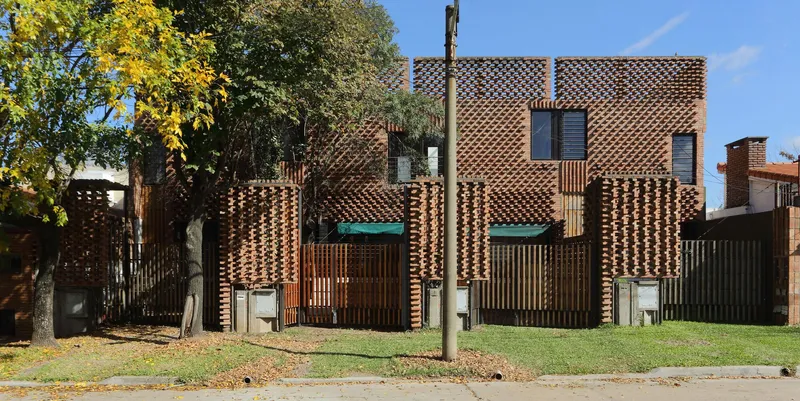
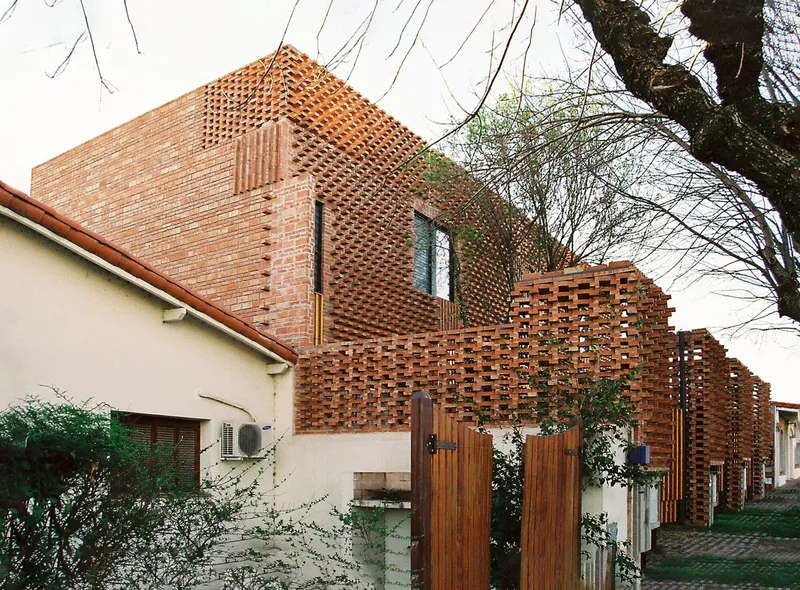
From the street, the four houses present themselves as a single architectural gesture. The facade runs unbroken across the lot, its top edge a clean horizontal against the sky, its surface animated by variations in brick laying rather than by applied ornament or color changes. In winter, when the surrounding trees are bare, the building's mass registers more forcefully against the smaller houses nearby. In warmer months, foliage softens the boundary between architecture and landscape.
The continuity is the point. Cadau treats the facade not as four separate compositions but as a single curtain that happens to contain four dwelling units behind it. That decision shifts the architectural problem from "how do I make each house look different" to "how do I make one surface do many things at once." The answer lies in the brick itself.
Brick as Instrument: Density, Shadow, Depth
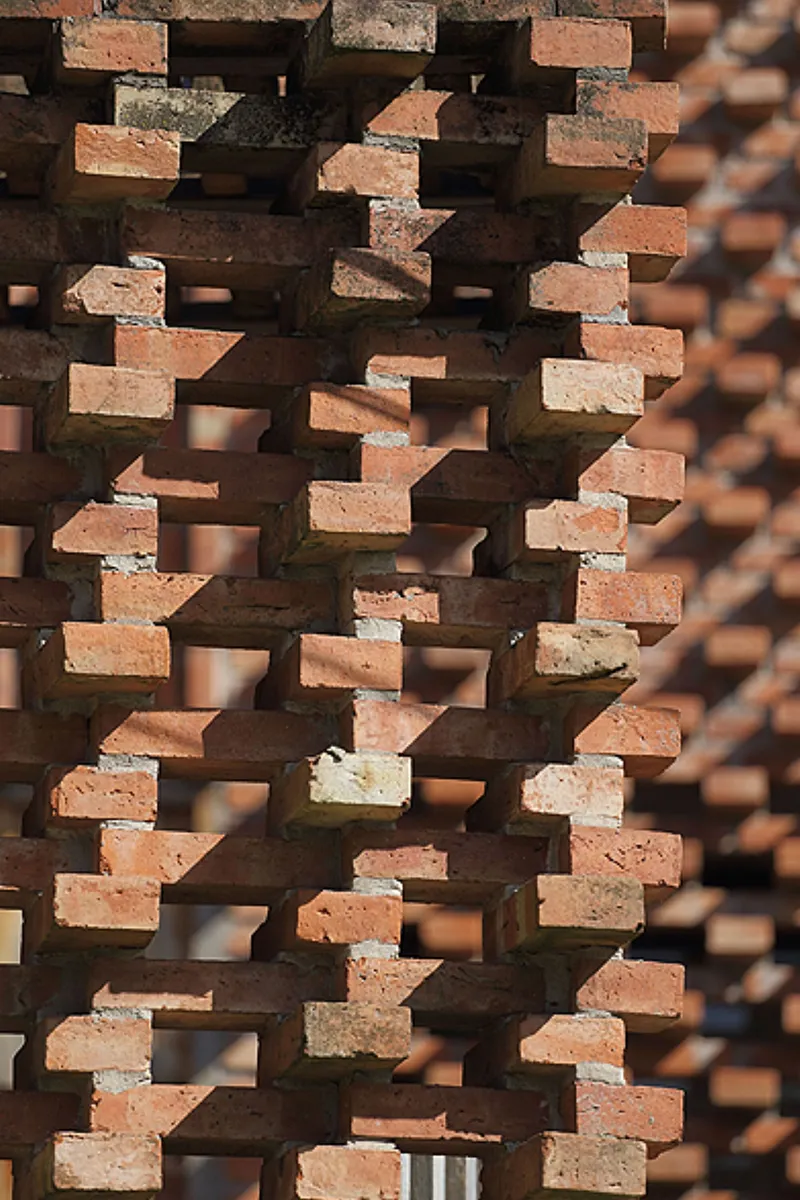
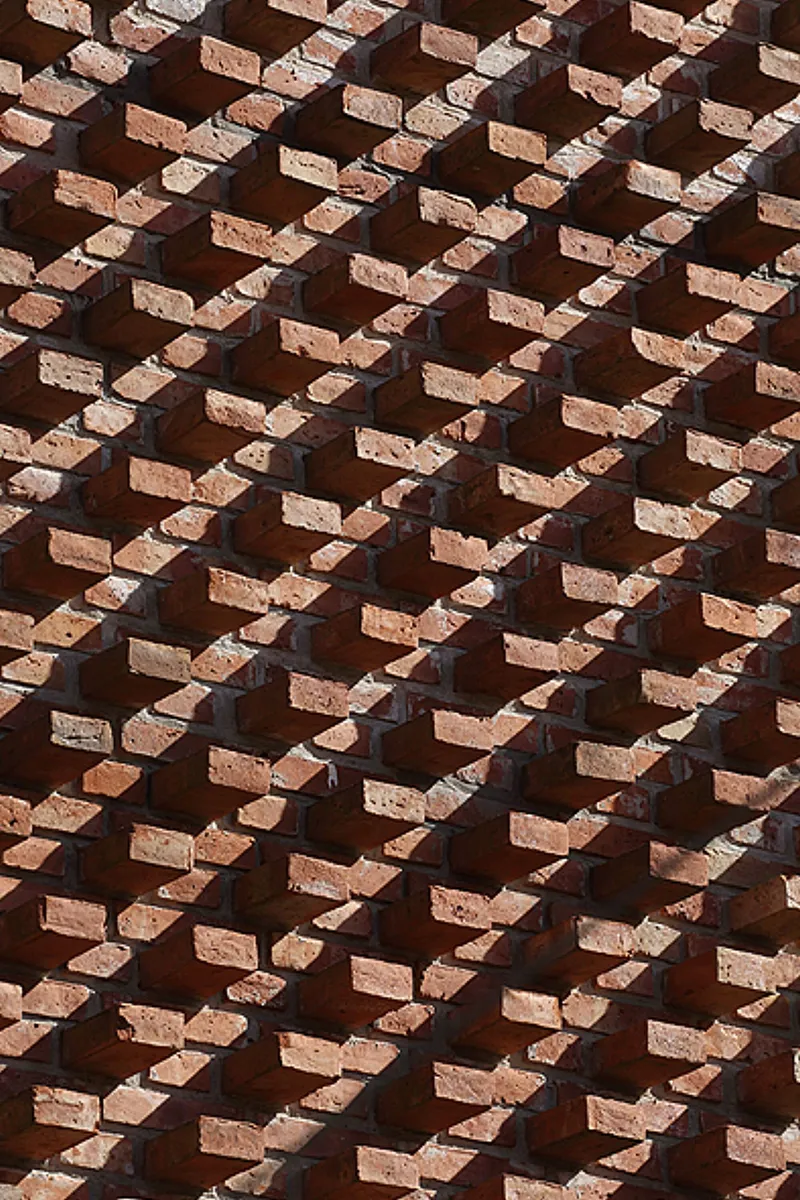
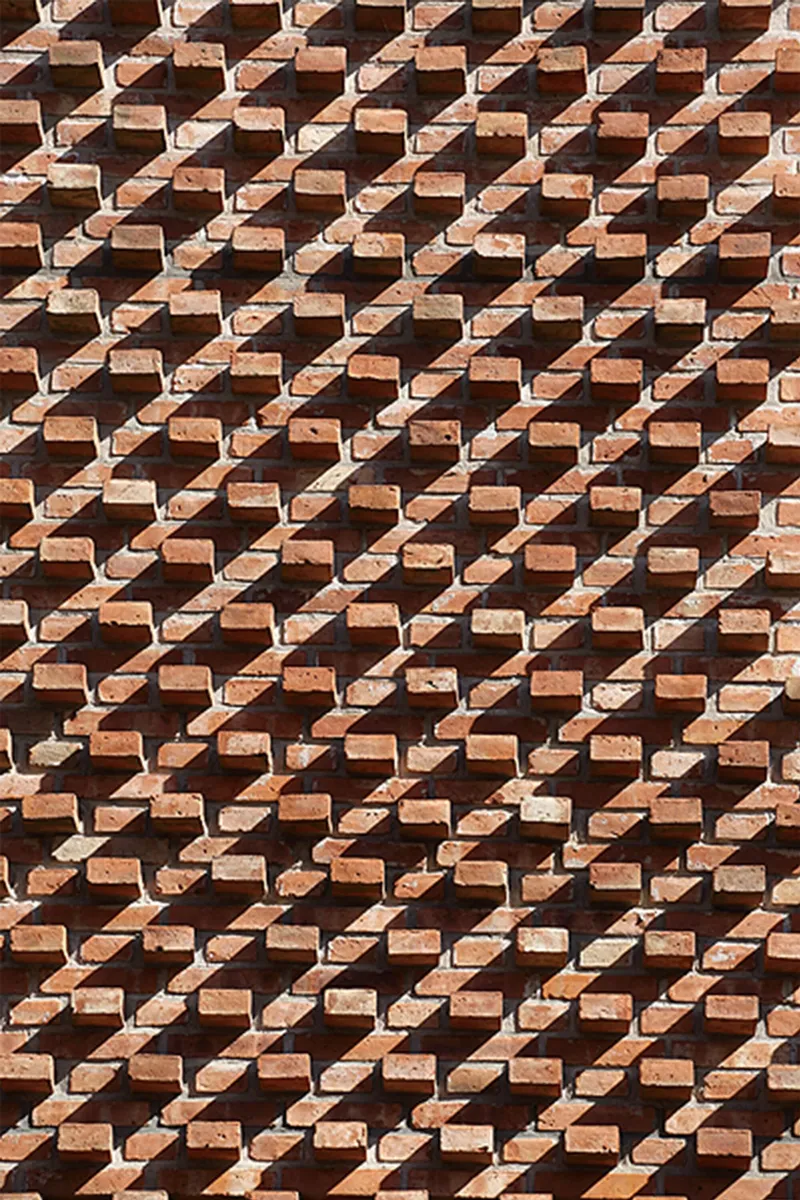
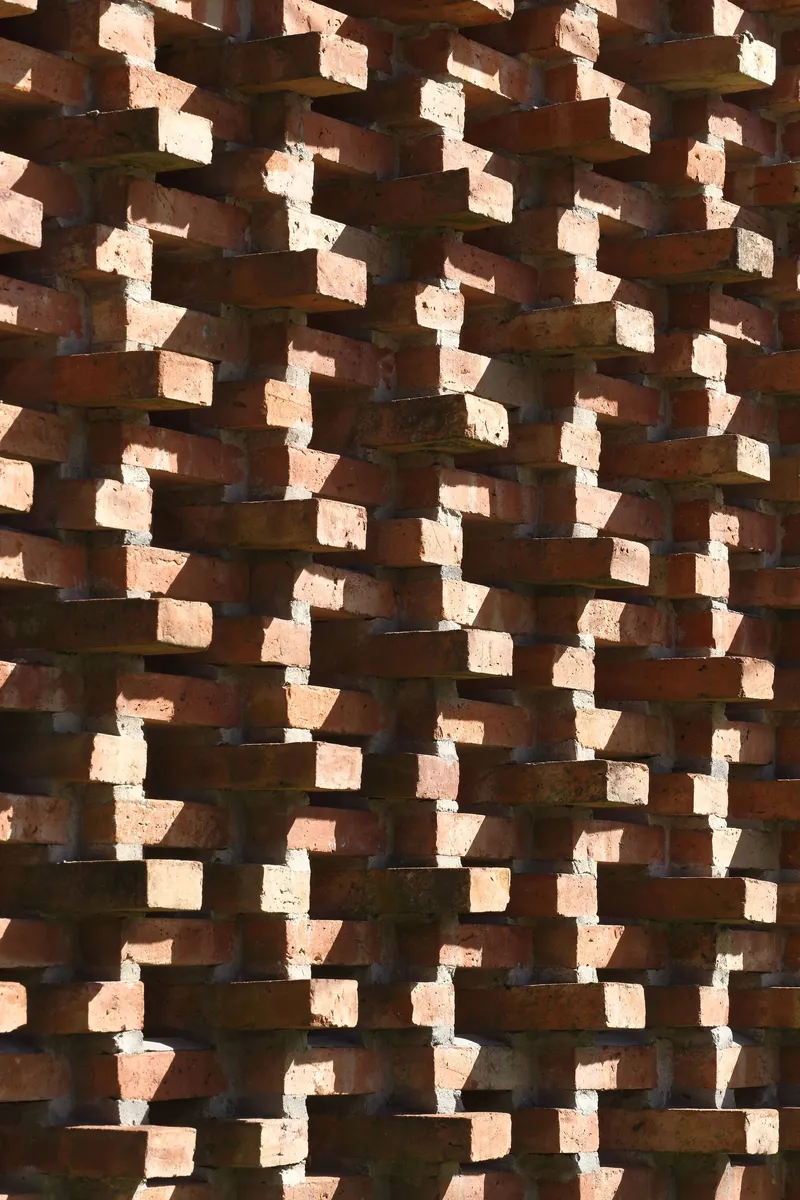
The close-up views of the brickwork reveal a material intelligence that is easy to miss at building scale. Individual bricks are rotated, projected, and staggered to create three-dimensional patterns that catch afternoon light in sharp diagonals. The depth of these projections is not decorative filler; it produces real shadow, real texture, and real variation in the amount of light passing through the wall. At some points the screen is nearly opaque. At others, it opens into a lattice that admits breeze and filtered sunlight to the terraces behind.
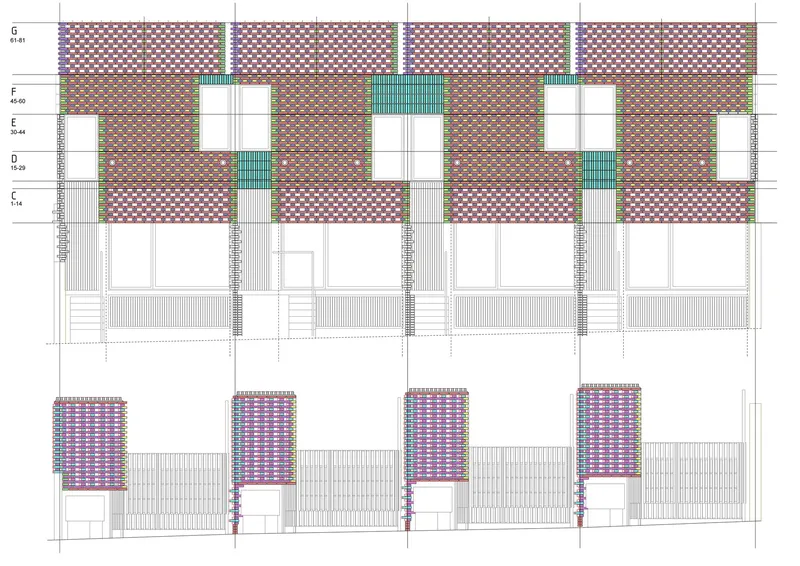
Cadau uses a limited palette of laying techniques, but he orchestrates them vertically so that the wall's character changes as it rises. The lower portions tend toward solidity, offering privacy and a sense of enclosure at ground level. Higher up, the pattern loosens into parasol-like screens over living areas and open railings at terrace edges. The brick stays the same; its behavior changes.

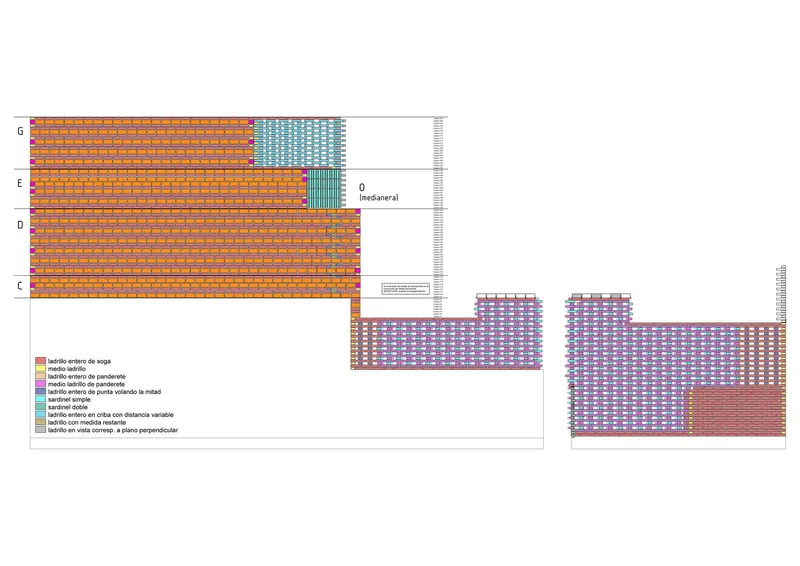
A color-coded diagram of the brick patterns makes the system legible. Different coursing techniques are mapped across the elevation, showing how a handful of standardized modules produce a facade that feels handcrafted. It is a lesson in what masonry can do when the designer takes the unit seriously: not as a neutral building block but as a pixel with orientation, depth, and shadow potential.
Courtyards and Entry Sequences
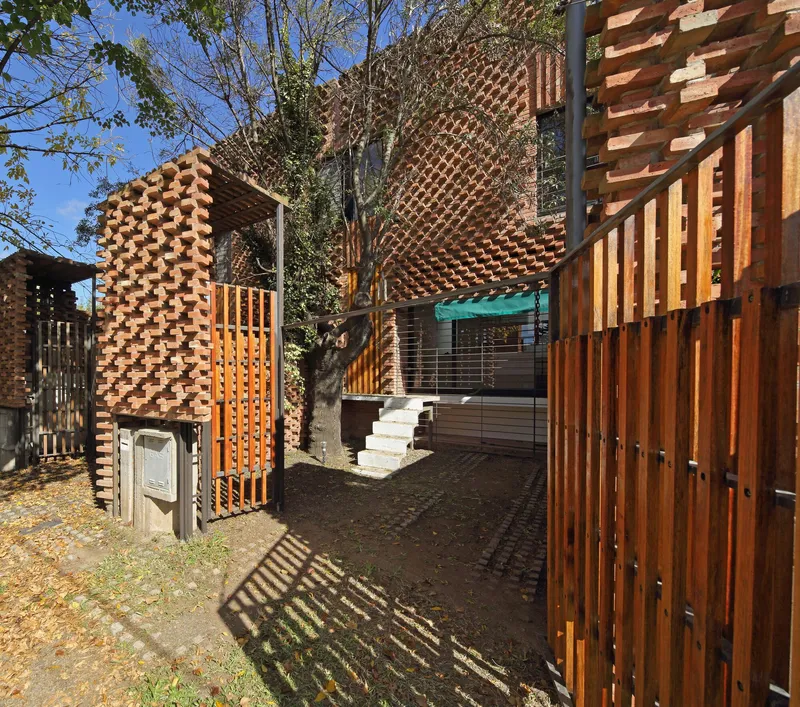
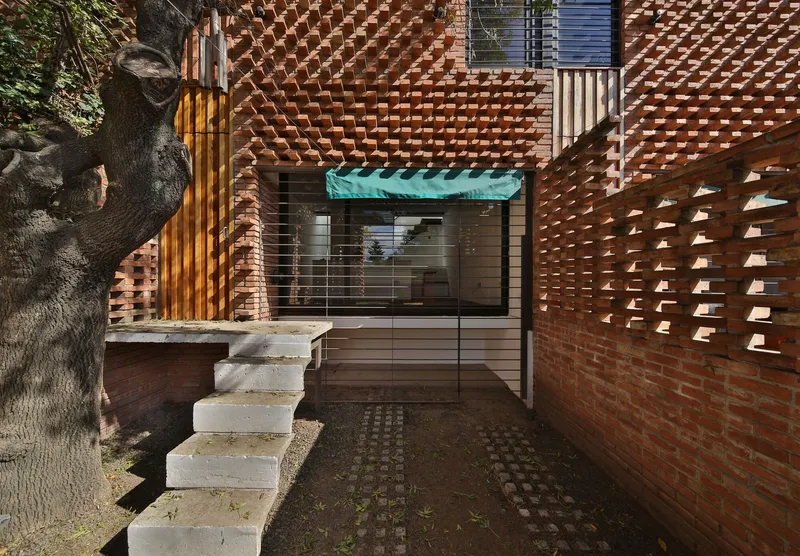
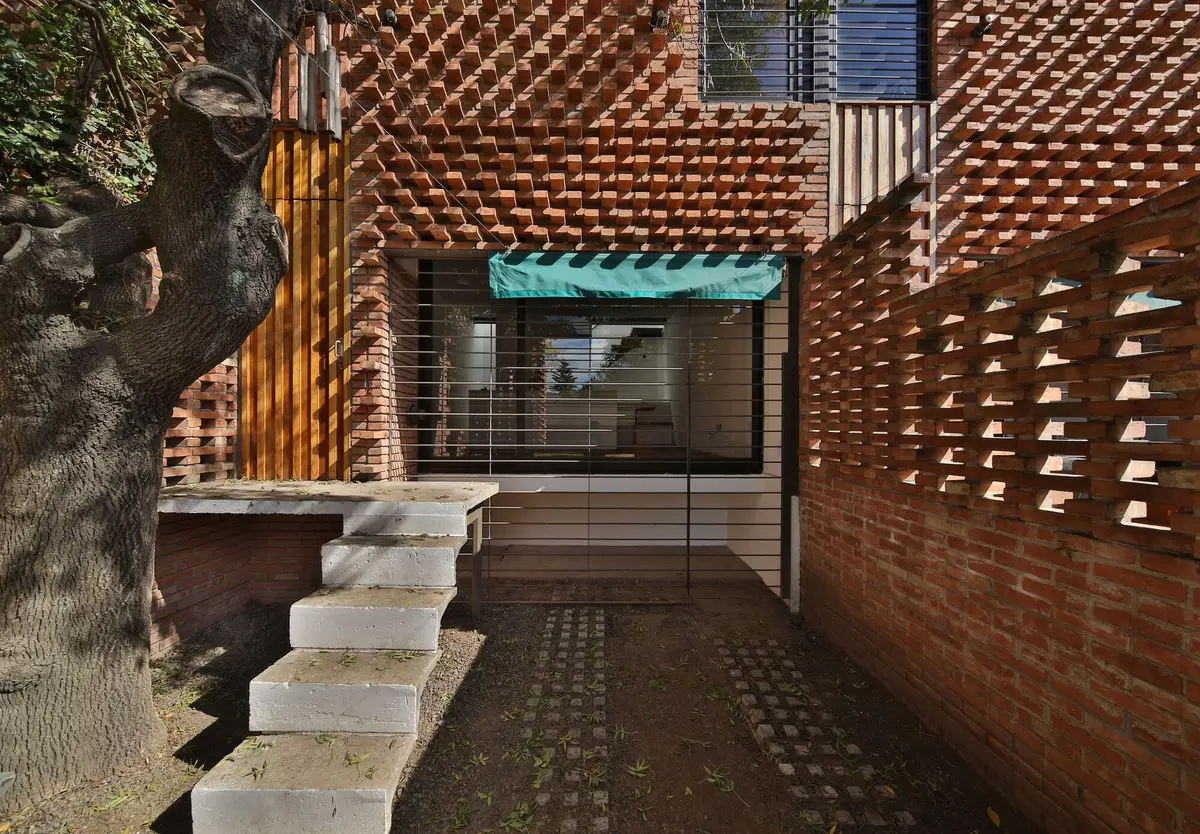
The front patios are the spatial heart of the project. Arriving at each house, you pass through timber slat screens and descend or ascend concrete steps alongside textured brick walls, with an old tree anchoring the courtyard. The sequence compresses and releases space: narrow entry, open court, filtered facade, interior. It is a layered threshold that gives each of the four houses its own sense of arrival despite sharing a single street front.
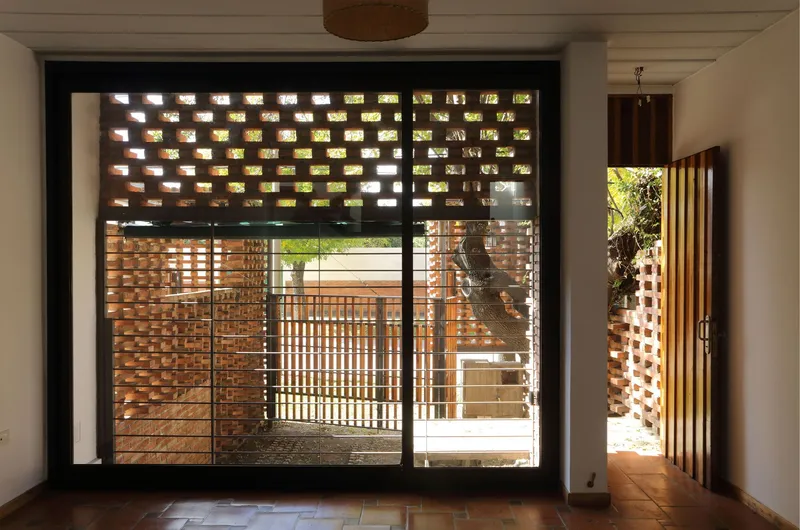
From inside, the view back through glazed doors captures the layered quality perfectly. Perforated brick, timber slats, and courtyard greenery stack into a series of translucent planes. Privacy is achieved not by a solid wall but by accumulated depth, each layer subtracting a bit more of the street's presence without eliminating it entirely.
Interior Circulation and Material Warmth
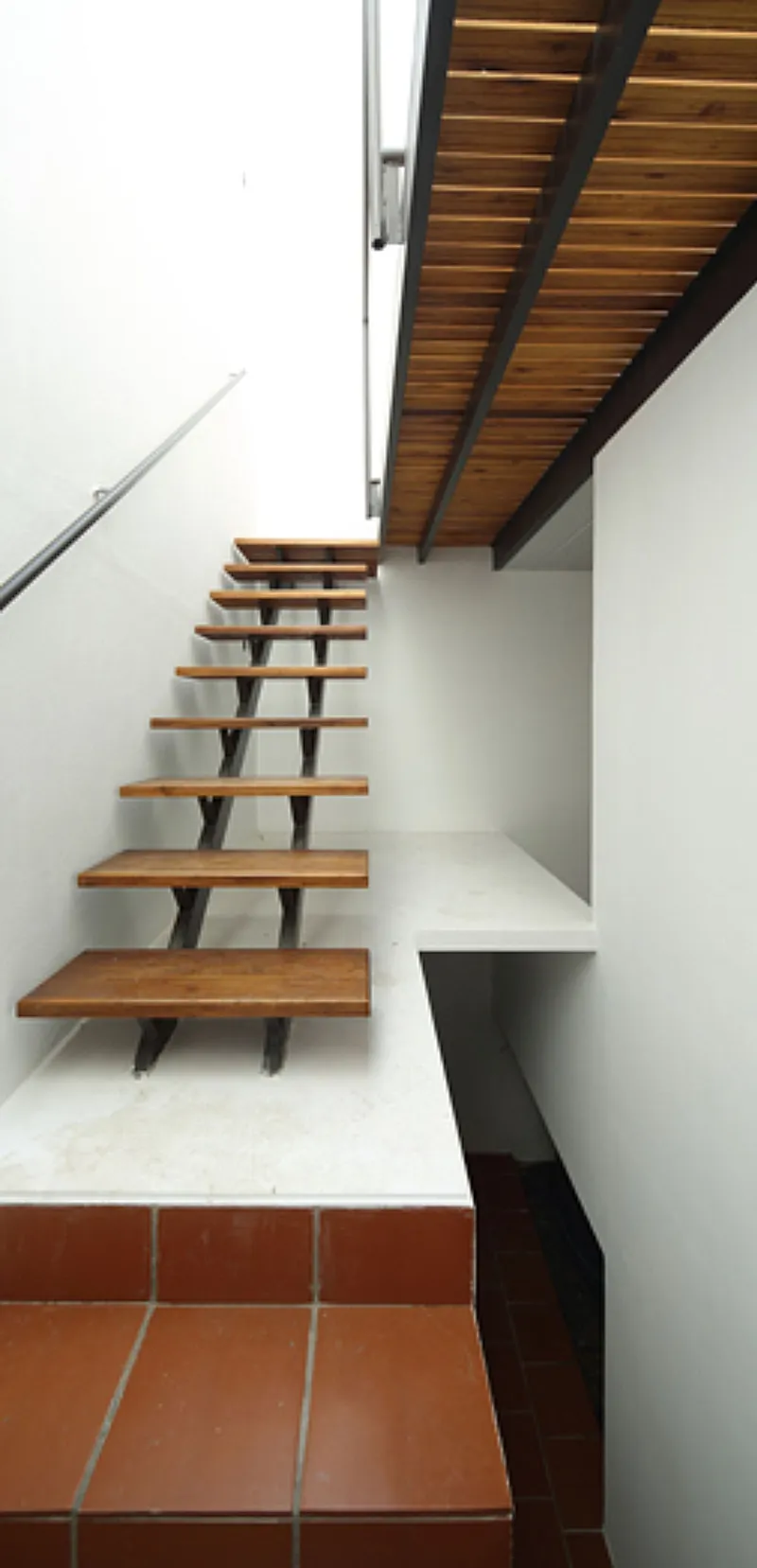
Inside, the material language shifts to timber and steel. An open-tread staircase with steel stringers rises beneath a slatted wood soffit, its rhythm echoing the brick screens outside. The palette is restrained: exposed structure, natural wood tones, concrete surfaces. Nothing competes with the facade for attention, and nothing needs to. The interiors serve as calm counterpoints to the textured exterior, letting the brick curtain do the heavy architectural lifting.
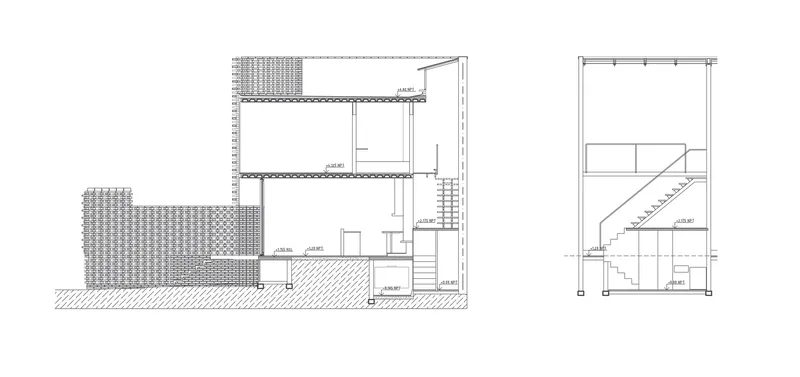
The split-level organization, visible in section, allows each unit to stack living spaces across half-levels connected by compact stairs. Terraces at different heights create outdoor rooms that are private from one another despite sitting side by side. It is an efficient use of a narrow lot depth, turning vertical displacement into spatial variety.
Plans and Drawings
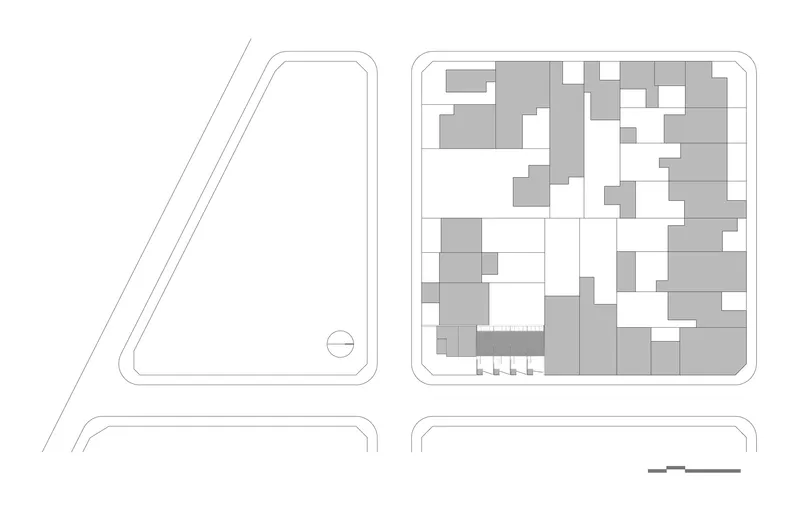
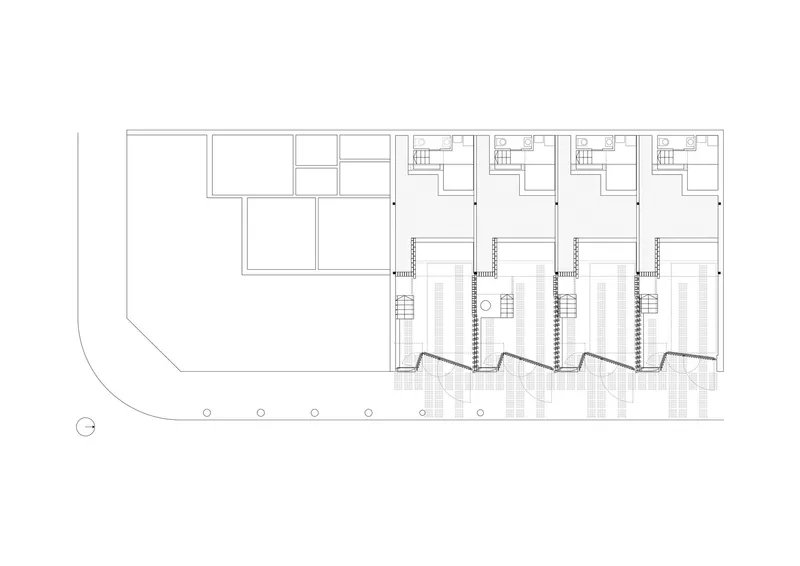
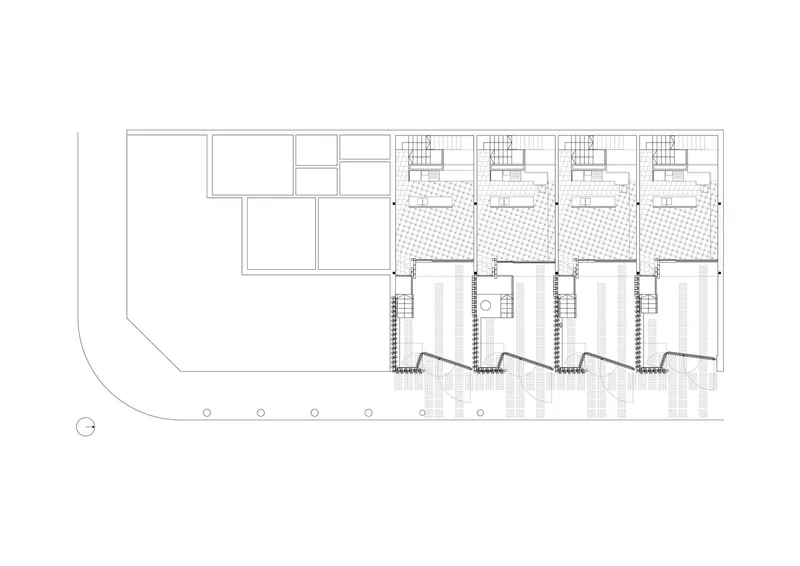
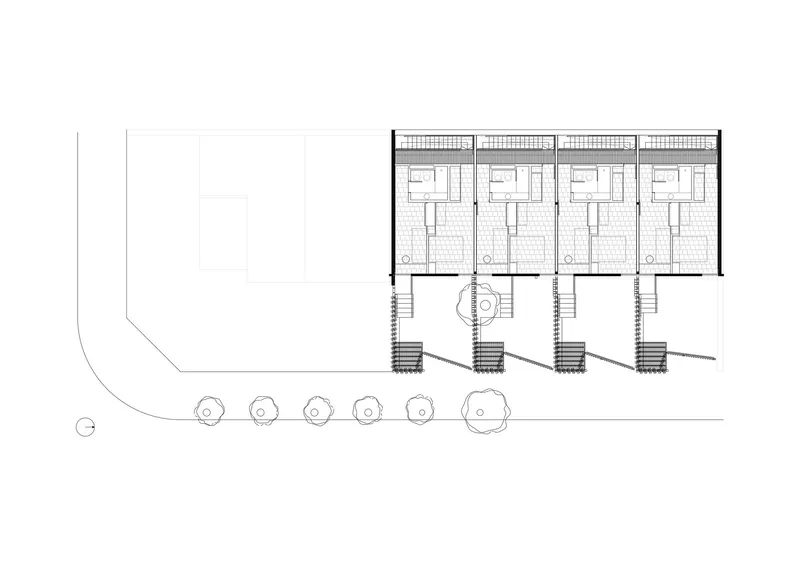
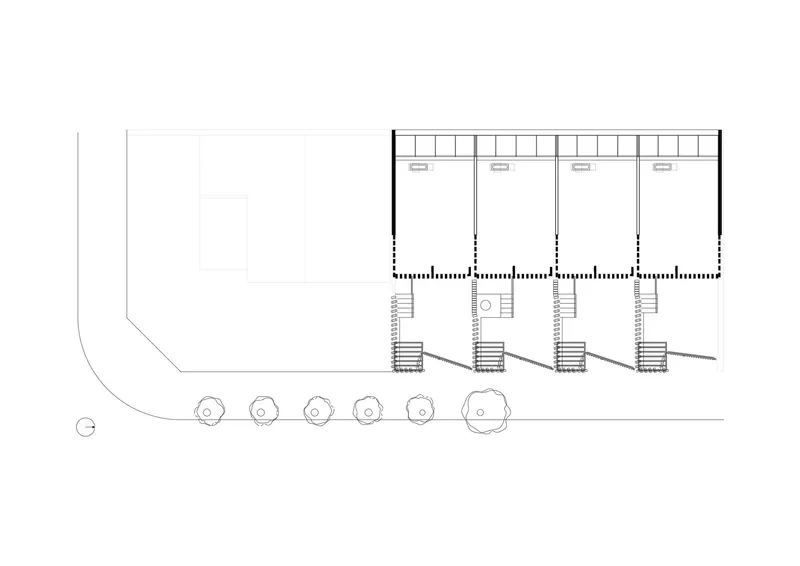

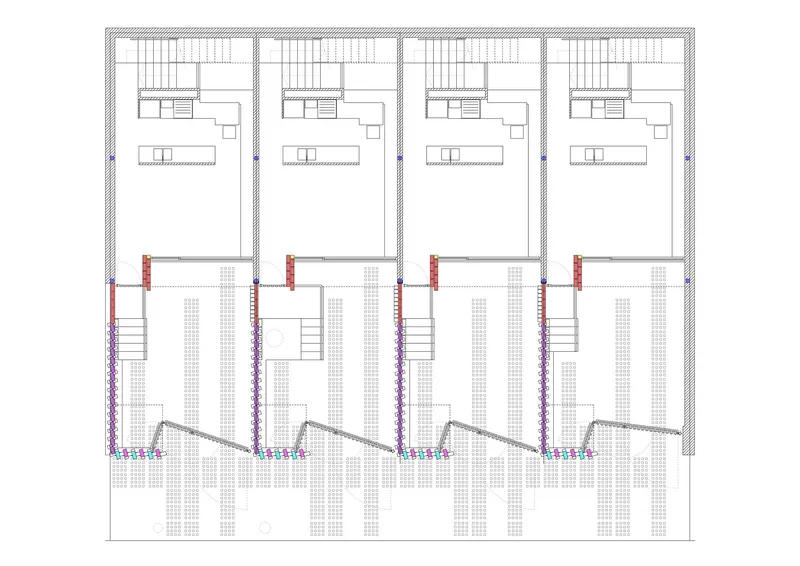
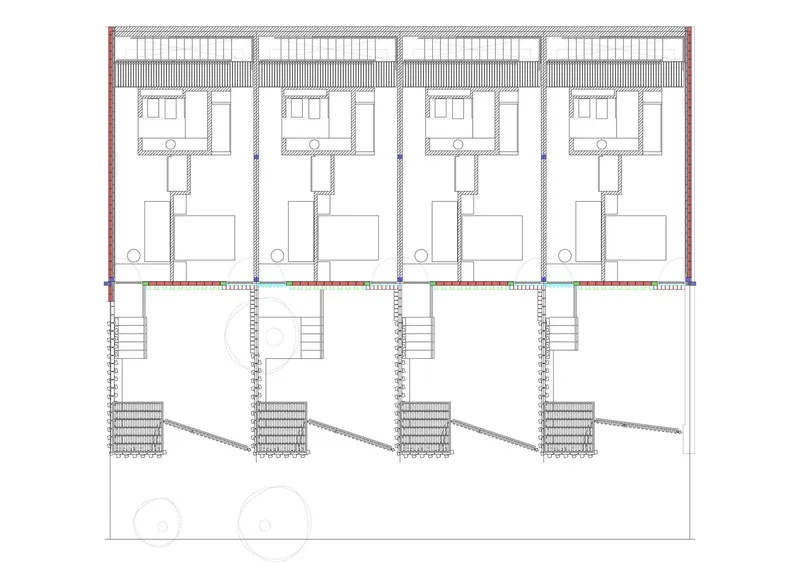
The plan drawings reveal the project's organizing logic with clarity. Four mirrored units share party walls, each containing internal stairs that connect living spaces at lower levels to bedrooms above. Terraces, indicated by hatched paving on the upper floors, provide every unit with private outdoor space behind the brick screen. The site plan shows the building positioned against the rear lot line, maximizing the depth of the front patios and their connection to the sidewalk planting.
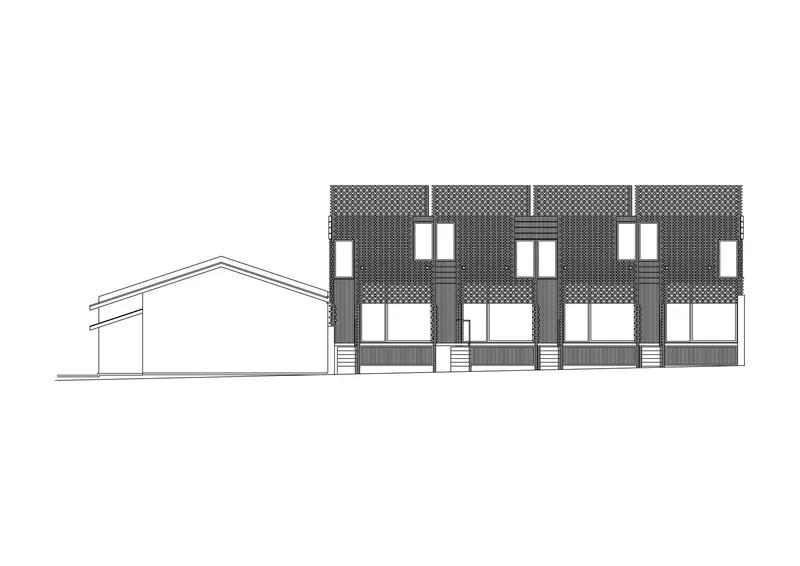
The sections and elevations demonstrate the split-level strategy and the facade's layered composition. A low-pitched roof structure on the adjacent corner chalet is drawn alongside the four townhouse units, making the scale relationship explicit. The elevation drawings confirm what the photographs suggest: window openings are staggered across the facade at multiple levels, punched through the brick curtain at points where the pattern loosens enough to allow glass.
Why This Project Matters
Fourteen years after completion, this project remains a sharp critique of the assumption that small-scale housing must look small. By investing in a single, continuous material surface and varying its behavior across the facade, Cadau turns four modest row houses into a piece of architecture that holds a street edge with confidence. The brick curtain is not expensive or exotic; it is ordinary masonry deployed with discipline and imagination. That combination is rarer than it should be.
The front patio strategy is equally worth studying. In a low-density neighborhood where houses typically sit behind fences or hedges, Cadau opens the ground plane to the sidewalk, creating a porous boundary between domestic and public life. The patios align with existing setbacks and street trees, so the new construction feels like a thickening of the neighborhood rather than an intrusion. It is a model for how infill housing can be both urban and generous, collective and individual, singular and serial.
4 Houses with a Front Patio, designed by Francisco Cadau Oficina de Arquitectura (lead architect Francisco Cadau, associate architect Andrea Lanziani). Located in Campana, Argentina. 438 m² total area. Completed in 2008. Photography by Gustavo Sosa Pinilla.
About the Studio
Share Your Own Work on uni.xyz
If projects like this are the kind of work you want to make, uni.xyz is a place to publish your own, find collaborators, and enter design competitions.


Popular Articles
Popular articles from the community


Faces of the Soviet Avant-Garde: Turning Moscow's Street Names into an Open-Air Museum
A network of sculptural installations across a Moscow residential district transforms forgotten architect names into spatial encounters with cultural memor
Opera by the Sea Estonia: Three Shells Dissolving Architecture into Tallinn's Coastline
A winning opera house proposal replaces monumental form with interconnected shells that blur the boundary between building, park and Baltic Sea.

Opera on the Sea: Driftwood Logic Shapes a Timber Opera House on Estonia's Coast
Trevor Orgill's opera house translates the entangled drift of floating timber into a civic building where wood, water, and music converge.
Temporary Home for Dogs: A Reversed Zoo Rethinks Animal Shelter Architecture
In Bucharest, a sinuous corridor and freed landscape flip the logic of containment, designing a shelter that works to make itself unnecessary.

Similar Reads
You might also enjoy these articles

Pixel Gardens: One Repeated Module Stacked Into a Terraced Social Housing Tower for Famagusta
Salem Bader's shortlisted housing tower builds a vertical neighbourhood from one repeated module, offsetting units to carve terraces, light and air.

Bao Huynh Watercolor Atelier: A Serene Art Retreat in Hội An
Bao Huynh Watercolor Atelier in Hội An blends multifunctional art spaces, sustainable design, local materials, and family-friendly living in a serene environment.

Atelier Macri Concept Store Interior Design by CASE-REAL
Atelier Macri store features a "ko" counter, walnut wood details, cork displays, blending retail, gallery, and seamless customer experiences.

Manuel Vargas Izquierdo Stadium and High-Performance Sports Center: Architectural Excellence in Jalpa de Méndez
The Manuel Vargas Izquierdo Stadium blends sustainable design, inclusive sports facilities, and cultural-inspired architecture, revitalizing Jalpa de Méndez’s public spaces.

Explore Building Patterns Competitions
Discover active competitions in this discipline

Challenge to reimagine the Iron Throne

Photograph architecture without architects

Illustrate the lost glory of Angkor Wat - Render Challenge

Design challenge to reuse E-waste
Comments (0)
Please login or sign up to add comments
No comments yet. Be the first to comment!