

Franz and Sue Cluster Three Schools Around Courtyards on a Single Campus in Austria
The Oberwart Education Campus bundles a primary school, music school, and community hall into a courtyard-driven complex in Burgenland.


Schools rarely get to be three things at once. The Oberwart Education Campus, designed by Franz and Sue, stacks a primary school, a music school, and a community events hall into a single 4,725 square meter complex in the Burgenland town of Oberwart, Austria. The building is organized around courtyards that give each program its own identity while threading them together through generous shared circulation. It is an exercise in making overlap productive rather than chaotic.
What makes this project genuinely interesting is the way it negotiates scale. Educational buildings at this density risk becoming institutional corridors connecting institutional rooms. Franz and Sue dissolve that pattern by using house-shaped plywood pavilions, oversized timber stairs, and reading nooks tucked under landings to break the internal volume into child-scaled episodes. The courtyards do the same thing externally, pulling light and landscape deep into the plan. The result is a campus that feels like a small village rather than a single building.
Courtyards and Campus Organization


The massing reads as a series of rendered wings, three storeys at most, that wrap around planted courtyards. From the entrance plaza, paved paths and planted beds distribute visitors across the different programs. Young trees and grass lawns soften the interior courtyards, ensuring that even rooms at the center of the plan receive daylight and a visual connection to landscape. The palette is restrained: light render, timber window frames, and paving that keeps the ground plane legible.
This courtyard typology is not novel, but its execution here is disciplined. Each court is sized differently, responding to its adjacent program. The primary school court is intimate, almost domestic; the larger forecourt near the gymnasium is civic and open. That calibration matters in a building where the users range from six-year-olds to adult musicians rehearsing in the evening.
House-Shaped Pavilions as Interior Landscape


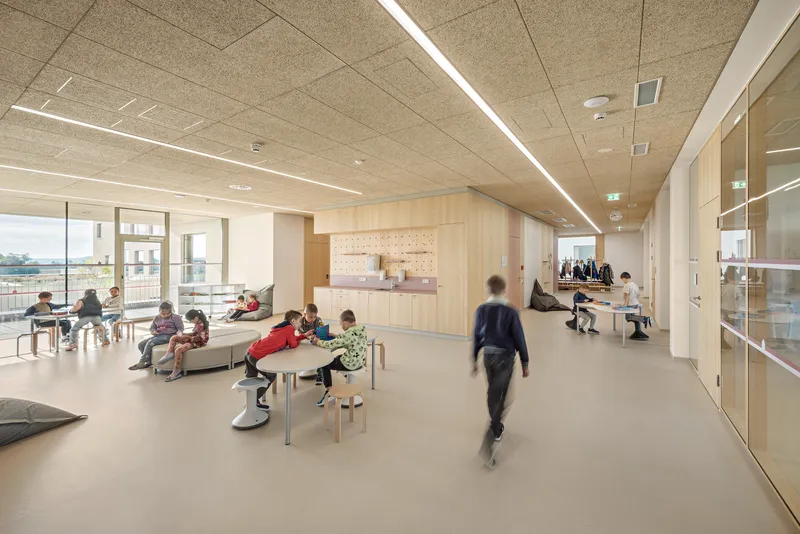
The most recognizable interior move is a set of house-shaped plywood volumes that sit inside the double-height halls. These are not decorative: they house small group rooms, reading corners, and informal teaching spaces, all wrapped in a gabled profile that children immediately understand as "house." The archetype is deliberate. In a building that consolidates three institutions, giving kids a recognizable form to orient around is a spatial anchor.
The plywood structures also modulate acoustics and sightlines. Standing on the main timber floor, you look past the pitched rooflines into adjacent activity zones. A glass-enclosed pavilion in the central hall lets teachers observe multiple groups without fragmenting the open plan. It is a practical solution dressed in a legible geometry, and it works because the architects resist over-decorating it. The birch plywood does the talking.
The Timber Staircase as Social Infrastructure


Wide timber stairs dominate the primary circulation zones, and the architects clearly designed them as much for sitting as for moving. Children perch on the treads, lean into triangular reading nooks tucked beneath the landings, and gather in informal clusters along the risers. The stair becomes an amphitheater, a library annex, and a meeting point all at once.
The yellow triangular niches under the staircase deserve attention. They are playful without being patronizing, scaled to a child's body, and integrated into the stair structure itself rather than applied as afterthought furniture. This kind of spatial generosity in the leftover volume beneath a flight of stairs signals an architect who has genuinely thought about how children occupy a building, not just how they move through it.
Dining and Communal Spaces
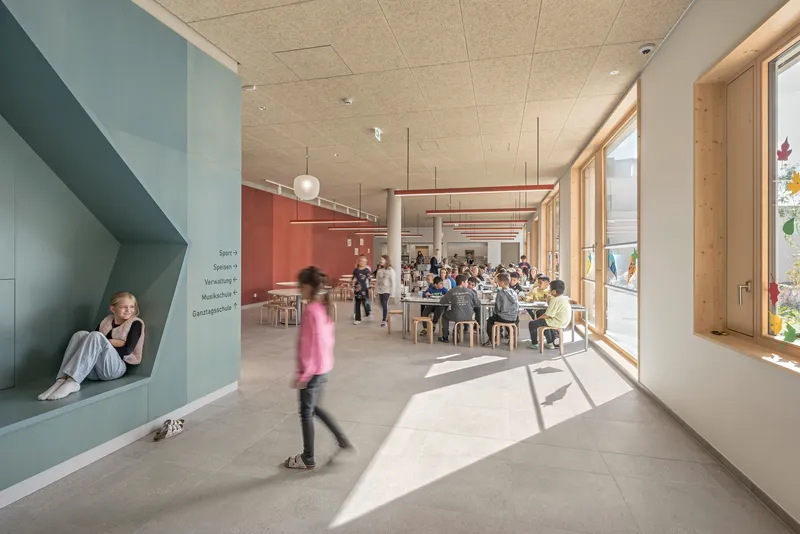

The dining hall doubles as a social heart. Acoustic ceiling panels manage the noise of a room full of children, while suspended red linear lighting provides a warm, horizontal datum that draws the eye across the space. A red accent wall in the adjacent dining zone picks up this color thread. It is one of the few moments where the architects introduce saturated color, and the restraint makes it effective.
Timber-framed windows line the dining spaces, maintaining the visual continuity with the courtyard landscape. The ceiling treatment is pragmatic: modular acoustic tiles that can be replaced without disrupting the room's appearance. When the evening program takes over, converting this space for music school events or community gatherings, the acoustic control already built into the architecture makes the transition seamless.
Classrooms and Corridors


The classrooms are calm, well-lit, and deliberately unadorned. Large timber-framed windows face the courtyard trees, and in autumn the foliage fills the room with warm, filtered light. White desks and neutral wall surfaces let the view do the atmospheric work. The corridors, similarly, are treated as inhabited space rather than residual connectors: coat hooks, glazed partitions into adjacent classrooms, and low sills invite pausing and looking.
Glazed partitions between corridors and classrooms serve a dual purpose. They allow passive supervision and they dissolve the sense of enclosure that traditional school hallways impose. A child walking to the bathroom can glance into a music lesson happening next door. This visual porosity encourages the cross-pollination that the campus model promises.
Plans and Drawings


The floor plans reveal the logic that holds the campus together. Wings cluster around courtyards in an almost pinwheel arrangement, with a large rectangular gymnasium volume anchoring one edge. The central circulation core acts as a hinge, distributing movement to the three programmatic zones. Tree circles in the courtyards are drawn with the same precision as the structural grid, suggesting that landscape is treated as integral to the architecture, not as decoration applied after the fact.
What the plans make clear is that this is not a compact building. The architects have traded floor-plate efficiency for spatial richness, allowing courtyards to consume plan area in exchange for daylight, ventilation, and orientation. For a public educational project, that trade-off represents a real commitment from the client and the municipality. The drawings also show a clear separation between the primary school clusters and the music school rooms, confirming that the shared-campus concept works through adjacency rather than overlap.
Why This Project Matters
The Oberwart Education Campus is not trying to reinvent school architecture. Its courtyard organization, its timber materiality, and its house-shaped pavilions all draw on well-tested ideas. What sets it apart is the conviction with which Franz and Sue deploy those ideas together, and the care with which they calibrate every space to its specific users: small children in the morning, teenage musicians in the afternoon, community groups in the evening. The building accommodates all three without defaulting to generic flexibility.
In a moment when many European municipalities are consolidating educational programs into single sites to save money and land, this project offers a useful model. It demonstrates that consolidation does not have to mean compression. By investing plan area in courtyards and generous circulation, the architects create a campus that feels expansive and specific rather than efficient and bland. That is a lesson worth studying, especially for the many school projects currently on drawing boards across the continent.
Oberwart Education Campus, Oberwart, Austria. Architects: Franz and Sue. Area: 4,725 m². Year: 2025. Photography: Hertha Hurnaus.
About the Studio
Share Your Own Work on uni.xyz
If projects like this are the kind of work you want to make, uni.xyz is a place to publish your own, find collaborators, and enter design competitions.


Popular Articles
Popular articles from the community


Singing Woman: An Opera House That Performs Before the Curtain Rises
Ovidiu Cristian Pavel's conceptual opera house translates Estonia's choral identity into a sculpted waterfront landmark facing the Baltic Sea.

The Amber Palace Opera: A Geological Fiction Surfaces on Tallinn's Baltic Waterfront
Pierre Brillard reimagines a Baltic legend as a public landscape, opera house, and waterfront promenade rooted in Tallinn's coastal identity.
Opera by the Sea Estonia: Three Shells Dissolving Architecture into Tallinn's Coastline
A winning opera house proposal replaces monumental form with interconnected shells that blur the boundary between building, park and Baltic Sea.

Opera on the Sea: Driftwood Logic Shapes a Timber Opera House on Estonia's Coast
Trevor Orgill's opera house translates the entangled drift of floating timber into a civic building where wood, water, and music converge.

Similar Reads
You might also enjoy these articles

Pixel Gardens: One Repeated Module Stacked Into a Terraced Social Housing Tower for Famagusta
Salem Bader's shortlisted housing tower builds a vertical neighbourhood from one repeated module, offsetting units to carve terraces, light and air.

Bao Huynh Watercolor Atelier: A Serene Art Retreat in Hội An
Bao Huynh Watercolor Atelier in Hội An blends multifunctional art spaces, sustainable design, local materials, and family-friendly living in a serene environment.

Atelier Macri Concept Store Interior Design by CASE-REAL
Atelier Macri store features a "ko" counter, walnut wood details, cork displays, blending retail, gallery, and seamless customer experiences.

Manuel Vargas Izquierdo Stadium and High-Performance Sports Center: Architectural Excellence in Jalpa de Méndez
The Manuel Vargas Izquierdo Stadium blends sustainable design, inclusive sports facilities, and cultural-inspired architecture, revitalizing Jalpa de Méndez’s public spaces.

Explore Campus Competitions
Discover active competitions in this discipline

Challenge to design a barrier free sports center

Challenge to design an outdoor ice-rink and park

Challenge to design public laboratory
Comments (0)
Please login or sign up to add comments
No comments yet. Be the first to comment!