

Studio Wok Designs a Funerary House in Northern Italy Where Light and Timber Guide the Grieving
Charred timber, vaulted ceilings, and garden courtyards create a space of quiet dignity for farewell ceremonies near Milan.


Funerary architecture rarely gets discussed in the same breath as residential or cultural design, yet few building types carry a heavier emotional burden. Studio Wok, the Milan-based practice, confronts that burden directly with Funerary House Luce, a compact facility that replaces clinical bleakness with warmth, natural light, and the texture of honest materials. The name itself, "Luce" (Italian for "light"), is not metaphorical window dressing: it describes the primary design strategy.
What makes this project genuinely interesting is its refusal to treat a funeral home as a merely functional container. Studio Wok has built a small piece of domestic architecture, borrowing the vocabulary of courtyards, vaulted ceilings, and carefully framed garden views to construct a sequence of rooms that guide visitors from public grief toward private contemplation. The result is a building that feels less like an institution and more like a house that happens to serve the most solemn purpose imaginable.
A Street Facade That Communicates Restraint
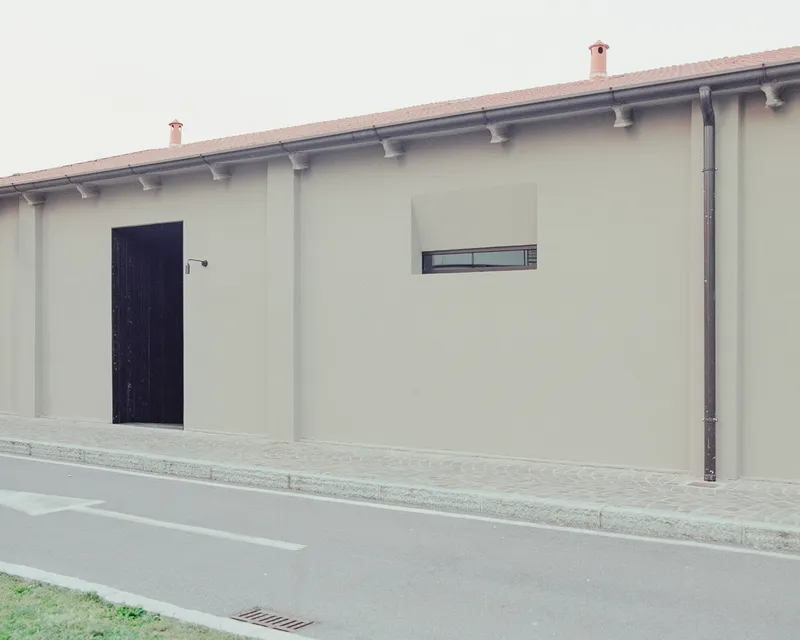
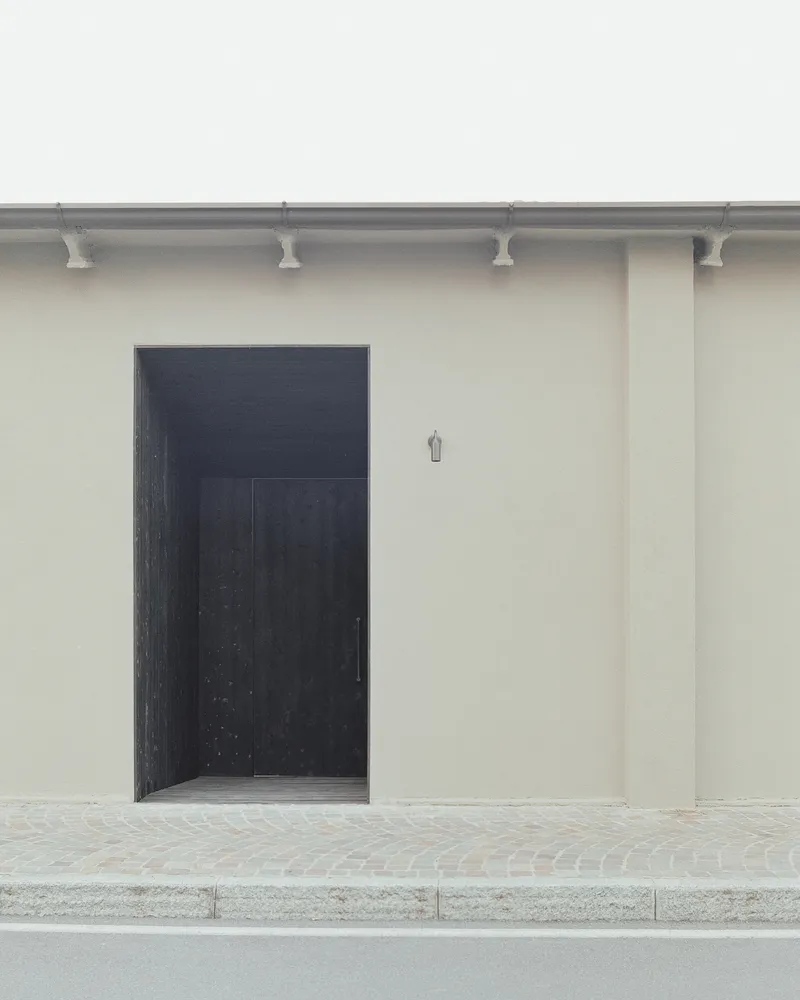
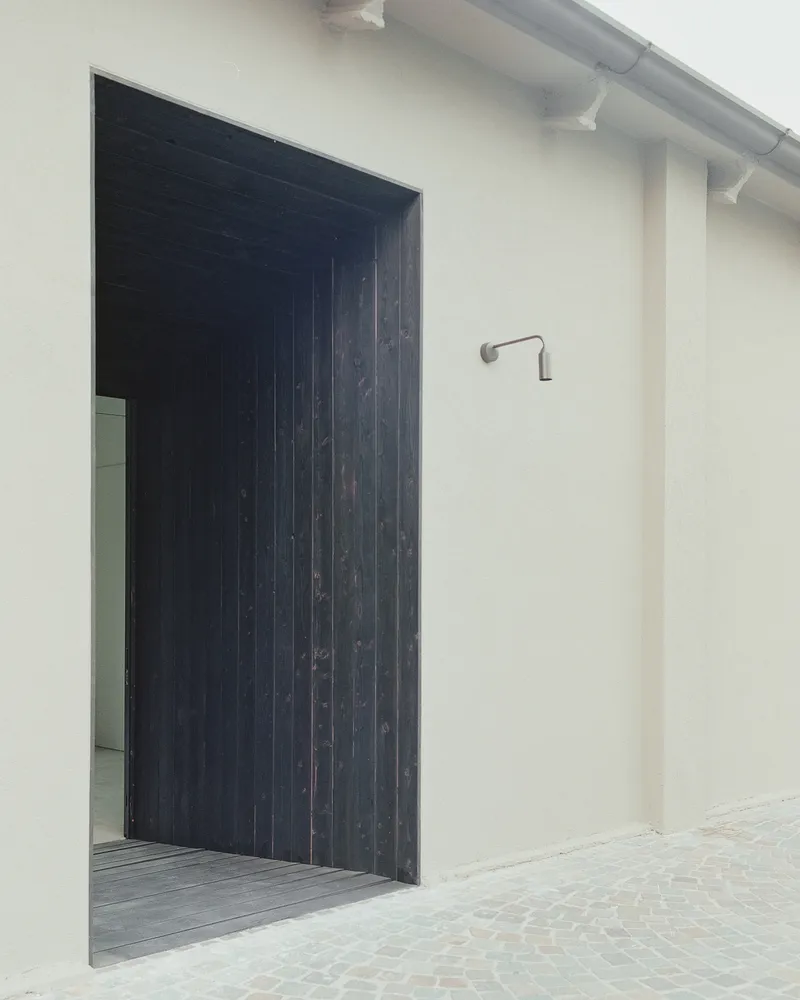
From the street, Funerary House Luce reads as deliberately understated. A smooth stucco wall, punctuated by a narrow window and a deeply recessed entry door clad in charred timber, presents a face of quiet seriousness without tipping into severity. Decorative terracotta corbels along the roofline tie the building to its regional context, acknowledging that a funeral home must belong to its neighborhood rather than announce itself with monumental gestures.
The entry threshold matters enormously in a building like this. Studio Wok uses the charred timber cladding, applied in vertical battens, to signal a crossing point: from the ordinary world outside to the charged interior. It is a material choice that carries symbolic weight (fire, transformation, permanence) without being literal about it.
Charred Timber as Threshold and Texture
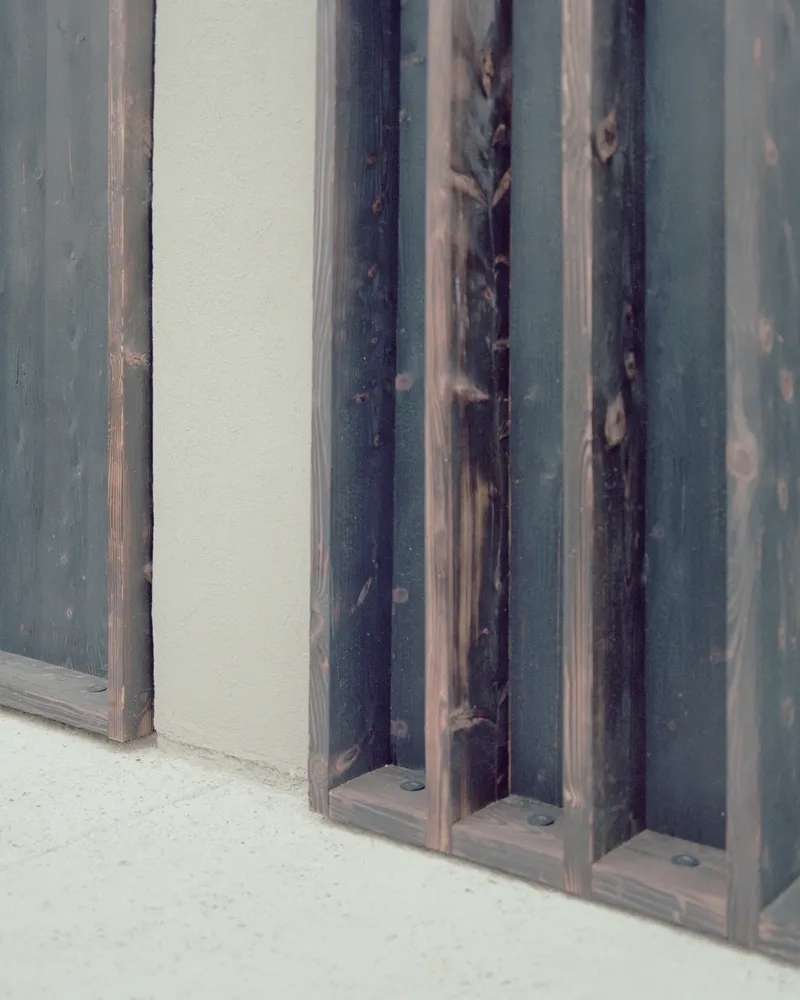
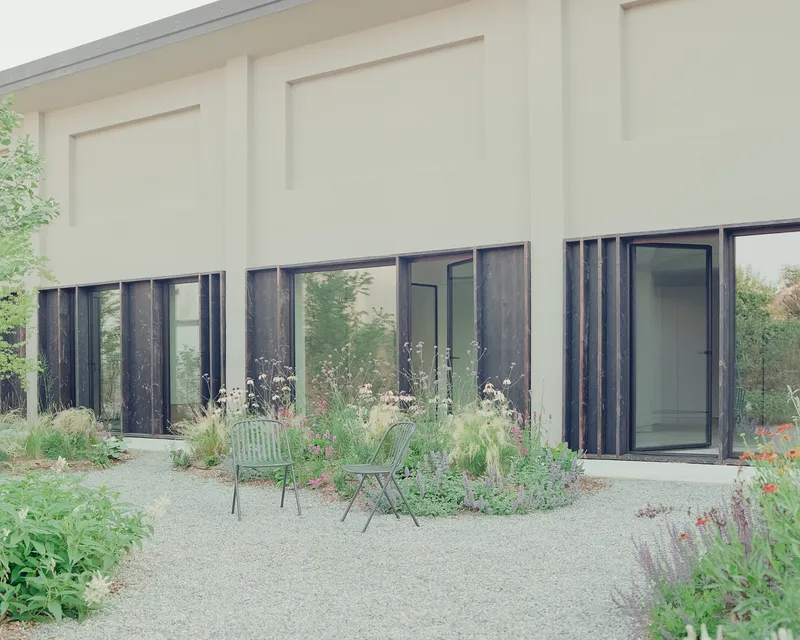
The shou sugi ban technique, charring the surface of timber to preserve and darken it, appears at every transitional moment: the street entrance, the garden courtyard doors, the juncture between exterior cladding and rendered plaster. Seen close up, the carbonized battens have a tactile grain that contrasts sharply with the smooth white walls they meet. The detail at floor level, where blackened wood touches pale render and gravel, is resolved with a precision that suggests craft rather than effect.
In the garden courtyard, the charred timber frames a series of glass doors that open onto planted beds and a gravel path. The courtyard is not large, but its proportions give it the feeling of an outdoor room, a decompression zone between arrival and the ceremonial spaces deeper inside. Planting is kept low and textural: grasses and ground cover that shift with the seasons rather than showy perennials.
Vaulted Interiors and the Quality of Stillness
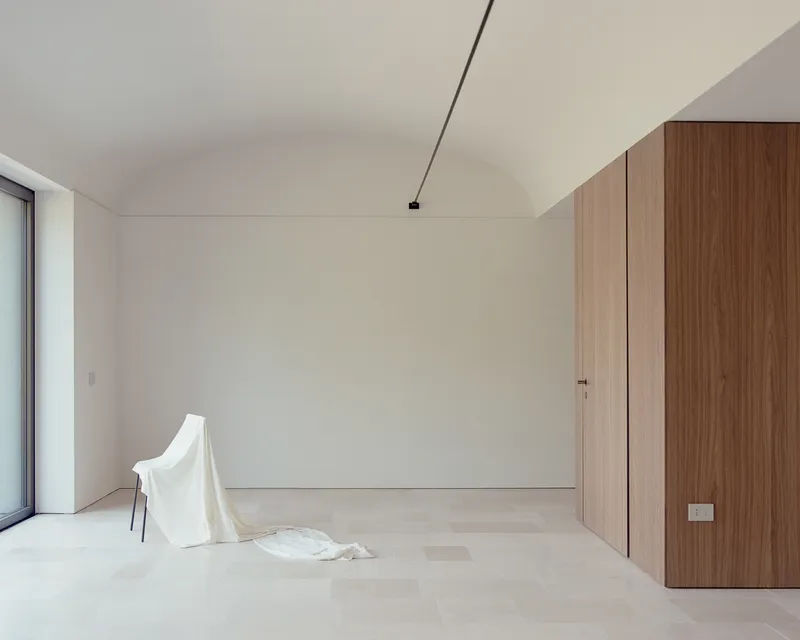
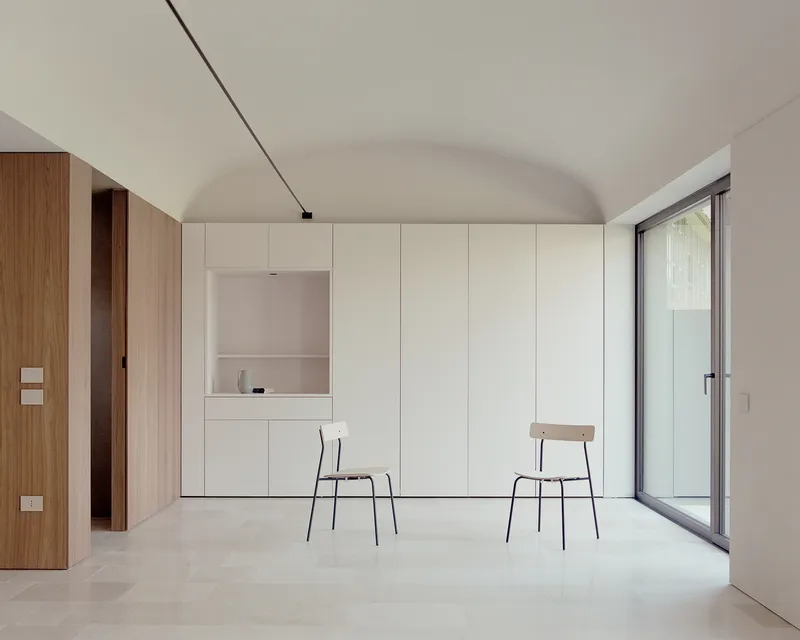
Inside, the vaulted ceilings do the heavy lifting. They lift the eye upward and soften the acoustics in rooms designed for hushed conversation and silence. Pale timber floors, white built-in cabinetry, and walnut joinery compose a palette that is warm without being sentimental. A draped cloth over a chair, an image that recurs in several rooms, suggests the presence of a body without showing one, a discreet piece of staging that keeps the architecture focused on those who are still here.
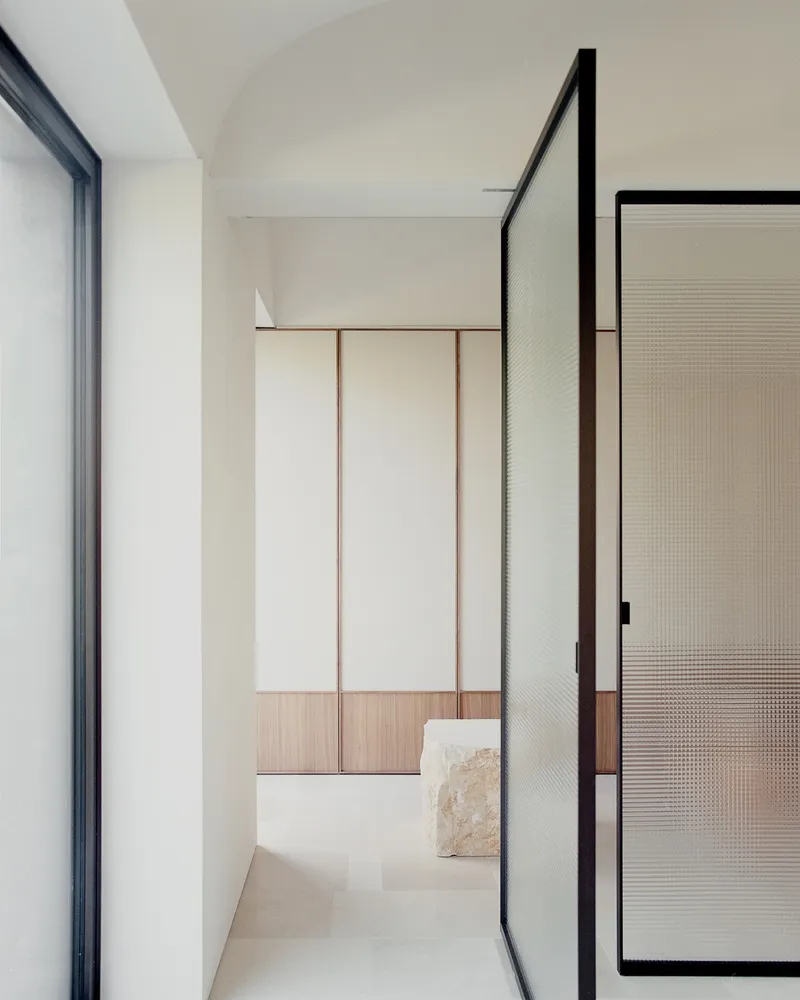
The hallway thresholds deserve particular attention. Black-framed reeded glass doors and walnut sliding panels create a layered sequence of enclosures, each slightly more private than the last. A timber bench beneath a vaulted ceiling marks one such transition, offering a place to sit before entering or after leaving a viewing room. These are not grand architectural moments, but they are precisely the kind of spatial generosity that matters in a building devoted to grief.
Reeded Glass and the Art of Soft Division
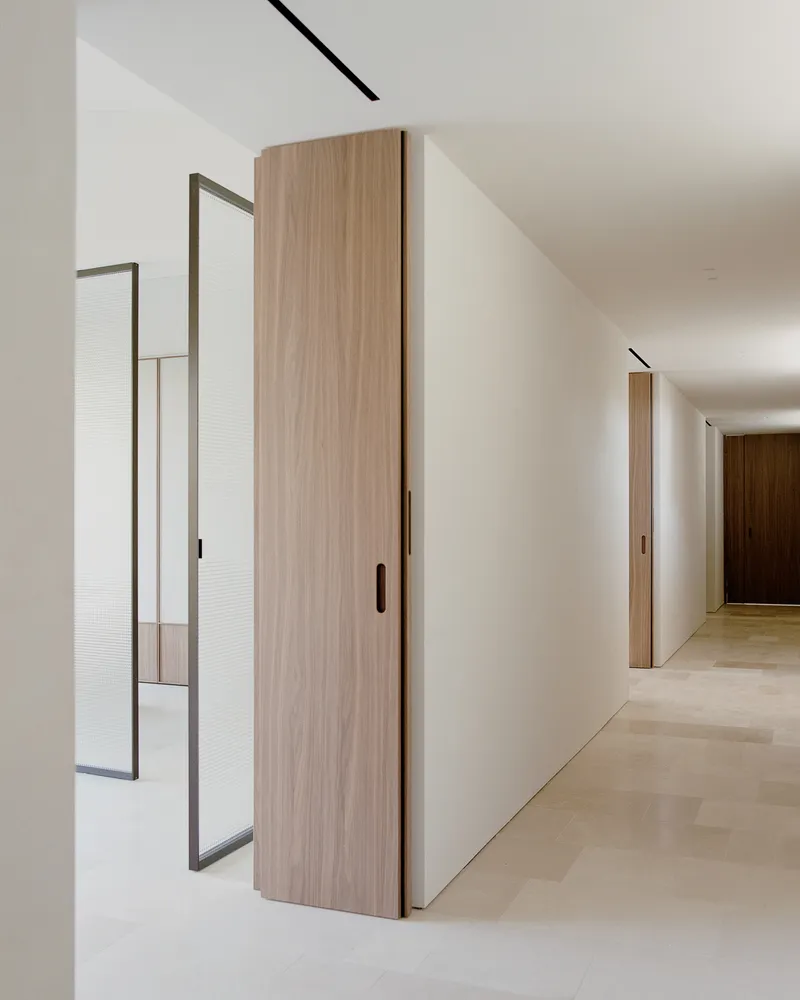
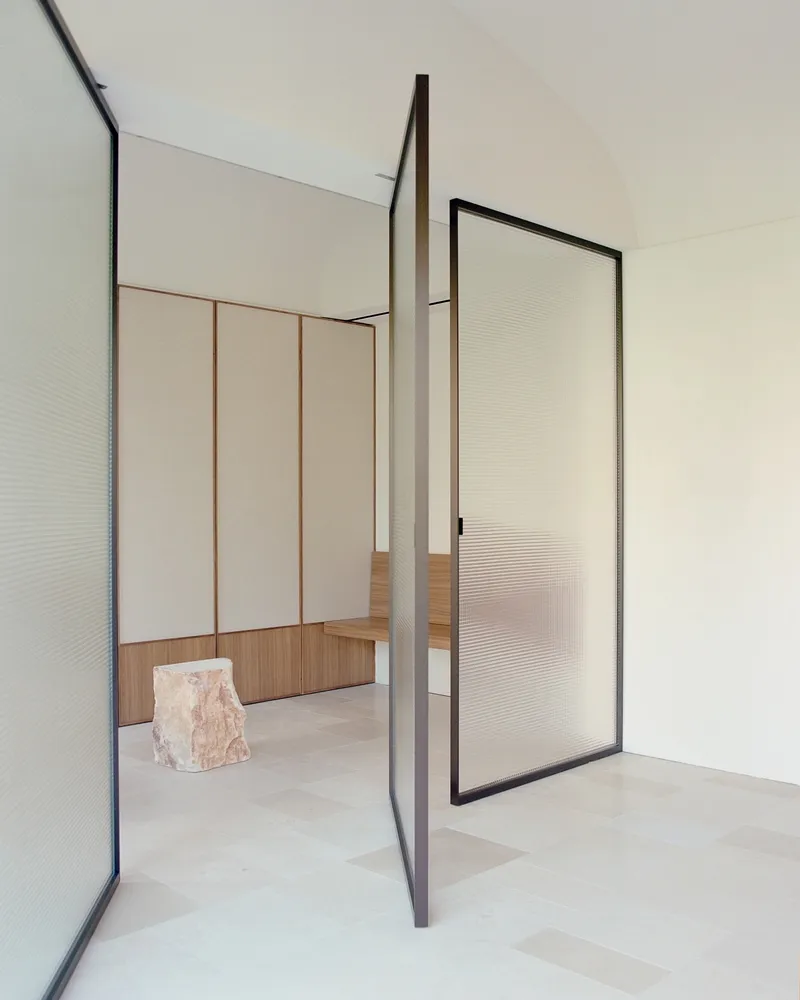
Studio Wok uses reeded glass extensively, and for good reason. In a funerary house, full transparency between rooms would be intrusive, but solid walls would feel oppressive. The reeded glass partitions, framed in dark metal, allow light and the suggestion of movement to pass between spaces while maintaining visual privacy. They register as translucent membranes rather than barriers.
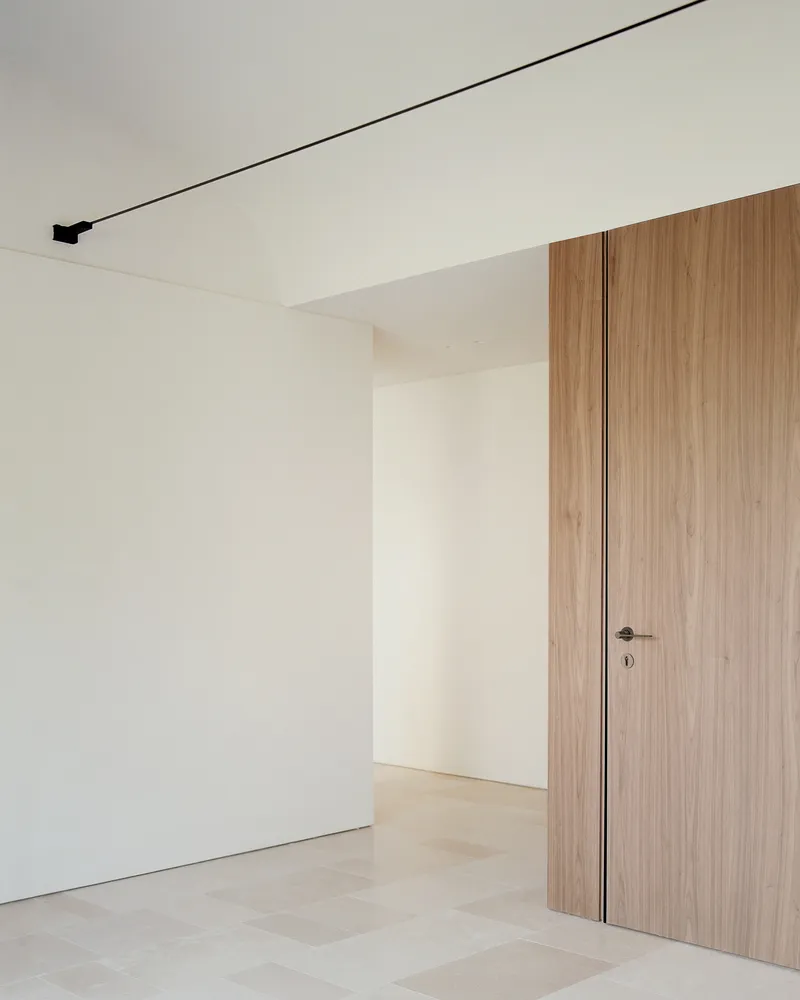
The pivoting translucent glass door captured between two rooms is a particularly elegant detail. It swings on a central axis, allowing it to serve as either an open passage or a closed screen depending on the ceremony's needs. Paired with the flush walnut doors and recessed ceiling track lighting elsewhere in the corridors, these elements form a system of adjustable enclosure that lets the building adapt to different rituals and family sizes.
Garden Views as Consolation
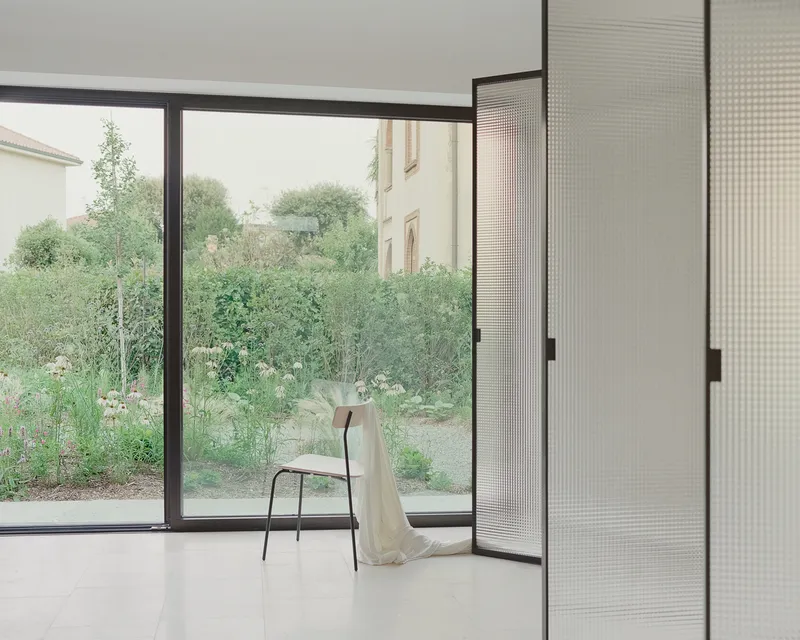
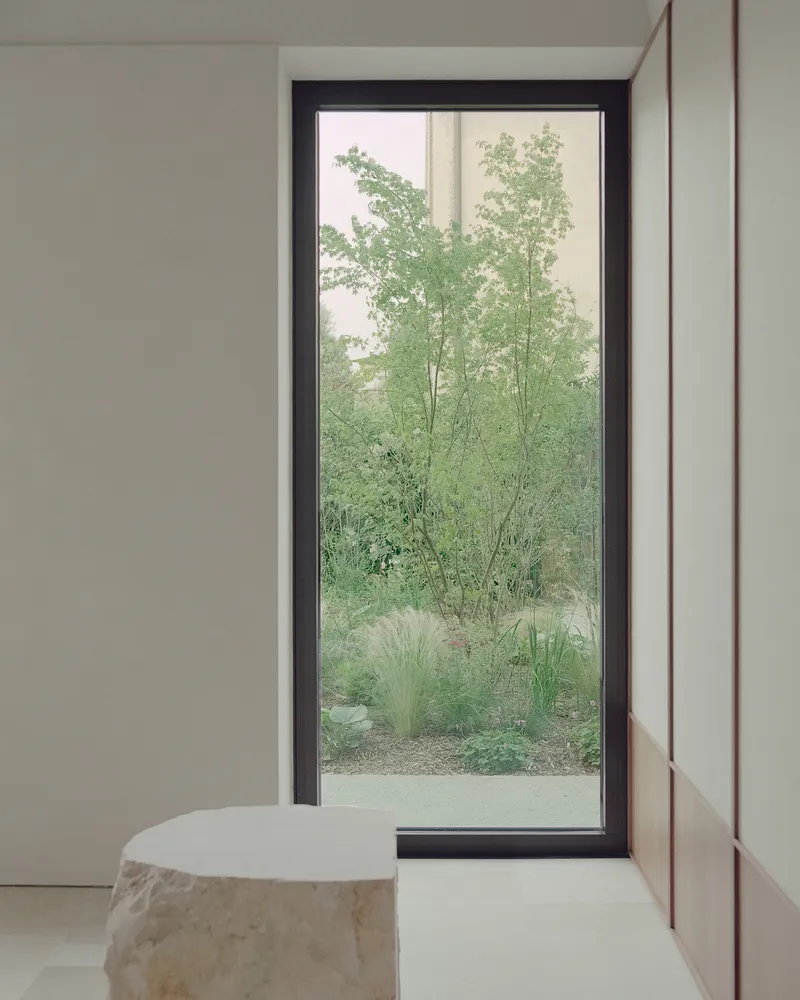
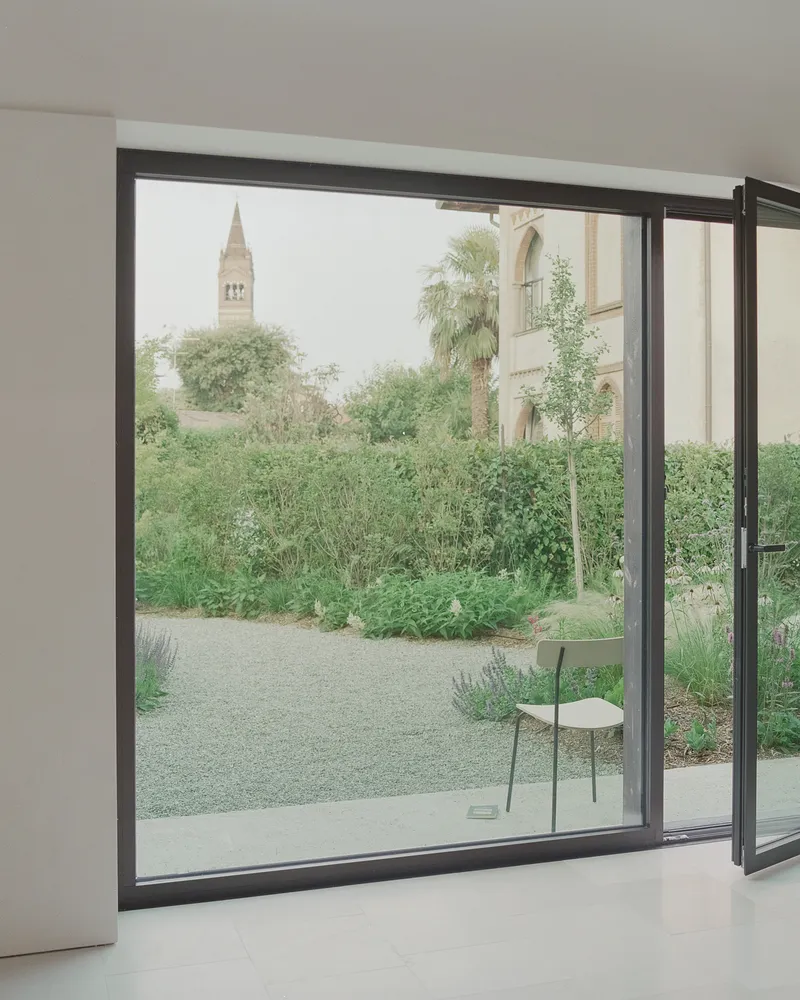
Every significant room in Funerary House Luce is oriented toward a garden. A corner window frames a single chair and a patch of green. A tall black-framed window opens onto a courtyard of birch trees and ornamental grasses. A sliding glass door reveals a view past a garden path to a church bell tower in the middle distance, tying the building to the broader landscape of ritual and community.
These views are not decorative: they are structural to the experience. Grief contracts attention inward; architecture can gently push it back outward. By giving mourners a living, changing landscape to look at, Studio Wok offers a quiet counterpoint to the finality happening inside the building. The birch trees will drop their leaves and regrow them. The grasses will brown and return. The light will shift through the day. These are not original observations, but the architecture makes them felt rather than said.
Why This Project Matters
Funerary House Luce matters because it takes a neglected typology seriously. Most funeral homes are either grimly functional or drowning in saccharine symbolism. Studio Wok finds a third path: a building that uses domestic scale, honest materials, and precise control of light and sequence to create conditions for genuine reflection. There is no grandiosity here, no overwrought narrative about death and rebirth. There is instead a carefully made building that trusts its occupants to bring their own meaning.
It also stands as a case study in how much atmosphere can be generated with a limited palette. Charred timber, walnut, reeded glass, white plaster, pale stone. Five materials, essentially, deployed with enough skill to produce a building that feels richer and more considered than many projects with ten times the budget. For architects working on small civic or institutional commissions, this is a project worth studying closely.
Funerary House Luce by Studio Wok, Northern Italy. Photography by Simone Bossi.
About the Studio
Share Your Own Work on uni.xyz
If projects like this are the kind of work you want to make, uni.xyz is a place to publish your own, find collaborators, and enter design competitions.


Popular Articles
Popular articles from the community


Juan García Correa, John González and Claudia Rueda Sink a Circular Amphitheater into a Manizales Engineering Building
On the La Nubia campus in Manizales, Colombia, the S1 Building folds labs and offices into a hillside of ramped lawns that double as a campus route.

David Macias Steps a Doorless Stone and Plaster House Down a Tropical Colombian Hillside
In the humid hills of Colombia, Threshold House replaces the front door with an open void and terraces its 850 m² down the slope instead of fighting it.

LT2A and OPEN Architectes Thread a Brick and Glass High School Through a Wooded Belgian Campus
In Braine-l'Alleud, a 3,000 m² wing for Collège Cardinal Mercier pairs pale brick with a glazed colonnade, deferring to a small chapel and a dense wood.

U.GA Architects Wraps an Oval Rooftop Pool in Curved Board-Formed Concrete on Busan's Jeollidan-gil
In Busan's Jeonpo-dong, a 454 m² mixed-use block stacks a neighborhood facility, guest rooms and an oval rooftop pool inside spiraling concrete walls.

Similar Reads
You might also enjoy these articles


Hodi-Mandai Geram
Project Function: Preservation and revitalization of the Intangible heritage and socio-spatial identity of the Hodi by Housing, Cultural Memory Center, Sacred Grove, landscape, local tourism economy


Olio Towers: A Mid-Rise for Performers That Fuses Housing, Rehearsal, and Stage
Located blocks from Houston's Theater District, this modular tower stacks living units around a central performance atrium.

Oasis: Modular Green Housing Carved into Dhaka's Urban Fabric
A shortlisted Plugin Housing entry reclaims unauthorized settlements in Dhaka with stepped concrete volumes, green roofs, and ventilation-driven design.

Black Hole: A Floating Megastructure for the Post-Physical Era
Emiliano Mazzarotto envisions a spherical, self-scaling arena where e-sports, digital hotels, and holographic stadiums replace traditional public space.

Explore Funerary Architecture Competitions
Discover active competitions in this discipline

Challenge to reimagine the Iron Throne

Photograph architecture without architects

Illustrate the lost glory of Angkor Wat - Render Challenge

Design challenge to reuse E-waste
Comments (0)
Please login or sign up to add comments
No comments yet. Be the first to comment!