

Garrison Architects Flips the Animal Shelter Inside Out on Staten Island
A translucent polycarbonate care center in Charleston gives shelter animals perimeter daylight and passive ventilation instead of warehouse gloom.


The conventional animal shelter is a grim typology. Dense rows of cages occupy the building core, sealed off from daylight. Animals lose any sense of a day/night cycle, stress compounds, barking ricochets, and the architecture itself becomes an agent of distress. Garrison Architects spent more than a decade developing an alternative for Staten Island's Charleston neighborhood, and the result is a building that inverts the expected plan: animals live along the perimeter, bathed in diffused natural light from a translucent polycarbonate envelope, while offices, veterinary rooms, and lobby functions nestle into the interior.
That reversal is the core idea, and it works because of a disciplined material strategy. The 511-square-meter facility, completed in 2022 as a $9.3 million replacement for an aging center, wraps its perimeter in 1.5-inch-thick polycarbonate panels that outperform typical glass thermally while flooding every enclosure with soft, even light. A raised outer roof plane above a lower interior ceiling creates a clerestory gap for passive ventilation, and a heat recovery system recycles energy from that airflow. The building earned LEED Silver certification, but the real achievement is spatial: 71 animals, including 50 cats, 15 dogs, and small mammals, occupy enclosures that face outward, not toward each other, breaking the acoustic feedback loop that makes traditional shelters so stressful.
A Lantern in a Dark Neighborhood
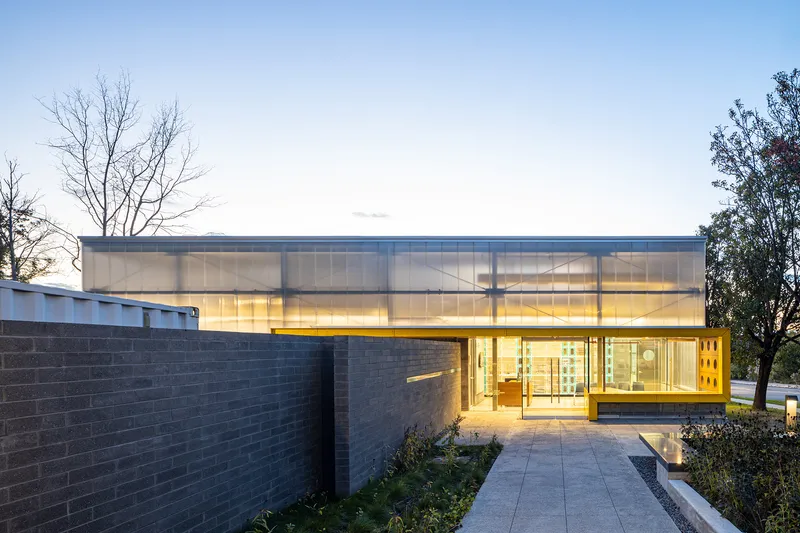
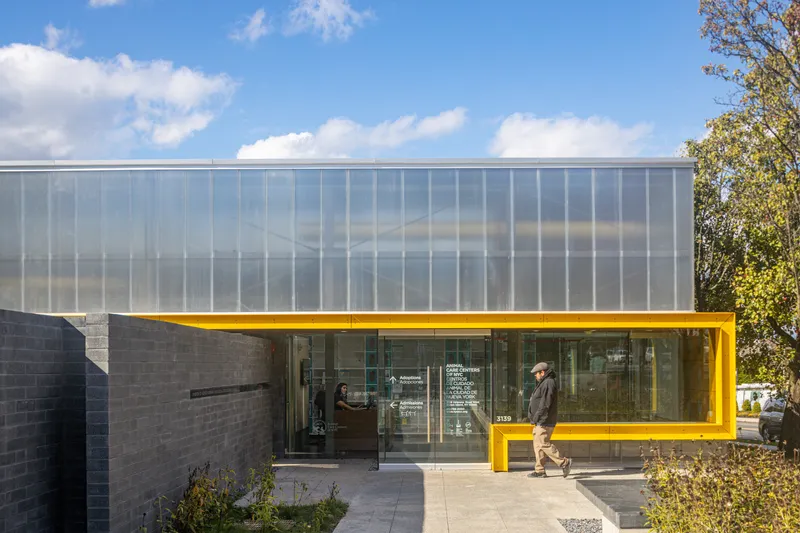
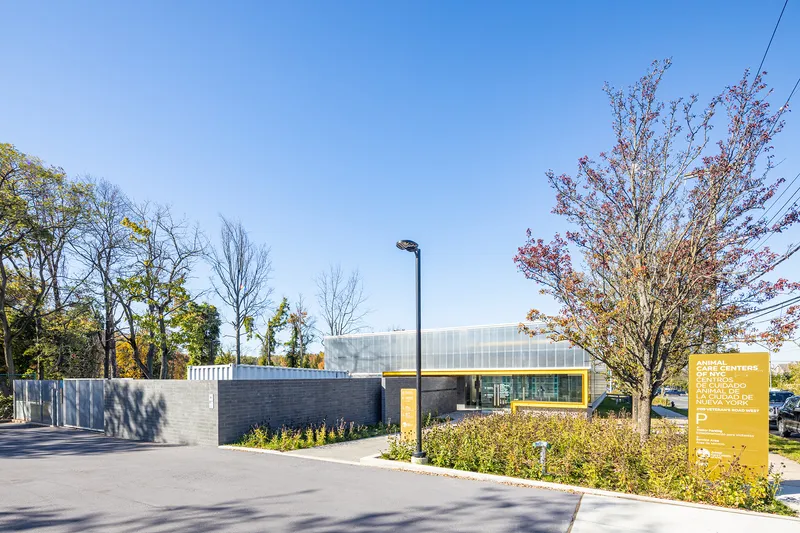
Charleston is not a neighborhood that glows at night. The polycarbonate shell changes that. At dusk, the upper volume reads as a luminous lantern hovering above a darker base of concrete masonry, and the yellow steel entrance canopy punches a visible civic signal into the streetscape. The site plan is modest: a rectangular footprint set among mature trees, with drought-tolerant native plantings, a parking area, and a gated service zone. Nothing about the landscape suggests institutional hardship. It looks like a place you would actually want to visit, which is the whole point of an adoption-oriented facility.
The Cattery and Its Portholes
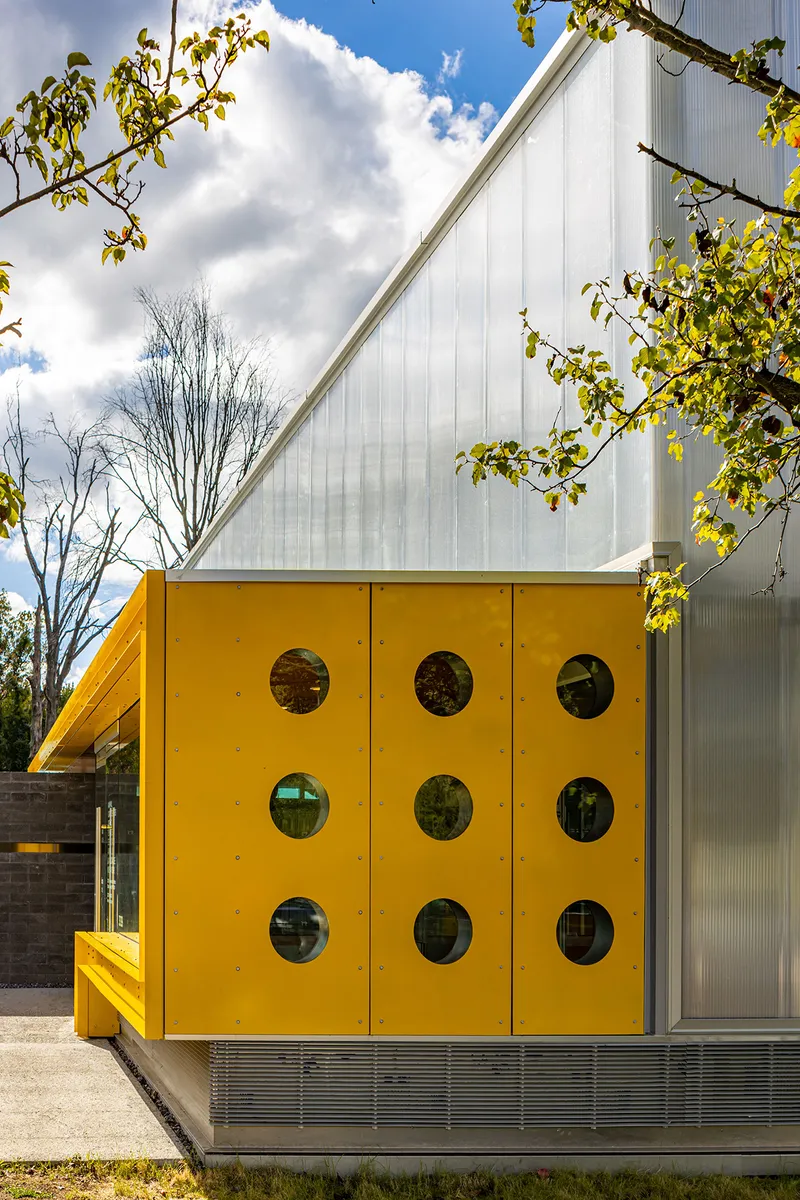
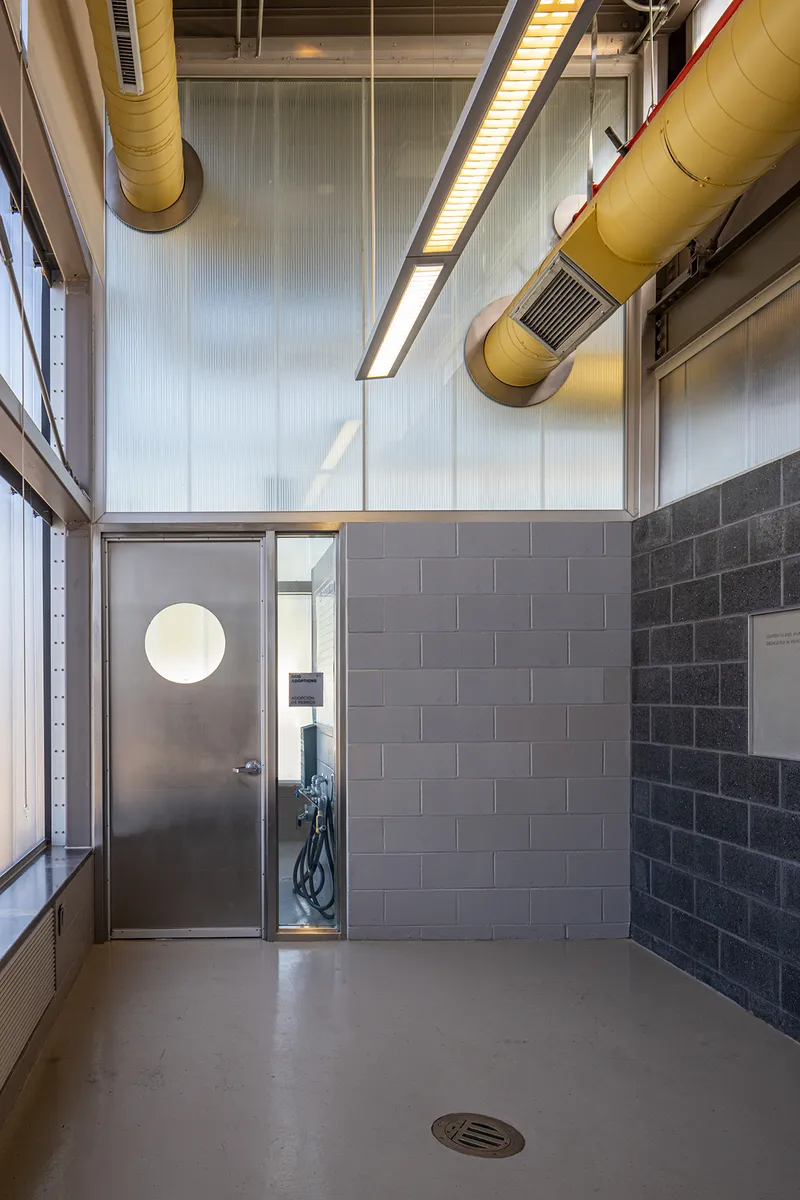
The cattery wing, a steel-framed annex clad in painted aluminum, is the most playful element. Nine circular porthole windows punctuate a yellow facade, scaled to feline proportions rather than human ones. Inside, matching porthole doors connect rooms, giving cats passages that feel scaled to their bodies rather than to staff convenience. It is a small gesture, but it signals something important about the design philosophy: the architecture prioritizes the experience of its non-human occupants.
These circular openings also do real work. They admit light, allow visual connection without physical contact between zones, and reinforce a legible wayfinding hierarchy. Round openings mean cat space. Rectangular openings mean human corridor. The distinction is immediate and requires no signage.
Honest Interiors and Exposed Systems
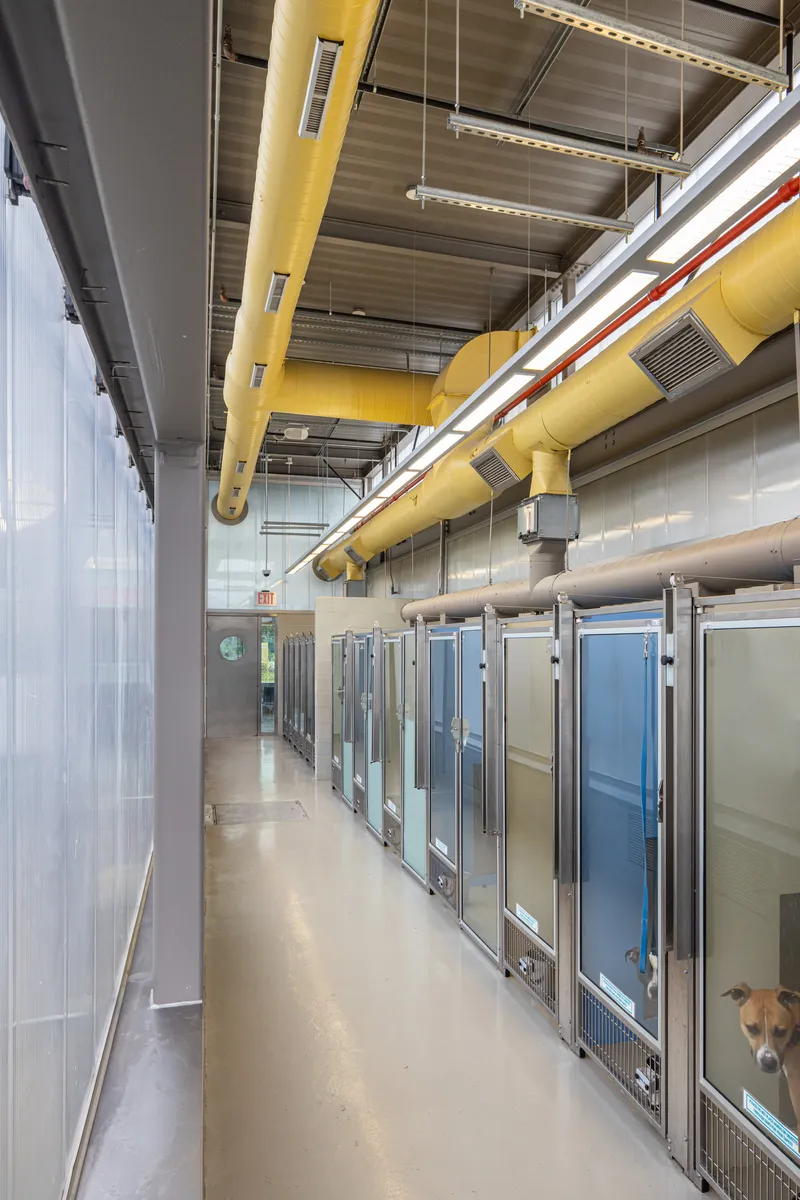
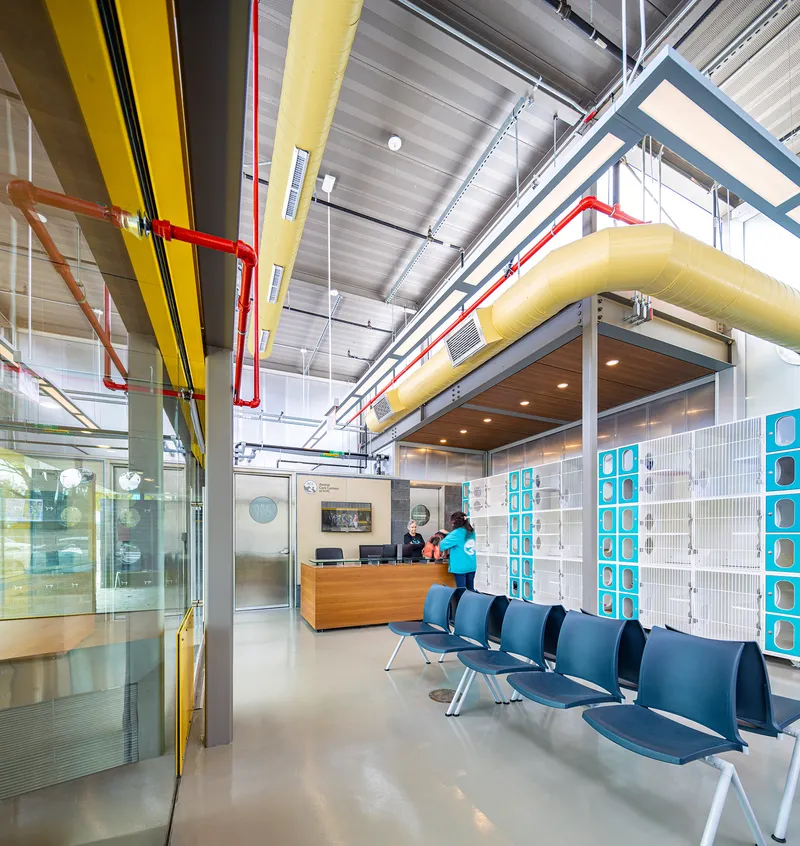
Inside, Garrison Architects leave the mechanical systems fully exposed. Color-coded ductwork in yellow, grey, and blue runs along corrugated metal ceilings, turning infrastructure into a legible diagram of how the building breathes. CMU walls are left unfinished, chosen specifically because they withstand abuse from animals and cleaning chemicals while minimizing long-term maintenance costs. The palette is utilitarian but not punishing. Color is deployed selectively, always on systems rather than surfaces, which gives the interiors clarity without resorting to the saccharine pastels typical of veterinary facilities.
The reception area uses the same strategy. Ducts in three or four colors converge overhead, and the corrugated ceiling reflects ambient light from the polycarbonate walls. For a building that processes animal intake, medical procedures, and public adoptions, the openness of the mechanical layout helps staff and visitors understand what each zone does. Transparency of construction reinforces transparency of purpose.
Climate Without Complexity
The passive strategy here is quiet but effective. The raised outer roof sits above the lower interior plane, creating a continuous clerestory gap along the building's perimeter. Louvers in this gap admit fresh air while exhausting stale, warm air from the enclosures. A heat recovery system captures energy from outgoing air and feeds it back in, maintaining a constant fresh air exchange without excessive energy use. For animals with sensitive respiratory systems, this matters enormously.
The polycarbonate itself is central to the thermal equation. At 1.5 inches thick, the panels insulate significantly better than single-pane glass while distributing daylight evenly, eliminating the hot spots and glare that glass curtain walls create. Locally produced CMU, high fly ash concrete, and recycled steel from Nucor round out a materials palette that keeps embodied carbon relatively low for a civic building of this scale.
Plans and Drawings
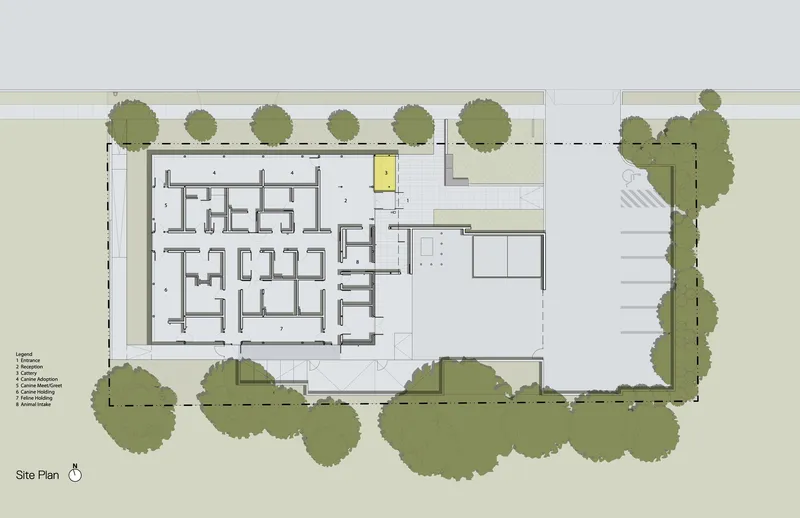
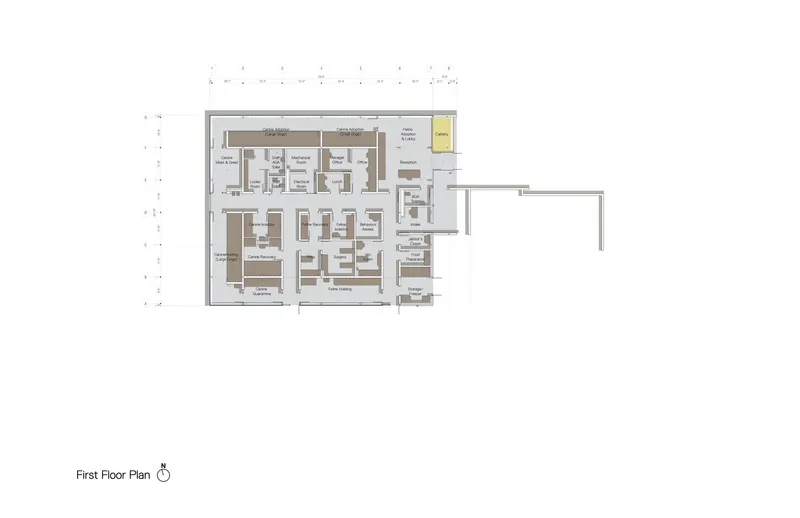
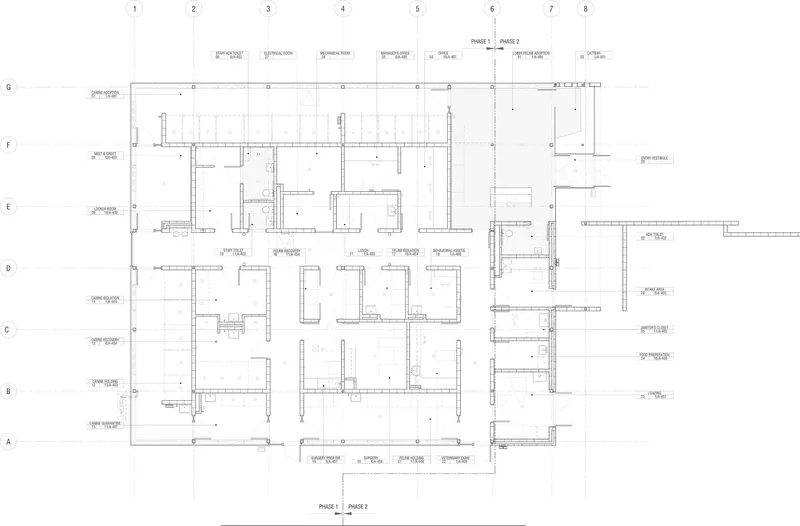
The site plan confirms the building's straightforward relationship to its lot: a rectangular volume oriented to maximize perimeter exposure, buffered by trees on three sides. The floor plan reveals the inside-out logic clearly. Animal enclosures ring the edges in a non-facing configuration, while the cluster of veterinary, office, and reception rooms occupies the core. Separate access points for adoptions and admissions prevent cross-traffic between incoming animals and outgoing families, a detail that reduces stress for both populations.
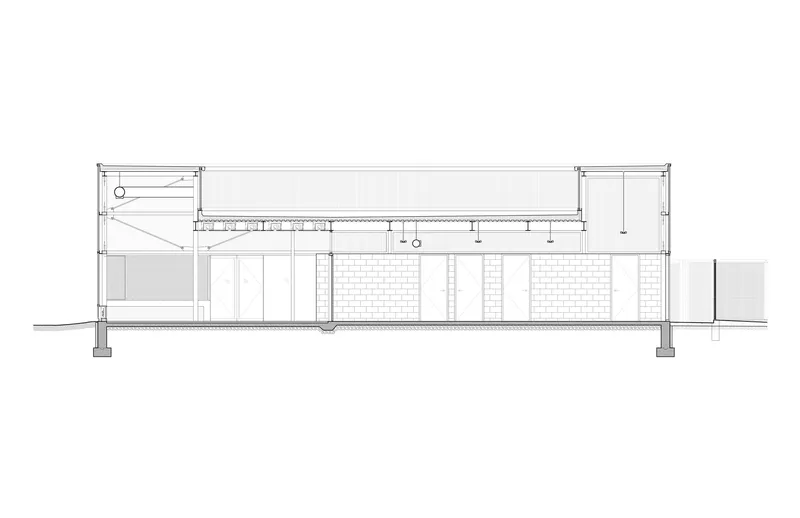
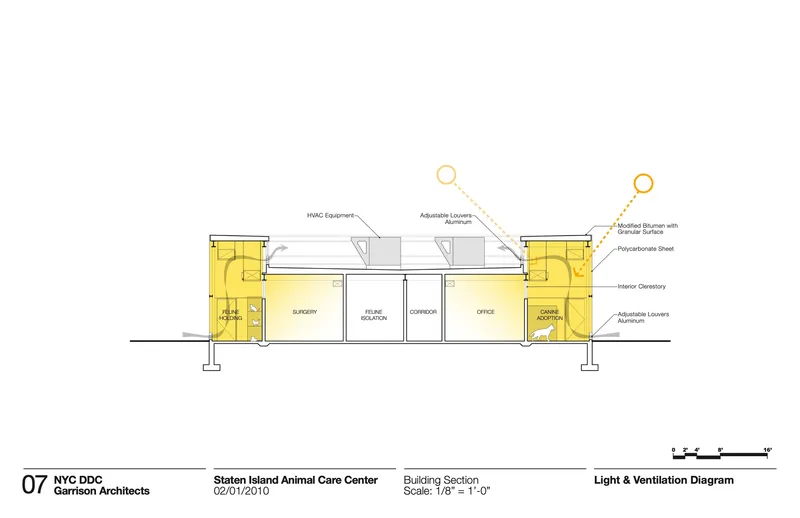
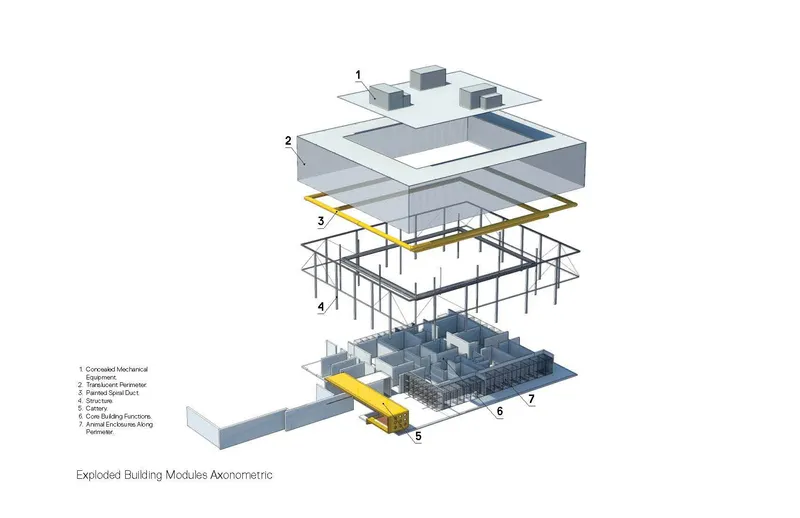
The building section shows how the dual roof planes generate the clerestory ventilation gap. The ventilation diagram labels every louver, skylight, and airflow path, making the passive strategy legible in a single drawing. The exploded axonometric separates the building into its constituent layers: foundation and CMU base, structural steel frame, mechanical core, polycarbonate shell, and roof elements. What it reveals is how few systems are actually at play. The building achieves its performance through careful arrangement of a small number of robust components, not through technological novelty.
Why This Project Matters
Animal shelters rarely get serious architectural attention. Budgets are tight, constituencies lack political power, and the assumption is that any building with cages and drains will do. Garrison Architects spent a decade proving otherwise. The inside-out plan is not a formal gimmick; it directly addresses the welfare problems that plague conventional shelters, from acoustic stress to light deprivation. Every design decision, from the non-facing enclosure layout to the passive ventilation clerestory, serves the wellbeing of animals who have no say in their environment.
The project also demonstrates that civic architecture on a modest budget can still be materially honest, environmentally responsible, and spatially generous. At $9.3 million for a LEED Silver building that houses 71 animals, the Staten Island Animal Care Center is not a flagship museum or a corporate headquarters. It is infrastructure for a community's obligations to its most vulnerable residents. That Garrison Architects treated those obligations with this level of rigor and invention is what makes the building worth studying.
Staten Island Animal Care Center, designed by Garrison Architects. Located in Staten Island, United States. 511 m². Completed in 2022. Structural Engineer: Murray Engineering. Landscape Architect: Wallace Roberts and Todd. Photography by Eduard Hueber.
About the Studio
Share Your Own Work on uni.xyz
If projects like this are the kind of work you want to make, uni.xyz is a place to publish your own, find collaborators, and enter design competitions.


Popular Articles
Popular articles from the community


Tsunami Convergenics: Turning Catastrophic Ocean Forces into Underwater Housing Infrastructure
A speculative underwater settlement off the coast of Onagawa, Japan, treats tsunamis and typhoons as energy sources rather than threats.

Singing Woman: An Opera House That Performs Before the Curtain Rises
Ovidiu Cristian Pavel's conceptual opera house translates Estonia's choral identity into a sculpted waterfront landmark facing the Baltic Sea.

Extended Shell: Retrofitting Kolkata's Balconies as Living Urban Thresholds
A modular retrofit system recovers the social and environmental intelligence of Kolkata's historic verandas for contemporary Park Street residents.

Opera by the Sea Estonia: Three Shells Dissolving Architecture into Tallinn's Coastline
A winning opera house proposal replaces monumental form with interconnected shells that blur the boundary between building, park and Baltic Sea.

Similar Reads
You might also enjoy these articles

Pixel Gardens: One Repeated Module Stacked Into a Terraced Social Housing Tower for Famagusta
Salem Bader's shortlisted housing tower builds a vertical neighbourhood from one repeated module, offsetting units to carve terraces, light and air.

Bao Huynh Watercolor Atelier: A Serene Art Retreat in Hội An
Bao Huynh Watercolor Atelier in Hội An blends multifunctional art spaces, sustainable design, local materials, and family-friendly living in a serene environment.

Atelier Macri Concept Store Interior Design by CASE-REAL
Atelier Macri store features a "ko" counter, walnut wood details, cork displays, blending retail, gallery, and seamless customer experiences.

Manuel Vargas Izquierdo Stadium and High-Performance Sports Center: Architectural Excellence in Jalpa de Méndez
The Manuel Vargas Izquierdo Stadium blends sustainable design, inclusive sports facilities, and cultural-inspired architecture, revitalizing Jalpa de Méndez’s public spaces.

Explore Dog Shelter Competitions
Discover active competitions in this discipline

Challenge to reimagine the Iron Throne

Photograph architecture without architects

Illustrate the lost glory of Angkor Wat - Render Challenge

Design challenge to reuse E-waste
Comments (0)
Please login or sign up to add comments
No comments yet. Be the first to comment!