
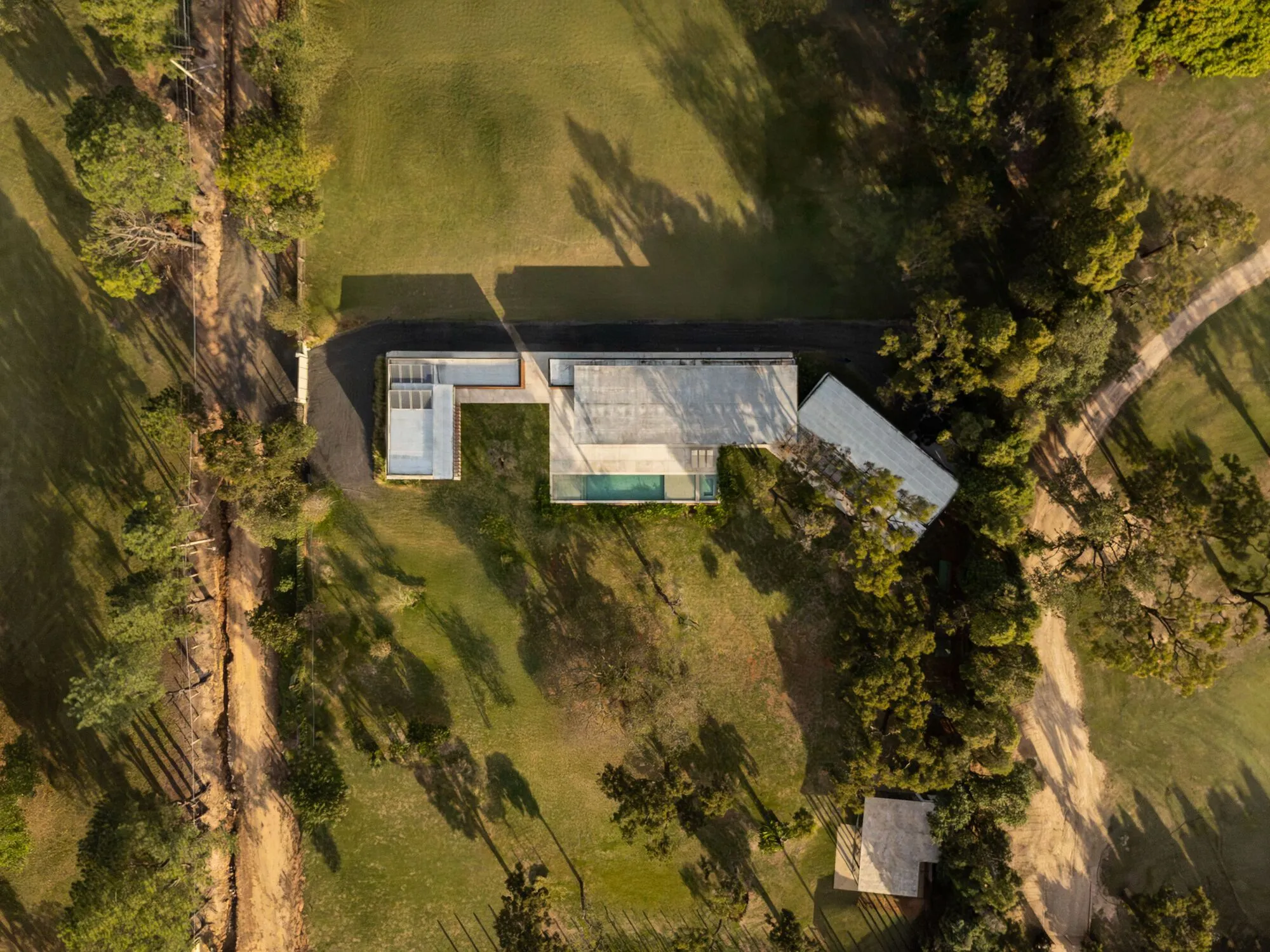
GC House Wraps Its Architecture Around a Tree
Estúdio Naia's timber-clad residence in São Paulo organizes pavilions around a central courtyard tree, letting landscape dictate the plan.


Most houses claim to "integrate with nature." Few actually reorganize their plan around a single existing tree. GC House by Estúdio Naia takes that commitment literally: the entire 706 square meter residence in the interior of São Paulo pivots around a gnarled specimen that predates the building by decades. Rather than clear the site and plant new landscaping later, the architects treated the tree as a fixed point and let two low-slung pavilions negotiate around it, creating a courtyard that feels both deliberate and inevitable.
What makes the project worth studying is not the gesture alone but the material and spatial discipline that follows from it. The L-shaped volumes sit flat against sloping terrain, wrapped in vertical timber slats that oscillate between opacity and transparency depending on program. The result is a house that reads as a series of screens and thresholds rather than walls and rooms, a strategy that blurs the line between covered terrace and conditioned interior with real conviction.
The Central Courtyard as Organizing Principle
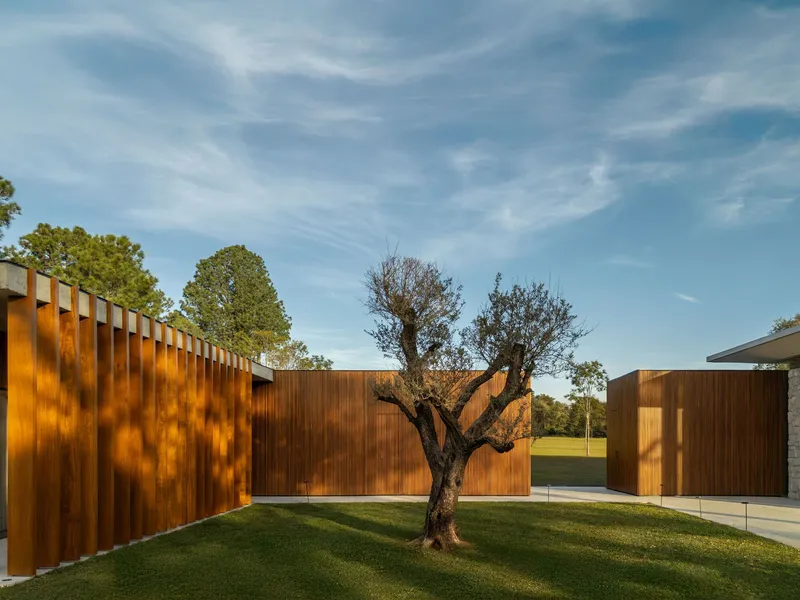


The courtyard is not decorative. It is the circulatory spine of the house, the space that connects the social block to the private wing and gives every room an orientation toward landscape rather than corridor. The gnarled tree at its center anchors the composition and provides a scale reference that keeps the long horizontal rooflines from feeling overbearing. Lawn flows uninterrupted beneath its canopy, and the planted beds that edge the timber screens soften the geometry without masking it.
Estúdio Naia clearly studied how shadow would move across this ground plane. The mature trees on site cast dappled light that shifts throughout the day, and the courtyard acts as a kind of sundial for the interior spaces, filling rooms with warm, filtered light in the afternoon and deep blue shade in the morning. It is landscape as infrastructure, not ornament.
Timber Screens and the Language of the Facade


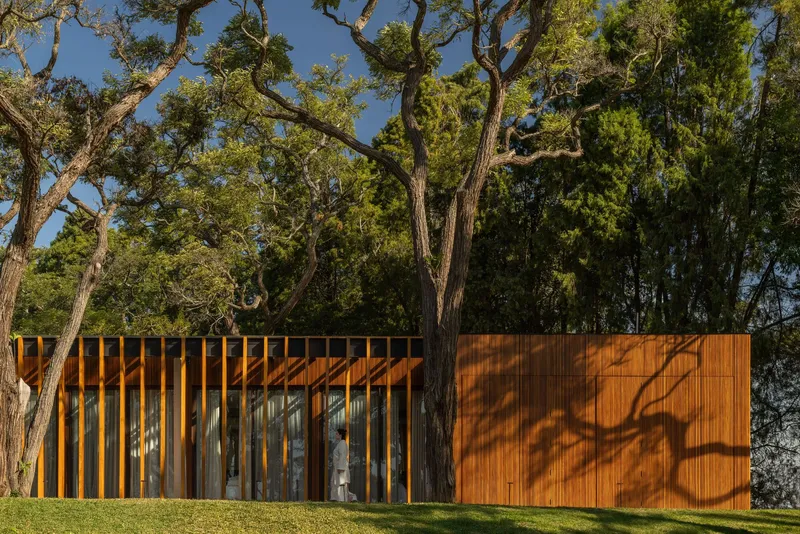
The vertical timber slats that wrap GC House are doing several jobs at once. They provide solar control, filter views from the street, create rhythm along facades that could easily become monotonous at this length, and unify what are actually distinct structural and programmatic volumes under a single material identity. Where the slats are spaced apart, they invite glimpses of interior life and garden beyond. Where they compress into solid panels, they signal private zones: bedrooms, bathrooms, service areas.
The choice to run the slats vertically is important. It gives the already low-profile house a subtle lift, counterbalancing the insistent horizontality of its roof planes. And because the timber ages and weathers, the facade will shift in tone over time, deepening into the landscape rather than standing apart from it. The way a figure disappears into shadow behind these screens, visible but not exposed, says a lot about the house's position on privacy.
Covered Terraces as Living Space


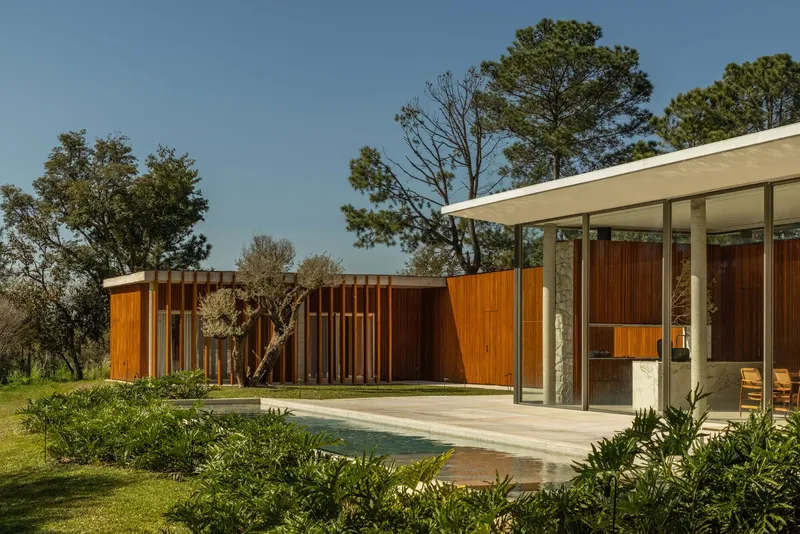
In São Paulo's climate, the covered terrace is arguably the most important room in any house, and GC House treats it accordingly. The pool terrace extends from the social block under a thin roof plane supported by slender columns that barely register against the sky. Stone flooring, a marble planter, and leather lounge chairs establish this as a space meant for sustained occupation, not just passage. The recessed glass doors behind can open fully, erasing whatever boundary remained between inside and out.
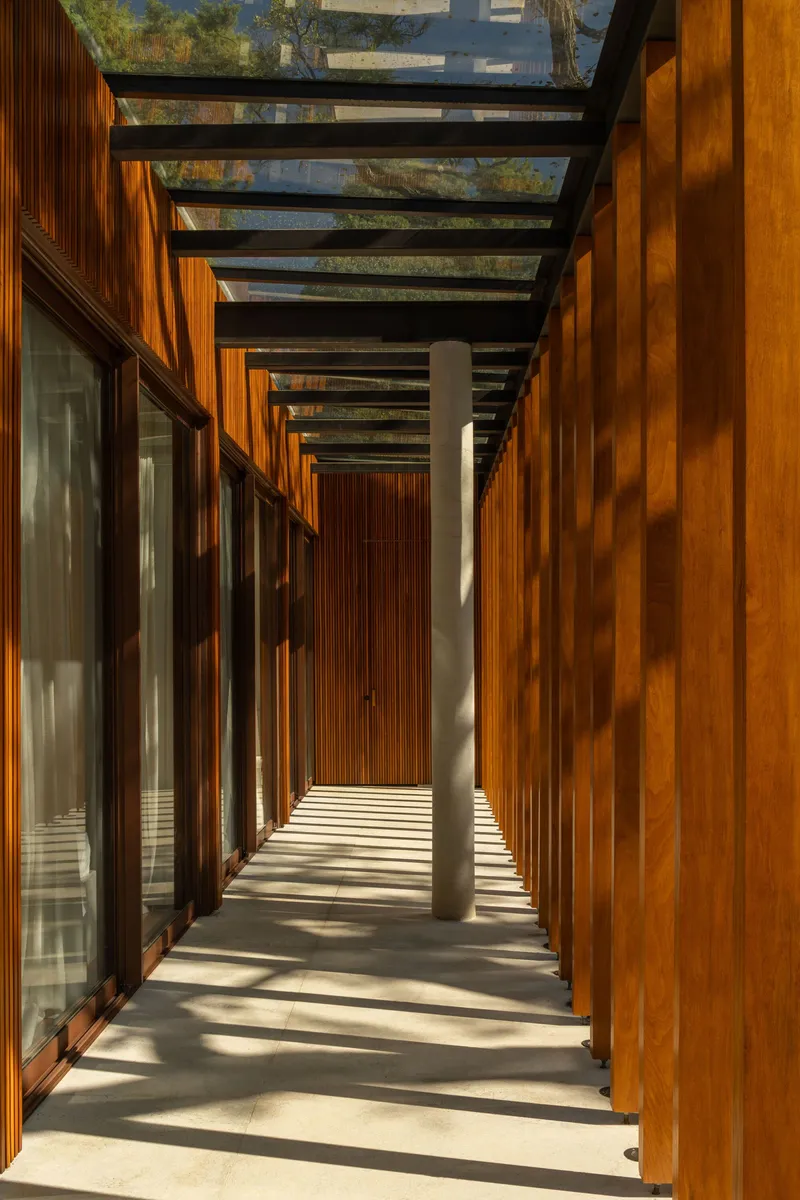
A separate covered walkway, defined by timber slat walls on both sides and steel beams overhead, connects volumes while casting striped shadows on pale stone. It functions as a cloister of sorts: a shaded, breezy corridor that turns the act of moving through the house into a sensory event.
Interior Warmth Without Excess

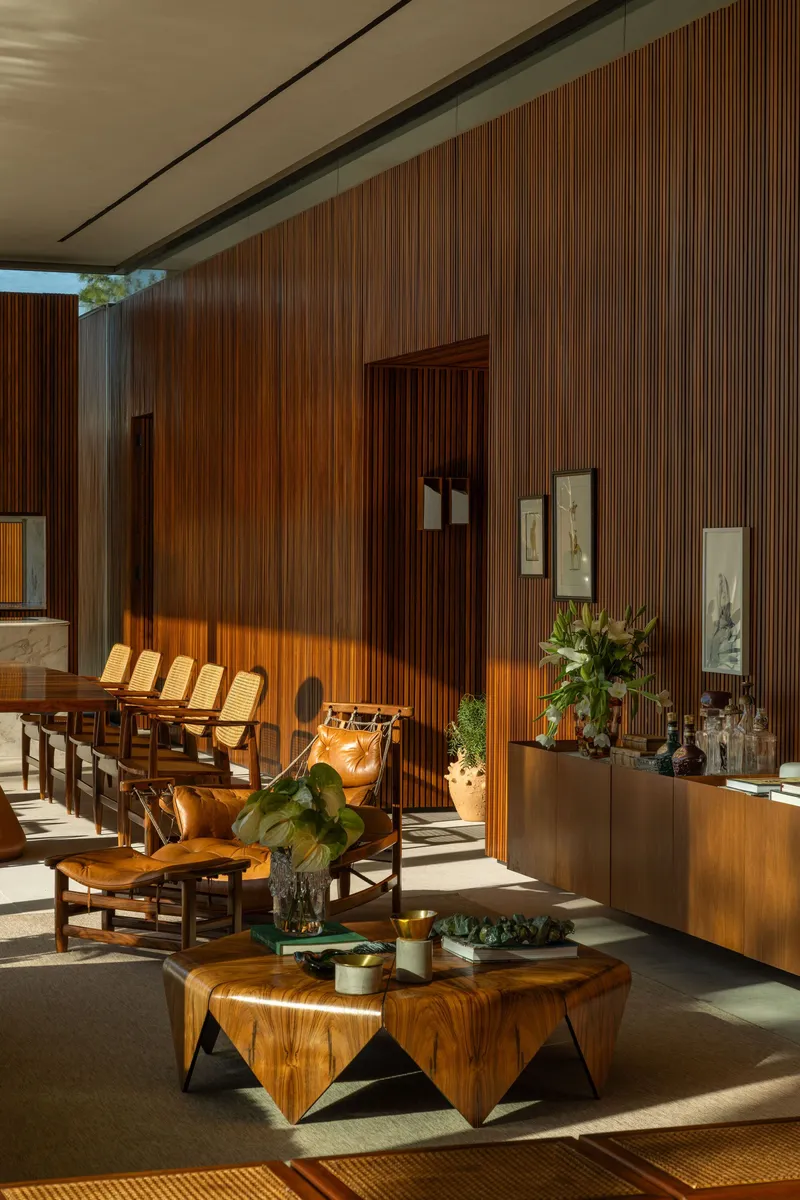
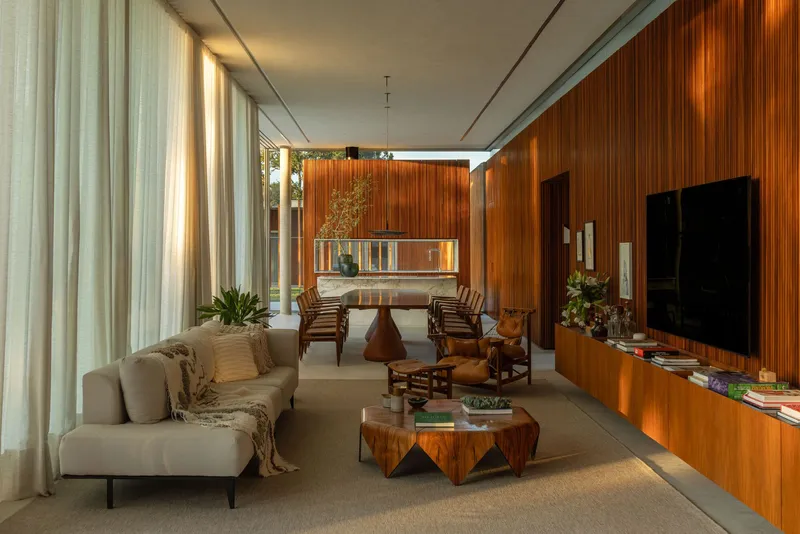
Inside, the timber vocabulary continues but loosens. Floor-to-ceiling shelving in the living room holds books and art, turning one wall into a curated gallery. Vertical timber panels catch afternoon sunlight through full-height glass, painting warm stripes across sofas and rugs. The palette stays tight: timber, white plaster ceilings, stone floors, sheer curtains. No material competes for attention, which lets the proportions and the light do the work.
There is a confidence in these rooms that comes from restraint. The cabinetry integrates seamlessly into walls. The ceiling plane stays flat and unadorned. The furniture is good but not showy. It is the kind of interior that photographs well precisely because it was designed to be lived in, not to perform for a camera.
Dining, Art, and the Social Core


The dining area occupies what feels like the gravitational center of the social wing. A sculptural timber table sits beneath vertical wood slat walls punctuated by clerestory windows that bring in light without views, keeping the focus inward on the table and on each other. Nearby, an illuminated marble-topped bar backed by timber slats and foliage creates a secondary gathering point, the kind of spot that anchors a party without requiring one.
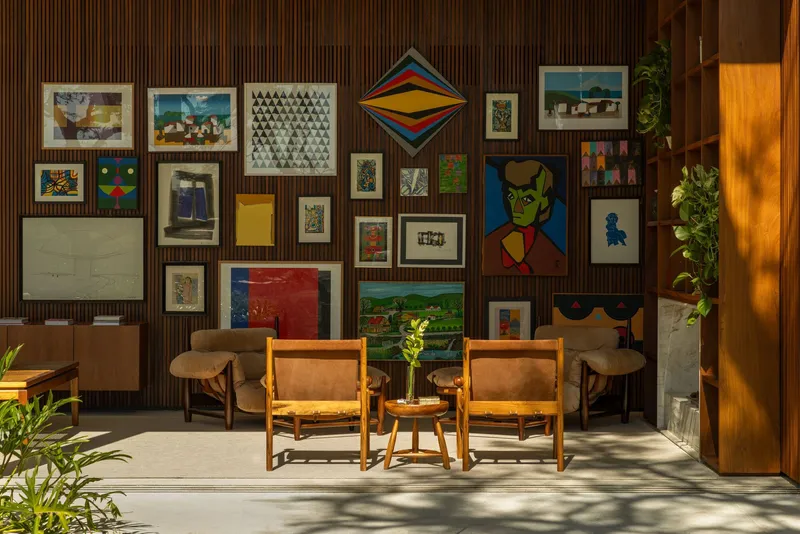
Art is everywhere but never museified. A dense salon-style hang of framed works covers one wall adjacent to timber bookshelves and potted palms. It reads as personal and accumulated rather than curated by a consultant. Combined with the cane-backed dining chairs and the patio that overlooks twisted tree branches, the social spaces project a warmth that is fundamentally domestic.

Private Rooms and Material Detail

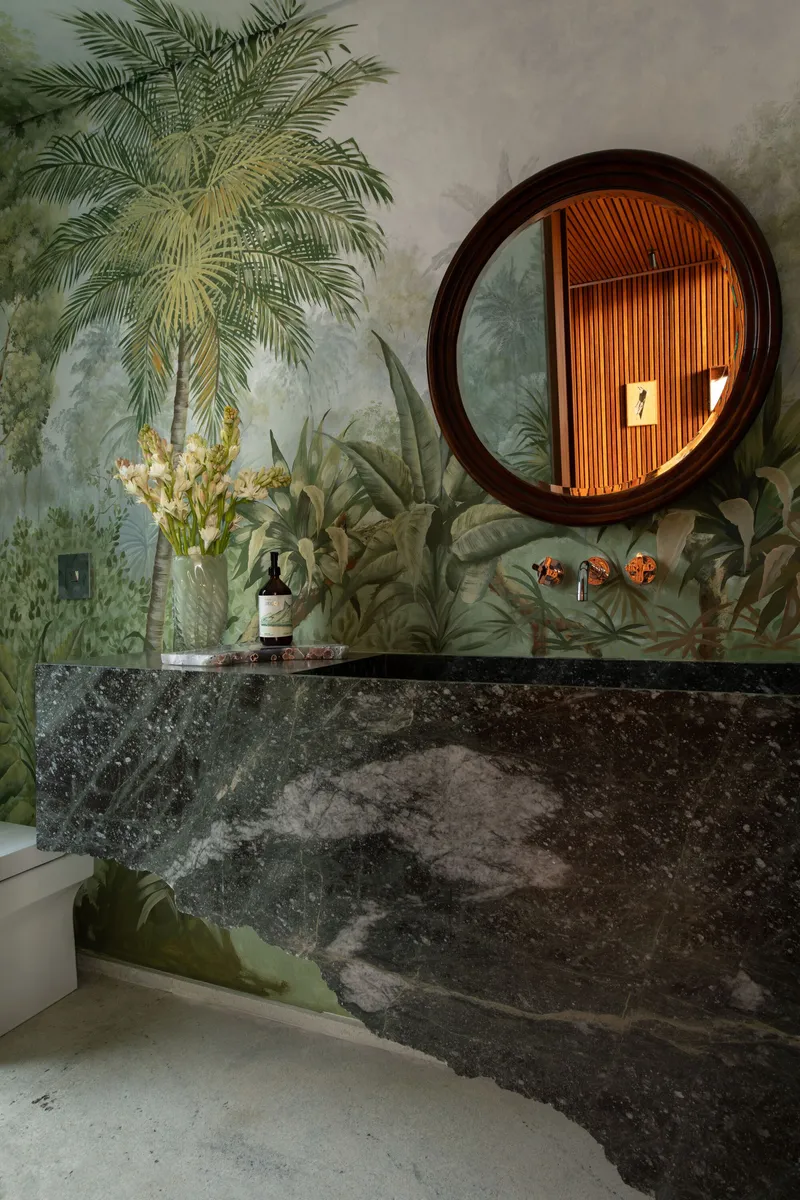
The private wing is quieter but no less considered. A bedroom with an integrated timber headboard wall frames a geometric abstract painting as its focal point, the kind of composition that only works when the architecture recedes just enough. The bathroom pairs a dark stone countertop with a circular mirror that reflects the timber slats behind, layering materials in a way that feels rich without becoming busy. Botanical wallpaper adds a controlled moment of pattern.
The covered walkway that connects these private rooms to the main house, with its striped shadow play on pale stone, ensures that even the daily commute from bedroom to kitchen feels intentional. Light, air, and landscape are never far away.
After Dark
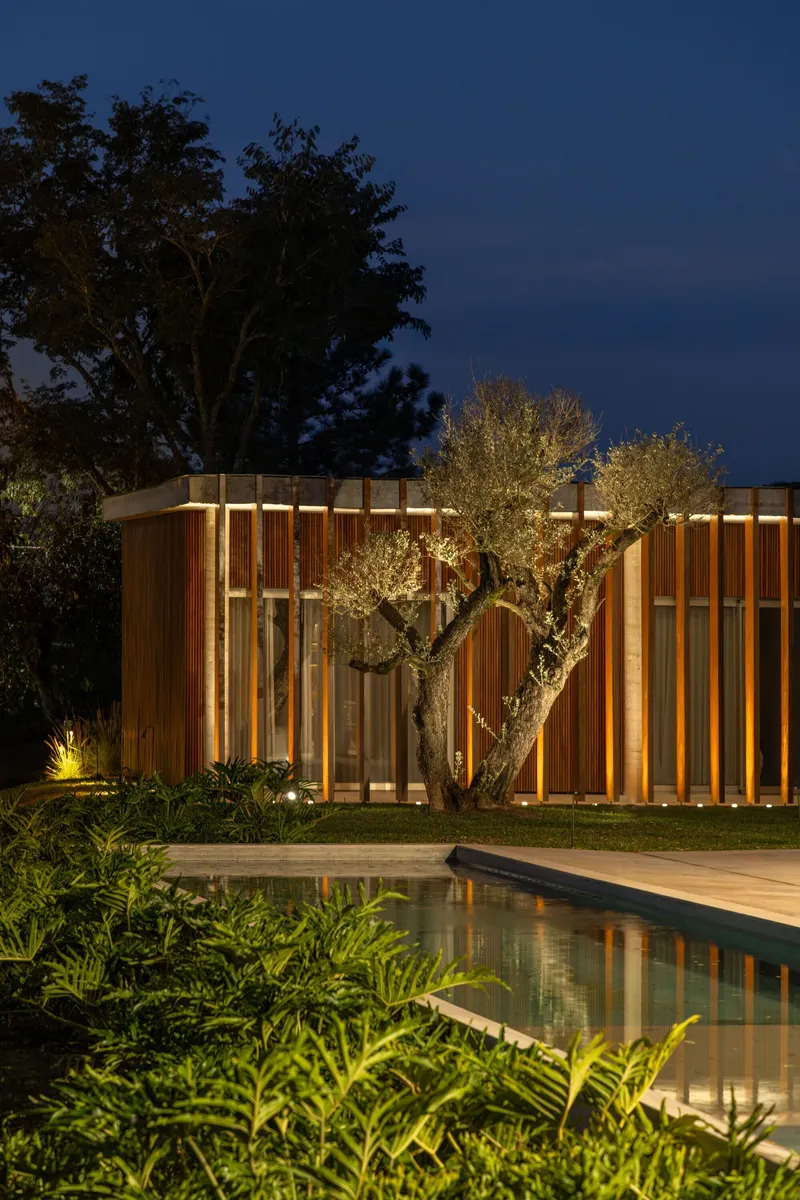
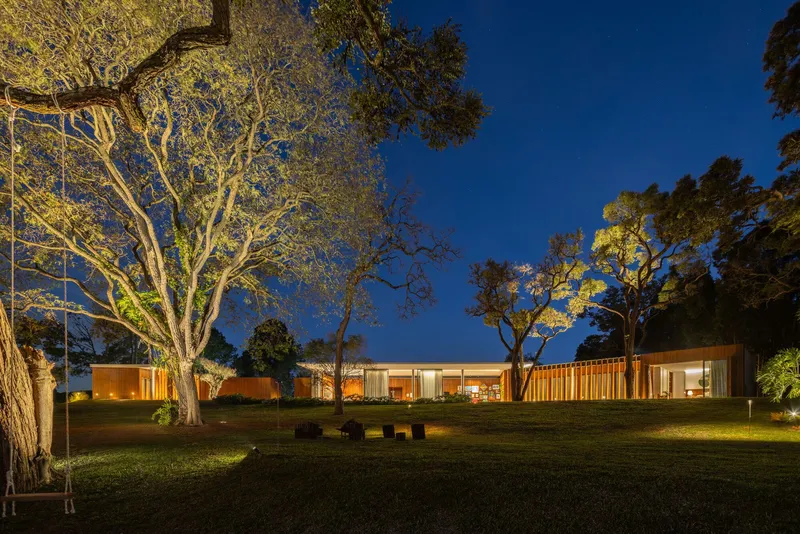

At dusk, the house transforms. Uplighting turns the mature trees into sculptural presences, and the timber slat facades glow amber from within. The pool reflects the illuminated olive tree beside it, doubling the scene. The long horizontal profile of the residence, so grounded and quiet during the day, becomes almost theatrical at night, a lantern set into a clearing.
The architects clearly designed for this moment. The curved timber volumes, barely noticeable in daylight, gain definition against the darkened lawn. The relationship between solid and void, so carefully calibrated through slat spacing and glass placement, reads completely differently after sunset. It is a house with two distinct personalities, both of them compelling.
Plans and Drawings

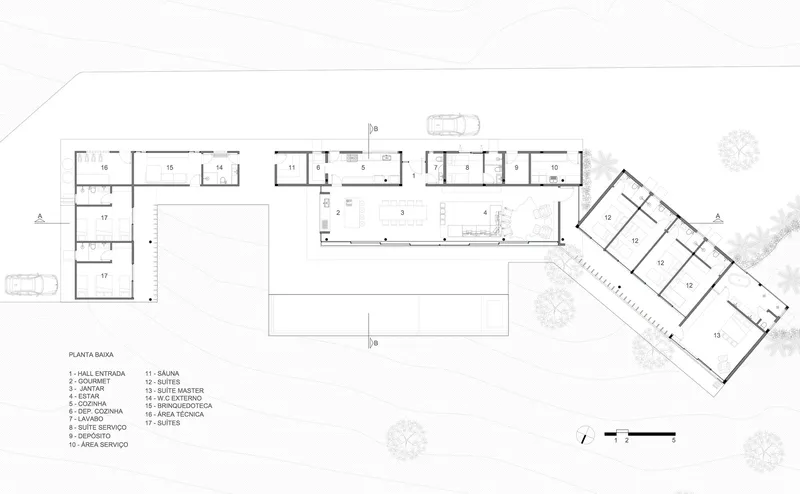

The site plan reveals the full scope of the strategy: orthogonal building volumes scattered across a sloping lot, with trees preserved as fixed elements that the architecture navigates around. The floor plan shows how the linear and angled wings create distinct zones (social, private, service) organized around the central courtyard and pool. There is nothing arbitrary about the angles; they respond to tree positions, topography, and solar orientation.
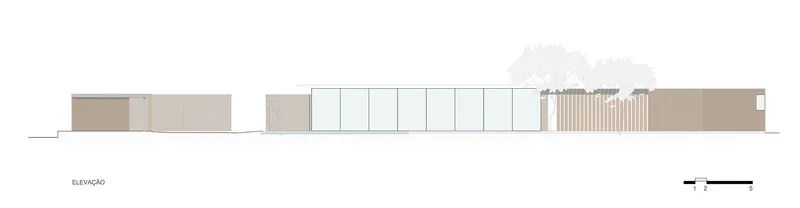
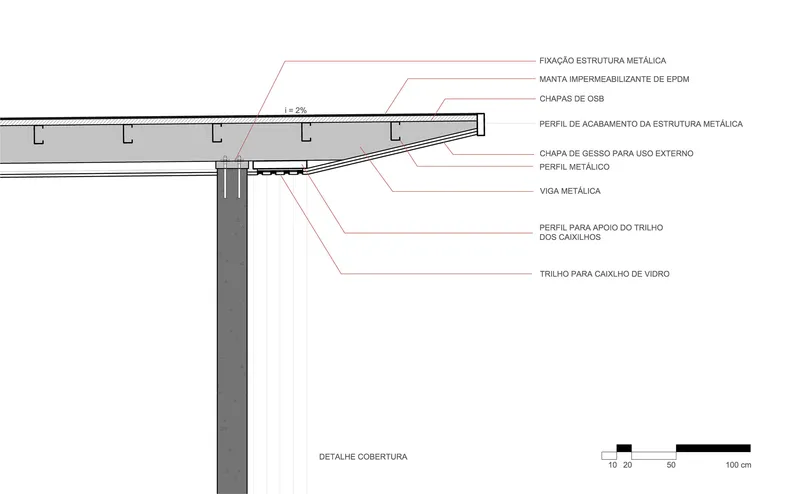
The sections confirm how flat the roof profile stays relative to the sloping terrain, with the pool terrace stepping down to meet grade naturally. The elevation drawing illustrates the timber screen facade's relationship to glazed bays and existing trees, showing how the slat rhythm modulates across program changes. A construction detail drawing breaks down the roof assembly: metal structure, EPDM waterproofing, and a glass cladding system that achieves the clean, thin roof edge visible in every exterior photograph.
Why This Project Matters
GC House is a useful case study in what happens when architects treat existing landscape not as a constraint to manage but as the primary design input. The tree at the center of the courtyard is not a preserved artifact; it is the generative element around which everything else was organized. That commitment ripples outward into every decision: the low profile, the L-shaped plan, the permeable facades, the covered walkways that privilege outdoor passage over sealed corridors. It produces a house that feels rooted in its site rather than dropped onto it.
Estúdio Naia also demonstrates that a single material idea, executed with discipline and varied through spacing, orientation, and program, can do the work of a dozen finishes. The vertical timber slat is wall, screen, headboard, and bar backdrop. It is opaque, translucent, and absent depending on where you stand. That kind of material intelligence, where one element carries multiple meanings, is harder than it looks and more rewarding than novelty for its own sake.
GC House by Estúdio Naia. Location: São Paulo, Brazil. Area: 706 m². Year: 2025. Photography by Israel Gollino.
About the Studio
Share Your Own Work on uni.xyz
If projects like this are the kind of work you want to make, uni.xyz is a place to publish your own, find collaborators, and enter design competitions.



Popular Articles
Popular articles from the community


Riyadh For All: Intergenerational Urban Design for Active Aging in Rabat
Riyadh For All reimagines urban design in Rabat with intergenerational co-living, adaptive courtyards, and Moroccan cultural exchange today.

The Ocean Hive: Sustainable Architecture for a Self-Sufficient Civilization at Sea
The Ocean Hive imagines sustainable architecture at sea, where modular habitats, algae, wave power and ocean waste sustain a growing colony.

The Earth Pod: 3D Printed Homes for Resilient Refugee Communities
The Earth Pod reimagines refugee housing through 3D printed homes made from clay, combining resilience, self-sufficiency, and rapid shelter.
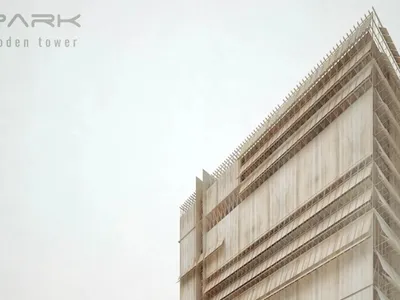
EW PARK: Sustainable Architecture Reimagines the Future of Urban Parking
EW PARK reimagines city parking as a modular wooden tower combining automation, solar energy, electric mobility, and adaptable urban design.


Similar Reads
You might also enjoy these articles

Bao Huynh Watercolor Atelier: A Serene Art Retreat in Hội An
Bao Huynh Watercolor Atelier in Hội An blends multifunctional art spaces, sustainable design, local materials, and family-friendly living in a serene environment.

Atelier Macri Concept Store Interior Design by CASE-REAL
Atelier Macri store features a "ko" counter, walnut wood details, cork displays, blending retail, gallery, and seamless customer experiences.

Manuel Vargas Izquierdo Stadium and High-Performance Sports Center: Architectural Excellence in Jalpa de Méndez
The Manuel Vargas Izquierdo Stadium blends sustainable design, inclusive sports facilities, and cultural-inspired architecture, revitalizing Jalpa de Méndez’s public spaces.

KAKR Buluh Awar Hall: Revitalizing Community and Ecology Through Bamboo Architecture
Community built bamboo hall revitalizes Buluh Awar village, empowering youth, restoring ecology, celebrating vernacular craftsmanship through sustainable architecture and culture.




Comments (0)
Please login or sign up to add comments
No comments yet. Be the first to comment!