
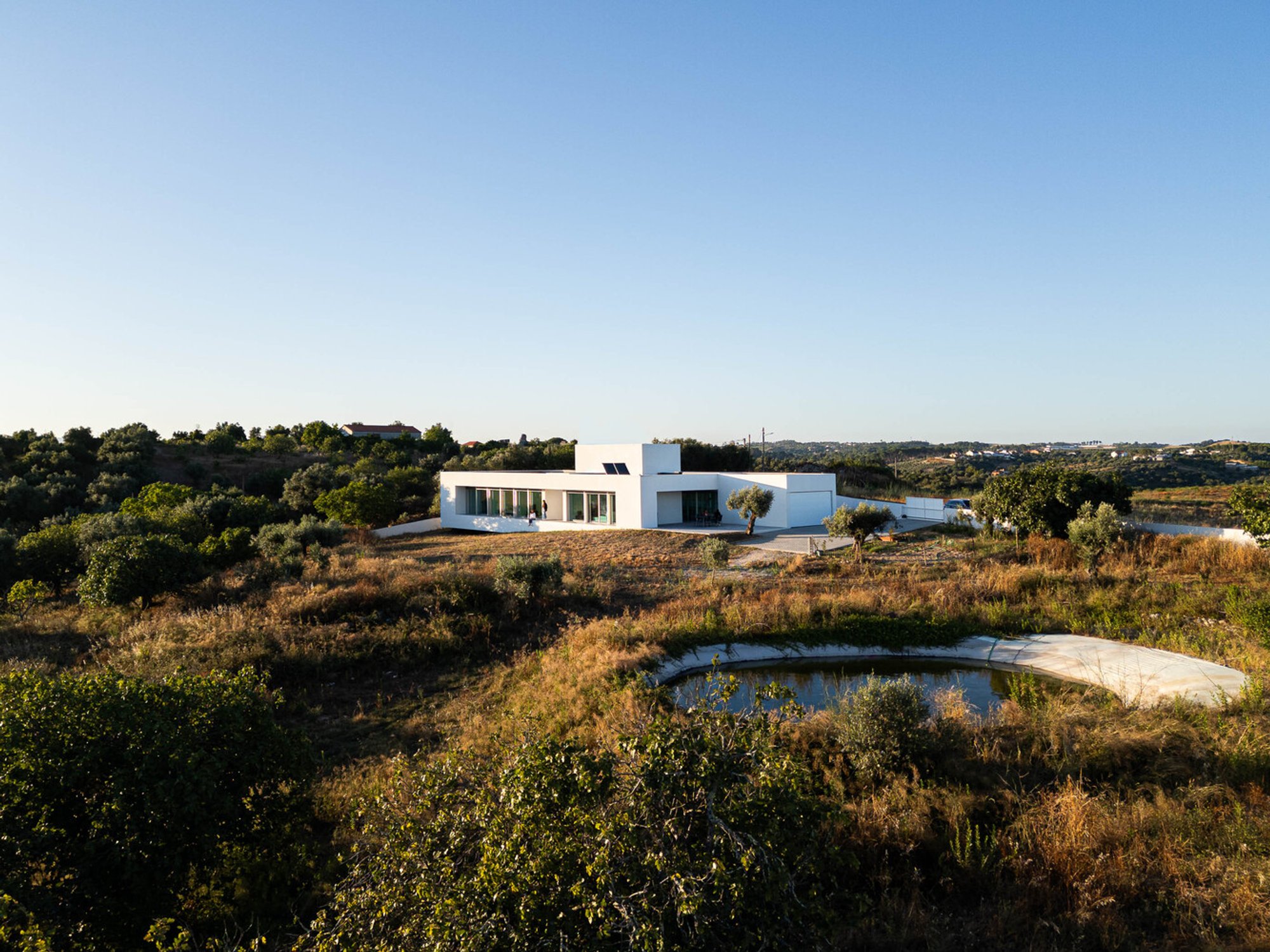
Adarq Wraps a Courtyard House Around Olive Trees on a Portuguese Hillside
GD House stretches a white linear volume across sloping terrain in northern Portugal, organizing domestic life around captured landscape.

There is a particular kind of ambition in planting a rigorously geometric house on a slope covered in wild grasses and olive trees and then insisting the landscape is still in charge. GD House, designed by Adarq (André David, Arquitecto), manages exactly that. Its long white volumes hug the hillside in northern Portugal, stepping with the grade rather than fighting it, and at its center a courtyard frames the gnarled trunks that were there long before the concrete was poured.
What makes the project worth studying is not its whiteness or its horizontality, both of which are well-trodden territory in Portuguese residential architecture. It is the way the house uses sectional variation, courtyard framing, and carefully placed skylights to make a single-story residence feel spatially rich without relying on double-height drama. Every room has a specific relationship to daylight and to the surrounding terrain, and none of them repeat the trick.
A White Line in the Landscape
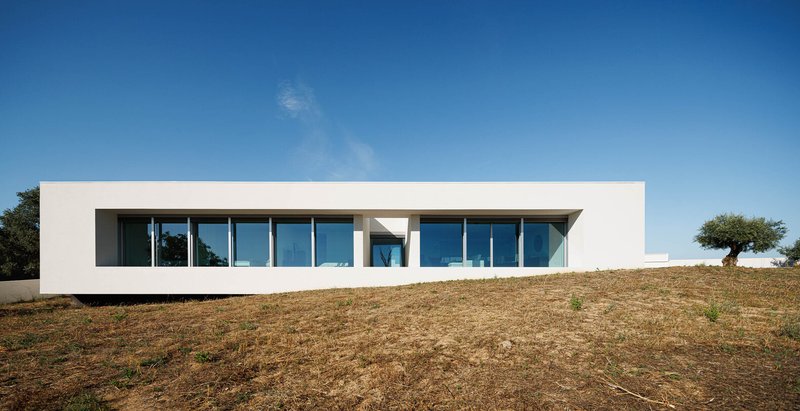
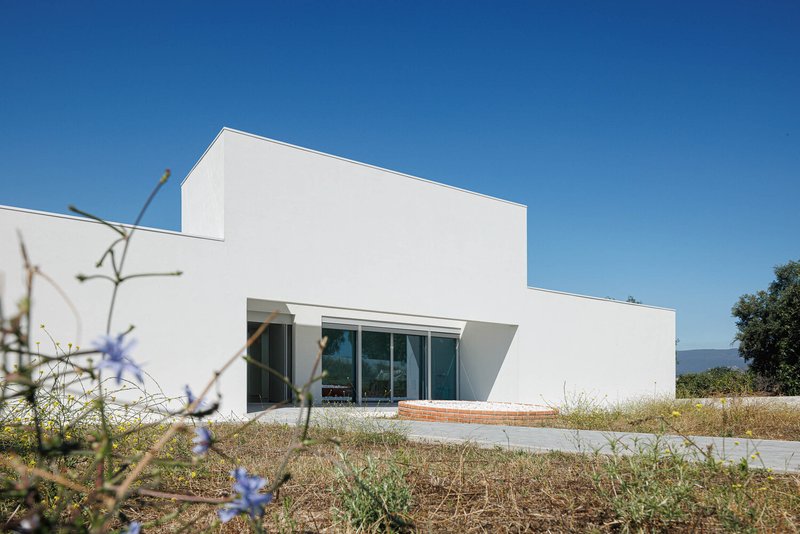
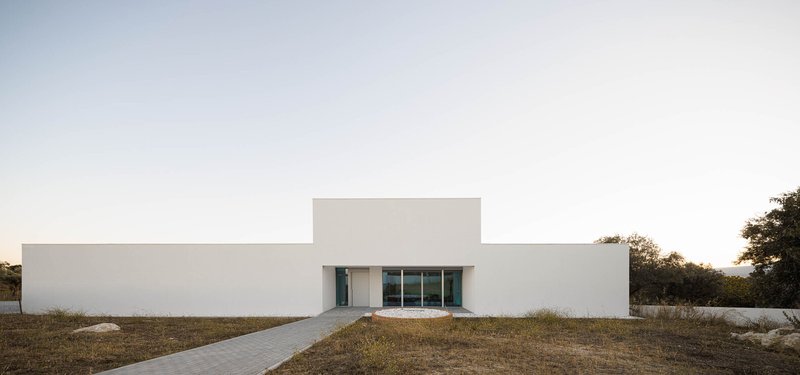
Seen from a distance, GD House reads as a single horizontal stroke drawn across the hillside. The building mass is deliberately thin and linear, which keeps its profile low against the terrain and maximizes the length of facade available for glazing. White stucco wraps the entire exterior, a surface treatment that makes the house almost disappear under the harsh midday sun while glowing warmly at dusk.
The stepped massing follows the topography, with each volume sitting at a slightly different elevation. Rather than cutting a flat platform into the slope, Adarq lets the house cascade, which reduces the amount of earthwork required and preserves more of the existing root systems around the olive trees. It is a pragmatic decision that also happens to produce a more interesting silhouette.
Thresholds and Entry
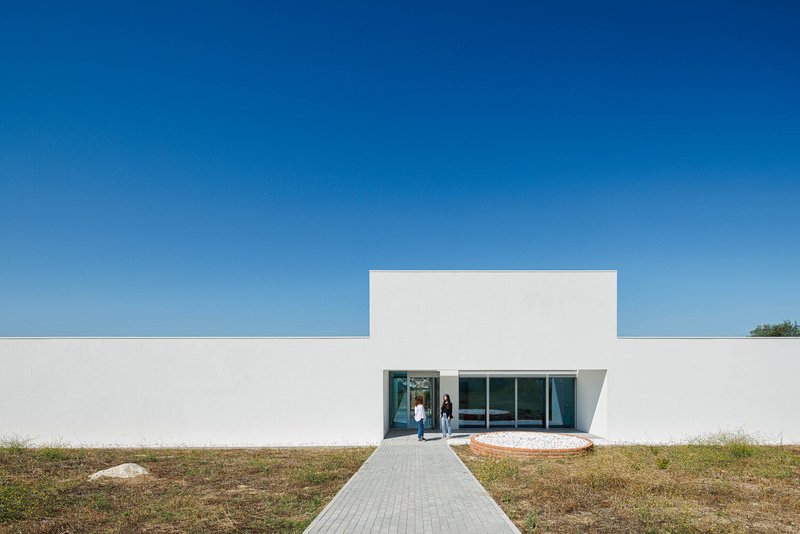
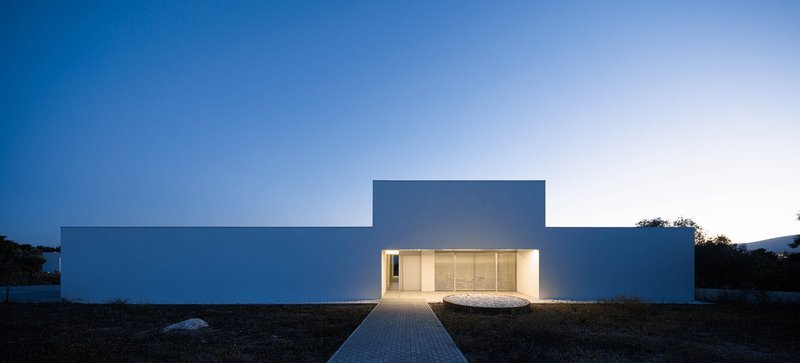
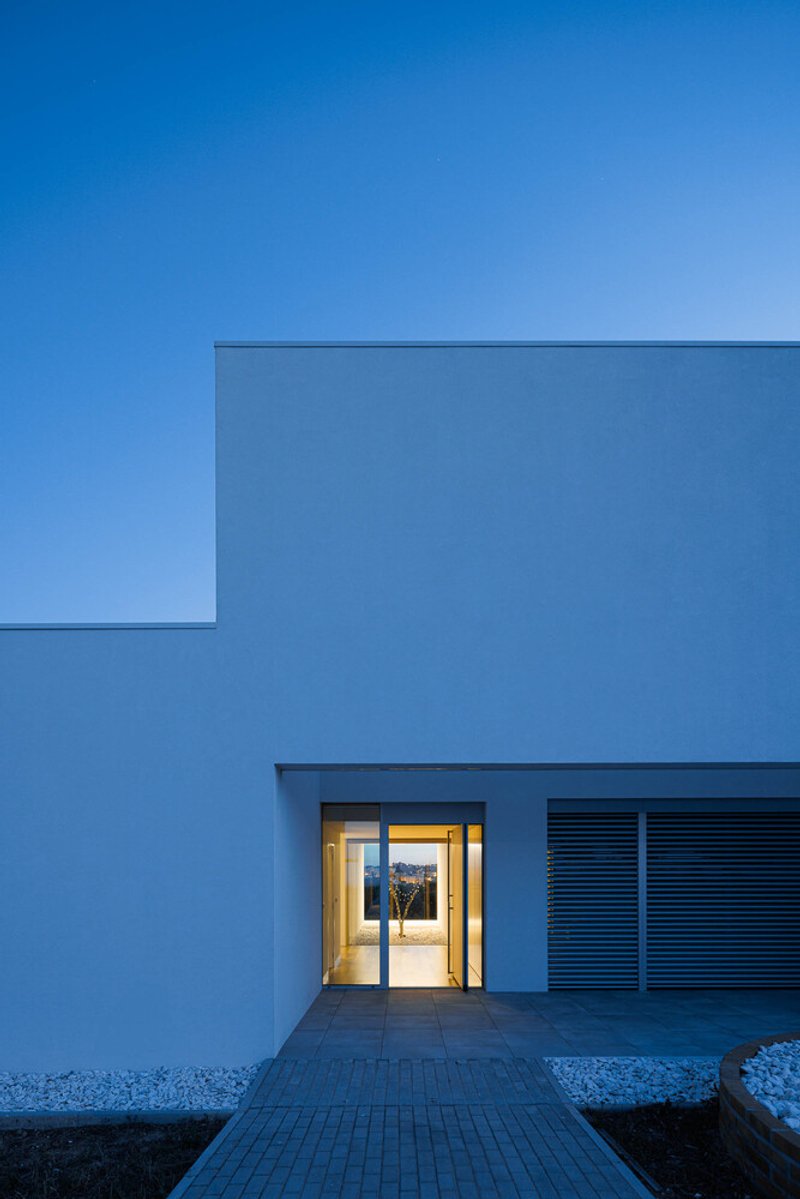
The approach to the house is slow and deliberate. A paved walkway cuts through dry grasses toward a deeply recessed entrance, framed by the overhanging volume above. At twilight, the glazed door becomes a lantern set into the mass of the facade, and the horizontal louvered panel beside it introduces the filtering language that reappears throughout the interior.
The depth of the recess matters. It creates a transitional zone between the exposed hillside and the controlled interior climate, a space that is already shaded and sheltered before you touch the door handle. The geometry is simple, just a rectangular cutout, but its proportions give it the weight of an intentional threshold rather than a mere notch in the wall.
The Courtyard as Organizing Device
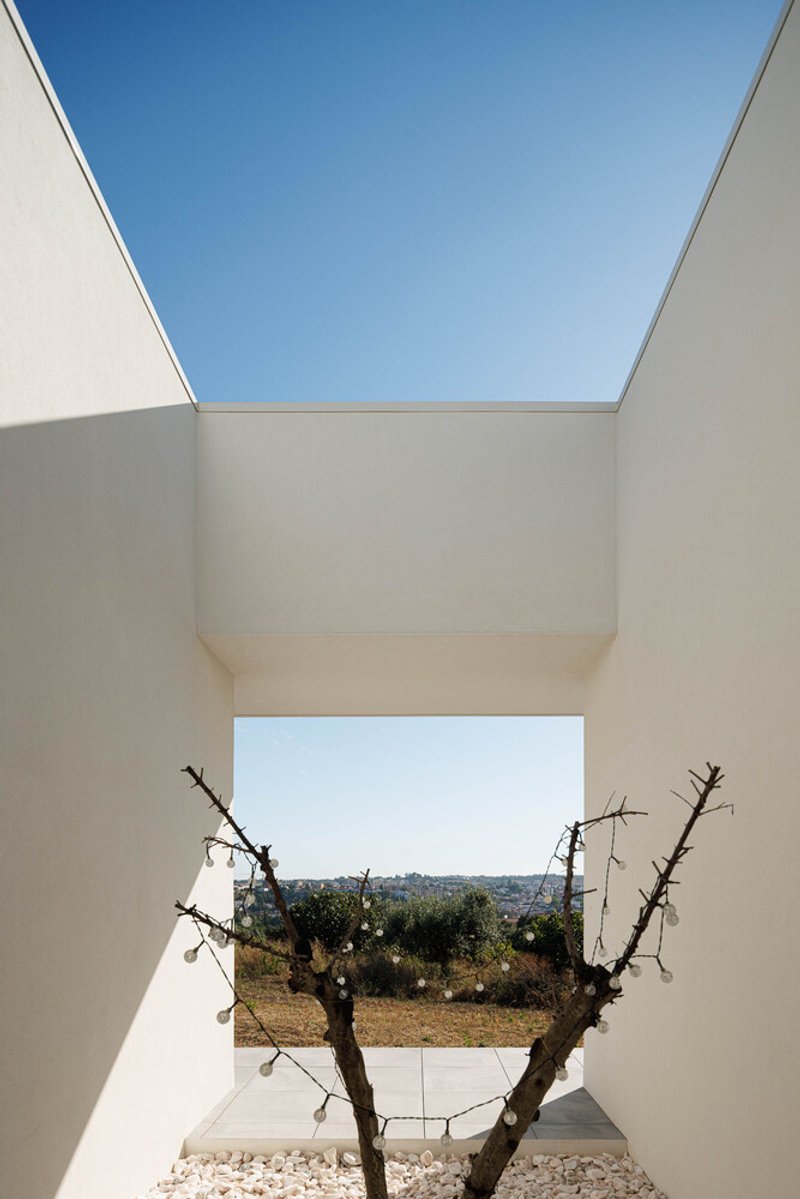
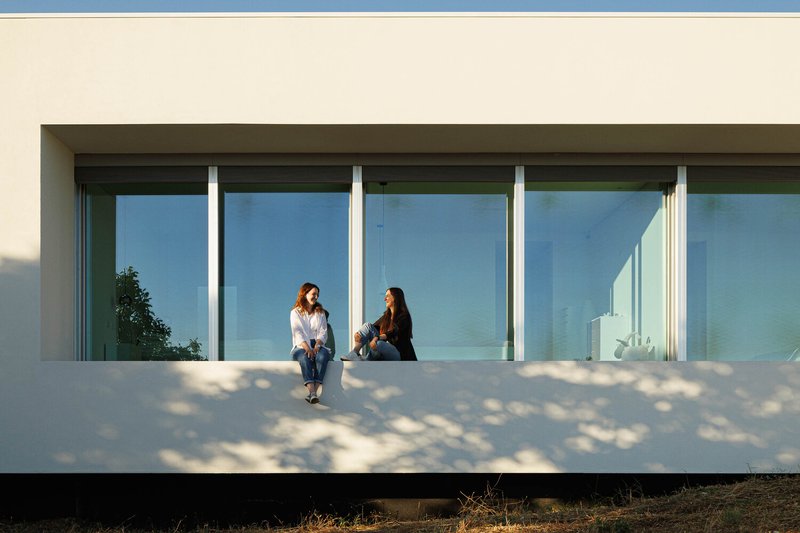
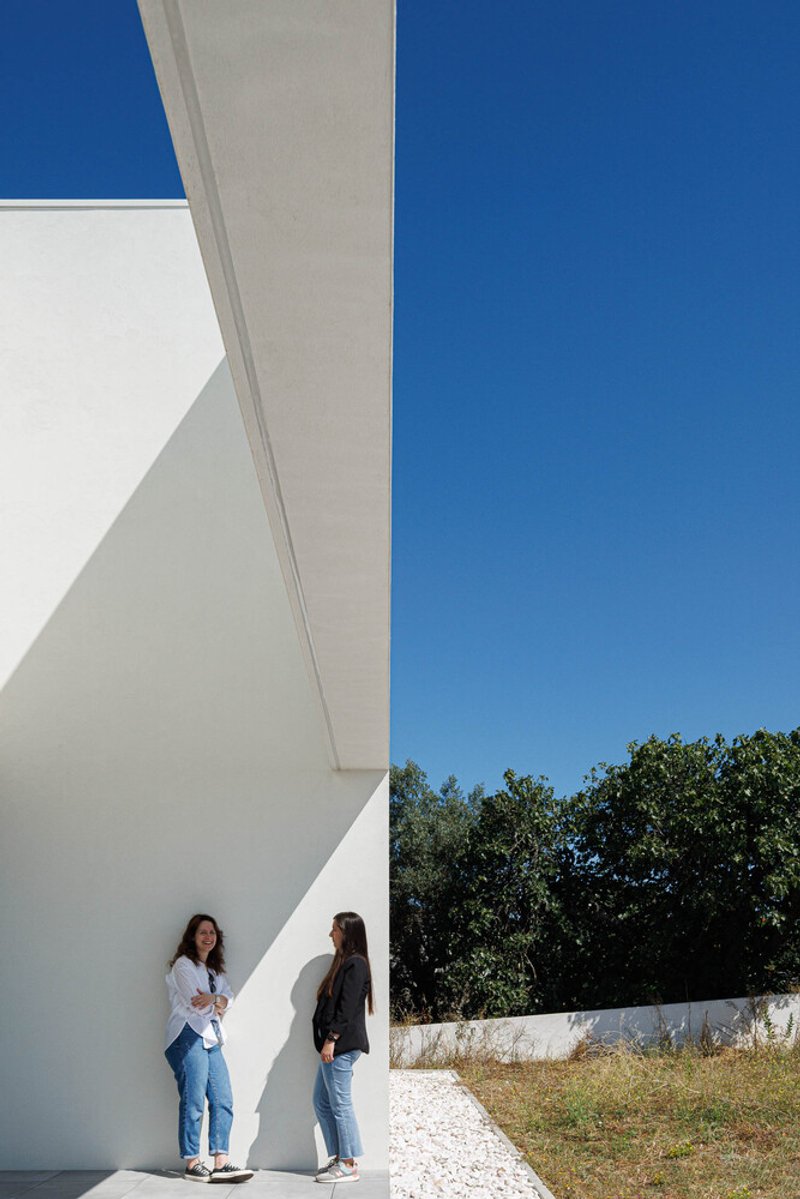
At the heart of the plan, a rectangular opening punches through the roof to frame a cluster of existing olive trees. Viewed from the interior through a precise rectangular aperture, these trees become almost sculptural, their twisted forms framed against sky and light. A skylight above washes the surrounding walls, turning the courtyard into the primary light source for the circulation spine of the house.
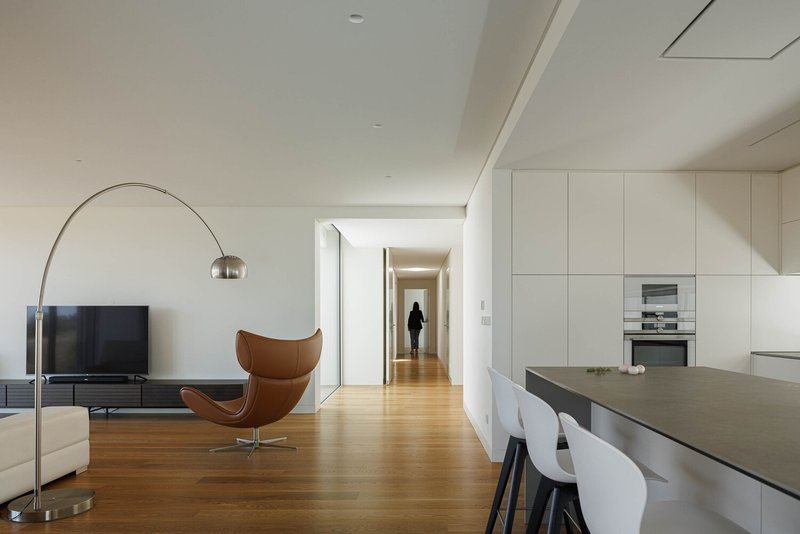
The cantilevered terrace extends from the living spaces outward, creating a covered outdoor zone where the boundary between inside and outside dissolves. Figures seated behind floor-to-ceiling glass are simultaneously in the house and in the canopy of dappled tree shadows. This is where the courtyard logic pays off: the house does not simply look at the landscape but captures pieces of it, holding them close.
Living Spaces and the Play of Light
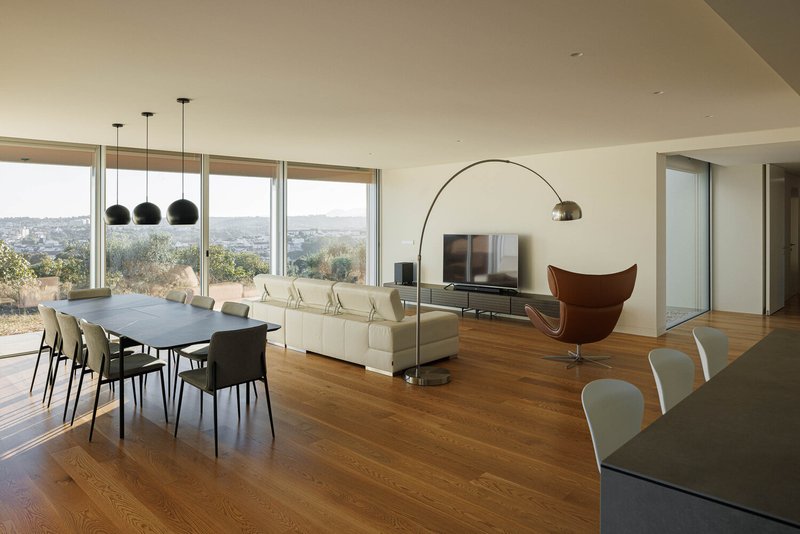
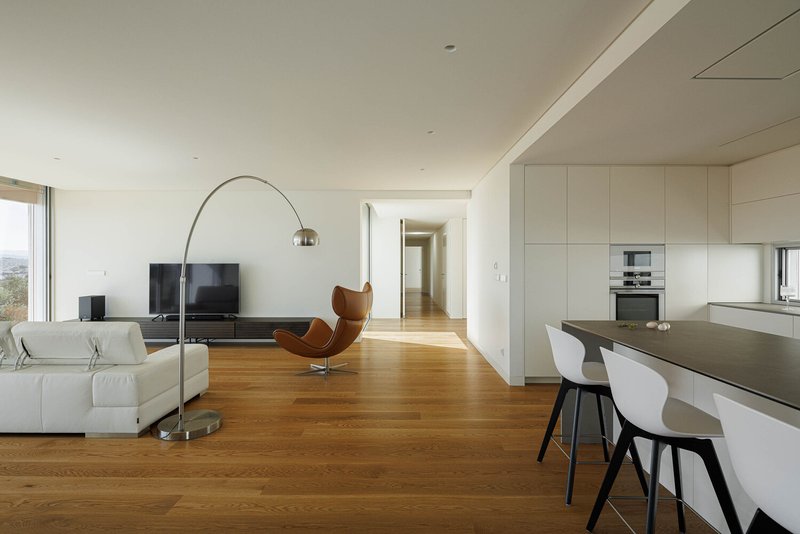
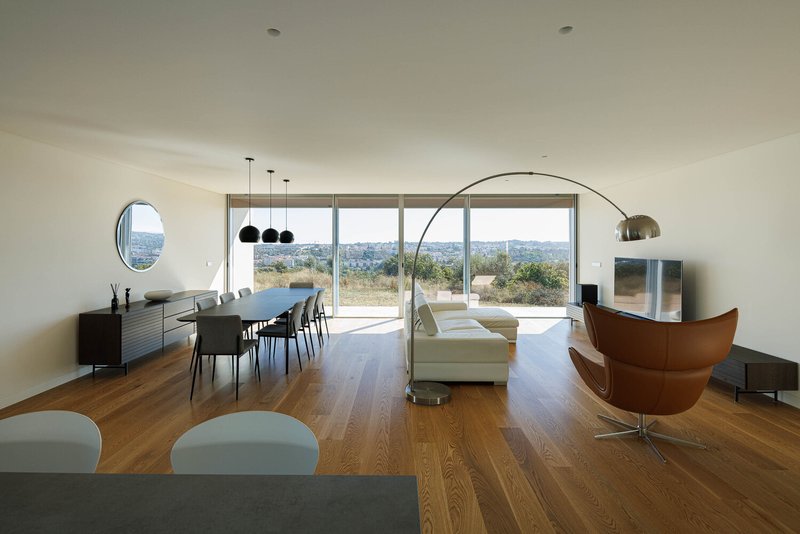
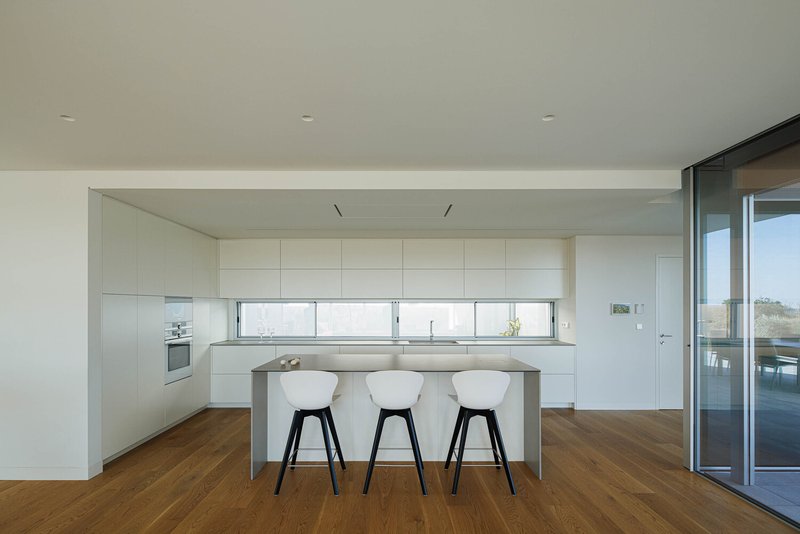
The open-plan living and dining area stretches along the southern edge of the house, where full-height glazing delivers panoramic views of rolling hills. Oak flooring runs continuously from the kitchen island through the lounge, unifying the social spaces and grounding the otherwise stark white palette with warmth. The kitchen island doubles as a spatial anchor, marking the point where the corridor axis meets the open volume.
Sliding glass doors at the far end of the living area open directly onto a terrace, collapsing the distinction between the interior floor plane and the exterior deck. When the panels are retracted, the room ventilates cross-directionally and the distant hills become the back wall of the space.
Louvers, Shadows, and Controlled Atmosphere
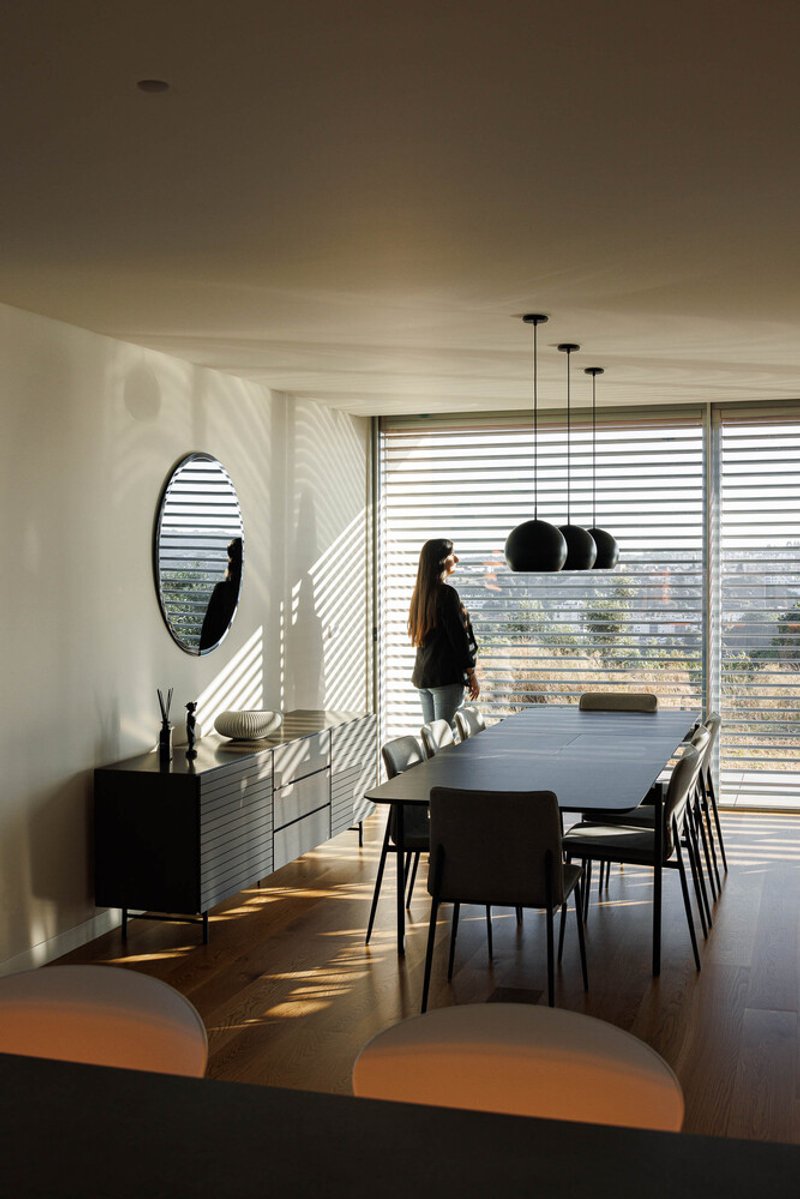
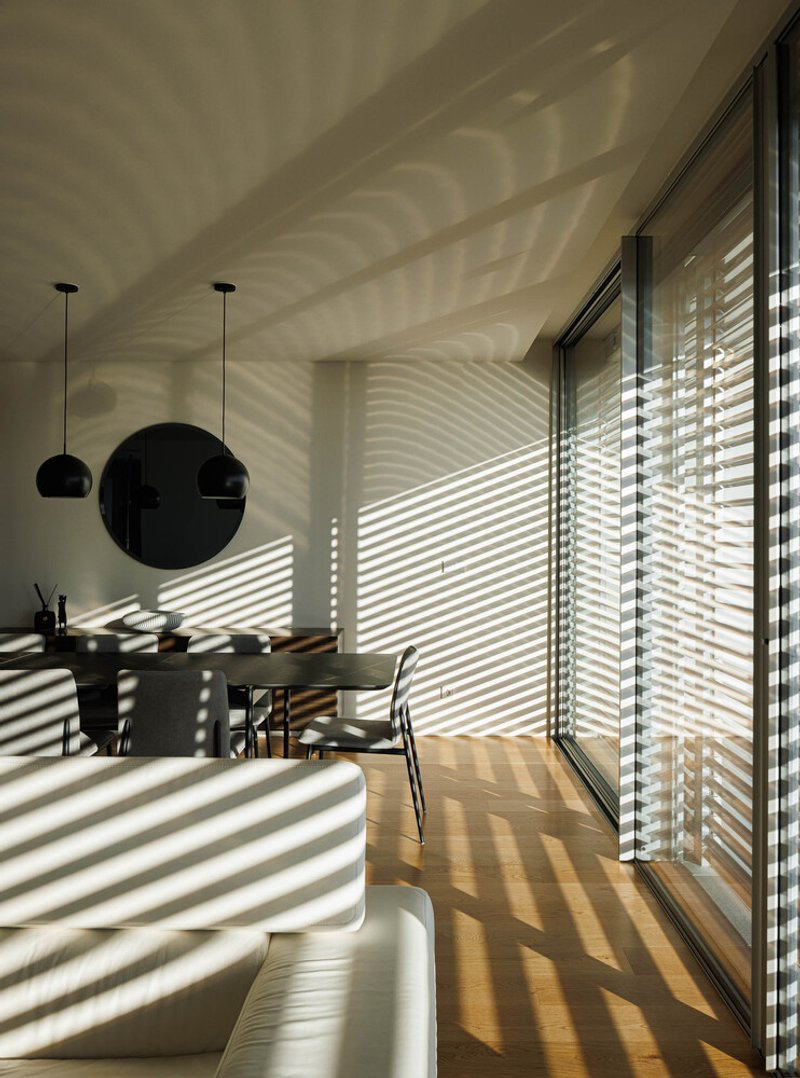
Some of the most compelling moments in GD House come from the exterior louvers that filter sunlight into the dining room. Striped shadow patterns sweep across walls and dark timber floors as the sun moves, transforming the room over the course of a day. This is not decorative; it is environmental control turned into spatial experience. The louvers reduce solar gain on the west-facing glazing while producing an interior atmosphere that changes by the hour.
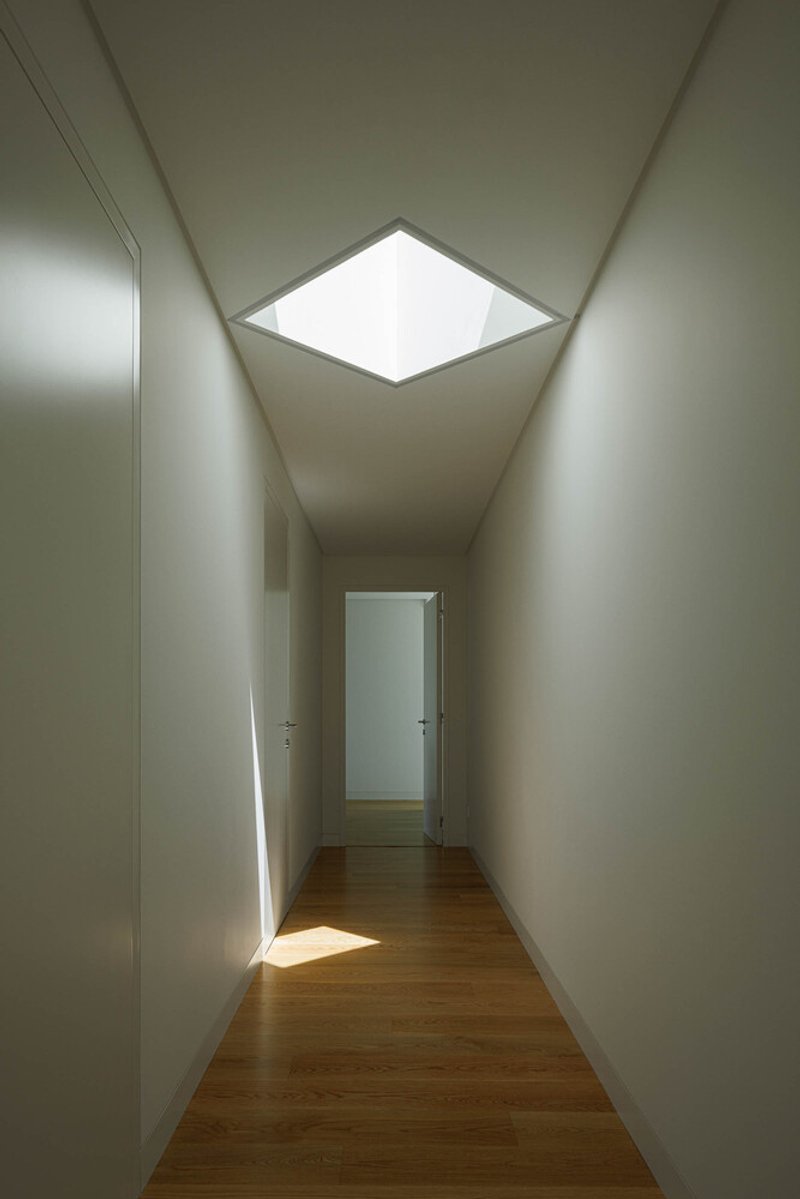
The same attention to overhead light appears in the narrow corridors, where square ceiling skylights punctuate the route between rooms. These small apertures are precisely placed to illuminate what would otherwise be a dark spine, and they create rhythmic pools of brightness that pull you through the house. It is a simple strategy executed with care.
Private Rooms and Material Detail
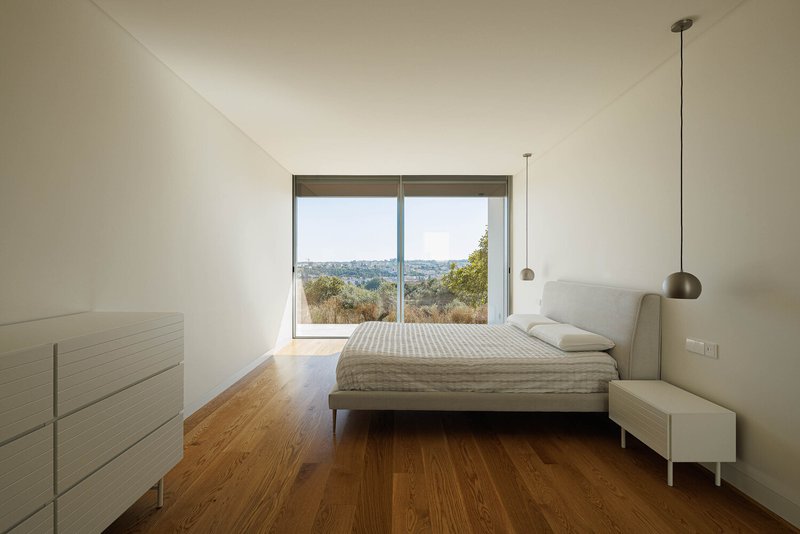
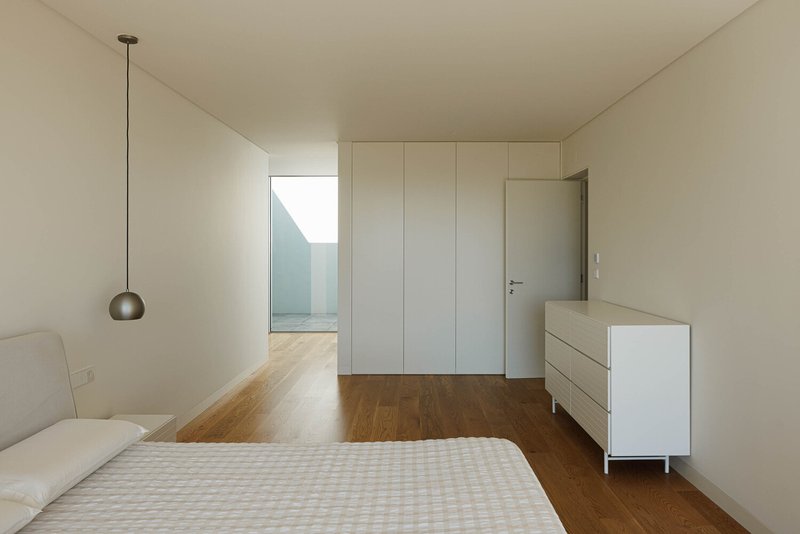
The bedrooms sit at the quieter end of the linear plan, each with its own framed view. One looks directly through sliding glass onto olive trees and distant hills, treating the landscape as a headboard. Built-in wardrobes and restrained pendant lighting keep the rooms uncluttered, putting the emphasis on the view and the quality of natural light entering from the side and above.
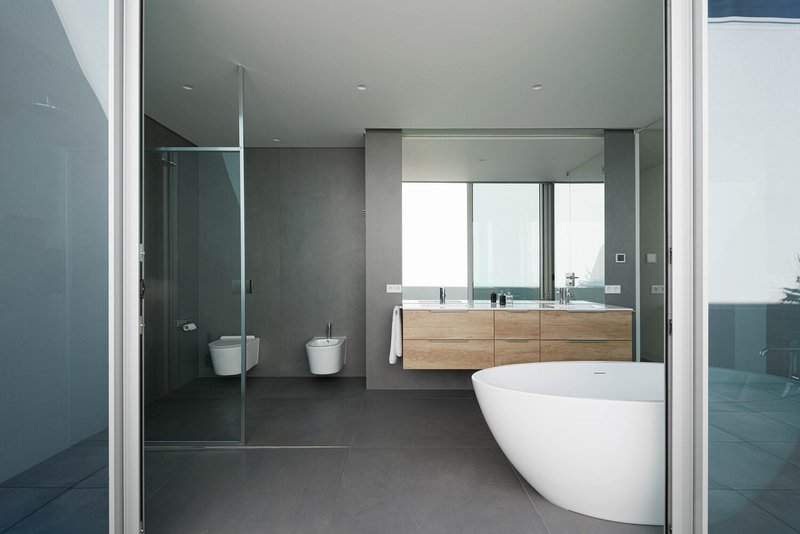
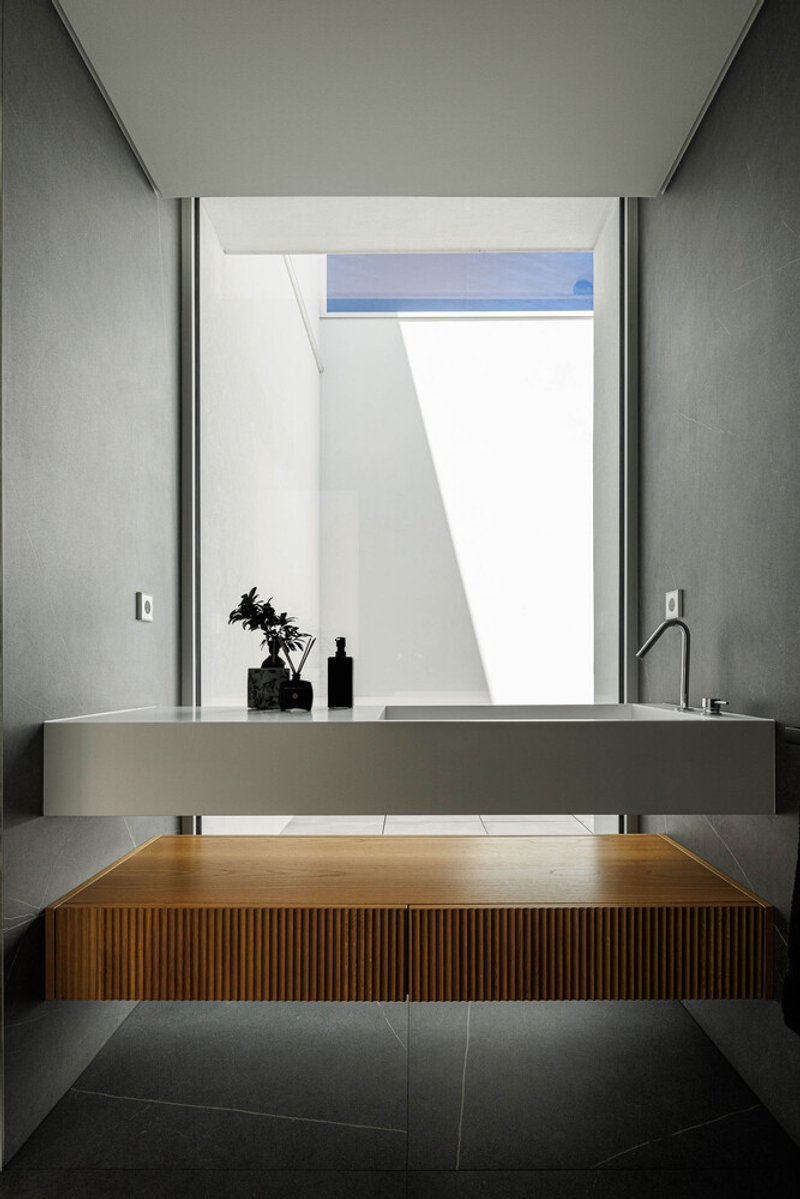
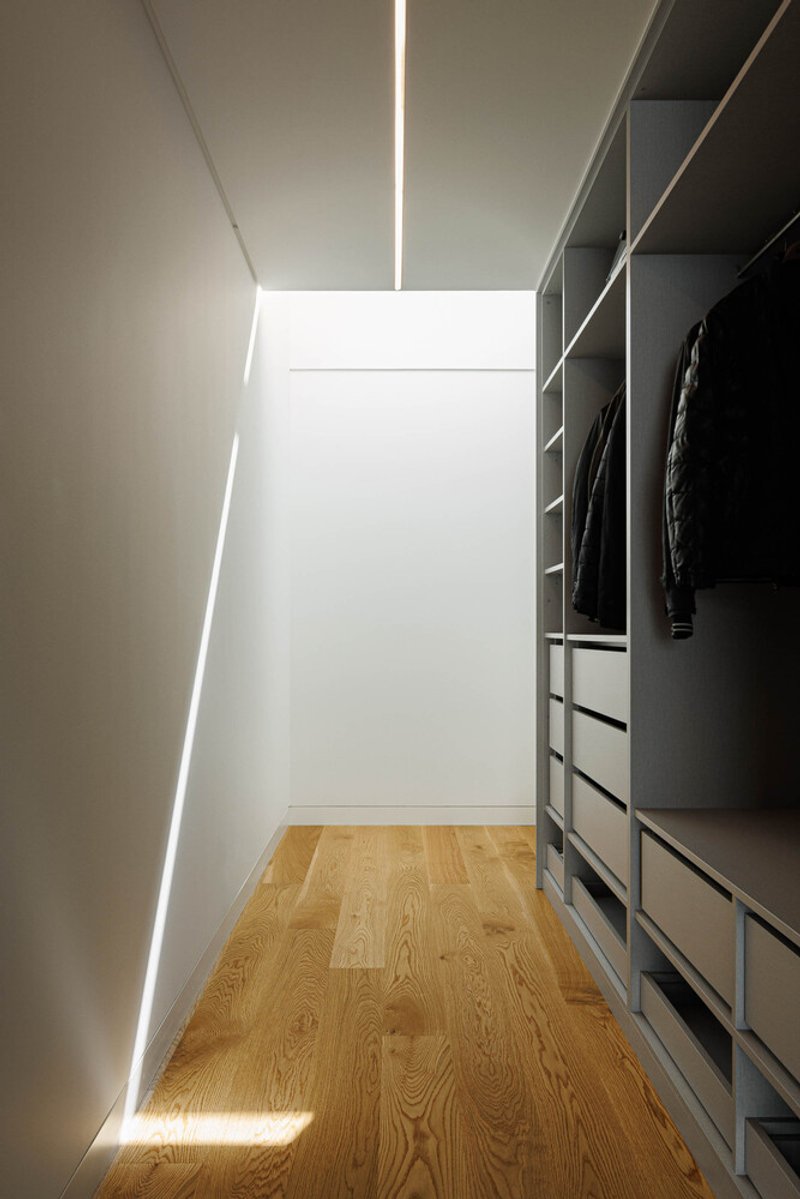
The bathrooms and ancillary spaces maintain the same material language: white walls, oak and timber accents, and concrete used sparingly for vanity surfaces. A freestanding tub sits beneath diffused daylight, and a powder room receives illumination from a skylight that makes the small volume feel generous. The walk-in closet is lit by a continuous LED strip along the wall-ceiling joint, a detail that substitutes for the natural light the room cannot receive.
Dusk and the Pond
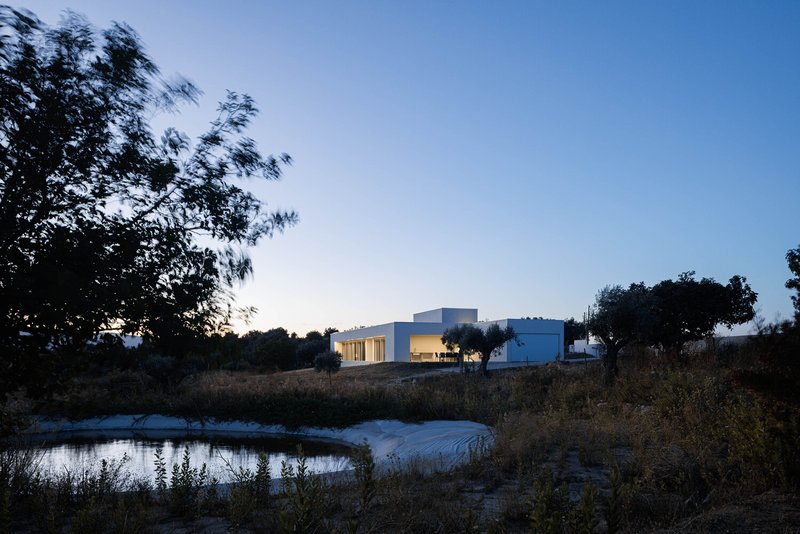
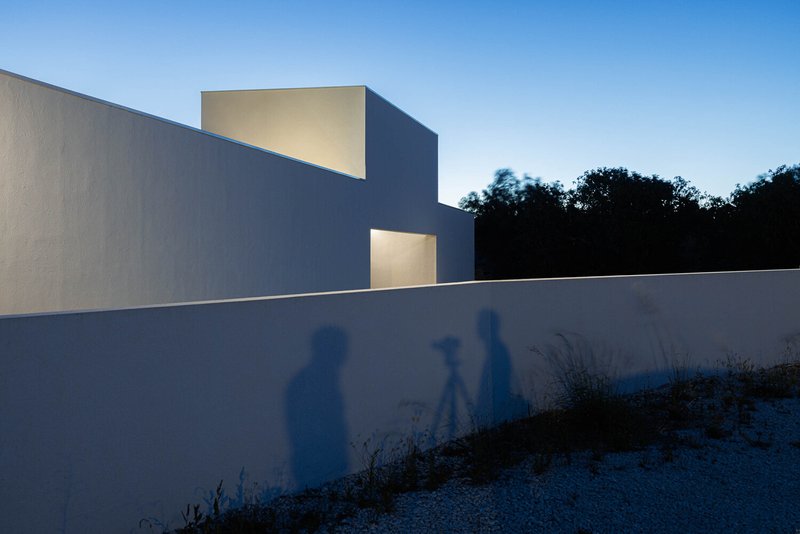
At dusk, the house reveals a second identity. The white volumes glow against a darkening sky, reflected in a circular pond set among native grasses. The pond is not an afterthought; the roof plan shows it as a deliberate element of the site composition, positioned to mirror the house and extend the perception of the building into the landscape. Perforated openings in the facade cast geometric shadows onto gravel paths, turning the exterior circulation into a sequence of light events.
The evening views also make clear how the stepped massing creates privacy between different wings of the house. Volumes overlap and offset, so that each lit interior is visible from outside only at specific angles. The house is open to the landscape but guarded from the street, a balance that the linear plan makes possible.
Plans and Drawings
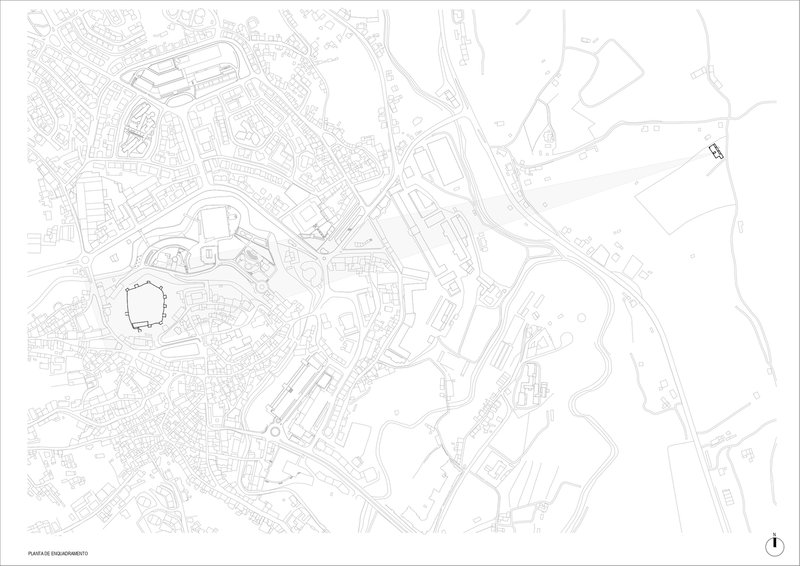
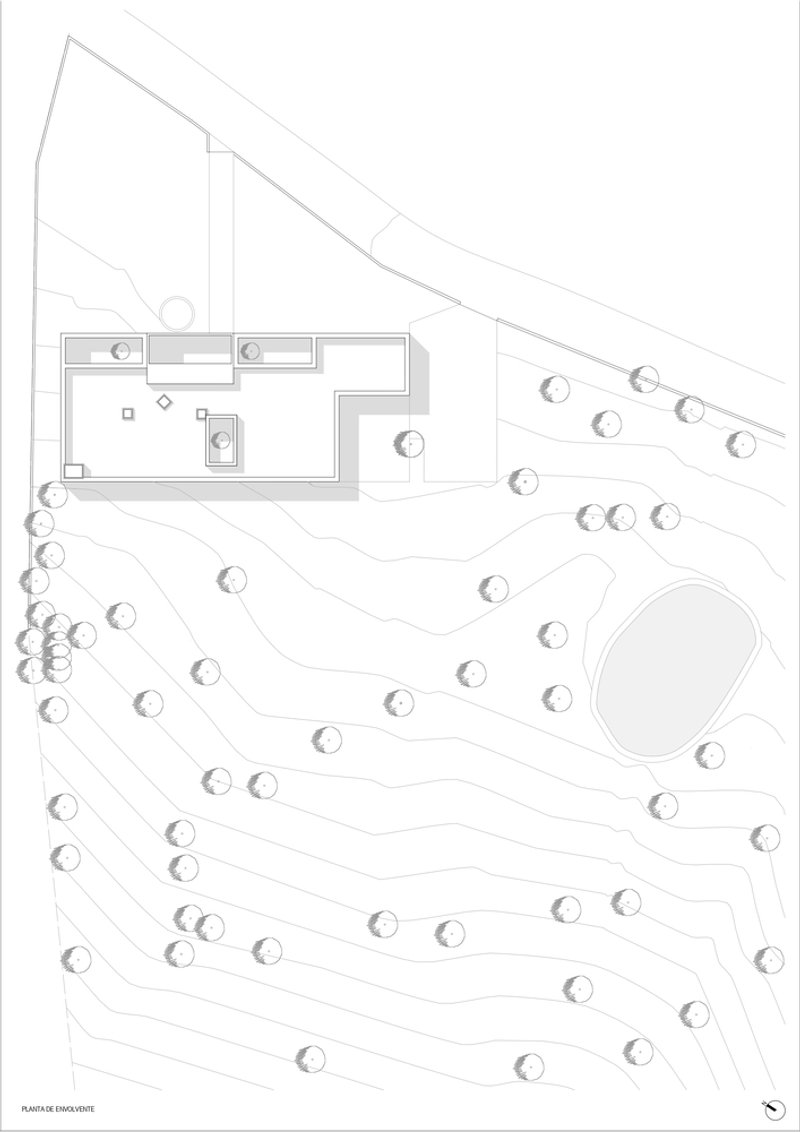
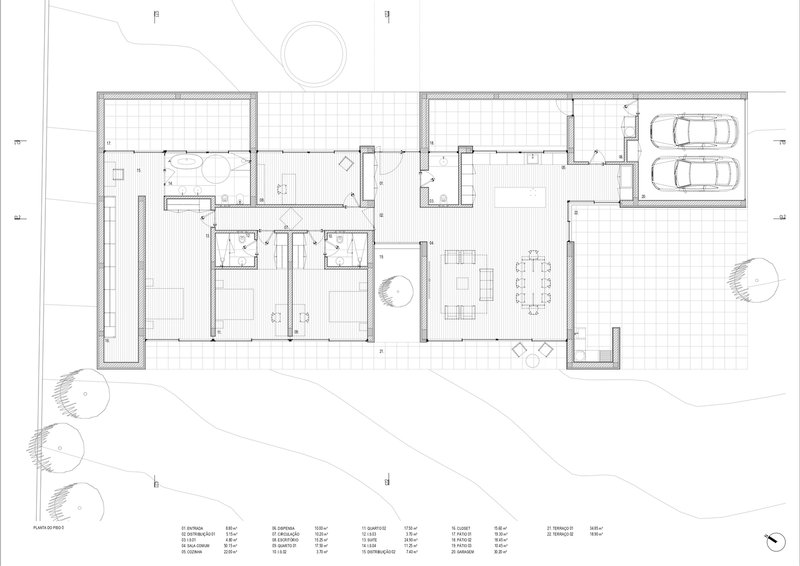
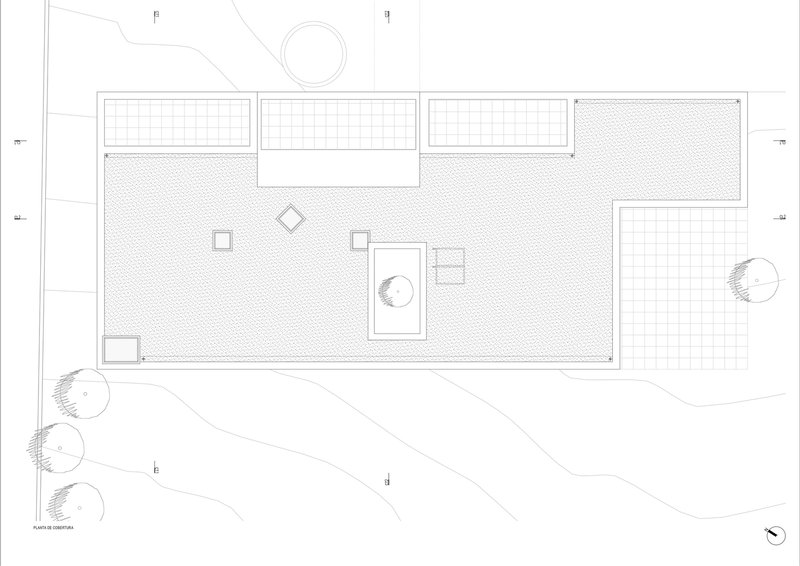
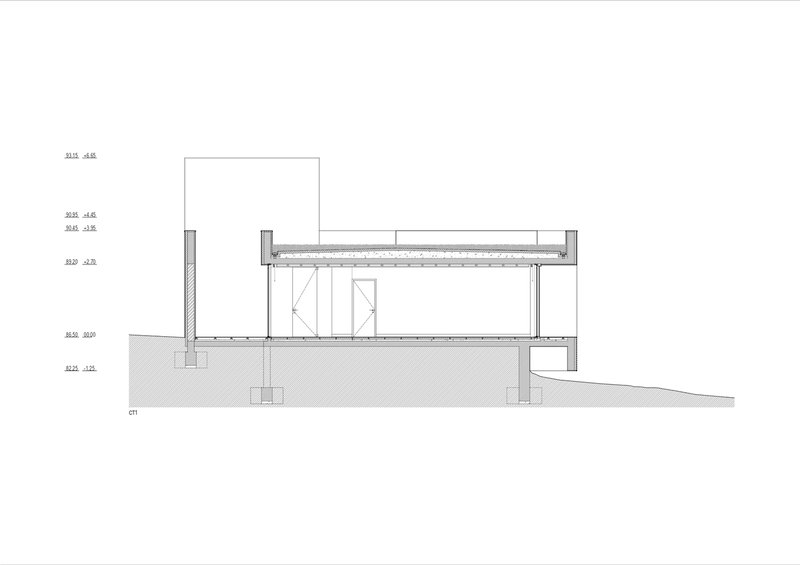
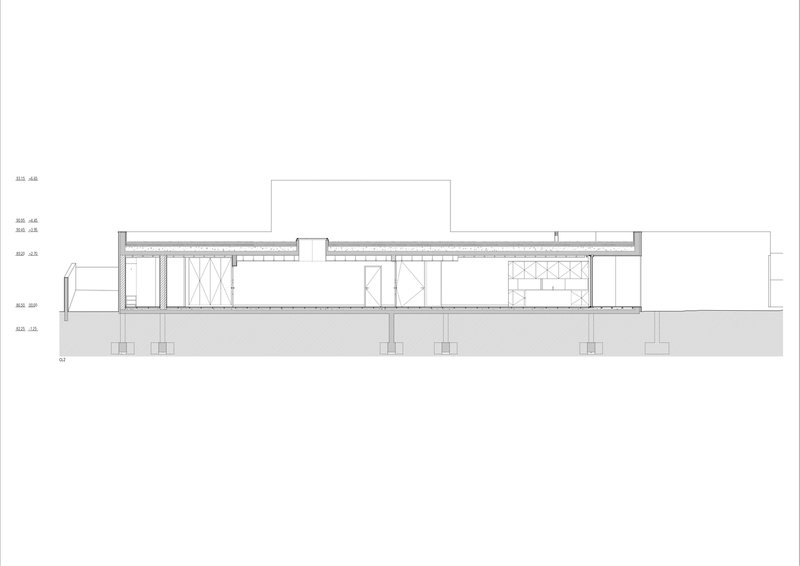
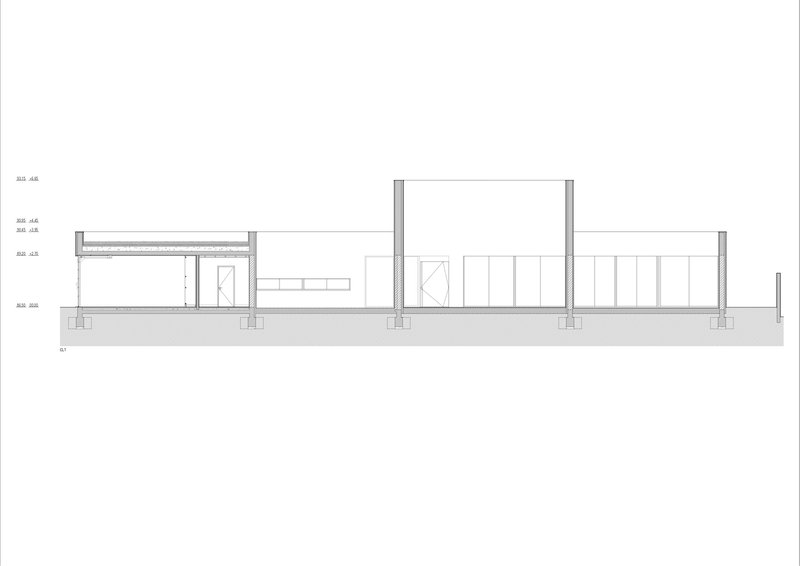
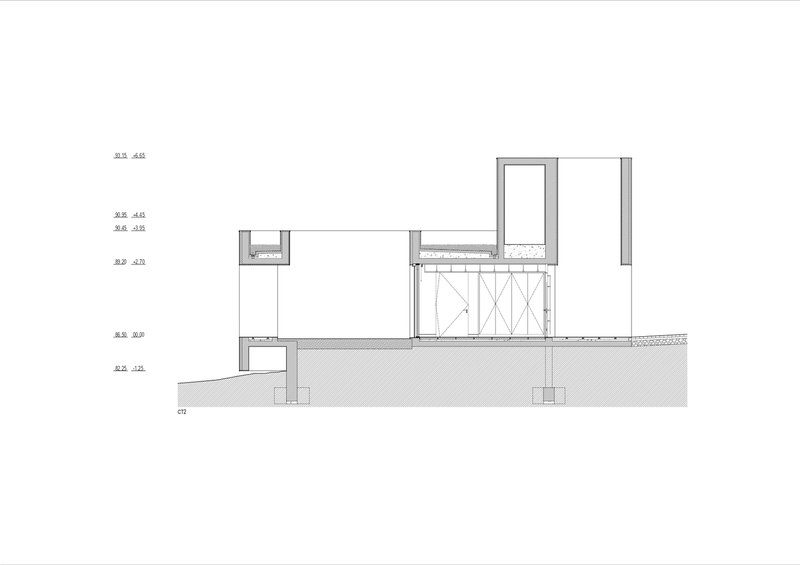
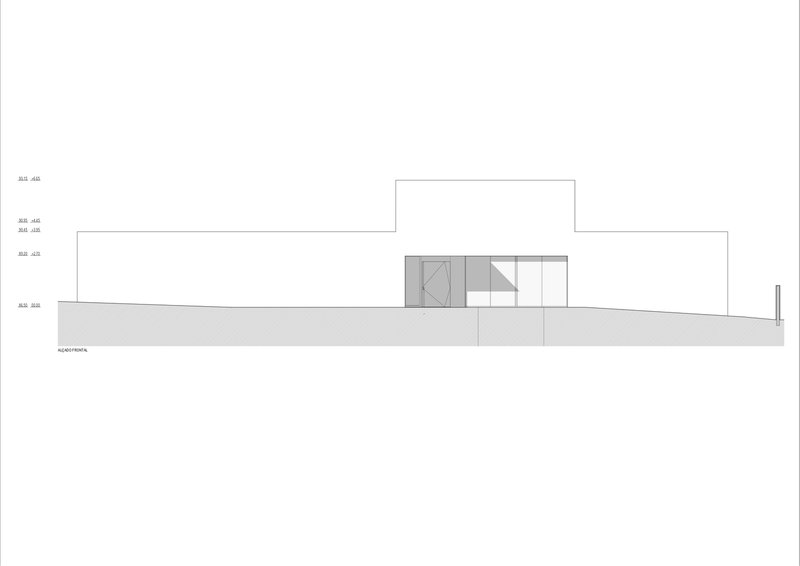
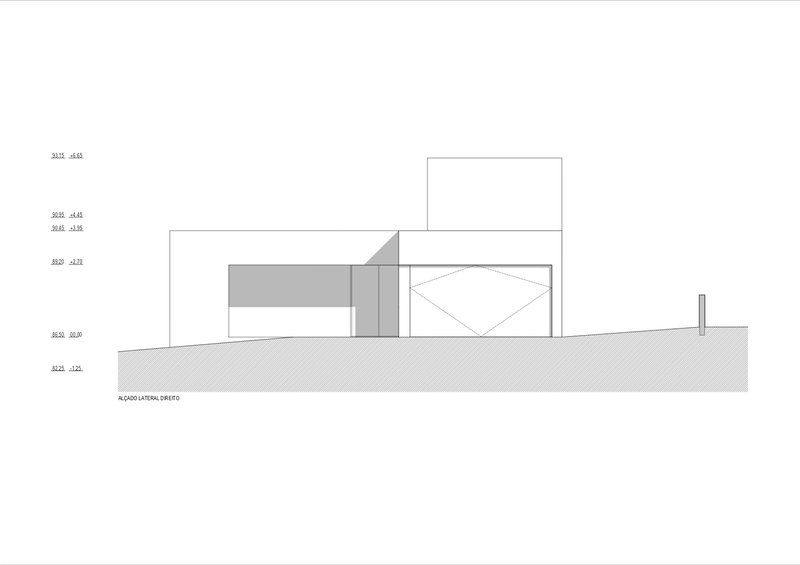
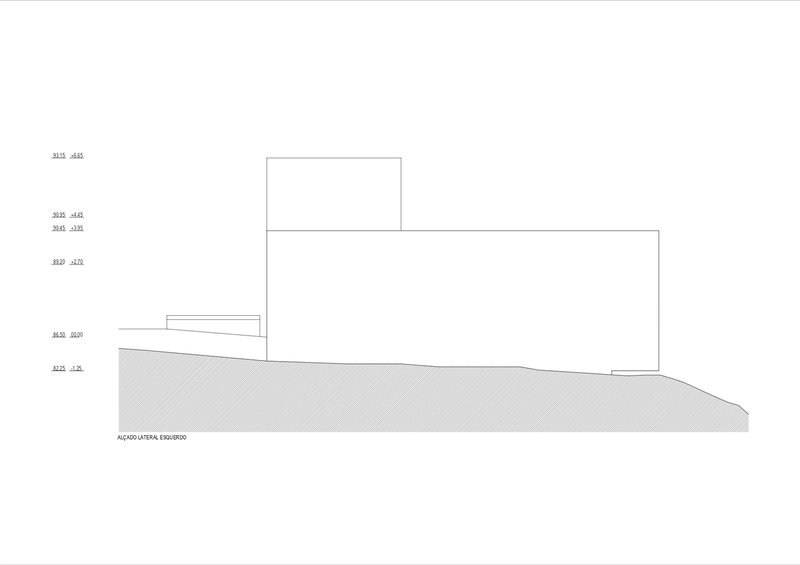
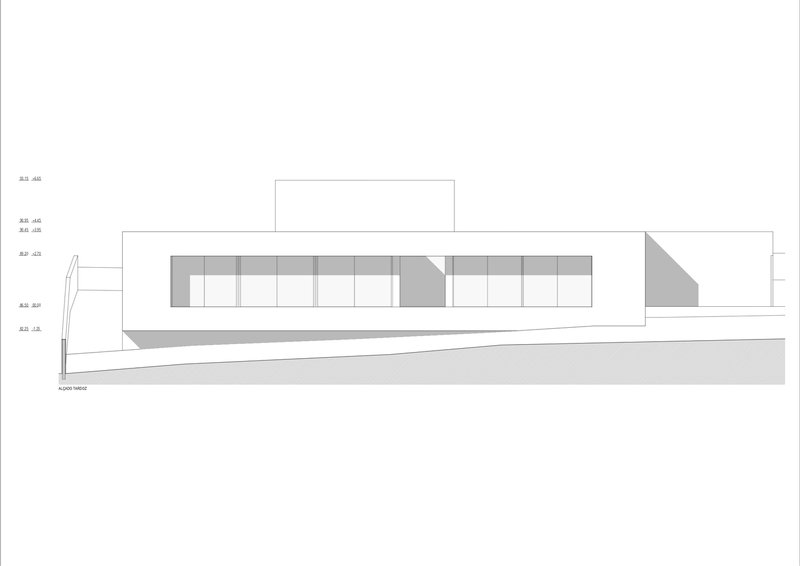
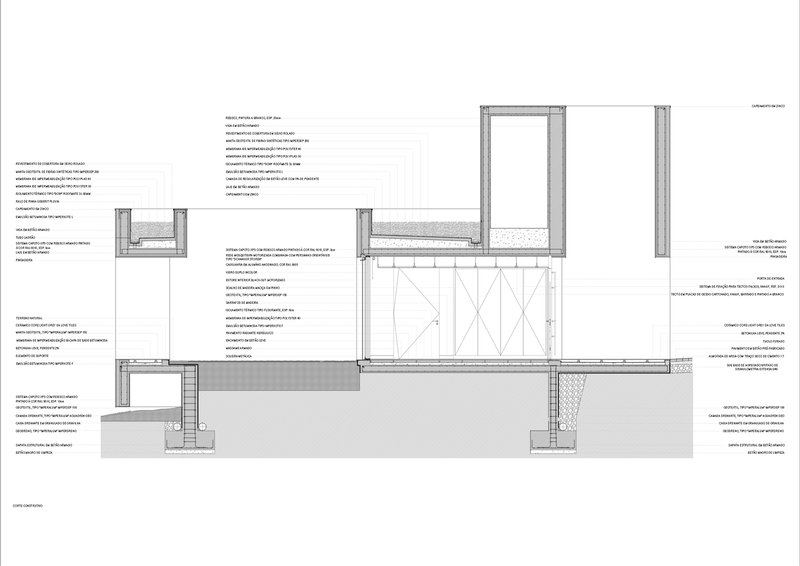
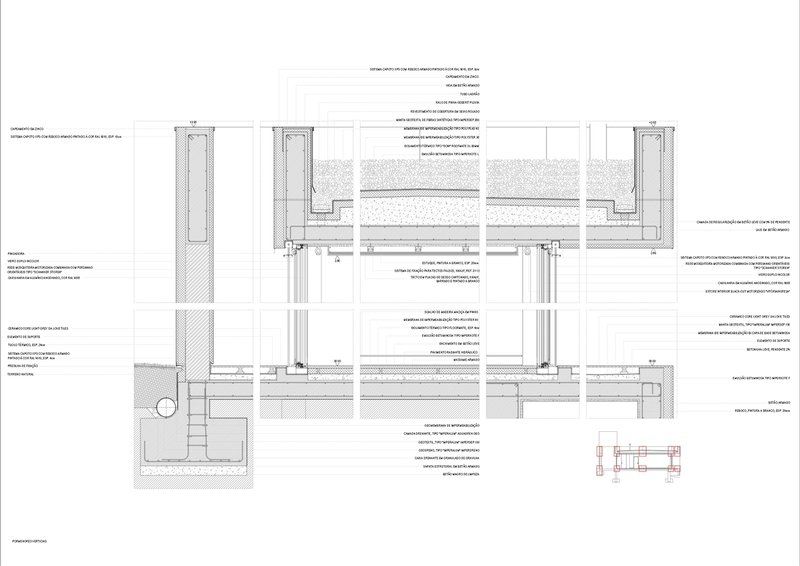
The site plans confirm what the photographs suggest: a long, narrow building mass oriented to maximize southern exposure while sheltering an interior courtyard from prevailing winds. The floor plan shows rooms arranged around a central living and dining core, with a garage at one end and bedrooms at the other, connected by the skylit corridor. Sections reveal how the timber roof structure, with exposed joists, spans the interior volumes while the building lifts on columns above the sloped ground at key points.
The construction details are worth examining closely. Window jamb and sill sections show the layered assemblies that achieve the flush exterior finish, with careful attention to thermal breaks and waterproofing at each connection. The foundation detail at grade illustrates how the floor slab meets the earth, a transition that the photographs make look effortless but the drawings reveal as technically demanding. Elevations show the full horizontal composition, with a central raised volume providing a vertical accent against the long, low profile.
Why This Project Matters
GD House is not reinventing the Portuguese courtyard house. It does not need to. What it does is execute the typology with a level of sectional intelligence and material restraint that elevates it beyond the generic white box on a hillside. The decision to organize the entire plan around captured olive trees, rather than simply preserving them in the garden, gives the house a center of gravity that most linear residences lack.
For architects working on sloping sites with existing vegetation, the project offers a clear lesson: geometry does not have to be imposed. The house steps, cantilevers, and recesses in response to what the land is already doing, and the result is a building that looks inevitable rather than placed. André David's careful detailing, from the louver shadows to the skylight placement, shows that sophistication in residential work comes from precision, not from spectacle.
GD House by Adarq (André David, Arquitecto), Portugal. Photography by Ivo Tavares Studio.
About the Studio
Share Your Own Work on uni.xyz
If projects like this are the kind of work you want to make, uni.xyz is a place to publish your own, find collaborators, and enter design competitions.




Popular Articles
Popular articles from the community

KCAP and DCA Architects Build a Stepped Urban Village on Singapore's King's Dock Waterfront
A 26,000 square meter residential development in Singapore trades tower isolation for terraced courtyards and a planted promenade along the harbor.
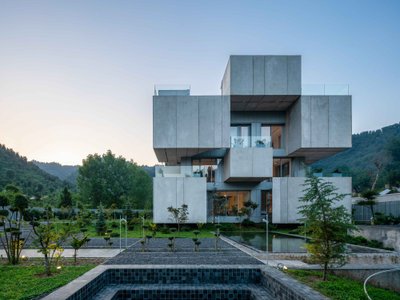
Bood Design Bureau Splits a Gilan Residence in Two to Let the Forest In
Double Side House negotiates privacy and openness through interlocking concrete volumes and planted courtyards in northern Iran's humid Caspian lowlands.
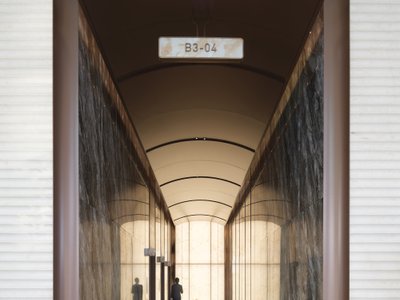
Guangzhou's Twin Towers Interiors Move Like Water
DuShe Architectural Design shapes the lobbies of a massive Guangzhou transit hub with undulating ceilings and deep geological materiality.
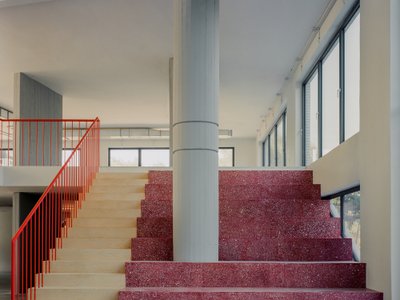
Art 1 Office Strips Athens Back to Its Bones
Neiheiser Argyros transforms a 40-year-old Athens office building into a vivid, materially rich workplace anchored by red steel, exposed concrete, and roof


Similar Reads
You might also enjoy these articles

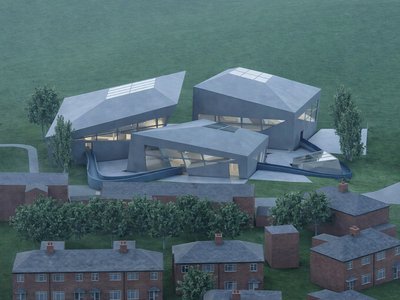
Filtering Space: A Gradual Spatial Experience
From urban intensity to spatial calm.


The Ken Roberts Memorial Delineation Competition (Krob)
As the most senior architectural drawing competition currently in operation anywhere in the world, it draws hundreds of entries each year, awarding the very best submissions in a series of medium-based categories.

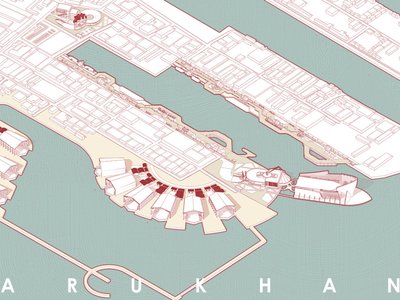
Waterfront Redevelopment and Urban Revitalization in Mumbai: Forging a New Dawn for Darukhana
A transformative waterfront redevelopment project reimagining Darukhana’s shipbreaking heritage into an inclusive urban future.

OUT-OF-MAP: A Call for Postcards on Feminist Narratives of Public Space
Rhizoma Design and Research Lab invites artists, designers, architects, researchers, and students to reflect on how feminist perspectives can reshape public space. Selected works will be exhibited in Barcelona, October 2026. Submissions open until 15 April 2026.
Explore Architecture Competitions
Discover active competitions in this discipline




The International Standard for Design Portfolios


The Global Benchmark for Architecture Dissertation Awards


The Global Benchmark for Graduation Excellence


Challenge to reimagine the Iron Throne
Comments (0)
Please login or sign up to add comments
No comments yet. Be the first to comment!