
Gensler Anchors a Shanghai Riverside Campus Around a Star-Shaped Canopy
LUMINA 2 stitches office towers, retail pavilions, and a 1,075-square-meter plaza into one permeable campus on the Huangpu River.


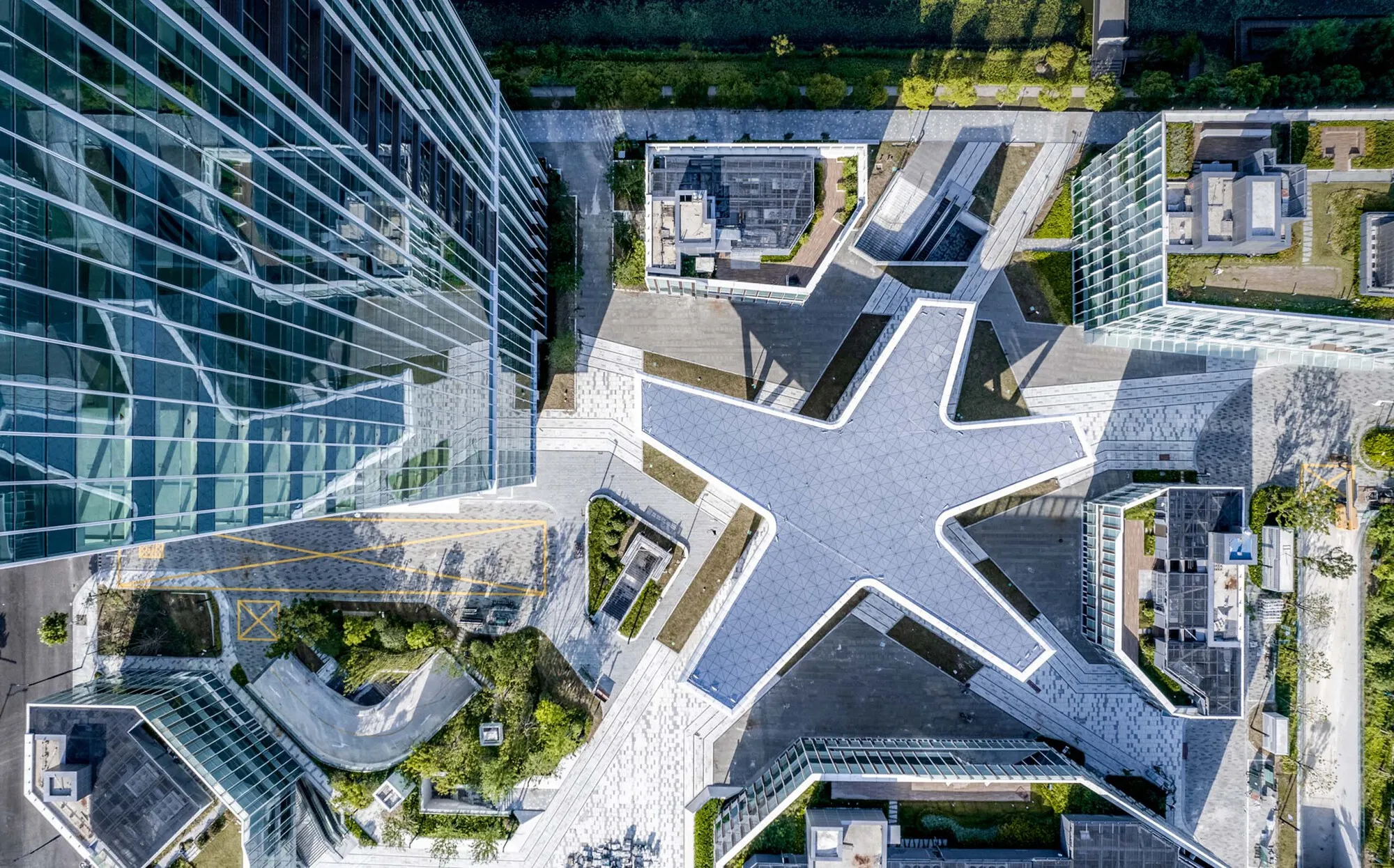
Office campuses in Chinese megacities often default to one of two modes: the sealed glass slab or the gated superblock. Gensler's LUMINA 2 in Shanghai's Xuhui Riverside District tries a third path. Instead of walling off 400,000 square meters of premium floor area, the scheme organizes four office buildings and five retail pavilions around a star-shaped canopy that radiates outward, pulling pedestrians in from all directions. The result is a campus that reads less like corporate territory and more like a public crossing point between the dense residential neighborhoods to the west and the art-and-media cluster at West Bund.
What makes the project genuinely interesting is the tension between its two building typologies. The office towers are rational, rectangular, and tall (60 and 100 meters respectively), while the retail pavilions below are irregular polygons wrapped in perforated metal screens. The canopy mediates between them, creating a continuous pedestrian datum that is neither indoors nor outdoors. It is a big, specific gesture in a city that rarely lacks ambition but often lacks coherence at ground level.
The Star Canopy as Public Infrastructure
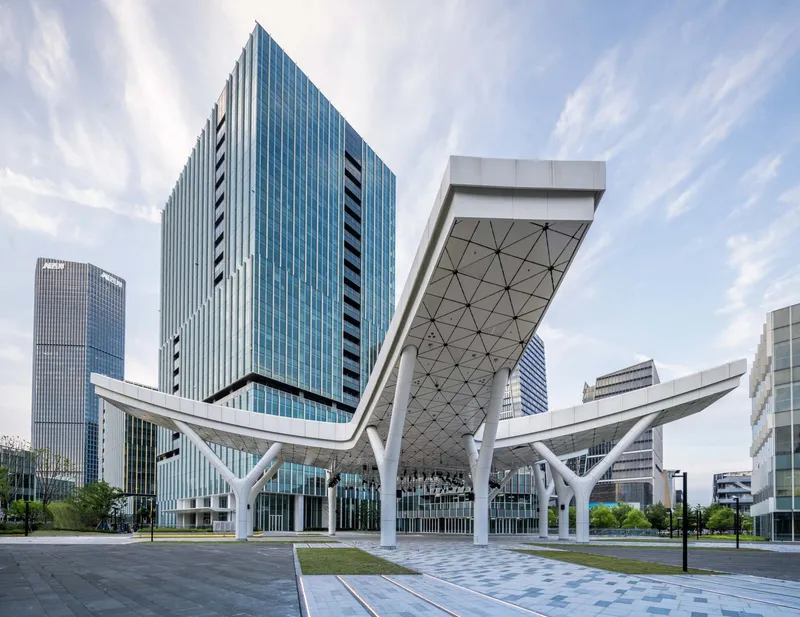


The star canopy is the project's signature element and its most provocative claim: that a piece of structural ornament can also function as genuine public infrastructure. Six arms radiate from a central node, creating a 1,075-square-meter sheltered plaza equipped with programmable spotlights, speakers, and sprinklers for events ranging from seasonal markets to stage performances. The triangulated aluminum roof, supported by white branching columns, provides shade and rain protection without enclosing the space, keeping it porous to cross-breezes from the nearby Huangpu River.
The geometry is not arbitrary. Buildings and pavilions align along the diagonal axes defined by the star's five points, so each arm frames a sightline or a pedestrian route into the surrounding neighborhood. It is a simple organizational device, but it does real work: it makes orientation intuitive and gives the campus a legibility that most sprawling mixed-use developments lack.
Tower Facades: Vertical Fins and Low-E Glass


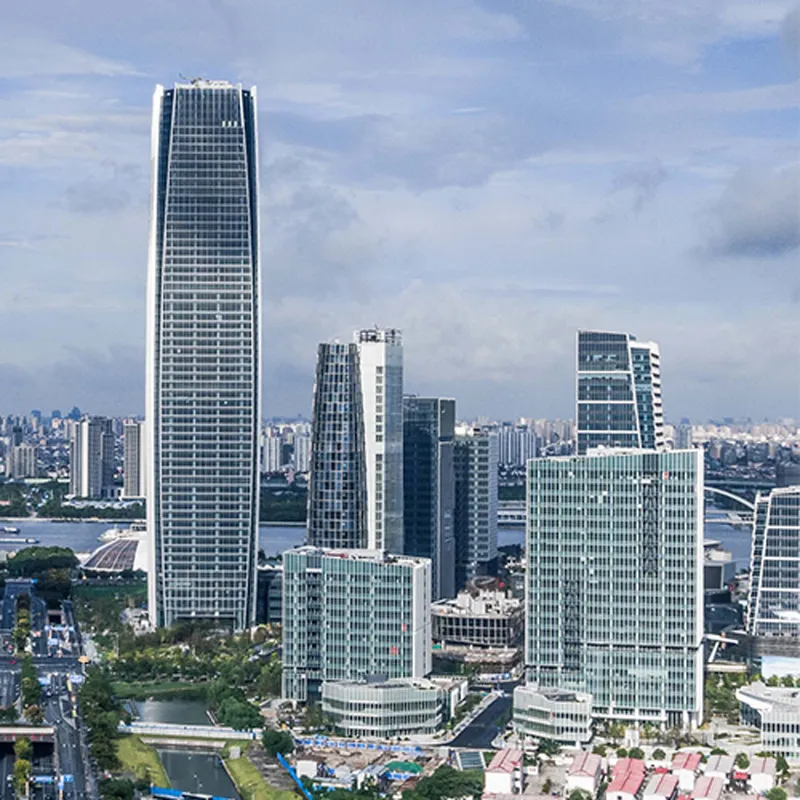
The office towers wear a curtain wall of Low-E insulated glazing units broken by three-dimensional vertical decorative fins that serve a dual purpose: solar shading and visual rhythm. The fins create a consistent texture that ties the tower volumes together despite their different heights, and they modulate daylight on the interior without resorting to heavy mechanical blinds. Up close, the interplay between the glass surface and the protruding louvers gives the facades a depth that disappears from a distance, where the towers read as sleek, reflective prisms.
It is a pragmatic facade strategy for Shanghai's humid subtropical climate. The energy efficiency rating hit 65 percent, and the project earned LEED Gold certification in early 2023 along with a China Green B rating. Thirty-four percent of building materials were reusable or recycled, a figure that is respectable if not revolutionary for a development of this scale.
Retail Pavilions and Perforated Pattern Screens

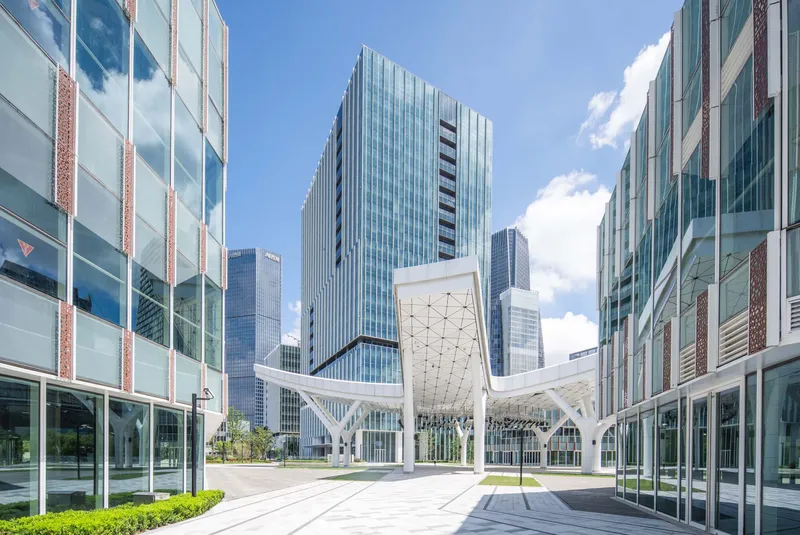
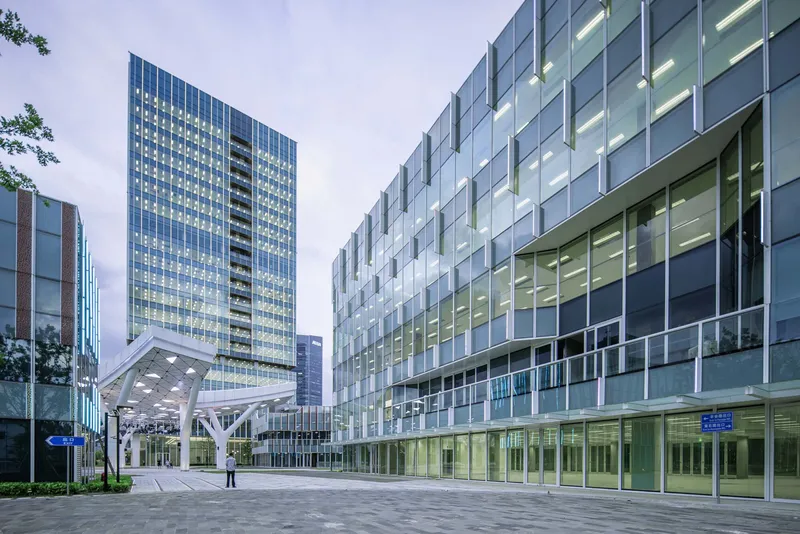
Where the towers are deliberately restrained, the low-rise retail pavilions announce themselves with color and texture. Three types of perforated metal panels, patterned after orchid, cherry, and bamboo motifs, wrap the pavilion volumes in screens that filter light, obscure mechanical systems, and give each building a distinct identity within the family. The red panels visible along certain facades inject warmth into a palette otherwise dominated by white steel and clear glass.
Ground-level foldable doors on the pavilions can open completely in favorable weather, merging interior retail or food-and-beverage spaces with the plaza. It is a detail that matters more than any structural feat: the difference between a campus that people walk through and one they actually linger in often comes down to whether the ground floor breathes.
Waterfront and Landscape

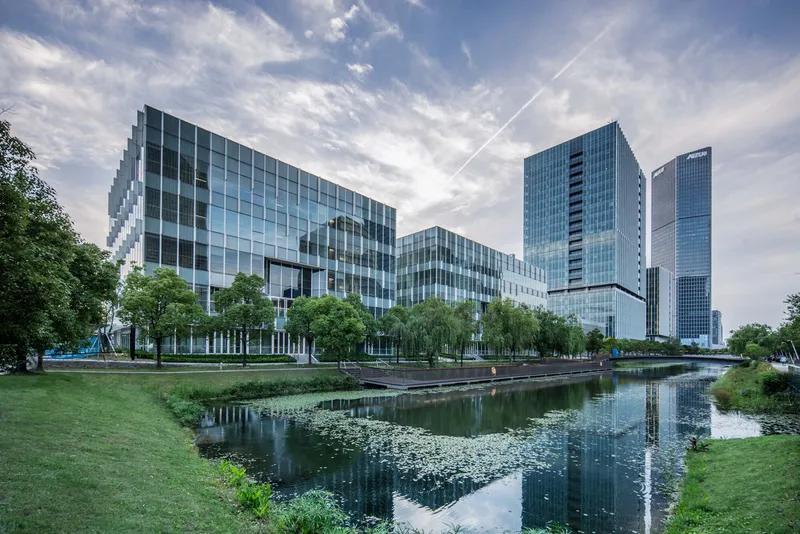

Gensler's original brief called for two towers on the east and west ends of the plot, which would have fragmented the ground plane and pushed landscaping to leftover pockets. The firm's counter-proposal consolidated the primary tower at the center of the site, freeing the eastern edge for a retail podium with direct river access and consolidating green space into substantial, usable zones rather than decorative strips. Landscaped ponds with lily pads soften the base of the towers and create foreground reflections that give the development a sense of scale at eye level.
The Xuhui Riverside location is strategic. West Bund has matured into Shanghai's cultural corridor, home to museums, galleries, and media companies. LUMINA 2 sits at the edge of that energy, and the permeable campus plan is designed to capture foot traffic from the waterfront promenade rather than turning its back on it.
Dusk and the Lit Campus

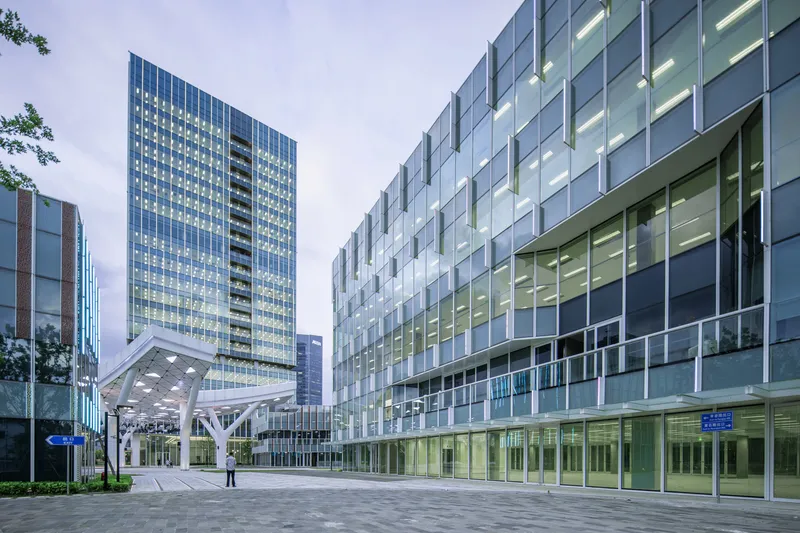
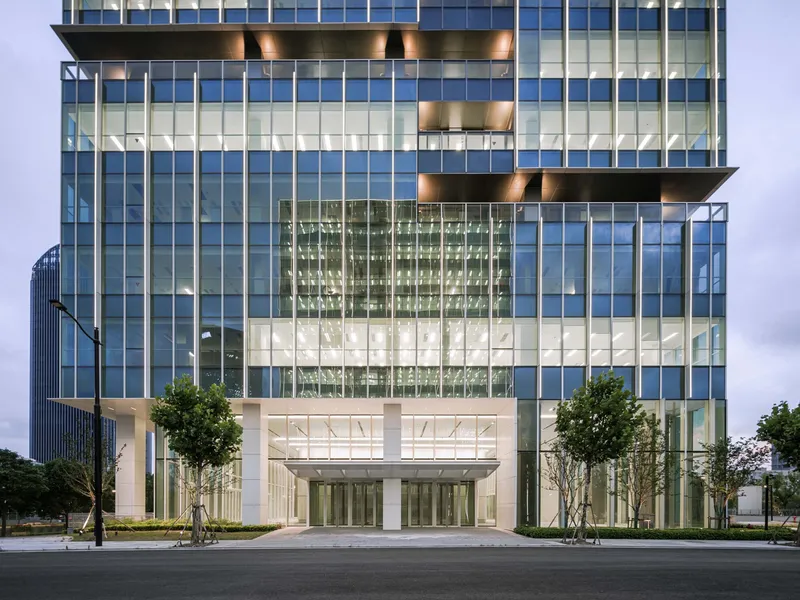
A campus like this lives or dies by what happens after 6 PM. The twilight photographs reveal a deliberate lighting strategy: the canopy's soffit glows evenly, the tower lobbies are fully transparent, and the tree-lined boulevard at the perimeter is lit to sidewalk scale rather than building scale. The effect is a campus that does not go dark when the office workers leave, because the retail and event programming under the canopy sustains activity into the evening.
The cantilevered upper floors of the towers, visible at the lobby entrances, create a threshold condition that is generous rather than imposing. You walk under a floating mass of office space to reach the lobby, an experience that compresses and then releases, a spatial trick as old as modernism but still effective when handled with restraint.
Terraces Carved from Volume


The office towers are not monolithic extrusions. Voids carved into the building mass create balconies and terraces at multiple levels, introducing natural light and ventilation into the deep floor plates. Rooftop terraces on the lower pavilion buildings are landscaped with planting beds and pedestrian paths, effectively extending the campus's green network vertically. For tenants, it means actual outdoor space, not a token balcony, integrated into the working day.
The cross-core layout inside the towers supports this strategy by keeping the structural and circulation elements tight, so that the floor plates maximize usable area while the carved voids do not compromise lettable space. Lifts are arranged in ten-floor zones, reducing wait times and allowing the core to be compact.
Plans and Drawings



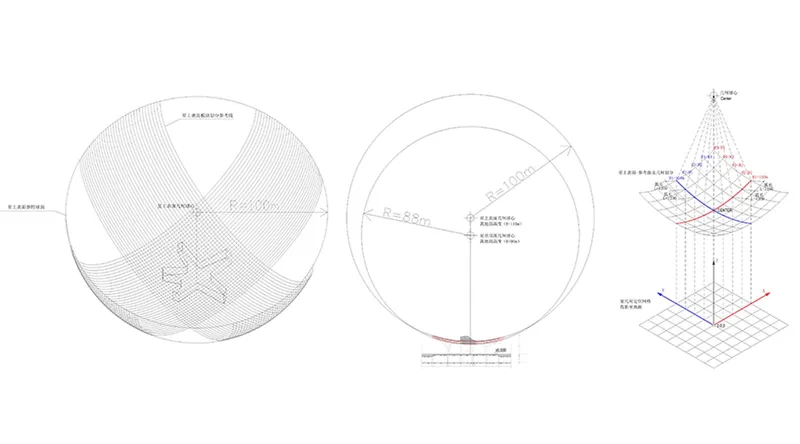
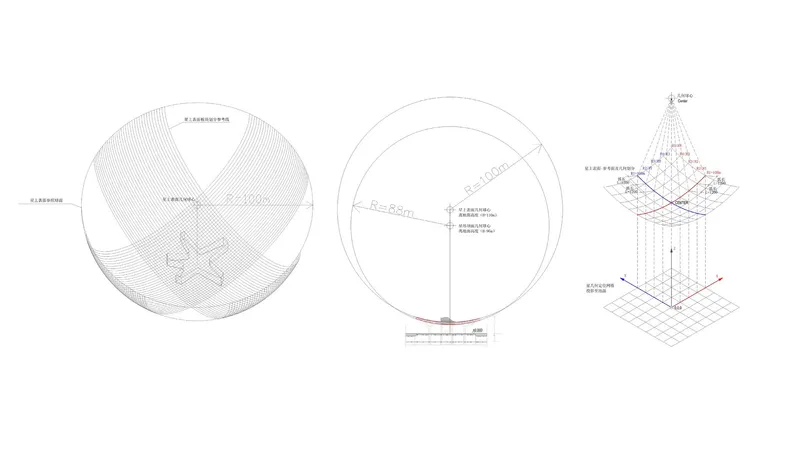


The diagrams make the site strategy legible. The intersecting axes radiating from a central node (image 18) show how the star geometry organizes circulation before any building form is introduced. The axonometric progression (image 21) reveals how the tower volumes develop from a transparent ground floor through planted terraces to the louvered upper facade, a vertical gradient from public to private. The radial structural geometry of the canopy (images 22 and 23) demonstrates how the branching columns distribute loads across irregular spans without resorting to a conventional grid.
The color-coded site rendering (image 26) clarifies the program distribution: towers on the interior of the site, retail pavilions ringing the canopy, and open space flowing to the waterfront edge. The elevation drawing (image 27) with its detail callouts confirms the layered facade composition of vertical louvers over floor-to-ceiling glazing, a system that repeats across both tower and pavilion typologies to unify the campus expression.
Why This Project Matters
LUMINA 2 matters because it demonstrates that a 400,000-square-meter commercial development does not have to be hostile to its surroundings. The star canopy is the headline, but the real achievement is the site strategy: consolidating the tower, pushing retail to the river, and aligning every axis to invite pedestrian movement through the campus rather than around it. In a district competing for creative-class tenants and cultural credibility, porosity is a competitive advantage.
The project also offers a useful model for how facade and landscape systems can do environmental work without announcing themselves as green gestures. The vertical fins, the carved terraces, the operable ground-floor doors, and the shaded canopy plaza all contribute to energy performance and occupant comfort, but they register as architectural decisions, not sustainability checklists. That integration is what makes the difference between a LEED plaque on the wall and a building people actually want to spend time in.
LUMINA 2 Offices, designed by Gensler with local design institute East China Architectural Design & Research Institute (Arcplus Group), structural and MEP engineering by Arup, and interior design by Hassell. Located in the Xuhui Riverside District, Shanghai, China. 400,000 m². Completed 2022.
About the Studio
Share Your Own Work on uni.xyz
If projects like this are the kind of work you want to make, uni.xyz is a place to publish your own, find collaborators, and enter design competitions.



Popular Articles
Popular articles from the community

EW PARK: Sustainable Architecture Reimagines the Future of Urban Parking
EW PARK reimagines city parking as a modular wooden tower combining automation, solar energy, electric mobility, and adaptable urban design.

Hill & Cross Opera: Sculptural Opera House Architecture Shaped by Tallinn’s Landscape and Identity
Hill & Cross Opera reimagines opera house architecture in Tallinn through its sculptural hill, civic plaza, glass wave and a luminous cross.

Riyadh For All: Intergenerational Urban Design for Active Aging in Rabat
Riyadh For All reimagines urban design in Rabat with intergenerational co-living, adaptive courtyards, and Moroccan cultural exchange today.

The Ocean Hive: Sustainable Architecture for a Self-Sufficient Civilization at Sea
The Ocean Hive imagines sustainable architecture at sea, where modular habitats, algae, wave power and ocean waste sustain a growing colony.

Similar Reads
You might also enjoy these articles

Bao Huynh Watercolor Atelier: A Serene Art Retreat in Hội An
Bao Huynh Watercolor Atelier in Hội An blends multifunctional art spaces, sustainable design, local materials, and family-friendly living in a serene environment.

Atelier Macri Concept Store Interior Design by CASE-REAL
Atelier Macri store features a "ko" counter, walnut wood details, cork displays, blending retail, gallery, and seamless customer experiences.

Manuel Vargas Izquierdo Stadium and High-Performance Sports Center: Architectural Excellence in Jalpa de Méndez
The Manuel Vargas Izquierdo Stadium blends sustainable design, inclusive sports facilities, and cultural-inspired architecture, revitalizing Jalpa de Méndez’s public spaces.

KAKR Buluh Awar Hall: Revitalizing Community and Ecology Through Bamboo Architecture
Community built bamboo hall revitalizes Buluh Awar village, empowering youth, restoring ecology, celebrating vernacular craftsmanship through sustainable architecture and culture.





Comments (0)
Please login or sign up to add comments
No comments yet. Be the first to comment!