
GGR Architectes Wraps a Concrete School in Red Steel Canopies in Southern France
The School Complex of the Olive Tree in Pechbonnieu rethinks the suburban school as a compact, skylit gathering place for all ages.


Schools in France's suburban periphery tend to follow a familiar script: low-rise volumes, tidy fencing, an asphalt yard. The School Complex of the Olive Tree in Pechbonnieu, designed by GGR architectes and completed in 2025, does something more deliberate. Rather than rehabilitating the existing building on site, the architects started fresh, replacing a dated facility with a compact, square-plan building that puts shared spaces at its core and treats raw concrete not as austerity but as honesty.
What makes the project worth studying is its refusal to separate. Primary and nursery programs share the same building, the same atrium, the same overhead light. A library and a multipurpose hall sit at the center rather than at the edges, pulling circulation inward and shortening the distances children travel between rooms. The result is a school that functions less like a corridor-and-classroom machine and more like a small civic building, anchored to its neighborhood by a series of red steel canopies that extend the architecture outward into courtyards and play zones.
A Red Threshold
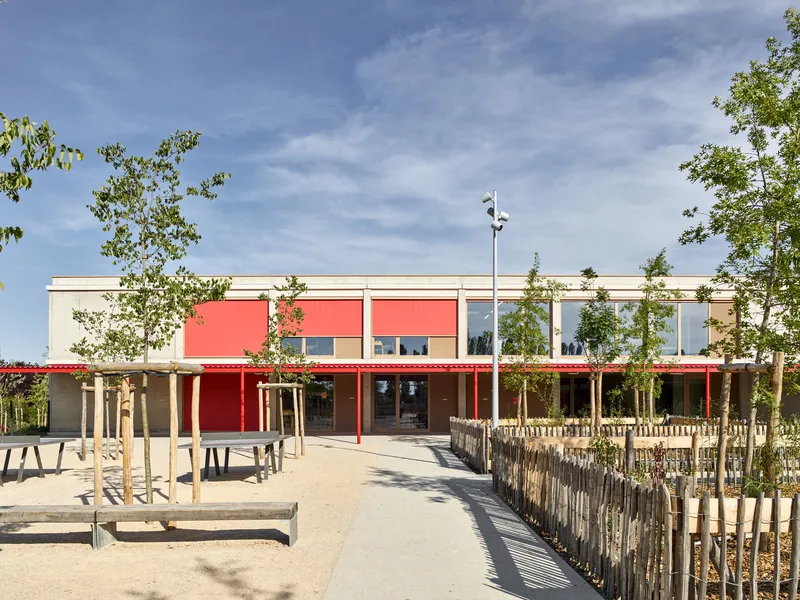
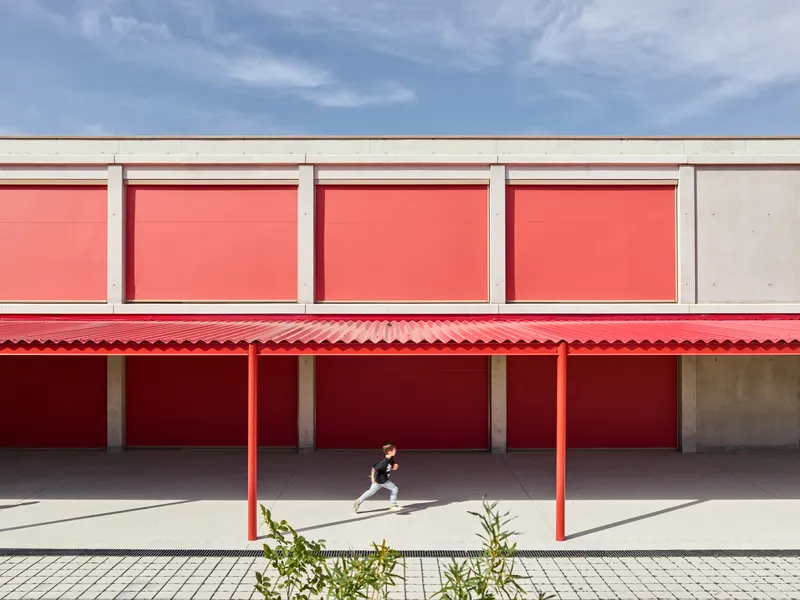
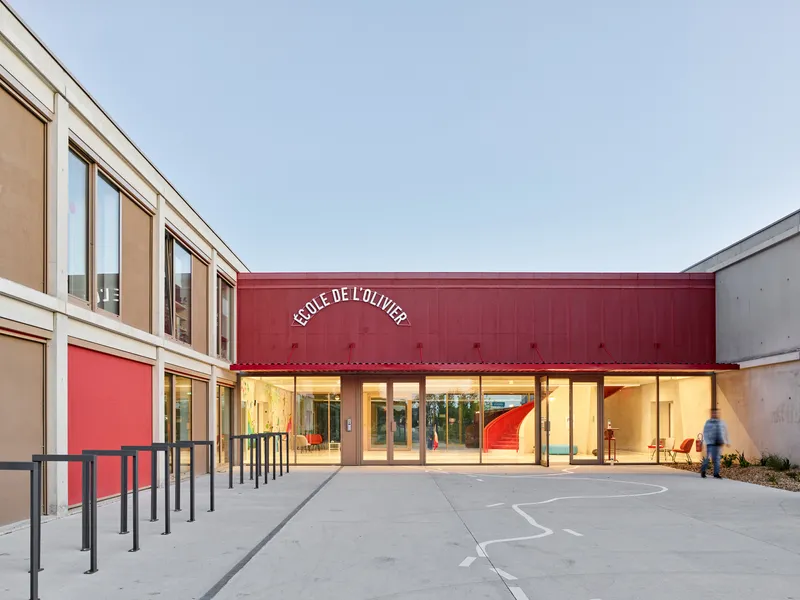
The school's most legible gesture from the street is its corrugated red canopy, a continuous steel plane supported by slender columns that shelters the entry sequence and wraps around the playground edges. It reads simultaneously as a porch, a wayfinding device, and a weather shield, doing practical work while giving the building a strong civic presence. The color is unapologetic, standing out against the muted suburban context without tipping into spectacle.
Timber columns at the forecourt soften the arrival, and young trees planted in the approach corridor suggest a landscape strategy that will mature over time. At dusk, the glass entrance beneath the canopy glows warmly, turning the school into a lantern for the neighborhood, a signal that this is a public building that belongs to more than just its school hours.
The Concrete Core

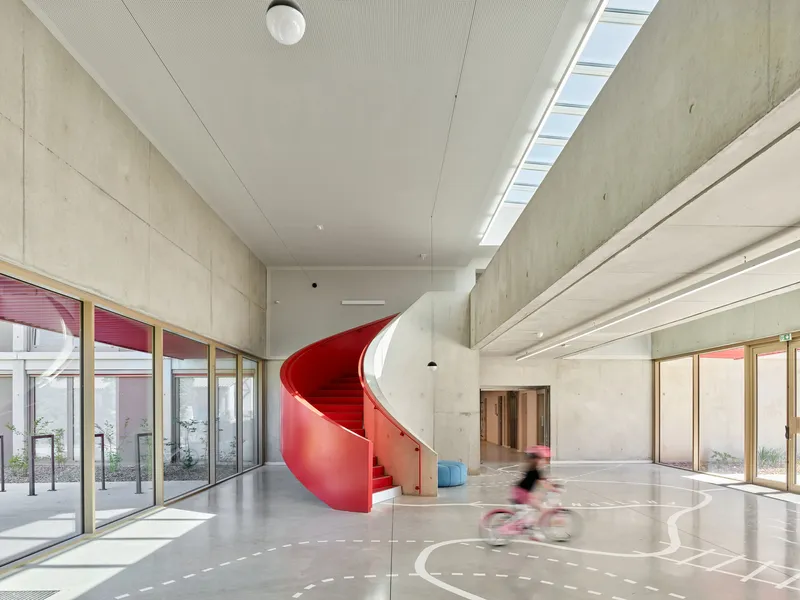
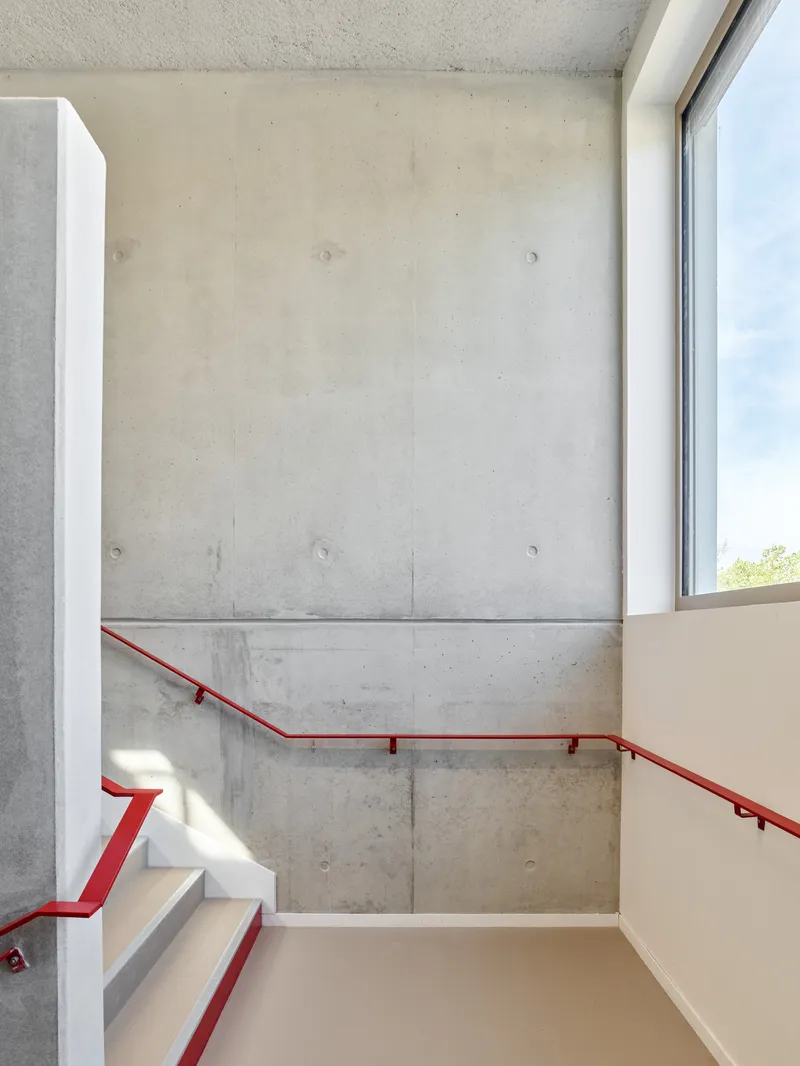
Inside, the palette shifts to board-formed concrete: walls, ceilings, stair cores. GGR architectes leave the structure almost entirely exposed, with the imprint of formwork visible on surfaces throughout. The decision keeps costs low (the project came in at €1,270 per square meter excluding taxes) and gives the interiors a directness that children, who are rarely impressed by architectural pretense, seem to respond to well.
The red helical staircase is the standout interior element. Set beside full-height glazing, it connects the two levels while acting as a sculptural anchor for the lobby. Its steel structure and painted finish pick up the language of the exterior canopies, threading color through the building like a continuous thread. The stairwell detailing, with its simple red handrail and corner window, shows a project that cares about the moments between rooms as much as the rooms themselves.
Light from Above

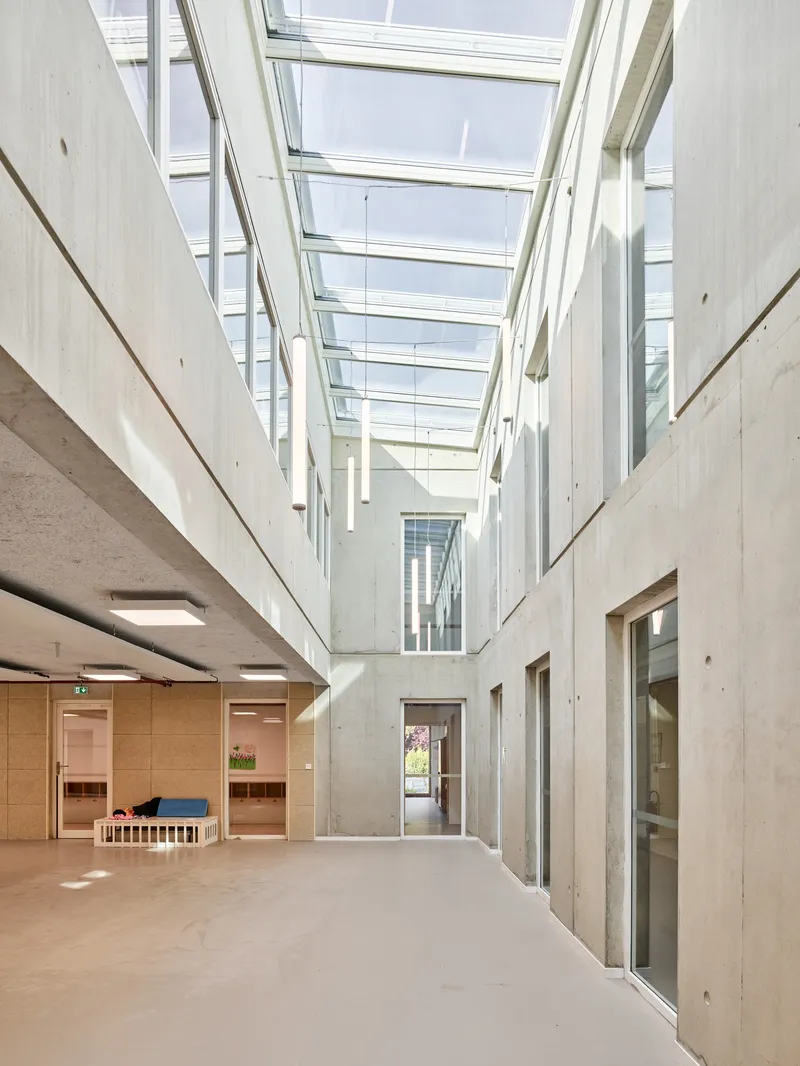
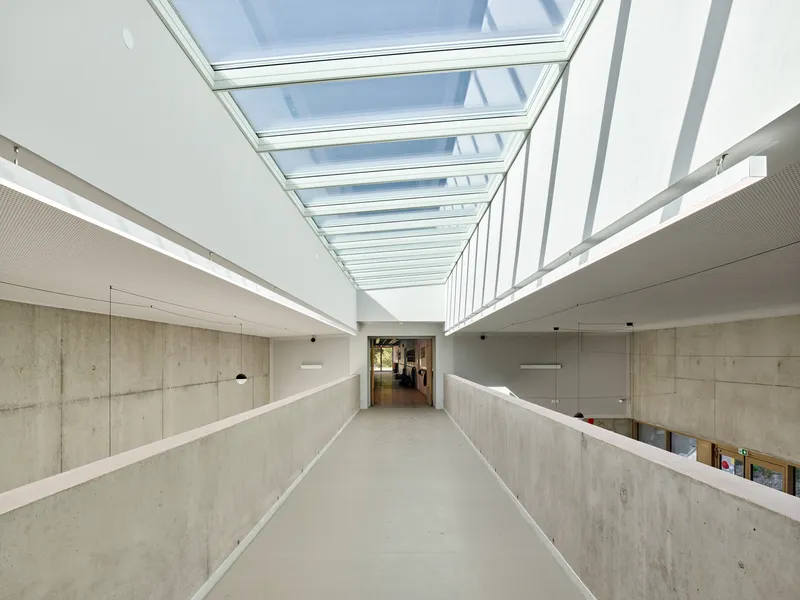
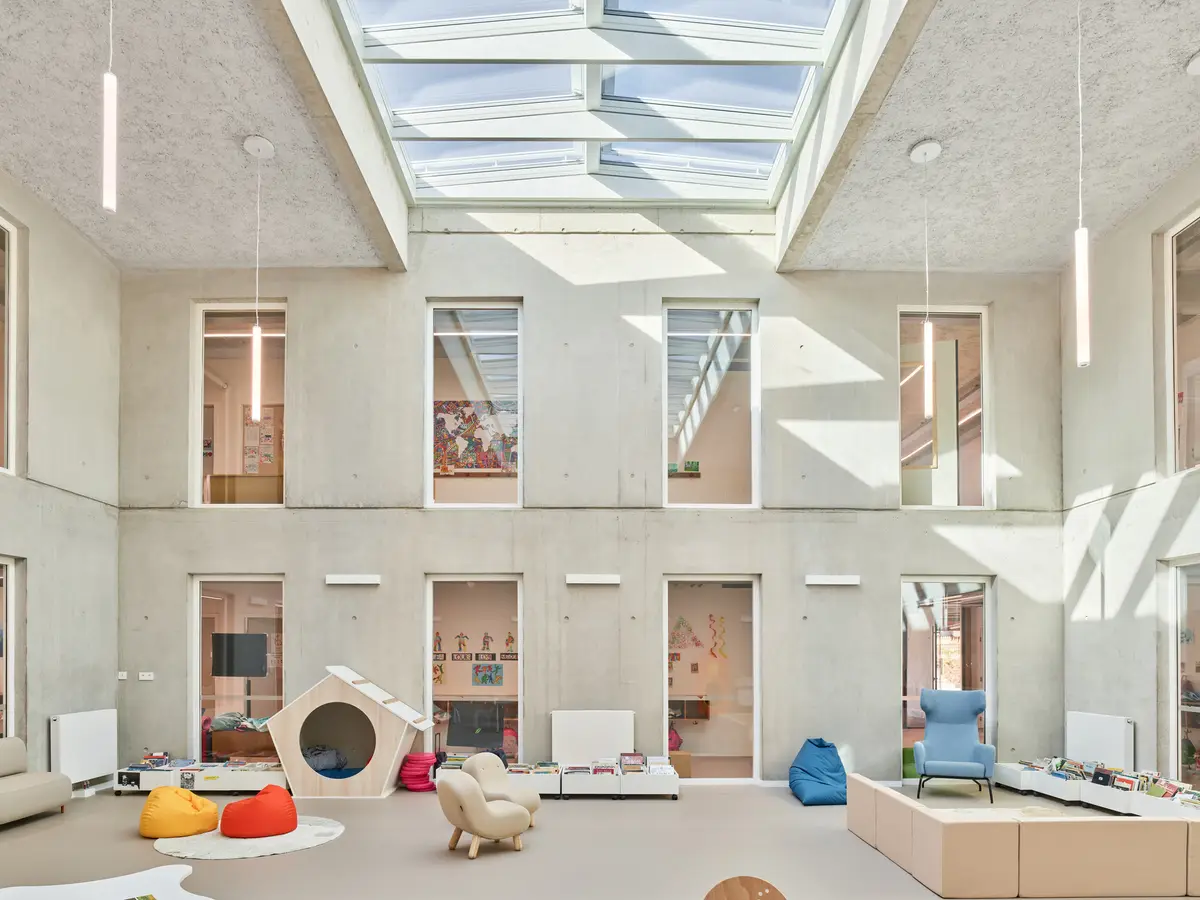
The double-height atrium is where the building's ambition becomes most apparent. A continuous linear skylight runs along the roof, flooding the central hall with diffused natural light that shifts across the concrete walls throughout the day. Timber furniture scattered on the pale floor below turns this space into something between a library, a commons, and a living room. It is the kind of space that invites lingering rather than passing through.
Upper-level corridors receive the same treatment, with glazed ceilings overhead that eliminate the typical institutional dimness of school hallways. The passive design extends beyond lighting: night-time ventilation cools the concrete mass during southern France's hot summer months, letting the structure itself act as a thermal battery. It is a straightforward climate strategy that avoids mechanical complexity by working with the building's own weight.
Classrooms Built for Use
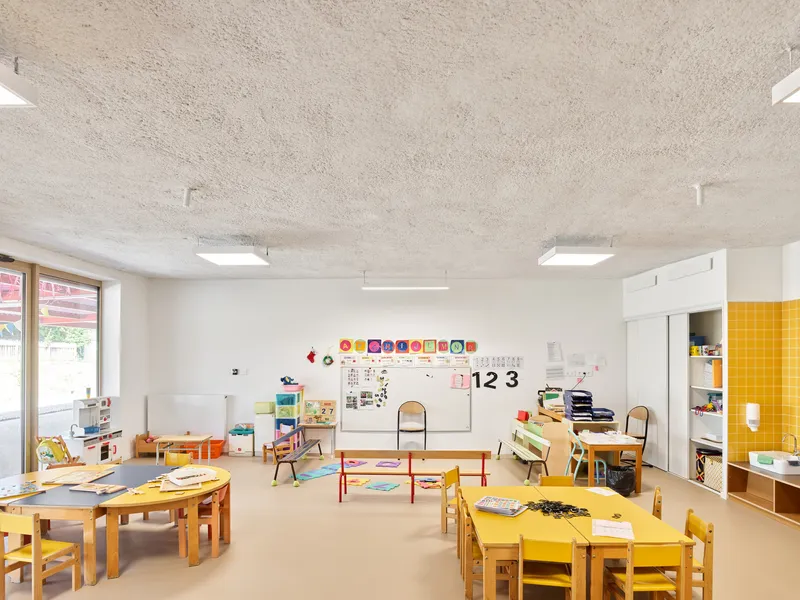
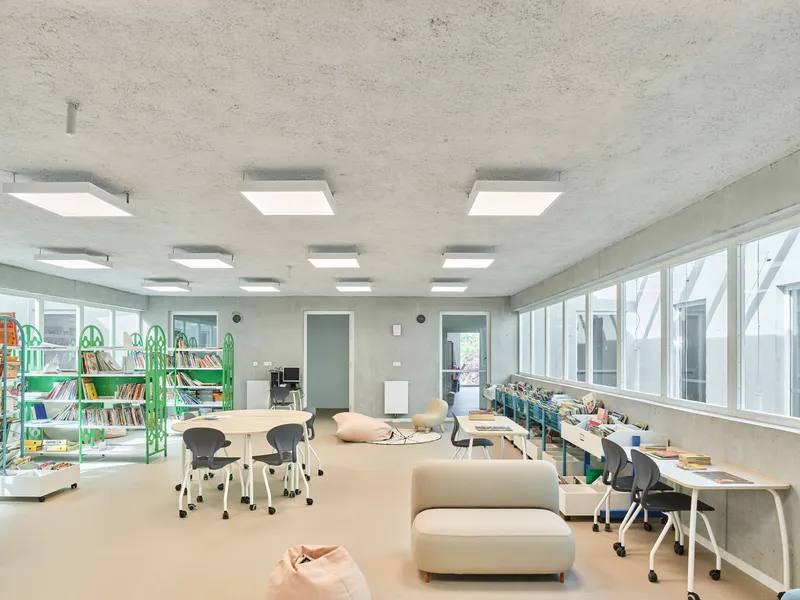
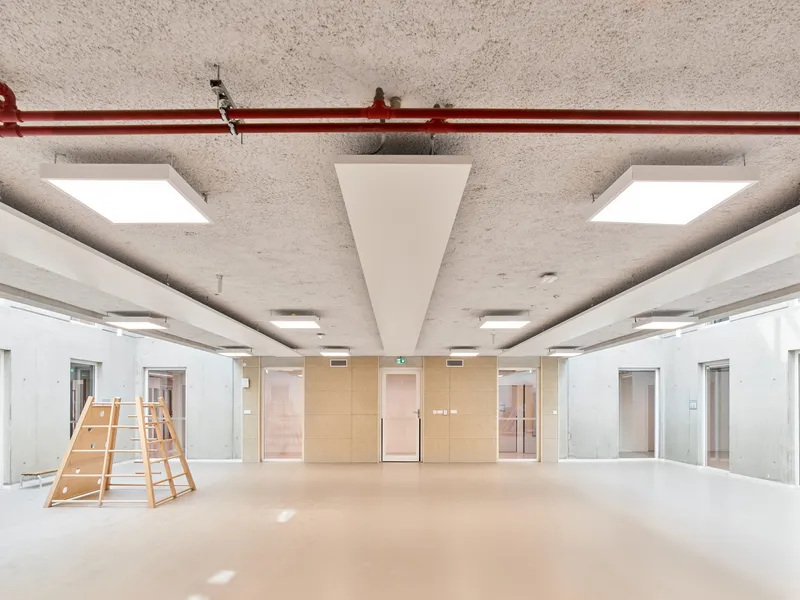
The classrooms are pragmatic and generous. Exposed concrete ceilings with visible beam grids give each room a consistent structural rhythm, while individual touches, a yellow tile partition here, green bookshelves there, a triangular acoustic panel suspended above a timber climbing frame, differentiate the spaces for their specific programs. The color coding is not decorative but functional, helping young children orient themselves within the building.
Square skylights punched through the concrete ceiling in some rooms bring light deep into the plan, reducing the reliance on perimeter glazing and keeping the compact footprint viable. The load-bearing system, deliberately simple, allows for spatial flexibility that could accommodate programmatic changes as the school evolves over decades.
Corridors as Social Spaces
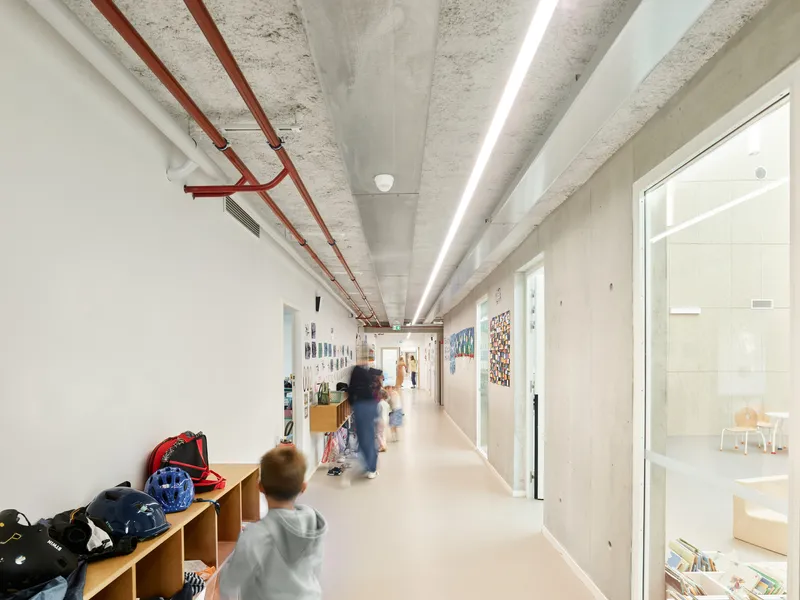
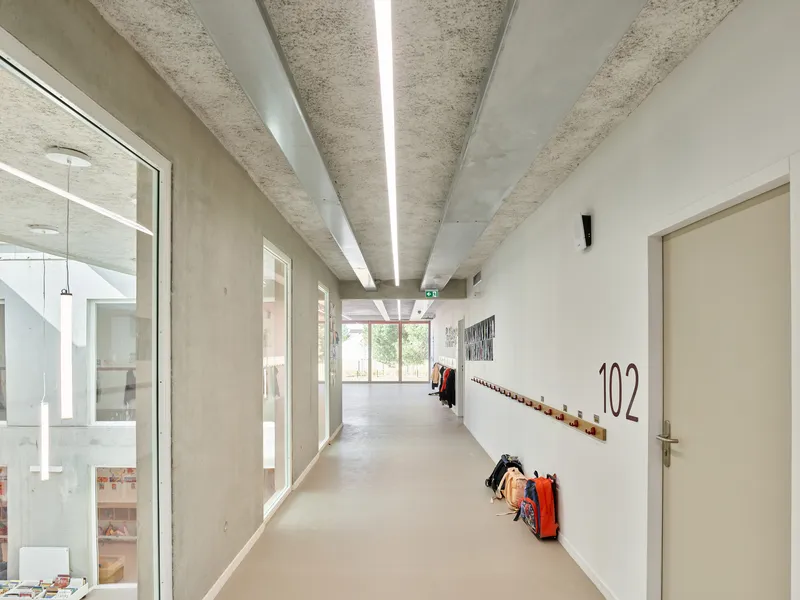
GGR architectes invest real care in the circulation zones. Hallways are wide enough to double as display galleries for children's artwork, with exposed red conduit running along the concrete ceilings adding an honest industrial texture. Storage cubbies line the walls at child height, a practical detail that also activates the corridor as territory that belongs to the students rather than the institution.
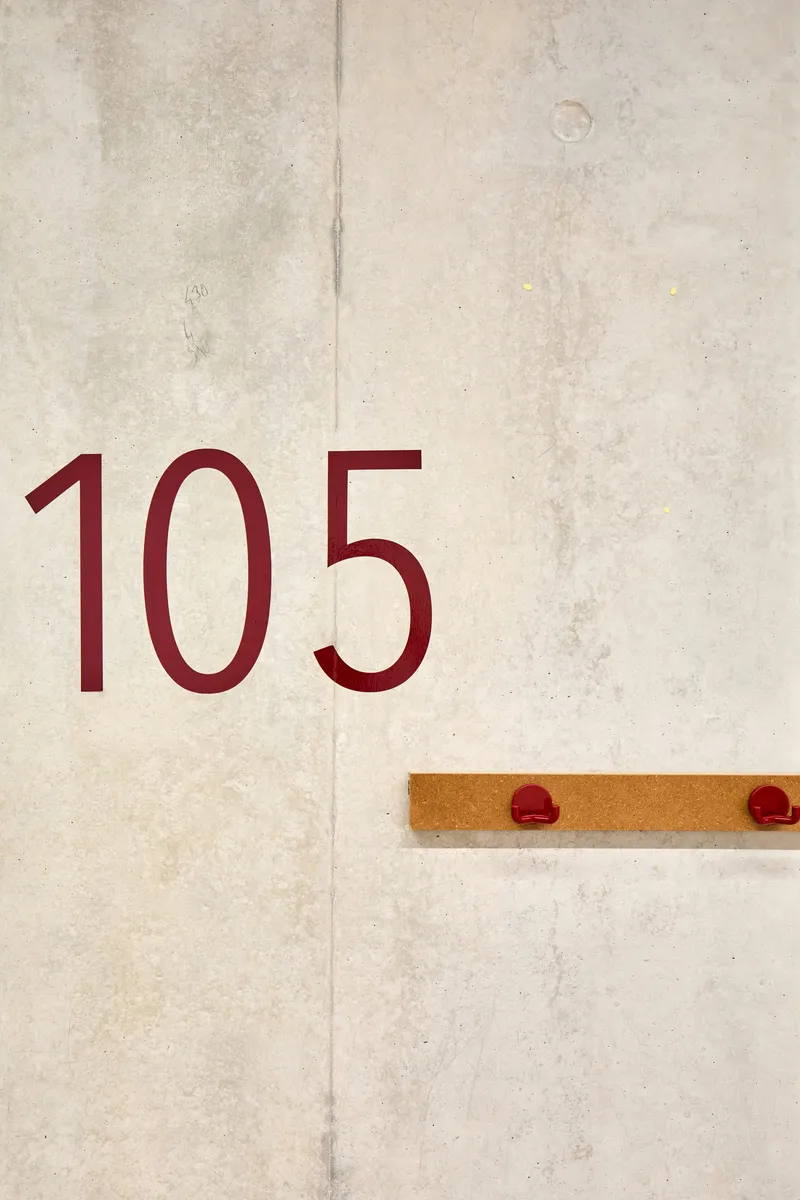
On the upper level, a glazed balustrade allows views down into the atrium, connecting the two floors visually and creating a sense of shared inhabitation. Even the room signage, maroon numerals painted directly onto board-formed concrete beside timber coat hooks, communicates the building's ethos: no applied layers, no false ceilings, just material doing its job.
Playground as Extension of Architecture


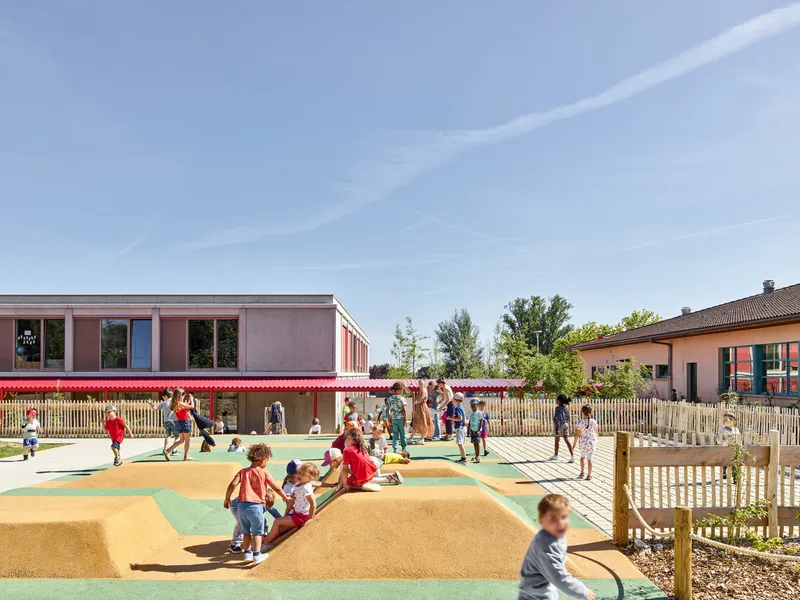
The outdoor play areas are treated with the same spatial intelligence as the interiors. Rubber-surfaced climbing mounds replace the tired catalogue of swings and slides, offering topographic play that encourages physical invention. The red canopy extends over portions of the yard, creating sheltered zones where children can play in rain or shade without retreating indoors.
Timber picket fencing defines the playground perimeter with a domestic warmth that avoids the chain-link institutional aesthetic common to French schools. Stepped concrete seats along the courtyard edges give teachers and parents places to sit, reinforcing the idea that the school is not a fenced-off zone but a permeable part of the neighborhood.
Urban Presence
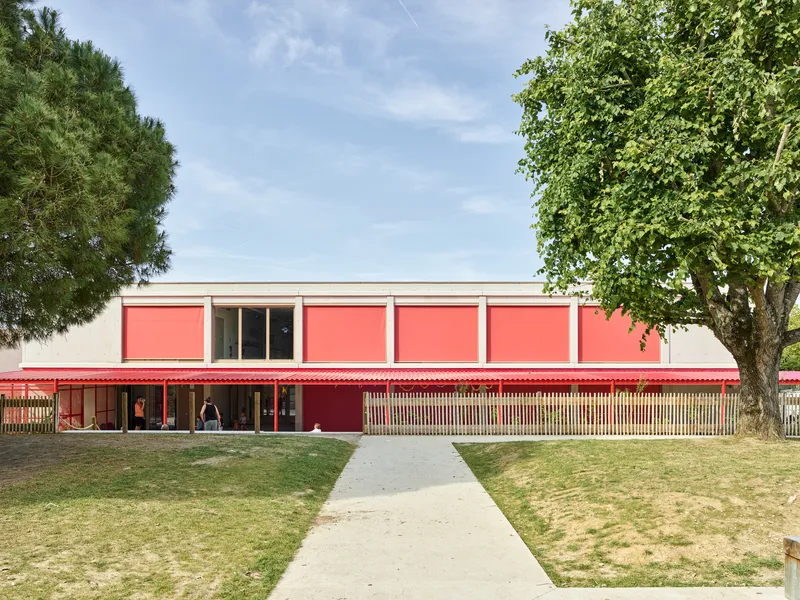
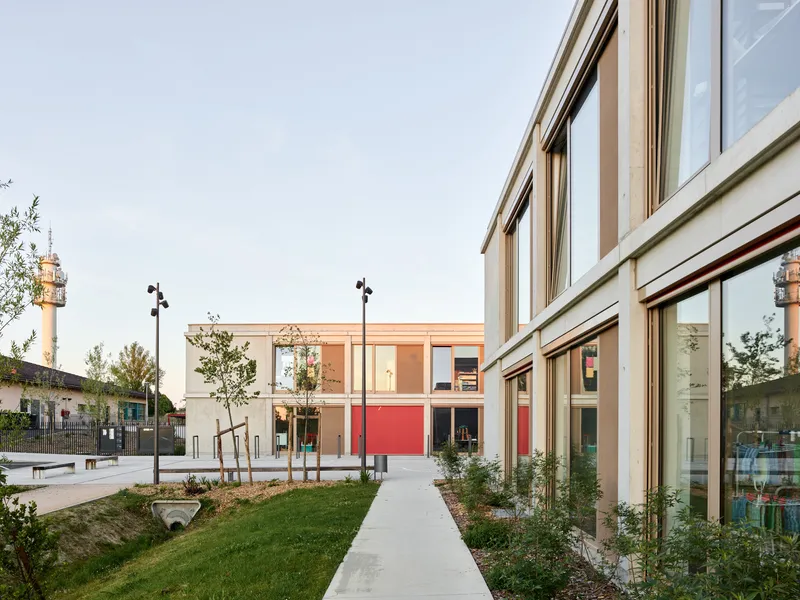

From the street, the building reads as two connected volumes: a two-storey facade with coral panel infill and horizontal timber screening facing the approach road, and glass-fronted courtyard volumes that open to the interior. The compact massing keeps the school from overwhelming its suburban context while still asserting a civic identity. A mosque minaret visible in the background of one courtyard view is a quiet reminder that this is a building embedded in a diverse, living neighborhood.
At golden hour, the planted beds and young trees along the street edge soften the building's concrete base, promising a matured landscape in years to come. The school forms an urban anchor connecting to a nearby shopping center, and the architects have clearly thought about what the building gives back to pedestrians and cyclists passing by, not just the children inside it.
Gathering at the Gate
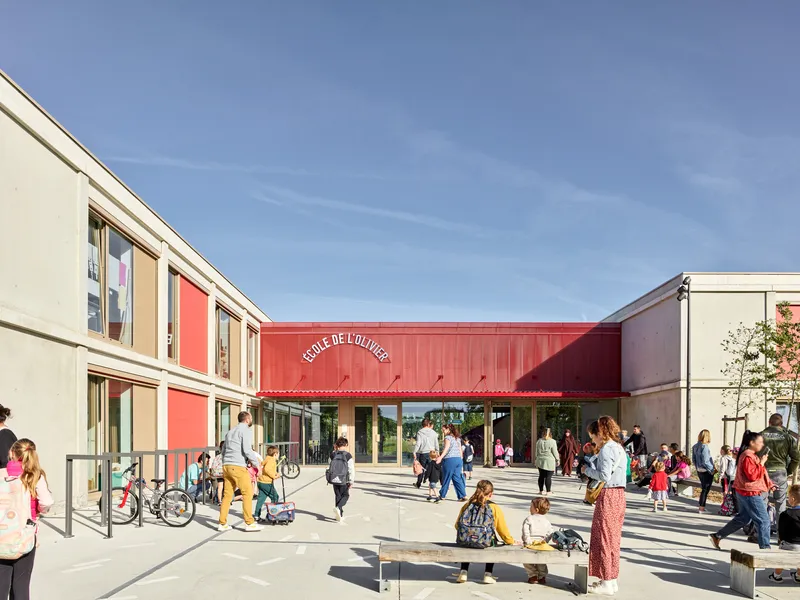
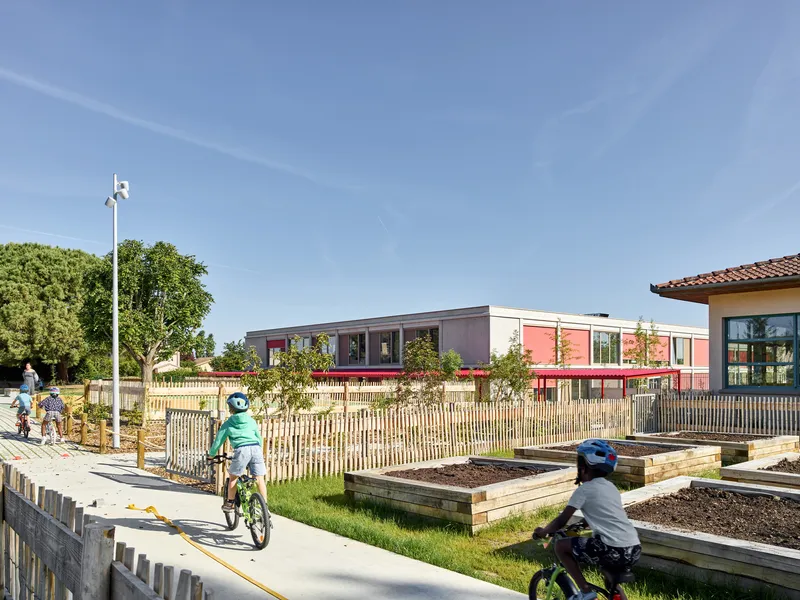

The dismissal-time photographs tell a story the plans cannot. Families congregate under the red canopy, children cycle along the timber-fenced path, and the building recedes into its role as background infrastructure for daily life. A school succeeds when it becomes invisible in this way, when its architecture supports the rituals of arrival and departure without friction.
Why This Project Matters
The School Complex of the Olive Tree demonstrates that rigorous economy and spatial generosity are not opposites. At just over €1,270 per square meter, GGR architectes delivered a building with double-height atriums, continuous skylights, and a coherent material language that many projects at twice the budget fail to achieve. The lesson is architectural rather than financial: when you strip away suspended ceilings, applied finishes, and decorative flourishes, you are forced to get the proportions and the light right. There is no fallback.
More broadly, the project challenges the suburban school's default isolation. By pulling shared programs to the center, extending canopies into the landscape, and treating the perimeter as porous rather than defensive, GGR architectes have built something closer to a small civic institution than a gated educational compound. In a country where the school remains one of the last universal public buildings, that ambition matters. Pechbonnieu now has a building worthy of it.
School Complex of the Olive Tree by GGR architectes. Pechbonnieu, France. 4,502 m². Completed 2025. Photography by Kevin Dolmaire.
About the Studio
Share Your Own Work on uni.xyz
If projects like this are the kind of work you want to make, uni.xyz is a place to publish your own, find collaborators, and enter design competitions.


Popular Articles
Popular articles from the community


longwave studio Reorganizes a 112 m² Tainan Apartment Around the Daily Routines of a Family and Two Cats
In Tainan, Taiwan, birch plywood, rust-red furniture and a freestanding plaster wall link arrival, storage, work and family life in one apartment.

U.GA Architects Wraps an Oval Rooftop Pool in Curved Board-Formed Concrete on Busan's Jeollidan-gil
In Busan's Jeonpo-dong, a 454 m² mixed-use block stacks a neighborhood facility, guest rooms and an oval rooftop pool inside spiraling concrete walls.

David Macias Steps a Doorless Stone and Plaster House Down a Tropical Colombian Hillside
In the humid hills of Colombia, Threshold House replaces the front door with an open void and terraces its 850 m² down the slope instead of fighting it.

Cube Design Draws an Ecological Corridor Between Two Shenzhen Hills with the Nankai Building
Beside Shenzhen's container docks, the Nankai Building pairs stacked balconies with a climbing green screen to connect two hillsides across its height.

Similar Reads
You might also enjoy these articles


LAVA Architecten Gives Vocational Education a Sawtooth-Roofed Face on a Mechelen School Campus
In Mechelen, Belgium, a 2,053 m² STEM school on a 6×6 m grid turns workshops and classrooms into rooms that can be rearranged as teaching changes.

KEMA Studio Turns a Derelict Marvila Attic into a 60 m² Lighthouse Apartment Above Lisbon
In Lisbon's Marvila district, a rebuilt roof, four skylights and two plywood volumes turn an unlivable attic into a bright home facing the Tagus.

Pixel Gardens: One Repeated Module Stacked Into a Terraced Social Housing Tower for Famagusta
Salem Bader's shortlisted housing tower builds a vertical neighbourhood from one repeated module, offsetting units to carve terraces, light and air.

Bao Huynh Watercolor Atelier: A Serene Art Retreat in Hội An
Bao Huynh Watercolor Atelier in Hội An blends multifunctional art spaces, sustainable design, local materials, and family-friendly living in a serene environment.


Comments (0)
Please login or sign up to add comments
No comments yet. Be the first to comment!