
GL Studio Packs a Culture and Sports Center into Shenzhen's Dense Urban Fabric
A 54,690 square meter civic complex in Guangming District weaves together libraries, galleries, and gymnasiums beneath a planted rooftop.


How do you drop nearly 55,000 square meters of civic program into one of the most densely built residential neighborhoods in Shenzhen without making the surrounding towers feel even more oppressive? GL Studio answers that question with the Yutang Culture and Sports Center, a compound of curved and rectilinear volumes that push upward through perforated metal skins while pulling residents inward through generous courtyards, ramps, and rooftop terraces. Completed in 2025 in Guangming District's Tianliao Community, the building replaces what was likely vacant or underused land with a genuine civic anchor: library, gallery, gymnasium, swimming pool, community spaces, and outdoor landscapes all folded into a single interconnected complex.
What makes the project genuinely interesting is not the scale alone but the way its massing fragments that scale. Rather than presenting a single monolithic block, GL Studio breaks the program into clustered volumes with distinct material identities: white concrete bands, dark perforated metal screens, and planted green roofs. These volumes step and shift in plan, creating outdoor rooms at ground level and rooftop gardens above. The result is a building that reads as a small neighborhood rather than an institution, a strategy that helps it hold its own against the residential towers crowding every edge of the site.
A Fractured Massing Strategy
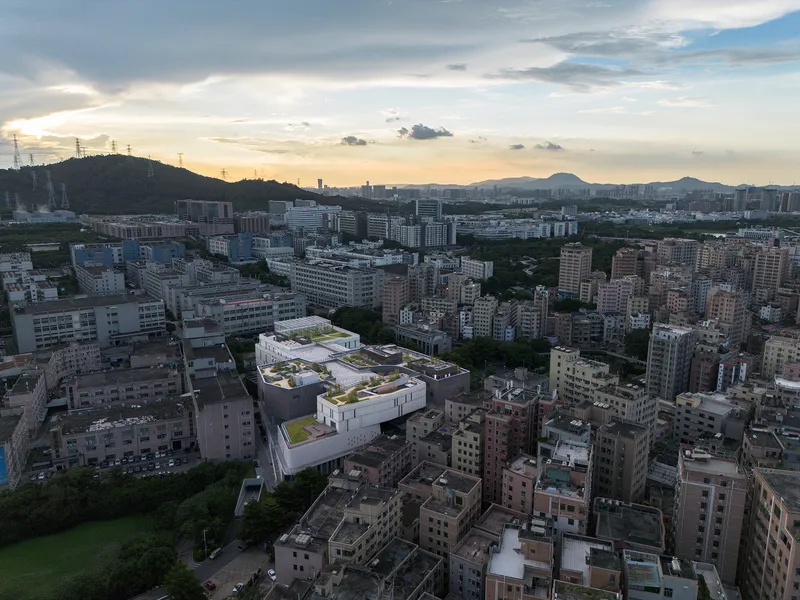
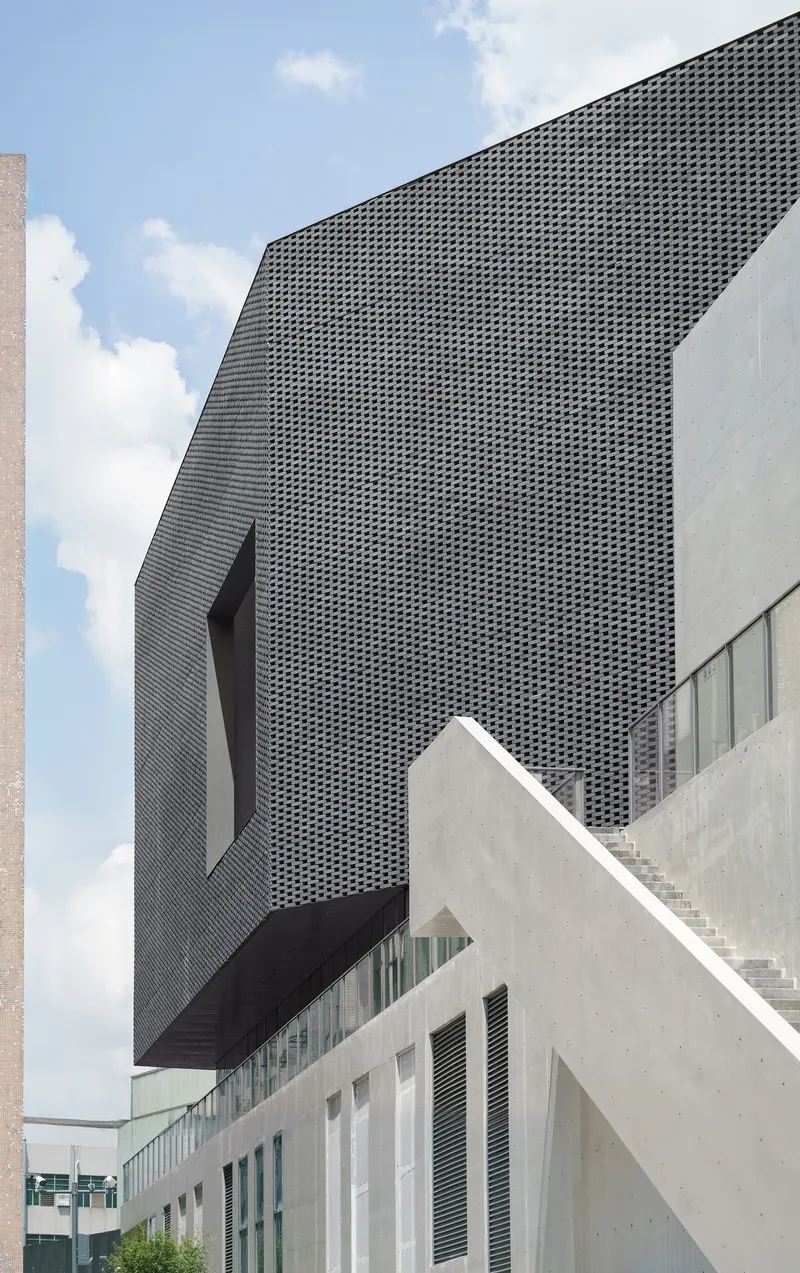
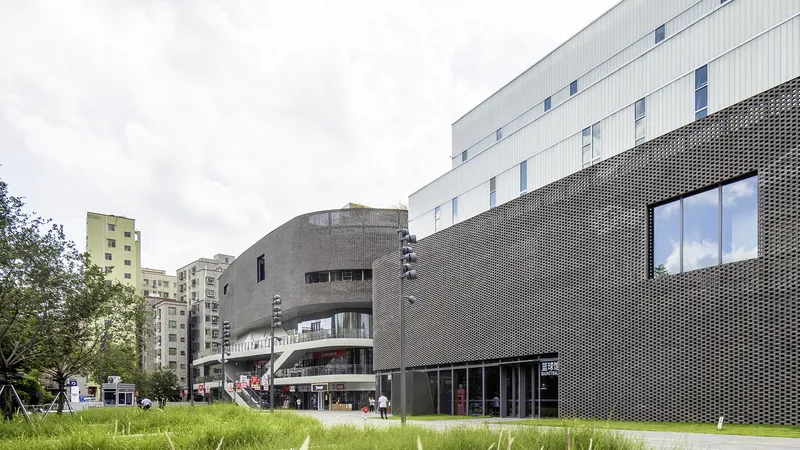
From above, the building's planted terraces almost disappear into the surrounding landscape, softening its presence against the relentless grid of housing towers. At street level, the perception changes completely. The dark perforated metal volume rises with authority above the white concrete base volumes, giving the complex a civic landmark without resorting to a single dominant tower or canopy. The perforated screens do double duty: filtering harsh Shenzhen sunlight while lending the facades a textile quality that shifts in appearance depending on viewing angle and time of day.
The curved plan forms are not arbitrary. They carve out space between the rectangular gymnasium block and the irregular site boundaries, creating the grassy lawns and tree-lined edges visible from the street. The massing is pragmatic before it is sculptural, which is exactly why it works.
Concrete as Character
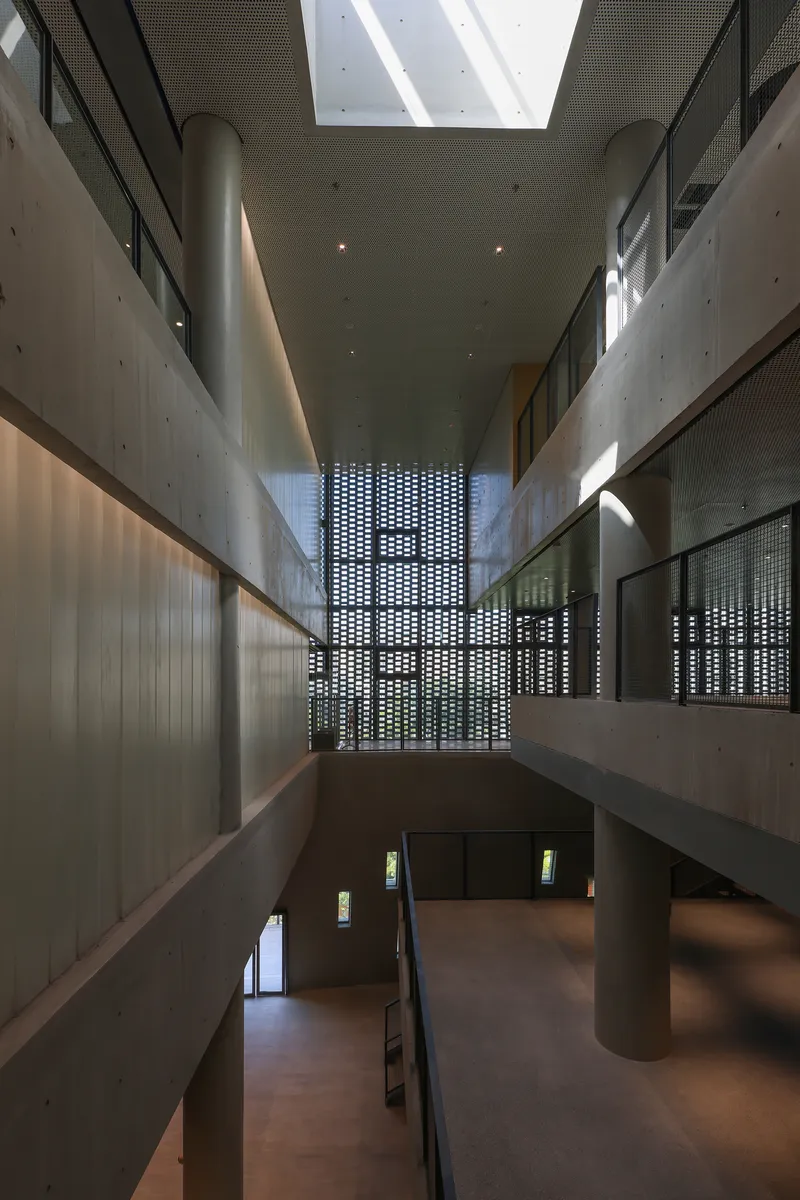
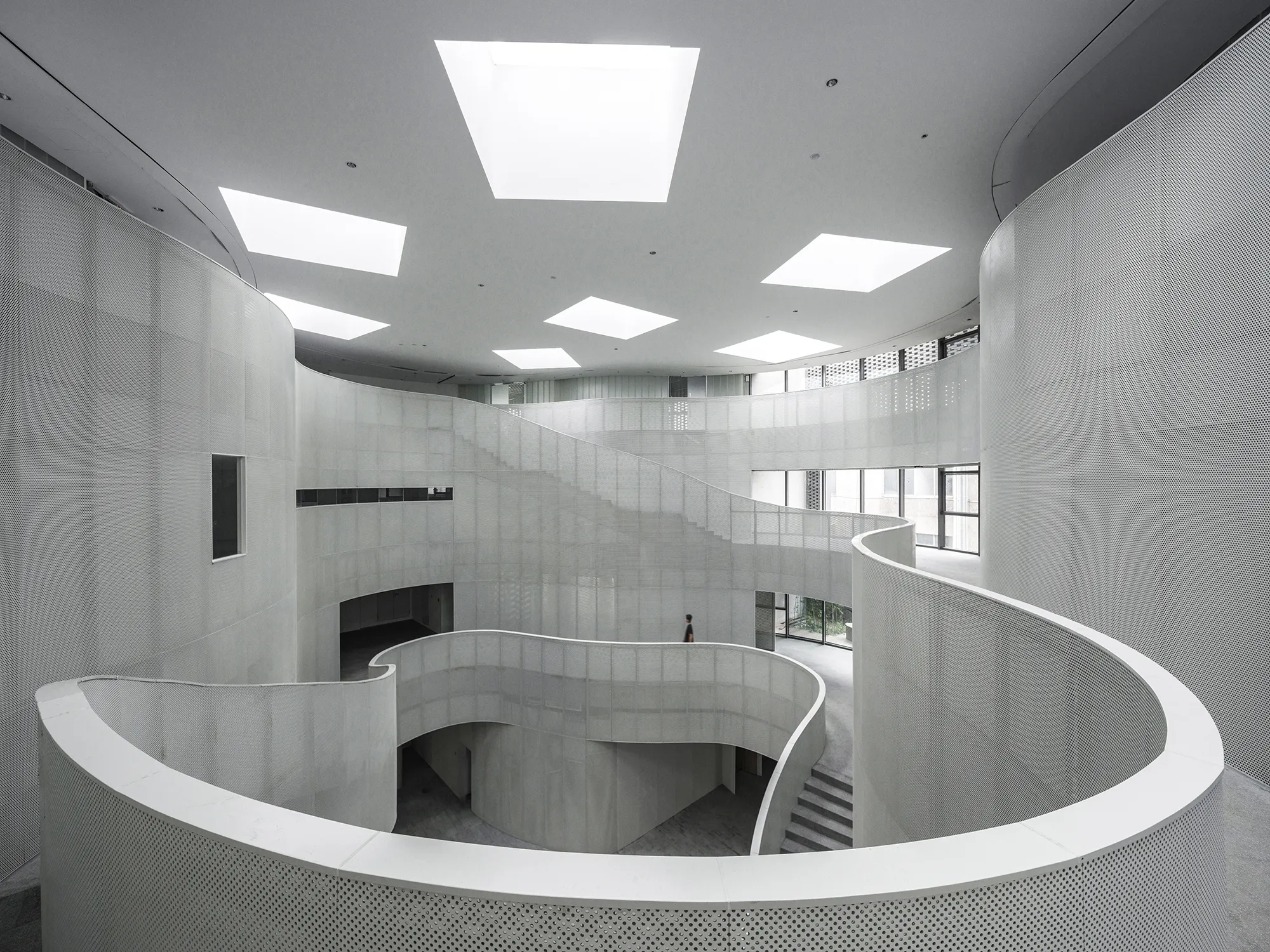
The interior material palette is dominated by board-formed concrete, and GL Studio commits to it with unusual discipline. The double-height atrium spaces feature tall cast-in-place walls with visible formwork grain, cylindrical columns that anchor the ground floor, and diagonal skylights that wash those surfaces with changing daylight. The effect is monastic in the best sense: calm, heavy, and deliberate.
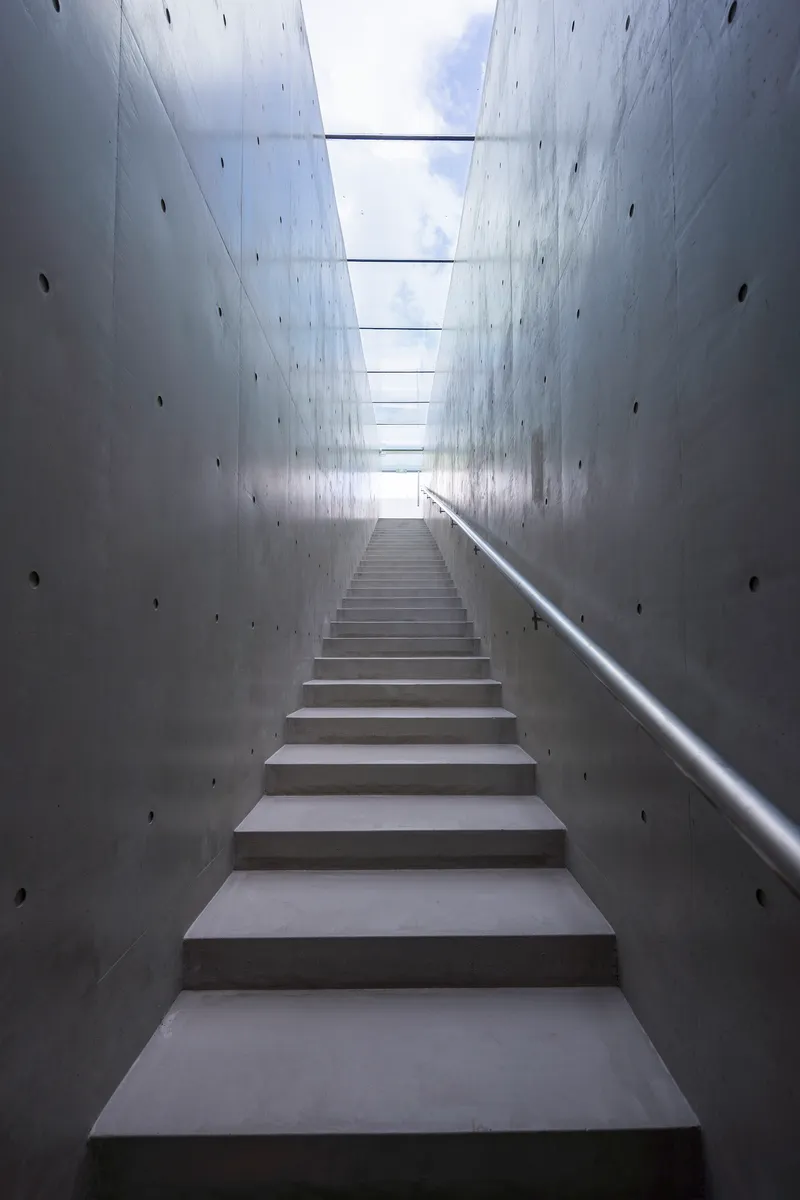
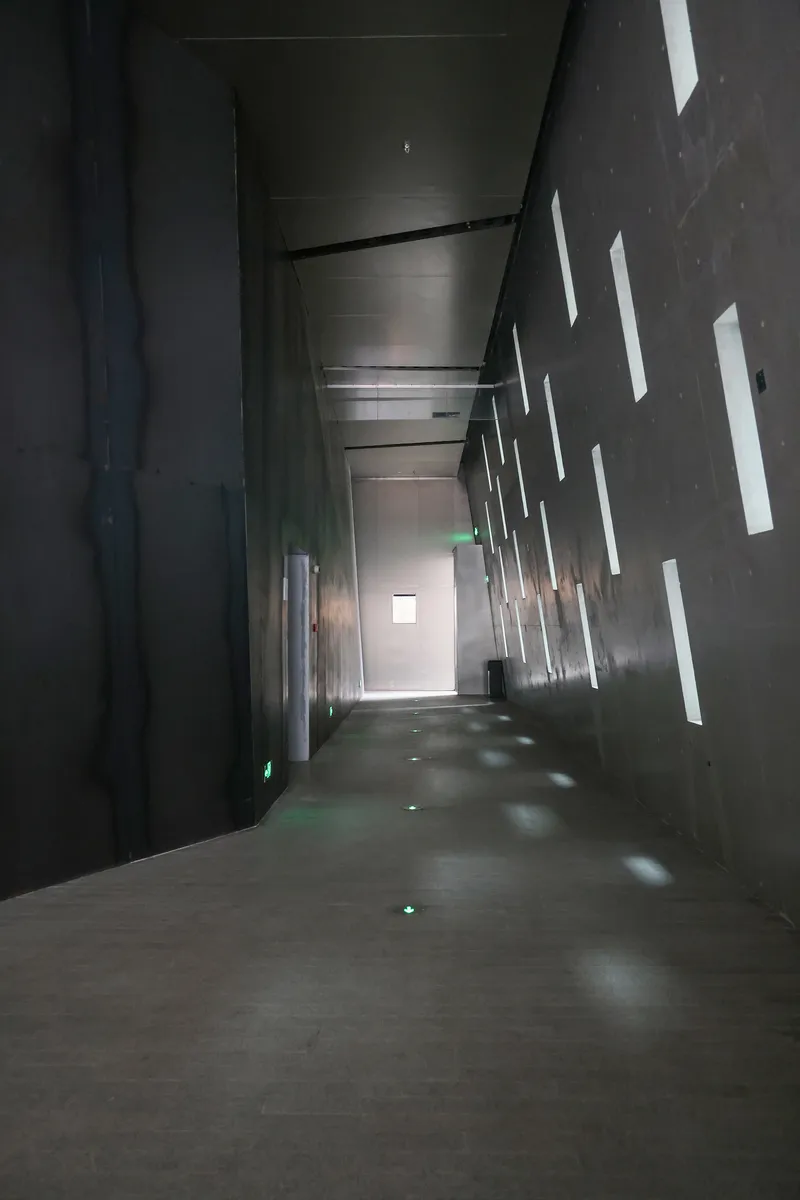
A concrete staircase ascending between two tall walls beneath a linear skylight is one of the most spatially compelling moments in the building. The light source is concealed until you are well into the climb, making the experience of ascent a gradual reveal. Elsewhere, a dark corridor with vertical light slots casts precise geometric shadows onto the floor, turning circulation into a sequence of controlled atmospheres rather than just connective tissue.
Threshold and Entry
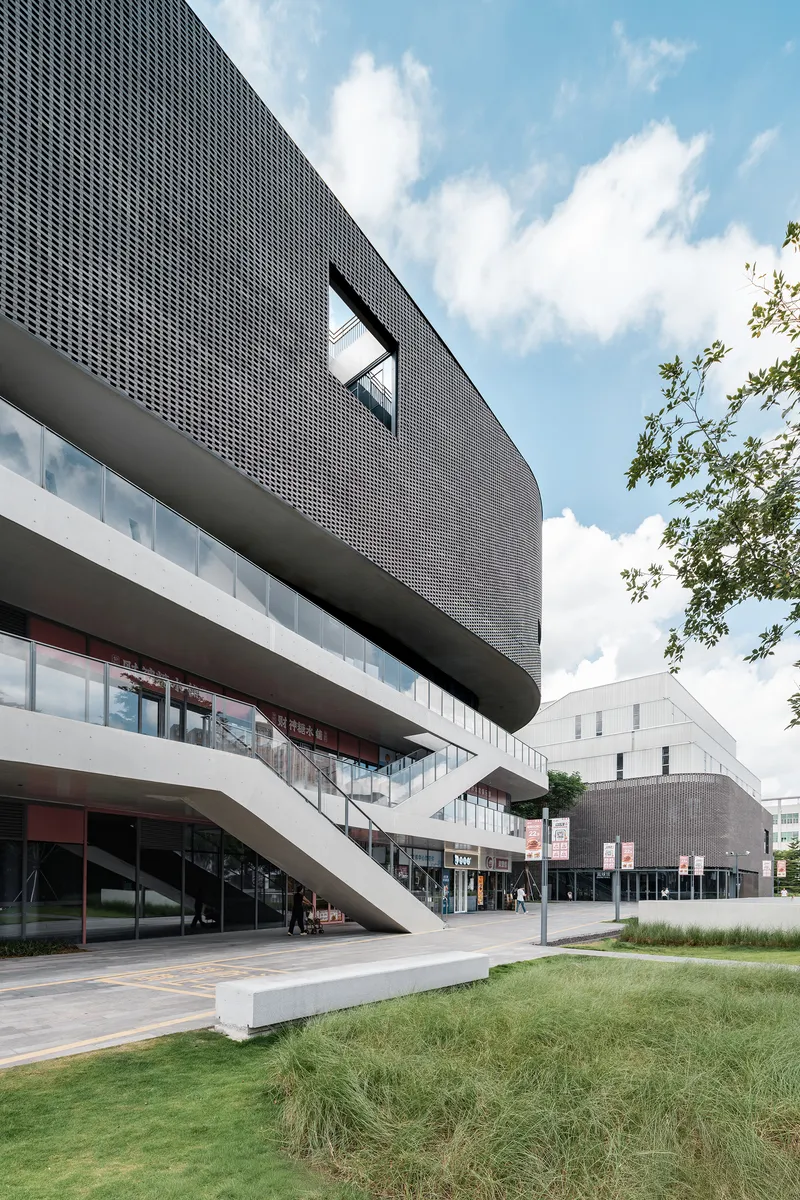
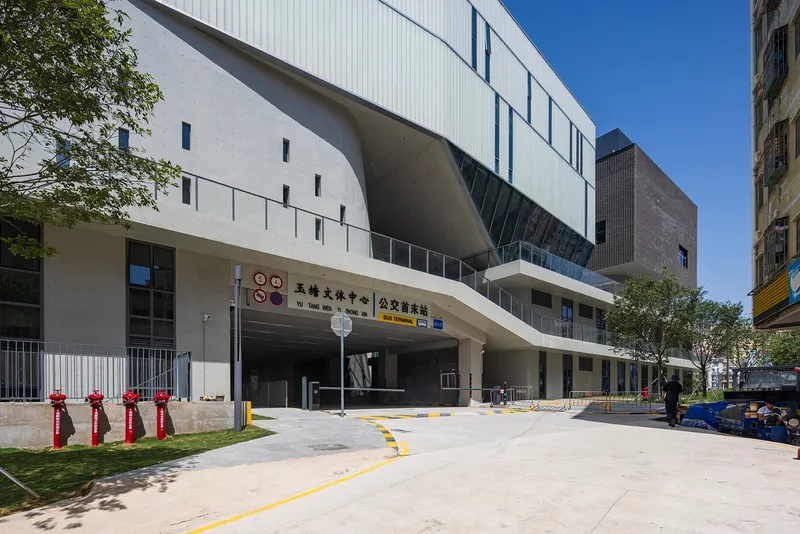
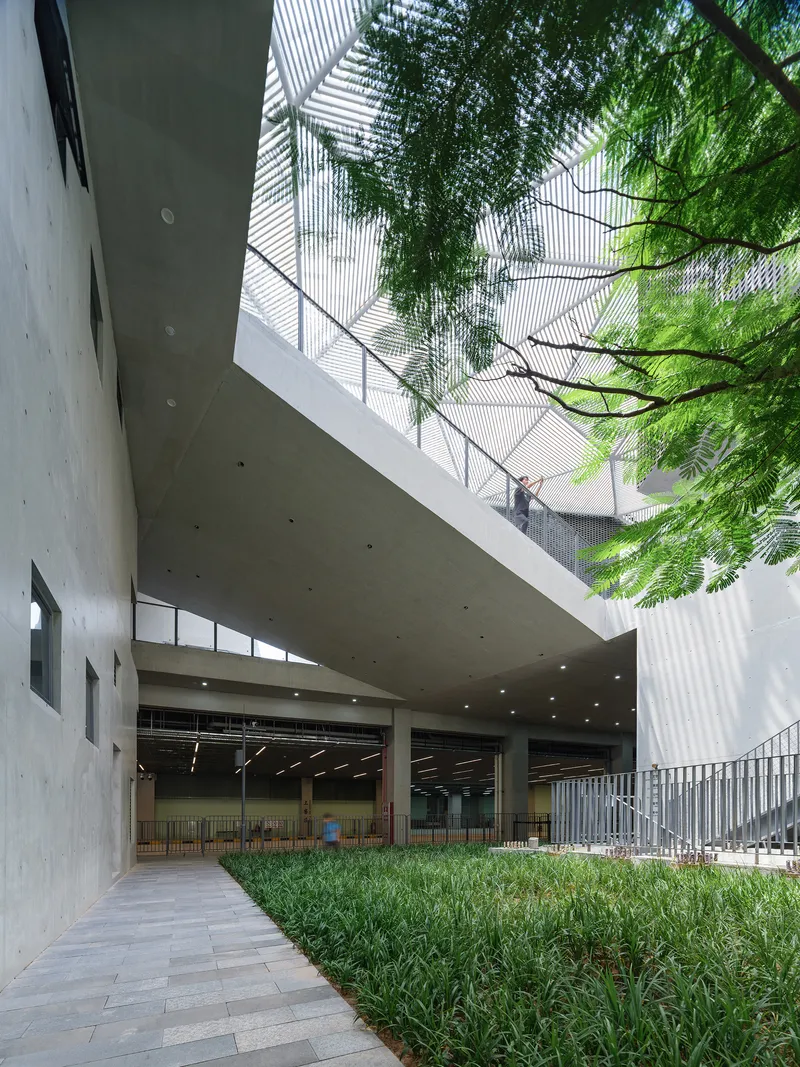
The building's entry sequence deserves attention. Cantilevered concrete bands extend over glazed openings, sheltering arrivals beneath deep overhangs that frame views into planted courtyards beyond. The covered driveway, with its exposed concrete ceiling flanked by white metal cladding, is generous enough to serve as a gathering space in its own right. Shenzhen's subtropical climate demands shade and rain protection, and GL Studio treats those requirements as design opportunities rather than afterthoughts.
The courtyard spaces are where interior and exterior truly merge. Grasses and tree canopy filter light into sheltered sitting areas, creating a microclimate that draws people deeper into the complex. It is a simple move, but the planting feels robust and considered rather than decorative.
The Spiral Atrium and Vertical Circulation
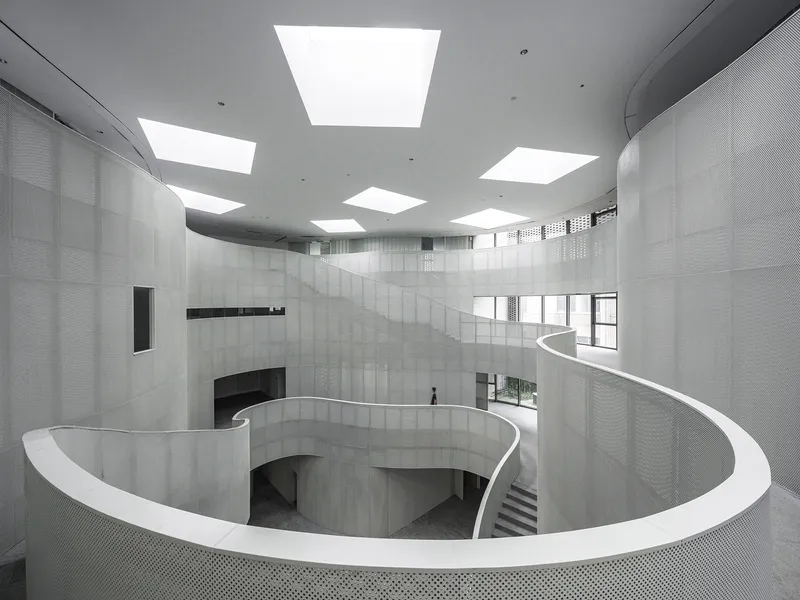
The spiraling white balustrade rising through a multi-story atrium beneath square skylights is the building's signature interior moment. It organizes vertical movement through the curved volumes, connecting the public programs on each floor while maintaining sightlines across levels. A lone figure on one of the landings gives the photograph its sense of scale: the atrium is tall, but the proportions are controlled enough that it never feels cavernous.
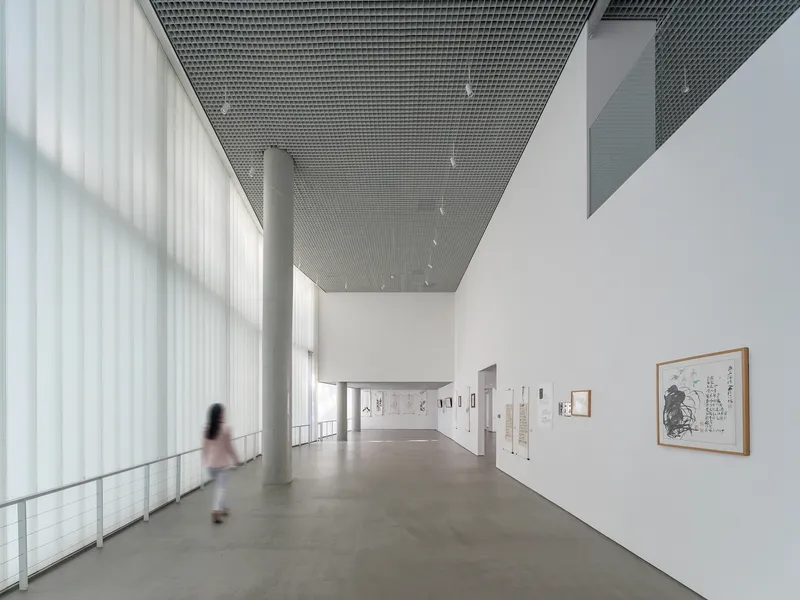
Adjacent gallery spaces use perforated metal ceilings and translucent curtain walls to create diffuse, even lighting. These rooms are simple and flexible, clearly designed to accommodate rotating exhibitions without competing with the art. The restraint here is welcome after the drama of the atrium.
Library and Program Interiors
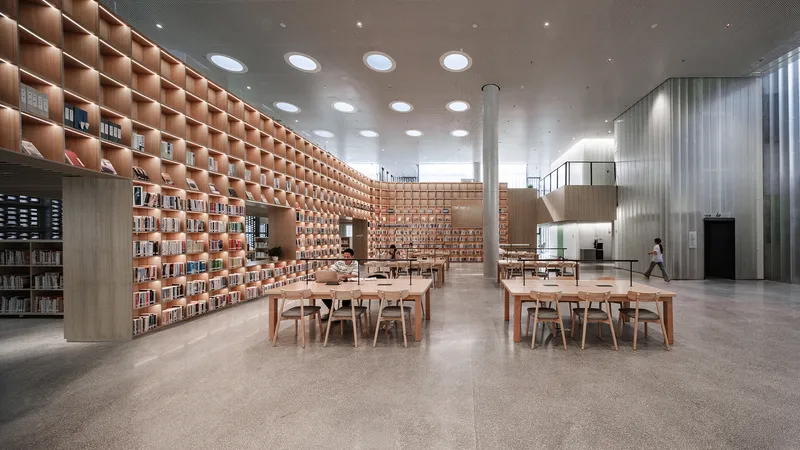
The library interior reveals a warmer material register. Timber bookshelves line a full wall, and translucent curtains soften the boundary between reading areas and the glazed perimeter. It is a quiet room that benefits from being set within the larger complex rather than isolated as a standalone building; the adjacency to the rooftop terrace and gallery spaces means that a visit to the library can unfold into a broader cultural experience.
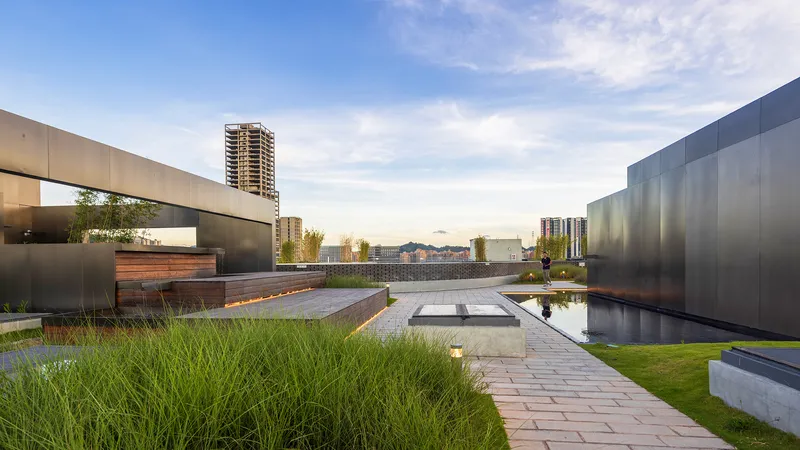
The rooftop terrace, with its reflecting pool and planted grasses, is the building's civic living room. At dusk, the dark metal perimeter walls frame views of the surrounding city while the water surface catches the fading sky. It is a straightforward landscape gesture, but it gives the neighborhood something it almost certainly lacked: a public outdoor space with genuine atmosphere.
Plans and Drawings
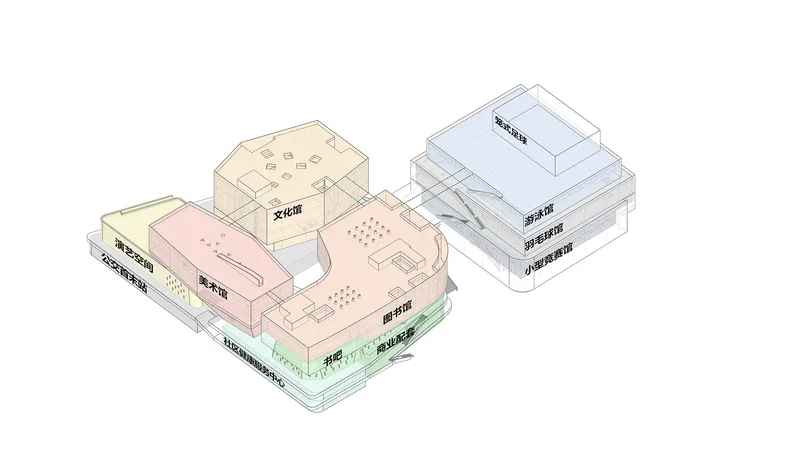
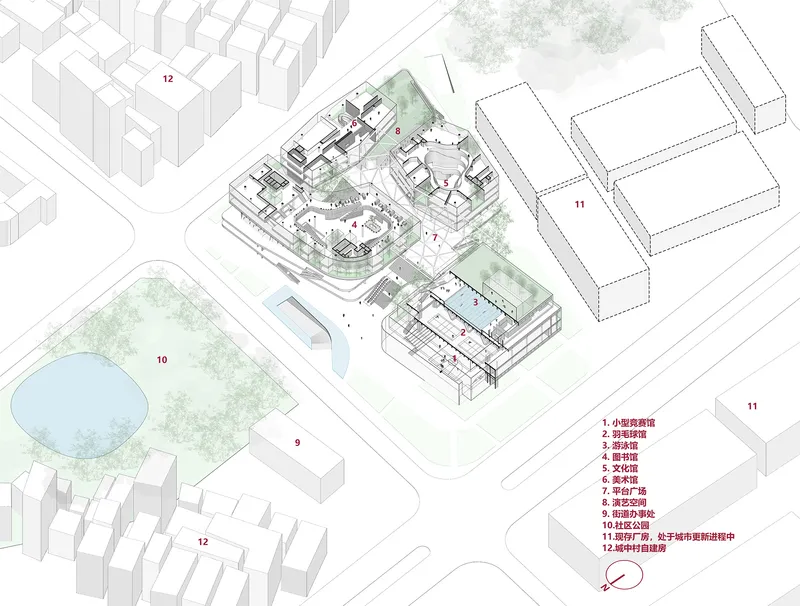
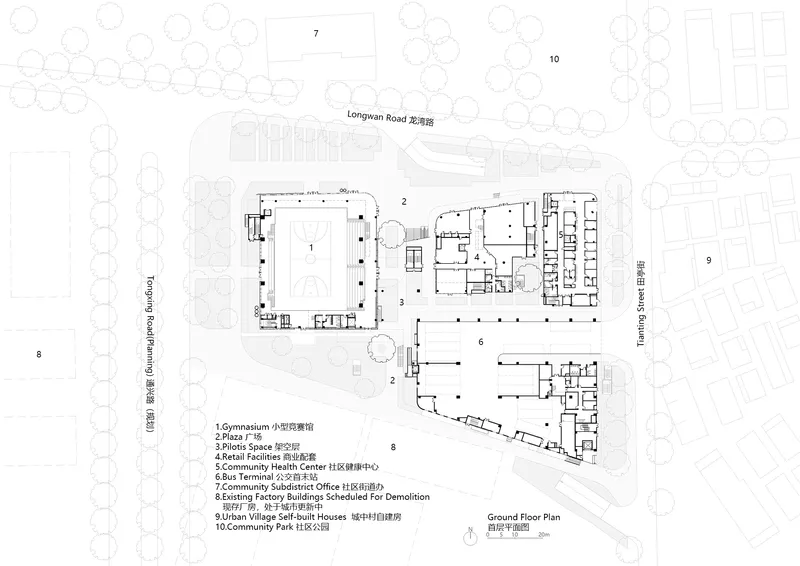
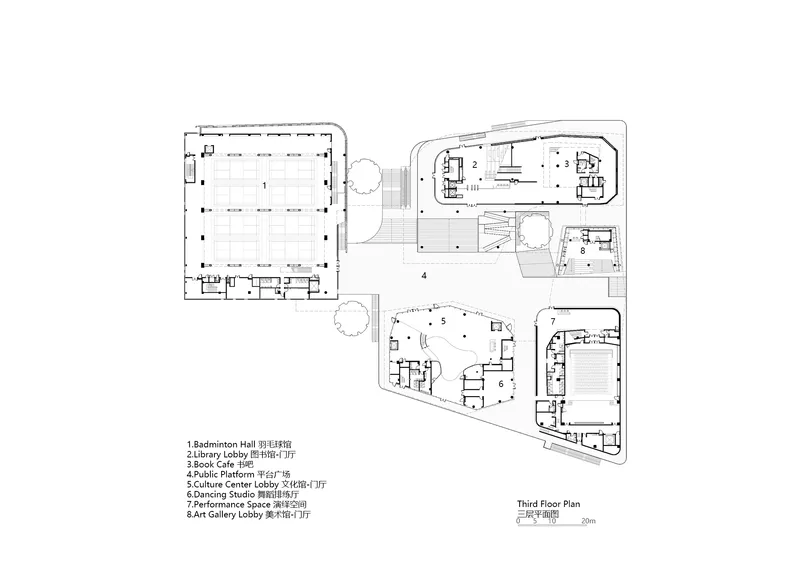
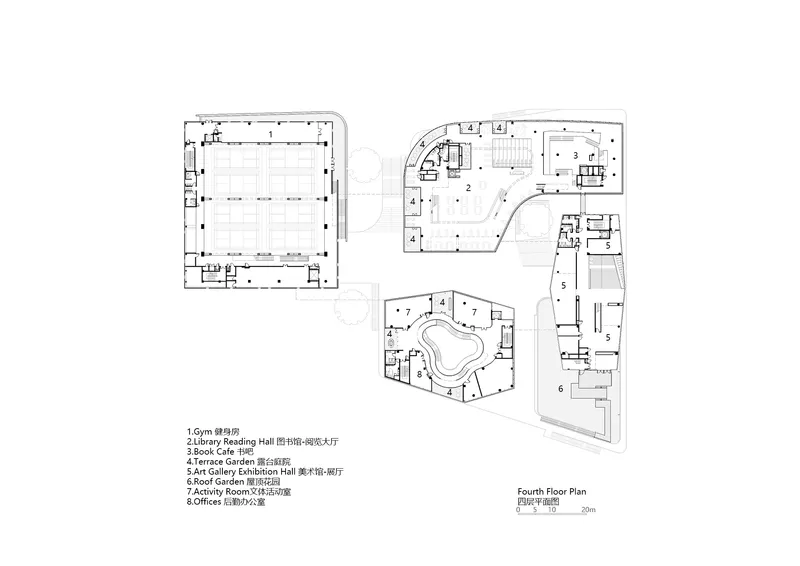
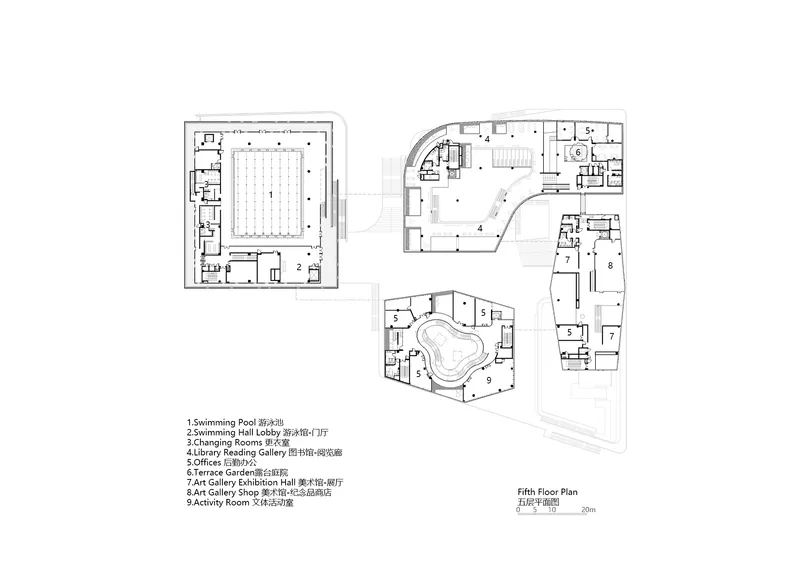
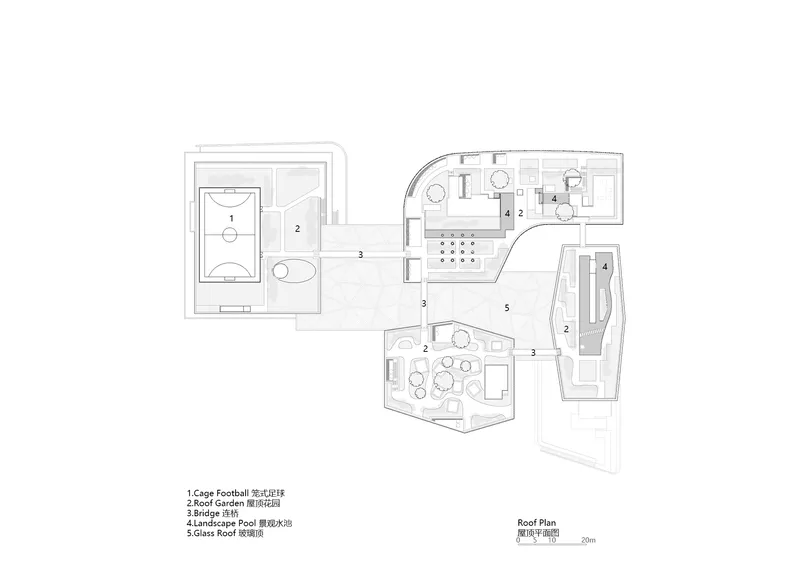
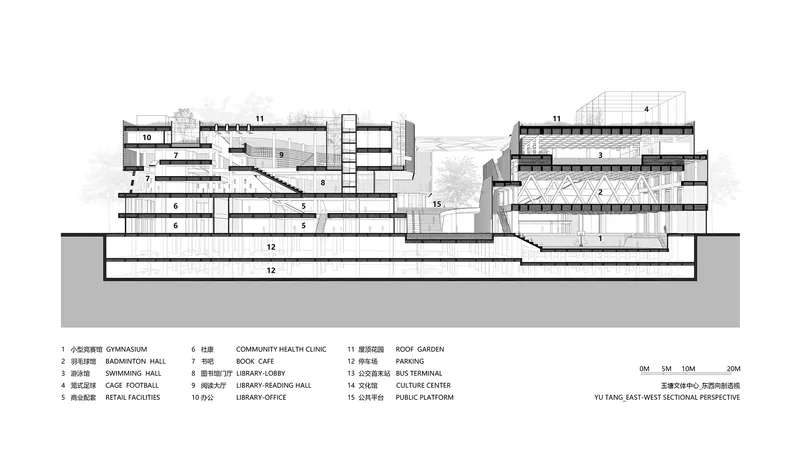
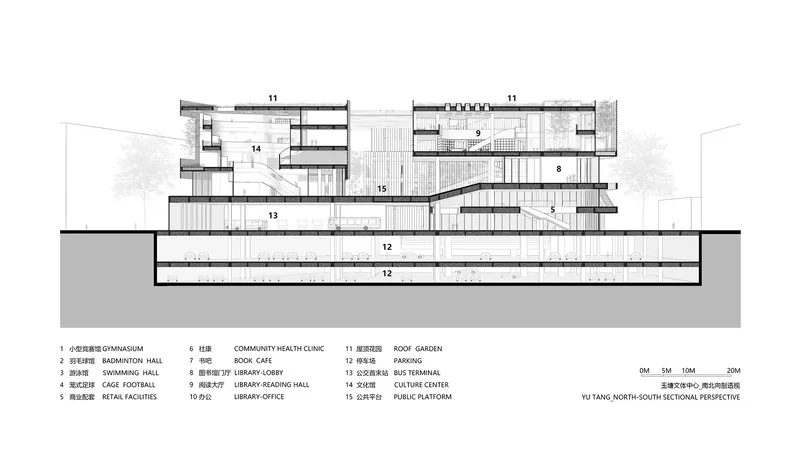
The axonometric drawings make the programmatic logic legible. Color-coded zones show how the gymnasium and pool occupy the rectangular block while cultural programs fill the curved organic volumes, with bridges and ramps stitching the two systems together. The ground floor site plan reveals just how constrained the site is: roads on multiple sides, dense tree planting used to buffer the building from adjacent traffic, and a compact footprint that maximizes open ground at grade.
The sections are the most revealing documents. Staggered floor plates connected by diagonal ramps create a continuous promenade through the building, while two subterranean parking levels absorb car infrastructure entirely below ground. The east-west section shows how the diagonal circulation paths generate the double-height voids that define the interior experience: each cut through the floor plate opens a new relationship between programs, light, and views.
Why This Project Matters
China's rapid urbanization has produced countless residential districts that lack meaningful public space. The Yutang Culture and Sports Center addresses that deficit directly, inserting a building that functions as both infrastructure and gathering place into a neighborhood that needed exactly that combination. GL Studio's decision to break the massing into multiple volumes with distinct identities is not just a formal choice; it is an urbanistic one, ensuring the building creates streets, courtyards, and roof gardens rather than simply occupying its lot.
The material discipline is equally important. Board-formed concrete, perforated metal, and restrained timber give the interiors a seriousness that matches the civic ambition of the program. In a market where public buildings often default to spectacle, GL Studio has produced something more durable: a place that earns its presence through spatial generosity, robust materials, and a clear understanding of what this particular neighborhood needs.
Yutang Culture and Sports Center by GL Studio. Located in Tianliao Community, Yutang Subdistrict, Guangming District, Shenzhen, China. 54,690 m². Completed 2025. Photography by ACF, Liqi Lu, and Kaixing Luo.
About the Studio
Share Your Own Work on uni.xyz
If projects like this are the kind of work you want to make, uni.xyz is a place to publish your own, find collaborators, and enter design competitions.


Popular Articles
Popular articles from the community


Conexión: Biophilic Design Reimagines High-Rise Living in Hong Kong
Conexión reimagines high-rise living in Hong Kong through biophilic design, green facades, shared spaces, daylight, water and nature within.

Riyadh For All: Intergenerational Urban Design for Active Aging in Rabat
Riyadh For All reimagines urban design in Rabat with intergenerational co-living, adaptive courtyards, and Moroccan cultural exchange today.

The Ocean Hive: Sustainable Architecture for a Self-Sufficient Civilization at Sea
The Ocean Hive imagines sustainable architecture at sea, where modular habitats, algae, wave power and ocean waste sustain a growing colony.

The Musturak Paradise: Senior Living Architecture for a Connected Future in Temara, Morocco
The Musturak Paradise reimagines senior living architecture in Temara via private homes, social spaces, culture, community, and shared care.


Similar Reads
You might also enjoy these articles

Bao Huynh Watercolor Atelier: A Serene Art Retreat in Hội An
Bao Huynh Watercolor Atelier in Hội An blends multifunctional art spaces, sustainable design, local materials, and family-friendly living in a serene environment.

Atelier Macri Concept Store Interior Design by CASE-REAL
Atelier Macri store features a "ko" counter, walnut wood details, cork displays, blending retail, gallery, and seamless customer experiences.

Manuel Vargas Izquierdo Stadium and High-Performance Sports Center: Architectural Excellence in Jalpa de Méndez
The Manuel Vargas Izquierdo Stadium blends sustainable design, inclusive sports facilities, and cultural-inspired architecture, revitalizing Jalpa de Méndez’s public spaces.

KAKR Buluh Awar Hall: Revitalizing Community and Ecology Through Bamboo Architecture
Community built bamboo hall revitalizes Buluh Awar village, empowering youth, restoring ecology, celebrating vernacular craftsmanship through sustainable architecture and culture.


Explore Sports Center Competitions
Discover active competitions in this discipline



Challenge to design public laboratory


Bring back Drive In's
Comments (0)
Please login or sign up to add comments
No comments yet. Be the first to comment!