

Global Warming Monument Architecture: The Spiral of the Beginning and the End
A spiral monument in Giza visualizes climate change through time, data, and human action, turning global warming into a living architectural experience.


In the evolving discourse of sustainable and conceptual architecture, few projects manage to synthesize symbolism, data, and spatial experience as powerfully as The Spiral of the Beginning and the End. Conceived as a global warming monument architecture in El Giza, Egypt, this project transcends the conventional definition of a memorial. It becomes a dynamic system that communicates the urgency of climate change while embedding human agency within its very operation.
Designed by Irina Zhemaitis and Timofey Tikhonov and recognized as an Editor's Choice entry of the Hourglass competition, the project stands as both an architectural landmark and a speculative instrument of awareness.


Concept: Architecture as a Climate Narrative
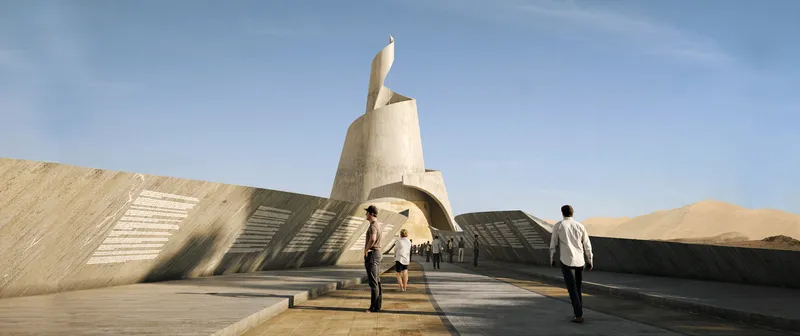
The central idea of this global warming monument is rooted in the spiral, a form deeply embedded in ancient Egyptian symbolism. Representing both origin and termination, the spiral becomes a spatial metaphor for the lifecycle of Earth and humanity.
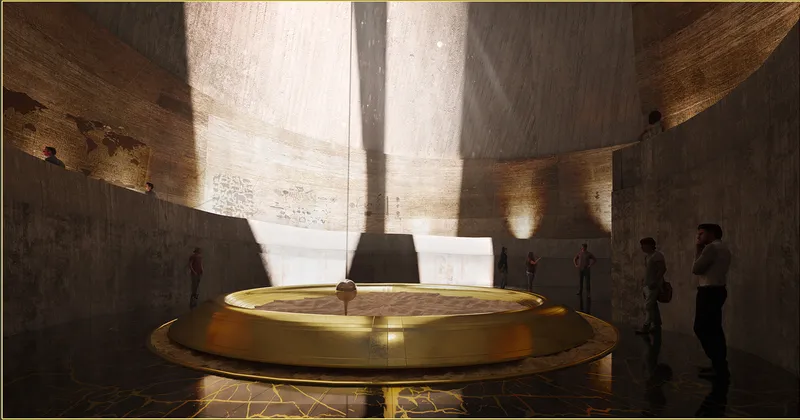
At the core of the structure lies a Foucault pendulum, a scientific device that demonstrates the Earth's rotation. However, here it is reinterpreted as a climate indicator. Suspended within a monumental chamber, the pendulum interacts with a sand-filled copper bowl beneath it. The level of sand is not arbitrary. It corresponds to global temperature data recorded since 1880.
As the sand accumulates, the pendulum's oscillation gradually slows. This direct physical relationship transforms abstract climate data into a tangible, observable phenomenon. At a critical point, the pendulum may stop entirely, symbolizing the potential collapse of ecological systems.
Spatial Journey: The Promenade of Awareness
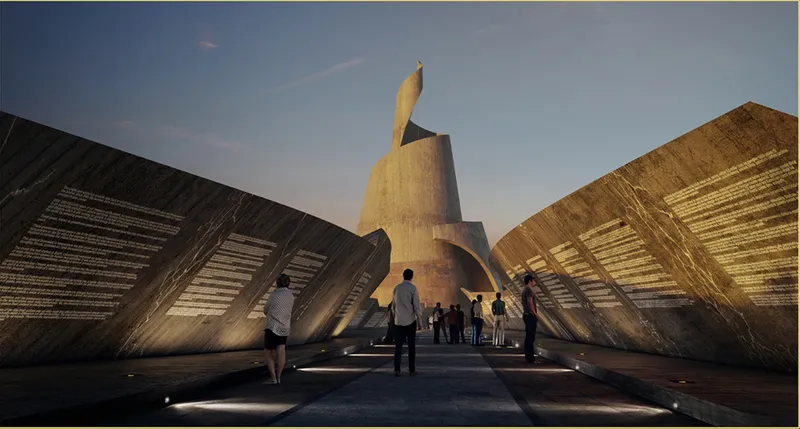
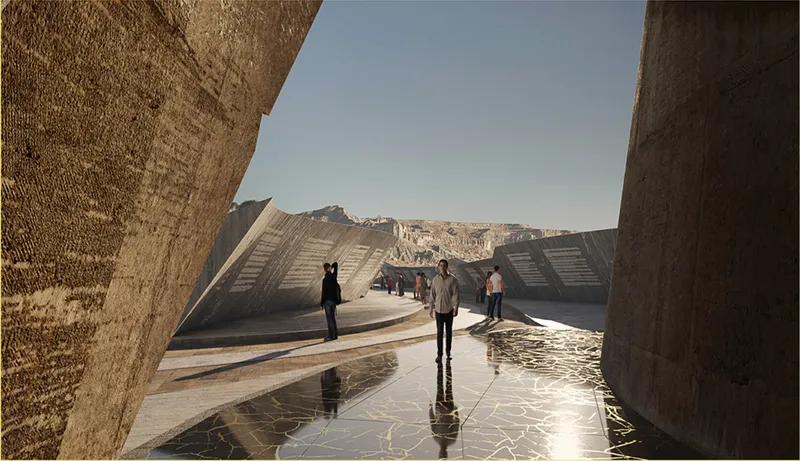
The architectural experience unfolds through a carefully choreographed promenade leading visitors toward the central spiral. This pathway is not merely circulatory. It functions as an educational corridor.
Visitors encounter engraved texts in 26 languages, outlining key facts about global warming. This multilingual approach reinforces the global scale of the issue. The promenade then transitions into a descending spiral ramp, lined with limestone slabs embedded with graphical information.
These inscriptions draw from techniques reminiscent of ancient Egyptian sunk reliefs, creating a dialogue between historical knowledge systems and contemporary environmental data. Graphs of temperature anomalies, projections of sea level rise, and representations of endangered species are integrated into the architectural fabric.

Interior Experience: Immersion and Reflection
Inside the main chamber, the spatial quality shifts dramatically. The volume is monumental, almost cathedral-like, evoking both awe and discomfort. Light filters from above, tracing the movement of the pendulum and emphasizing the circular geometry of the space.
At the center, the sand bowl becomes an interactive element. Visitors can physically add sand, symbolizing individual and collective contributions to climate change. However, this act is irreversible. Once added, the sand cannot be removed. This design decision introduces a powerful ethical dimension, forcing users to confront the permanence of their actions.
The walls surrounding the chamber are inscribed with additional data and narratives, transforming the interior into a repository of environmental knowledge. The architecture thus operates simultaneously as a monument, museum, and data visualization system.
Dynamic System: Architecture that Responds to Time
Unlike static memorials, this project is inherently dynamic. The movement of the pendulum and the accumulation of sand create a continuously evolving condition. The monument changes over time, reflecting both natural processes and human behavior.
This temporal dimension positions the project within a broader discourse of responsive and performative architecture. It challenges the idea of permanence by introducing variability and uncertainty. The structure is not just a record of the past but an active participant in the present and future.
Materiality and Context
The choice of materials reinforces the conceptual framework. The use of stone and textured surfaces references ancient construction techniques, grounding the project in its Egyptian context. At the same time, the refined geometries and precision of the spiral introduce a contemporary architectural language.
Situated in the desert landscape of El Giza, the monument establishes a strong visual dialogue with its surroundings. The warm tones of the structure blend with the الرمال, while the sculptural form stands out as a landmark visible from a distance.
Symbolism and Global Relevance
The project operates on multiple symbolic levels. The spiral represents time, the pendulum represents planetary motion, and the sand represents accumulated human impact. Together, they create a cohesive narrative that is both scientific and poetic.
Importantly, the monument addresses a global audience. By incorporating multilingual texts and universally understandable data visualizations, it ensures accessibility across cultural boundaries. The project acknowledges that climate change is not a localized issue but a shared global responsibility.
Jury Perspective
The project has been widely appreciated for its clarity of concept and strong visual identity. As noted by juror Jonas Prismontas:
"Lovely presentation and quite an iconic design. In a way the slight resemblance to the Tatlin's Tower makes this another amazing unbuilt spiral. The pendulum idea is really interesting."
This observation highlights the project's architectural lineage while recognizing its innovative integration of scientific principles.
The Spiral of the Beginning and the End exemplifies how architecture can move beyond form-making to become a medium of communication and action. As a global warming monument architecture, it transforms data into experience, and awareness into participation.
By embedding time, interaction, and symbolism into its design, the project challenges visitors to reconsider their relationship with the environment. It is not merely a monument to what has been lost, but a call to action for what can still be preserved.
In an era where climate change demands urgent and collective response, this project demonstrates the potential of architecture to inform, engage, and inspire change at a global scale.



Popular Articles
Popular articles from the community


Hill & Cross Opera: Sculptural Opera House Architecture Shaped by Tallinn’s Landscape and Identity
Hill & Cross Opera reimagines opera house architecture in Tallinn through its sculptural hill, civic plaza, glass wave and a luminous cross.

The Earth Pod: 3D Printed Homes for Resilient Refugee Communities
The Earth Pod reimagines refugee housing through 3D printed homes made from clay, combining resilience, self-sufficiency, and rapid shelter.

Conexión: Biophilic Design Reimagines High-Rise Living in Hong Kong
Conexión reimagines high-rise living in Hong Kong through biophilic design, green facades, shared spaces, daylight, water and nature within.

Co-Life: Senior Housing Design That Reconnects Older Adults With the City
Co-Life reimagines senior housing design through healing gardens, shared streets, workshops, and a sustainable community across generations.


Similar Reads
You might also enjoy these articles

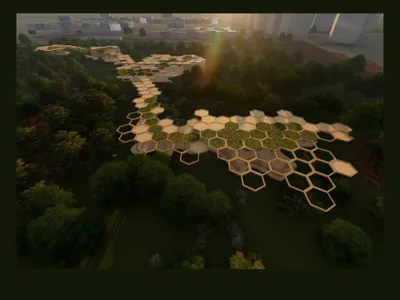
Eco Chapel: A Green Architecture Pavilion Designed in Symbiosis with the Forest
Eco Chapel uses green architecture to weave prayer, learning and reuse into a forest pavilion shaped by modular hexagonal canopies for life.
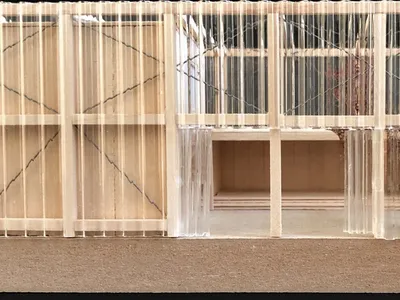
Kaffeebühnen: Coffee Shop Architecture Designed as a Civic Stage Between Vienna’s City and Park
Kaffeebühnen turns coffee shop architecture into a civic stage, linking Vienna’s park edge, urban life, warm timber yards, and coffee craft.
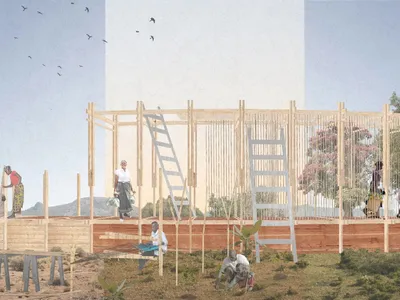
Healing Façade: Sustainable Architecture for Reforestation, Community, and Sacred Ecology in Ethiopia
Healing Façade reimagines sustainable architecture as a living wall that restores soil, catches water and renews Ethiopia's forest churches.


Urban Forest: A Vertical Ecosystem for 5,000 Workers in Singapore's Changi Business Park
Radially stacked pods and layered green decks turn a 7-acre plot into 47 acres of ecological workspace projected for 2040.


Explore Conceptual Architecture Competitions
Discover active competitions in this discipline


Challenge to design a portable theatre


Challenge to design a portable music platform

Challenge to design an open learning module for the elderly
Comments (0)
Please login or sign up to add comments
No comments yet. Be the first to comment!