
Gonzalez Haase Carves an Icelandic Landscape into a Regent Street Flagship for 66° North
Rammed earth walls and volcanic red aggregate transform a John Nash building into a geological retail experience in London.


Regent Street is a place where Victorian grandeur meets the relentless churn of global retail. So when Icelandic outdoor brand 66° North chose a ground-floor unit inside a 19th-century John Nash listed building for its first store outside Scandinavia, the challenge was not just fitting out a shop. It was transplanting an entire national geology into 700 square meters of London limestone. Gonzalez Haase Architects answered by treating the interior as terrain: curved rammed earth walls rise and fall across the plan like glacial ridges, their heights deliberately varied to frame, reveal, and obstruct sightlines in a sequence that rewards movement.
What makes the project genuinely interesting is its refusal to treat Iceland as a mood board. There are no aurora borealis projections, no basalt column wallpaper. Instead, the architects distilled the island into two material operations: grey British clay for the static, geological armature, and a volcanic red aggregate for the heated, eruptive accents. The result is a bi-chrome landscape that feels unmistakably geological without resorting to illustration, and that absorbs the irregular column grid and non-orthogonal plan of the existing building as though the space had always been a lava field.
Entering Through the Crust
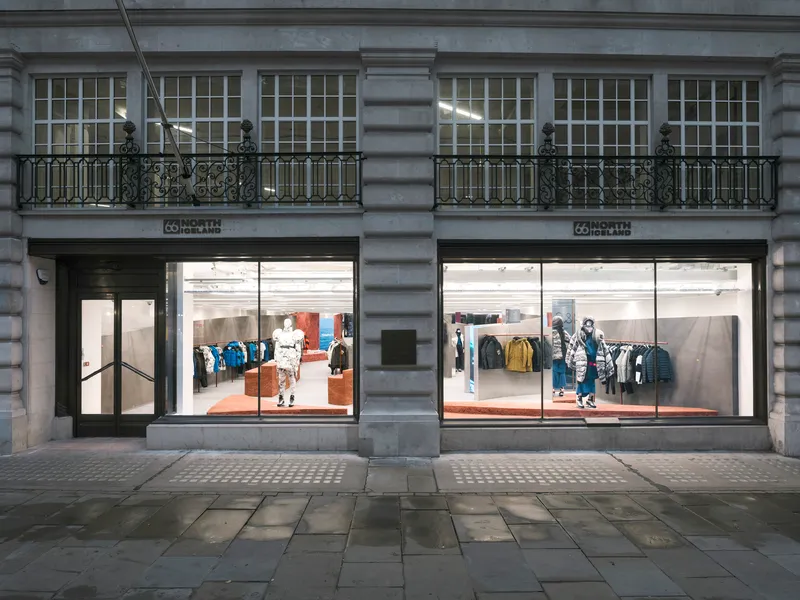
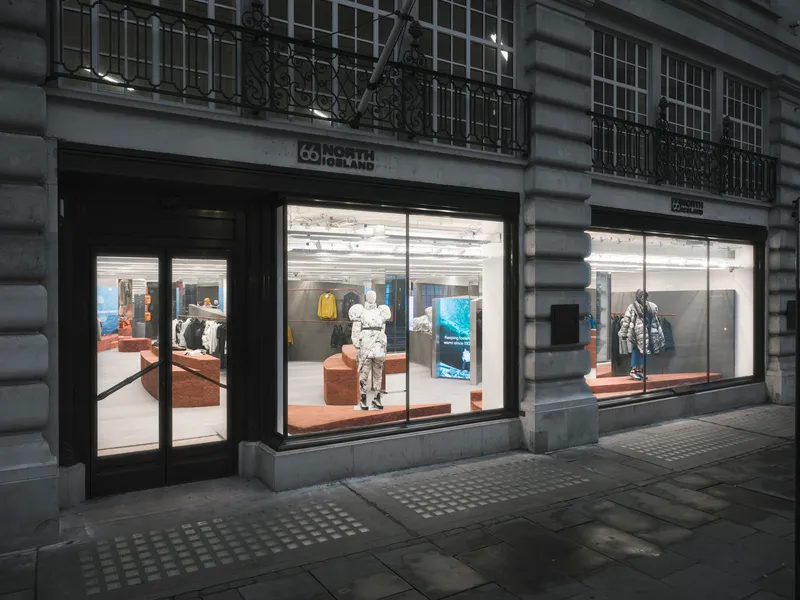
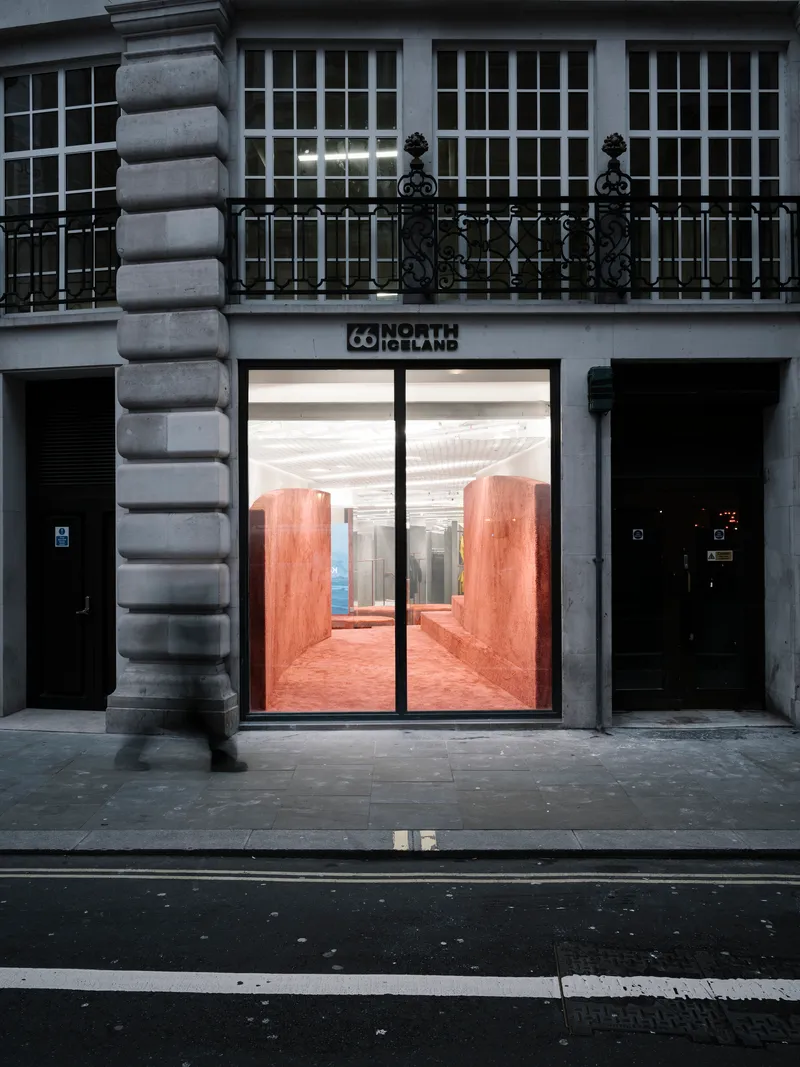
The store occupies a symmetrical pair of arched shopfronts at 100 Regent Street, with a secondary entrance on Glasshouse Street. Seen from the pavement at dusk, the illuminated interiors glow warmly behind Nash's rusticated stone facade, the reddish tones of the interior providing a striking contrast against grey masonry. The storefront glazing is generous enough to make the interior legible from the street, turning the rammed earth topography into a kind of geological vitrine.
The 18-meter-long entrance wall is subtly curved, which accomplishes two things at once. It softens the threshold between the formality of the street and the organic interior, and it catches daylight at shifting angles throughout the day. For a store selling weatherproof outerwear, the decision to make light itself a variable rather than a constant is conceptually precise.
A Grey Palette That Moves
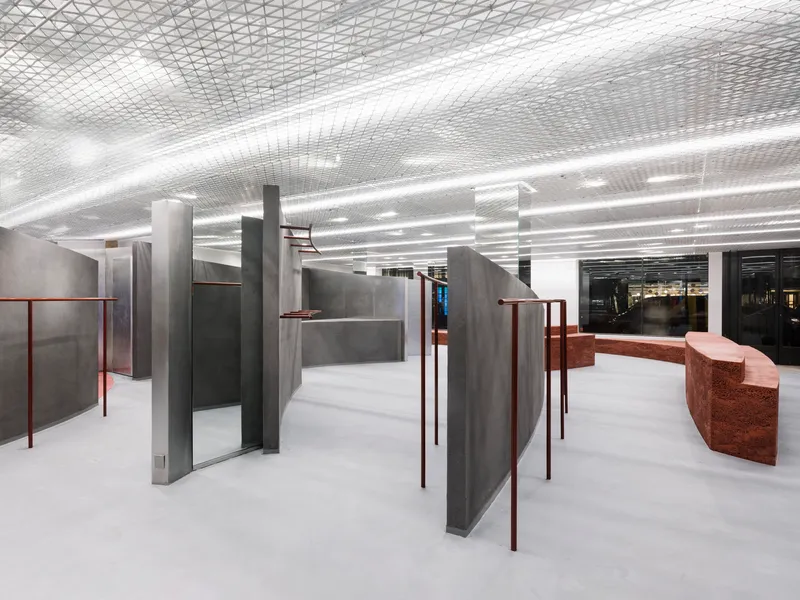
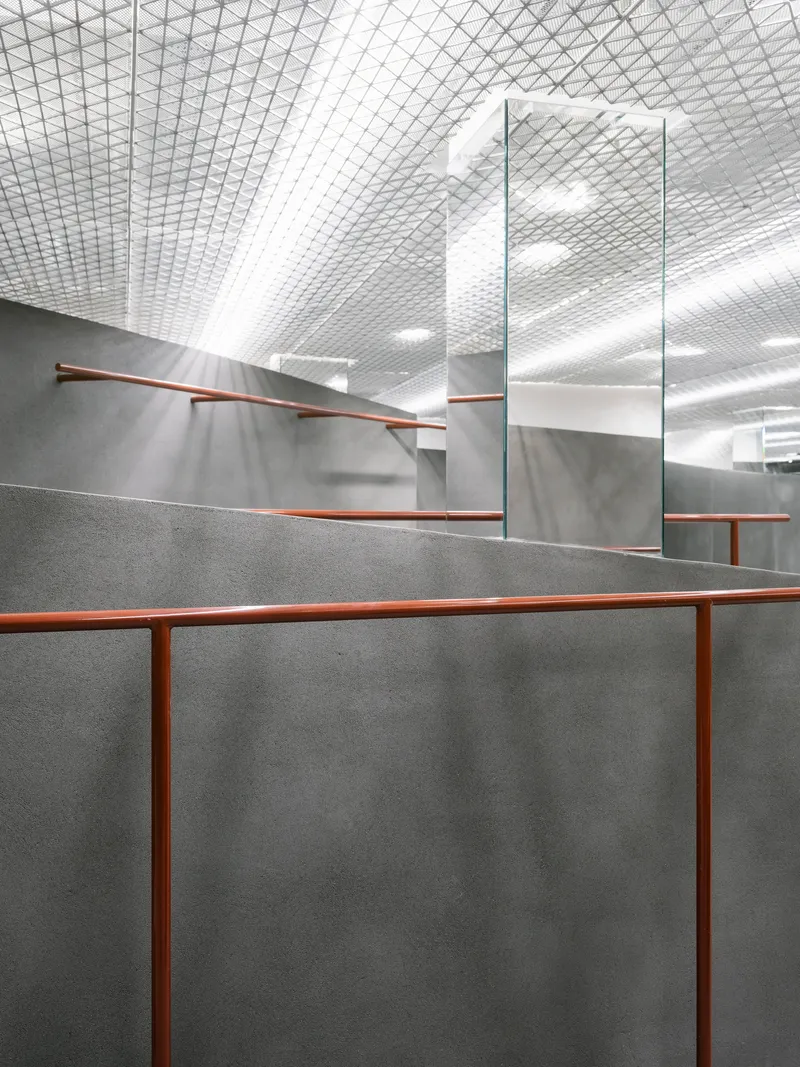
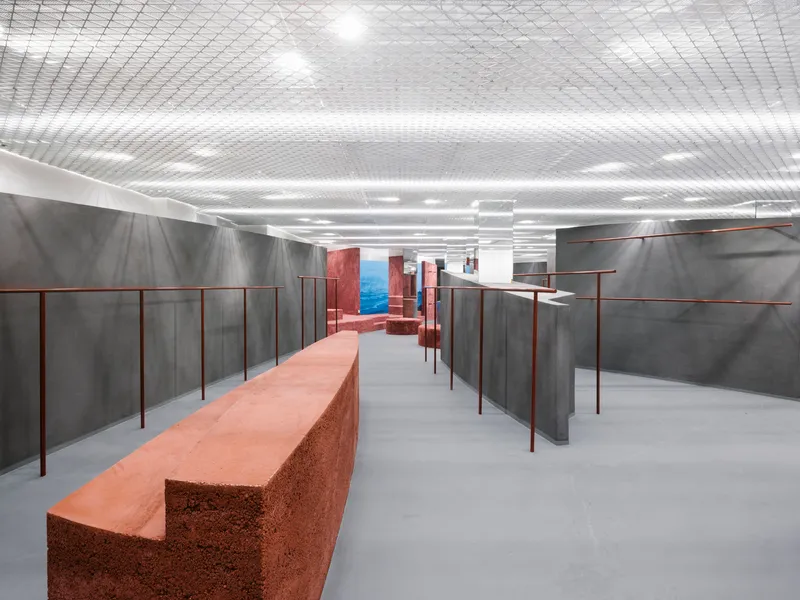
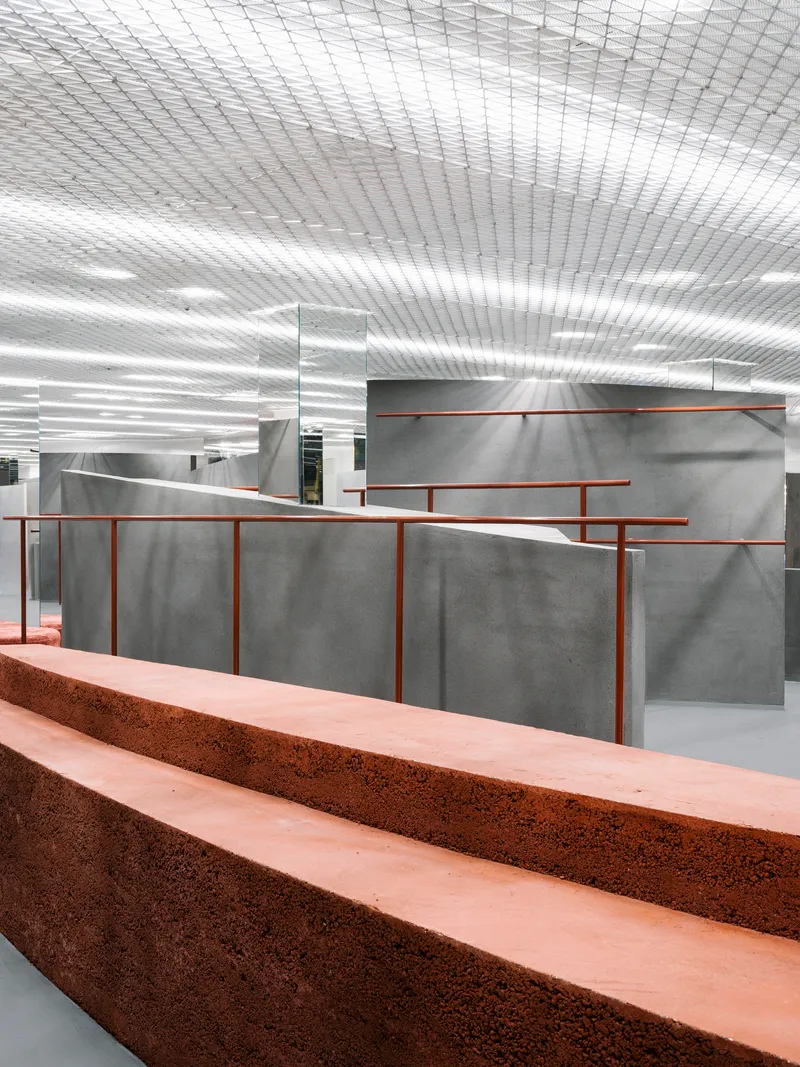
Grey is often a safe choice in retail. Here it becomes the dominant argument. The freestanding rammed earth partitions are made from natural British clay, a material decision rooted in the firm's strategy of sourcing locally wherever a new 66° North location opens. Each wall surface is slightly different in tone and texture, absorbing and reflecting light in ways that mimic the shifting overcast of an Icelandic sky. The partitions vary in height: some sit below eye level, inviting views across the floor; others rise to full-wall enclosures that compress space before releasing it again.
The existing plan has no straight walls and a chaotic mix of column types, a condition most retailers would conceal behind drywall. Gonzalez Haase chose instead to work with this irregularity, positioning the curved partitions so that the concrete columns read as geological intrusions rather than structural inconveniences. The overall effect is a floor where no two corridors feel identical and where the act of browsing becomes genuinely exploratory.
Copper Rails as Tectonic Seams
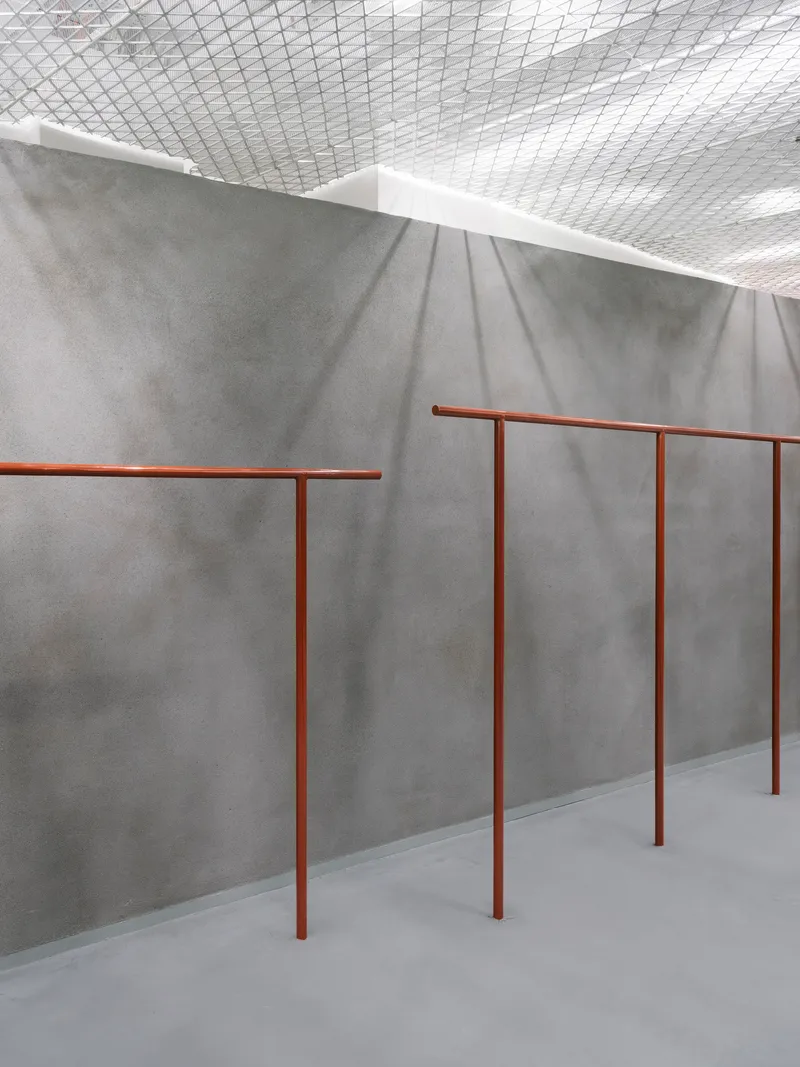
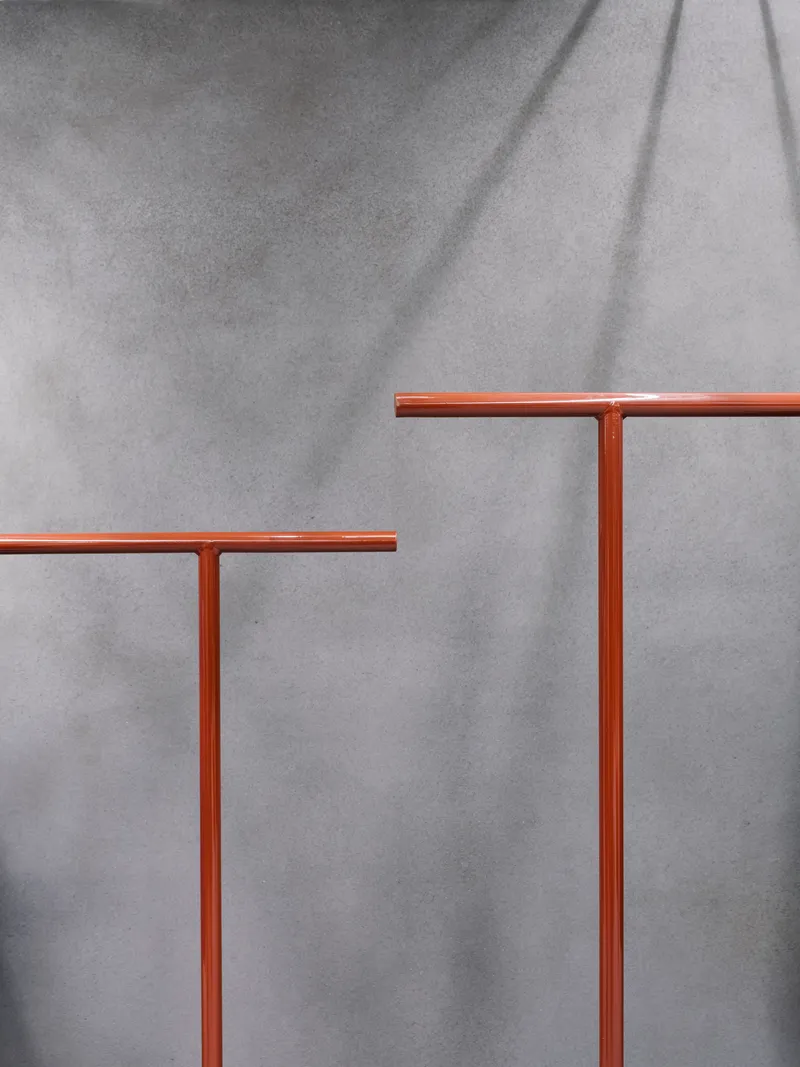
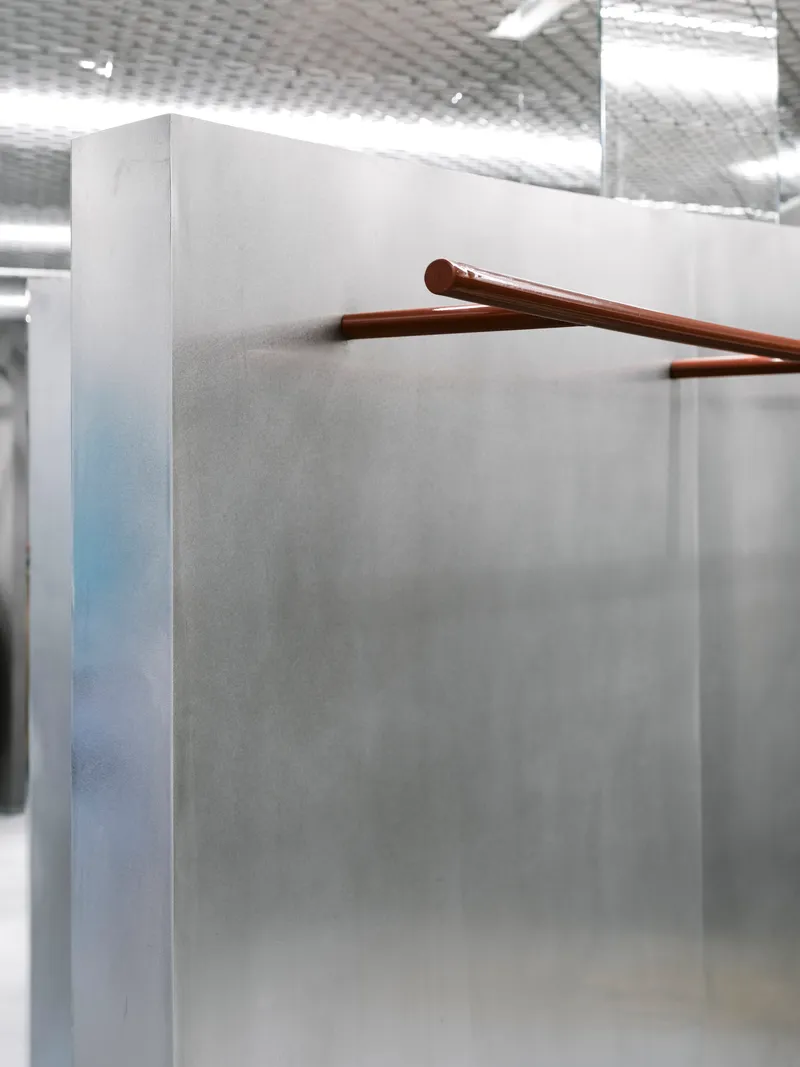
Look closely at the copper-toned tubular handrails and they reveal themselves as more than functional garment racks. They are the connective tissue of the interior, the element that links one rammed earth wall to the next and gives the landscape its human scale. The T-shaped profiles cast sharp shadow lines against the soft, matte clay surfaces, a deliberate contrast between the geological and the manufactured.
The detail is restrained but specific. Rails extend directly from the wall surface without visible brackets, as if extruded from the clay itself. This kind of precision keeps the space from tipping into an art installation: the rails remind you that this is, after all, a place where you are supposed to pick up a jacket and try it on.
Volcanic Red as Counterpoint
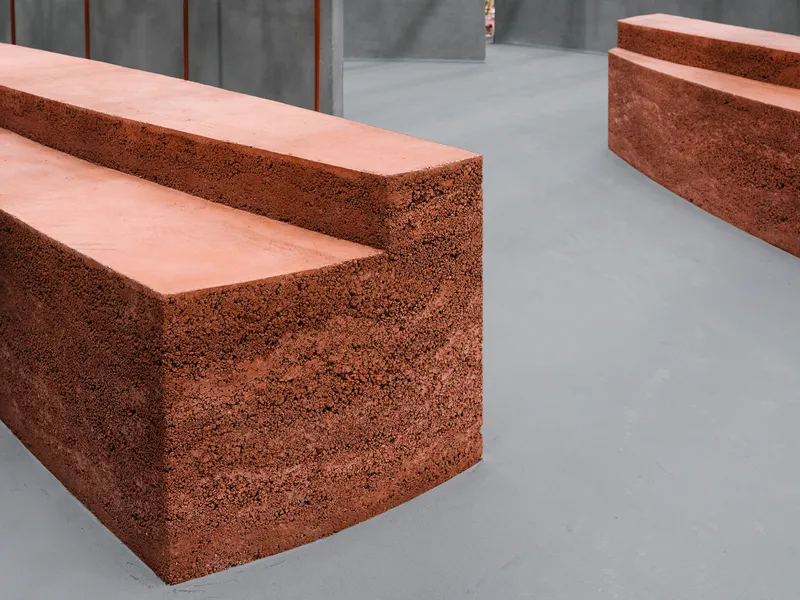
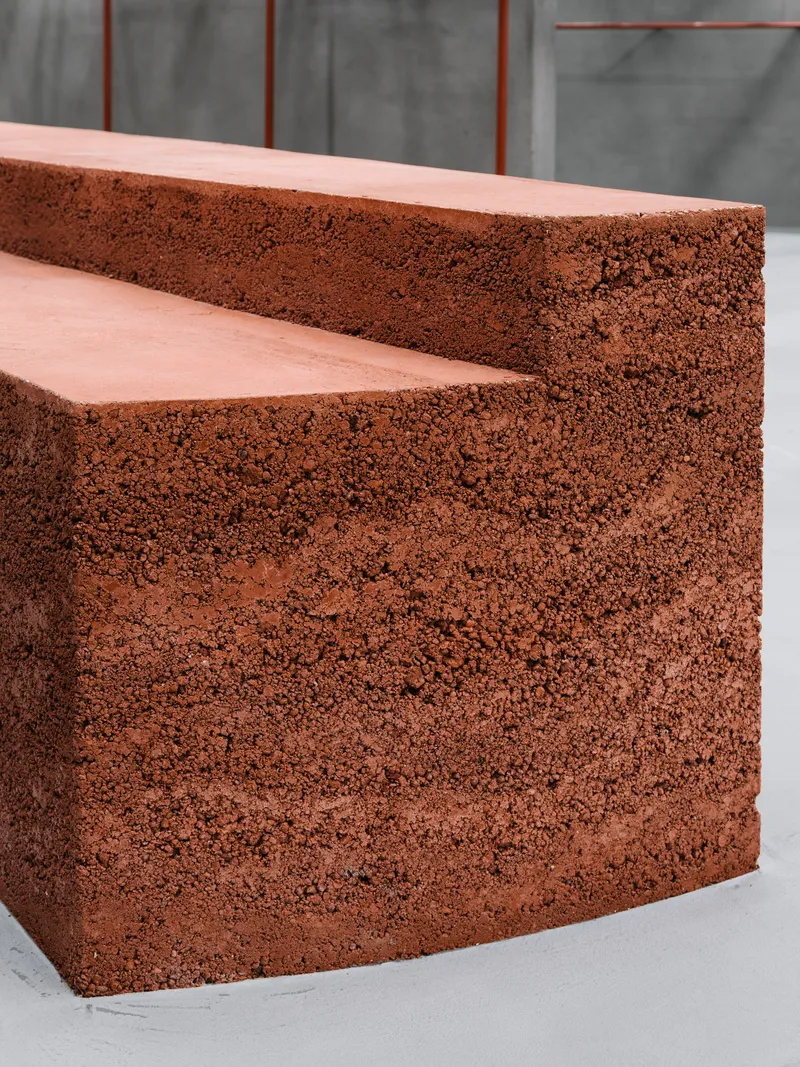
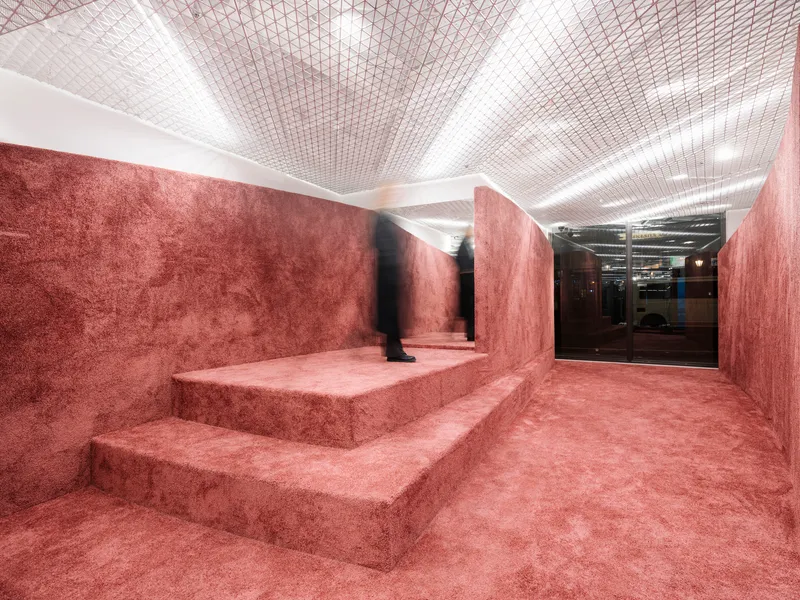
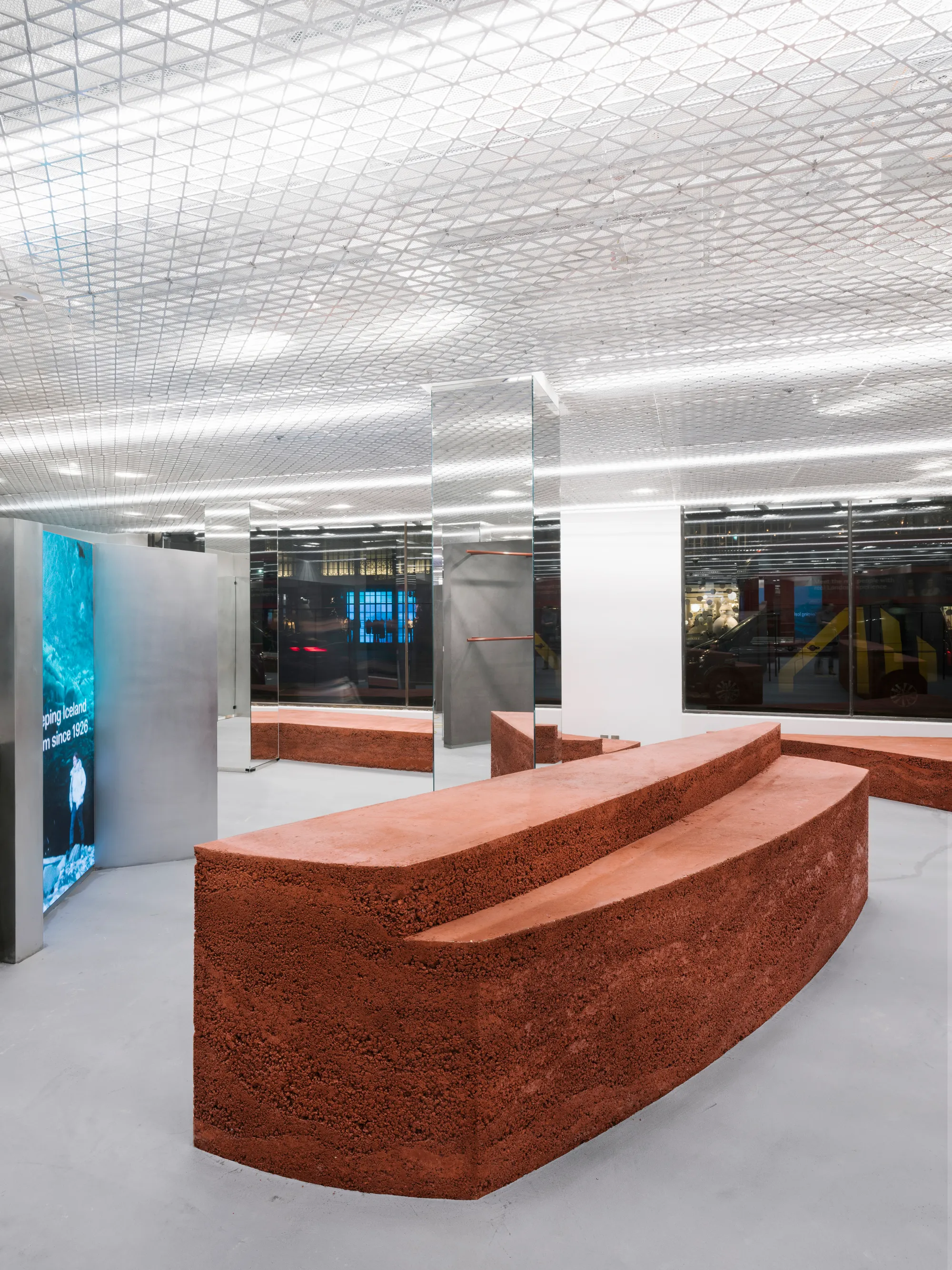
Against the grey field, the red volcanic aggregate surfaces hit with real force. Benches, stepped platforms, and carved plinths are clad in a porous reddish concrete that reads as a direct geological sample, as if someone had sliced open a lava flow and polished the top. The smooth tread surfaces sit atop rough, vesicular aggregate in a way that makes the material's origin legible. You understand immediately that this is stone, not paint.
The stepped platforms serve dual purposes. On the retail floor, they are display plinths. In the lower-level showroom space, they become seating for community events and workshops. The earthy red was chosen specifically for the London location, a thread that will change with each future store depending on what local geology and pigment offer. It is a smart framework: consistent brand language, site-specific materiality.
An Artificial Sky Overhead
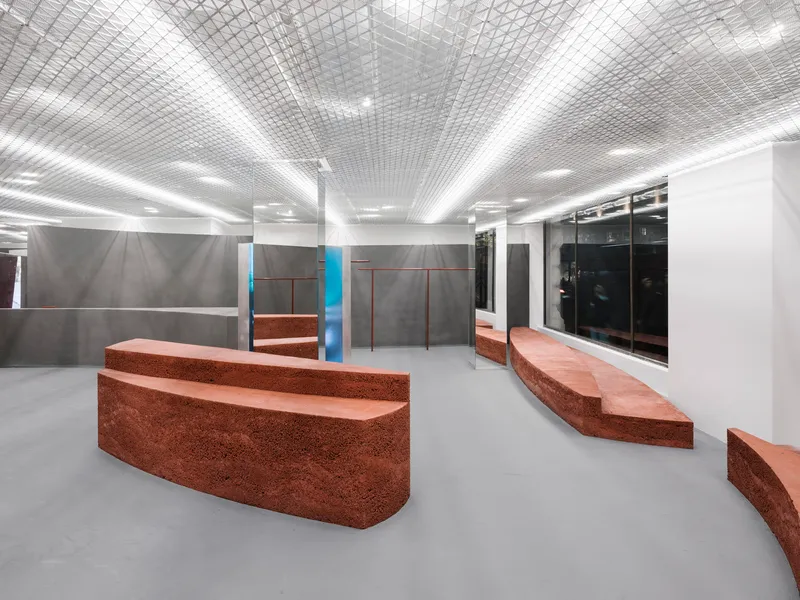
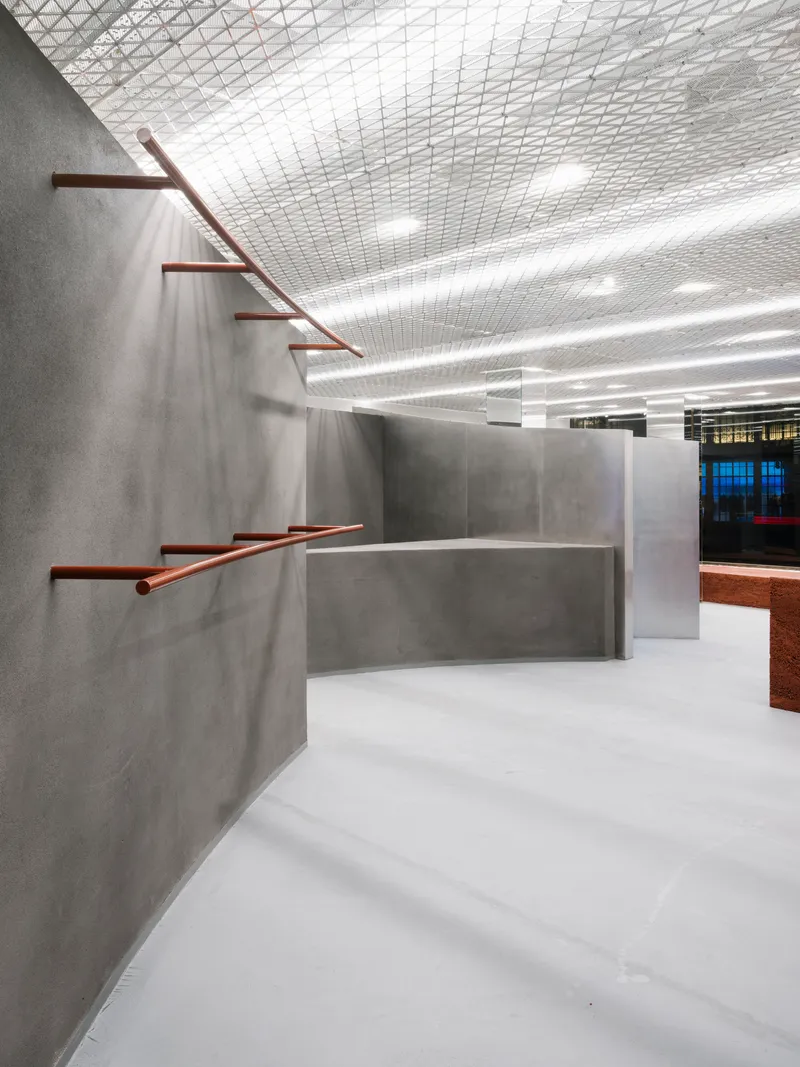
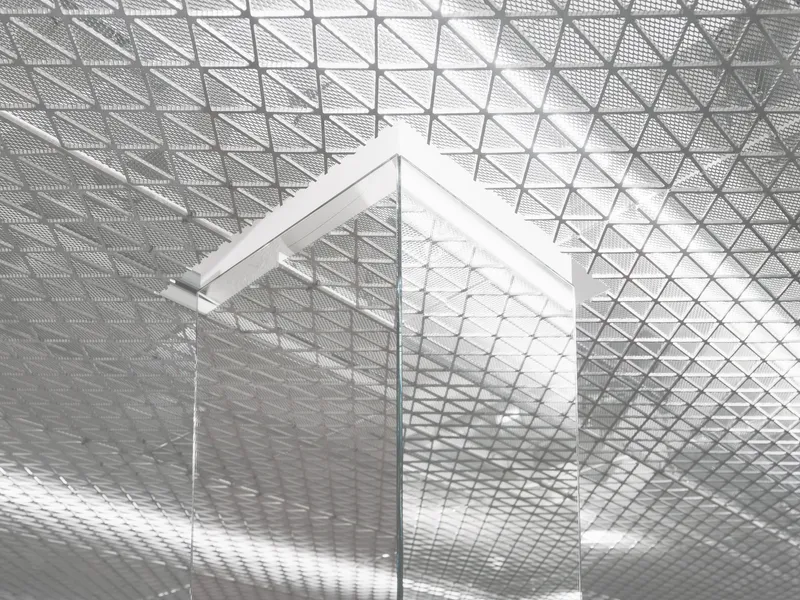
The custom diamond-patterned mesh ceiling is arguably the project's most atmospheric gesture. Lit from above with a bespoke LED system, it diffuses light into a misty, overcast glow that evokes the perpetual cloud cover of an Icelandic winter. Light patterns radiate and dissolve across the undulating metal surface, throwing soft, restless shadows onto the clay walls below. The ceiling is never uniform: depending on where you stand, the mesh catches light differently, reinforcing the sense of weather as a dynamic interior condition.
Glass corner panels interact with the mesh to produce reflected light patterns that further dissolve the boundary between structure and atmosphere. It is a ceiling that behaves less like architecture and more like sky, which is exactly the point.
Moments of Program
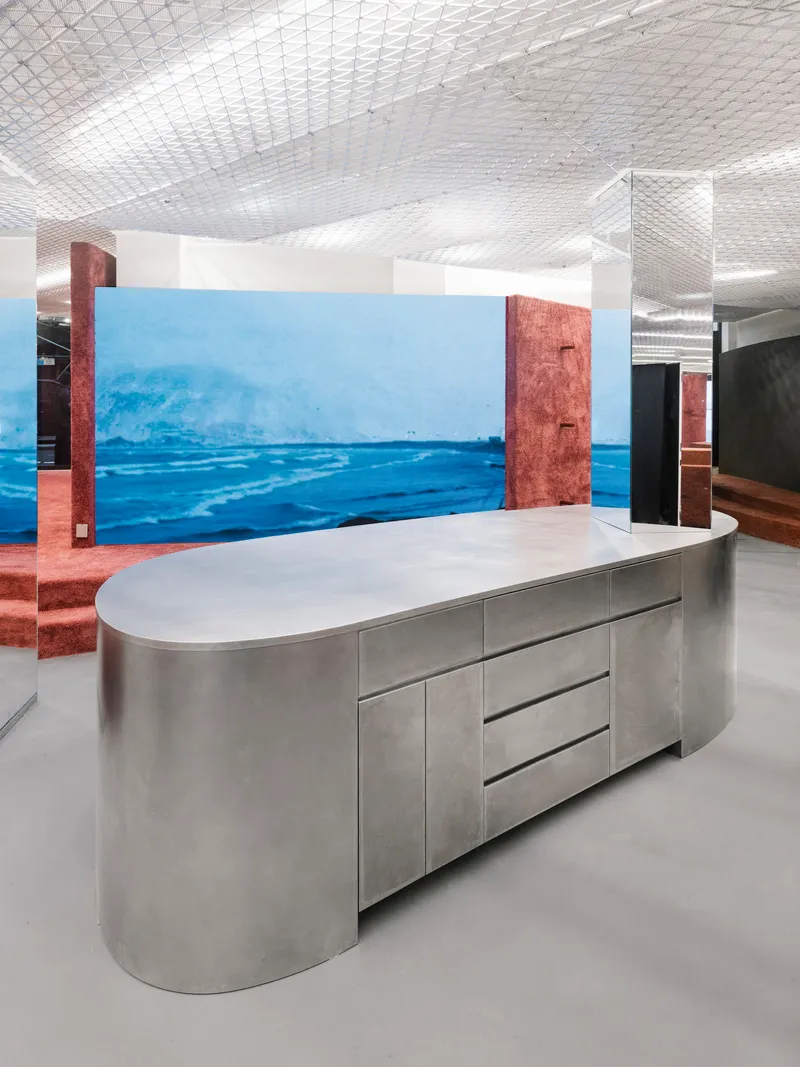
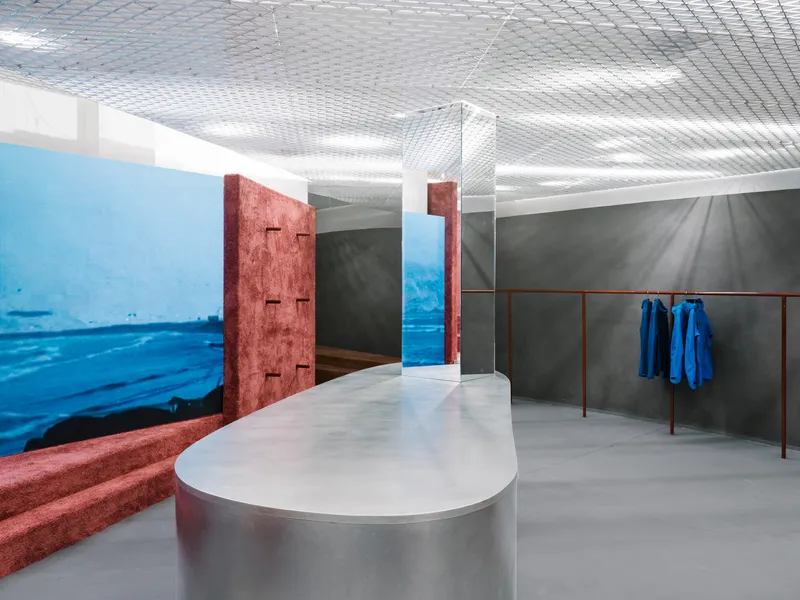
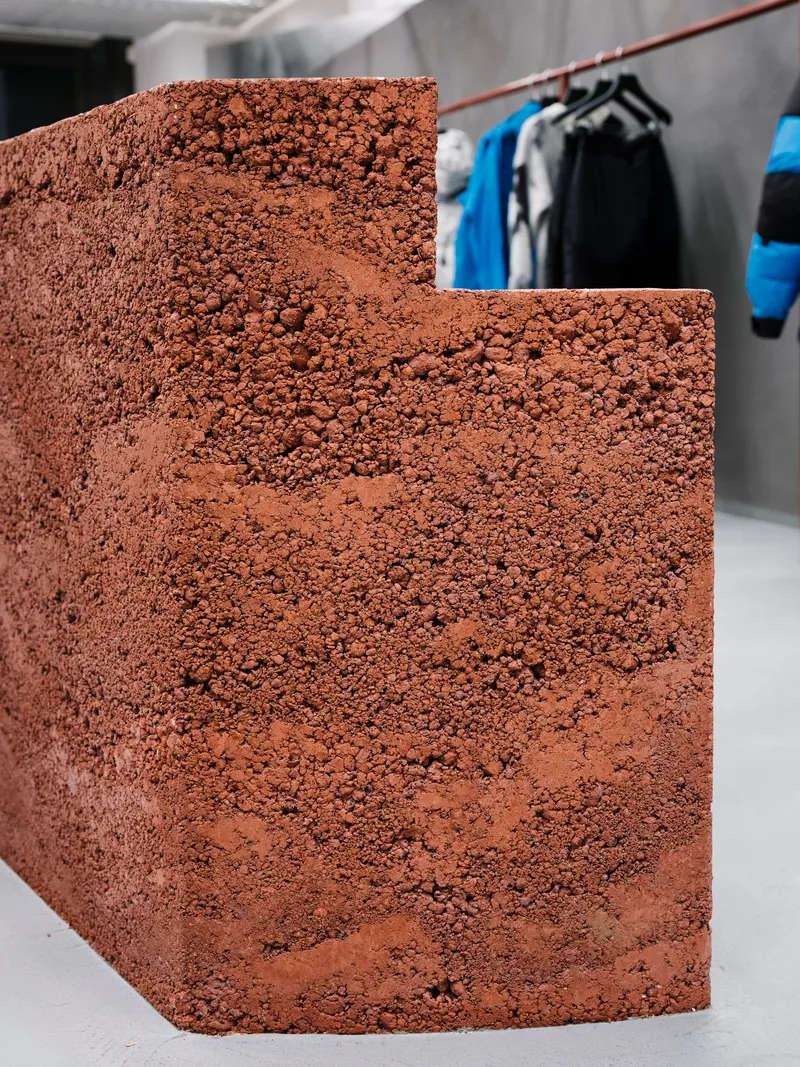
The retail program is threaded through the landscape rather than zoned into conventional departments. An oval stainless steel counter with integrated drawers sits against a large-scale ocean photograph, grounding the checkout experience in Icelandic imagery without being heavy-handed. Garment rails appear between reddish-brown textured columns, and the curved aggregate stairs in the background hint at the lower level where the brand hosts workshops and community gatherings.
These programmatic moments are deliberately understated. The architecture does not compete with the merchandise; it contextualizes it. When you see a rack of blue parkas framed between two rammed earth walls beneath a misty ceiling, you understand the brand's relationship to landscape and climate without anyone having to explain it.
Plans and Drawings
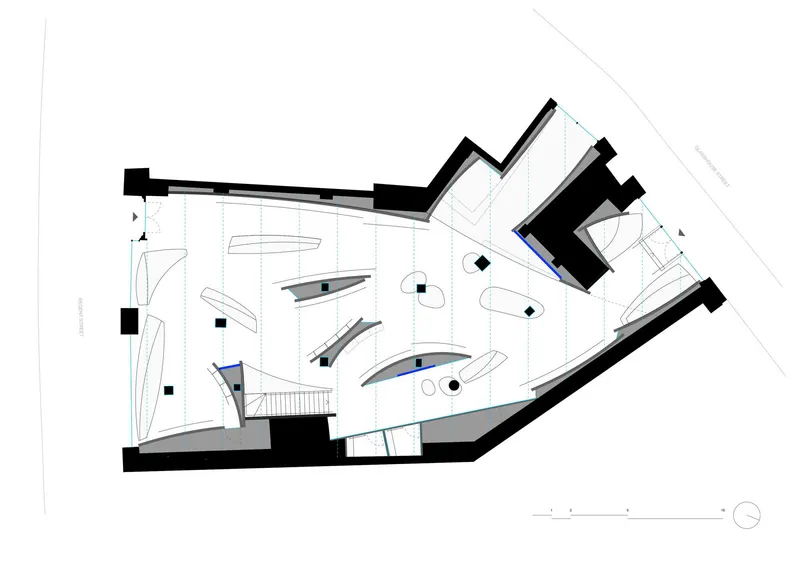
The floor plan confirms what the photos suggest: there is not a single straight partition wall in the entire interior. Organic, curved display elements orbit a central staircase within the angled perimeter of the Nash building. The plan reads almost like a topographic survey, with the freestanding islands and walls registering as contour lines rather than conventional retail fixtures. The two access points on Regent Street and Glasshouse Street create a through-route that encourages wandering rather than a single prescribed path.
Why This Project Matters
Retail interiors cycle through trends with alarming speed, and most flagship stores are designed to be gutted and redone every five years. What Gonzalez Haase has built here resists that logic. Rammed earth is not easily removable. A custom mesh ceiling calibrated to simulate weather is not a cosmetic upgrade. The commitment to raw, site-specific materials over fashionable finishes suggests a store that intends to age rather than be replaced, which aligns with the ethos of a brand that makes gear designed to last through decades of North Atlantic storms.
More broadly, the project demonstrates that you can evoke a place through material logic rather than representational imagery. Iceland is present in every surface of this store, not because anyone hung a photograph of a glacier (there are no glaciers here), but because the architects understood that geology, light, and weather are architectural conditions, not decorative themes. That distinction matters. It is the difference between a store that tells you about Iceland and one that puts you inside something that feels, even faintly, like it.
66° North Flagship Store by Gonzalez Haase Architects, London, United Kingdom. 700 m². Completed 2023. Photography by Ostkreuz Photography.
About the Studio
Share Your Own Work on uni.xyz
If projects like this are the kind of work you want to make, uni.xyz is a place to publish your own, find collaborators, and enter design competitions.




Popular Articles
Popular articles from the community


Hill & Cross Opera: Sculptural Opera House Architecture Shaped by Tallinn’s Landscape and Identity
Hill & Cross Opera reimagines opera house architecture in Tallinn through its sculptural hill, civic plaza, glass wave and a luminous cross.

Riyadh For All: Intergenerational Urban Design for Active Aging in Rabat
Riyadh For All reimagines urban design in Rabat with intergenerational co-living, adaptive courtyards, and Moroccan cultural exchange today.

Conexión: Biophilic Design Reimagines High-Rise Living in Hong Kong
Conexión reimagines high-rise living in Hong Kong through biophilic design, green facades, shared spaces, daylight, water and nature within.

Co-life: Sustainable Architecture for Age-Friendly Community Living
Co-life reimagines sustainable architecture for seniors through courtyards, rammed earth, shared gardens, and spaces designed for belonging.


Similar Reads
You might also enjoy these articles

Bao Huynh Watercolor Atelier: A Serene Art Retreat in Hội An
Bao Huynh Watercolor Atelier in Hội An blends multifunctional art spaces, sustainable design, local materials, and family-friendly living in a serene environment.

Atelier Macri Concept Store Interior Design by CASE-REAL
Atelier Macri store features a "ko" counter, walnut wood details, cork displays, blending retail, gallery, and seamless customer experiences.

Manuel Vargas Izquierdo Stadium and High-Performance Sports Center: Architectural Excellence in Jalpa de Méndez
The Manuel Vargas Izquierdo Stadium blends sustainable design, inclusive sports facilities, and cultural-inspired architecture, revitalizing Jalpa de Méndez’s public spaces.

KAKR Buluh Awar Hall: Revitalizing Community and Ecology Through Bamboo Architecture
Community built bamboo hall revitalizes Buluh Awar village, empowering youth, restoring ecology, celebrating vernacular craftsmanship through sustainable architecture and culture.


Explore Commercial Buildings Competitions
Discover active competitions in this discipline


Challenge to design luxury tourism on rails


VR headsets Storefront design competition

Designing a staircase for a client
Comments (0)
Please login or sign up to add comments
No comments yet. Be the first to comment!