

Groupe A Anchors a Glass and Timber Courthouse on the Waterfront of Lac-Saint-Jean
In Roberval, a civic building bridges a heritage downtown and a dramatic lakefront through stone, glass, and timber craft.


Courthouses are among the most symbolically loaded building types a society commissions. They must communicate authority without intimidation, openness without casualness, and permanence without rigidity. In Roberval, a small city on the southwestern shore of Lac-Saint-Jean in Québec, Groupe A has delivered a courthouse that does all of this while solving a genuinely difficult site problem: how to connect a heritage downtown core to the water's edge without erasing either condition.
The 8,500 square meter building completed in 2025 sits at the intersection of the town's historic fabric and its most powerful natural asset, the lake. Rather than choosing one orientation over the other, Groupe A designed a complex that turns both ways, wrapping a new glass and stone volume around an existing masonry building and opening generous glazed facades toward the harbor. The result is a courthouse that feels simultaneously rooted in its civic context and drawn toward the landscape, a tension the architects exploit to superb effect in nearly every interior space.
Between Town and Water
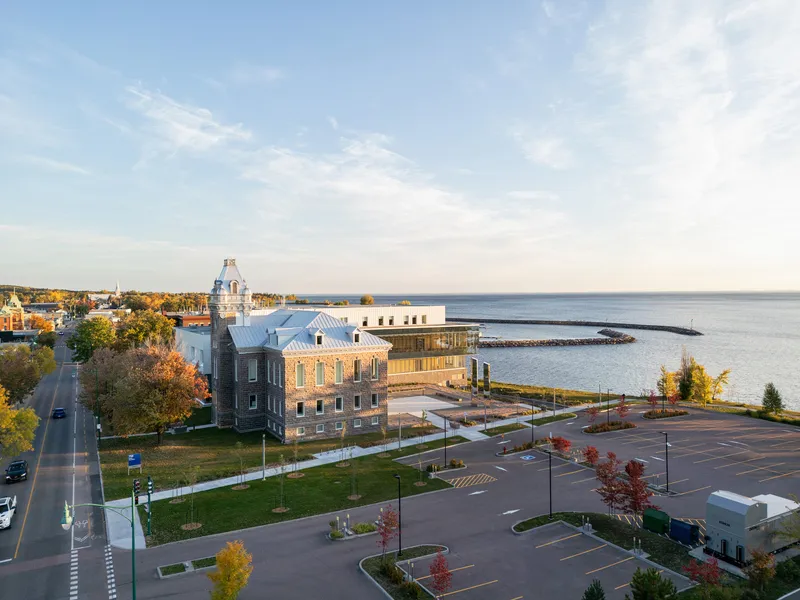
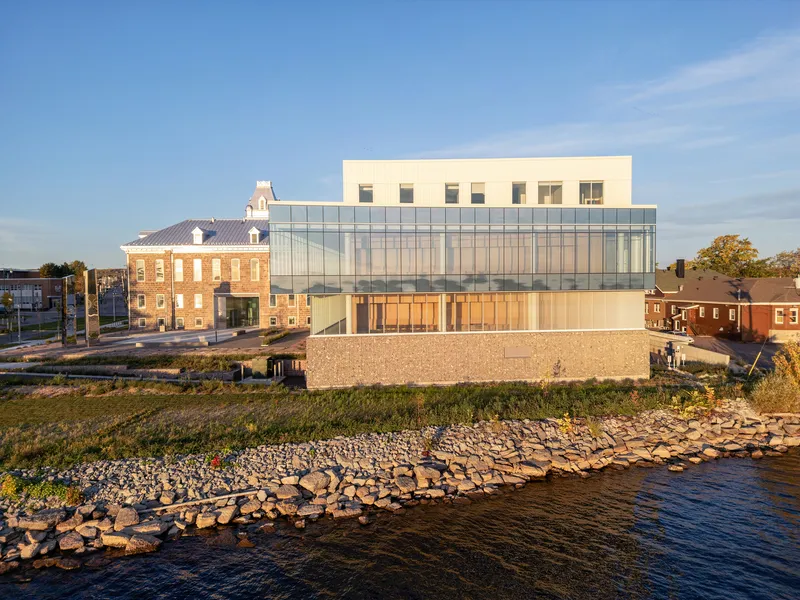

From the air, the strategy reads clearly. The new building extends along the waterfront as a long, relatively low bar, its glass curtain wall set above a heavy gabion stone base that reads as a geological extension of the shoreline. This is not a building that hovers above the ground; it grips it. The gabion walls give the base a rugged, almost fortification-like presence, while the glass volumes above dissolve into reflections of sky and water at golden hour.
On the town side, the project is a different building entirely. The historic masonry clock tower, with its brick and stone detailing, remains the dominant presence. Groupe A chose not to compete with it. The new addition sits alongside and slightly behind the tower, connected but deferential. Carved totem poles on the lawn signal the Indigenous cultural context of the Lac-Saint-Jean region, a gesture that grounds the civic program in a broader understanding of place.
Heritage and Addition in Dialogue
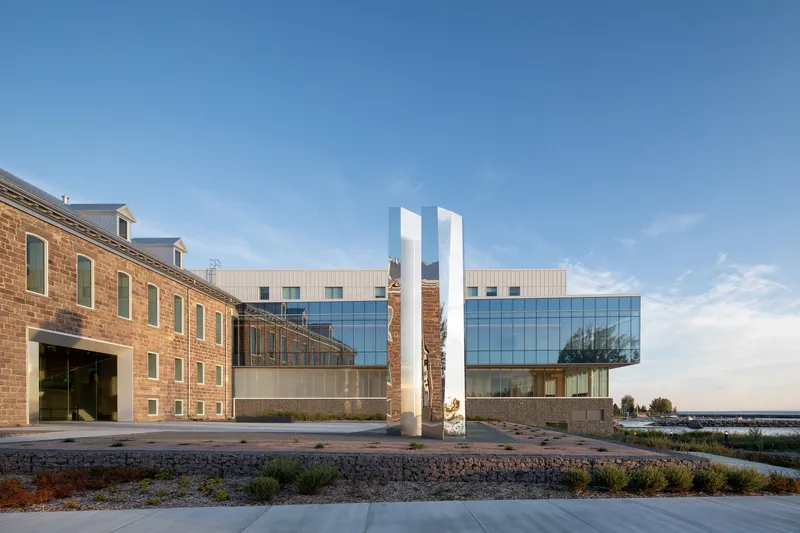
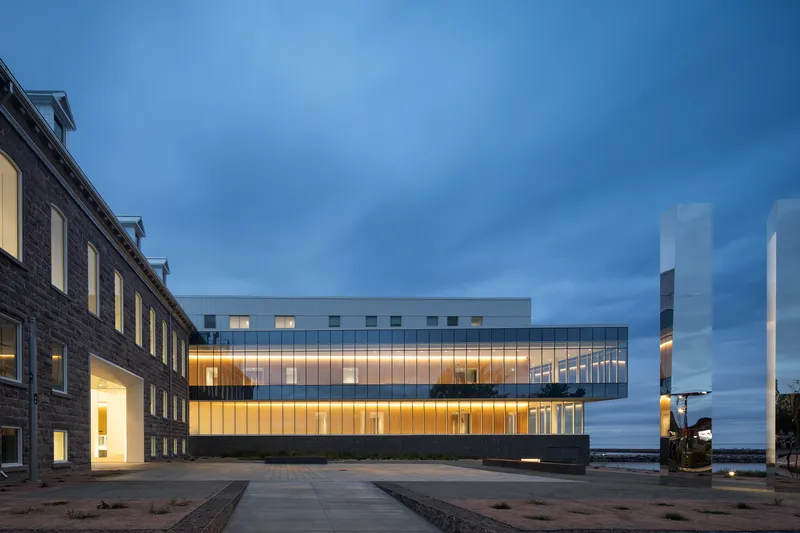

The relationship between old and new is handled with restraint that avoids both mimicry and aggressive contrast. A planted courtyard separates the historic brick building from the glass and panel addition, giving each its own breathing room while creating an outdoor space that belongs to neither volume alone. At dusk, the illuminated glass extension glows beside the darker mass of the heritage building, making the temporal gap between them palpable without rendering it confrontational.
The translucent paneled volume beside the clock tower is particularly well judged. Rather than clear glass, which would have created a void next to solid masonry, the translucent skin produces a soft, diffuse presence that acknowledges the tower's primacy. It is a move that works across seasons; with autumn foliage framing the composition, the warm tones of the panels echo the changing leaves without any forced materiality.
Timber Staircases as Civic Sculpture


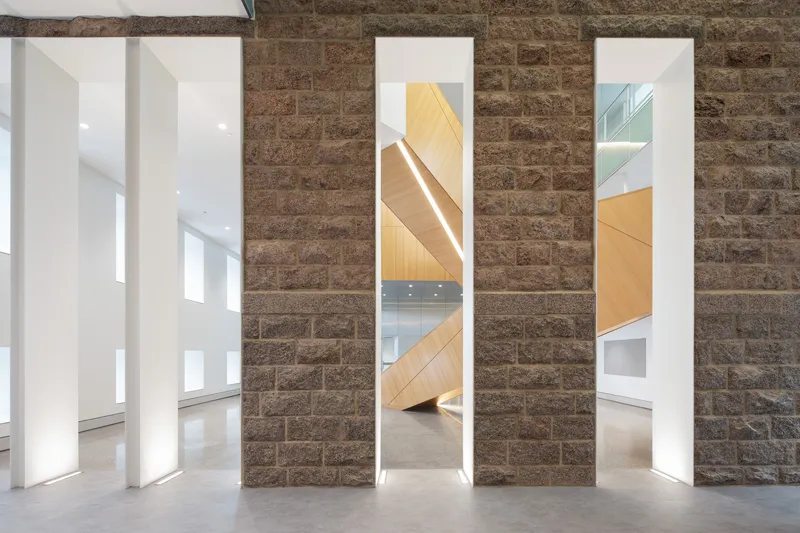
The interior circulation is where Groupe A makes its boldest architectural statement. Timber-clad staircases, tilted and angular, rise through the double-height lobby like pieces of land art. Integrated LED lighting along their edges turns them into luminous lines at night, but even in daylight they carry serious spatial weight. The staircases intersect and cross in the white-walled atrium, creating a dynamic section that makes vertical movement an event rather than a chore.
Tall vertical openings cut through dark stone block walls to frame the staircases from adjacent spaces, creating a layered sequence of reveals. You never see the full composition at once; instead, fragments of timber, light, and movement appear through these slots, pulling you deeper into the building. It is a cinematic technique applied to civic architecture, and it works because the proportions are generous enough to feel dignified rather than theatrical.
The Atrium as Civic Room
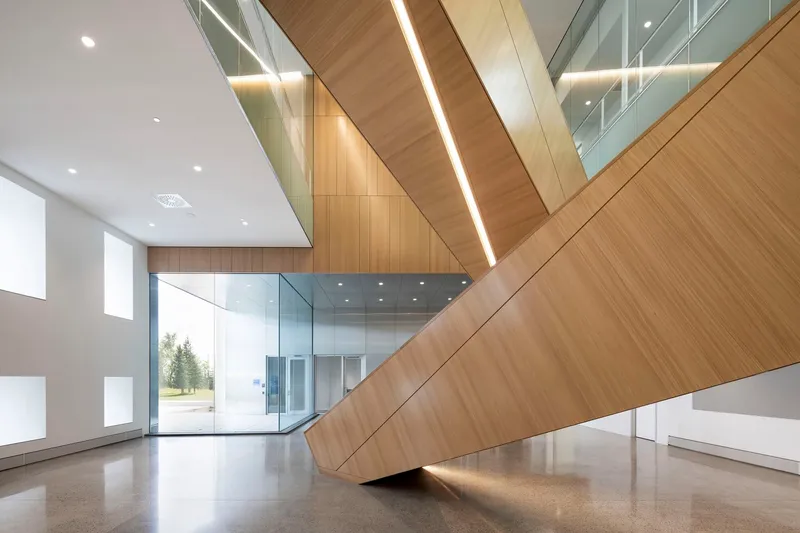


The multi-story atrium is the organizational heart of the building. Angular timber-clad ceiling planes slice across the upper volume, breaking what could have been a generic void into a series of interlocking spatial events. A glass-enclosed mezzanine overlooks the polished concrete floor below, while the diagonal timber staircase with its integrated lighting becomes the primary visual anchor. The material palette is disciplined: timber, concrete, glass, stone, and very little else.
From the upper levels, the atrium reads as a section through the building's civic ambition. A person ascending the stone entry stair is visible through glass balustrades from three levels above, a deliberate transparency that makes the building's public character legible. In a courthouse, where so much of the program is necessarily closed, these moments of openness carry real significance.
Corridors That Frame the Landscape
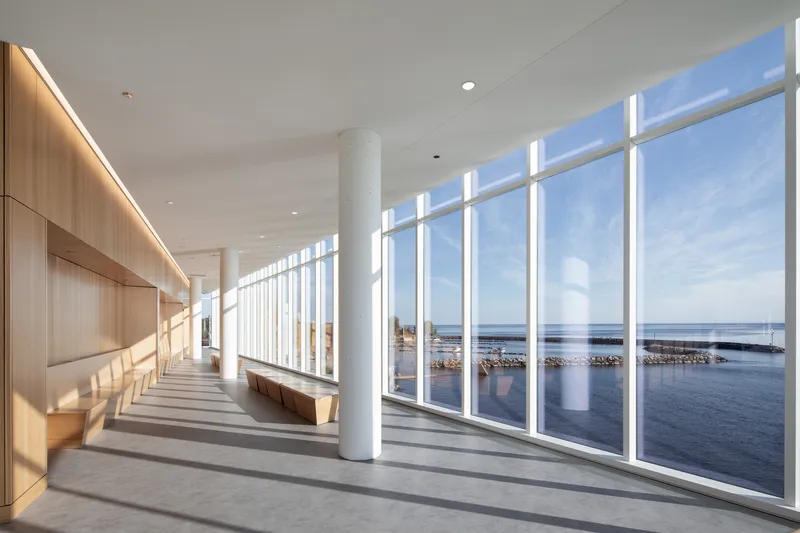
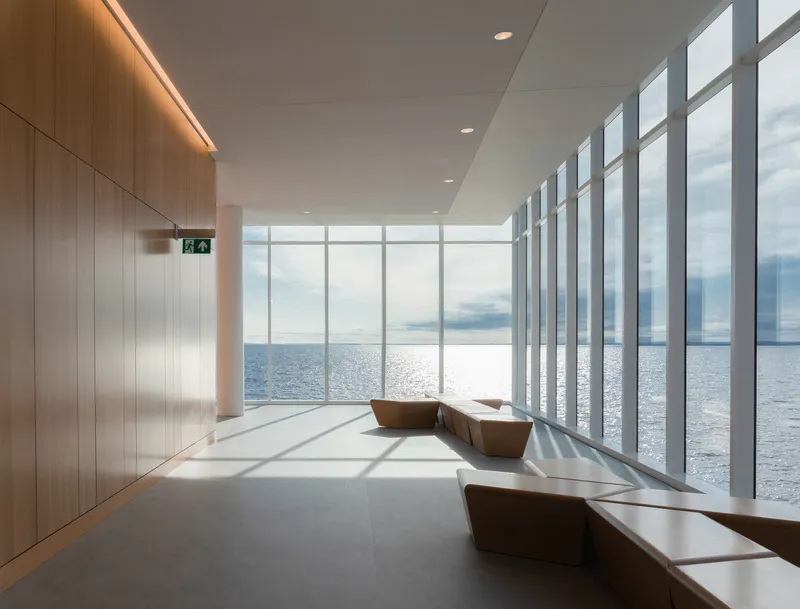

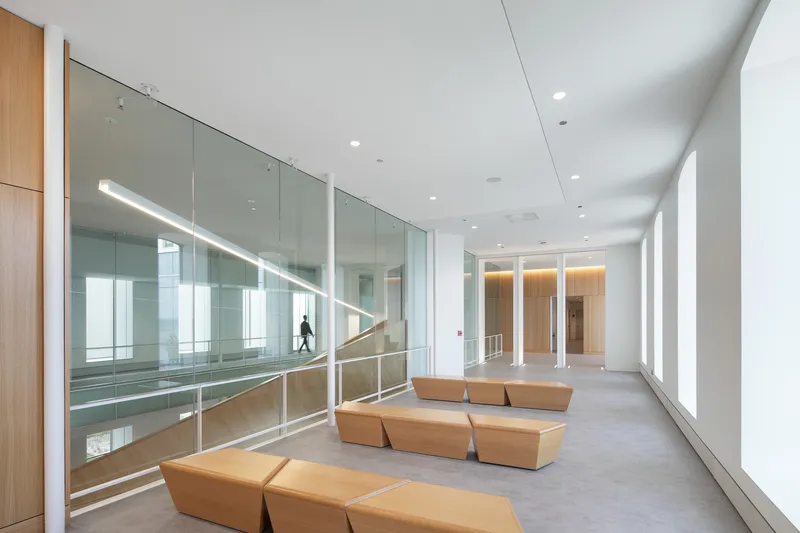
The waterfront corridors are among the finest spaces in the building. Floor-to-ceiling glazing runs the length of the bar, framing the harbor and the lake beyond. Timber-clad walls on the interior side provide warmth and acoustic softness, with integrated seating that invites pause. These are not merely circulation routes; they are rooms in their own right, places where the experience of waiting, which dominates so much of a courthouse visit, becomes something almost contemplative.
Timber benches cast long shadows on the polished concrete as light moves across the water. Vertical white mullions in another corridor create a rhythmic screen that fragments views of the adjacent masonry building and parking area into something more composed. The attention to how light, material, and view interact along these corridors elevates what is typically dead space in institutional buildings into the project's most memorable sequence.
Courtrooms and Waiting Spaces
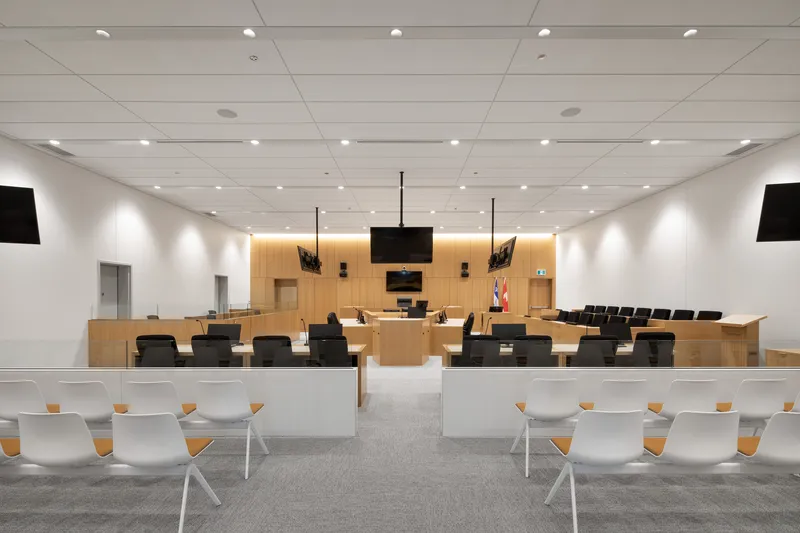

The courtrooms themselves are restrained and serious. Timber judicial benches, recessed lighting, and rows of gallery seating establish the appropriate gravity without resorting to heavy-handed monumentality. The material continuity with the rest of the building, particularly the use of timber, means the courtrooms feel like concentrated versions of the same architectural language rather than isolated boxes inserted into a shell.
Waiting areas on the upper levels feature orange modular seating along glazed balustrades, injecting a controlled note of color into the otherwise neutral palette. A perforated metal screen wall with illuminated borders separates the gallery seating from elevator doors, a detail that manages the practical challenge of acoustic privacy while maintaining the building's commitment to visual permeability. These are spaces designed for people under stress, and the care taken with them reflects well on both the architects and the institution.
Plans and Drawings
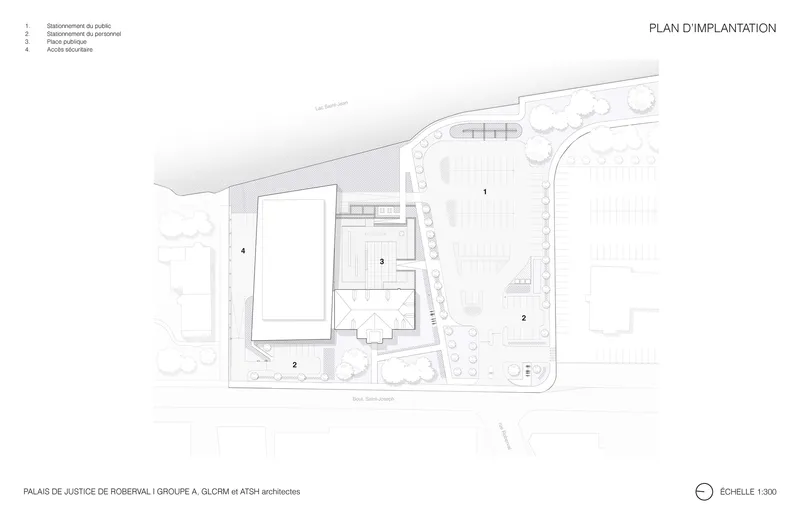


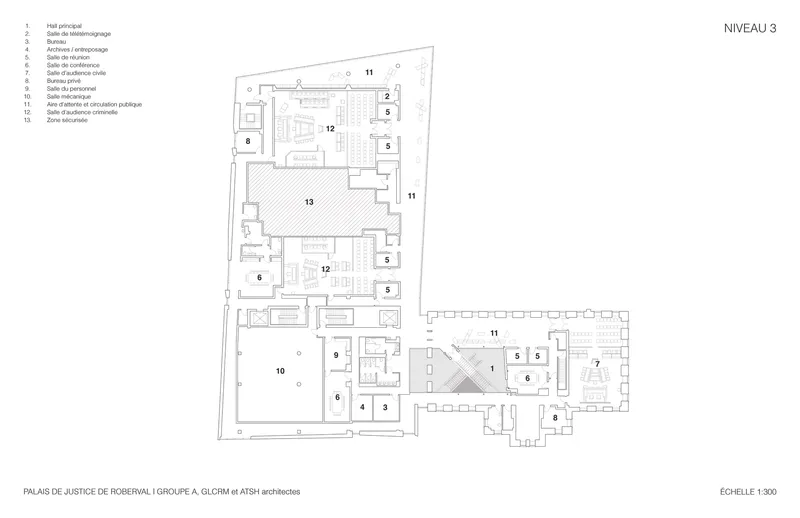
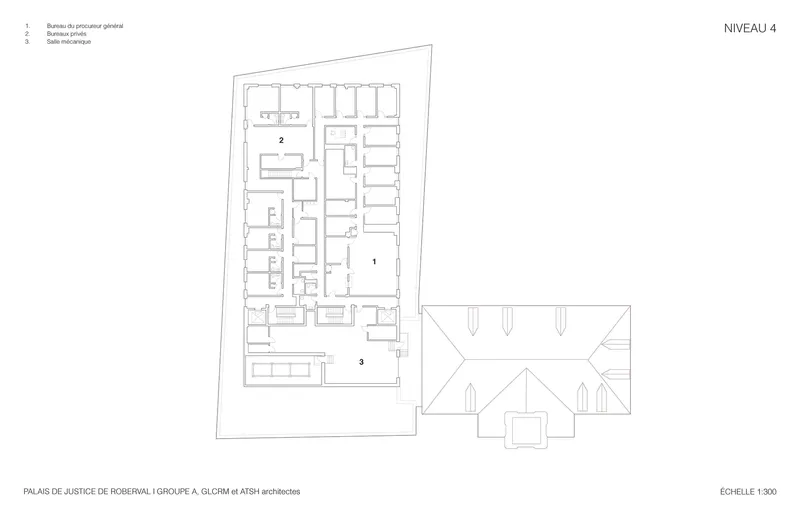
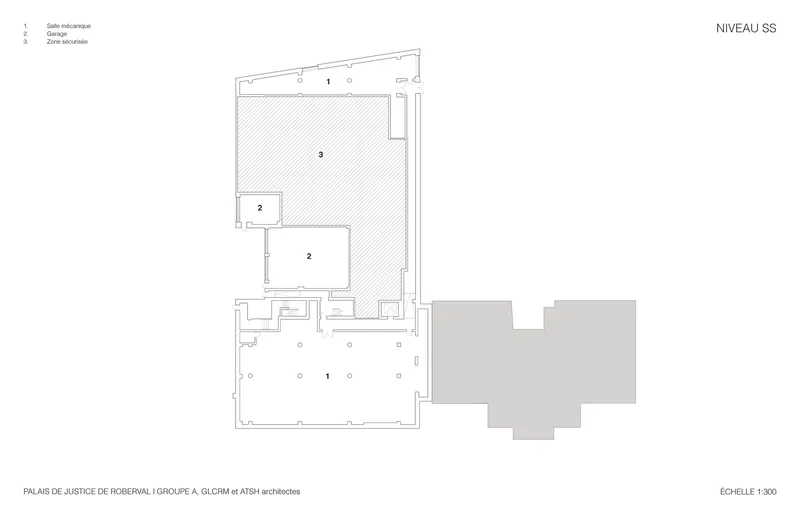


The plans reveal a clear organizational logic. A central atrium anchors circulation at every level, with courtrooms and meeting rooms arranged around a central void on the upper floors. The irregular trapezoidal geometry of the site is absorbed into the plan without awkward residual spaces; the architects have used the angled condition to create varied room proportions that feel deliberate rather than compromised. At the basement level, a large hall and service rooms occupy the footprint beneath the gabion base.
The elevation drawings confirm the measured relationship between the historic clock tower and the horizontal addition. The tower retains its vertical dominance while the new bar extends laterally, creating a composition that reads as accretive rather than competitive. The south elevation, with trees drawn in the landscape, suggests how the building will settle into its site as vegetation matures around the gabion walls.
Why This Project Matters
The Roberval Courthouse matters because it demonstrates that civic architecture in smaller cities does not need to settle for competent anonymity. Groupe A has produced a building that is specific to its site, serious about its program, and genuinely beautiful in its material and spatial execution. The decision to orient the primary public experience toward the lake, while maintaining a respectful posture toward the historic town center, resolves a duality that lesser projects would have flattened into a single gesture.
It also matters as a statement about what a courthouse can feel like. The timber staircases, the waterfront corridors, the carefully framed views: these are not decorative additions to a functional program. They are the program, reinterpreted through architecture that takes seriously the idea that justice is a public act and its buildings should honor the people who pass through them. In a building type too often dominated by security protocols and bureaucratic floor plates, Roberval is a reminder that ambition and care are not mutually exclusive.
Roberval Courthouse by Groupe A, located in Roberval, Canada. Completed in 2025. 8,500 m². Photography by Adrien Williams.
About the Studio
Share Your Own Work on uni.xyz
If projects like this are the kind of work you want to make, uni.xyz is a place to publish your own, find collaborators, and enter design competitions.


Popular Articles
Popular articles from the community


Cloaked Colonization: A Mobile Underwater Habitat That Moves Like a Fish
Micah Abaya's shortlisted EHC Pacific entry reimagines ocean settlement as a dispersed network of self-sustaining architectural organisms.

Singing Woman: An Opera House That Performs Before the Curtain Rises
Ovidiu Cristian Pavel's conceptual opera house translates Estonia's choral identity into a sculpted waterfront landmark facing the Baltic Sea.

Faces of the Soviet Avant-Garde: Turning Moscow's Street Names into an Open-Air Museum
A network of sculptural installations across a Moscow residential district transforms forgotten architect names into spatial encounters with cultural memor

The Amber Palace Opera: A Geological Fiction Surfaces on Tallinn's Baltic Waterfront
Pierre Brillard reimagines a Baltic legend as a public landscape, opera house, and waterfront promenade rooted in Tallinn's coastal identity.

Similar Reads
You might also enjoy these articles

Pixel Gardens: One Repeated Module Stacked Into a Terraced Social Housing Tower for Famagusta
Salem Bader's shortlisted housing tower builds a vertical neighbourhood from one repeated module, offsetting units to carve terraces, light and air.

Bao Huynh Watercolor Atelier: A Serene Art Retreat in Hội An
Bao Huynh Watercolor Atelier in Hội An blends multifunctional art spaces, sustainable design, local materials, and family-friendly living in a serene environment.

Atelier Macri Concept Store Interior Design by CASE-REAL
Atelier Macri store features a "ko" counter, walnut wood details, cork displays, blending retail, gallery, and seamless customer experiences.

Manuel Vargas Izquierdo Stadium and High-Performance Sports Center: Architectural Excellence in Jalpa de Méndez
The Manuel Vargas Izquierdo Stadium blends sustainable design, inclusive sports facilities, and cultural-inspired architecture, revitalizing Jalpa de Méndez’s public spaces.

Comments (0)
Please login or sign up to add comments
No comments yet. Be the first to comment!