
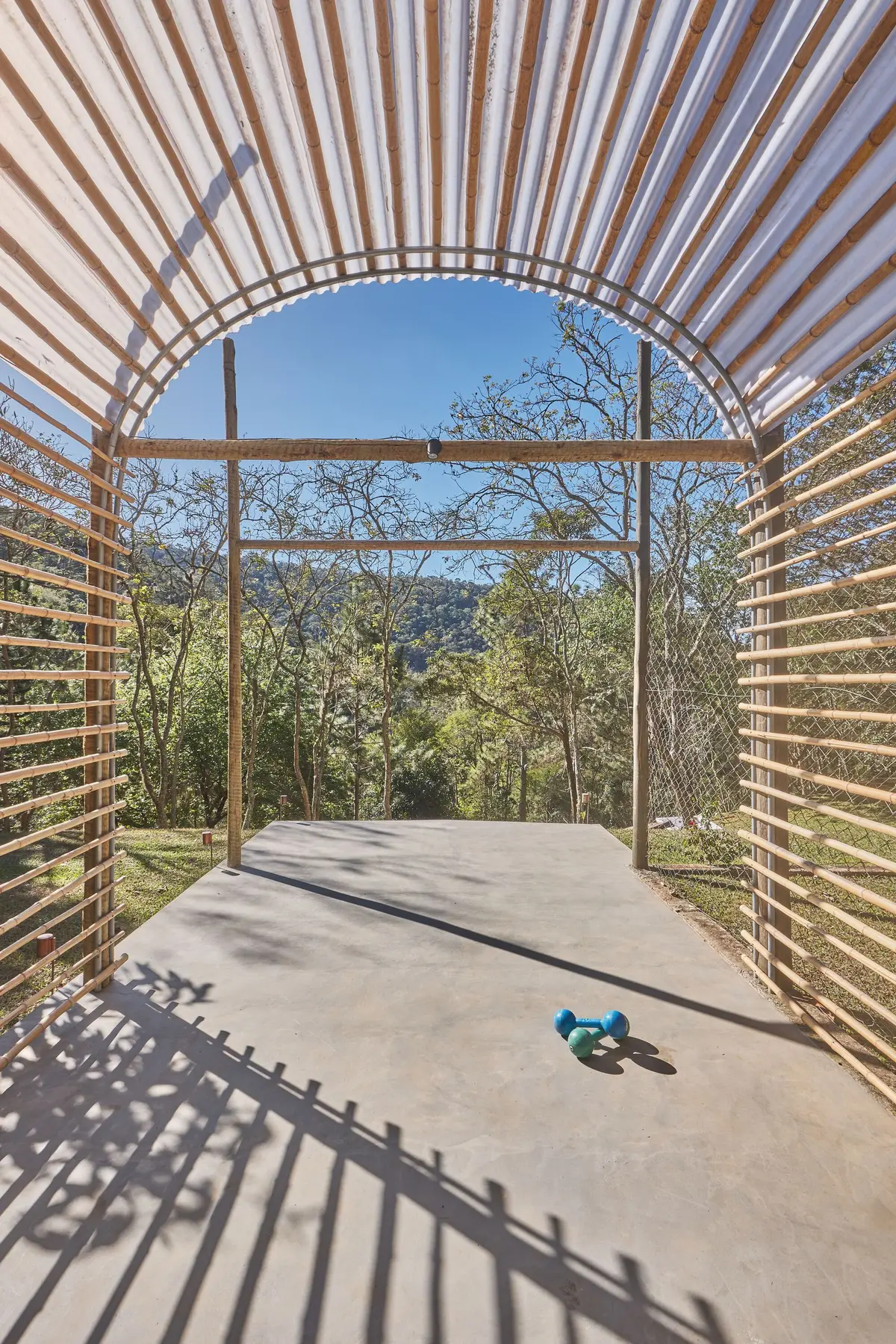
gru.a Wraps a 20-Square-Meter Fitness Shelter in Bamboo and Polycarbonate at Petrópolis
A barrel-vaulted canopy in the Brazilian highlands grafts new materials onto a eucalyptus soccer-field frame to create a place for exercise.


Most architects, given a clearing in the Atlantic Forest highlands with a few weathered eucalyptus posts marking the corners of a makeshift soccer field, would start over. gru.a, the São Paulo studio led by Pedro Varella and Caio Calafate, did the opposite. They kept the posts, read them as a structural gift, and layered a barrel-vaulted shelter onto what was already standing. The result is Academia Shelter, a 20 m² outdoor training canopy in Petrópolis that proves you can build something genuinely elegant with almost nothing.
What makes the project worth studying is not its program, which is modest, but the logic by which it was assembled. The existing eucalyptus verticals accept galvanized steel tubes as arched ribs; bamboo poles fill the gaps; polycarbonate tiles cap the vault to admit light while shedding rain. Every material is cheap, locally available, and legible in the final form. There is no cladding hiding structure, no finish coat smoothing over joints. The building is its own construction drawing.
Grafting New onto Old
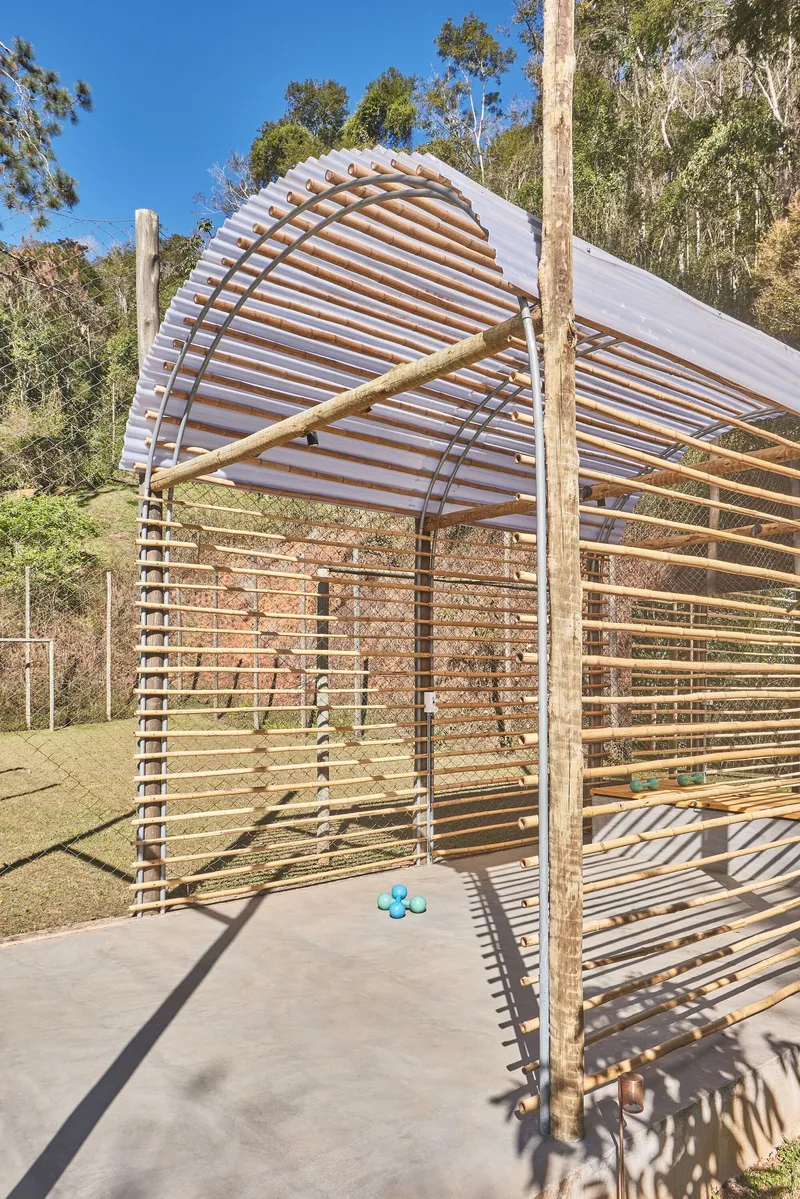
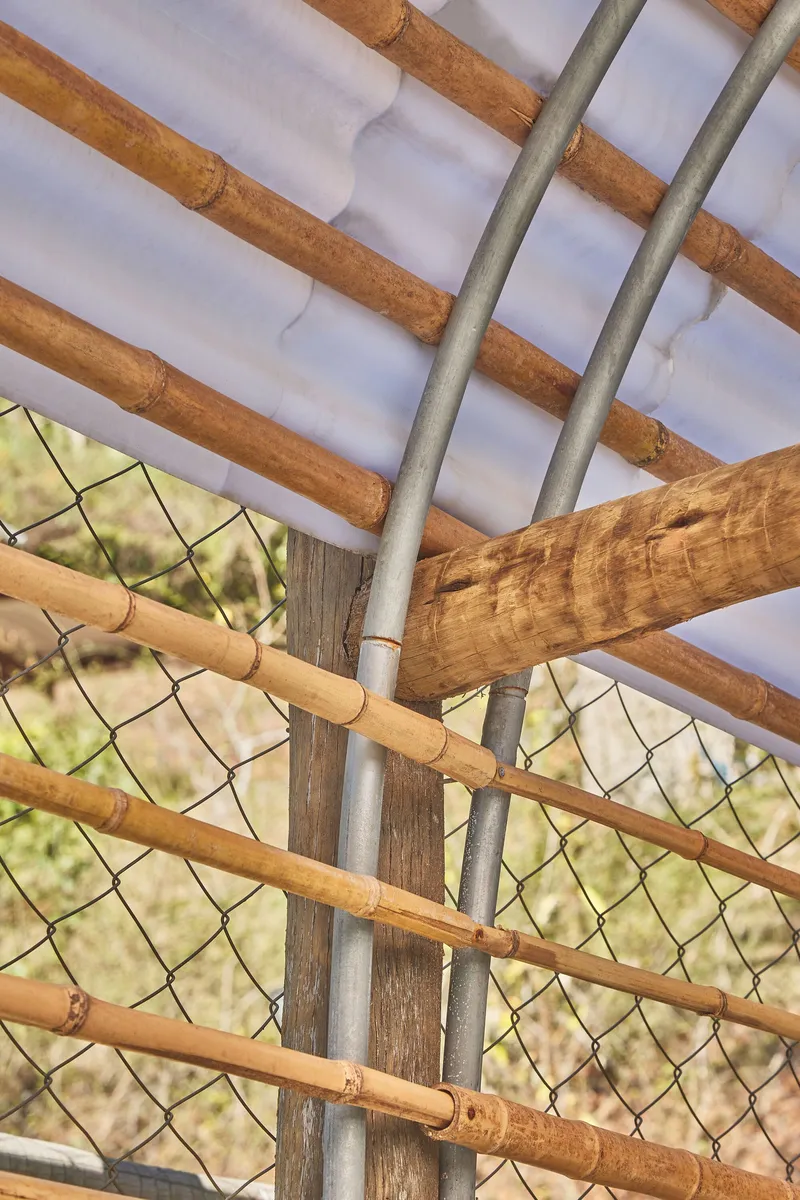
The most revealing detail in the project is the junction point where bamboo poles, chain-link mesh, and galvanized pipe meet the existing eucalyptus columns. There is no attempt to conceal the joint or pretend the materials share an origin. The connection is frank: a steel clamp, a wire tie, maybe a bolt. It looks provisional, and that is precisely the point. The shelter was designed to be additive and reversible, a parasite on a host that was itself already informal.
From the exterior, the arched profile of the polycarbonate canopy rises just high enough above the horizontal slat walls to register as architecture rather than fence. The translucent panels glow faintly in overcast light, giving the vault a lantern quality that signals habitation without shouting.
Filtered Light and the Slatted Enclosure
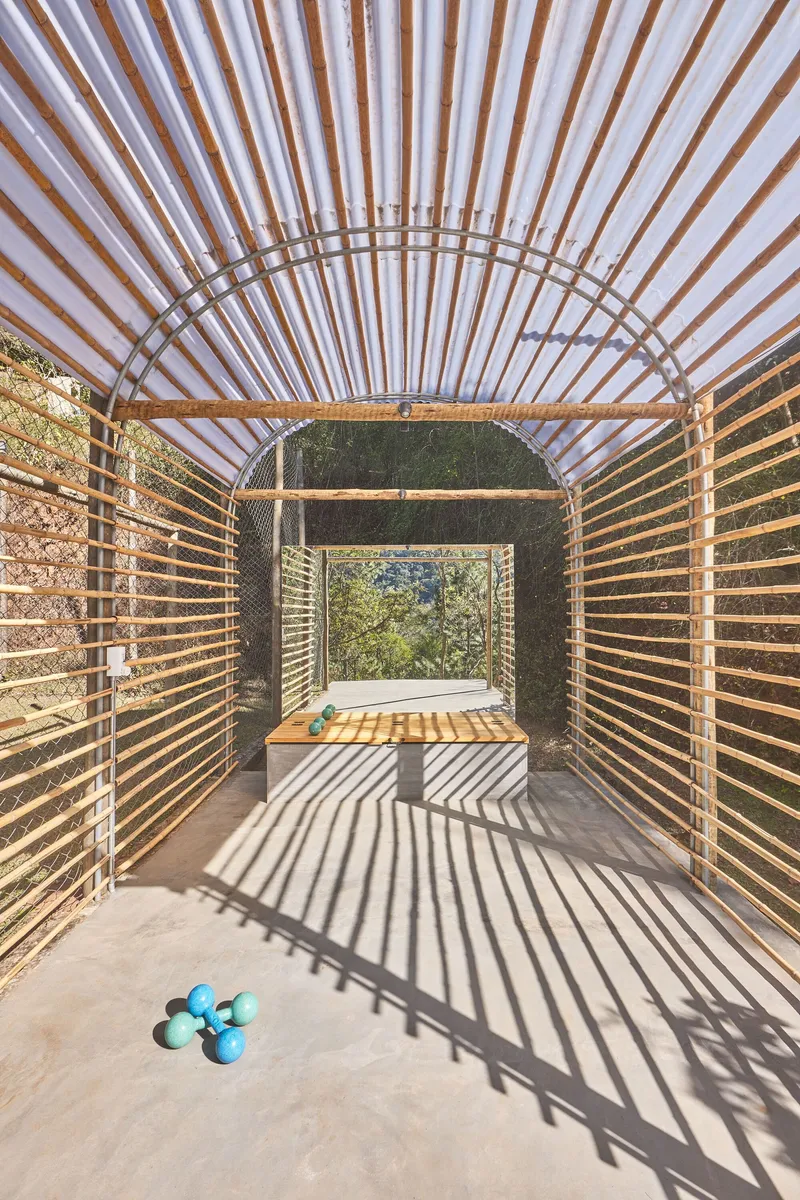
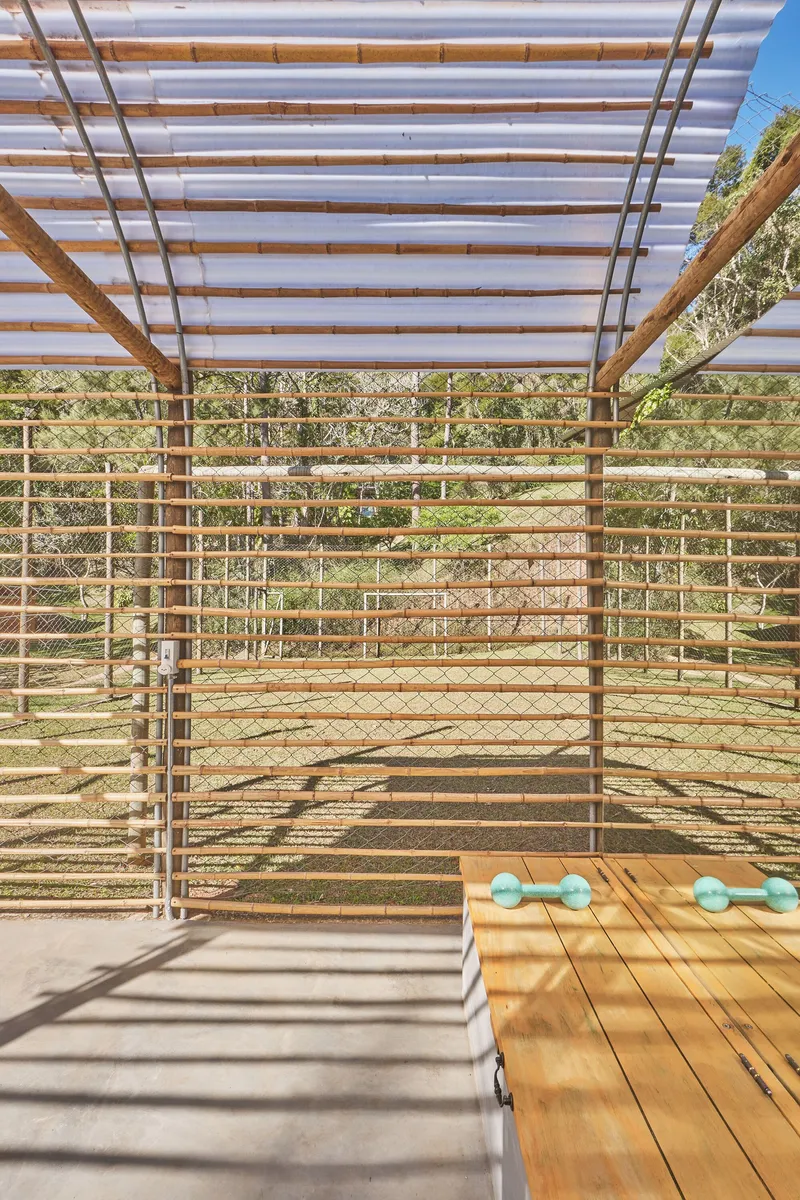
Horizontal timber slats wrap the long sides of the shelter, doing triple duty as privacy screen, wind filter, and light modulator. The gaps between boards are generous enough to keep the interior ventilated in Petrópolis's humid subtropical climate, but tight enough to cast a dense pattern of striped shadows across the concrete floor. On sunny mornings the effect is almost cinematic: parallel lines of light sliding across the slab as the sun moves, marking time the way a sundial would.
Inside, the layered arched ribs of the vault create a rhythmic depth that belies the shelter's compact footprint. Standing at one end, you read six or seven frames receding toward the opposite wall, each rib picking up a slightly different quantity of light. The repetition turns 20 square meters into something that feels like a nave.
Framing the Forest
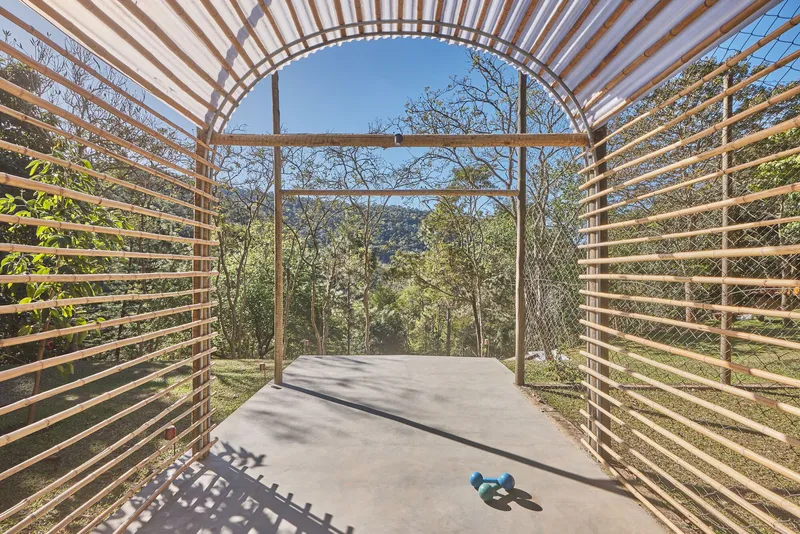
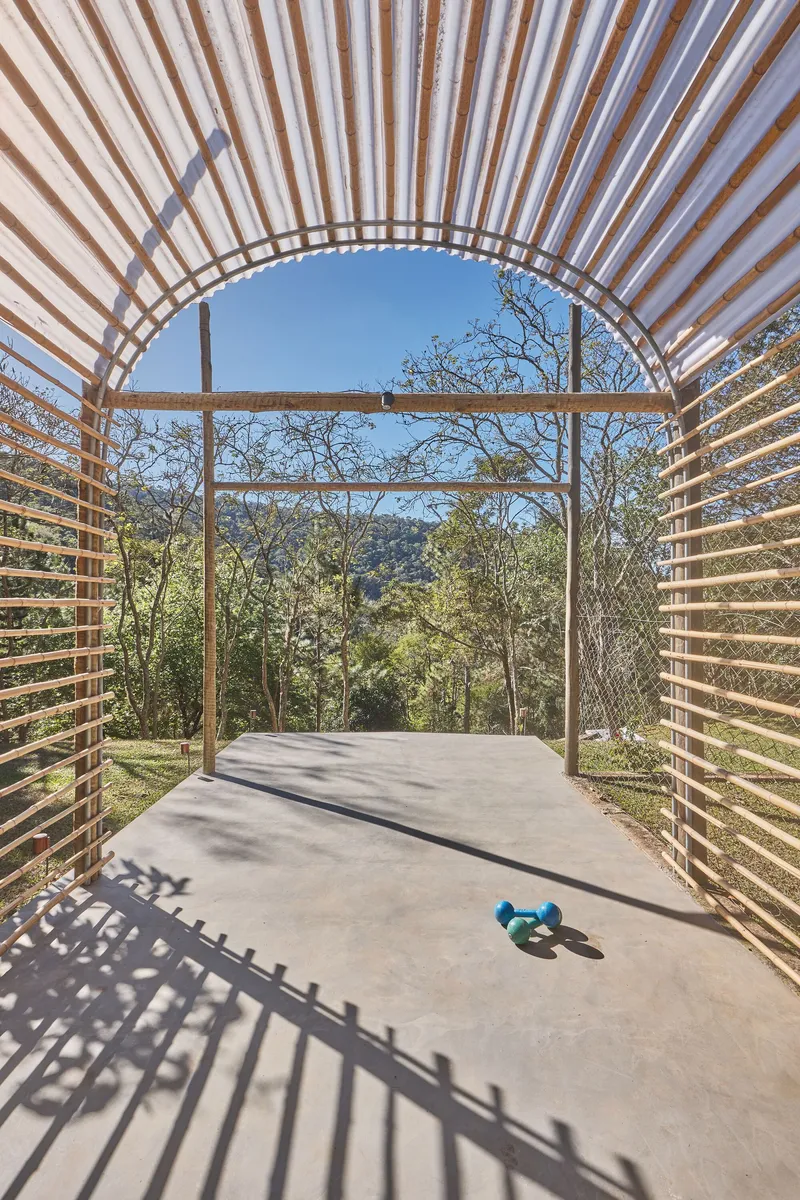
The barrel vault's open ends transform the shelter into a viewing device. From inside, the Atlantic Forest hillside is framed as a deep green panel held between the curve of the roof and the flat plane of the floor. Blue exercise equipment, the only saturated color in the composition, sits casually against this backdrop, reinforcing the building's identity as a place for physical work rather than contemplation. The contrast is useful: it reminds you that this is not a meditation pavilion but a gym, however small and open-air.
The concrete slab anchors the project to the ground with the minimum necessary gesture. It is flat, unpolished, and extends just far enough beyond the vault to define an apron of outdoor space. No plinth, no step, no threshold ceremony. You walk onto it the way you walk onto a basketball court.
Plans and Drawings
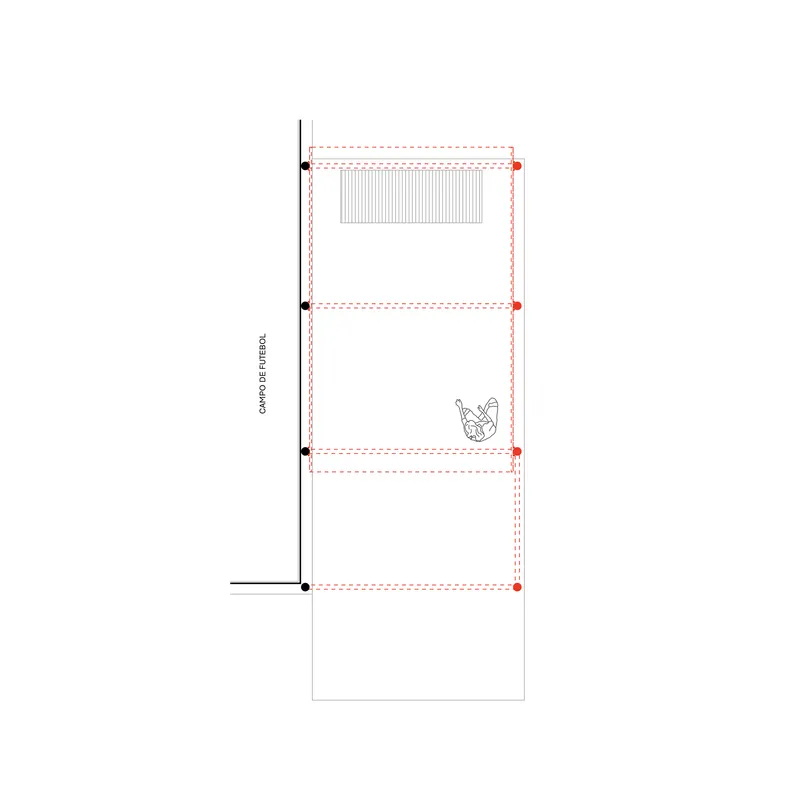
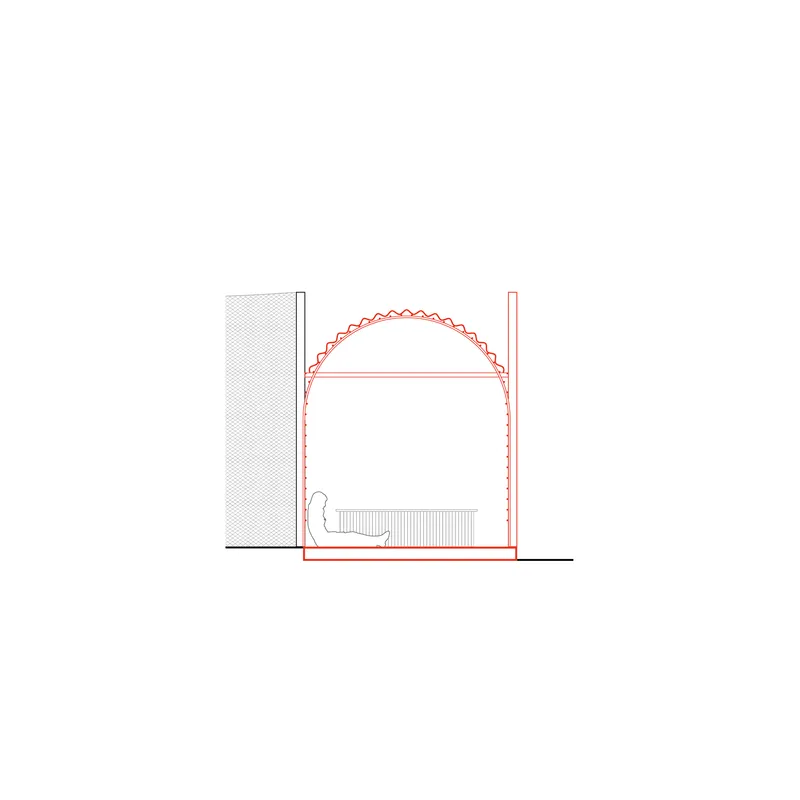
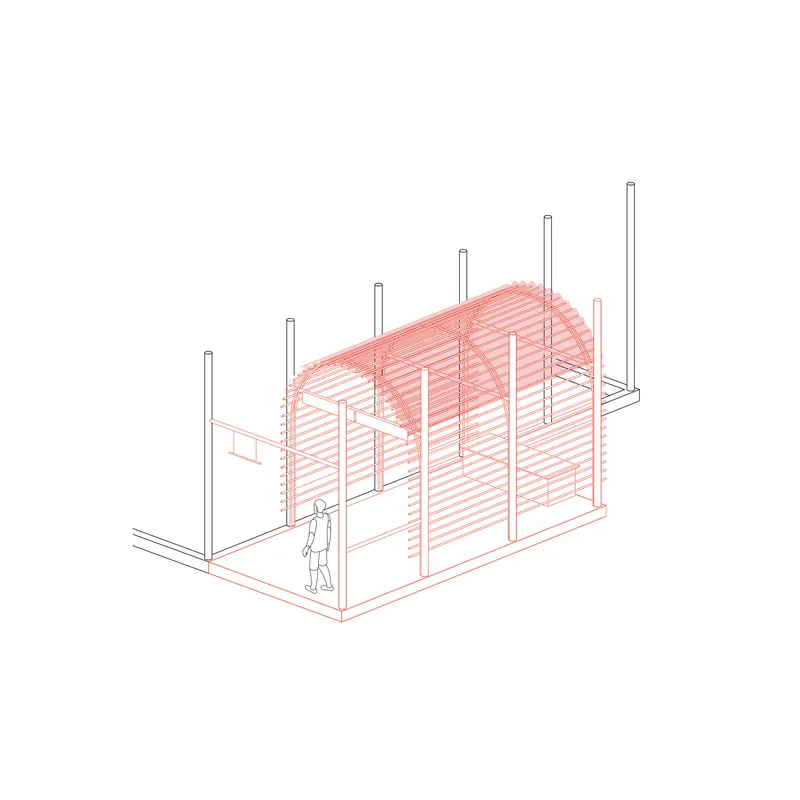
The section drawings reveal a detail invisible in photographs: the shelter sits on a sloped site that drops away on one side, meaning the concrete slab doubles as a retaining element at its downhill edge. The axonometric makes the structural hierarchy explicit. Vertical eucalyptus posts carry arched galvanized ribs, which in turn support the polycarbonate skin. Bamboo infill and slats hang from this frame without bearing load. It is a clear kit of parts, each layer doing one thing.
The section showing the adjacent three-level vertical structure hints at a broader site strategy: the shelter is one episode in a landscape of incremental constructions. It was not conceived as a standalone object but as a new layer added to an evolving compound. That context matters, because it explains why the architects chose to keep the eucalyptus frame rather than replace it. Continuity with the site's own history of making was a design value, not a compromise.
Why This Project Matters
At 20 square meters, Academia Shelter barely qualifies as a building. But its value lies precisely in its refusal to be more than it needs to be. In a discipline obsessed with novelty and authorial gesture, gru.a found a way to be original by being adaptive. They treated an existing structure not as a constraint but as a collaborator, and they chose materials that foreground their own cheapness rather than disguising it. The result is architecture that is honest about its means and generous in its spatial effects.
Projects like this one matter because they expand the definition of what counts as architectural work. Not every commission is a museum or a tower. Sometimes it is a canopy over a patch of concrete where people do pull-ups in the morning mist. The skill is in recognizing that even at this scale, decisions about proportion, enclosure, and light can produce a space that exceeds its program. gru.a understood that, and the shelter is proof.
Academia Shelter by gru.a (Pedro Varella, Caio Calafate). Petrópolis, Brazil. 20 m². Completed 2022. Photography by Rafael Salim.
About the Studio
Share Your Own Work on uni.xyz
If projects like this are the kind of work you want to make, uni.xyz is a place to publish your own, find collaborators, and enter design competitions.


Popular Articles
Popular articles from the community


Cube Design Draws an Ecological Corridor Between Two Shenzhen Hills with the Nankai Building
Beside Shenzhen's container docks, the Nankai Building pairs stacked balconies with a climbing green screen to connect two hillsides across its height.


Manzana Morphosis: Stretching Barcelona's Grid into a Living Landscape for 2050
A radical reworking of the Eixample manzana turns density into a tool for generous public space, vertical ecology, and environmental performance.

Singing Woman: An Opera House That Performs Before the Curtain Rises
Ovidiu Cristian Pavel's conceptual opera house translates Estonia's choral identity into a sculpted waterfront landmark facing the Baltic Sea.

David Ortega Stacks a Two-Story Mexico City Penthouse Around a Steel Stair and a Pergola-Shaded Roof Terrace
In Colonia Roma, a 300 m² penthouse uses oak joinery, a planted steel stair and a slatted roof pergola to make a new-build apartment feel like a house.

Similar Reads
You might also enjoy these articles

LAVA Architecten Gives Vocational Education a Sawtooth-Roofed Face on a Mechelen School Campus
In Mechelen, Belgium, a 2,053 m² STEM school on a 6×6 m grid turns workshops and classrooms into rooms that can be rearranged as teaching changes.

KEMA Studio Turns a Derelict Marvila Attic into a 60 m² Lighthouse Apartment Above Lisbon
In Lisbon's Marvila district, a rebuilt roof, four skylights and two plywood volumes turn an unlivable attic into a bright home facing the Tagus.

Pixel Gardens: One Repeated Module Stacked Into a Terraced Social Housing Tower for Famagusta
Salem Bader's shortlisted housing tower builds a vertical neighbourhood from one repeated module, offsetting units to carve terraces, light and air.

Bao Huynh Watercolor Atelier: A Serene Art Retreat in Hội An
Bao Huynh Watercolor Atelier in Hội An blends multifunctional art spaces, sustainable design, local materials, and family-friendly living in a serene environment.

Explore Shelter Competitions
Discover active competitions in this discipline

Challenge to design a portable theatre

Challenge to design a portable music platform

Challenge to design an open learning module for the elderly
Comments (0)
Please login or sign up to add comments
No comments yet. Be the first to comment!