
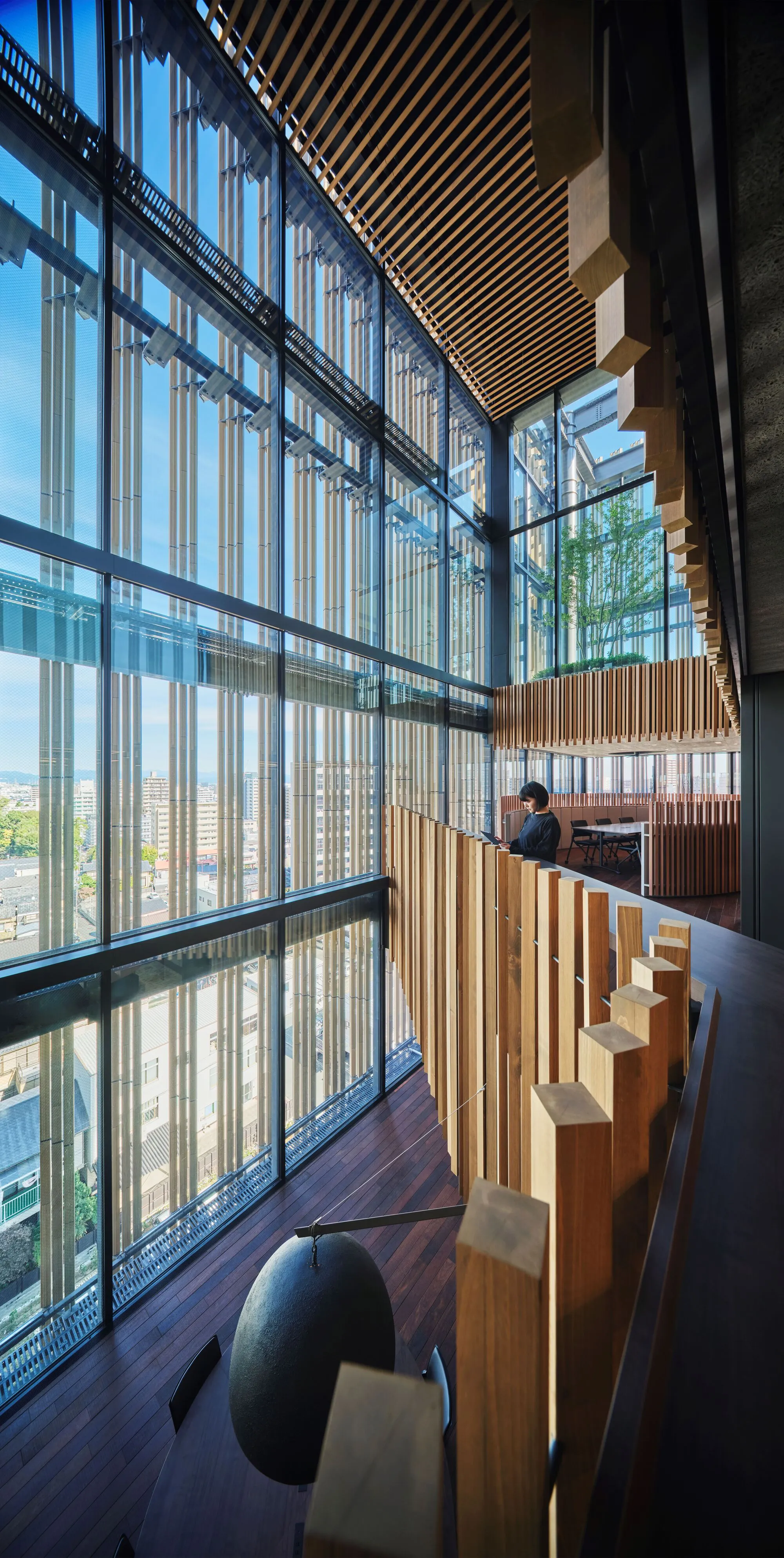
A Bank Headquarters Built Like a Timber Lantern
Nikken Sekkei wraps a Hamamatsu financial institution in terracotta louvers and layered wood, grounding corporate life in craft and climate.


Banks rarely get to be generous buildings. Their architecture tends toward opacity, projecting solidity and discretion in equal measure. The new headquarters and main branch of Hamamatsu Iwata Shinkin Bank, designed by Nikken Sekkei, breaks from that convention. Completed in 2023, the 16,178 square meter complex in Hamamatsu, Japan, treats the corporate workplace as a social instrument: open atria, rooftop terraces, and a consistent language of timber and terracotta that connects every floor to daylight and the city beyond.
What makes the project genuinely interesting is how it reconciles two contradictory ambitions. On one hand, it consolidates what were previously separate operations into a single headquarters designed to accelerate internal decision-making. On the other, it refuses the hermetic, inward-turning floorplate that consolidation usually produces. Instead, the building opens itself up: to views of a neighboring temple, to natural ventilation, and to the kind of informal encounter spaces that flatten hierarchy. The timber louver screen that wraps the tower is not decoration. It is the mechanism through which the building manages solar gain, frames the city, and announces a particular institutional identity rooted in the craft traditions of the Shizuoka region.
The Louver Facade as Climate Strategy
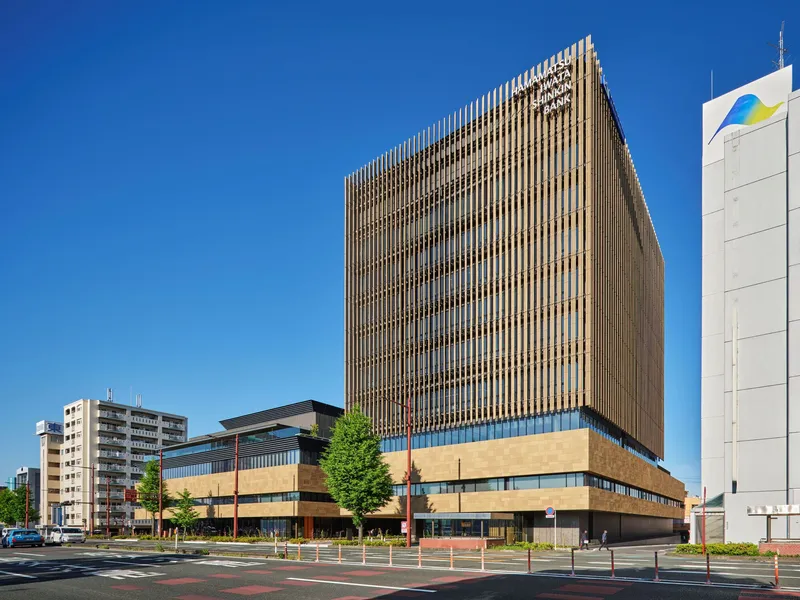
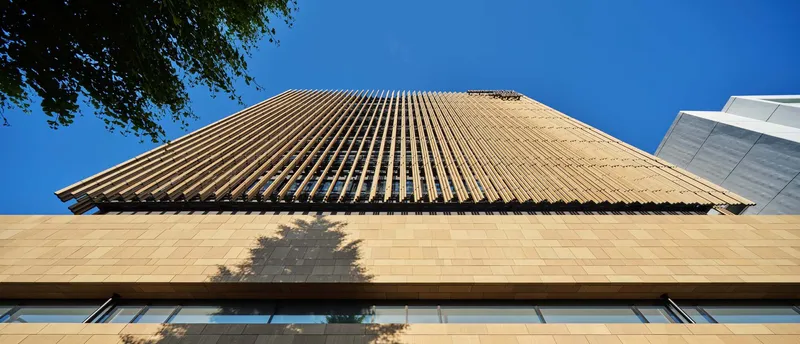
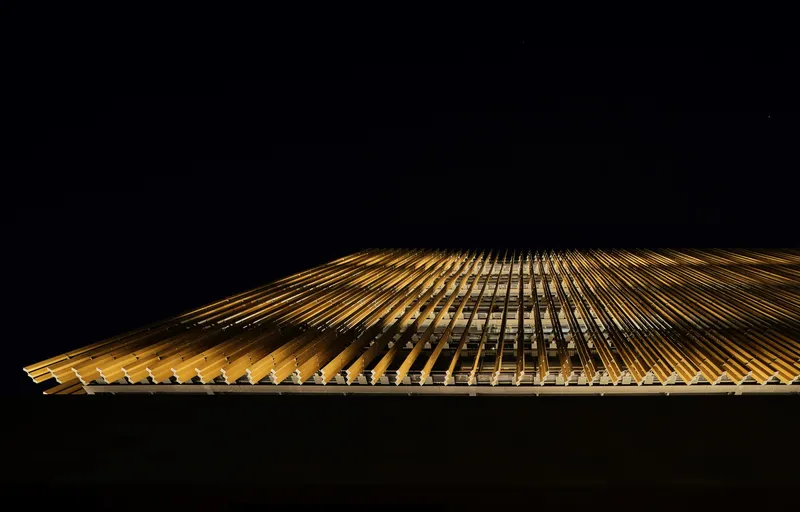
The tower's defining gesture is its vertical brise-soleil, a grid of terracotta louvers mounted over a pale stone and glass base. Seen from the street, the facade reads as a warm, permeable screen, shifting from translucent to opaque depending on the light and angle. At night, the louvers glow from within, transforming the building into a lantern. During the day, they do serious environmental work, cutting solar heat gain on the southern and western exposures while still admitting diffused light to the perimeter offices.
The cantilevered louver canopy at the lower levels projects shadow patterns onto the stone base, softening the transition between public sidewalk and institutional entrance. It is a detail that rewards attention: the louvers are not timber but terracotta, chosen for durability and fire resistance while maintaining the warmth and texture that timber would provide. The material palette reads as honest. Nothing here pretends to be something it is not.
Two Volumes and a Temple
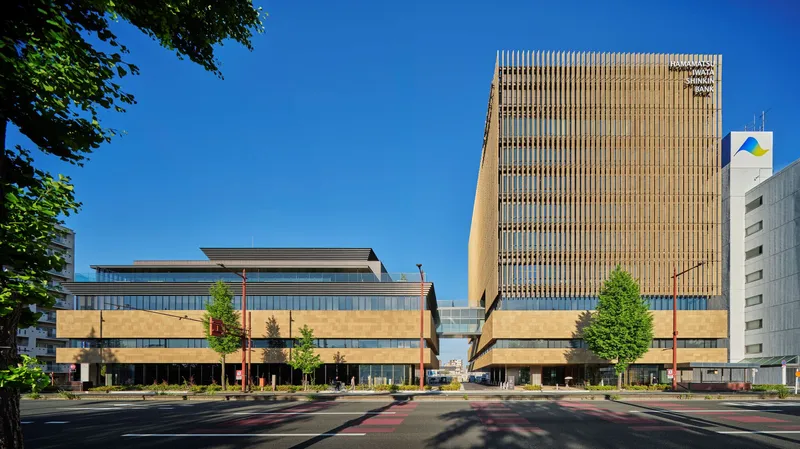
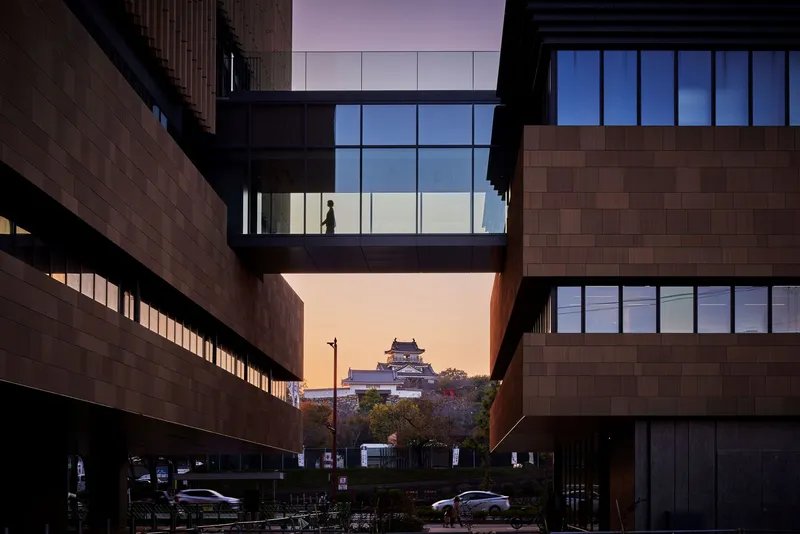
The complex is organized as two distinct volumes: a low-rise horizontal block and the taller office tower, separated by a gap that serves as a framed courtyard view toward an adjacent temple. At dusk, that gap becomes a cinematic aperture, the timber-clad masses receding to either side while the temple's traditional silhouette holds the center. It is a remarkably deliberate piece of urban choreography for a financial headquarters, one that acknowledges the building's context rather than dominating it.
The dual-volume arrangement also creates practical advantages: separate functional identities for public banking and private office operations, distinct circulation paths, and the possibility of phased occupation. The parking lot and street frontage are handled with restraint, allowing the building masses themselves to define the block rather than surrendering it to infrastructure.
The Atrium as Organizational Spine
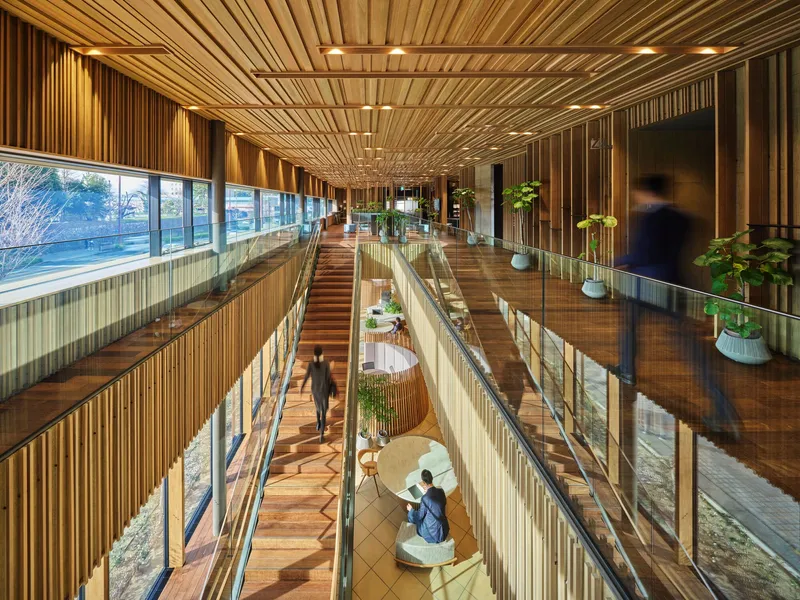
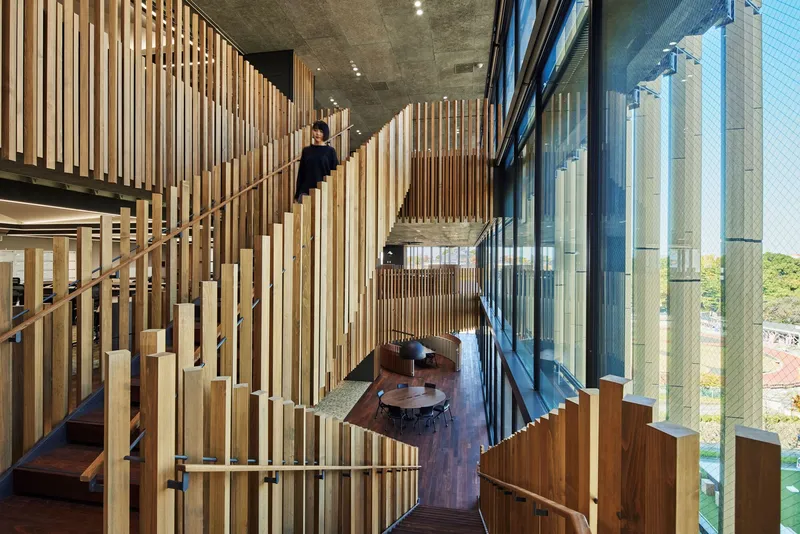
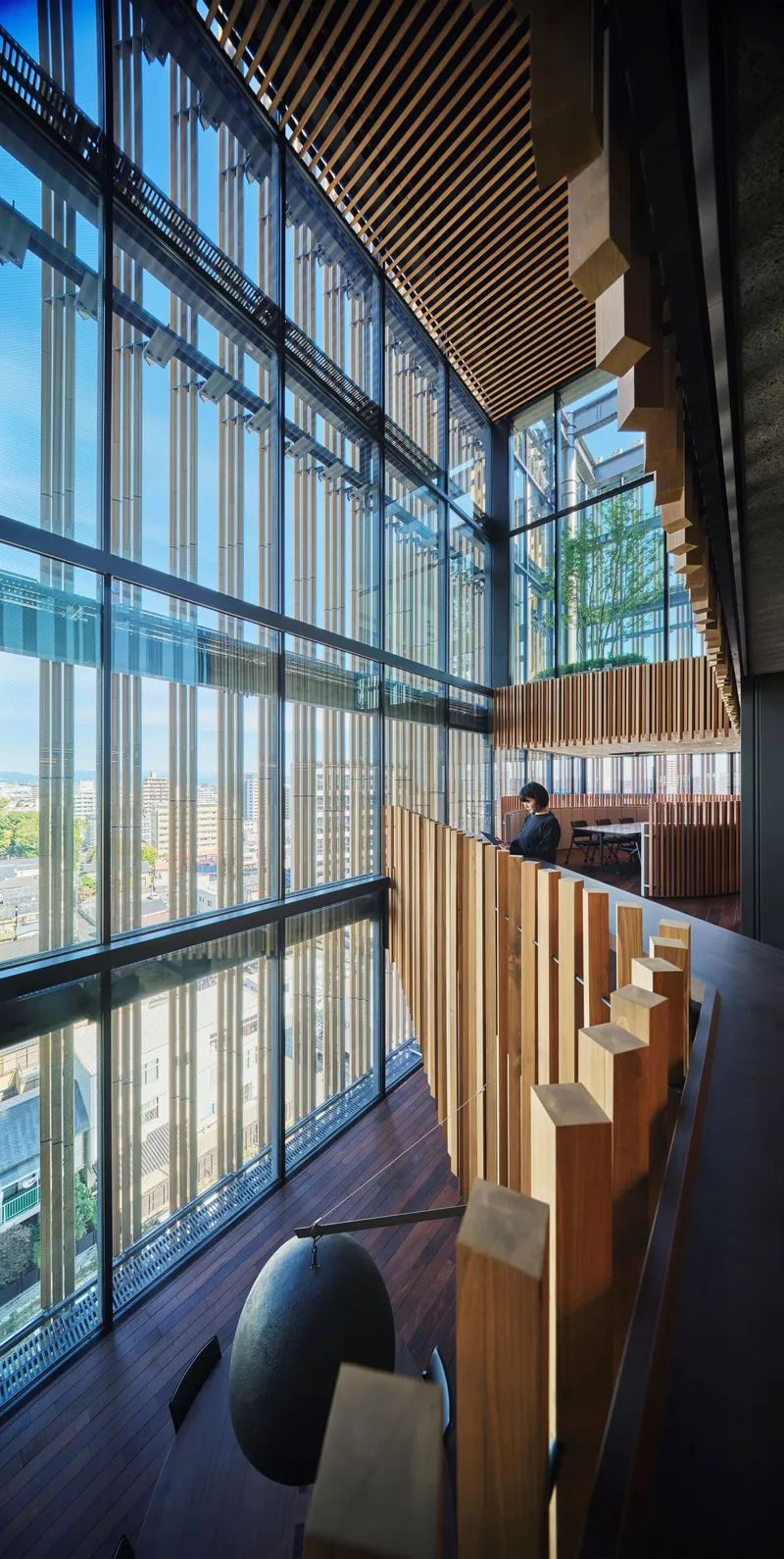
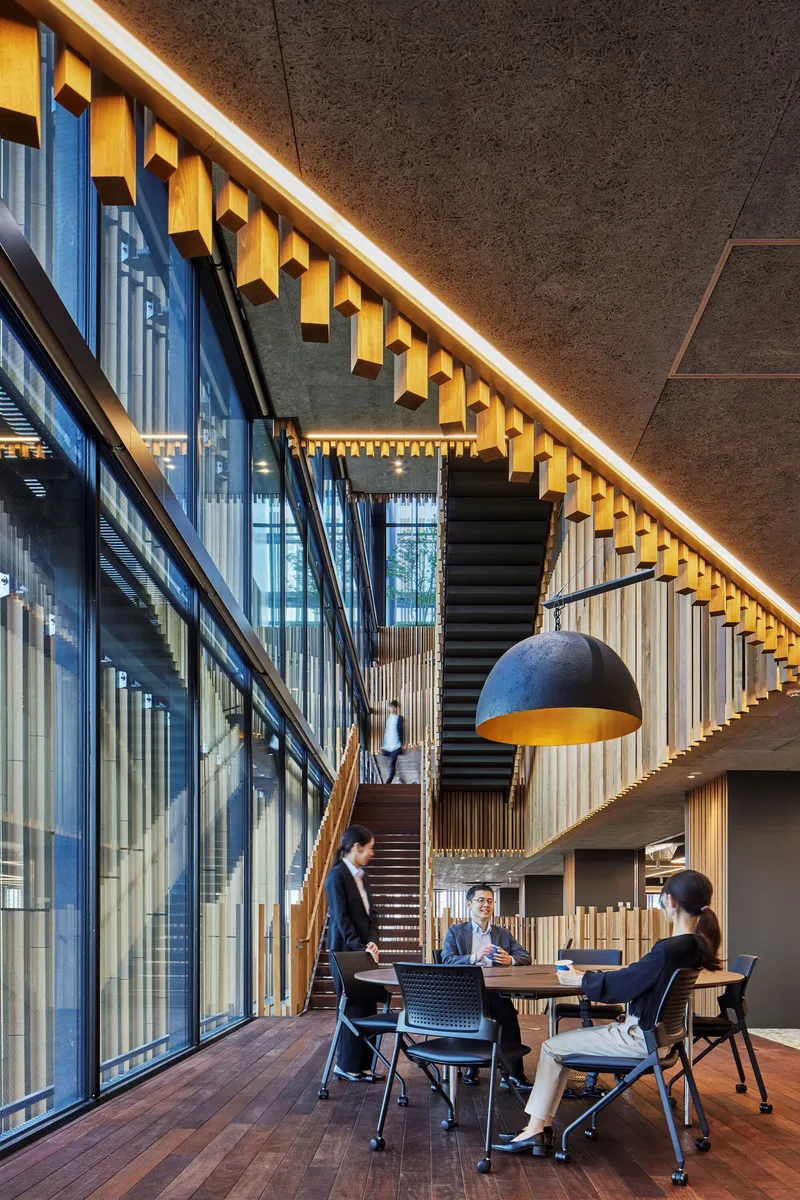
The multi-story atrium is the social engine of the building. Rising through several floors, it is lined with timber slat screens and glass railings, with potted plants distributed across levels to bring greenery into the section. The timber slat ceiling above is both acoustic treatment and visual warmth, pulling your eye upward and giving the space a domestic scale despite its institutional program.
Views through the vertical timber battens toward the glazed facade create layered depth: you are always aware of the exterior, always oriented. Figures on stairs and in seating areas are visible across floors, reinforcing the visual connectivity that the client apparently sought. The atrium is not a grand void for its own sake. It is a device for making a large organization feel smaller, for creating the casual sightlines that encourage conversation between departments that might otherwise never interact.
Workspaces Between Formality and Flexibility
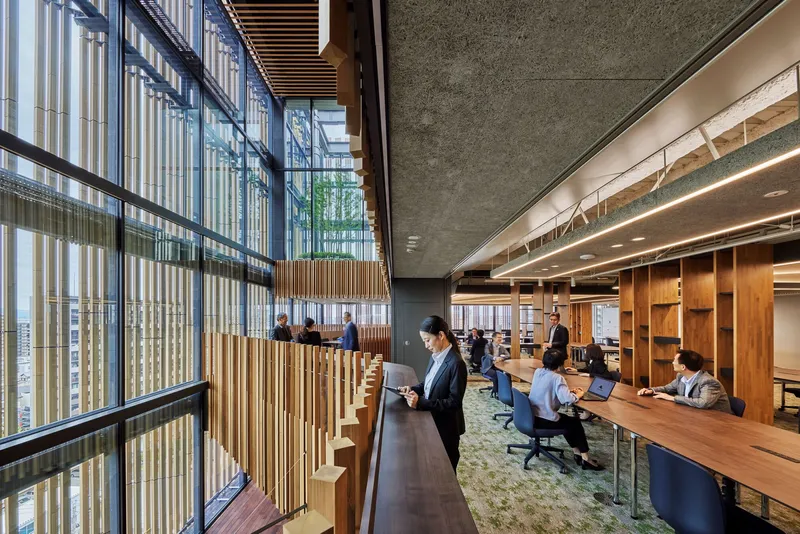
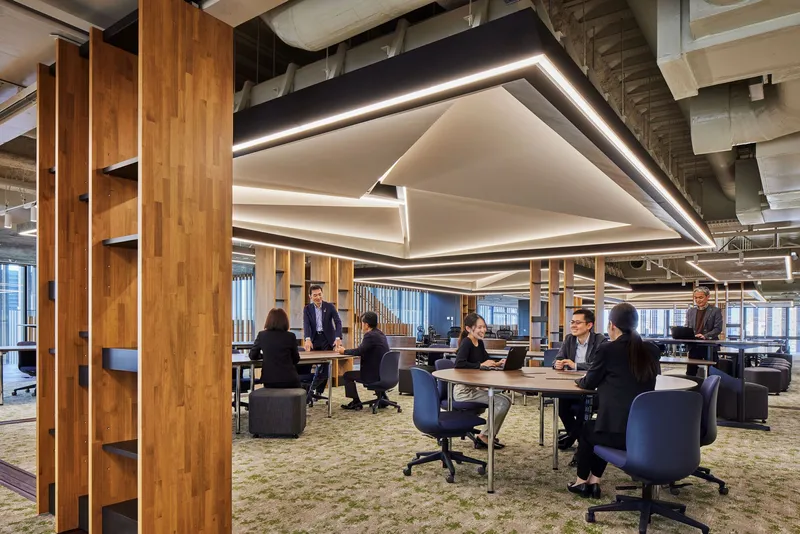
The office floors move through a spectrum of formality. Open workspaces with timber desks sit beside vertical wood slat screens and floor-to-ceiling glazing, establishing a perimeter zone that benefits from daylight and views. Deeper in the plan, collaborative tables cluster beneath suspended geometric light fixtures, giving the interior a workshop quality that is far from the fluorescent grid ceiling of a typical Japanese corporate office.
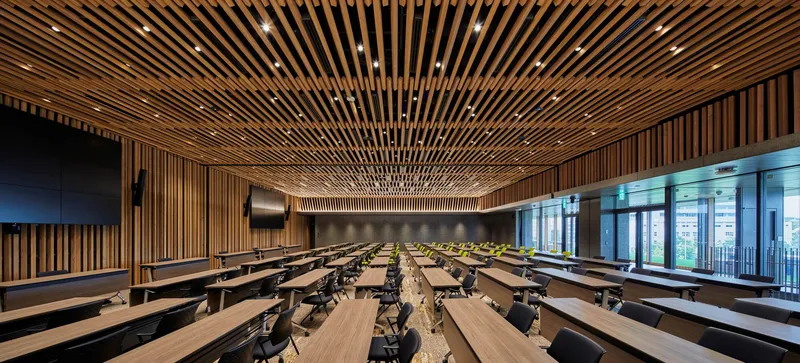
Meeting areas introduce color sparingly: yellow acoustic baffles hang above a discussion zone adjacent to a timber staircase, marking the space as distinct without overwhelming the restrained material palette. A lecture hall with a radiating timber slat ceiling and rows of desks facing full-height windows gives formal presentations the benefit of natural light. Every workspace is calibrated to its purpose, but none feels locked into a single use.
Arrival and Reception
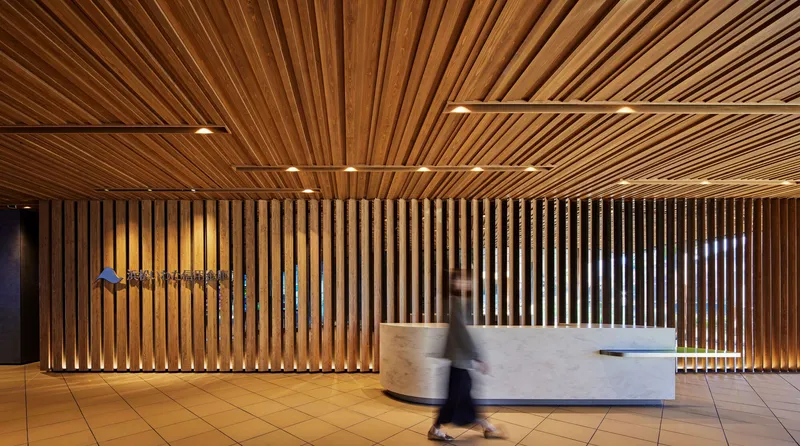
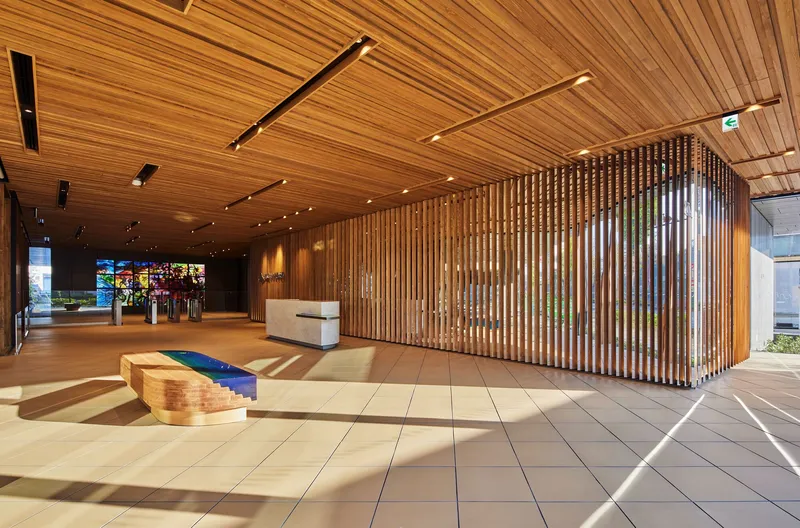
The entrance sequence is handled with confidence. The lobby reception desk sits beneath a radiating slatted ceiling, its timber slat wall wrapping around to create a continuous surface that guides visitors inward. A carved wooden bench receives sunlight through the glazed entrance wall, a small gesture that signals warmth and patience in a building type not usually associated with either.
The transition from street to interior is graduated: the louver canopy outside, the stone base, the glazed threshold, and then the timber-wrapped lobby. Each layer peels back a degree of exposure, so that by the time you reach the reception desk, the city has receded and the building's own atmosphere has taken hold. The lecture hall, located in the lower volume, mirrors this quality of contained warmth, its ceiling slats radiating from a central point like a sunburst.
Rooftop and Terrace Life
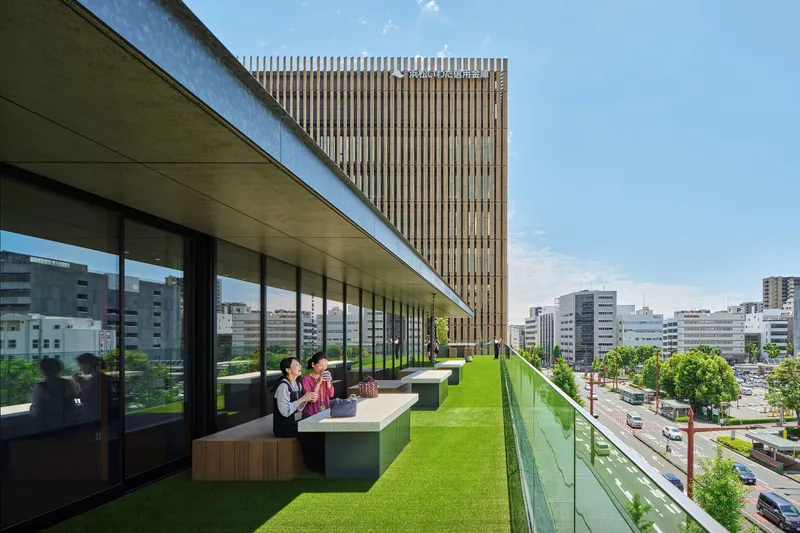
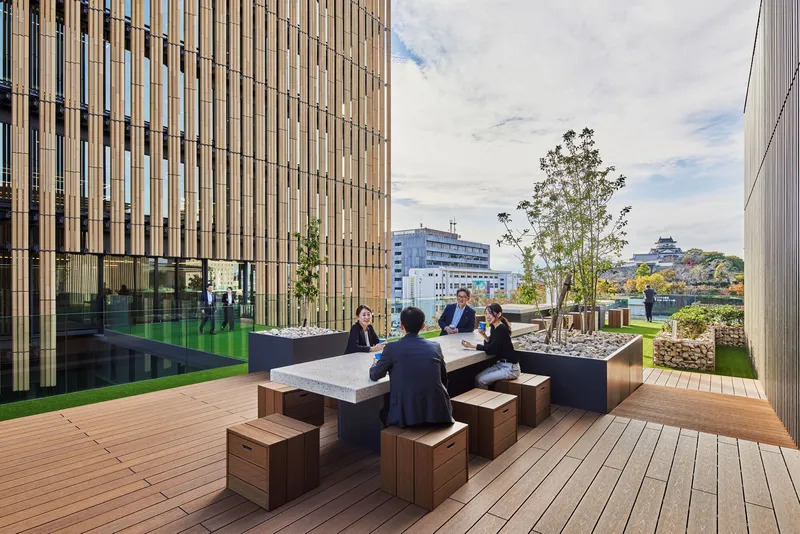
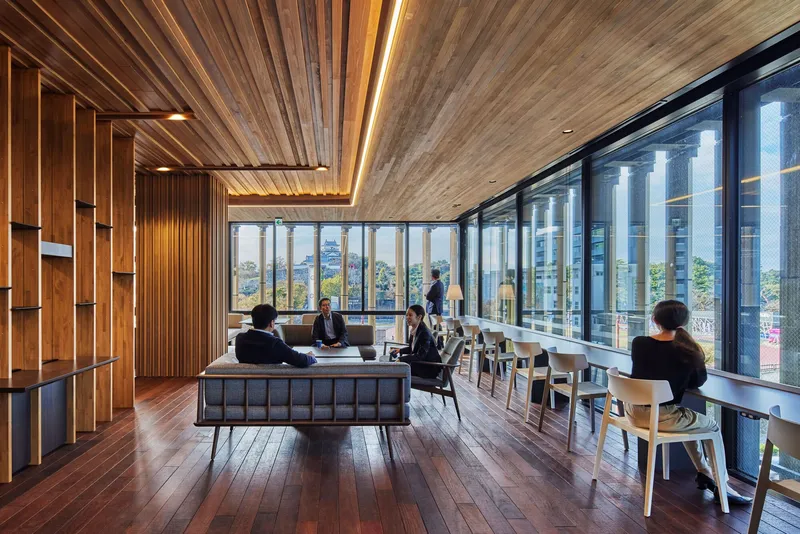
The rooftop terraces are treated as genuine amenity rather than afterthought. One features artificial grass and bench seating behind a glass balustrade, offering panoramic views across Hamamatsu's low-rise urban fabric. Another uses timber decking and more intimate seating arrangements, oriented toward a distant temple and mature trees. An upper-floor lounge with floor-to-ceiling glazing and a timber ceiling extends the terrace experience inward for days when the weather does not cooperate.
These outdoor spaces serve a real function in a workplace culture that prizes long hours and collective effort. They offer decompression without requiring anyone to leave the building, and they reinforce the visual connection to the surrounding neighborhood that the architects clearly worked hard to establish. The glass balustrades keep the views clean and the sightlines unbroken. Nothing competes with the sky.
Plans and Drawings
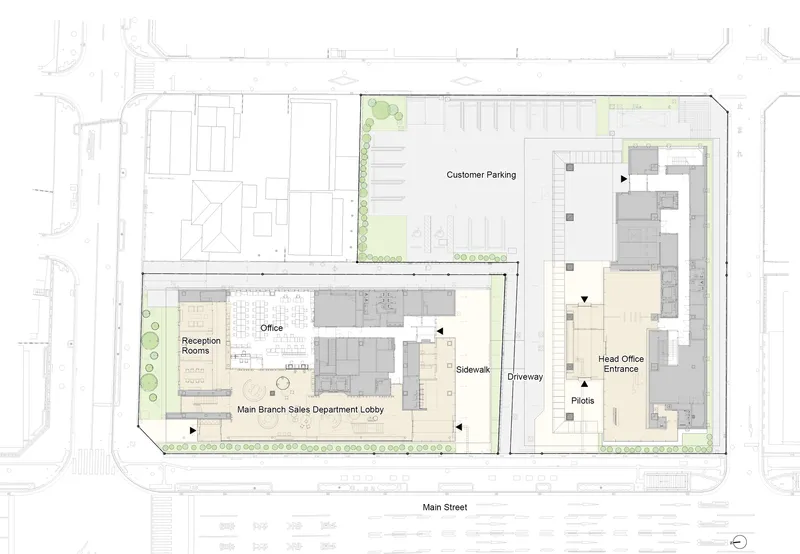
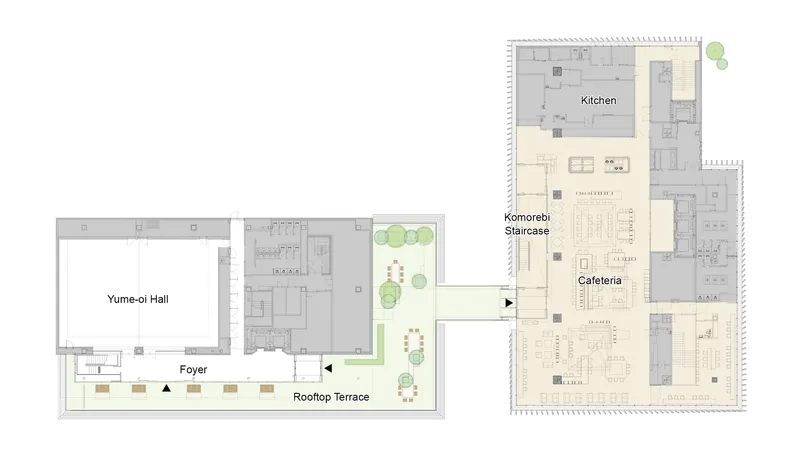
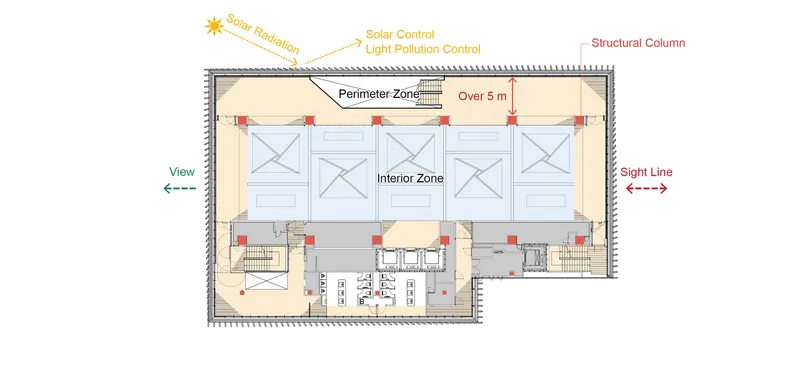
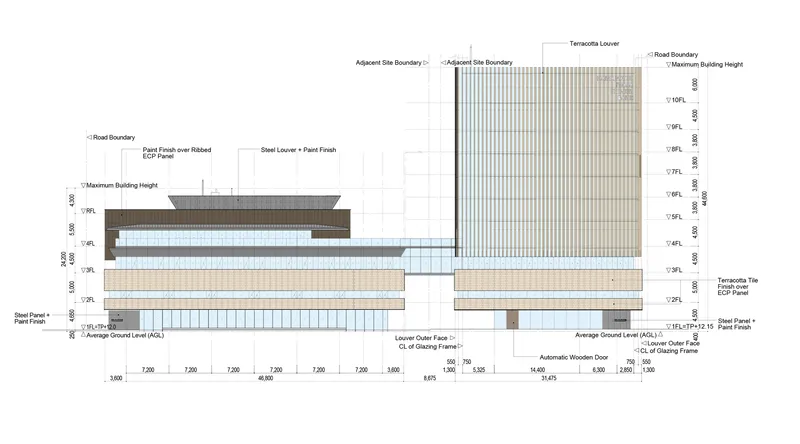
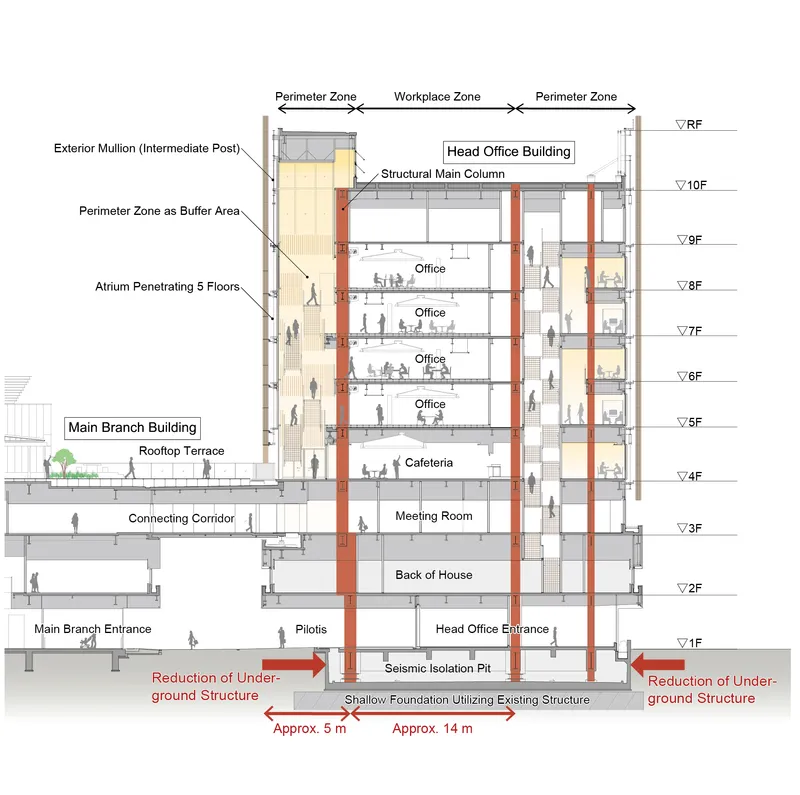
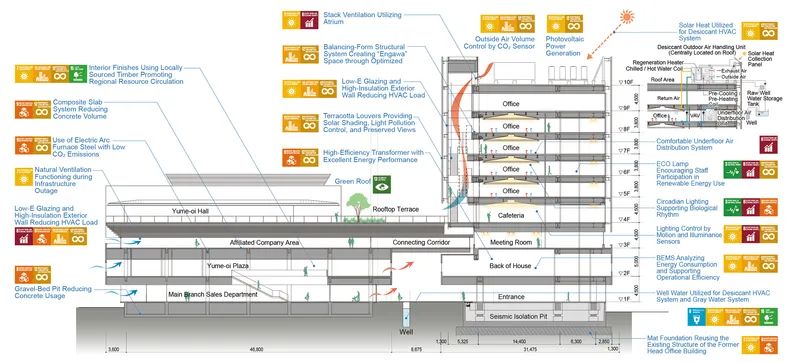
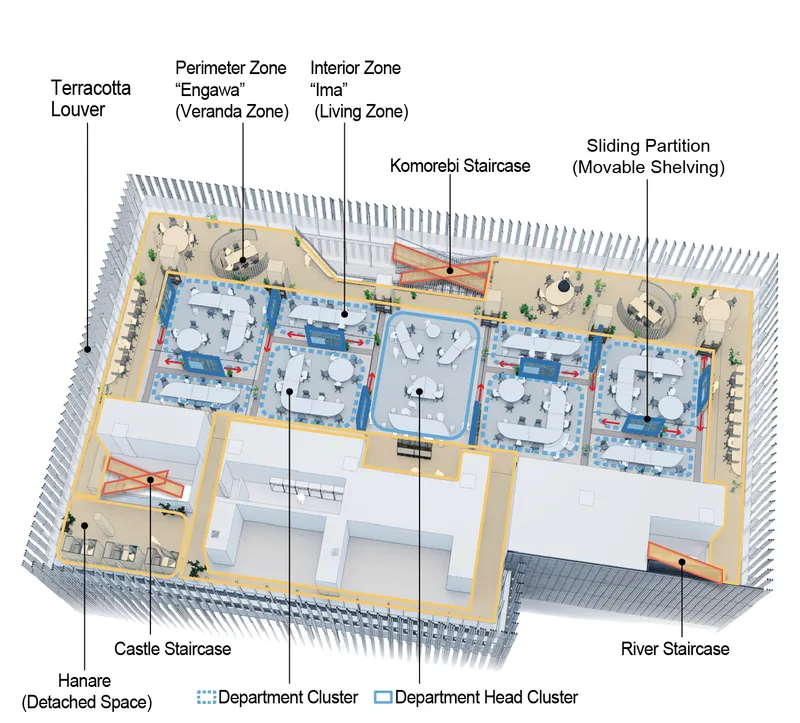
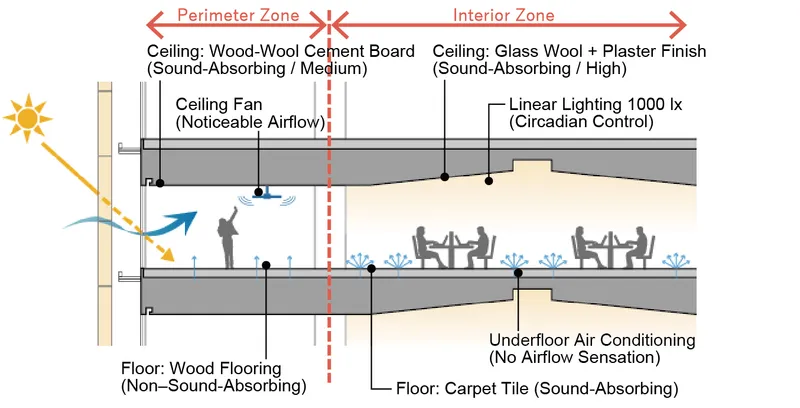
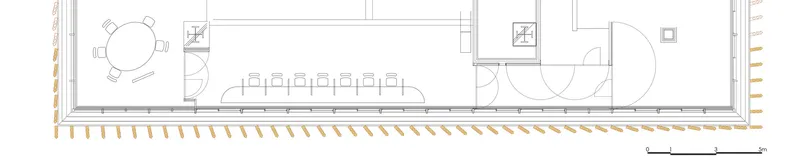
The drawings reveal the rigor behind the building's relaxed appearance. The site plan confirms the deliberate separation of the two volumes and the framed view corridor toward the temple. Floor plans show a clear distinction between perimeter zones, where solar control and natural light are prioritized, and interior zones that rely on underfloor air conditioning and controlled artificial lighting. The section drawings are particularly revealing: a seismic isolation pit sits beneath the structure, a green roof caps it, and between those extremes, natural ventilation pathways and solar shading strategies are annotated with the kind of thoroughness that suggests the environmental performance is not aspirational but engineered.
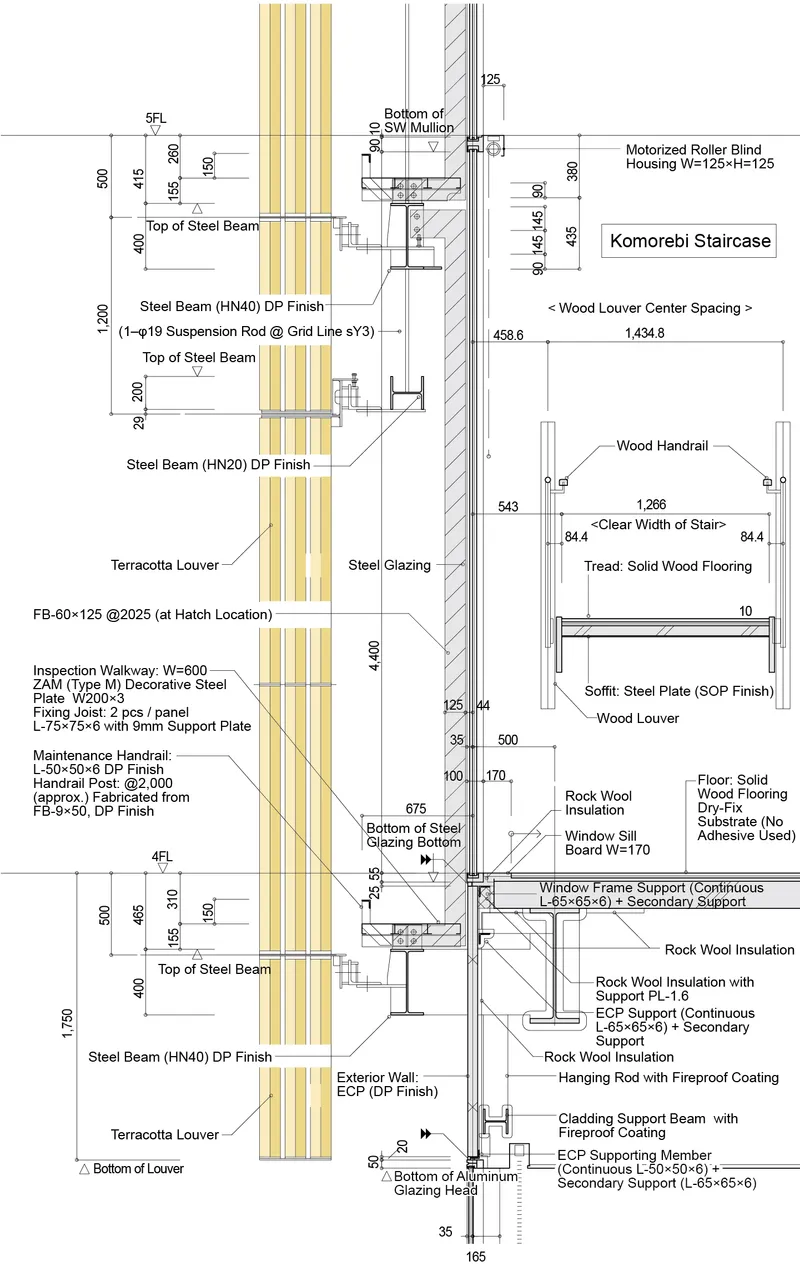
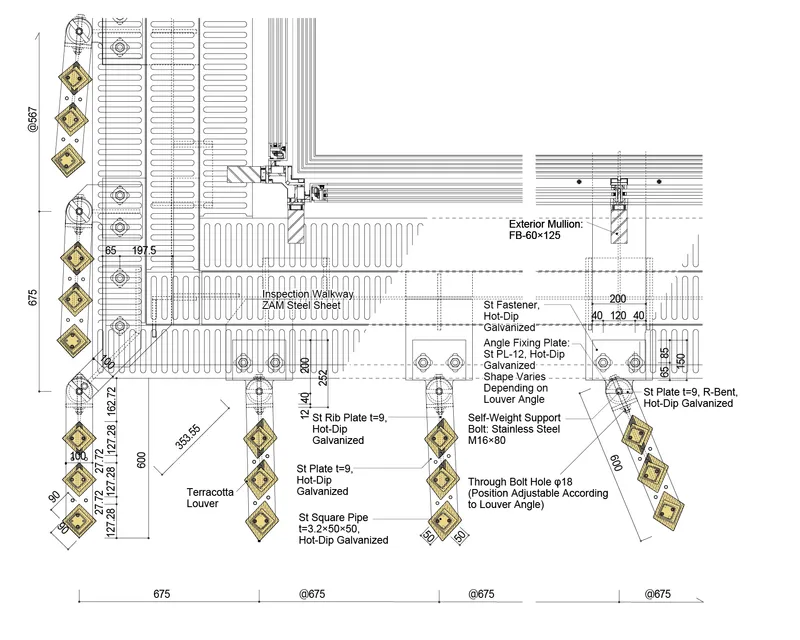
The detailed wall section and plan details of the mullion connections show the terracotta louvers attached via hot-dip galvanized steel plates, with rock wool insulation layered behind the rainscreen. The axonometric drawing of a typical floor illustrates how sliding partitions allow departments to reconfigure their territory, a practical acknowledgment that the organizational chart of a regional bank is not a fixed thing. Even the small floor plan showing a round table, dining table, and bathroom fixtures suggests that executive hospitality spaces received the same level of attention as the public banking hall.
Why This Project Matters
Hamamatsu Iwata Shinkin Bank's new headquarters matters because it demonstrates that a regional financial institution can commission architecture that is simultaneously rigorous and humane. Nikken Sekkei, a firm capable of enormous scale, shows discipline in restraint here: a limited material palette applied consistently, environmental strategies that are integrated rather than appended, and an urban posture that respects its neighbors. The building does not shout. It earns attention through craft, detail, and a clear idea about what a workplace should feel like.
More broadly, the project suggests a model for institutional architecture in Japan's secondary cities. Hamamatsu is not Tokyo or Osaka. Its skyline is modest, its pace different. A building that uses terracotta louvers, timber interiors, and framed temple views to root itself in a specific place, rather than defaulting to the generic glass tower of global finance, makes a quiet argument for locality. In an era when corporate architecture tends toward placelessness, that argument is worth hearing.
Hamamatsu Iwata Shinkin Bank Head Office and Main Branch by Nikken Sekkei. Hamamatsu, Japan. 16,178 m². Completed 2023.
About the Studio
Share Your Own Work on uni.xyz
If projects like this are the kind of work you want to make, uni.xyz is a place to publish your own, find collaborators, and enter design competitions.




Popular Articles
Popular articles from the community


Co-Life: Senior Housing Design That Reconnects Older Adults With the City
Co-Life reimagines senior housing design through healing gardens, shared streets, workshops, and a sustainable community across generations.

Co-life: Sustainable Architecture for Age-Friendly Community Living
Co-life reimagines sustainable architecture for seniors through courtyards, rammed earth, shared gardens, and spaces designed for belonging.

The Musturak Paradise: Senior Living Architecture for a Connected Future in Temara, Morocco
The Musturak Paradise reimagines senior living architecture in Temara via private homes, social spaces, culture, community, and shared care.

Conexión: Biophilic Design Reimagines High-Rise Living in Hong Kong
Conexión reimagines high-rise living in Hong Kong through biophilic design, green facades, shared spaces, daylight, water and nature within.


Similar Reads
You might also enjoy these articles

Bao Huynh Watercolor Atelier: A Serene Art Retreat in Hội An
Bao Huynh Watercolor Atelier in Hội An blends multifunctional art spaces, sustainable design, local materials, and family-friendly living in a serene environment.

Atelier Macri Concept Store Interior Design by CASE-REAL
Atelier Macri store features a "ko" counter, walnut wood details, cork displays, blending retail, gallery, and seamless customer experiences.

Manuel Vargas Izquierdo Stadium and High-Performance Sports Center: Architectural Excellence in Jalpa de Méndez
The Manuel Vargas Izquierdo Stadium blends sustainable design, inclusive sports facilities, and cultural-inspired architecture, revitalizing Jalpa de Méndez’s public spaces.
KAKR Buluh Awar Hall: Revitalizing Community and Ecology Through Bamboo Architecture
Community built bamboo hall revitalizes Buluh Awar village, empowering youth, restoring ecology, celebrating vernacular craftsmanship through sustainable architecture and culture.





Comments (0)
Please login or sign up to add comments
No comments yet. Be the first to comment!