
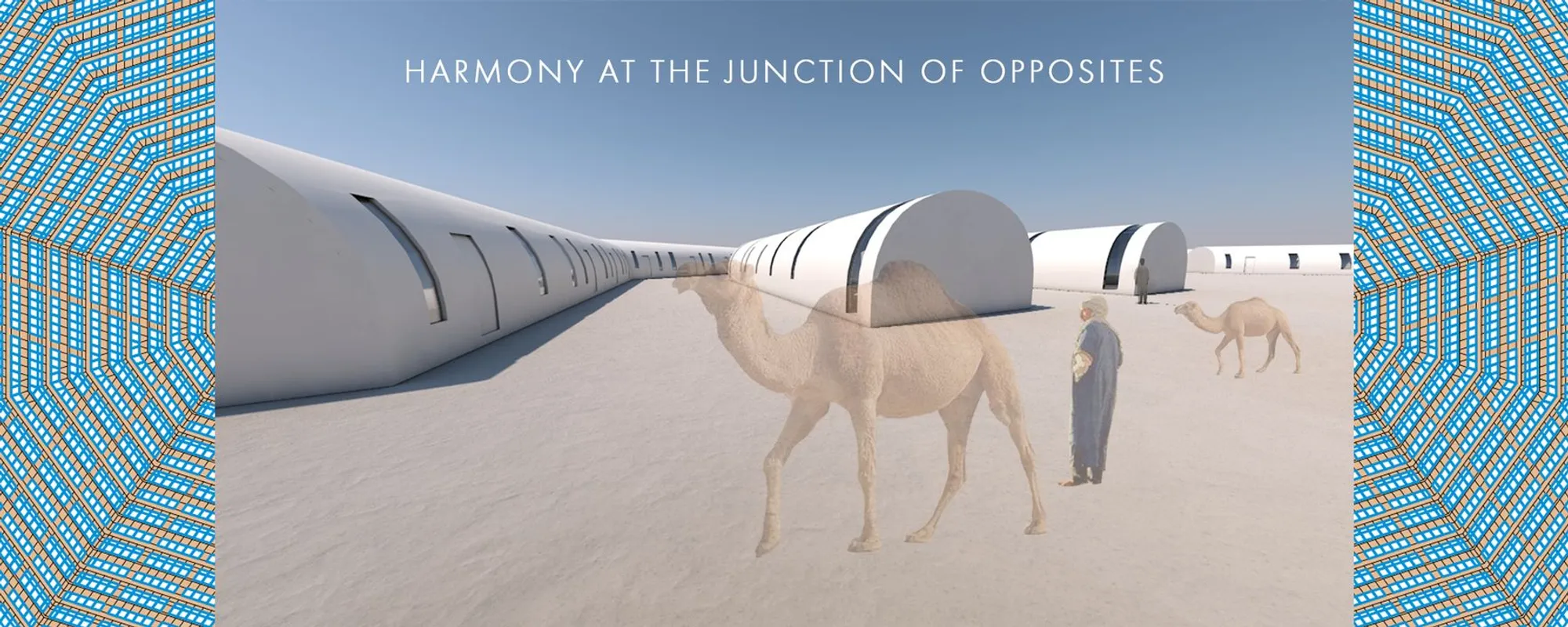
Harmony at the Junction of Opposites: Penrose Geometry Meets Desert Habitat
A modular settlement in Mauritania draws on quasicrystal patterns, Islamic ornamentation, and the Eye of the Sahara to reconcile nature with technology.


What if the mathematical pattern underlying quasicrystals could organize an entire desert settlement? In the stony expanses of Mauritania, a visionary habitat proposal takes the Penrose mosaic, a geometric system of infinite non-repeating order, and transforms it into a concentric urban grid of modular, self-shading structures. The result is a settlement that reads simultaneously as cosmic diagram and climate-responsive architecture, where ring roads, arched vaults, and Mashrabiya lattice screens grow outward from a communal core like the geological strata of the Richat Structure itself.
"Harmony at the Junction of Opposites" is designed by Мария Крылова and Рена Алиева. Inspired by the Eye of the Sahara, the striking geological formation also known as the Richat Structure, the project reinterprets the golden section and Penrose tiling as both urban plan and spiritual metaphor. The architectural language bridges Islamic Girih and Islami ornamentation with the rational order of mathematics, proposing a settlement that celebrates the coexistence of opposites: art and science, faith and reason, nature and technology.
Concentric Rings Radiating from a Communal Core
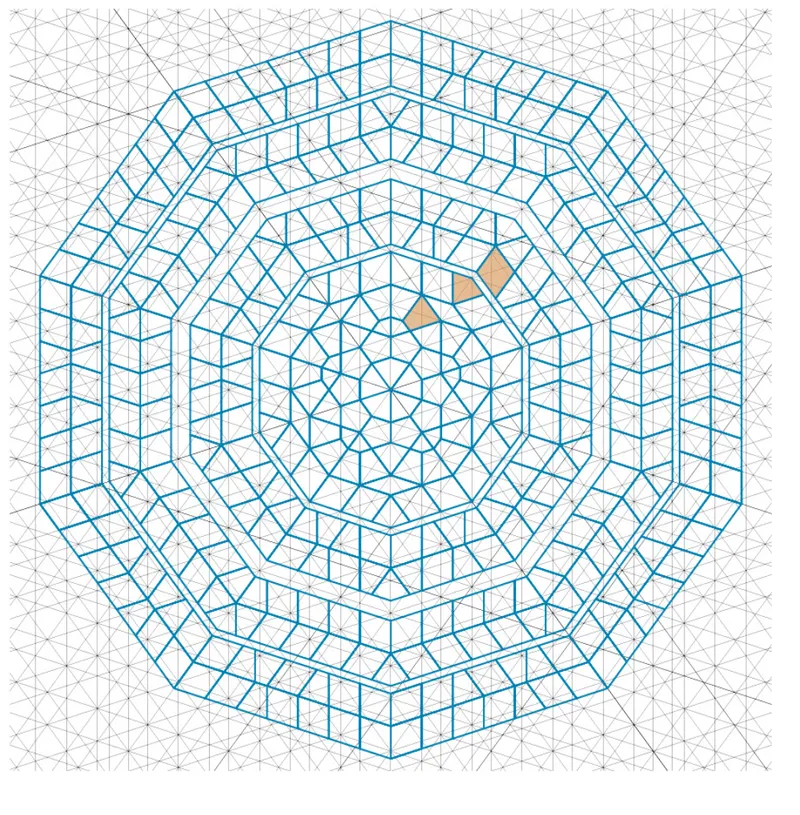
The axonometric wireframe reveals the settlement's fundamental logic: an octagonal structure organized in concentric rings of modular units. Ring roads create circulation loops while radial roads connect these rings to a central core, producing a pattern that echoes both organic growth and cosmic geometry. Each segment of the grid functions as an autonomous neighborhood, adaptable to varied programmatic needs including housing, workshops, cultural centers, and shared open spaces. Public functions like cafes, small theaters, and museums occupy the central zones, while residential modules line the outer rings for privacy and ventilation.
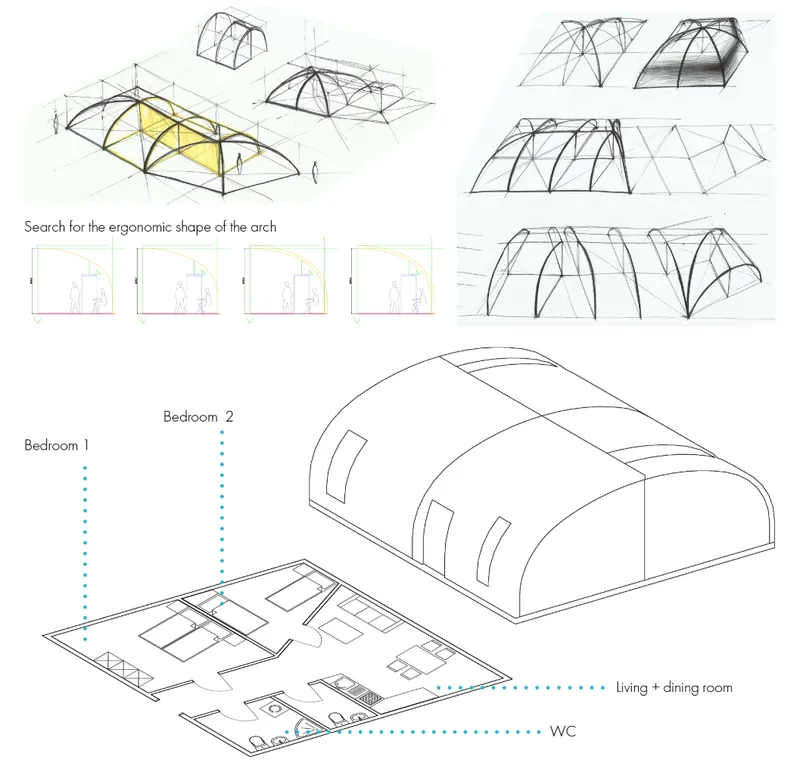
The concept sketches clarify how individual modules translate this urban geometry into inhabitable space. Polygonal base plans transition into arched vaults overhead, creating ergonomic, self-shading roof forms suited to the Sahara's extreme climate. Labeled bedrooms and living spaces demonstrate that these are not abstract diagrams but fully resolved dwelling units, each designed for walkability and community engagement. Residents access amenities on foot or by bicycle, a sustainable alternative to vehicular transport that the circular zoning actively encourages.
Factory-Built Modules That Interlock into Urban Fabric
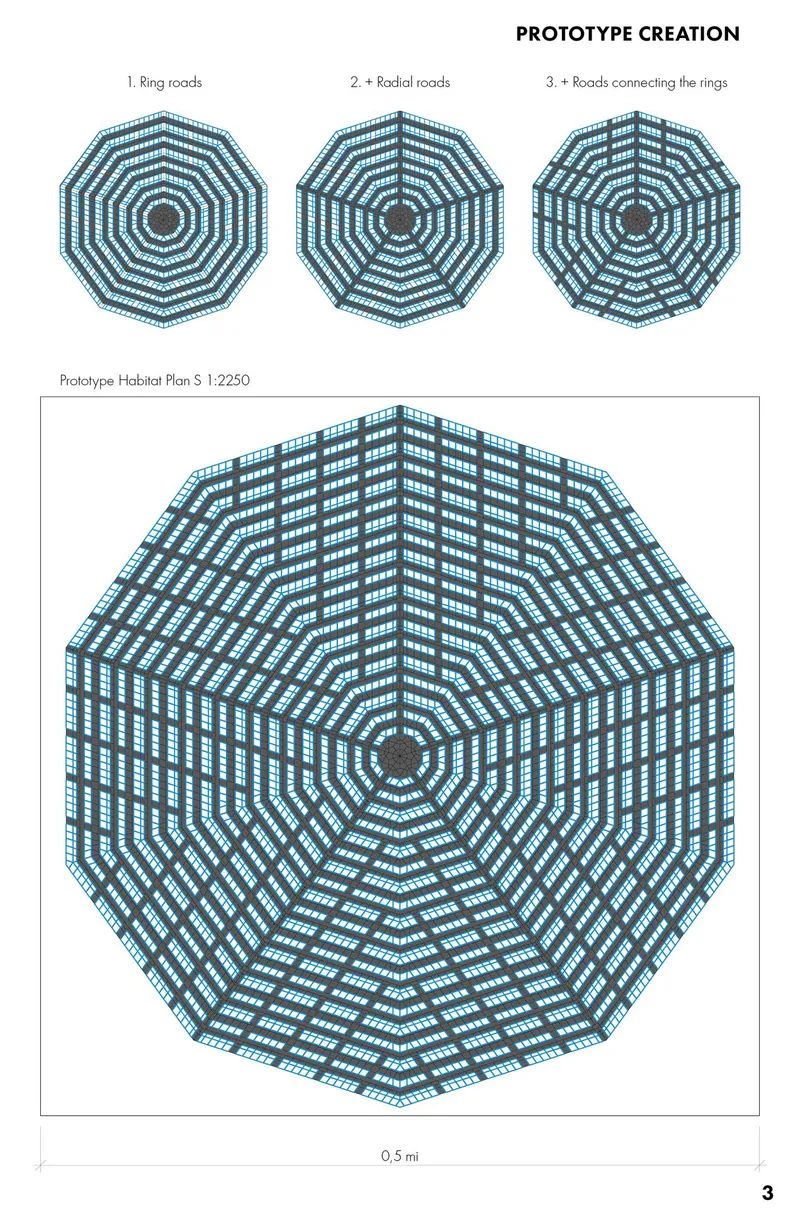
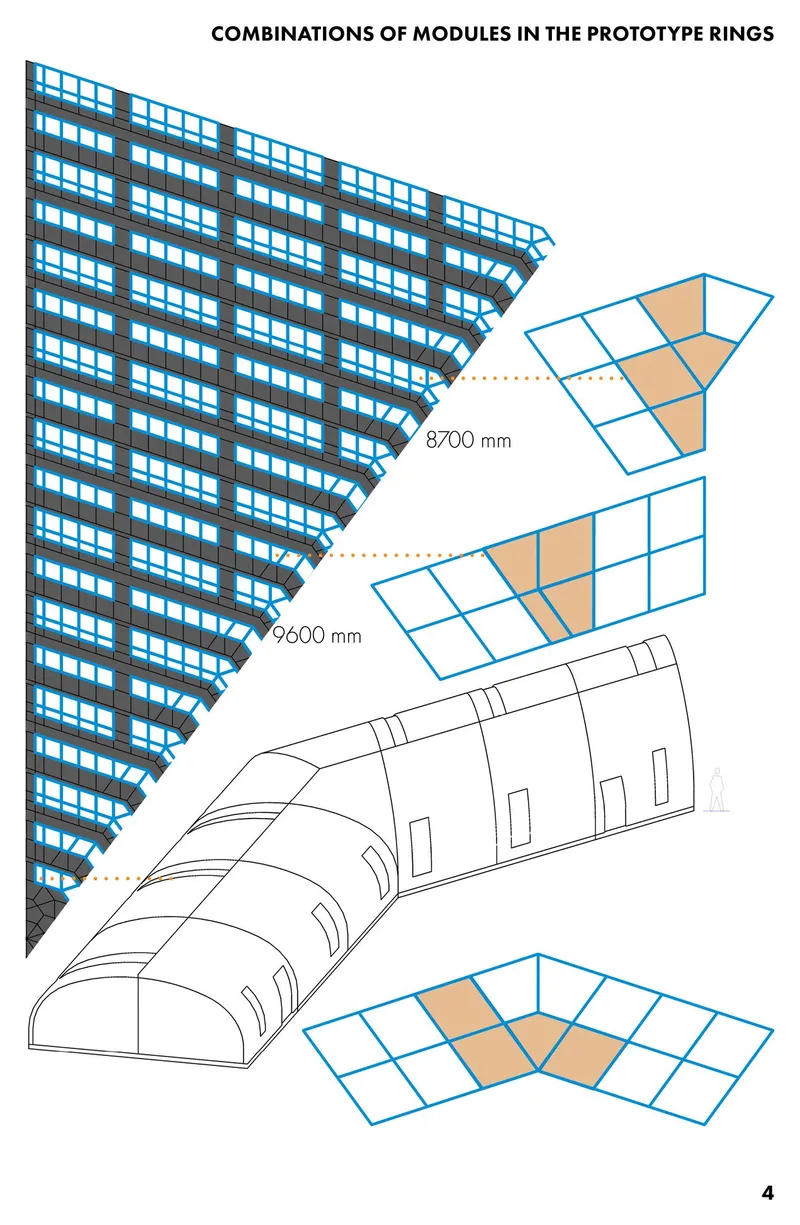
The assembly sequence drawings make the construction logic legible. Each module is pre-assembled at a factory and transported to the site, where units combine to form residential and public clusters. The plan and elevation drawings trace how a ring-based structure is built incrementally, ring by ring, a process that allows scalable construction and rapid assembly in remote environments. The system's structural efficiency derives from the interlocking geometry itself: lightweight modules click together to form a continuous pattern of urban rings and radial connections.
The axonometric diagram of a wedge-shaped building segment breaks this further, revealing module combinations and their dimensional relationships. Within each wedge, units of different sizes nest together to accommodate varied room types. The geometry is not decorative overlay; it is the load path, the spatial organizer, and the climate strategy simultaneously. This is where the Penrose grid transcends metaphor and becomes a genuine structural principle, connecting the abstract mathematics of quasicrystals to the pragmatic demands of desert habitation.
Mashrabiya Lattice and Layered Wall Assemblies Against Desert Heat
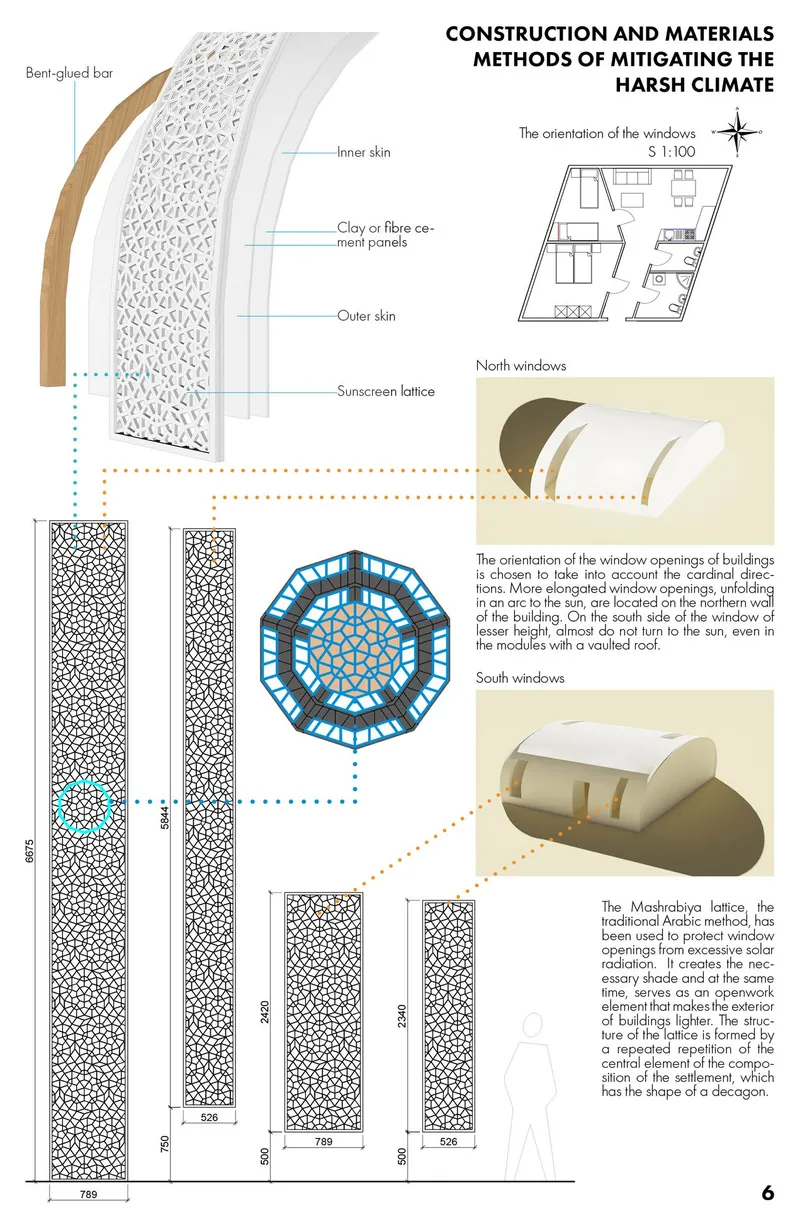
The construction detail drawings expose the wall's layered intelligence. The Mashrabiya lattice, a defining element of Arabic architecture, serves as both sunshade and ornament. Crafted from fiber cement or clay panels with an inner wooden structure, it filters sunlight while permitting airflow, a passive cooling strategy rooted in centuries of desert building knowledge. Orientation diagrams alongside the details indicate how these screens are positioned relative to solar angles, ensuring that each facade responds to its specific exposure rather than applying a uniform solution.
What makes this approach compelling is its refusal to separate the cultural from the technical. The lattice patterns reference the non-figurative expression valued in Islamic art, where abstraction is not merely decorative but deeply spiritual, reflecting the celebration of divine geometry rather than representation of living beings. By integrating this tradition into a high-performance wall assembly, Крылова and Алиева argue that sustainability and cultural identity are not competing agendas. They are, in the language of the project, harmonized opposites.
Octagonal and Circular Layouts Tested at the Site Scale
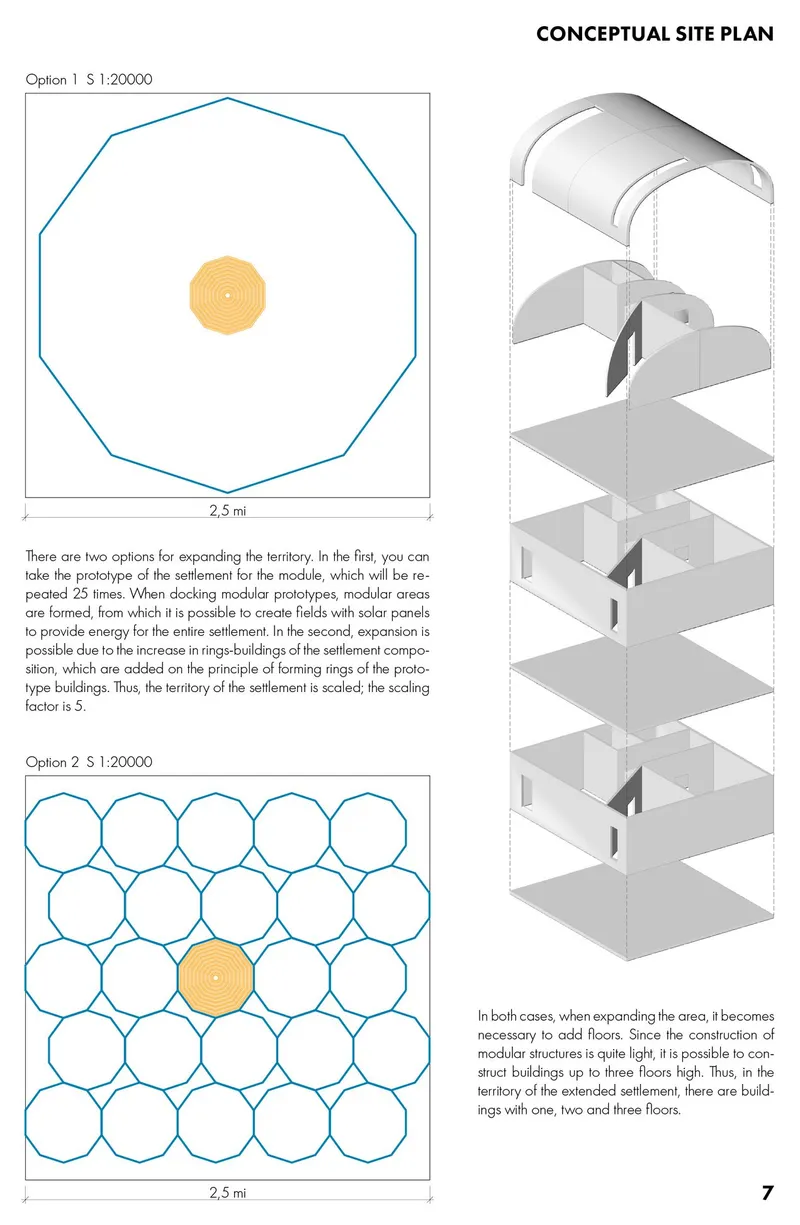
The final site plan options present two settlement configurations, one octagonal and one circular, each accompanied by an exploded axonometric of stacked floors. The octagonal variant maximizes edge conditions and inter-ring connections, while the circular layout more closely mirrors the Richat Structure's geological concentricity. Both share the same modular DNA: wedge-shaped segments that repeat around a center, scalable outward as population grows. This geometric precision resonates with ancient urban planning principles seen in desert civilizations, where settlements evolved around central communal courtyards.
The exploded axonometric is especially revealing. By pulling the floors apart vertically, it exposes the vertical stacking logic: how ground-level public programs support upper residential layers, how ventilation channels thread through the section, and how the arched roof forms cap the assembly to shed heat. It is a drawing that rewards close reading, and it confirms that the project's ambitions extend well beyond diagrammatic beauty into genuine spatial resolution.
Why This Project Matters
Desert architecture often splits into two camps: high-tech environmental machines that ignore cultural context, or romanticized vernacular revivals that dodge the realities of contemporary construction. "Harmony at the Junction of Opposites" refuses that binary. By grounding its urban plan in the Penrose mosaic, a mathematical model that inherently bridges science and art, the project creates a framework where factory-built modules, Mashrabiya climate screens, and Girih-derived ornamentation are not separate systems but expressions of a single geometric order.
Крылова and Алиева demonstrate that modularity need not mean monotony and that spiritual depth need not mean structural naivety. Their settlement reads as a serious proposal for remote, extreme environments: scalable, transportable, climatically responsive, and rooted in a cultural tradition that has been solving these same problems for centuries. The Eye of the Sahara is not just a poetic reference here. It is a design brief, asking architects to build with the same patience, concentricity, and layered logic that geological time produces.
View the Full Project
About the Designers
Designers: Мария Крылова, Рена Алиева
Enter a Design Competition on uni.xyz
uni.xyz runs architecture and design competitions year-round that reward proposals with spatial conviction and real site intelligence.
Project credits: Harmony at the Junction of Opposites by Мария Крылова, Рена Алиева.


Popular Articles
Popular articles from the community


Riyadh For All: Intergenerational Urban Design for Active Aging in Rabat
Riyadh For All reimagines urban design in Rabat with intergenerational co-living, adaptive courtyards, and Moroccan cultural exchange today.

Play: Fragments of Their World
Familiar architecture becomes modular playground design, creating safe spaces where displaced children can learn, connect, imagine and play.

The Ocean Hive: Sustainable Architecture for a Self-Sufficient Civilization at Sea
The Ocean Hive imagines sustainable architecture at sea, where modular habitats, algae, wave power and ocean waste sustain a growing colony.

The Musturak Paradise: Senior Living Architecture for a Connected Future in Temara, Morocco
The Musturak Paradise reimagines senior living architecture in Temara via private homes, social spaces, culture, community, and shared care.

Similar Reads
You might also enjoy these articles

Lunar Spiral: Space Architecture Shaped by the Mathematics of the Universe
Lunar Spiral reimagines space architecture through Fibonacci geometry, lunar regolith, levitating habitats, and self-sustaining Moon living.
The Main Dream: Modular Architecture for Play, Learning, and Community
A modular playground turns recycled plastic into adaptable spaces where refugee children can play, build, learn, and reconnect.
Play: Fragments of Their World
Familiar architecture becomes modular playground design, creating safe spaces where displaced children can learn, connect, imagine and play.

Wadi Rum Observatory: Desert Architecture Designed for the Night Sky
Wadi Rum Observatory turns desert architecture into a quiet instrument for astronomy, hiding research spaces under Jordan's starlit terrain.
Comments (0)
Please login or sign up to add comments
No comments yet. Be the first to comment!