
H+F Arquitetos Burrow Beneath São Paulo's Ipiranga Museum to Double Its Size Without Touching the Facade
A 6,800-square-meter underground extension quietly transforms Brazil's oldest museum while letting its 1890 palace speak for itself.


The Museu do Ipiranga is not just any museum. It sits on the very ground where Emperor Pedro I declared Brazil's independence in 1822, housed inside a 123-meter-long Renaissance-revival palace designed by Tommaso Gaudenzio Bezzi and completed in 1890. After closing in 2013 due to structural deterioration, the building reopened in September 2022 following a nine-year restoration and modernization led by H+F Arquitetos. The result is a 16,338-square-meter complex, nearly half of which is entirely new, that expanded the museum from 12 galleries to 49 without adding a single volume above grade.
What makes this project genuinely interesting is not the engineering feat of excavating beneath a heritage building, though that is considerable. It is the discipline of the architectural argument: the new work exists to reveal the old. Every contemporary element, from the pigmented concrete matched to São Paulo's red laterite soil to the industrial-feeling steel and glass insertions, is calibrated to read as structurally honest and temporally distinct. The architects describe this as showing the "opposite side of the museum," exposing decorated ceilings, skylights, and rooms the public had never been allowed to enter. The expansion is not an annex bolted onto the side of a monument. It is a subterranean counterweight that reconnects the museum to its park and its city.
Going Underground
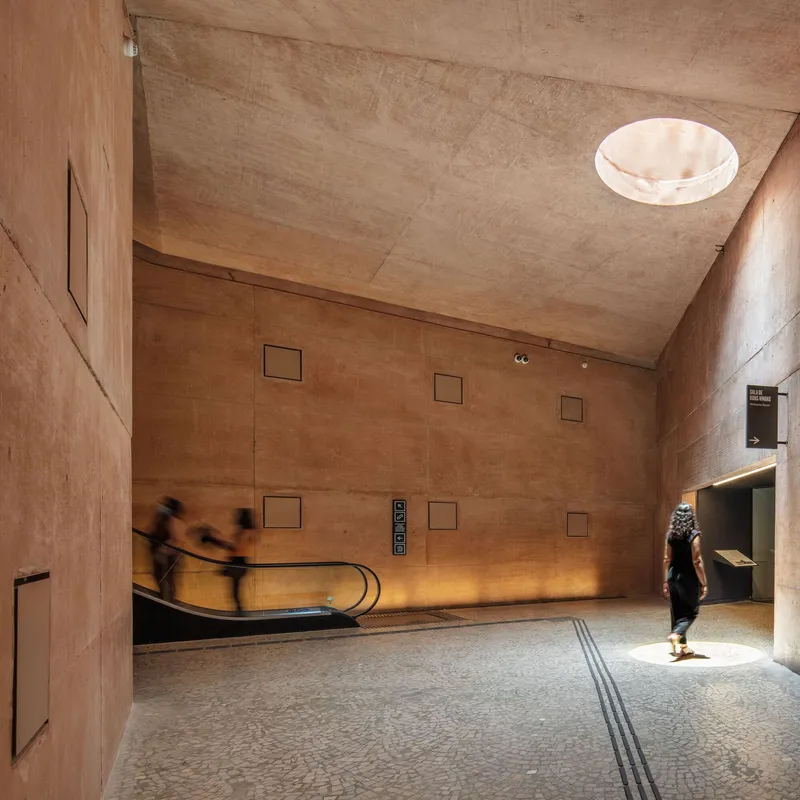

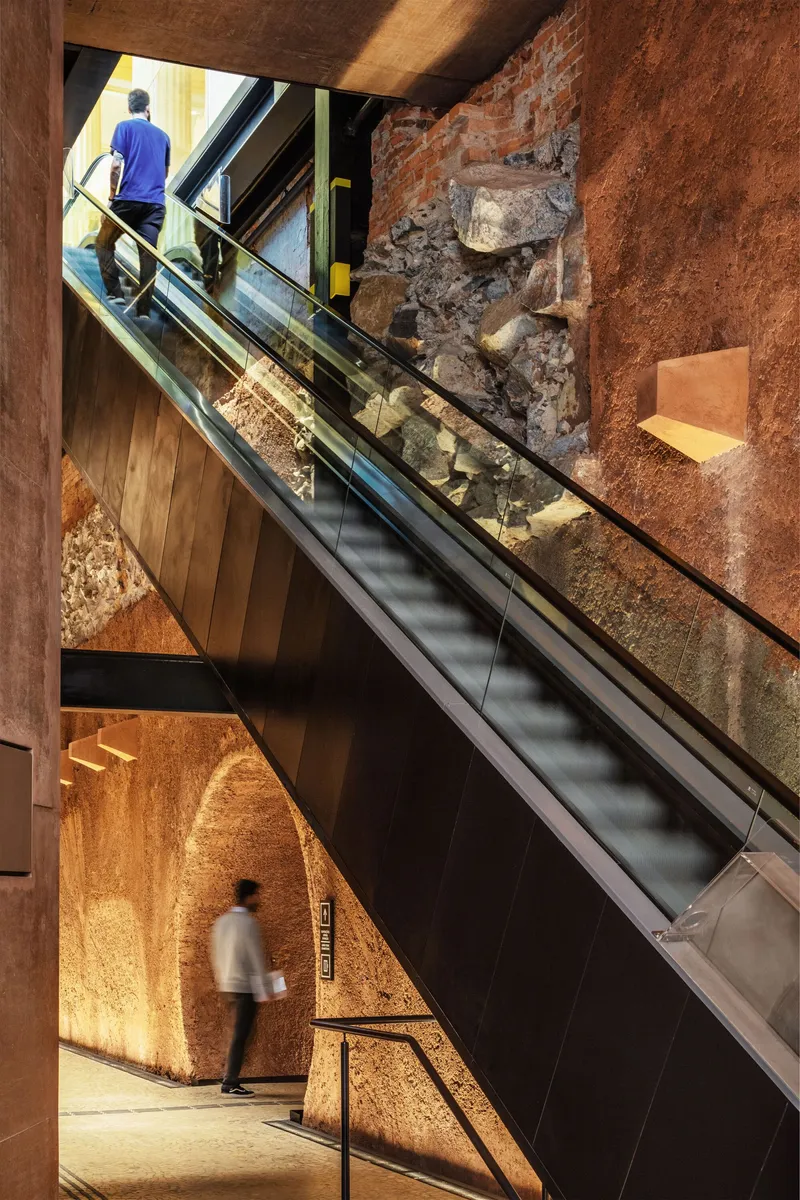
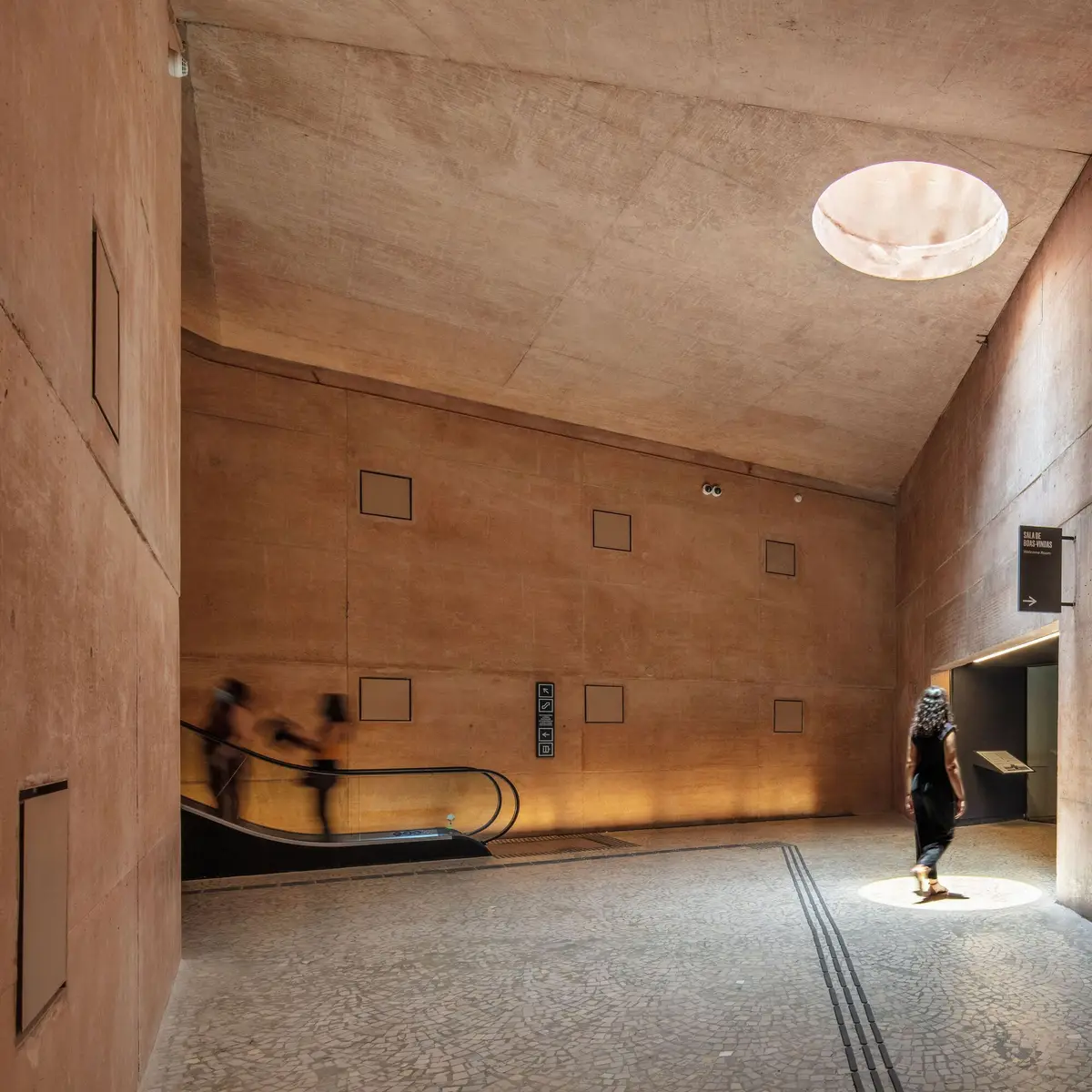
The primary architectural move is the creation of over 6,800 square meters of new space entirely below ground. Visitors now enter through a subterranean lobby defined by rammed-earth-toned walls, circular skylights, and escalators that cut dramatically through excavated strata. The materiality here is deliberately raw: earth-colored concrete, exposed brick from the original foundations, and terrazzo floors that feel civic rather than decorative. These are not neutral white gallery boxes. They carry the weight and coloration of the soil they displaced.
The circular skylight in the lobby is a particularly effective detail, pulling daylight down through the mass of earth above and giving orientation to a space that could easily feel dislocating. Moving between levels on the escalators, you pass through visible layers of construction history, old brickwork meeting new concrete in a section that the architects have wisely left legible rather than concealing behind finishes.
The Palace Revealed
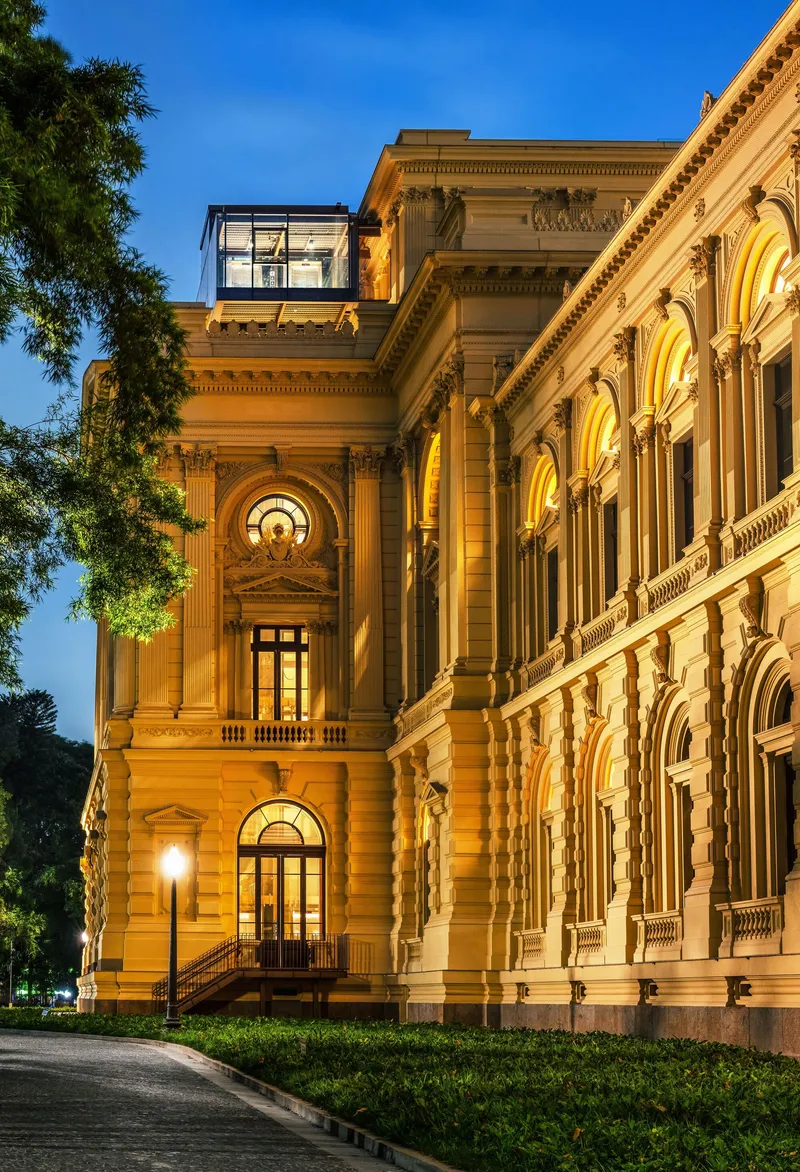
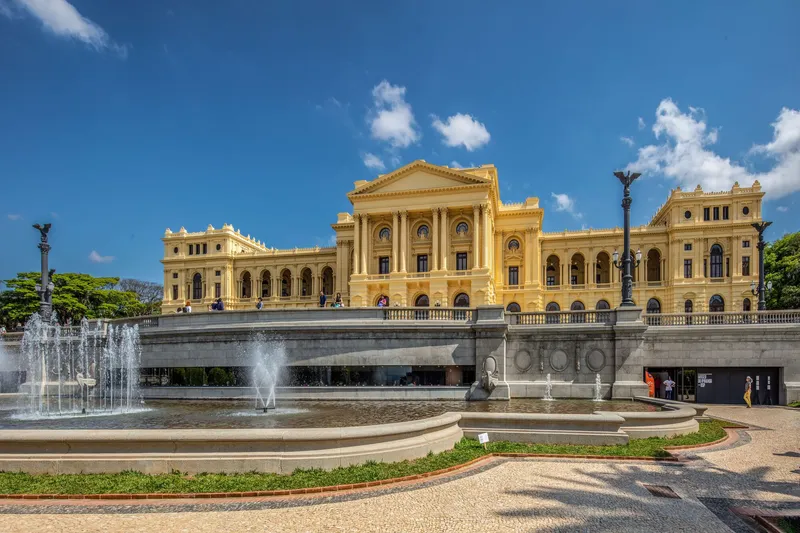
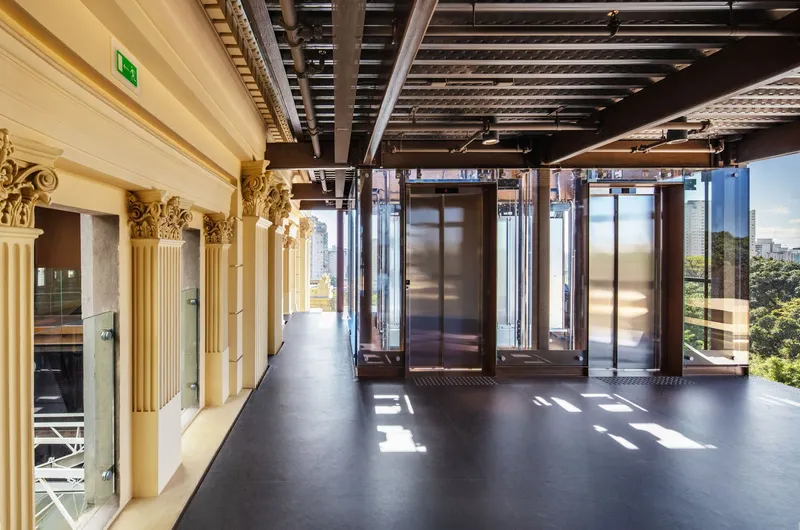
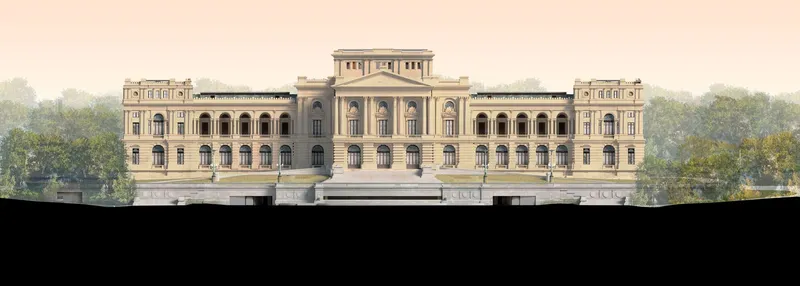
The 8,351 square meters of restored historic fabric are handled with a light touch that nonetheless required enormous technical effort. The ornamental stone facade, with its arched openings and neoclassical columns, has been cleaned and stabilized to read as it did in the 1890s. At dusk, the illumination strategy pulls the building's texture forward without theatrics. Inside, the original lobby with its cream-colored ornamental columns now coexists with glass-enclosed elevators and exposed ceiling structures, a juxtaposition that is frank rather than jarring.
The Versailles-inspired garden and circular fountain plaza have also been restored, reestablishing the axial procession from park to museum entrance. The arched bridge across the fountain basin creates a deliberate pause before arrival, a bit of Baroque scenography that H+F Arquitetos wisely preserved rather than streamlining.
New Insertions, Tectonic Honesty

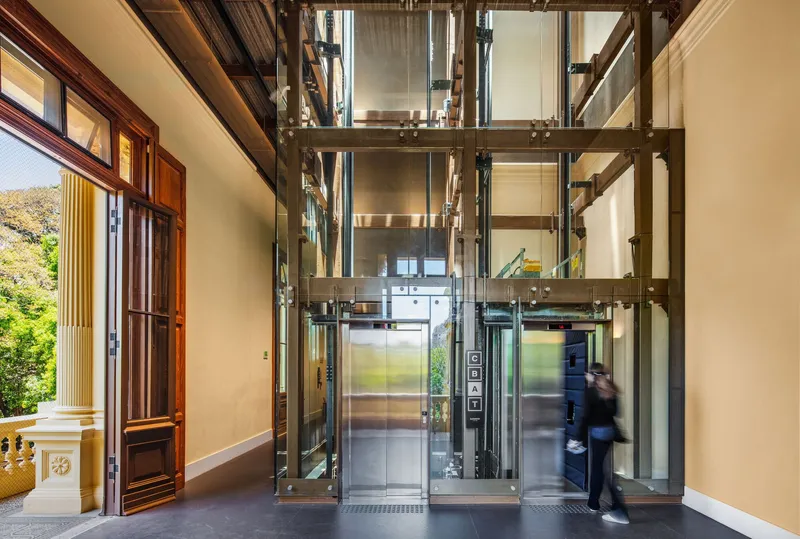
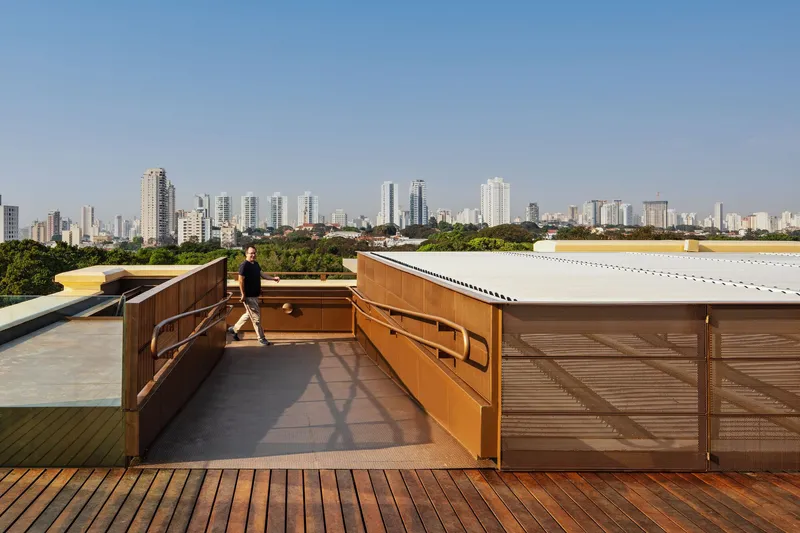
Where new structural elements meet old, the architects have opted for an industrial register that could not be confused with the original palace. The multi-level atrium with its exposed steel framework, glass balustrades, and translucent roof is the clearest expression of this strategy. It is not mimicking the 19th-century structure. It is standing alongside it, speaking a different language but maintaining the same spatial generosity.
The glass elevator shafts, with their exposed mechanical systems, operate as vertical display cases of infrastructure, a conscious decision to celebrate the building's new circulatory system rather than hide it. On the roof, a new viewing terrace with timber louvers and decking gives visitors a previously inaccessible vantage point over São Paulo's skyline. This is the one moment where the project adds to the building's silhouette, and the lightweight timber construction keeps the gesture modest.
Gallery Spaces and the Coffered Ceiling
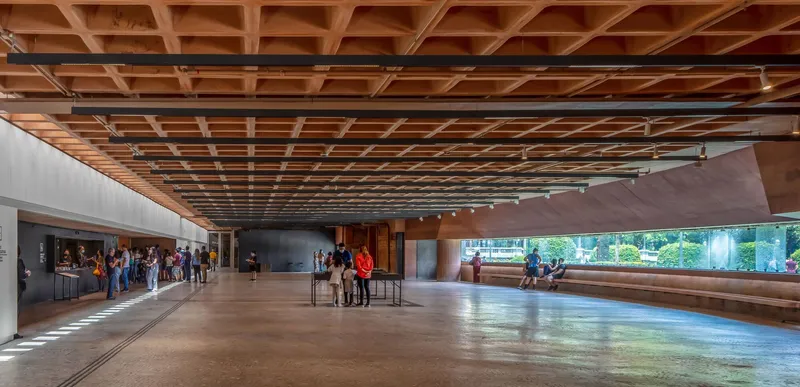


The expansion from 12 to 49 galleries demanded a new spatial vocabulary for exhibition. H+F Arquitetos developed a timber coffered ceiling system, visible across multiple gallery types, that integrates lighting strips within its grid. The effect is warm without being domestic, institutional without being sterile. In the galleries facing the gardens, long windows frame the landscape as a continuous backdrop to the collection, a curatorial decision embedded in architecture.
The corridors connecting these spaces feature a waffle-textured ceiling treatment in a lighter register, with white walls and generous proportions that allow the art to breathe. New openings punched between formerly isolated galleries improve circulation flow, a practical intervention that also transforms the spatial experience from a series of dead-end rooms into a continuous promenade.
Passive Climate and the Auditorium
One of the project's most significant but least visible achievements is its climate strategy. The architects improved natural ventilation through subtle modifications to windows, openings, and roofs, achieving thermal comfort in the historic galleries without air conditioning or active acclimatization systems. Mechanical cooling is reserved exclusively for the underground temporary exhibition spaces, where controlled conditions are a curatorial necessity. Rainwater capture and disposal systems have also been integrated. For a 16,000-square-meter museum in tropical São Paulo, the decision to rely on passive strategies for the majority of the building is both ecologically and economically ambitious.
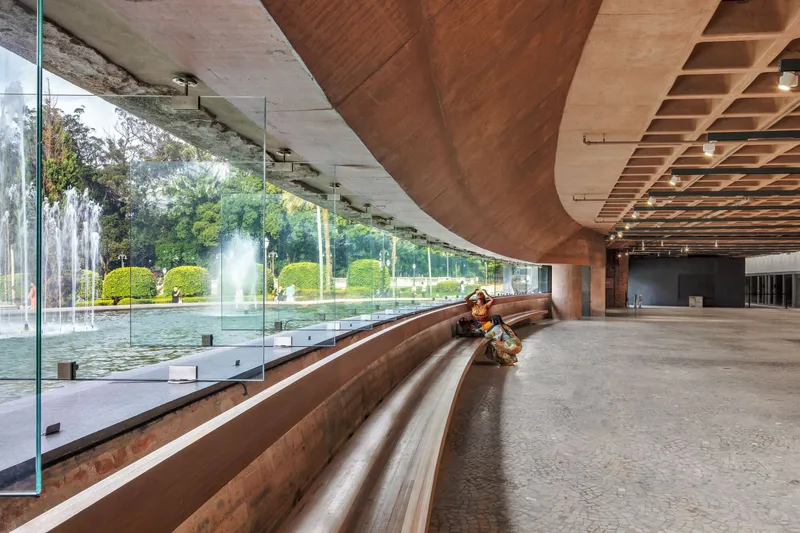
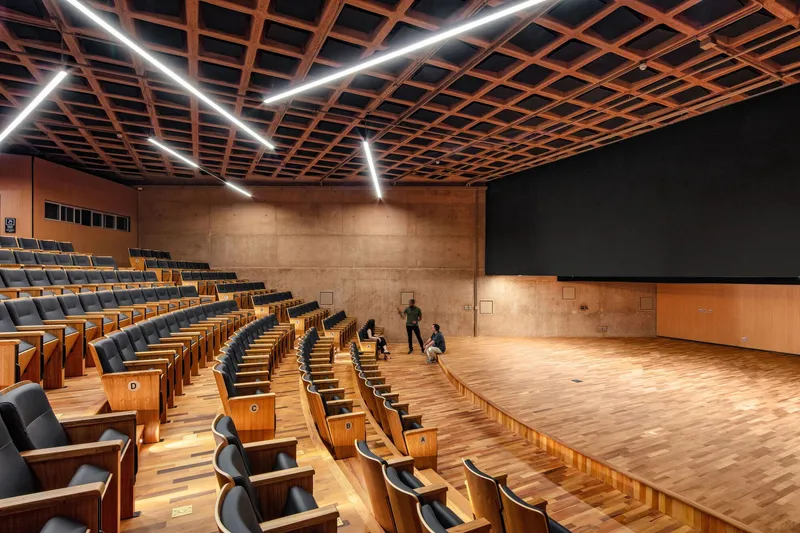
The updated auditorium, with its timber grid ceiling, linear lighting, and reupholstered seating, reads as a space that has been carefully calibrated rather than replaced wholesale. The tiered seating along the glass wall in the entrance corridor doubles as informal gathering space, looking out over the fountain and gardens in a moment that blurs the line between museum and public park.
Plans and Drawings
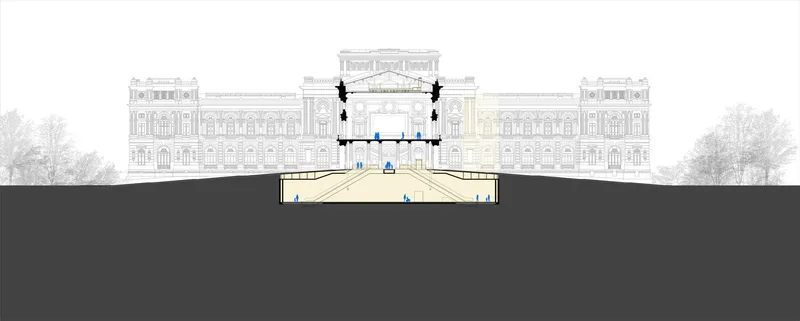
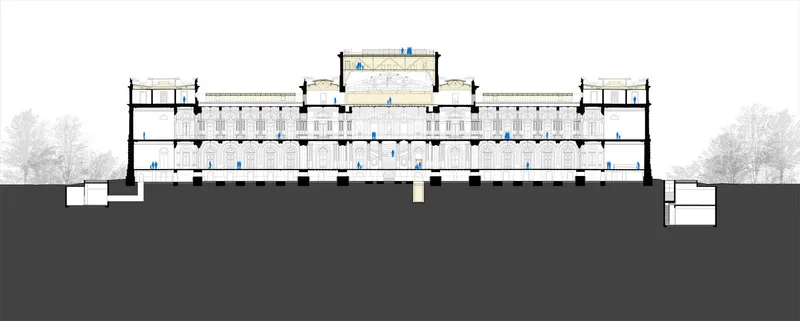
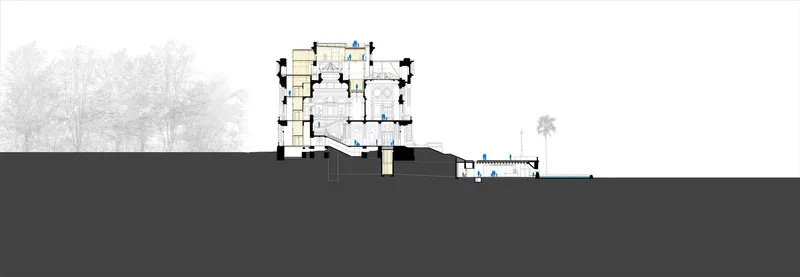


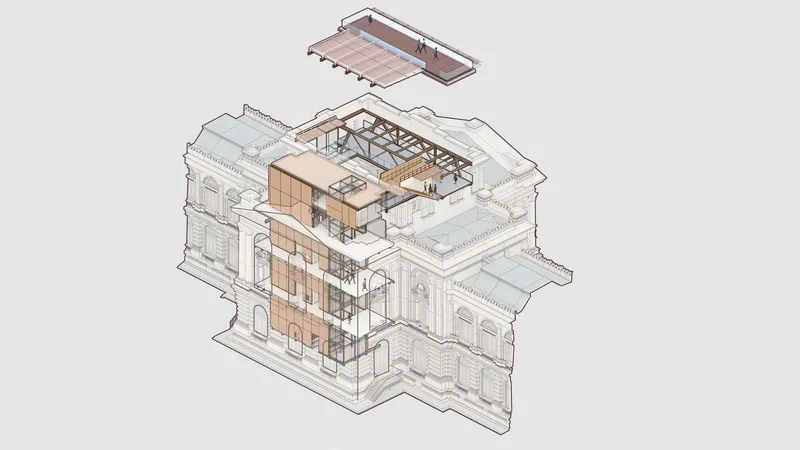
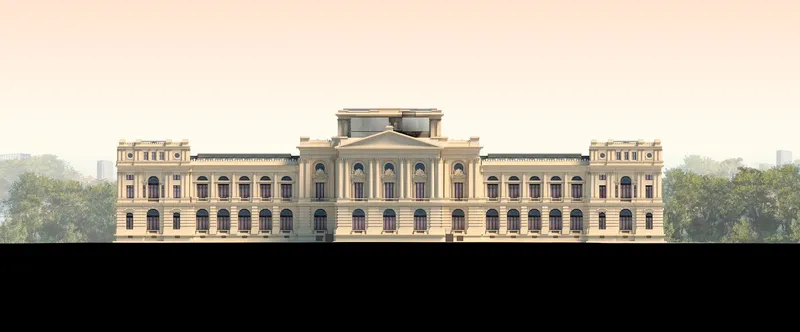

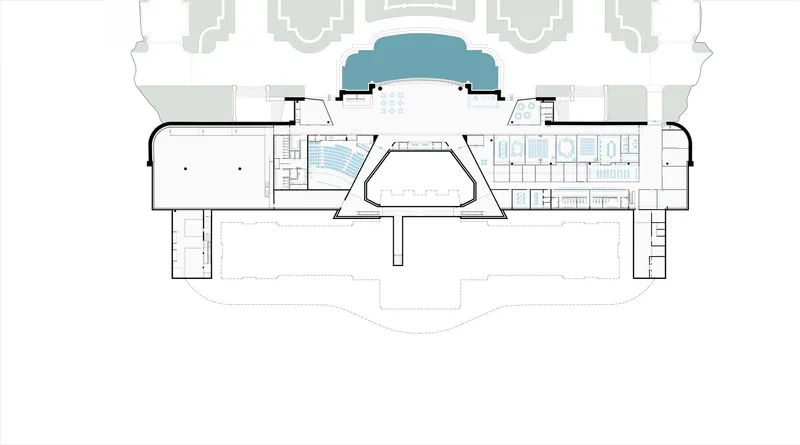
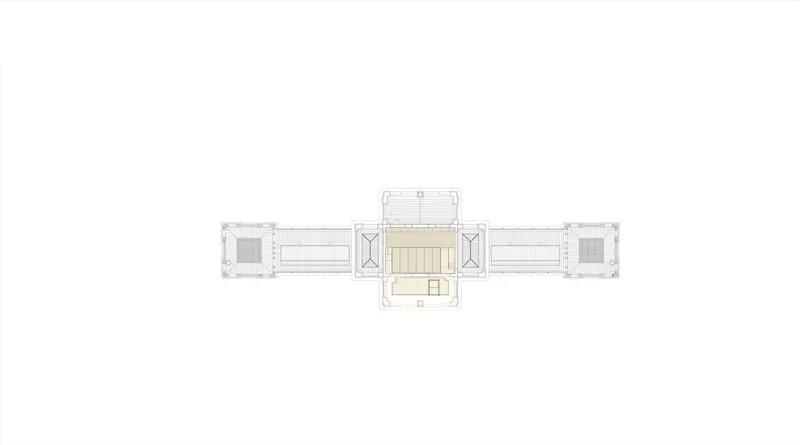


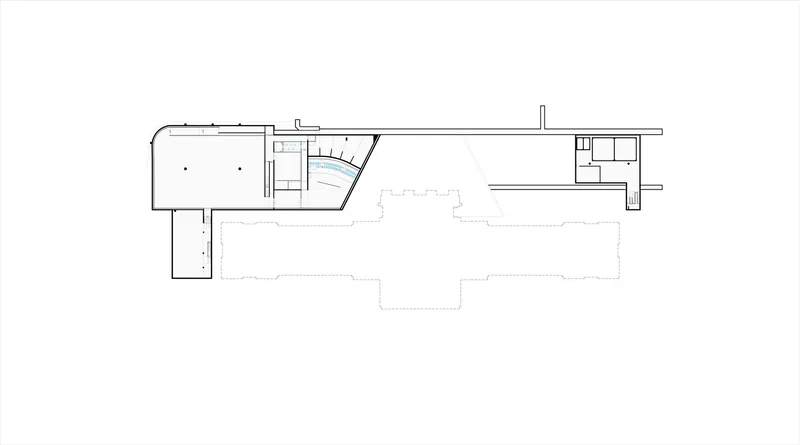
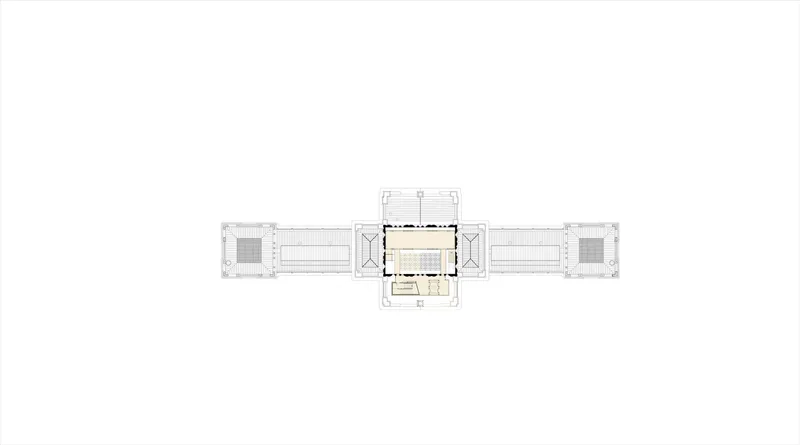
The section drawings are the most revealing documents in the set. They show the full scale of the underground excavation beneath the palace, with new volumes reaching down two levels while the historic building floats above, seemingly undisturbed. The axonometric diagrams make the logic of insertion legible: yellow-coded volumes represent new program threaded through the existing masonry shell, connecting previously isolated wings. The floor plans chart the evolution from a cross-shaped 19th-century arrangement to a hybridized plan where curved underground extensions and angled entrances create new spatial sequences while the original symmetry remains intact overhead.
Why This Project Matters
Heritage museum expansions are a crowded field, and the temptation to build a signature addition, a glass wing, a titanium blob, an angular shard, is well documented. H+F Arquitetos took the opposite path: they went down. The result is a project where the new architecture serves the old, not by mimicking it or deferring to it, but by creating a distinct underground world that makes the historic palace more accessible, more functional, and more deeply connected to its landscape than it has been at any point in its 130-year history.
The passive climate approach deserves particular attention. In a moment when museum retrofits routinely involve massive mechanical systems, the decision to ventilate the historic galleries naturally, reserving air conditioning only for spaces that genuinely require it, sets a standard that few institutions of this scale have been willing to attempt. Paired with the tectonic clarity of the new insertions and the disciplined restraint of the restoration, the Ipiranga Museum makes a convincing case that the most radical thing you can do with a heritage building is simply let it be seen clearly.
Modernization and Restoration of the Ipiranga Museum by H+F Arquitetos. São Paulo, Brazil. 16,338 m². Completed 2022. Photography by Nelson Kon and Alberto Ricci.
About the Studio
Share Your Own Work on uni.xyz
If projects like this are the kind of work you want to make, uni.xyz is a place to publish your own, find collaborators, and enter design competitions.


Popular Articles
Popular articles from the community


David Ortega Stacks a Two-Story Mexico City Penthouse Around a Steel Stair and a Pergola-Shaded Roof Terrace
In Colonia Roma, a 300 m² penthouse uses oak joinery, a planted steel stair and a slatted roof pergola to make a new-build apartment feel like a house.

LT2A and OPEN Architectes Thread a Brick and Glass High School Through a Wooded Belgian Campus
In Braine-l'Alleud, a 3,000 m² wing for Collège Cardinal Mercier pairs pale brick with a glazed colonnade, deferring to a small chapel and a dense wood.

U.GA Architects Wraps an Oval Rooftop Pool in Curved Board-Formed Concrete on Busan's Jeollidan-gil
In Busan's Jeonpo-dong, a 454 m² mixed-use block stacks a neighborhood facility, guest rooms and an oval rooftop pool inside spiraling concrete walls.

David Macias Steps a Doorless Stone and Plaster House Down a Tropical Colombian Hillside
In the humid hills of Colombia, Threshold House replaces the front door with an open void and terraces its 850 m² down the slope instead of fighting it.

Similar Reads
You might also enjoy these articles


LAVA Architecten Gives Vocational Education a Sawtooth-Roofed Face on a Mechelen School Campus
In Mechelen, Belgium, a 2,053 m² STEM school on a 6×6 m grid turns workshops and classrooms into rooms that can be rearranged as teaching changes.

KEMA Studio Turns a Derelict Marvila Attic into a 60 m² Lighthouse Apartment Above Lisbon
In Lisbon's Marvila district, a rebuilt roof, four skylights and two plywood volumes turn an unlivable attic into a bright home facing the Tagus.

Pixel Gardens: One Repeated Module Stacked Into a Terraced Social Housing Tower for Famagusta
Salem Bader's shortlisted housing tower builds a vertical neighbourhood from one repeated module, offsetting units to carve terraces, light and air.

Bao Huynh Watercolor Atelier: A Serene Art Retreat in Hội An
Bao Huynh Watercolor Atelier in Hội An blends multifunctional art spaces, sustainable design, local materials, and family-friendly living in a serene environment.


Comments (0)
Please login or sign up to add comments
No comments yet. Be the first to comment!