
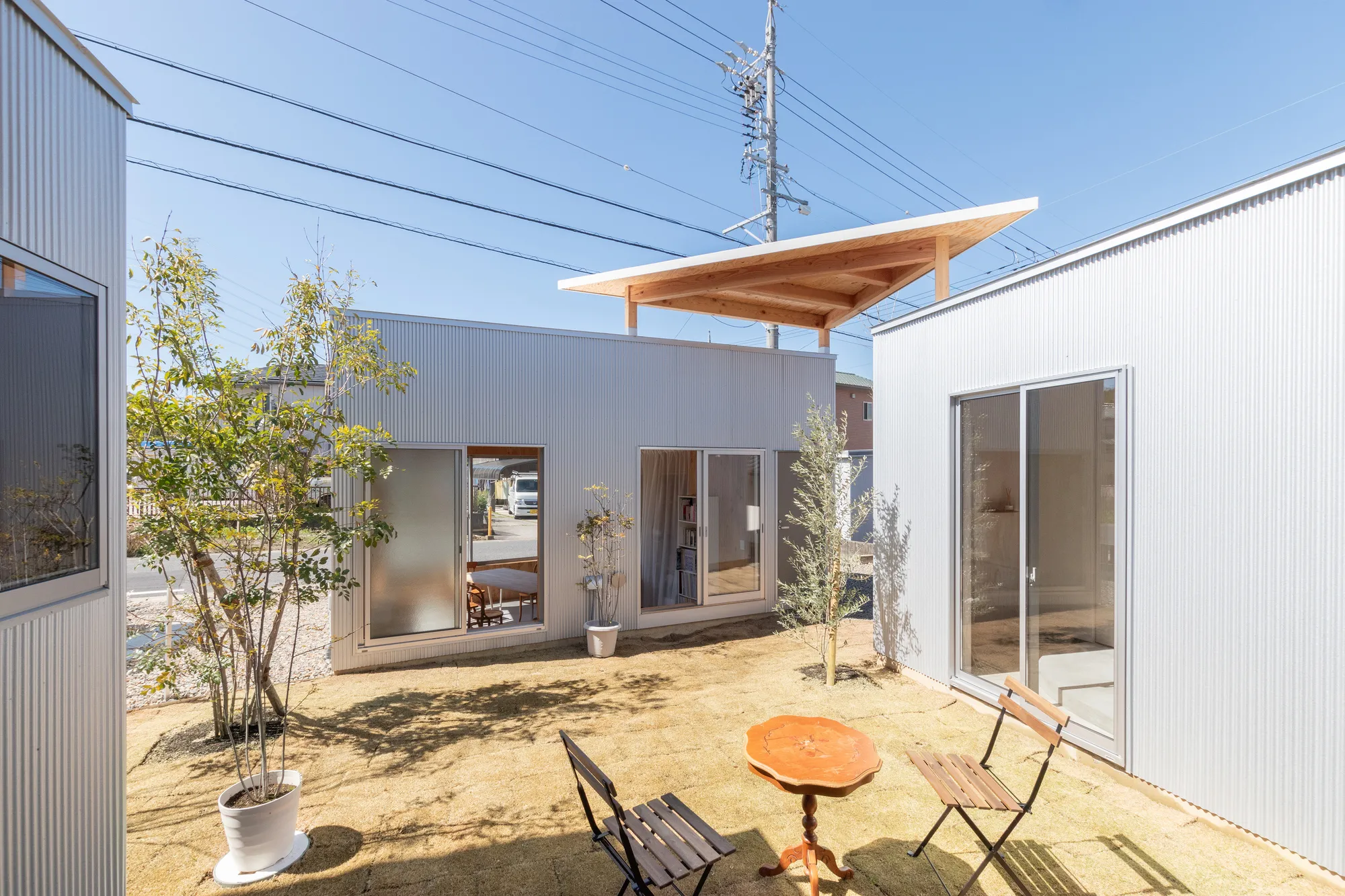
Hidekazu Kishi Builds His Own Family Home as a Cluster of Volumes Around a Sand Courtyard
An 85-square-meter architect's residence in Nisshin, Japan, fragments its program into pitched volumes wrapped in corrugated metal.


Architects designing their own homes face a peculiar pressure: the building becomes a manifesto whether they intend it or not. Hidekazu Kishi Architects' House in Umenoki, completed in 2024 in Nisshin, Japan, reads less like a declaration and more like a negotiation. At just 85 square meters, the house sits within an old settlement that is slowly turning over, with new residential fabric replacing inherited plots. Rather than planting a singular object on the site, Kishi broke the program into a cluster of small volumes that wrap around a central courtyard, mimicking the grain of the neighborhood while quietly rewriting its spatial logic.
What makes the project genuinely interesting is its refusal to treat compactness as a constraint. The courtyard, filled with sand and planted with young trees, acts as the organizing heart, pulling light and air into every room while offering a kind of private commons for the family. The house is adjacent to a long-established community center on its north side, and Kishi seems to have absorbed the lesson that communal spaces can scale down to the domestic without losing their generosity.
A Neighborhood in Miniature
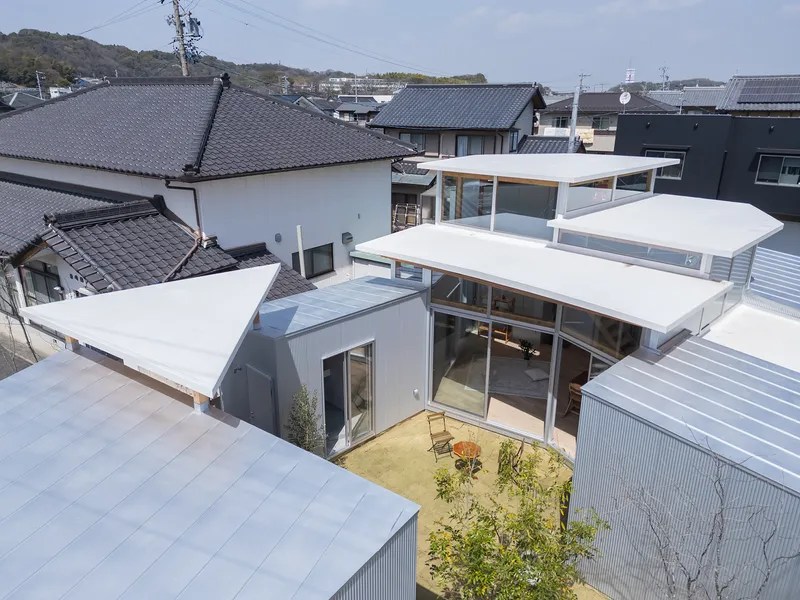
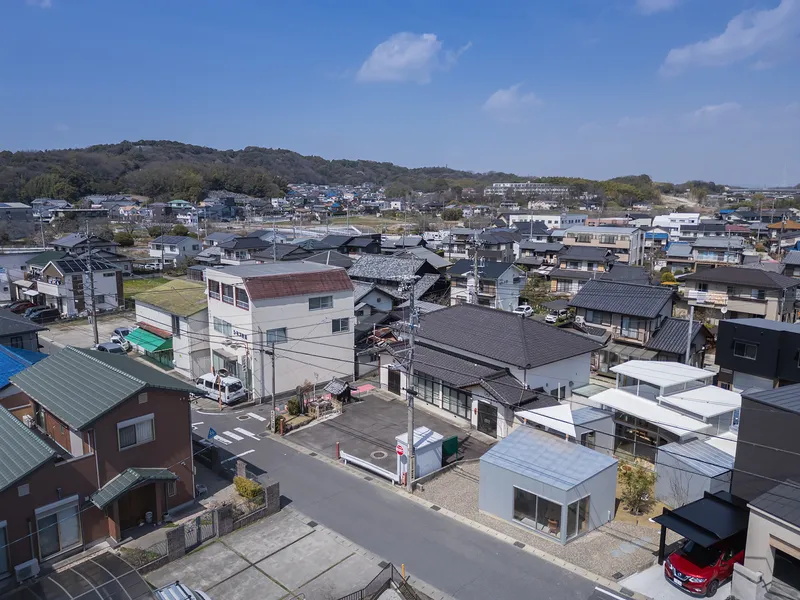
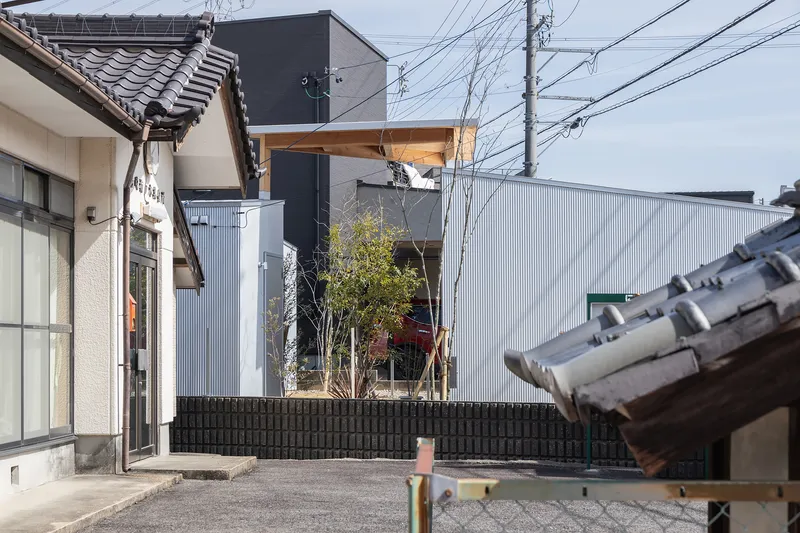
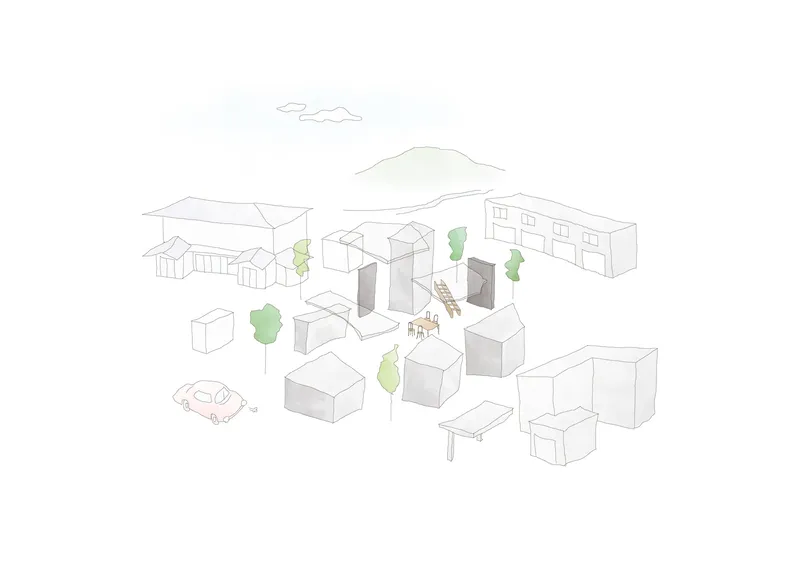
From above, the house reads as a small settlement rather than a single dwelling. Multiple pitched roof volumes, clad in corrugated metal, cluster together at varying heights, their ridgelines stepping up and down in a way that echoes the tiled roofs of older houses nearby. Kishi clearly studied the aerial texture of the neighborhood before deciding on this strategy: the house doesn't mimic its neighbors, but it rhymes with them. The corrugated metal cladding keeps costs honest and weathers in a way that will only deepen its relationship to the surrounding roofscape over time.
The aerial view reveals just how dense this part of Nisshin is. Every plot is accounted for, every gap between buildings negotiated. Against that backdrop, the decision to give up buildable area for a courtyard is not a luxury but a calculated trade. The house gains something more valuable than floor space: a center.
The Sand Courtyard as Organizing Device
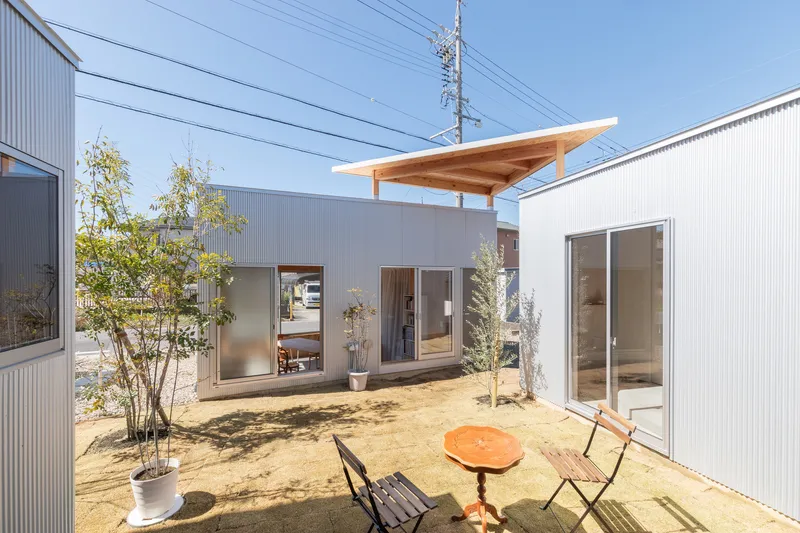
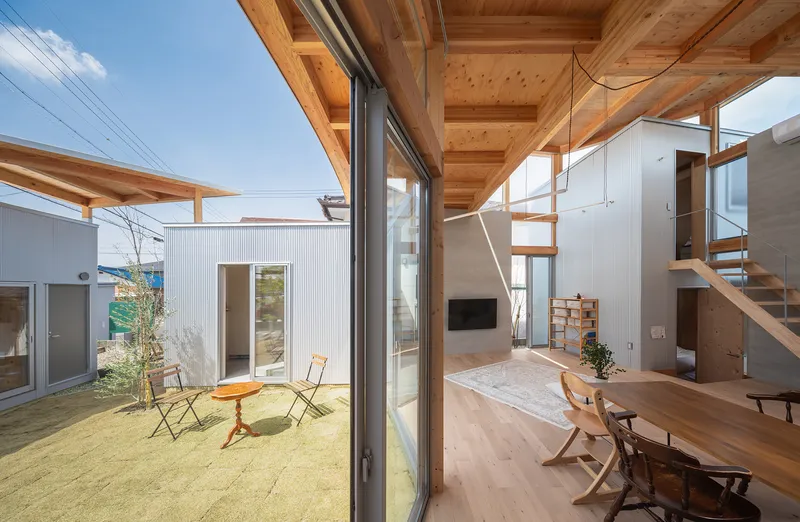
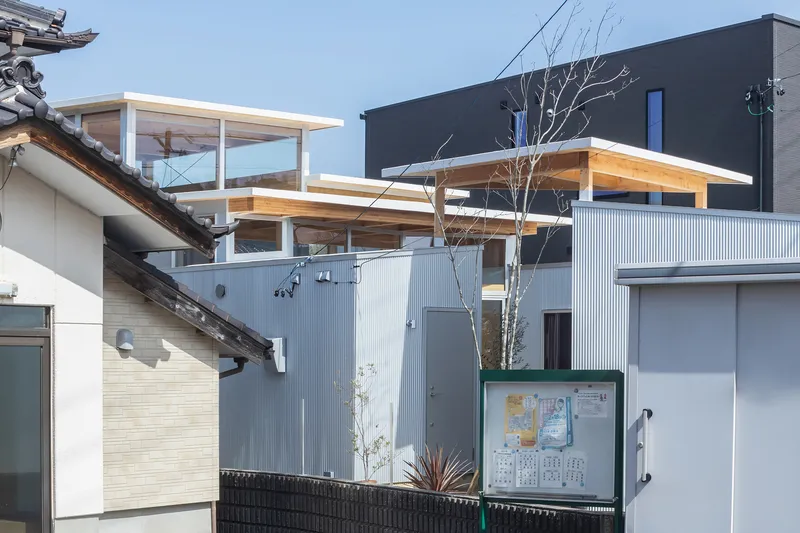
The courtyard is the project's strongest move. Sand covers the ground rather than grass or pavement, giving the space a dry, mineral quality that reads closer to a Zen garden than a Western patio. Young trees rise from the sand, their trunks still slender, promising a future canopy that will transform the character of the space over years. Three sides of the courtyard are defined by the corrugated metal volumes, which lean in just enough to create a sense of enclosure without claustrophobia.
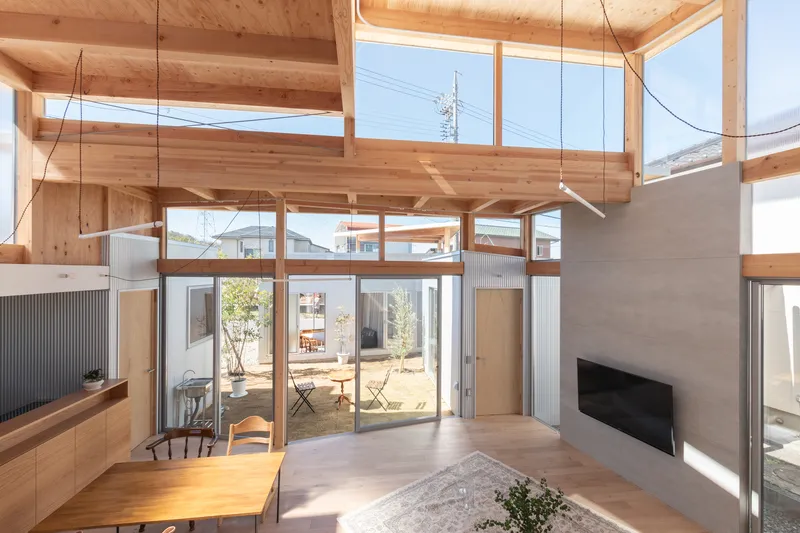
Sliding glass doors open directly from the living areas onto this courtyard, collapsing the threshold between interior and exterior. From certain angles, the stacked volumes with their flat timber roofs and glass enclosures rise above the neighboring tiled roofs, signaling that something different is happening here. But the signal is quiet. The corrugated metal and modest scale keep the house from announcing itself too loudly.
Timber Structure as Interior Atmosphere
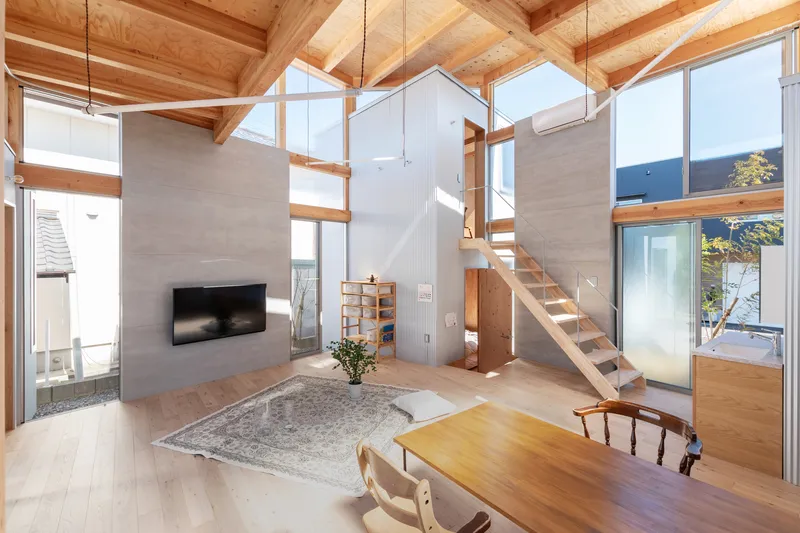
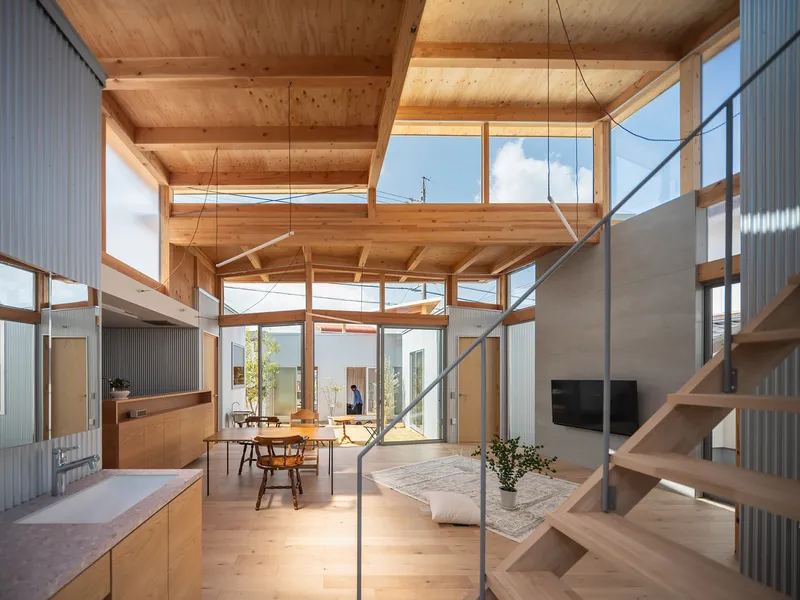
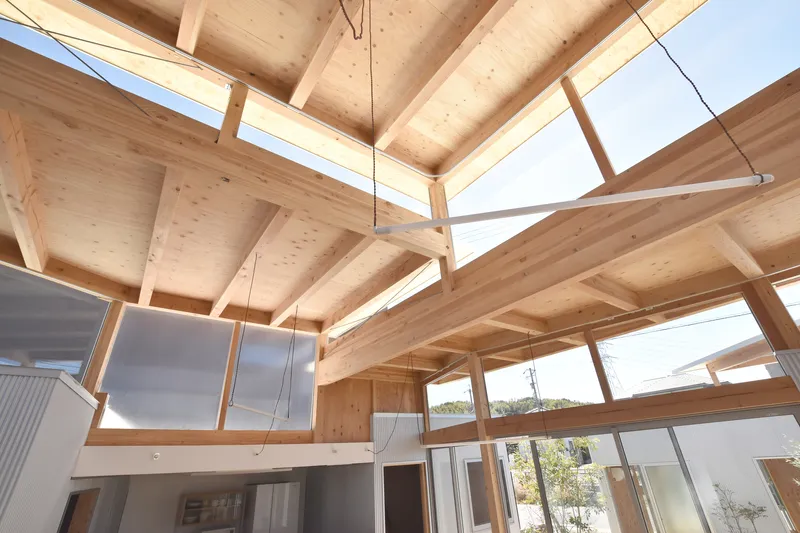
Step inside and the corrugated metal exterior gives way entirely to timber. The exposed post-and-beam structure is the dominant material presence, with beams layering across the ceiling at multiple heights and directions. Clerestory windows sit above the beam lines, washing the wood with daylight that shifts throughout the day. The effect is warm without being saccharine: the joints are visible, the wood is not stained into uniformity, and the structural logic is legible.
Kishi uses the layered ceiling planes to differentiate zones within the open plan. Where beams stack densely, the ceiling feels lower and more intimate. Where they open up to reveal double-height volumes, the space breathes. It is a simple technique, but it requires confidence and careful proportioning to pull off without making the interior feel chaotic. Here, it works.
Living Between Levels
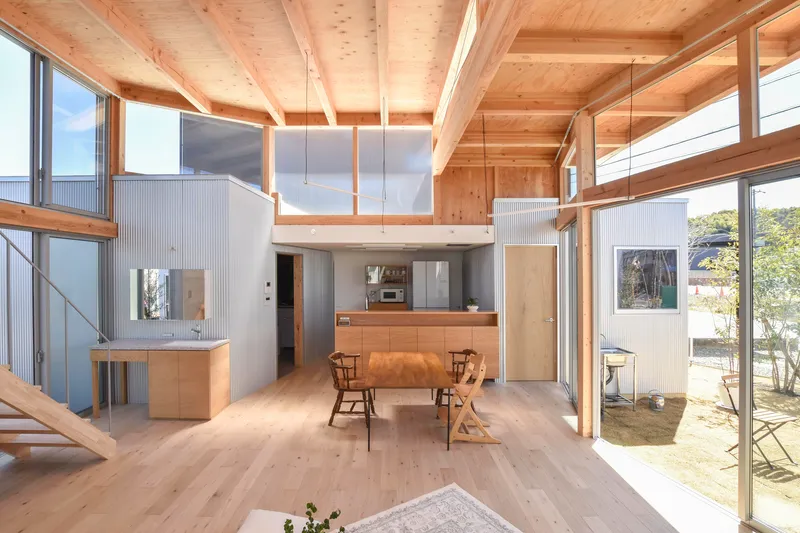
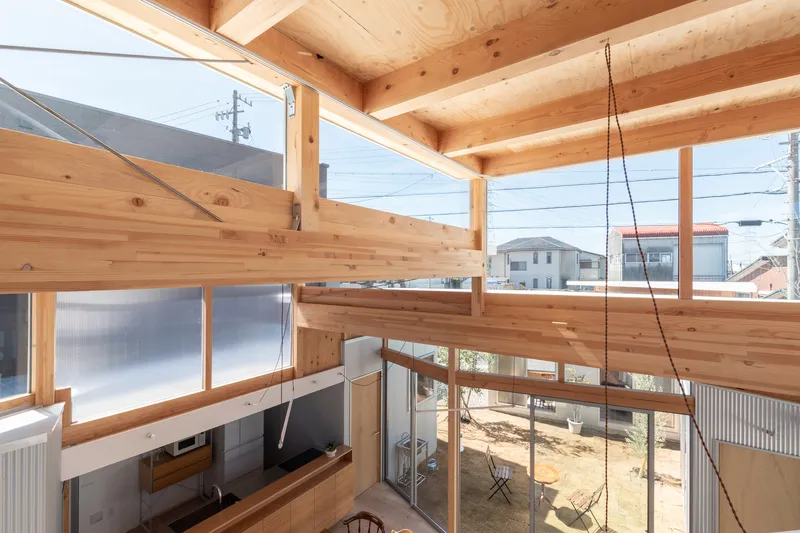
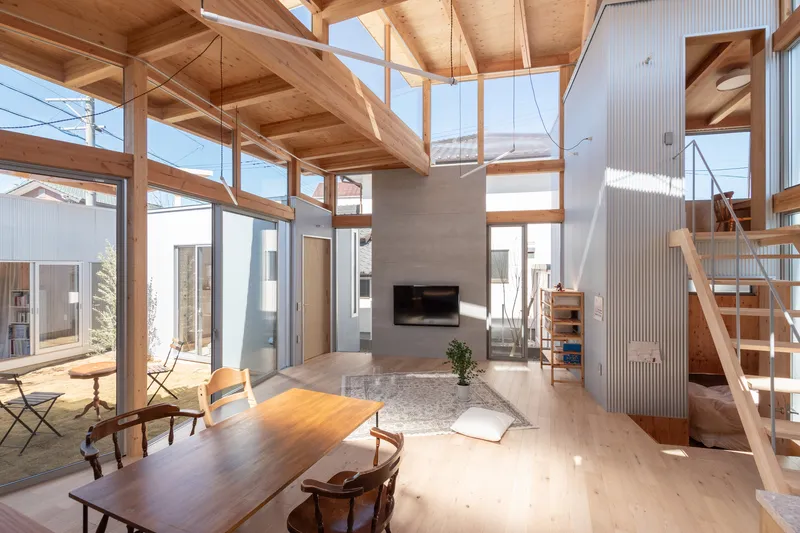
The mezzanine level is where the section really earns its keep. A timber-railed gallery overlooks the dining area and, beyond it, the courtyard garden. Clerestory windows at this level frame fragments of the neighboring houses, acknowledging the density of the surroundings rather than trying to screen it out. The mezzanine is not a separate floor so much as a thickened edge of the double-height space, borrowing volume from below while offering a perch above.
At ground level, a concrete fireplace wall anchors the living room, its mass a counterpoint to the lightness of the timber frame. A suspended light fixture hangs beneath the vaulted timber ceiling, and the proportions of the room feel generous despite the modest overall footprint. The structural engineering by Komatsu Structural Design keeps the timber frame lean, letting posts and beams do their work without redundancy.
Rooms at the Edges
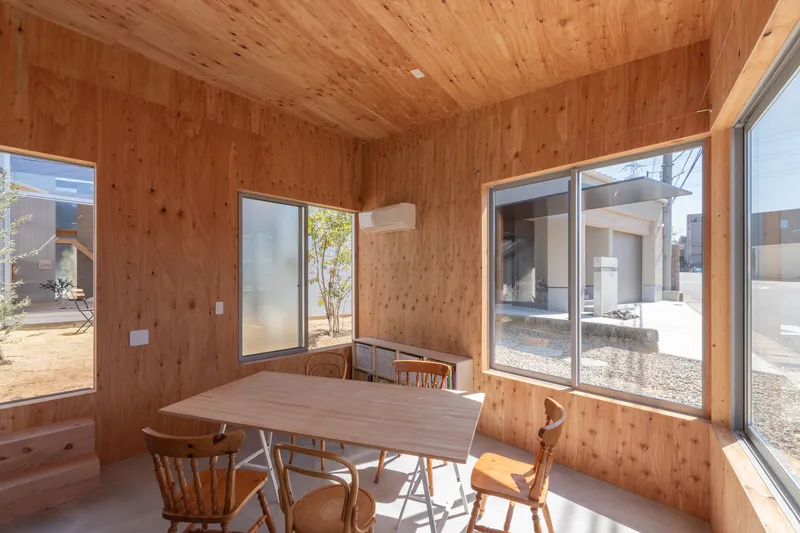
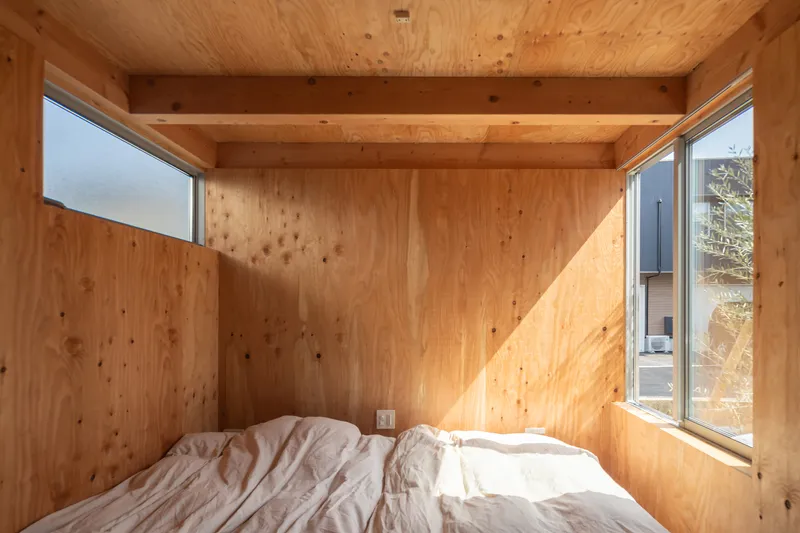
The dining room and bedrooms sit at the periphery of the plan, tucked into the smaller volumes that form the courtyard's perimeter. Corner windows in the dining room open onto gravel courtyards planted with small trees, creating secondary outdoor pockets that extend the visual field without requiring additional floor area. The plywood-lined bedroom is pared down to essentials: exposed beams, a white futon on the floor, and corner windows that catch morning light. It is a room that knows exactly what it is.
These peripheral spaces benefit enormously from the courtyard arrangement. Every room has at least two orientations of natural light, and the planted trees filter views between inside and out. In a neighborhood this tight, privacy is typically achieved by closing up. Kishi achieves it by looking inward.
The Double-Height Section
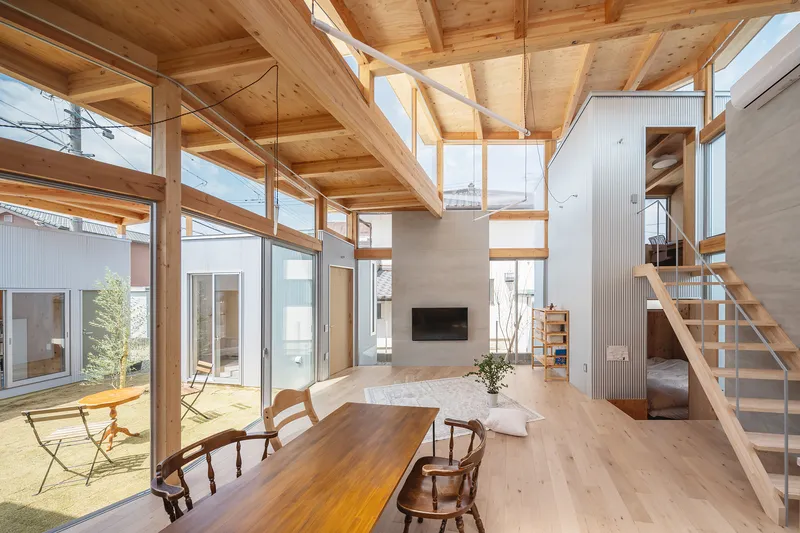
The double-height living space is the spatial set piece of the house. Exposed timber beams span overhead, and glazed walls on two sides open the room to the courtyard and to clerestory light above. The room manages to feel tall and sheltering at the same time, a quality that comes from the warmth of the wood and the relatively narrow plan section. You are always aware of the roof structure overhead, which gives the space a tent-like quality, as if the timber frame is holding the sky at bay.
Plans and Drawings
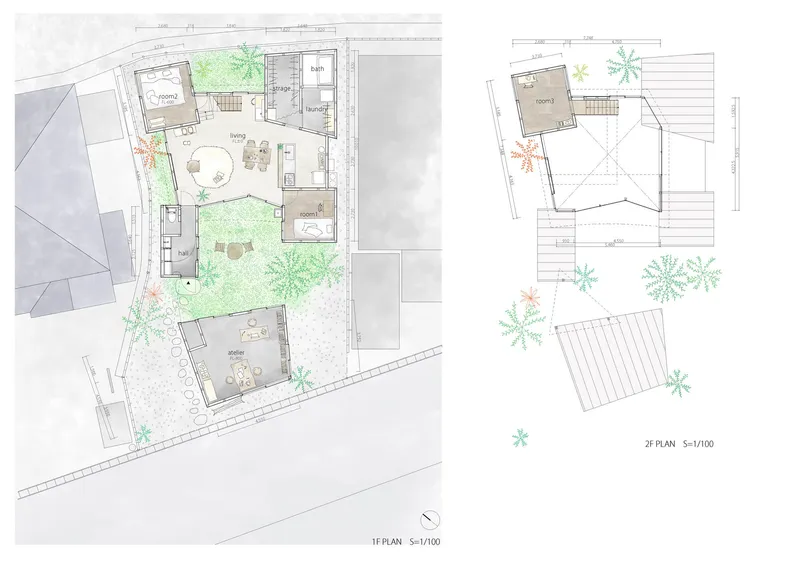
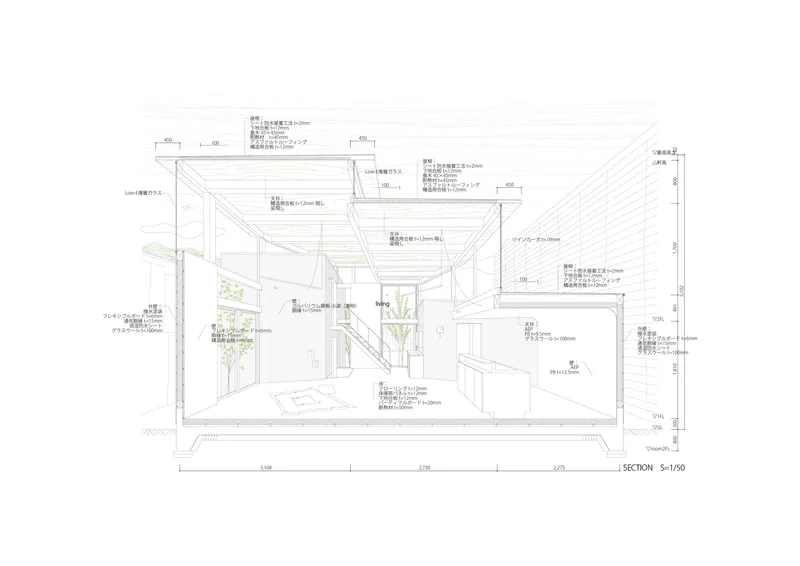
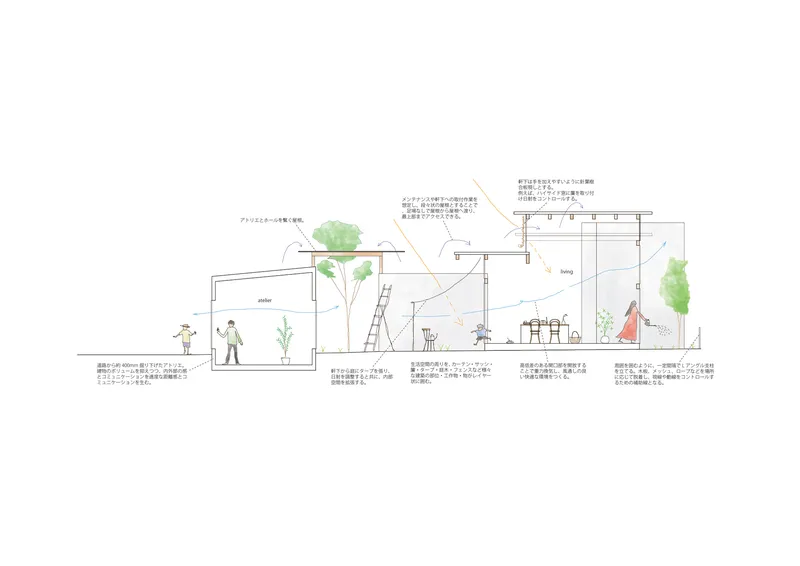
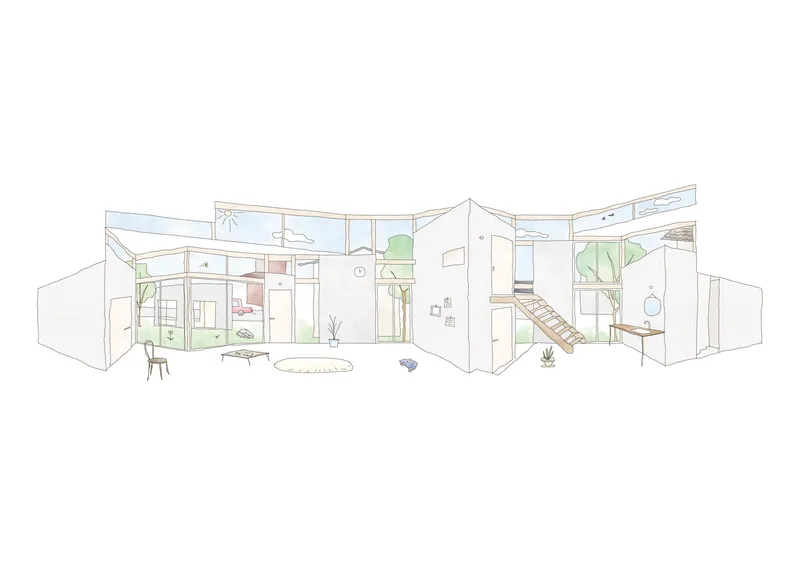
The watercolor floor plans reveal the courtyard's centrality with unusual clarity. Trees appear not as afterthoughts but as structural elements of the plan, positioned to mediate between rooms and to create depth in the courtyard views. The section drawings expose the spatial ambition hiding within the modest footprint: double-height volumes, a mezzanine that hovers over the living area, and roof structures that create distinct interior microclimates. An annotated section identifies the atelier alongside the living spaces, confirming that Kishi designed the house to accommodate his practice as well as his family.
The axonometric neighborhood drawing is a charming and revealing document. It places the house within its block, showing the relationship to adjacent plots, the community center, and even a distant mountain. The cutaway perspective goes further, populating the interior with furniture, a ladder, and figures that give scale to the rooms. These are drawings made by someone who sees architecture as inseparable from daily life, not as an abstract formal exercise.
Why This Project Matters
House in Umenoki is a quiet argument for fragmentation as a domestic strategy. In a culture and a market that increasingly favor airtight boxes maximizing their lot coverage, Kishi chose to break his program apart and give a substantial portion of his small site to an outdoor room. That decision cascades through the entire design: every interior space gains light from multiple directions, every room has a relationship to landscape, and the section becomes complex enough to make 85 square meters feel like significantly more.
The project also demonstrates something about what it means for an architect to build for themselves. There is no client to convince, no brief to satisfy beyond one's own convictions. Kishi used that freedom not for formal experimentation but for a kind of radical ordinariness: corrugated metal, timber frames, sand and trees, rooms sized to their purpose. The result is a house that feels inevitable, as if it grew from the logic of its site rather than being imposed upon it. That is harder to achieve than it looks.
House in Umenoki by Hidekazu Kishi Architects, Nisshin, Japan. 85 m², completed 2024. Structural engineering by Komatsu Structural Design.
About the Studio
Share Your Own Work on uni.xyz
If projects like this are the kind of work you want to make, uni.xyz is a place to publish your own, find collaborators, and enter design competitions.




Popular Articles
Popular articles from the community


The Musturak Paradise: Senior Living Architecture for a Connected Future in Temara, Morocco
The Musturak Paradise reimagines senior living architecture in Temara via private homes, social spaces, culture, community, and shared care.

The Ocean Hive: Sustainable Architecture for a Self-Sufficient Civilization at Sea
The Ocean Hive imagines sustainable architecture at sea, where modular habitats, algae, wave power and ocean waste sustain a growing colony.

Conexión: Biophilic Design Reimagines High-Rise Living in Hong Kong
Conexión reimagines high-rise living in Hong Kong through biophilic design, green facades, shared spaces, daylight, water and nature within.

Play: Fragments of Their World
Familiar architecture becomes modular playground design, creating safe spaces where displaced children can learn, connect, imagine and play.


Similar Reads
You might also enjoy these articles

Bao Huynh Watercolor Atelier: A Serene Art Retreat in Hội An
Bao Huynh Watercolor Atelier in Hội An blends multifunctional art spaces, sustainable design, local materials, and family-friendly living in a serene environment.

Atelier Macri Concept Store Interior Design by CASE-REAL
Atelier Macri store features a "ko" counter, walnut wood details, cork displays, blending retail, gallery, and seamless customer experiences.

Manuel Vargas Izquierdo Stadium and High-Performance Sports Center: Architectural Excellence in Jalpa de Méndez
The Manuel Vargas Izquierdo Stadium blends sustainable design, inclusive sports facilities, and cultural-inspired architecture, revitalizing Jalpa de Méndez’s public spaces.

KAKR Buluh Awar Hall: Revitalizing Community and Ecology Through Bamboo Architecture
Community built bamboo hall revitalizes Buluh Awar village, empowering youth, restoring ecology, celebrating vernacular craftsmanship through sustainable architecture and culture.




Comments (0)
Please login or sign up to add comments
No comments yet. Be the first to comment!