
HILT: A Toothbrush Split Into the Part That Lasts and the Part That Wears Out
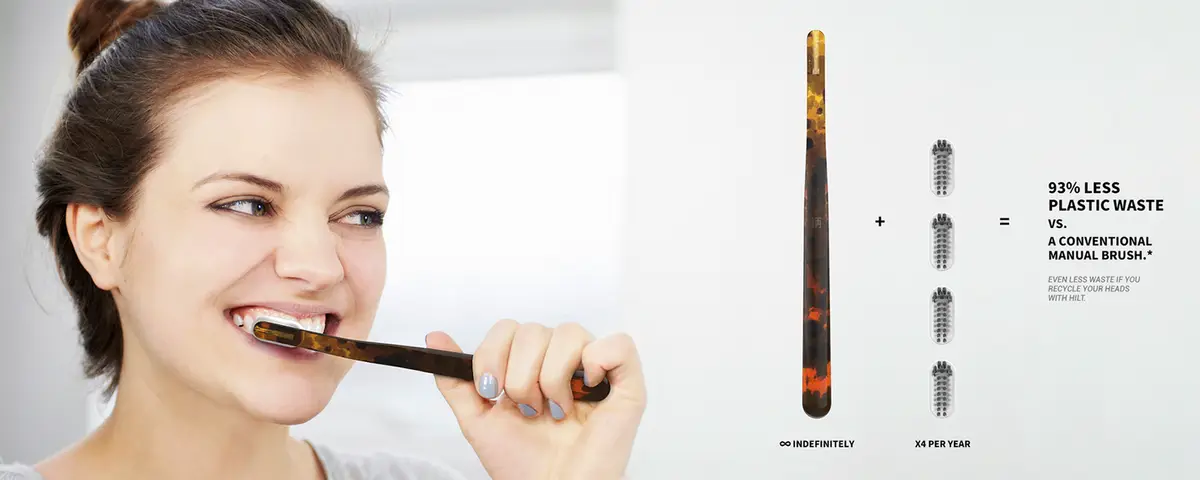
Joe Miller's HILT pairs a permanent handle in bamboo, titanium or recycled plastic with minimal-plastic heads that users send back for recycling.


Most toothbrushes fail at one end only. The bristles fray within a few months, yet the whole object goes in the bin, handle and all. HILT: Ecological Toothbrushes starts from that mismatch and makes it the organising principle of the design. It separates the brush into a permanent handle and a replaceable head, so that material, money and attention go to the part that deserves to last.
Designed by Joe Miller, HILT received a Citation at the International Product Design Awards 2019. What lifts it above a material swap is its scope. Miller designs the handle and the head, and also the shop page, the subscription, the return packaging and a digital tracker. The toothbrush becomes the visible tip of a small circular system.
Five Handles, Five Arguments for Permanence
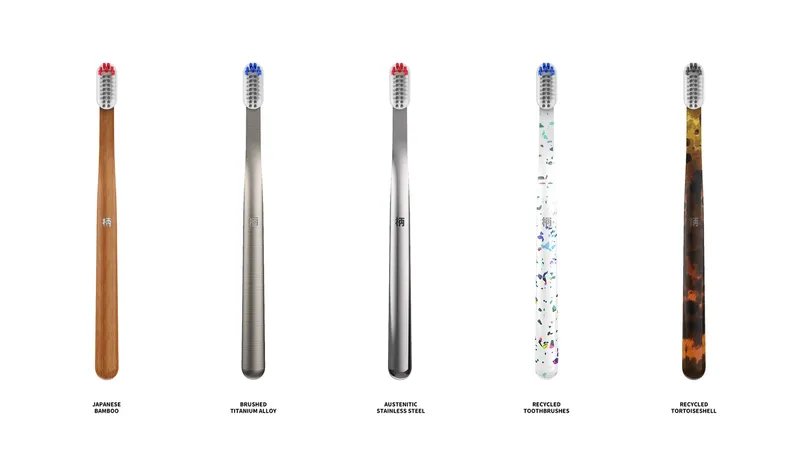
The lineup sets out the project's core move. Five handles sit side by side: Japanese bamboo, brushed titanium alloy, austenitic stainless steel, a recycled composite made from discarded toothbrushes, and a tortoiseshell-patterned plastic. Each was chosen for durability and for how it feels in the hand, and none is disguised. The bamboo shows its grain, the metals show their brushed finish, and the recycled version keeps the coloured flecks of its previous life on its surface.
This is the logic of exposed structure applied to a bathroom object. Robust material goes where the product is held every day and needs to survive for years. The heads, which are designed to be thrown away, use the minimum amount of plastic Miller could manage. The split is a resource budget expressed as form, and it targets the most waste-intensive part of oral care directly.
Choosing a Material as the First Act of Use
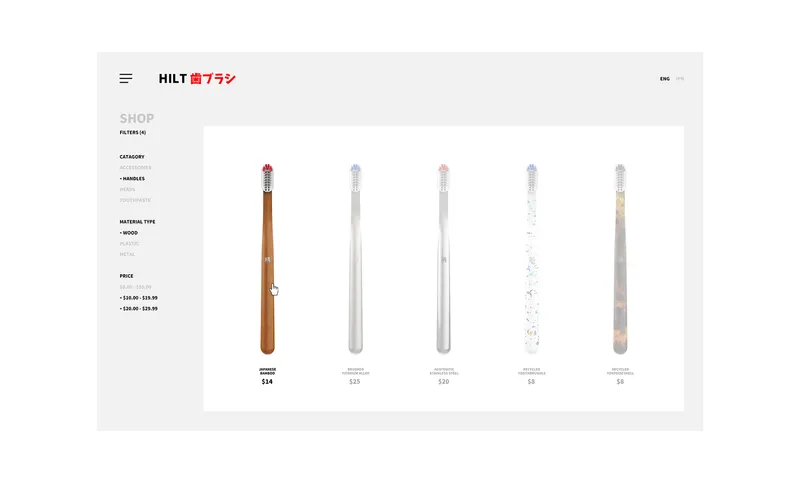
The shop page mockup shows the product as a buyer meets it. A filter sidebar runs down one side and the five handles sit in a row. When the cursor lands on bamboo, the others fade to grey. It is a modest interface, but it frames the purchase as a long-term commitment to a material, not a pick from a rack of near-identical plastic sticks.
Behind that storefront sits a subscription service that sends replacement heads at the right intervals. Here the design moves beyond the object and into behaviour. The subscription keeps the handle in use and makes timely replacement the default. It also gives the system a predictable flow of heads going out, which matters once you ask what happens when they come back.
Packaging That Is Designed to Make the Return Trip
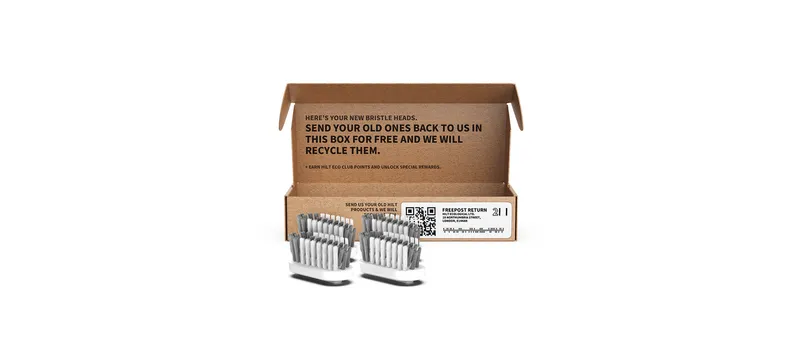
The return box is the most persuasive image in the set. An open cardboard carton carries a printed recycling message and a QR label, with two white-based bristle heads resting in front of it. The packaging that delivers new heads also becomes the vehicle for sending used ones back for recycling. Closing the loop needs no separate bag, no drop-off point and no extra effort from the user.
A digital interface completes the circuit, letting users track personal and collective reductions in plastic and carbon output. The QR label is the hinge between the physical and digital layers. Whether the numbers motivate people over the long term is an open question, but the intent is clear: the user becomes a participant in the product's lifecycle and not only its end point.
Moodboards That Give Each Material Its Own Character
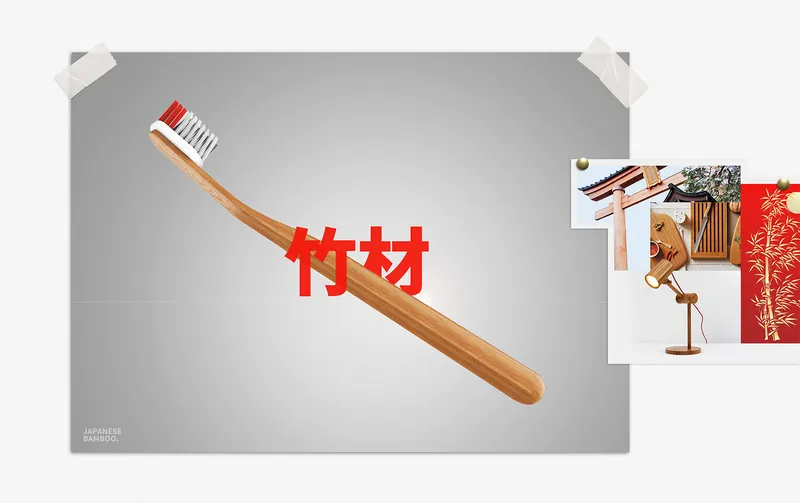
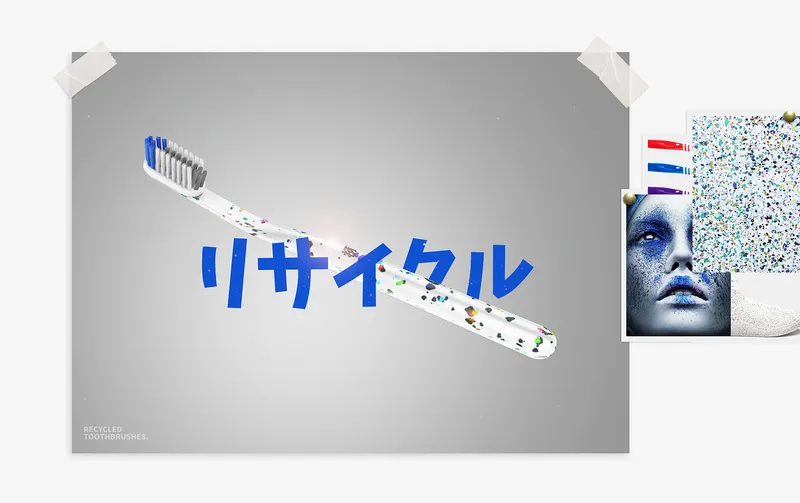
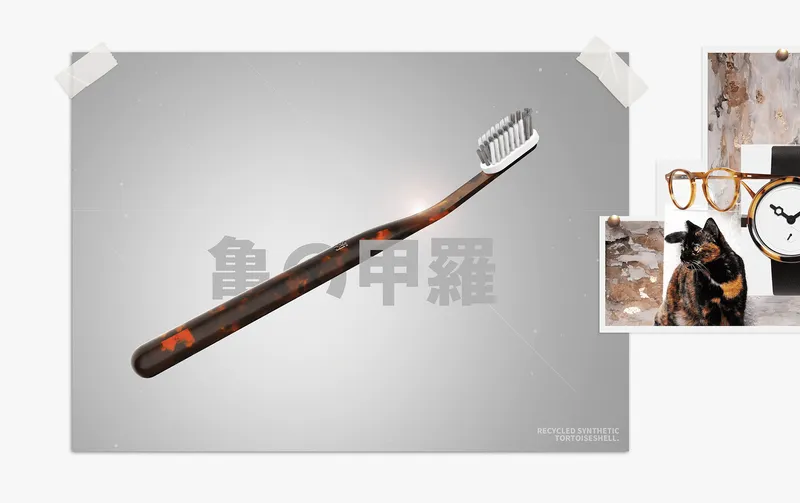
Three poster compositions pair individual handles with pinned moodboards. The bamboo brush with red bristles sits beside a torii gate, a wooden lamp and a bamboo pattern. The recycled speckled handle with blue bristles and blue katakana is matched with speckled terrazzo and a powdered face. The tortoiseshell brush with white bristles appears alongside round glasses, a wristwatch and a calico cat. Each board treats its material as the start of a story, not a colour option.
This matters because a durable product only succeeds if people want to keep it. By tying each handle to a recognisable set of objects and textures, Miller borrows the attachment people feel for well-made glasses or a good watch. The recycled composite gains the most from this treatment. Set next to terrazzo, its flecks read as a deliberate finish rather than evidence of waste.
Why This Project Matters
HILT does not claim to reinvent brushing teeth. Its contribution is diagnostic. It identifies exactly which part of a disposable product actually wears out and redesigns the whole system around that answer. The permanent handle, the minimal-plastic head, the subscription and the return box are each familiar on their own. Together they form a coherent argument that sustainability can be built into the structure of an everyday product rather than applied to its surface.
For young designers, the lesson is in the breadth of the brief Miller set himself. The project gives as much attention to the storefront, the shipping box and the feedback screen as to the object. That is where circular design succeeds or fails, and HILT's Citation at IPDA 2019 recognises a proposal that took the whole lifecycle seriously, down to the cardboard.
View the Full Project
About the Designers
Designer: Joe Miller
Enter a Design Competition on uni.xyz
uni.xyz runs architecture and design competitions year-round that reward proposals with spatial conviction and real site intelligence.
Project credits: HILT: Ecological Toothbrushes by Joe Miller International Product Design Awards 2019 (uni.xyz).


Popular Articles
Popular articles from the community


The Amber Palace Opera: A Geological Fiction Surfaces on Tallinn's Baltic Waterfront
Pierre Brillard reimagines a Baltic legend as a public landscape, opera house, and waterfront promenade rooted in Tallinn's coastal identity.

Extended Shell: Retrofitting Kolkata's Balconies as Living Urban Thresholds
A modular retrofit system recovers the social and environmental intelligence of Kolkata's historic verandas for contemporary Park Street residents.

Tsunami Convergenics: Turning Catastrophic Ocean Forces into Underwater Housing Infrastructure
A speculative underwater settlement off the coast of Onagawa, Japan, treats tsunamis and typhoons as energy sources rather than threats.

Faces of the Soviet Avant-Garde: Turning Moscow's Street Names into an Open-Air Museum
A network of sculptural installations across a Moscow residential district transforms forgotten architect names into spatial encounters with cultural memor

Similar Reads
You might also enjoy these articles

Healing Façade: A Modular Chapel System That Restores Ethiopia's Sacred Forests
Winner of the Eco-Chapel competition, this circular timber façade collects water from air to rebuild soil and reforest degraded Ethiopian landscapes.
Kaffeebühnen: Where Coffee Shop Architecture Becomes a Civic Stage in Vienna
A linear sequence of timber boxes, transparent shells, and open yards turns the Viennese café tradition into a public performance space.
Eco Chapel: A Modular Forest Pavilion That Grows Like the Landscape It Protects
Hexagonal timber modules weave through existing trees, turning a chapel into a living system for prayer, education, and reforestation.


Urban Forest: A Vertical Ecosystem for 5,000 Workers in Singapore's Changi Business Park
Radially stacked pods and layered green decks turn a 7-acre plot into 47 acres of ecological workspace projected for 2040.

Explore Eco-Design Competitions
Discover active competitions in this discipline

Design challenge to equip cities with modern furniture

Packaging challenge - Design meets sustainability
Comments (0)
Please login or sign up to add comments
No comments yet. Be the first to comment!