

HOIKIENG19: A Sculptural Tower House in Da Nang
Hinzstudio shapes a narrow Vietnamese lot into a curving, light-filled vertical home where every level breathes and connects.


Vietnam's tube house tradition is one of the most demanding typologies in residential architecture. Narrow lots, party walls on both sides, and relentless tropical heat conspire against comfort and spatial generosity. Most builders respond with stacked boxes and a single facade to the street. HOIKIENG19 by Hinzstudio, led by architect Phan Văn Trần Tuấn, refuses that formula. Instead, it treats the 255 square meter footprint as an opportunity to sculpt a vertical sequence of rooms linked by a continuous curving staircase, soft arched openings, and pockets of greenery that pull nature through the section.
What makes this project genuinely interesting is the discipline of its formal language. The curves here are not decorative appliqué. They organize circulation, frame light, and dissolve the hard edges that make narrow houses feel claustrophobic. From the street, the facade reads as a white sculptural mass with planted terraces cascading downward. Inside, the same curvilinear logic governs everything from the stairwell to the bathroom thresholds. It is a house that commits fully to a single spatial idea and follows it to every corner.
A Facade That Performs
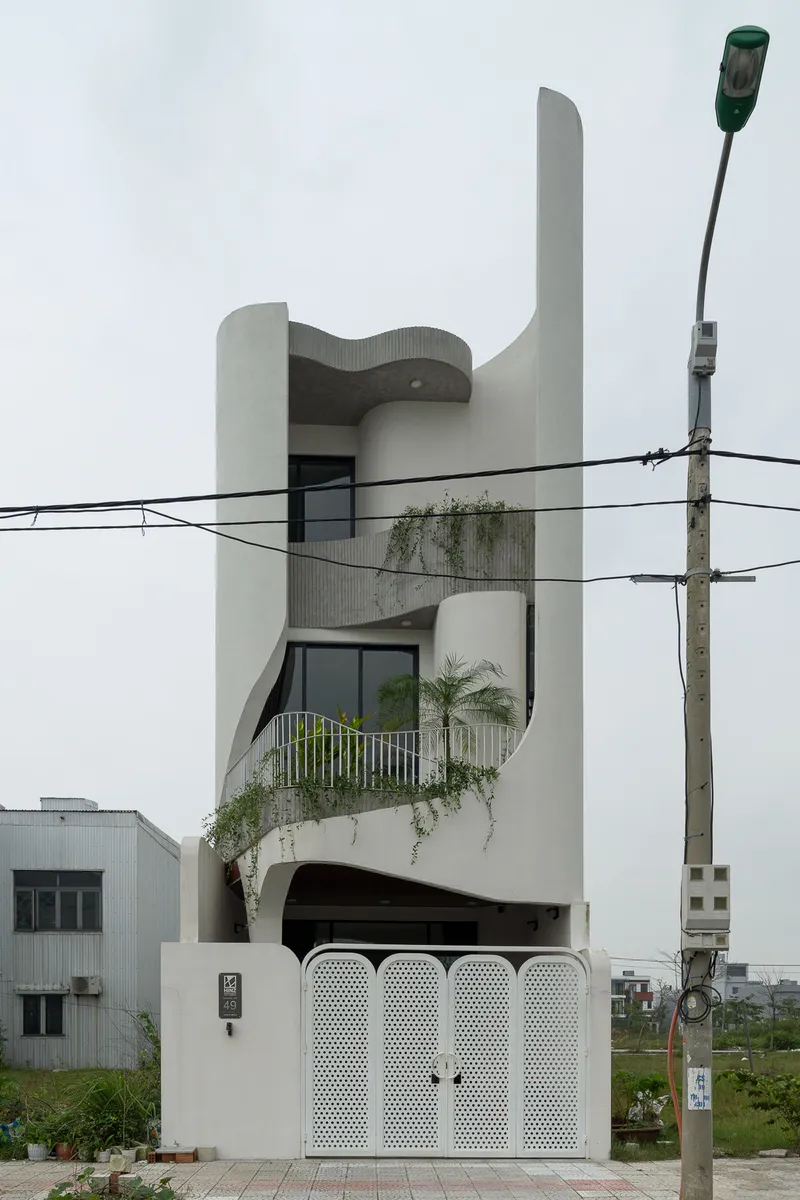
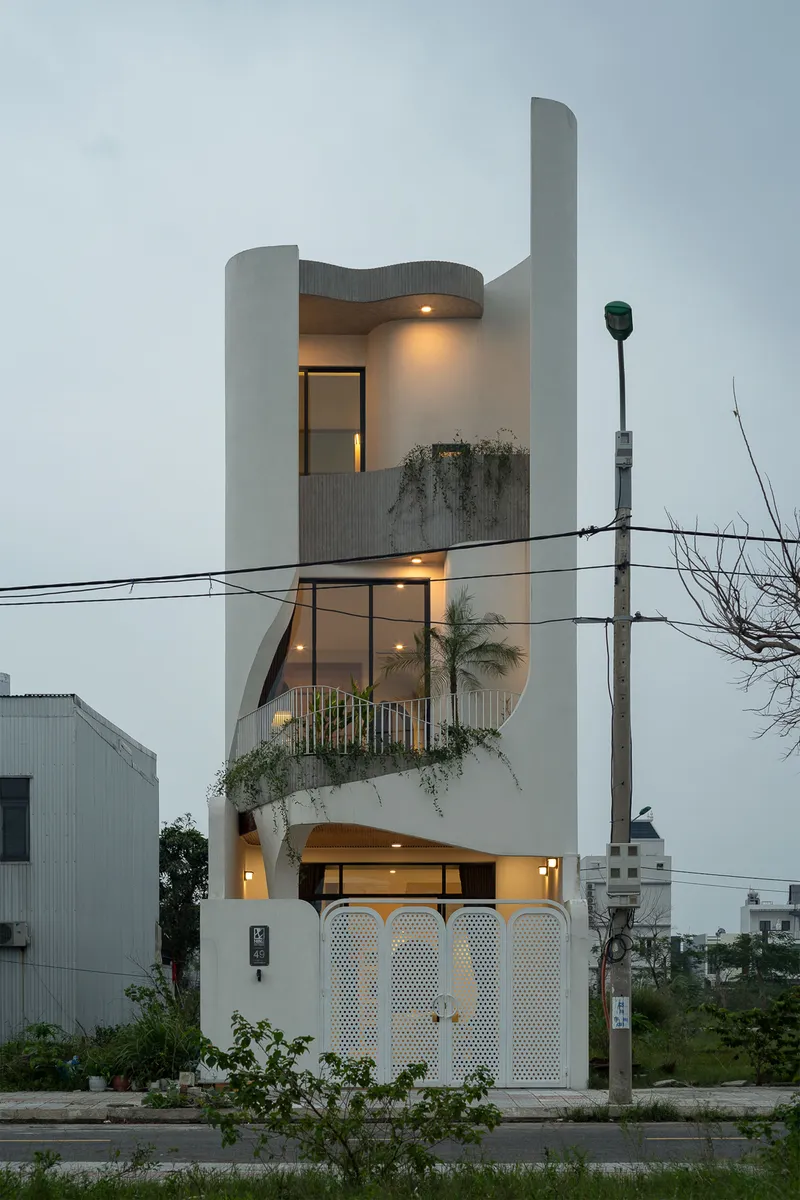
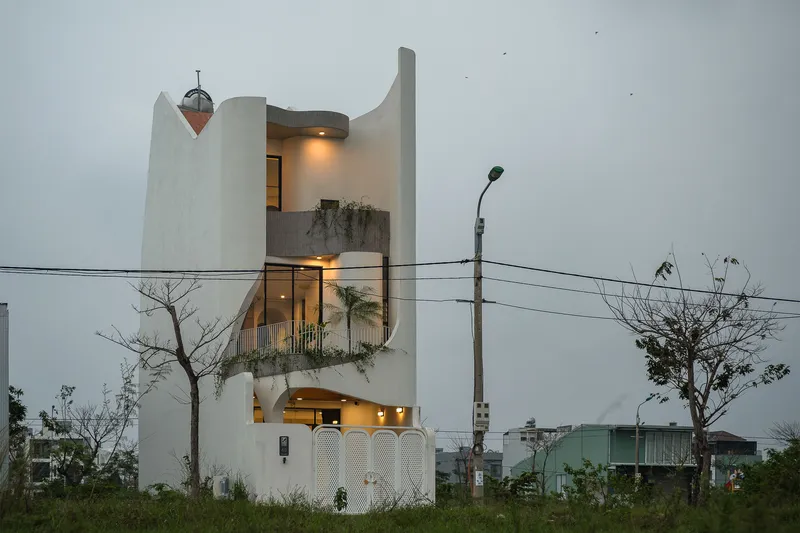
The street-facing elevation does three jobs at once. Perforated gate panels filter views and airflow at ground level, curved parapets create planting troughs that trail greenery down the facade, and the overall massing steps back as it rises. The result is a building that feels both solid and porous. At dusk, the facade glows from within, its vertical slots and recessed balconies turning the house into a lantern on a narrow residential street crowded with power lines and neighboring walls.
Da Nang's climate demands that facades do more than look good. The planted balconies provide shade, the perforations encourage cross-ventilation, and the white finish reflects solar gain. Hinzstudio treats the elevation as environmental infrastructure dressed in architectural expression, not the other way around.
The Staircase as Spine
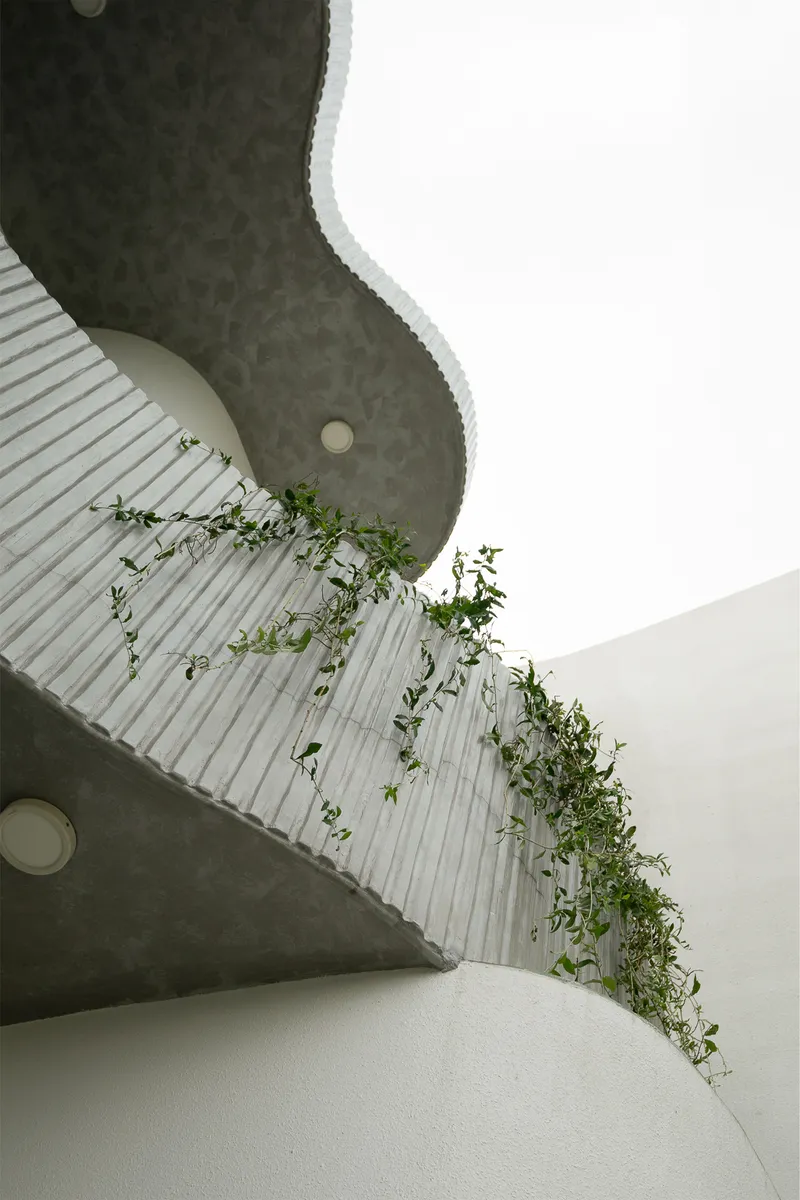
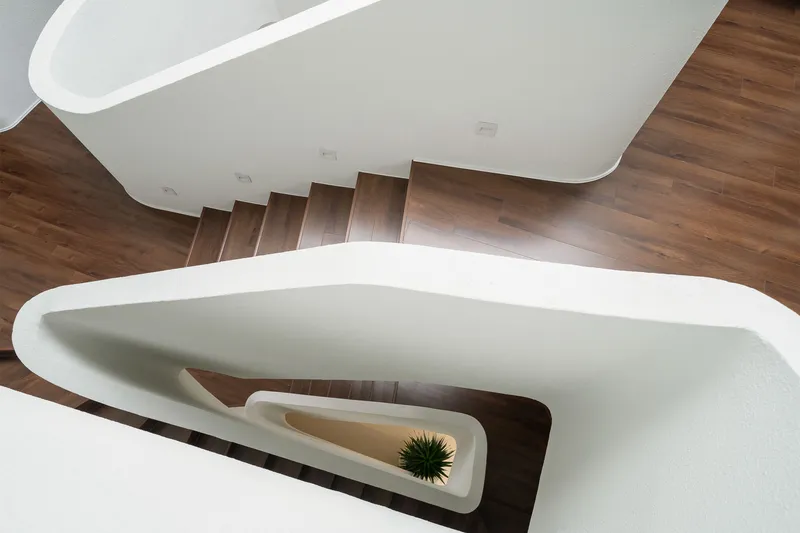

In a tower house, the staircase is everything. It consumes a huge percentage of the plan and determines how each floor relates to the next. Here, the stair wraps upward in a continuous curve, its white ribbed underside becoming a sculptural ceiling for the rooms below. Dark timber treads ground the otherwise ethereal geometry, and a recessed planter at one landing introduces a moment of green surprise mid-climb.
The vertical view through the stairwell is perhaps the most telling image of the whole project. A person leaning over the upper landing peers down through layered curved openings, and the house suddenly reveals itself as a single connected volume rather than a stack of isolated floors. That sense of visual continuity is rare in this typology, and it transforms the experience of moving between levels from obligation to pleasure.
Living and Dining: The Double-Height Core
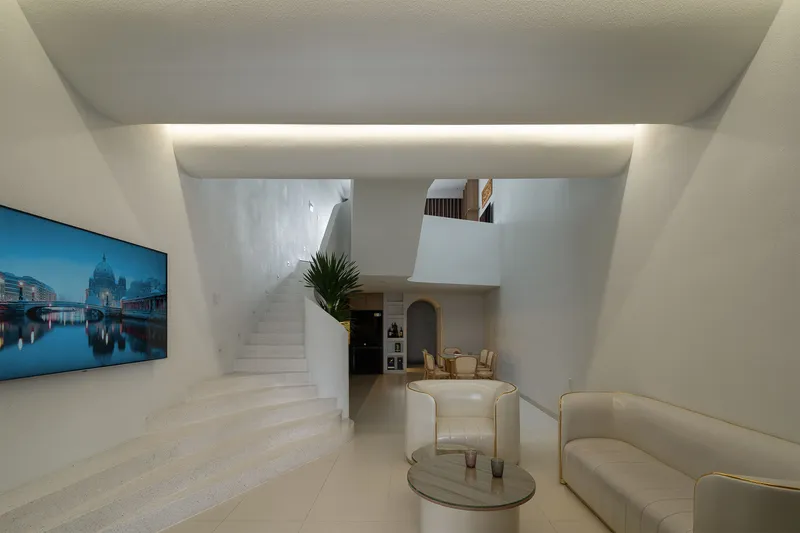
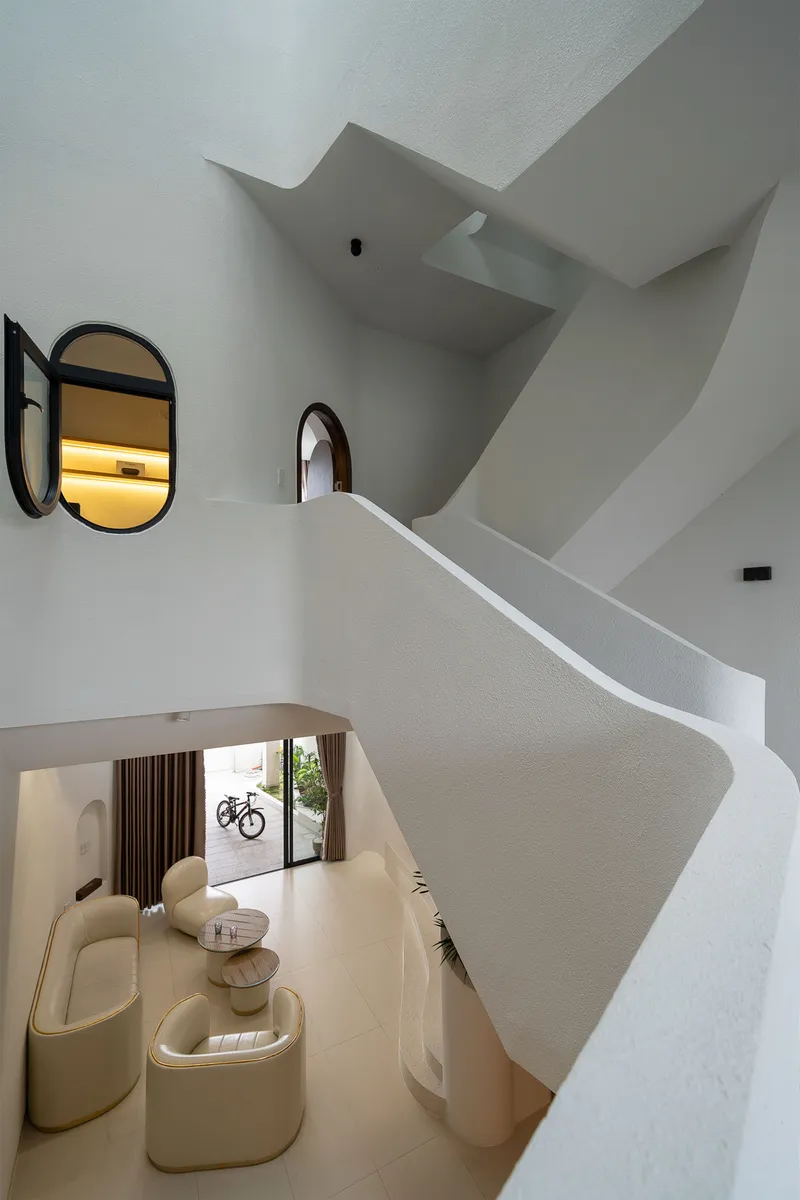
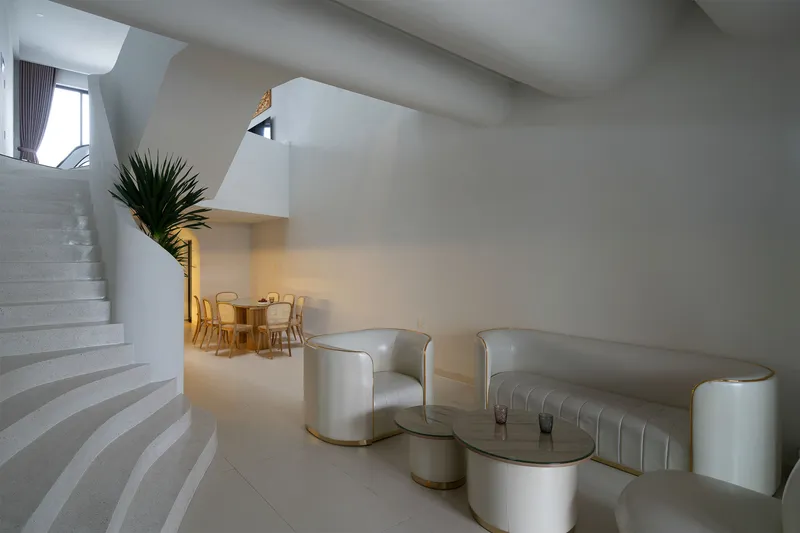
The ground and first levels open up into a double-height living space that is the social heart of the house. Arched mirrors on the upper wall amplify daylight and create a sense of spatial depth well beyond the actual dimensions. Beige upholstery, sculptural ceiling forms, and the ever-present curve of the staircase soften what could be an austere white interior.
The dining area sits at the base of the stair, framed by flowing plaster surfaces and vertical timber slat screens that modulate views toward the kitchen. There is a deliberate informality to the arrangement. Family members at the dining table can see up to the landing above, out toward the street, and into the kitchen simultaneously. Openness without a lack of definition is the balancing act, and Hinzstudio manages it with spatial generosity rather than partition walls.
Kitchen and Everyday Spaces
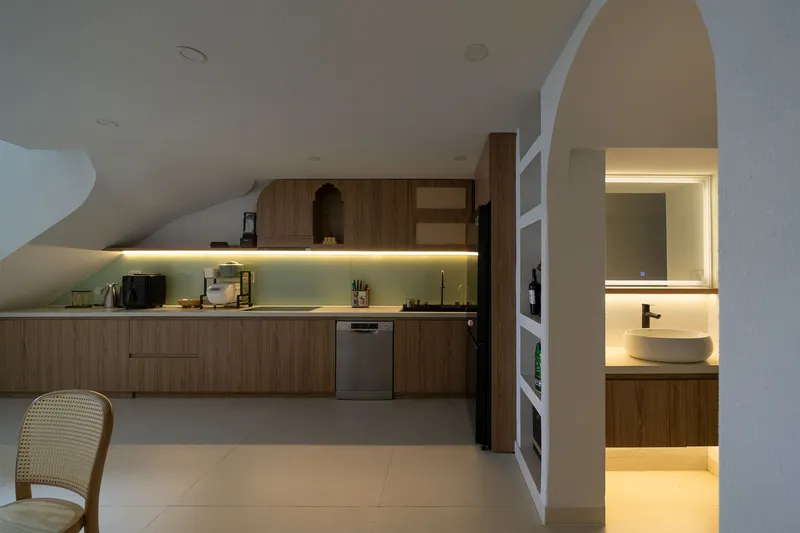
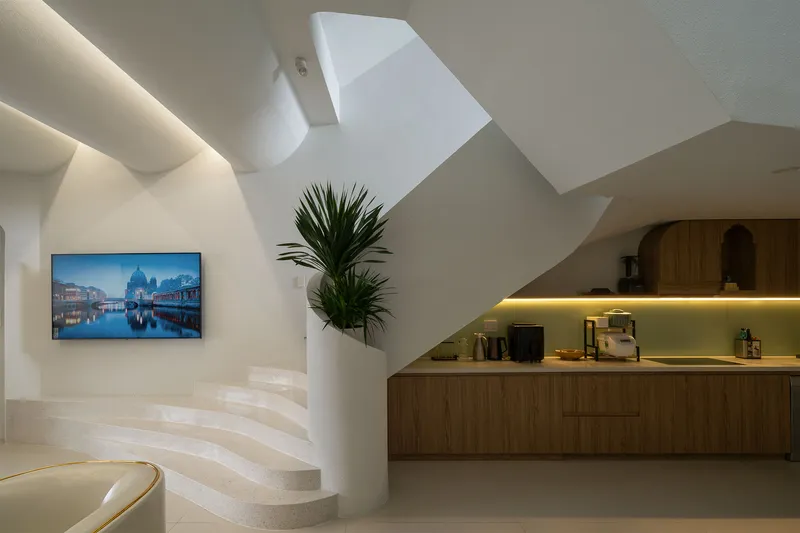
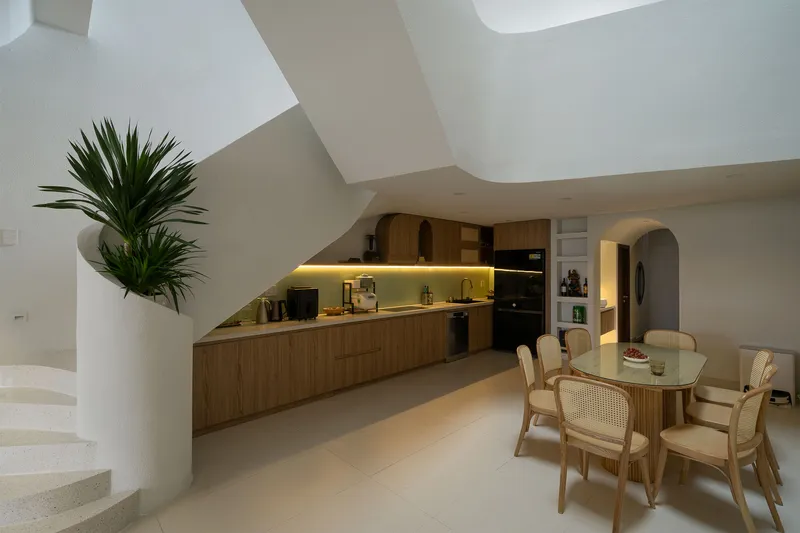
The kitchen occupies a service wing at the rear of the ground floor, finished in warm timber cabinetry with LED strips beneath the upper cabinets. It is a restrained, functional space that avoids the temptation to over-design. An angular white ceiling plane connects it visually to the more expressive volumes beyond, while a potted palm at the counter's edge provides a casual green accent.
What works here is the tonal shift. After the dramatic double-height living room, the kitchen feels intimate and grounded. The timber surfaces lower the visual temperature, and the compact plan means everything is within arm's reach. It is a space designed for daily life rather than photography, which is exactly the right instinct for a family home.
Private Rooms: Arches, Color, and Calm
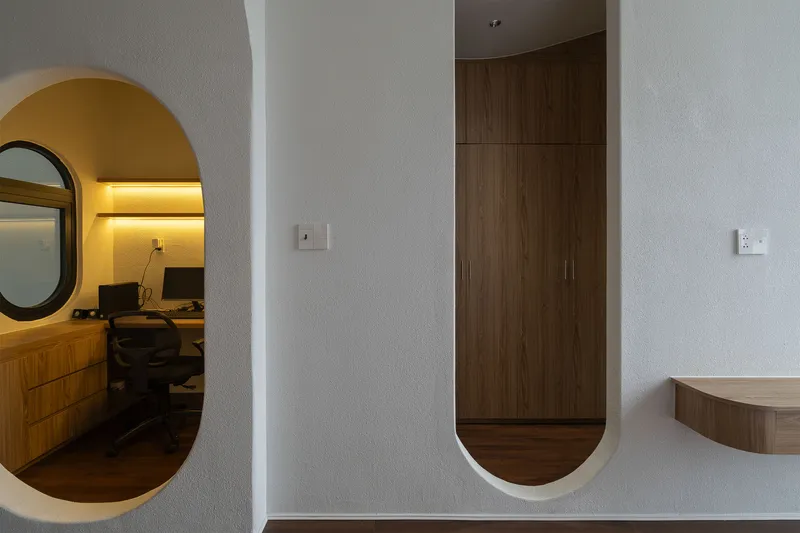
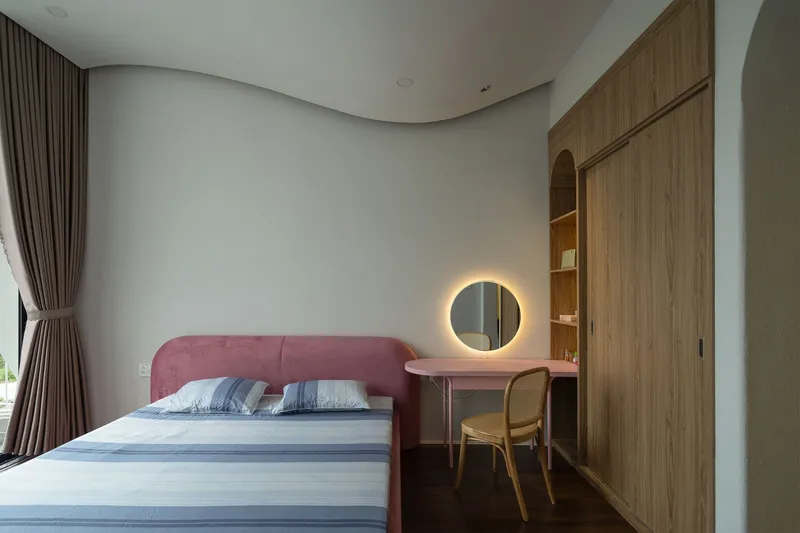
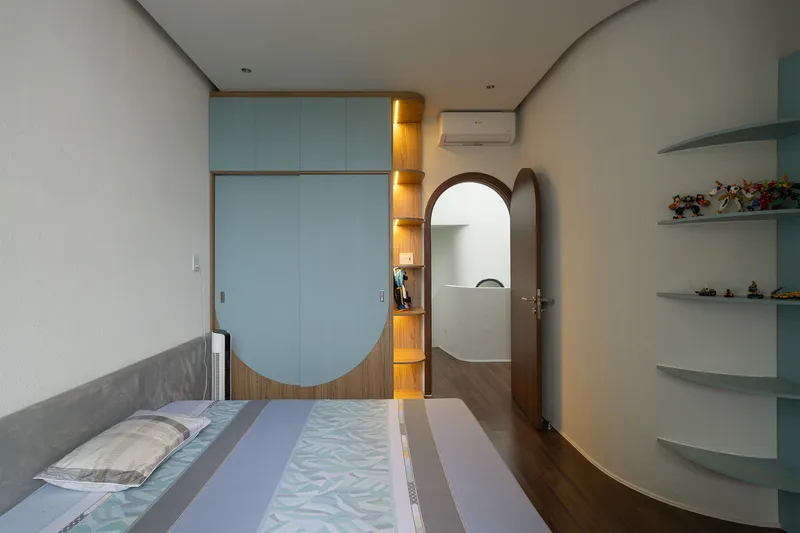
The bedrooms on the upper floors adopt the house's curvilinear vocabulary through arched openings, integrated wardrobes with arched timber accents, and soft color palettes. One room features pink upholstery and curtained daylight; another uses blue panels and warm integrated lighting to create a distinct identity. White arched frames carve out study niches and wardrobe alcoves that feel purposeful rather than leftover.
Each bedroom is clearly tailored to its occupant, and the color choices give individual character without breaking the house's overall coherence. The arch motif, repeated at different scales from doorway to furniture detail, ties these private spaces back to the public ones below.
Details: Bathrooms, Study Nooks, Balconies
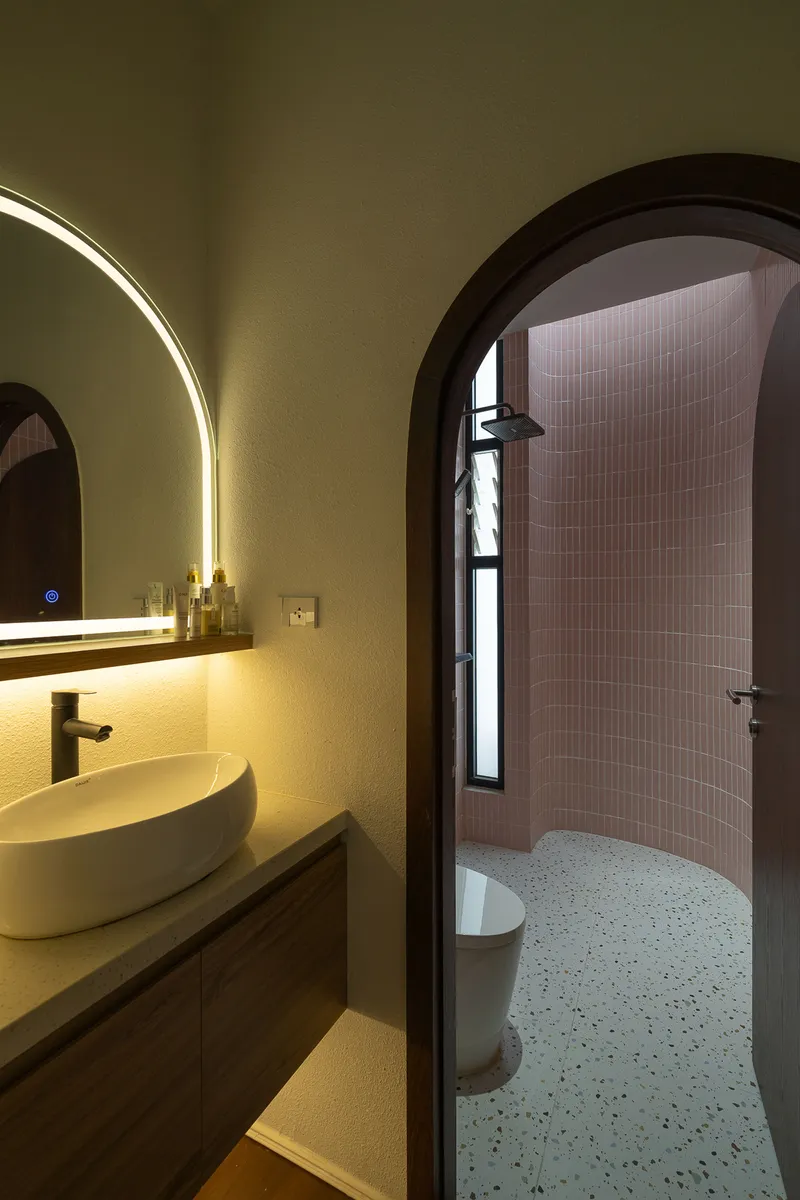
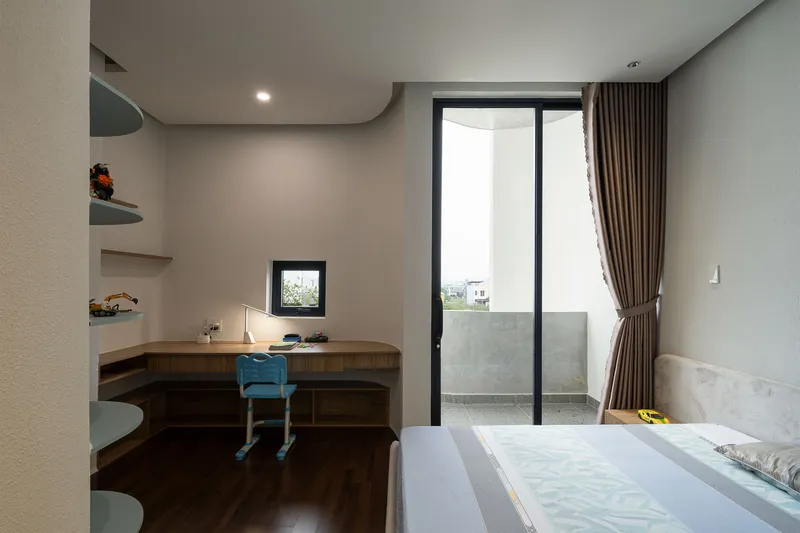
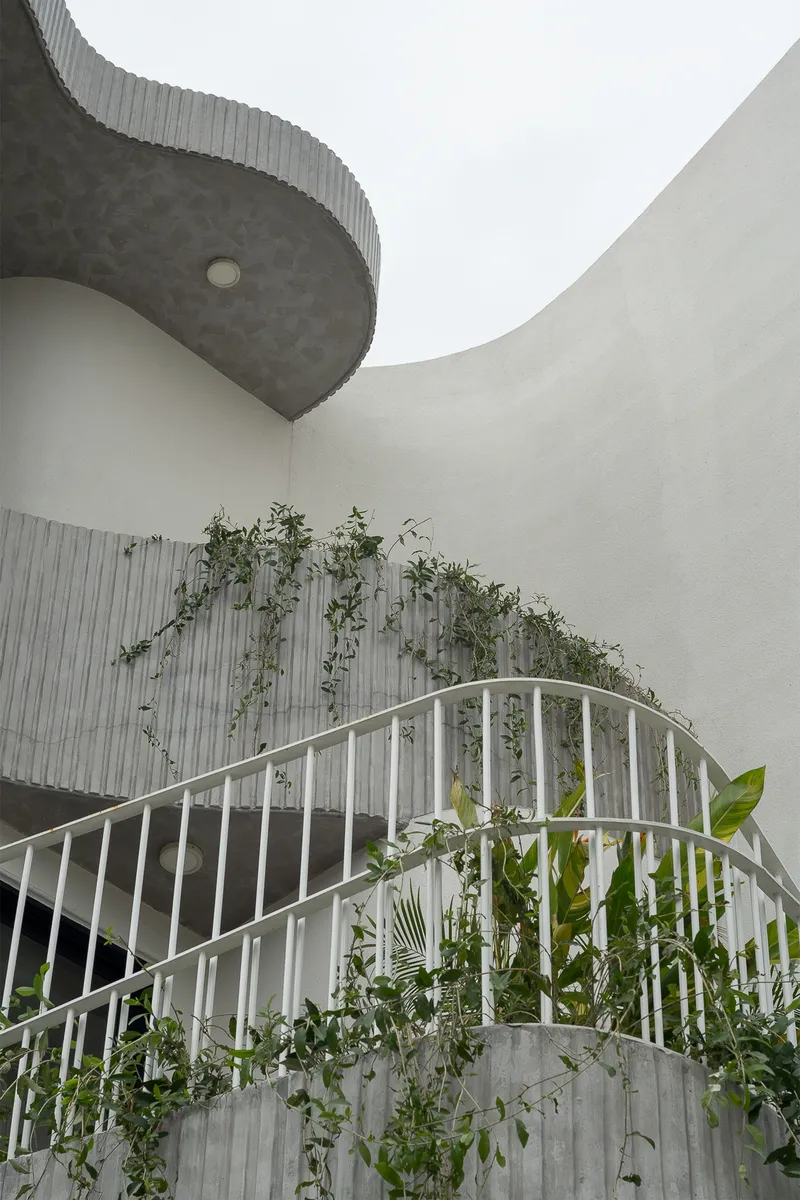
The pink-tiled shower enclosure with its backlit circular mirror is a standout moment. It commits to a color without apology, and the arched entry frame makes a small bathroom feel generous and considered. Elsewhere, a study nook with a timber desk and glazed door opens directly onto a planted balcony, collapsing the boundary between work and outdoor air. The balconies themselves, wrapped in white metal railings with climbing plants against corrugated walls, act as green buffers between interior and street.
Night Readings
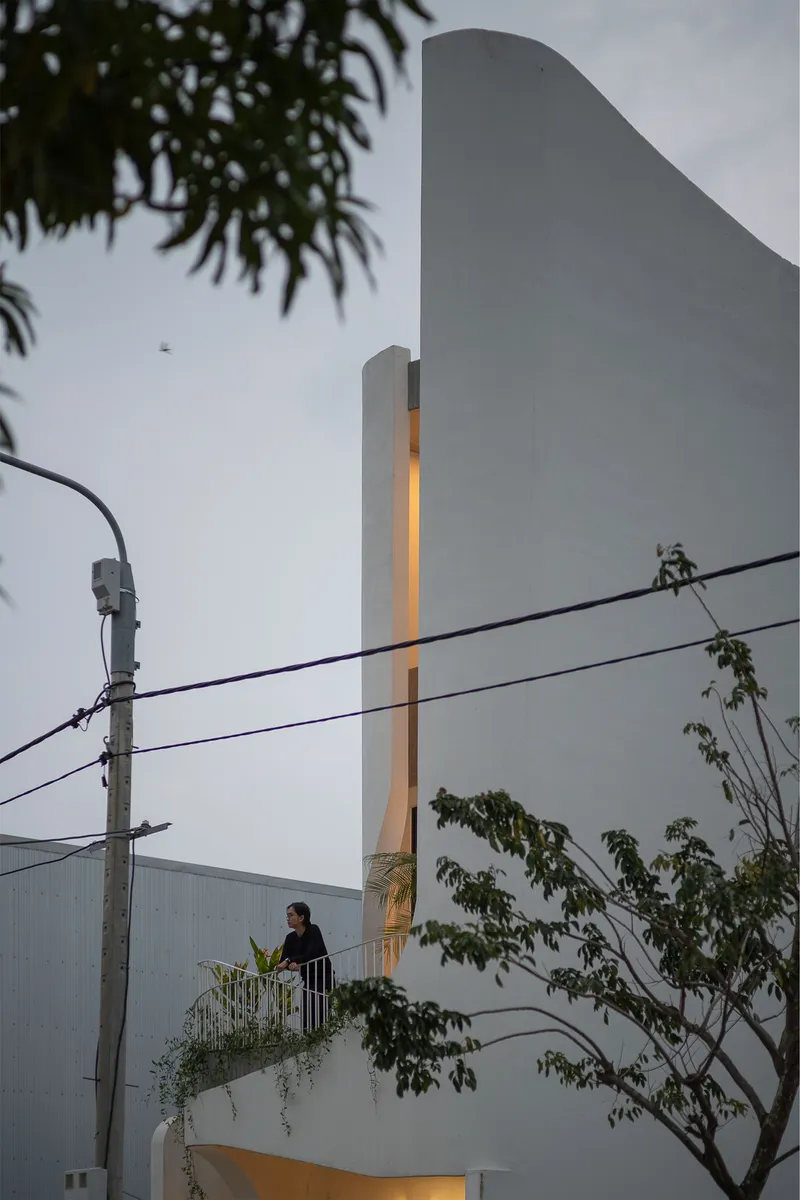
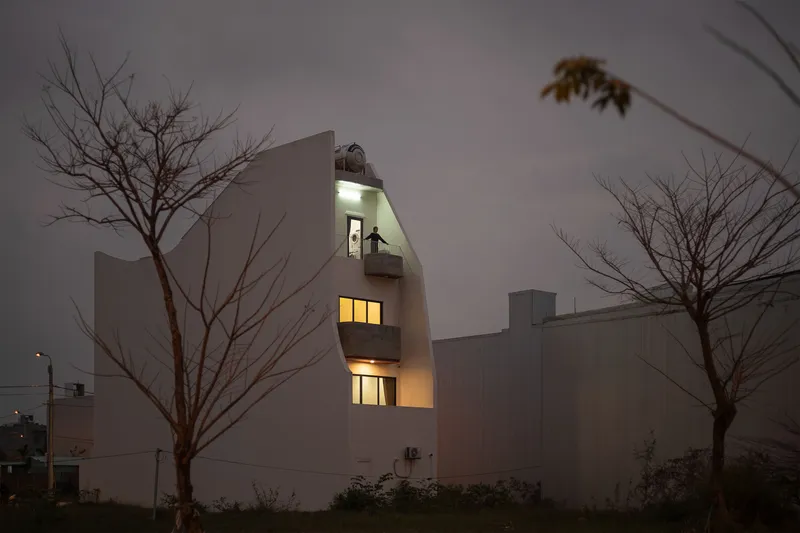
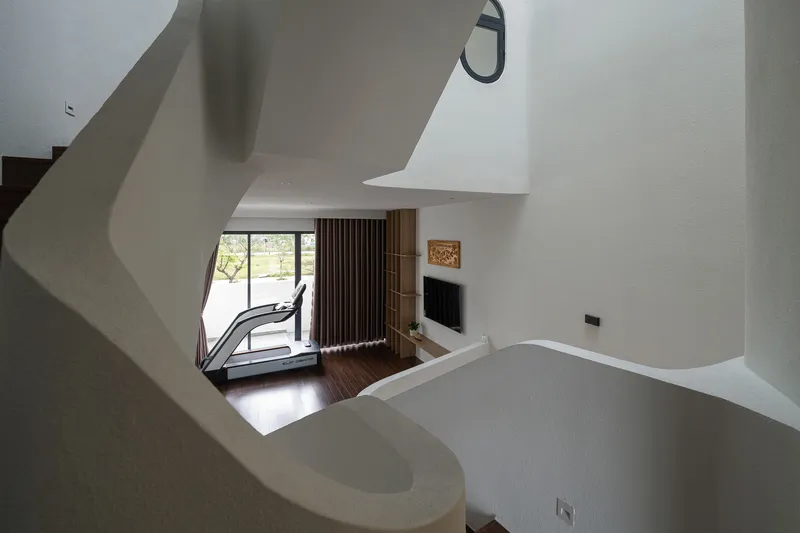
The house reads differently at night. The illuminated vertical slot on the front facade becomes a glowing line drawing against the dark sky, while the rear elevation reveals its stacked openings like a sectional diagram made real. Inside, the curved stairwell with its under-tread lighting takes on an almost theatrical quality. These nighttime views confirm that the spatial strategy holds up under changing conditions. The house was not designed for one photographic moment; it performs across the full cycle of a day.
Plans and Drawings
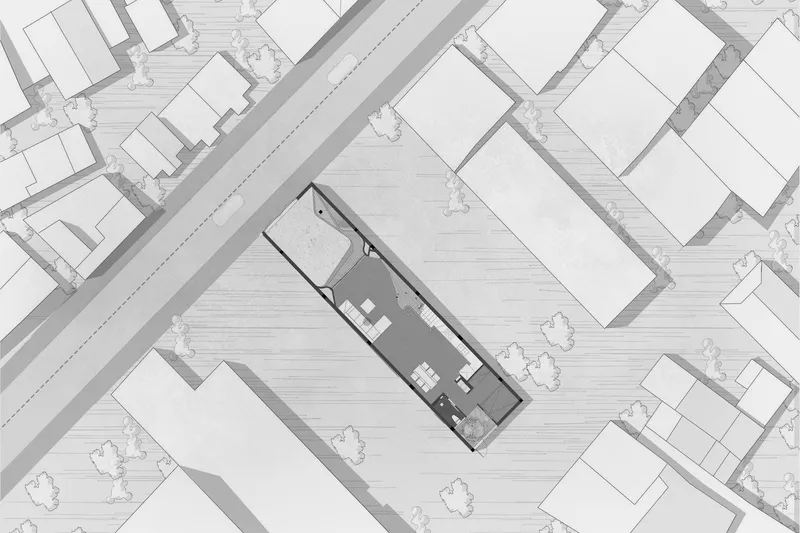
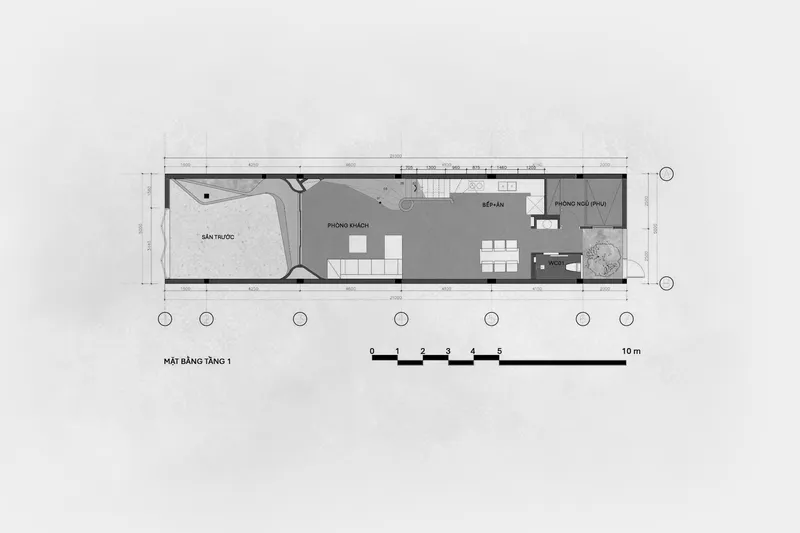
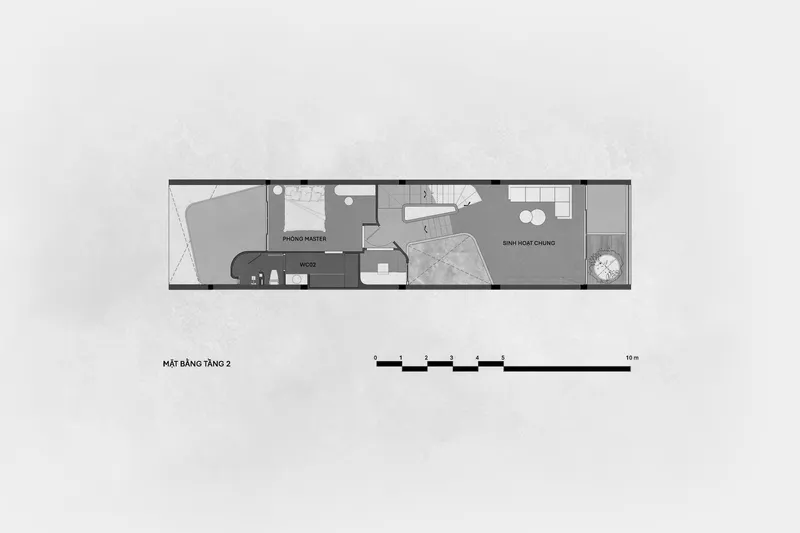
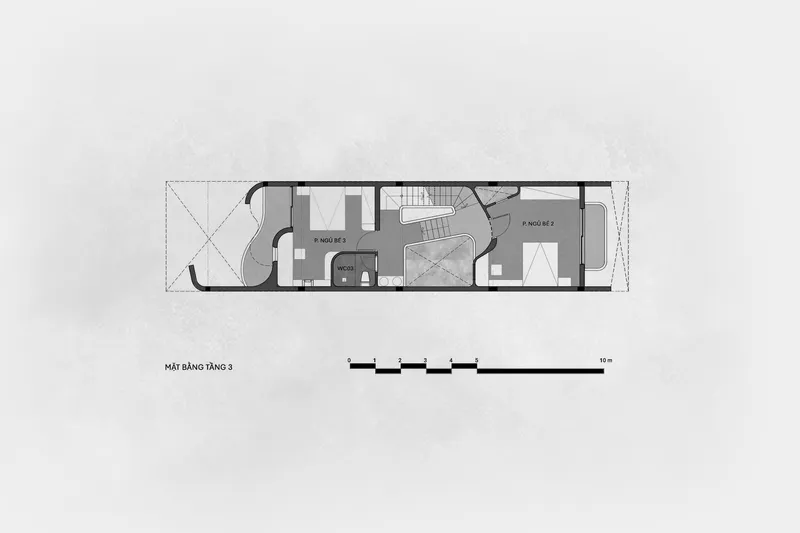
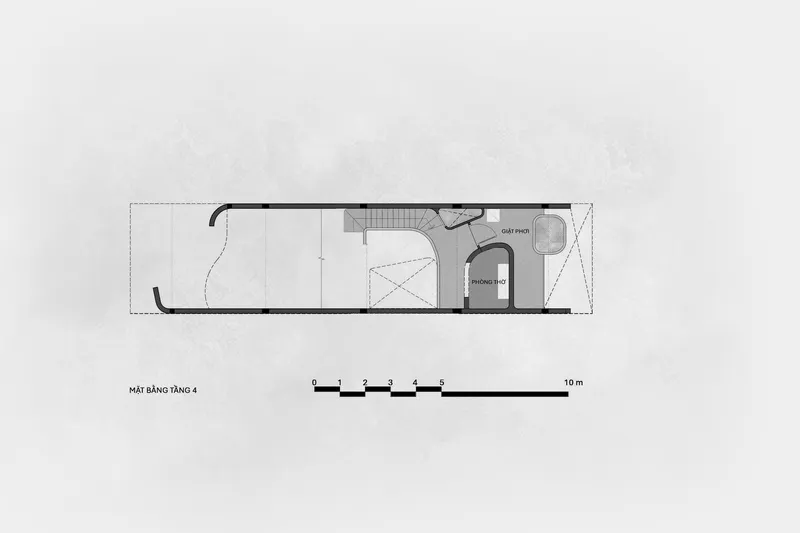
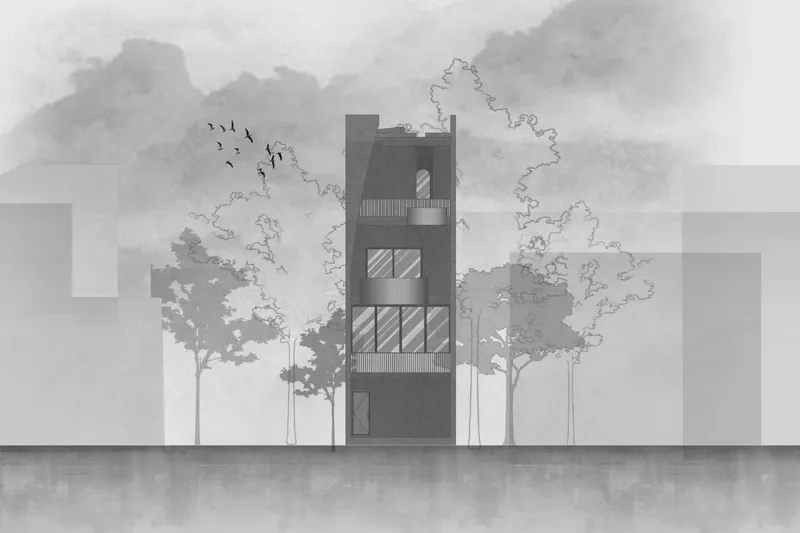
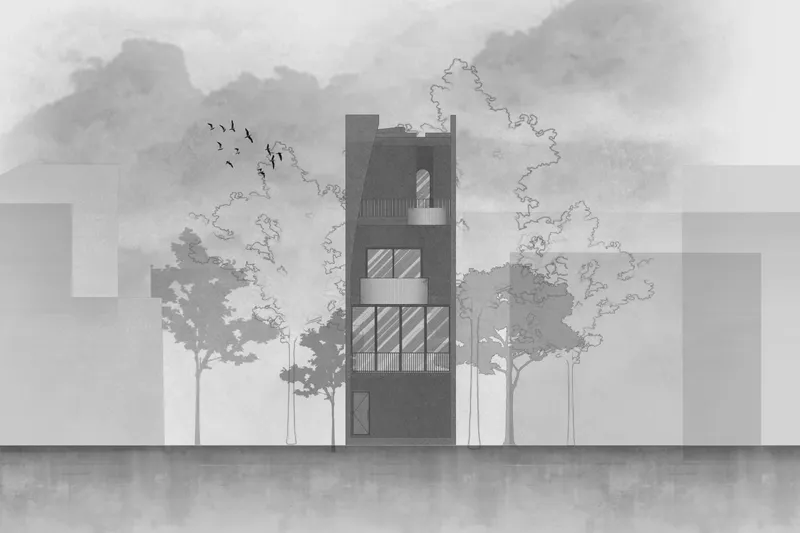
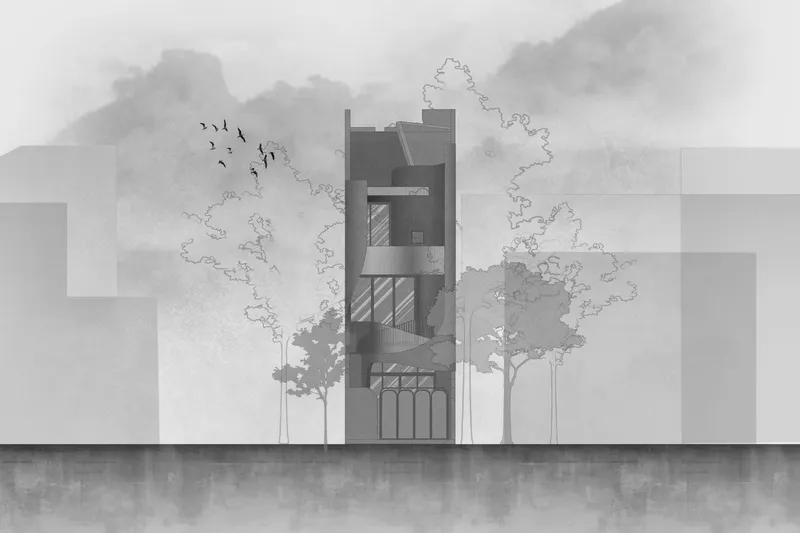
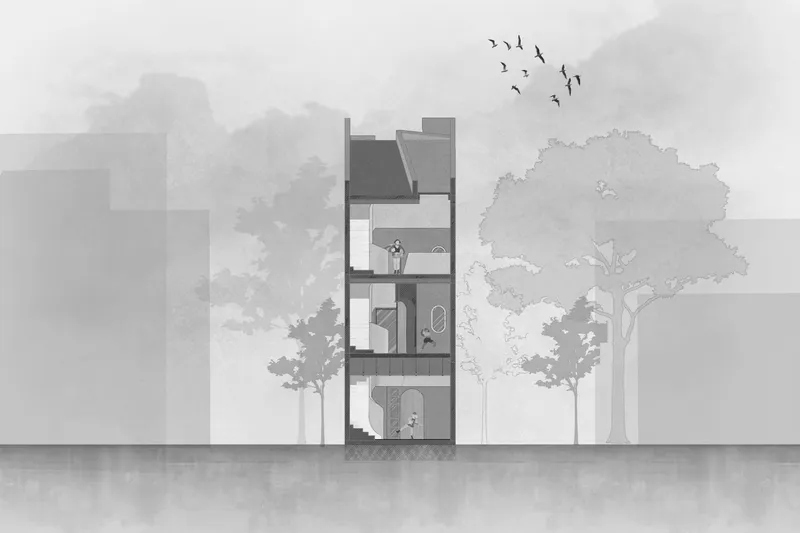
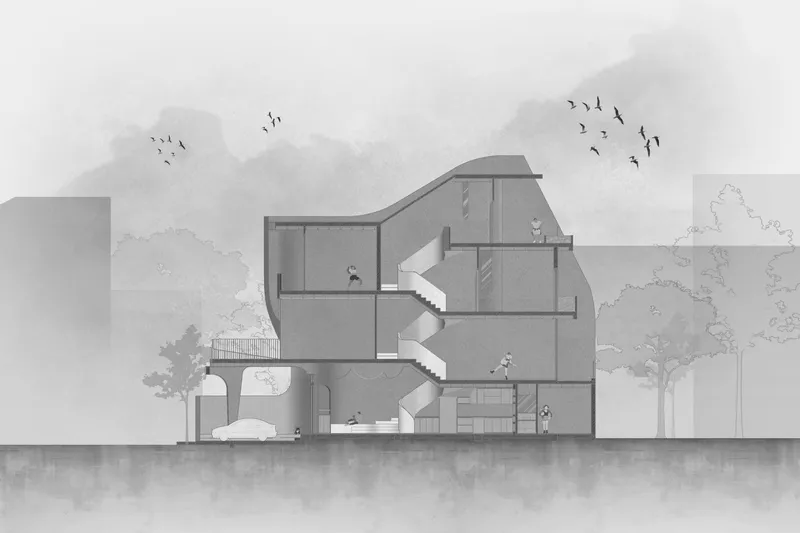
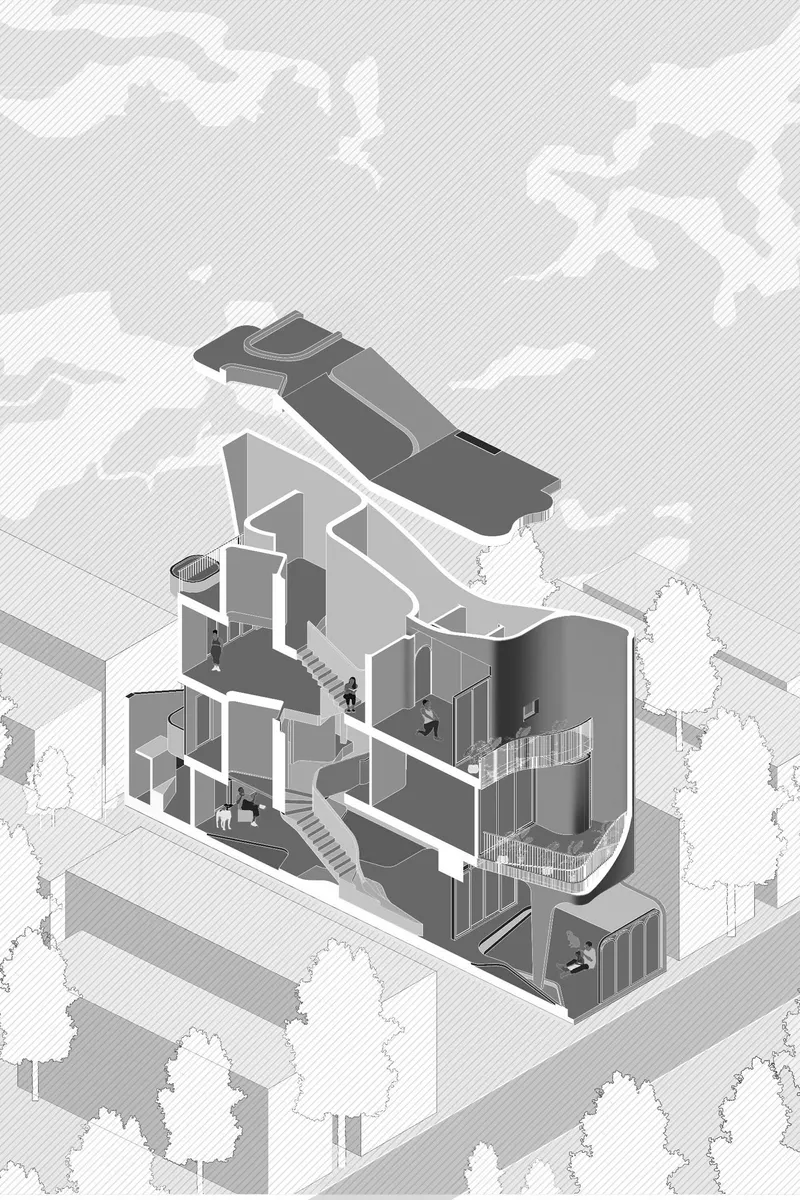
The site plan reveals the constraint: a narrow lot positioned diagonally within a dense urban block. The floor plans show how Hinzstudio placed the staircase as a central spine, freeing the perimeter for rooms that receive light and air from both the street and a rear courtyard. The section drawings are the most revealing documents. Zigzagging staircases connect split-level floors, and the voids between levels are legible as deliberate spatial events rather than structural necessities. The axonometric cutaway exposes the interior arrangement in full, confirming the clarity of the organizational logic beneath the soft, curved surfaces.
The elevation drawings, rendered with flanking trees and birds overhead, place the house in a gentle, almost narrative context. They communicate the architects' ambition for the building to be part of its street and its landscape, not an isolated object. The four-story massing, tight to its neighbors, is legible as a tower only because of its vertical proportions; in plan, it is a modest footprint handled with care.
Why This Project Matters
HOIKIENG19 matters because it demonstrates that the Vietnamese tube house does not have to be a compromised typology. Within the same dimensional constraints that produce bland repetitive boxes across the country's cities, Hinzstudio has created a spatially rich, environmentally responsive, and visually unified home. The consistent use of curves, from the facade down to the bathroom threshold, is not style for its own sake. It is a legible design decision that improves circulation, softens narrow proportions, and creates family connections across levels.
For architects working in dense urban contexts, the takeaway is clear: section design and circulation strategy matter more than plan area. A generous stairwell, a well-placed void, a balcony that acts as both garden and buffer can transform a constrained lot into a place of genuine spatial pleasure. Hinzstudio proves that commitment to a single formal idea, pursued rigorously through every scale of the project, is enough to elevate the everyday house into architecture worth studying.
HOIKIENG19 House by Hinzstudio, led by Phan Văn Trần Tuấn. Da Nang, Vietnam. 255 m². Completed 2023.
About the Studio
Share Your Own Work on uni.xyz
If projects like this are the kind of work you want to make, uni.xyz is a place to publish your own, find collaborators, and enter design competitions.


Popular Articles
Popular articles from the community


Opera on the Sea: Driftwood Logic Shapes a Timber Opera House on Estonia's Coast
Trevor Orgill's opera house translates the entangled drift of floating timber into a civic building where wood, water, and music converge.
Opera by the Sea Estonia: Three Shells Dissolving Architecture into Tallinn's Coastline
A winning opera house proposal replaces monumental form with interconnected shells that blur the boundary between building, park and Baltic Sea.

Singing Woman: Contemporary Architecture Inspired by Estonia’s Voice and the Sea
Singing Woman turns Estonia’s song culture into flowing opera house architecture, blending public life, landscape, sea, and national memory.
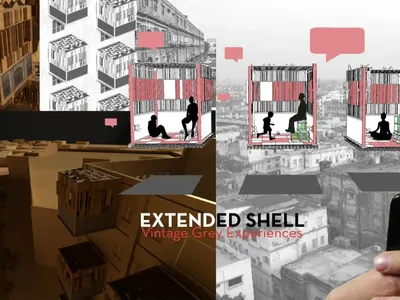
Extended Shell: Retrofitting Kolkata's Balconies as Living Urban Thresholds
A modular retrofit system recovers the social and environmental intelligence of Kolkata's historic verandas for contemporary Park Street residents.

Similar Reads
You might also enjoy these articles

Bao Huynh Watercolor Atelier: A Serene Art Retreat in Hội An
Bao Huynh Watercolor Atelier in Hội An blends multifunctional art spaces, sustainable design, local materials, and family-friendly living in a serene environment.

Atelier Macri Concept Store Interior Design by CASE-REAL
Atelier Macri store features a "ko" counter, walnut wood details, cork displays, blending retail, gallery, and seamless customer experiences.

Manuel Vargas Izquierdo Stadium and High-Performance Sports Center: Architectural Excellence in Jalpa de Méndez
The Manuel Vargas Izquierdo Stadium blends sustainable design, inclusive sports facilities, and cultural-inspired architecture, revitalizing Jalpa de Méndez’s public spaces.
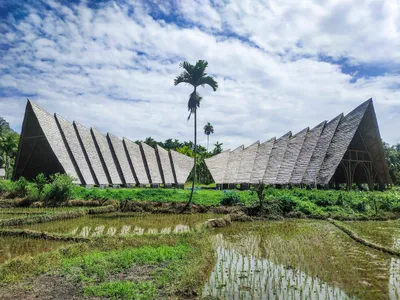
KAKR Buluh Awar Hall: Revitalizing Community and Ecology Through Bamboo Architecture
Community built bamboo hall revitalizes Buluh Awar village, empowering youth, restoring ecology, celebrating vernacular craftsmanship through sustainable architecture and culture.


Comments (0)
Please login or sign up to add comments
No comments yet. Be the first to comment!