
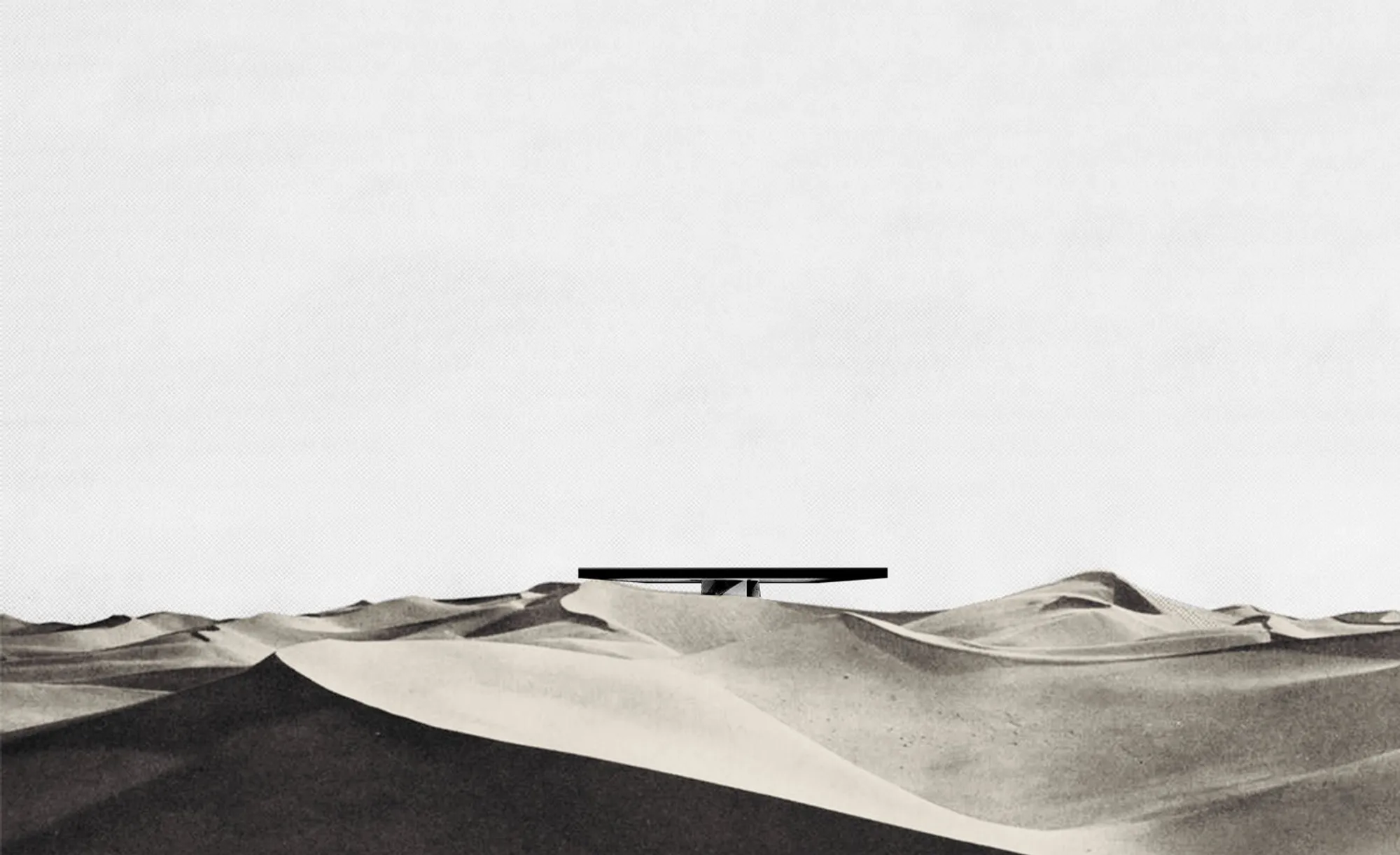
Hourglass as a Climate Change Beacon
A minimal earth monument that frames time, climate change, and human impact, transforming landscape into a living, evolving architectural memory.


In contemporary discourse, sustainable memorial architecture is shifting from static symbolism to dynamic ecological engagement. The project Hourglass, designed by Agata Holdenmajer, exemplifies this transition. Recognized as an Honorable Mention in the Hourglass competition, the proposal redefines the memorial not as an object of permanence alone, but as a living interface between time, environment, and human perception.
Set within a vast desert landscape, the project operates as both a climate change monument and a spatial instrument for reflection. It does not impose itself on nature. Instead, it frames it, allowing the earth itself to become the primary subject.
Concept: Architecture as a Pause in Time
The conceptual foundation of Hourglass emerges from a simple yet critical observation: modern society has lost the ability to pause. The project responds by creating a timeless architectural intervention that encourages stillness and introspection.
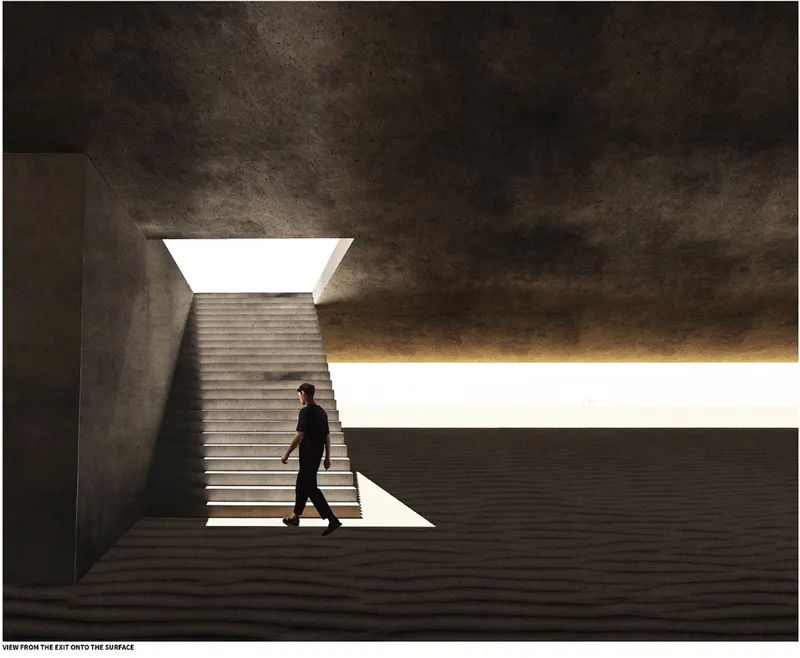
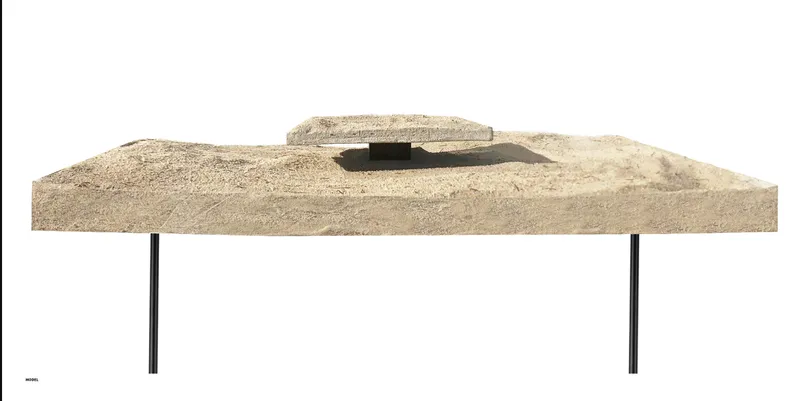
Rather than assigning a fixed program, the design functions as a neutral platform. A reinforced concrete structure elevates a portion of the earth, transforming it into a framed landscape. Visitors descend below ground and re-emerge onto the platform, experiencing a deliberate shift in perception.
This spatial sequence reframes the land as a work of art, encouraging users to engage with the environment not as background, but as subject.
Climate Change Narrative Through Spatial Design
Unlike conventional monuments that rely on text or figurative representation, Hourglass communicates through environmental processes. The project highlights how natural systems evolve over time, particularly under the influence of climate change.
Wind becomes an active design agent. Sand dunes continuously reshape the terrain, ensuring that the monument is never visually static. This constant transformation reinforces the idea that the planet is not fixed, but in flux.
By exposing visitors to these subtle yet powerful changes, the architecture fosters awareness of global warming and ecological fragility. It does not dictate a message. Instead, it creates conditions for realization.
Dynamic Landscape as Living Material
A defining aspect of this sustainable architectural proposal is its reliance on living landscape systems. The project treats sand not as a passive surface, but as an active, responsive material.
Dune formations evolve through wind patterns, creating a continuously shifting topography. This phenomenon introduces temporality into the architectural experience. Each visit reveals a different configuration of the same site.
This approach aligns with post-humanist thinking in architecture, where human control is minimized and natural processes are allowed to operate independently. The monument exists, but it does not dominate.
Minimal Intervention, Maximum Impact
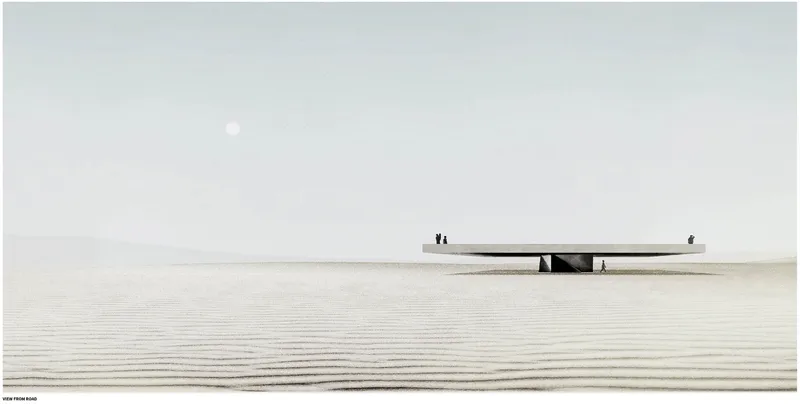
The formal language of Hourglass is deliberately restrained. A thin horizontal slab, supported by a recessed structure, creates a strong geometric contrast against the organic desert context.
The intervention is minimal in footprint but profound in implication. By lifting a portion of the ground, the design emphasizes what is often overlooked: the earth itself.
Materially, the use of reinforced concrete ensures longevity, allowing the structure to endure across generations. At the same time, its simplicity ensures that it remains secondary to the evolving landscape it frames.
Spatial Experience: From Descent to Reflection
The architectural journey is carefully choreographed. Visitors approach the structure across the open desert, where its low profile maintains a subtle presence.
Entry occurs through a cut in the ground, leading to a shaded, enclosed space. This moment of compression contrasts sharply with the expansive openness above. A staircase then guides visitors upward, culminating in the elevated platform.
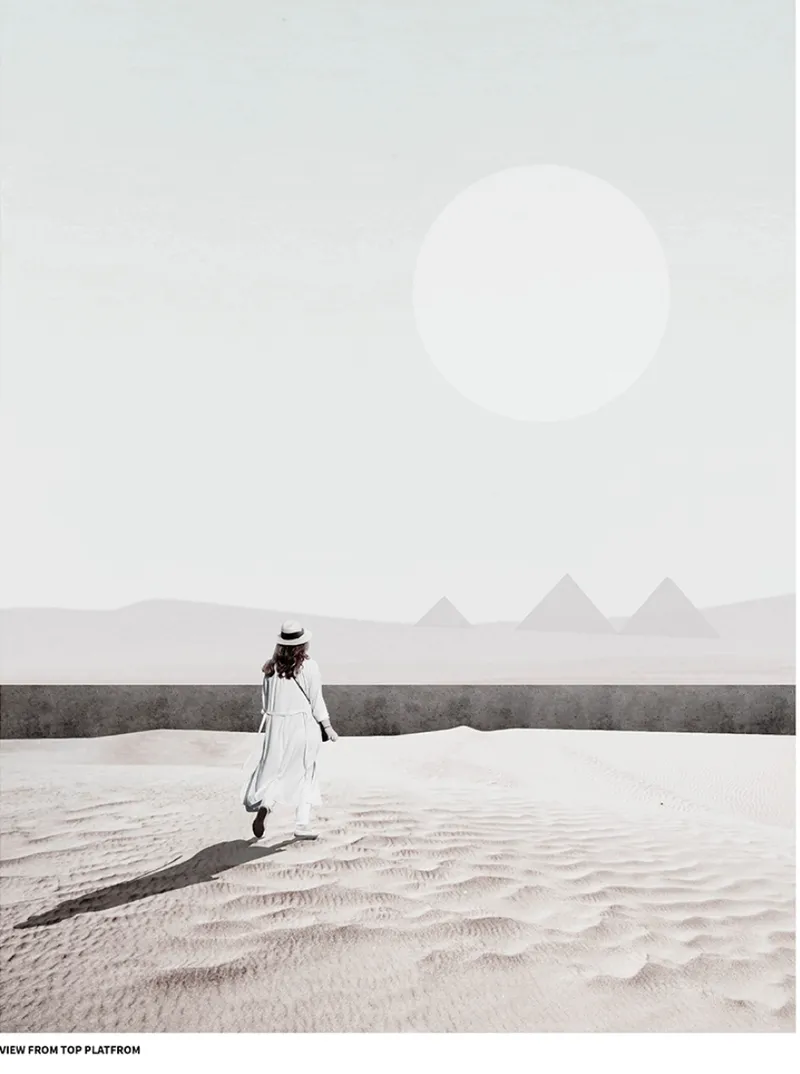
Here, the experience shifts from introspection to observation. The horizon, dunes, and sky become the primary visual elements. The architecture recedes, allowing the environment to take precedence.
Environmental Responsibility and Awareness
Hourglass embodies a conscious effort toward environmental awareness without resorting to technological excess. Its sustainability lies in its conceptual clarity rather than mechanical systems.
By encouraging users to stop, observe, and reflect, the project addresses a critical gap in contemporary society: the absence of environmental mindfulness. The act of pausing becomes a form of ecological engagement.
This aligns with broader trends in eco-conscious architecture, where the goal is not only to reduce impact but to reshape perception and behavior.
Timelessness and Autonomy
The monument is designed to function independently of human intervention. It requires no maintenance, no programming, and no external input to remain relevant.
Its durability stems from both material and concept. While the concrete structure ensures physical permanence, the evolving landscape ensures experiential continuity.
This duality allows Hourglass to operate as a timeless architectural system, capable of adapting to changing environmental conditions while maintaining its core intent.
Global Relevance and Replicability
Although conceived for a specific desert context, the principles underlying Hourglass are universally applicable. The idea of creating spaces for reflection, framed by natural processes, can be adapted across diverse geographies.
In an increasingly urbanized world, such interventions could serve as critical counterpoints. Whether placed within dense cities, forests, or coastal regions, the concept retains its relevance.
This scalability positions Hourglass within a broader network of potential climate awareness architecture, capable of addressing global audiences through localized expressions.
Juror Insight: Critical Reflection on Context
Juror Jonas Prismontas acknowledged the project’s strength in its simplicity and visual clarity, noting its compelling architectural presence. However, he also raised an important critique regarding contextual contrast.
According to Prismontas, the design might achieve greater emotional impact if situated in a more contrasting environment. In its current desert setting, the elevated platform risks blending into the surrounding sandscape. Alternative contexts, such as an urban void or forest edge, could amplify its symbolic resonance.
This observation highlights a critical dimension of architectural design: the relationship between object and context. While Hourglass succeeds as a conceptual and spatial proposal, its placement remains open to further exploration.
Hourglass represents a significant evolution in sustainable memorial architecture. It shifts the focus from static commemoration to dynamic engagement, from object to process, and from representation to experience.
By framing the earth as both subject and medium, the project challenges conventional notions of monumentality. It invites users to pause, observe, and reconsider their relationship with the planet.
In doing so, it transforms architecture into a quiet yet powerful agent of environmental awareness. Not through spectacle, but through stillness. Not through imposition, but through revelation.




Popular Articles
Popular articles from the community


Riyadh For All: Intergenerational Urban Design for Active Aging in Rabat
Riyadh For All reimagines urban design in Rabat with intergenerational co-living, adaptive courtyards, and Moroccan cultural exchange today.

The Musturak Paradise: Senior Living Architecture for a Connected Future in Temara, Morocco
The Musturak Paradise reimagines senior living architecture in Temara via private homes, social spaces, culture, community, and shared care.

Lunar Spiral: Space Architecture Shaped by the Mathematics of the Universe
Lunar Spiral reimagines space architecture through Fibonacci geometry, lunar regolith, levitating habitats, and self-sustaining Moon living.

The Ocean Hive: Sustainable Architecture for a Self-Sufficient Civilization at Sea
The Ocean Hive imagines sustainable architecture at sea, where modular habitats, algae, wave power and ocean waste sustain a growing colony.


Similar Reads
You might also enjoy these articles

Eco Chapel: A Green Architecture Pavilion Designed in Symbiosis with the Forest
Eco Chapel uses green architecture to weave prayer, learning and reuse into a forest pavilion shaped by modular hexagonal canopies for life.
Kaffeebühnen: Coffee Shop Architecture Designed as a Civic Stage Between Vienna’s City and Park
Kaffeebühnen turns coffee shop architecture into a civic stage, linking Vienna’s park edge, urban life, warm timber yards, and coffee craft.
Healing Façade: Sustainable Architecture for Reforestation, Community, and Sacred Ecology in Ethiopia
Healing Façade reimagines sustainable architecture as a living wall that restores soil, catches water and renews Ethiopia's forest churches.


Urban Forest: A Vertical Ecosystem for 5,000 Workers in Singapore's Changi Business Park
Radially stacked pods and layered green decks turn a 7-acre plot into 47 acres of ecological workspace projected for 2040.

Explore Architecture Competitions
Discover active competitions in this discipline



Challenge to reimagine the Iron Throne


Photograph architecture without architects


Illustrate the lost glory of Angkor Wat - Render Challenge


Design challenge to reuse E-waste
Comments (0)
Please login or sign up to add comments
No comments yet. Be the first to comment!