

House BP By Santiago Berlotti: A Linear Architecture Rooted in the Argentine Landscape
House BP in Argentina is a linear, earth-toned residence blending monolithic architecture, open galleries, and seamless integration with the rural landscape.


House BP is a contemporary residential project by architect Santiago Berlotti, located in Mendiolaza, Argentina, a semi-rural setting defined by gentle topography and expansive landscape views. Completed in 2024, the 400 m² house is conceived as an architectural response to land, climate, and horizon—an intervention that reads the site carefully and builds with restraint, material honesty, and spatial clarity.
Architecture Shaped by Topography and Views
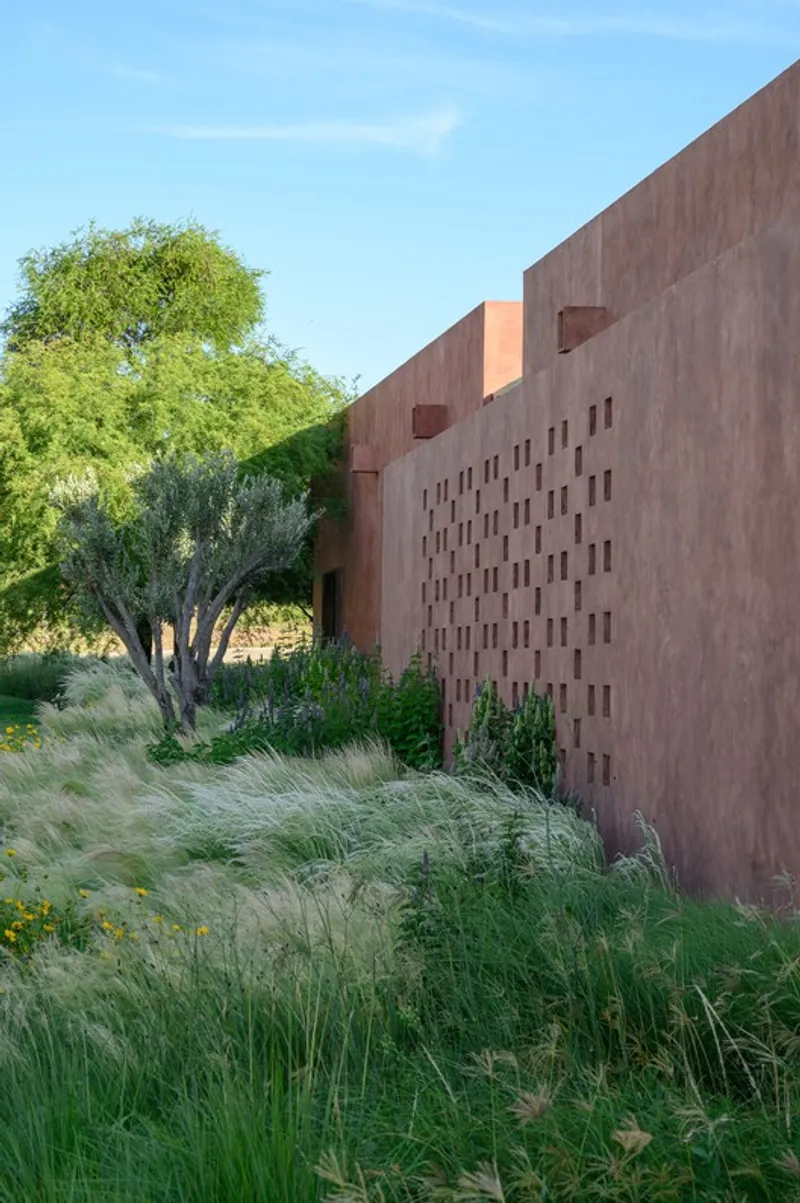
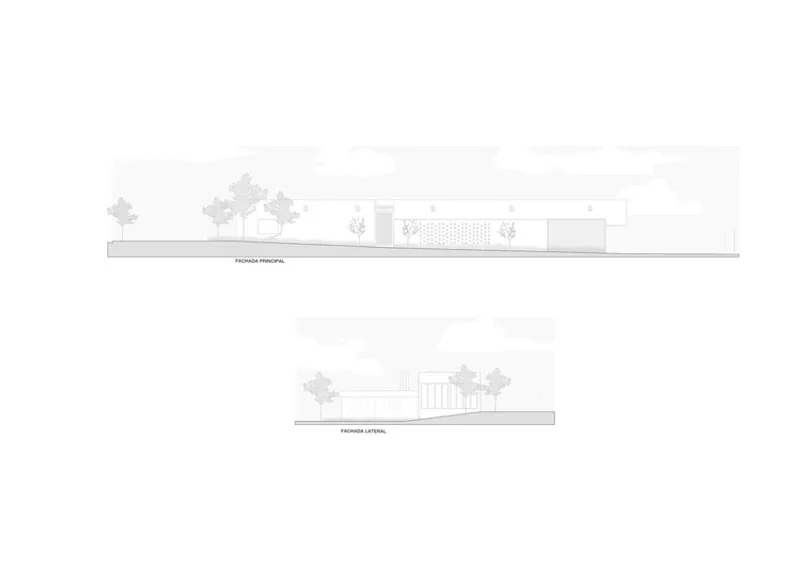
Positioned on a naturally elevated portion of the plot, House BP takes advantage of its height to open long, uninterrupted views of the surrounding rural terrain. The house is organized as a strictly longitudinal volume, aligned with the boundaries of the land and embedded into the site through a green platform that follows the natural movement of the soil. Rather than dominating the landscape, the architecture extends it—becoming part of the terrain itself.
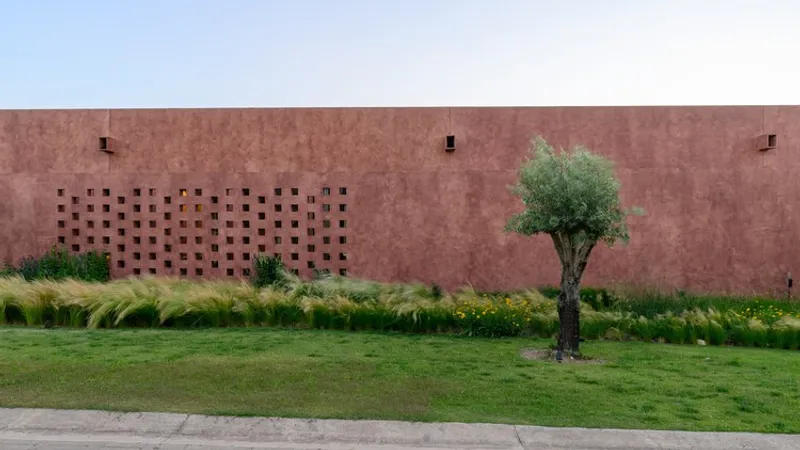
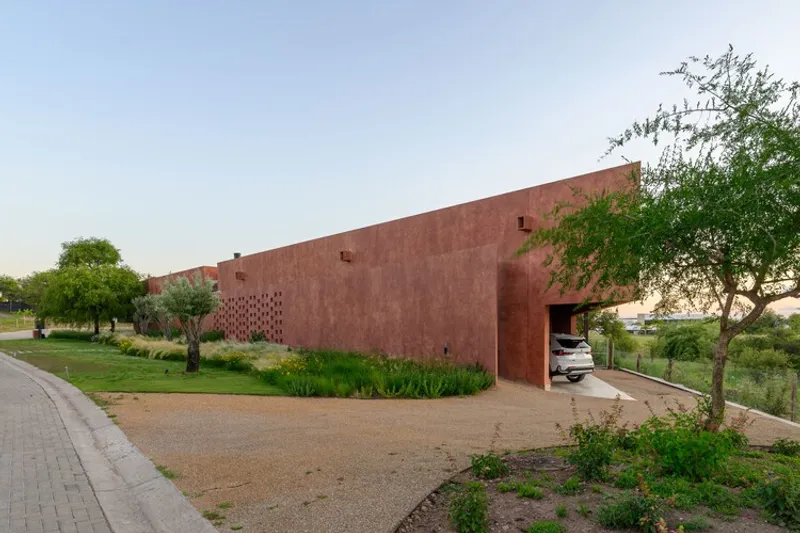
The project is defined by two simultaneous formal strategies. The first is a monolithic main volume, composed of continuous walls finished in earthy, pigmented cement plaster. This volume presents an almost blind, introspective façade toward vehicular access, offering privacy, protection, and thermal stability. In contrast, the opposite façade is entirely permeable—opening generously toward the landscape and dissolving the boundary between inside and outside.
The second element is a lighter, complementary pavilion, slightly detached from the main body. With its black metal carpentry, glass planes, and horizontal sunshades, this structure introduces a contemporary counterpoint to the massiveness of the primary volume, filtering light while maintaining visual transparency.
Spatial Organization: Social Openness and Private Retreat
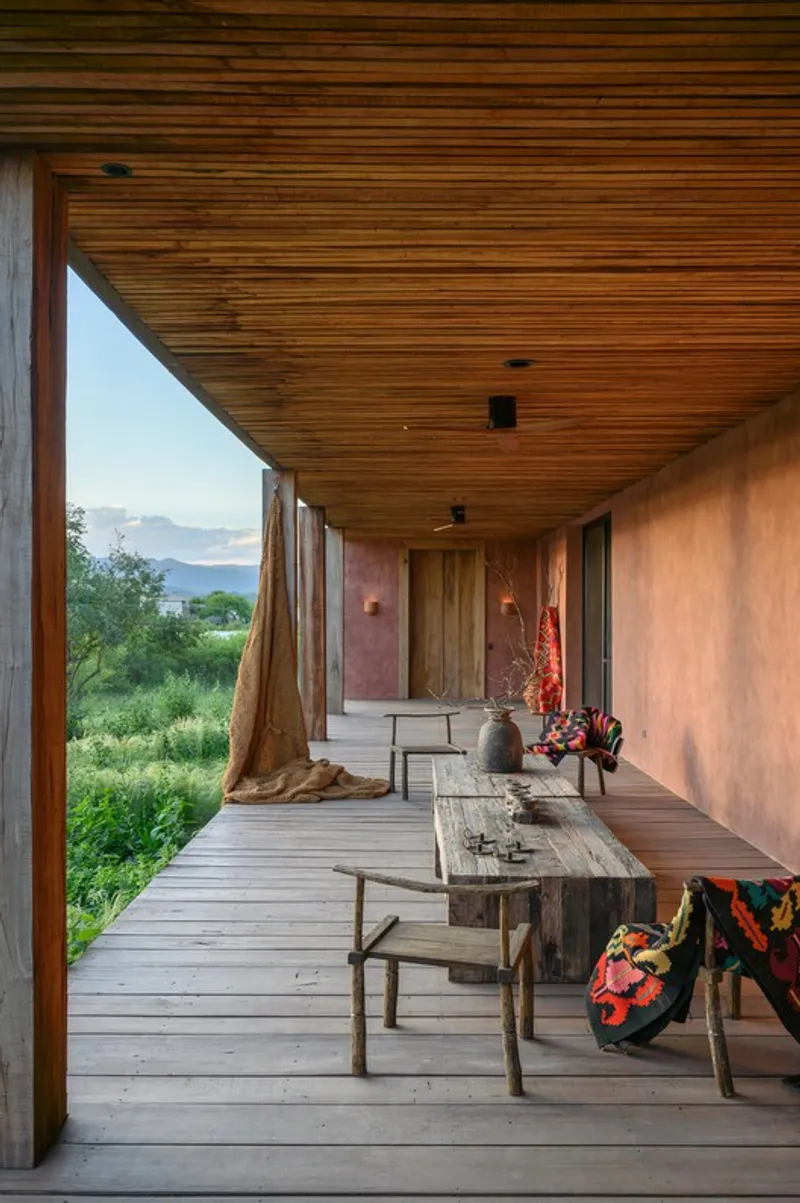
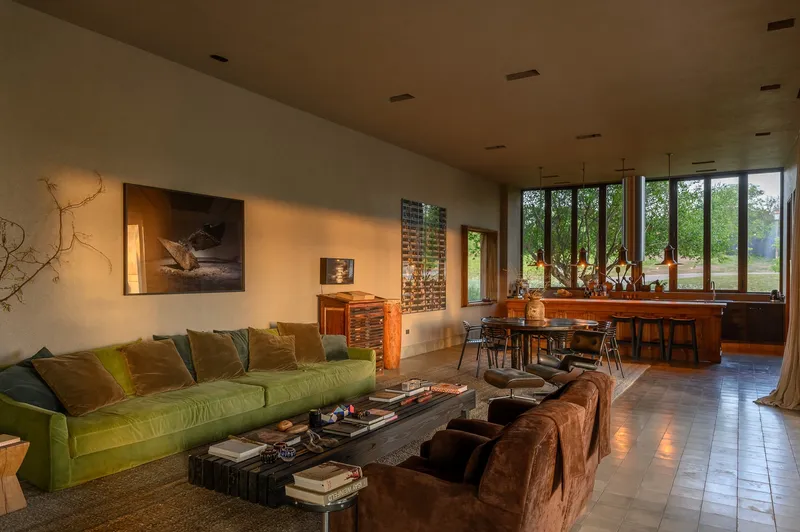
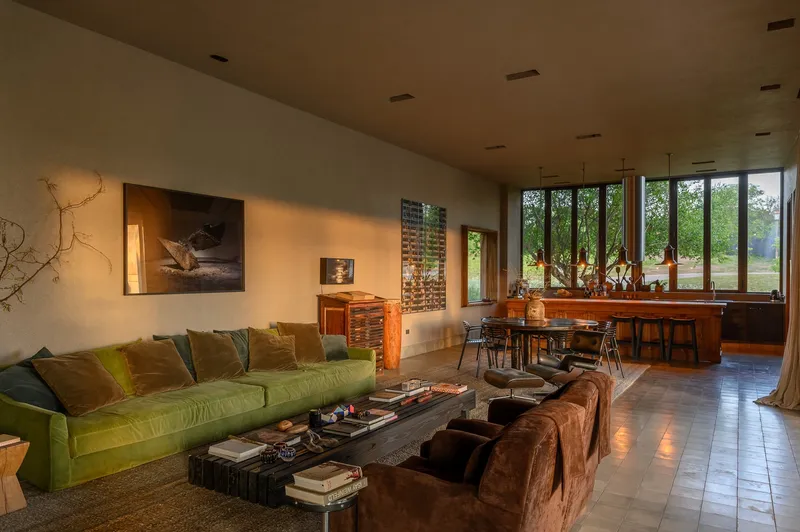
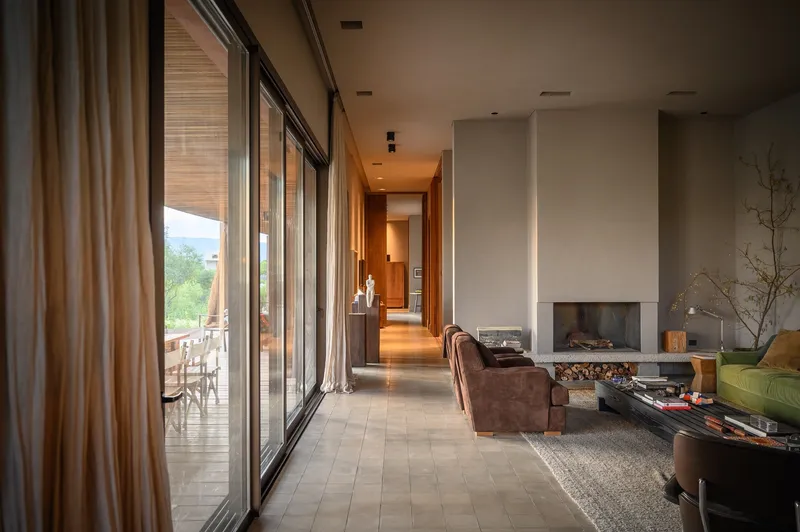
Internally, House BP is organized with clear functional zoning. The social core—living room, dining area, and kitchen—is conceived as a single, continuous space that encourages flexibility and interaction. This open-plan interior connects directly to a parallel longitudinal gallery, allowing daily activities to extend outward and reinforcing the relationship with the landscape.
The private wing, located along one side of the house, contains the bedrooms. These spaces are accessed via a linear hallway and protected by the thermal mass of the walls. Carefully controlled openings ensure privacy while maintaining natural ventilation and climate comfort. The separation between social and private zones creates a calm, intuitive domestic rhythm suited to rural living.
Landscape as Architecture
Landscaping plays a crucial role in the project’s identity. Instead of decorative planting, the garden is designed as a natural extension of the mountainous terrain, composed of native grasses, herbaceous plants, and indigenous shrubs. Arranged loosely and following the site’s topography, the vegetation softens the edges of the built form and reinforces its integration into the environment.
A linear swimming pool, positioned alongside the main gallery, acts as a reflective horizontal plane. It visually prolongs the geometry of the house while mirroring the sky and surrounding vegetation, enhancing the dialogue between architecture and nature.
Materiality Rooted in Place
The material palette of House BP is deliberately restrained and deeply connected to its context. The walls are finished in handcrafted pigmented cement plaster, offering chromatic unity and a mineral texture that resonates with the local landscape. These surfaces respond dynamically to changing light conditions—appearing pink at dawn, ochre at sunset, and muted under cloudy skies.
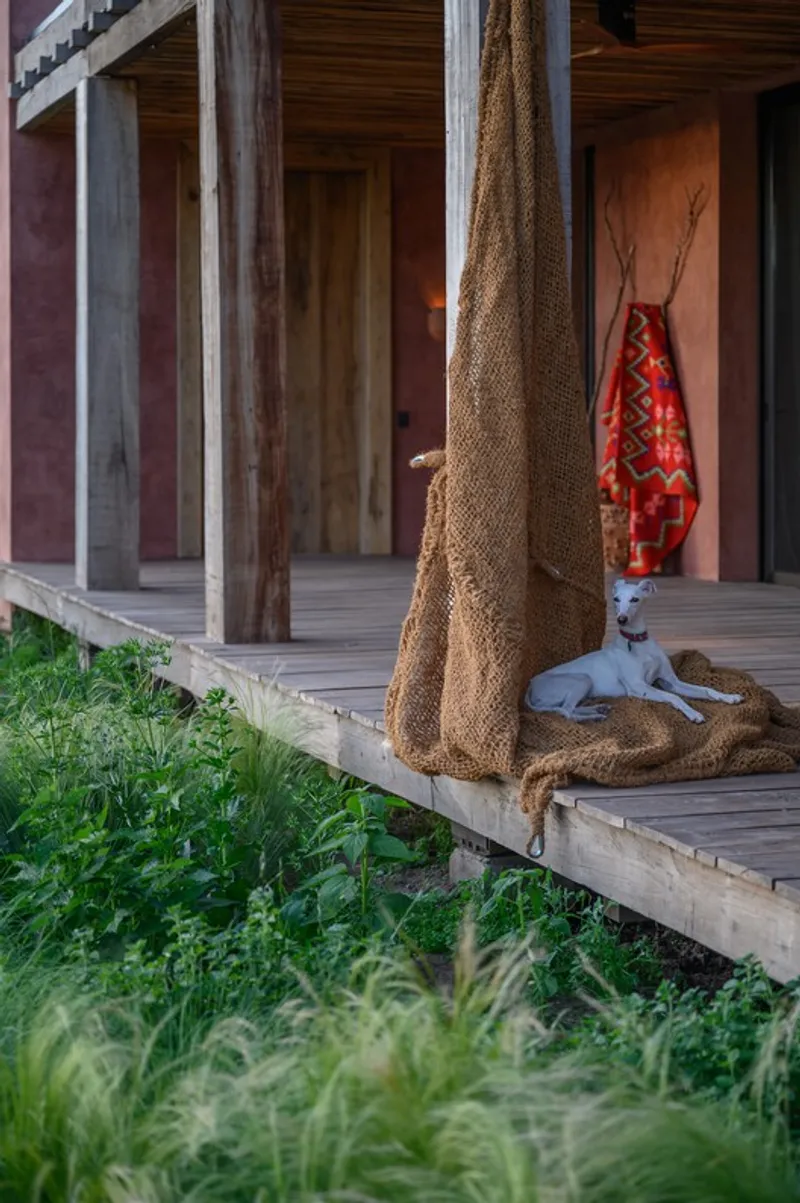
The main gallery is defined by a solid wood structure, featuring irregular columns and slatted ceilings that function as a continuous architectural element. This introduces warmth and tactility, balancing the mass of the monolithic walls. In the complementary pavilion, glass and black metal carpentry regulate transparency through sunshades and slats, ensuring comfort without sacrificing openness.
A Territorial Architecture
Conceptually, House BP is understood as a linear cut in the landscape—a composition shaped by contrasts: solid and void, weight and lightness, protection and openness. The house is austere and introverted toward access, yet expansive and generous toward the views. This duality allows the architecture to adapt to climate, sun orientation, wind, and privacy needs without confrontation.
Rather than presenting itself as an isolated object, the house functions as a territorial presence, accompanying and amplifying the landscape. Its architecture dissolves into the colors of the earth, the texture of the climate, and the temporality of the site—an example of contemporary residential design that prioritizes belonging over spectacle.
All the photographs are works of Gonzalo Viramonte


Popular Articles
Popular articles from the community


Faces of the Soviet Avant-Garde: Turning Moscow's Street Names into an Open-Air Museum
A network of sculptural installations across a Moscow residential district transforms forgotten architect names into spatial encounters with cultural memor

Temporary Home for Dogs: A Reversed Zoo Rethinks Animal Shelter Architecture
In Bucharest, a sinuous corridor and freed landscape flip the logic of containment, designing a shelter that works to make itself unnecessary.

The Amber Palace Opera: A Geological Fiction Surfaces on Tallinn's Baltic Waterfront
Pierre Brillard reimagines a Baltic legend as a public landscape, opera house, and waterfront promenade rooted in Tallinn's coastal identity.

Opera by the Sea Estonia: Three Shells Dissolving Architecture into Tallinn's Coastline
A winning opera house proposal replaces monumental form with interconnected shells that blur the boundary between building, park and Baltic Sea.

Similar Reads
You might also enjoy these articles


Hodi-Mandai Geram
Project Function: Preservation and revitalization of the Intangible heritage and socio-spatial identity of the Hodi by Housing, Cultural Memory Center, Sacred Grove, landscape, local tourism economy


Olio Towers: A Mid-Rise for Performers That Fuses Housing, Rehearsal, and Stage
Located blocks from Houston's Theater District, this modular tower stacks living units around a central performance atrium.

Oasis: Modular Green Housing Carved into Dhaka's Urban Fabric
A shortlisted Plugin Housing entry reclaims unauthorized settlements in Dhaka with stepped concrete volumes, green roofs, and ventilation-driven design.

Black Hole: A Floating Megastructure for the Post-Physical Era
Emiliano Mazzarotto envisions a spherical, self-scaling arena where e-sports, digital hotels, and holographic stadiums replace traditional public space.

Explore Latin American Houses Competitions
Discover active competitions in this discipline

Challenge to reimagine the Iron Throne

Photograph architecture without architects

Illustrate the lost glory of Angkor Wat - Render Challenge

Design challenge to reuse E-waste
Comments (0)
Please login or sign up to add comments
No comments yet. Be the first to comment!