
Idam Design Studio Stacks Open Living Around a Four-Meter Brick Jali Wall in Kerala
House of Heights in Kayamkulam, India, draws on childhood memories of tall trees to create a vertically oriented family home.

Most houses in Kerala settle into the landscape. House of Heights, designed by Idam Design Studio in Kayamkulam, India, deliberately pushes upward. Architects Jishnu Vijay, Govind S Mohan, and Prijith Vijayan conceived the 285 square meter residence as a vertical response to the tall trees already standing on the site. The result is a house that mirrors the proportions of its canopy: double-height living spaces, a four-meter brick jali wall, and angled concrete slabs that filter light the way a forest floor does. Completed in 2023, the project is as much autobiography as architecture, shaped by one designer's memory of growing up in a small traditional house in Thamarakulam, surrounded by green farmland.
What makes the house genuinely interesting is the tension between communal openness and material weight. The plan eliminates most interior walls in favor of connected living, dining, and kitchen zones, yet it builds that openness out of heavy, tactile materials: brick, concrete, red oxide. There is no contradiction here. The jali wall, the perforated ceiling panels, and the circular concrete openings all do structural and environmental work simultaneously, turning mass into porosity. The house breathes because its heaviest elements are the ones that let air and light through.
Vertical Ambition in a Tropical Garden
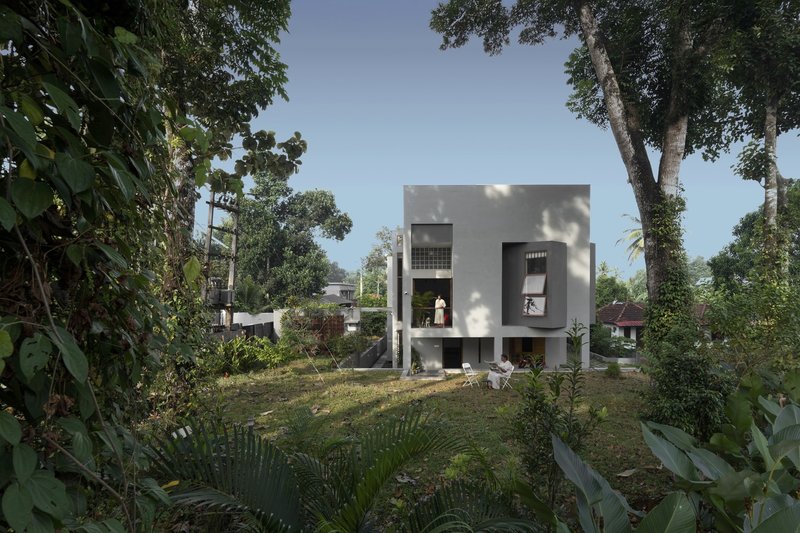
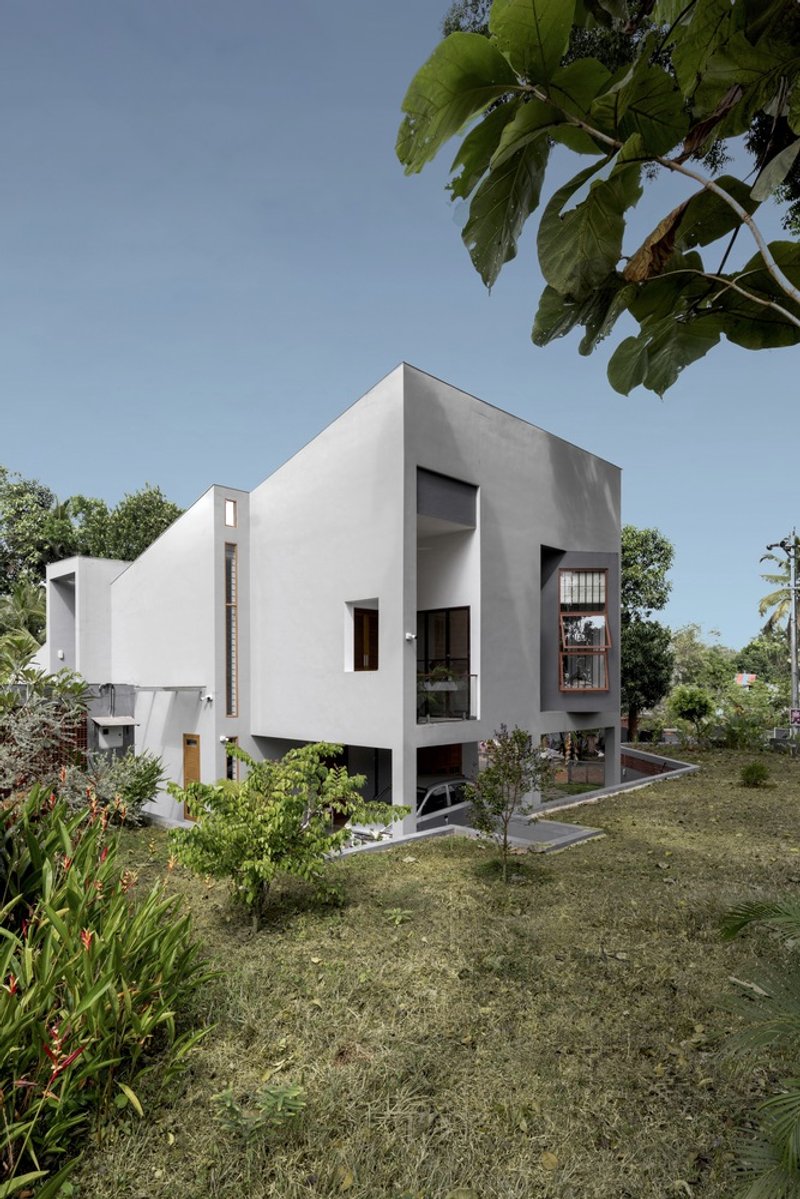
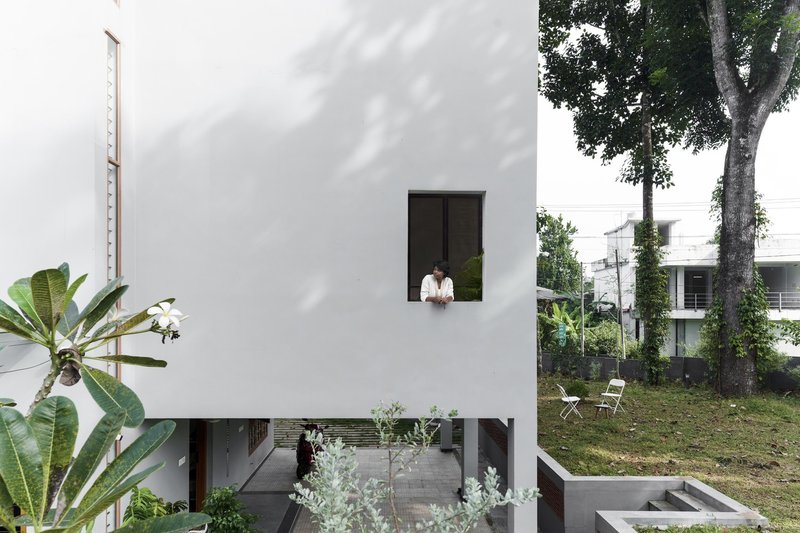
Seen from the garden, House of Heights reads as a cluster of white rendered volumes stacked and shifted against one another. The triangular side elevation is not decorative; it follows the geometry of inclined concrete roof slabs that channel rainwater and modulate solar gain. Pilotis lift parts of the ground floor above the sloping terrain, allowing the garden to flow beneath the building rather than stop at its edge. Mature banana trees, palms, and deciduous canopy crowd in tight, reinforcing the sense that the architecture emerged from the vegetation rather than displacing it.
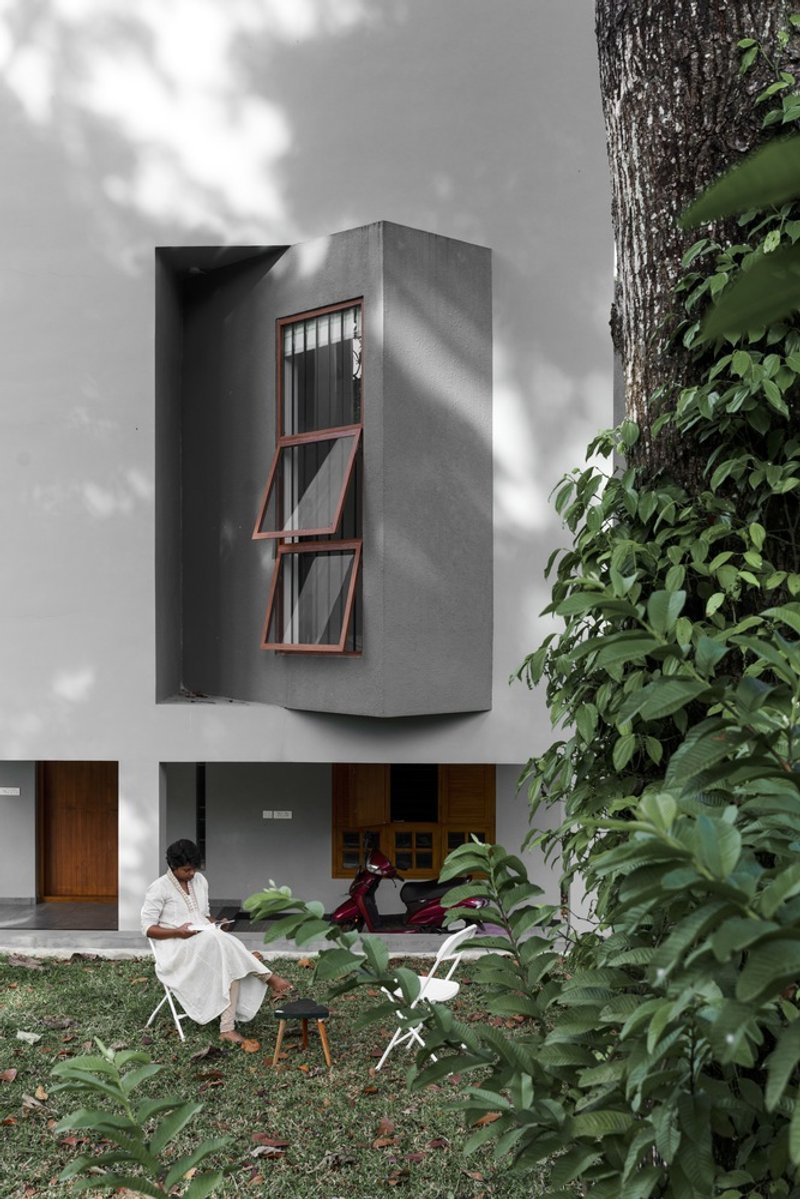
The facade treatment is deliberately restrained: white stucco punctuated by square and rectangular openings of varying scale. A single window high on one face frames a figure looking out, establishing the house as a series of viewfinders pointed at the landscape. The restraint pays off. Without competing colors or cladding materials, the building lets its massing and apertures do the talking.
The Jali Wall and Concrete Perforations
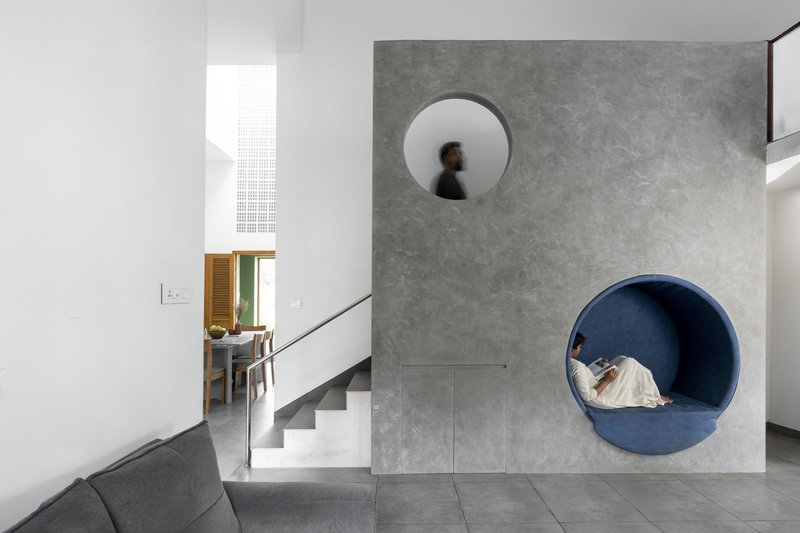
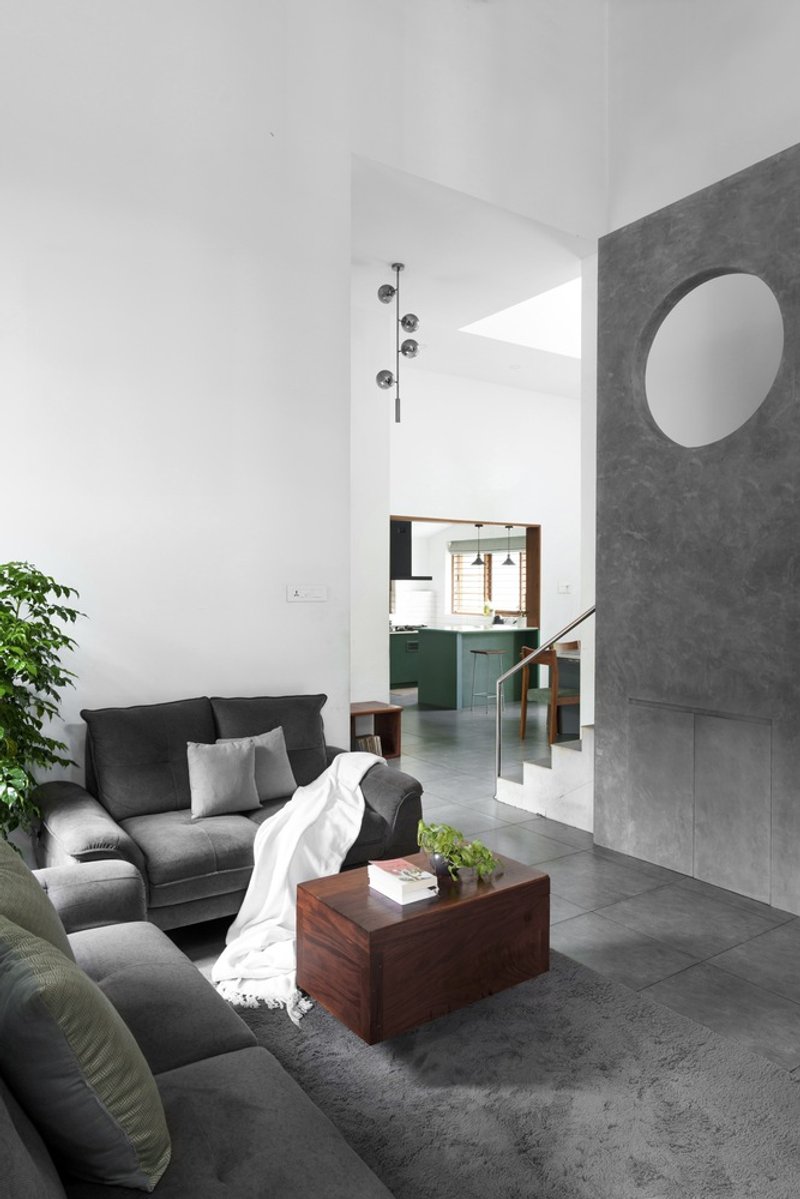
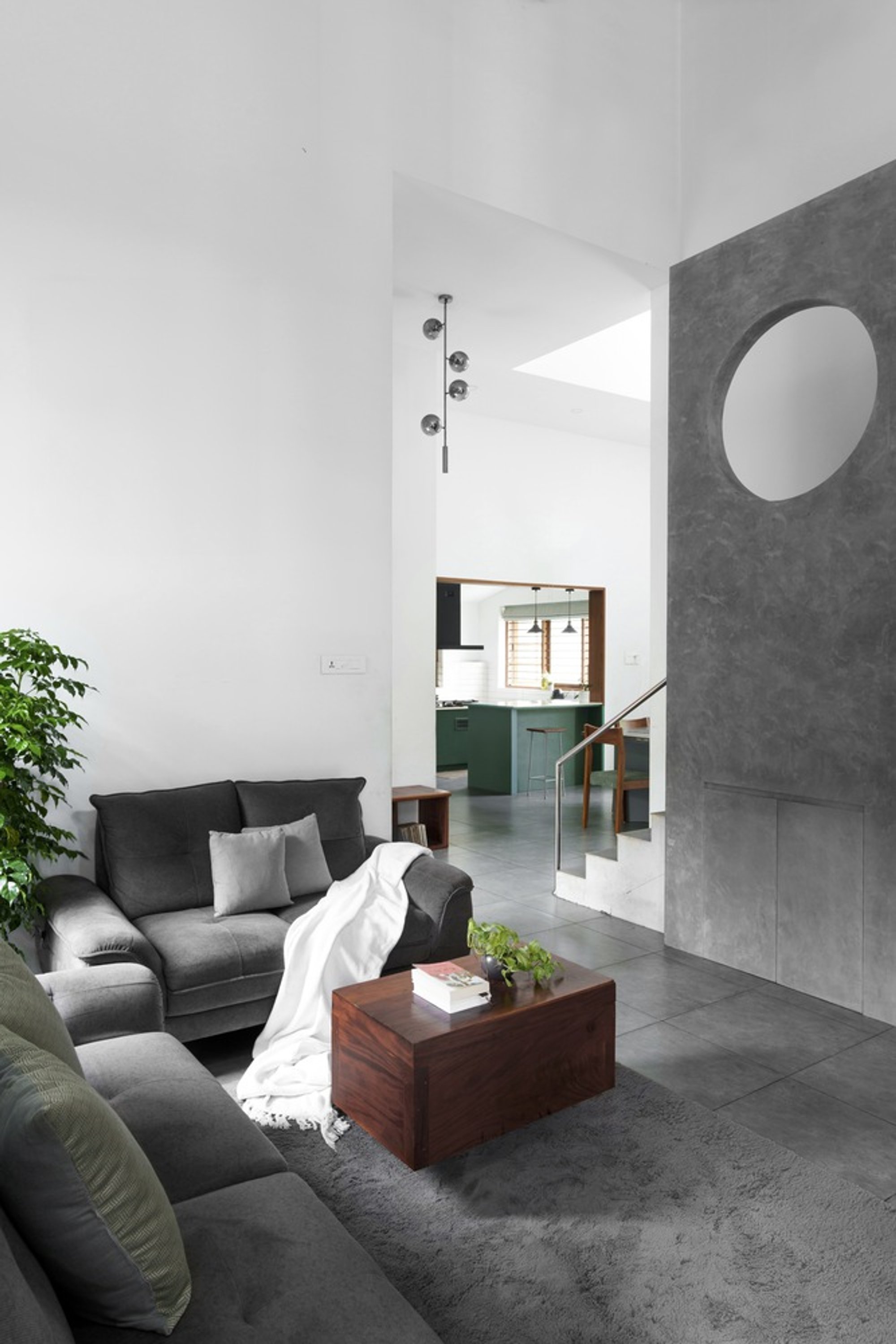
The interior's most striking feature is a grey concrete wall with large circular openings that separates the stairwell from the dining and living zones. Rather than using glass or standard partition walls, the architects punched generous rounds through poured concrete, creating visual connections between floors and rooms while retaining acoustic and spatial separation. This is not a screen; it is a structural wall doing the work of a screen. The circular geometry softens what could have been a brutalist divider, and the openings frame carefully composed views of the kitchen beyond.
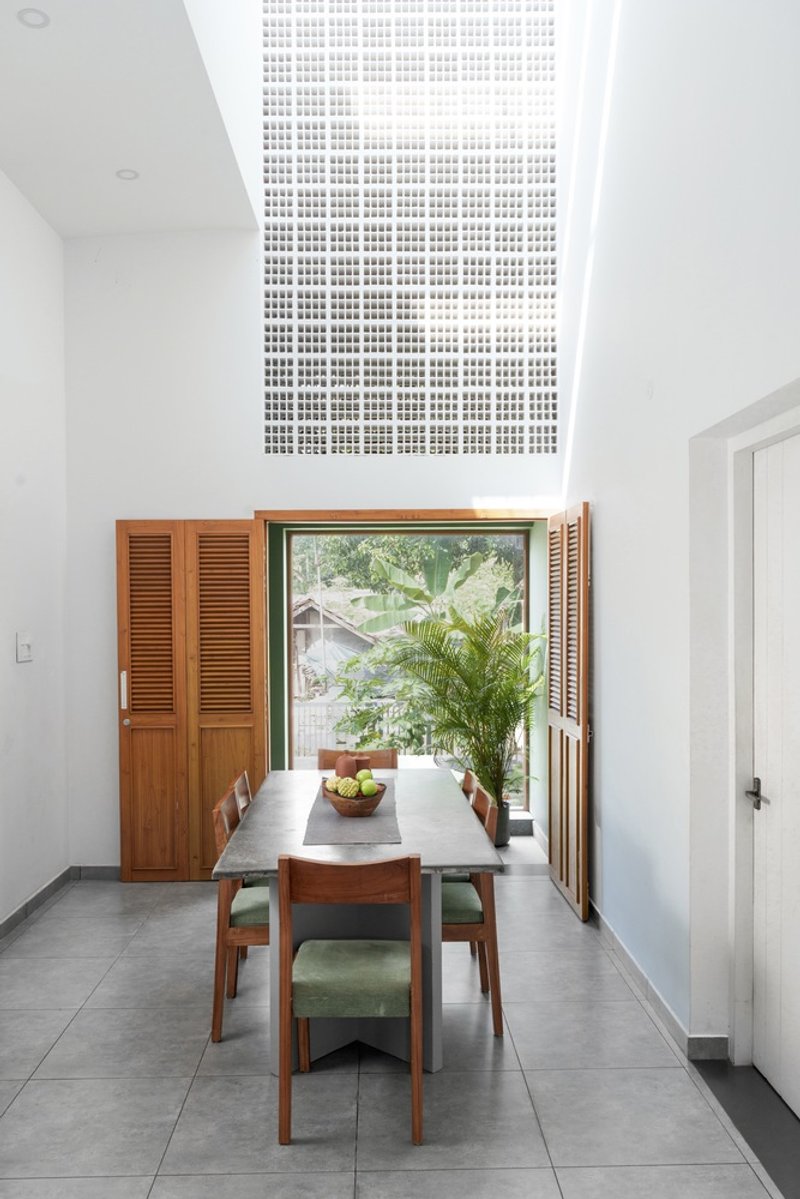
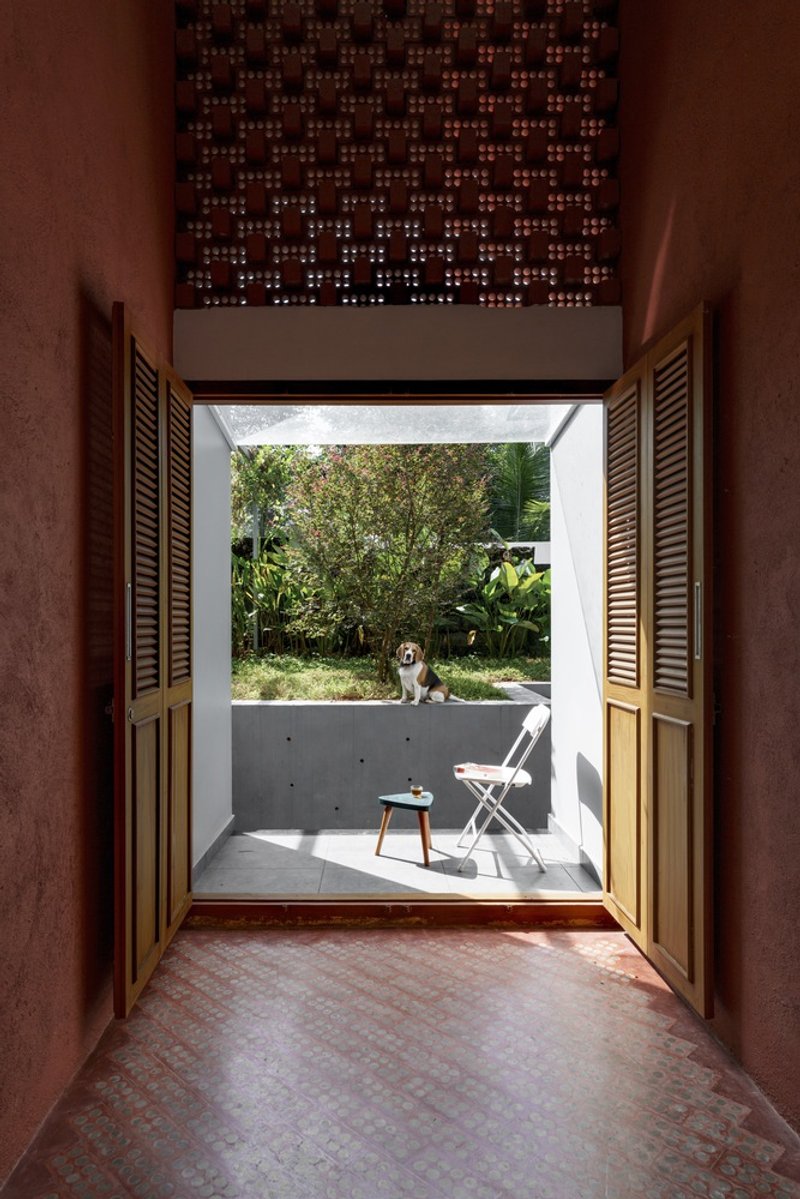
Elsewhere, the brick jali wall rises the full four meters of the living room. Local masons interlocked standard bricks with jali bricks to achieve the necessary structural width at that height, a solution born from collaboration rather than specification. The perforated white ceiling panels in the dining room continue the theme, filtering zenithal light into a soft, diffused wash over the timber table below. Every heavy element in the house has been made to admit light or air, and the cumulative effect is a building that feels both grounded and luminous.
Kitchen as Control Room
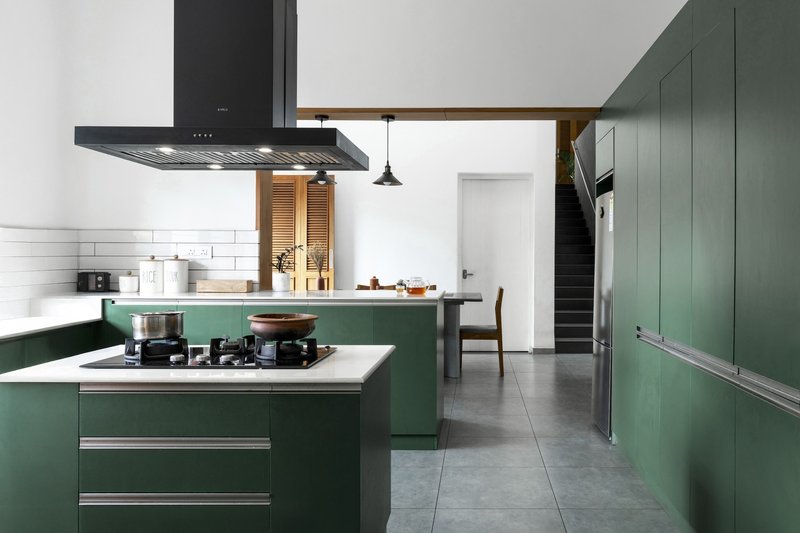
The kitchen occupies a pivotal position in the plan, with sightlines reaching into the living room, the dining area, and out to the garden. Green cabinetry and white subway tile give it a distinct material identity without severing it from the surrounding spaces. A timber-framed doorway connects to an adjacent zone, and the island countertop is positioned so that someone cooking can maintain visual and conversational contact with the rest of the household. In a house that privileges togetherness, the kitchen is the nerve center.
Open timber shutters on the upper level extend this logic outdoors. A concrete balcony becomes an extension of the living space, framed by banana leaves and open sky. The boundary between inside and outside is managed not by sealed glass but by operable shutters, a strategy that suits Kayamkulam's tropical climate and reinforces the house's commitment to cross-ventilation over mechanical cooling.
Rooms for Solitude
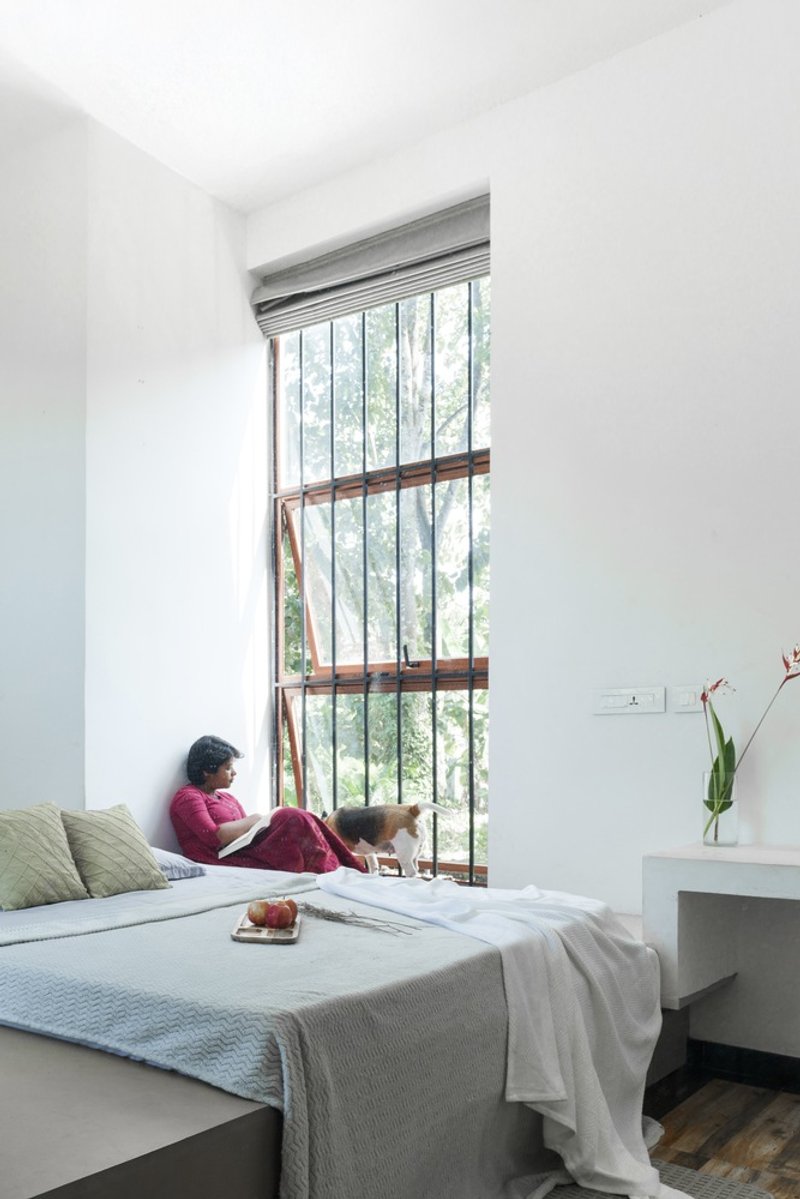
For all its emphasis on openness, the house does not neglect privacy. Upstairs bedrooms feature tall steel-framed windows that look directly into the tree canopy, creating intimate reading nooks where a person can sit in a deep window reveal and be surrounded by green. The proportions are generous enough to accommodate a body but narrow enough to feel enclosed, a window seat that doubles as a small room within a room.
At ground level, a projecting concrete box with angled timber windows creates a similar retreat. The reading space, finished in traditional red oxide, revives a regional material that had largely fallen out of fashion. Its warmth and texture set it apart from the cooler concrete and white plaster of the communal areas, signaling a shift in mood from collective to contemplative.
Thresholds and Courtyards
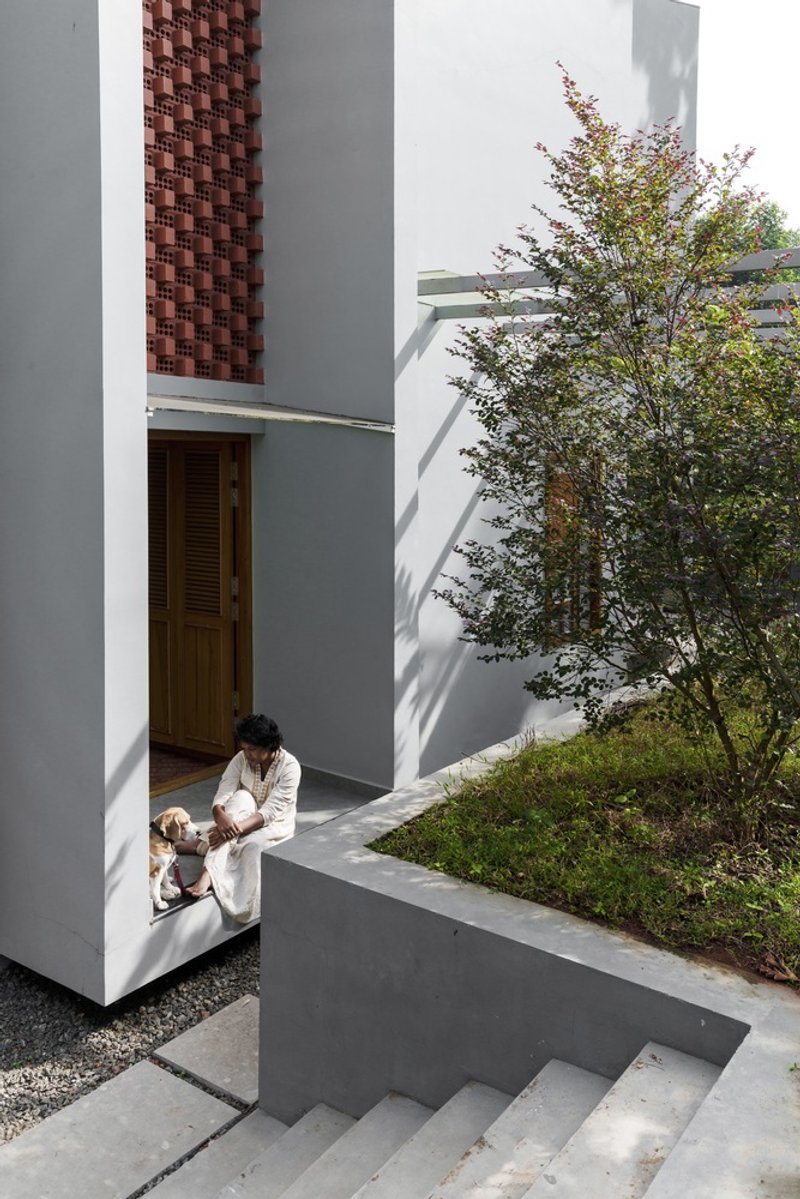
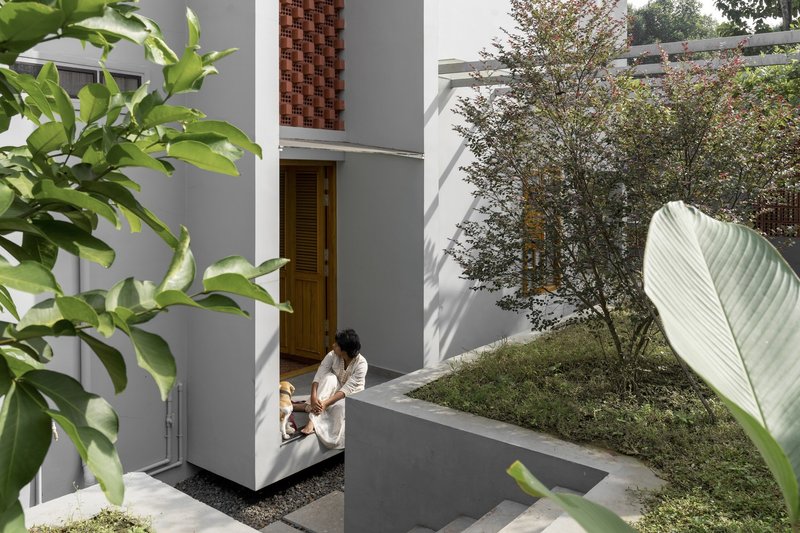
The transition from garden to interior is choreographed through a sequence of courtyards and half-levels. A concrete stairway descends to a courtyard where the timber entry door sits, creating an arrival experience that moves down before it moves in. The shift in grade separates the house psychologically from the street while keeping it physically embedded in the slope. A person and a dog on the path give scale to what might otherwise read as abstract: this is a house designed around daily routines, not photographic moments.
The courtyard view framed by banana leaves, with a sloped lawn rolling away from the building, captures the essential ambition of the project. The house does not sit on its site; it occupies it at every level, from the pilotis to the rooftop, with landscape threading through at each threshold.
Plans and Drawings
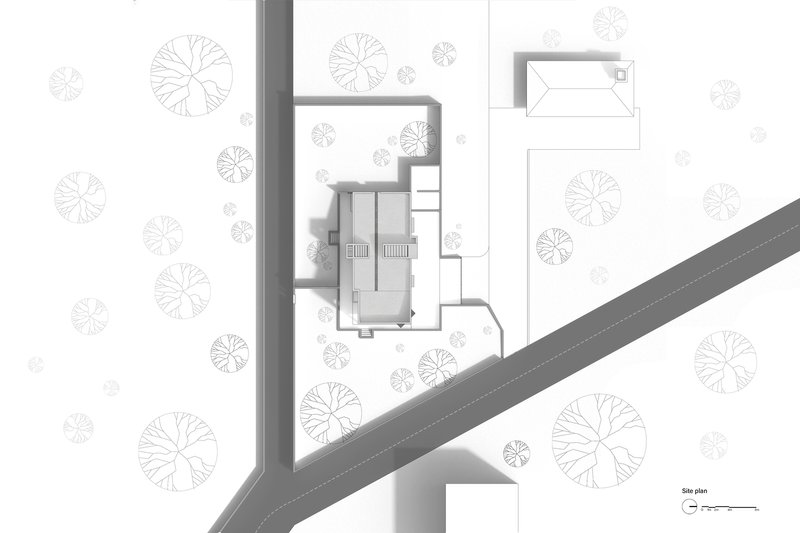
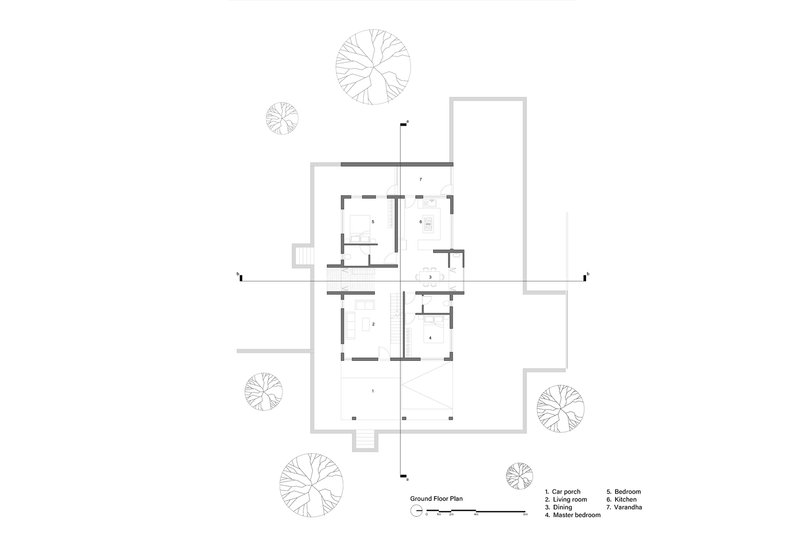
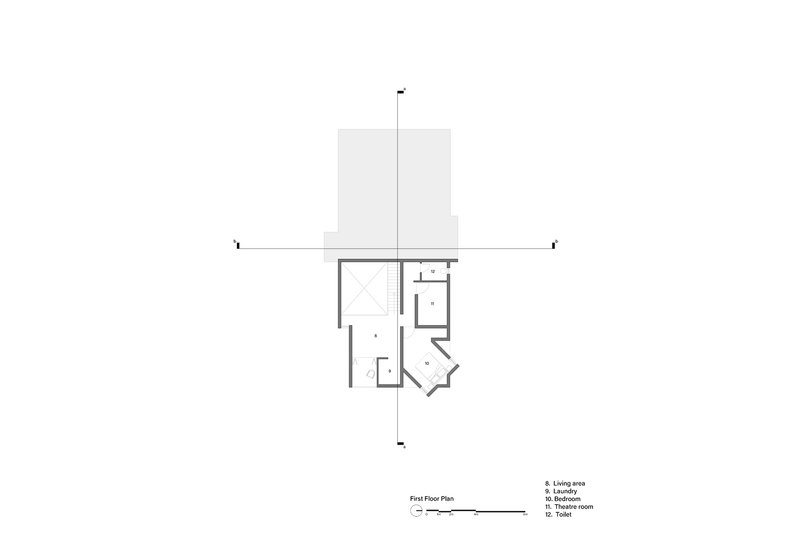
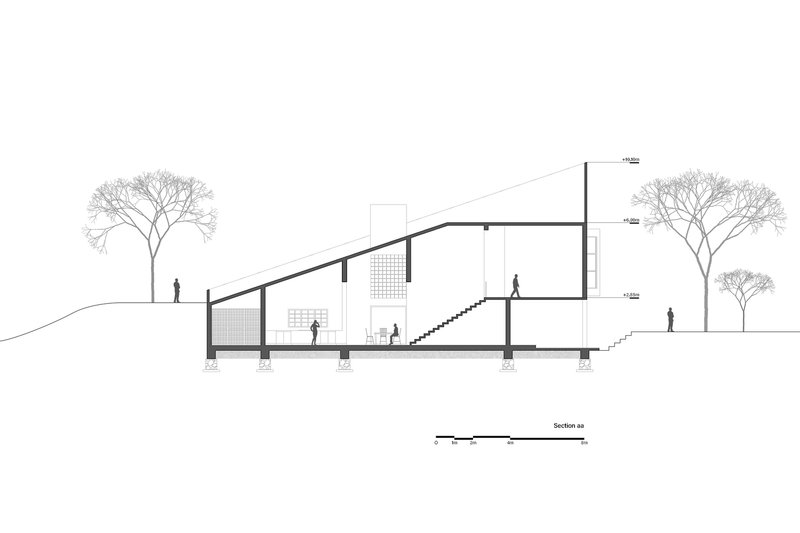
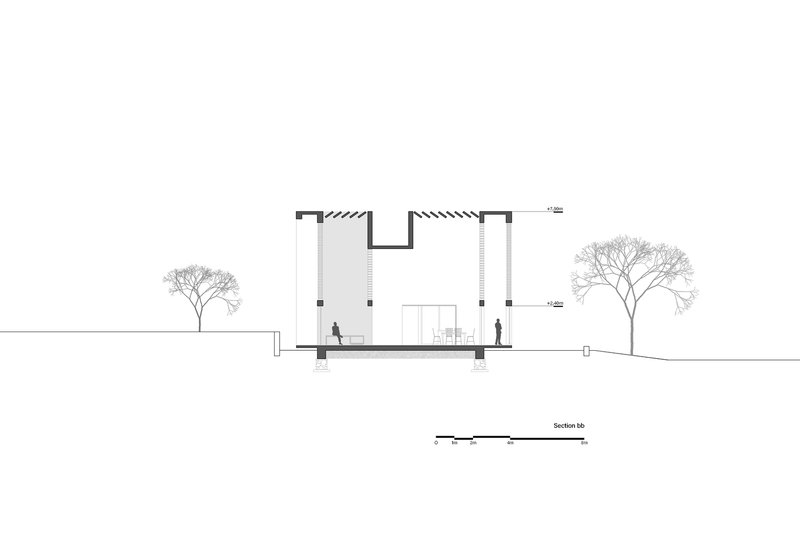
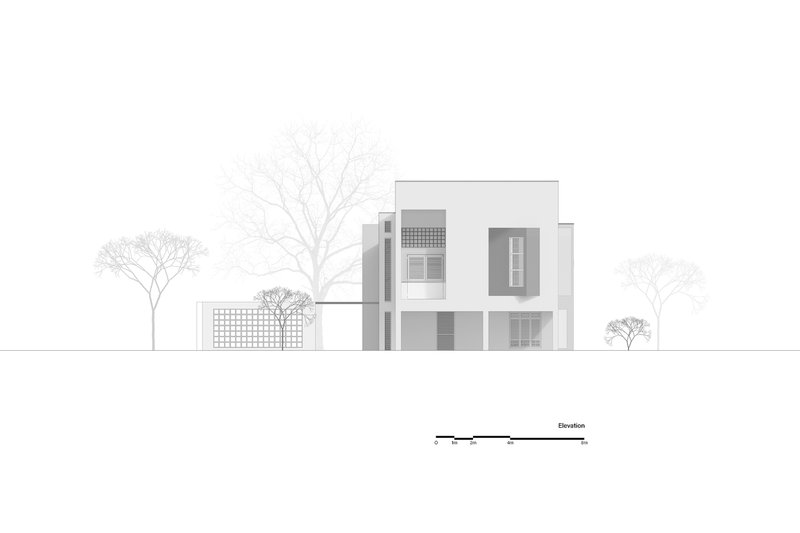
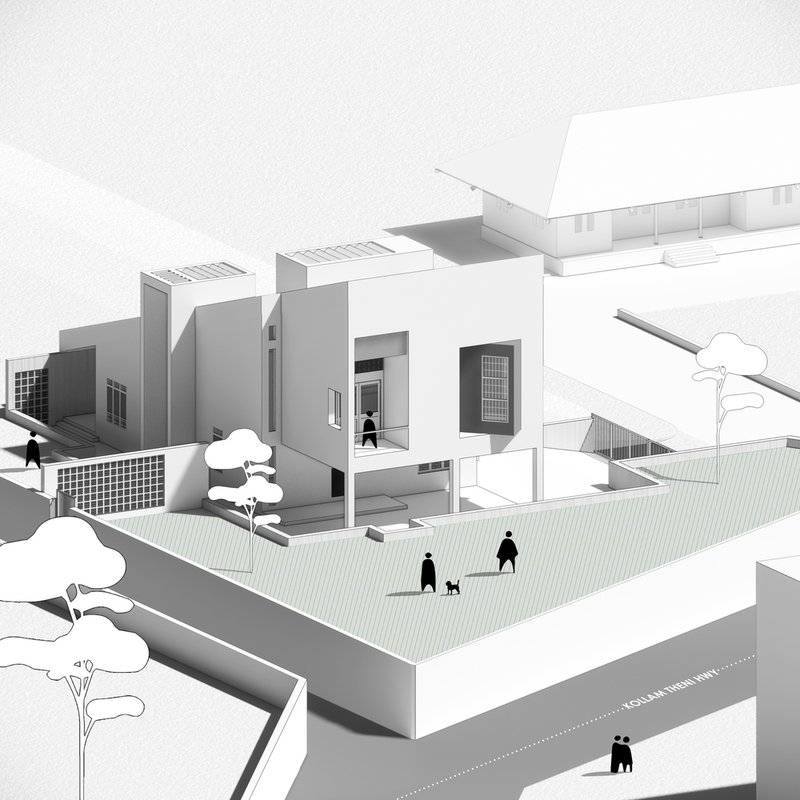
The site plan reveals the house's careful positioning among existing tree canopies, angled slightly off the diagonal road to maximize garden frontage on three sides. Ground and first floor plans confirm the open-plan strategy: living, dining, and kitchen flow into one another at grade, while the upper level accommodates bedrooms, a therapy room, and laundry in a more compartmented arrangement. The sections are the most revealing drawings, showing how inclined roof slabs create varying ceiling heights across the double-height living volume and how ventilation paths run vertically through the building. The axonometric drawing pulls everything together, illustrating the courtyard's role as an organizing void around which the stacked volumes rotate.
Why This Project Matters
House of Heights demonstrates that open-plan living does not require lightness. The heaviest materials in the building, brick, concrete, red oxide, are the same ones that deliver ventilation, filtered light, and spatial continuity. By perforating mass rather than eliminating it, Idam Design Studio achieves an openness that carries weight, both literally and experientially. The four-meter jali wall is the clearest example: a structural element that also functions as an environmental membrane, built by local masons who had to invent the interlocking technique on site.
The project also matters as a case study in autobiographical architecture. The designer's childhood in a small house surrounded by tall trees is not merely backstory; it is encoded in every decision, from the vertical proportions to the window seats that frame canopy views. Architecture rooted in personal memory risks sentimentality, but here the memories have been translated into measurable strategies: specific ceiling heights, precise aperture placements, a material palette drawn from the region's building traditions. The result is a house that feels deeply specific to its occupants and its place, which is the only kind of specificity that lasts.
House of Heights by Idam Design Studio (Jishnu Vijay, Govind S Mohan, Prijith Vijayan), Kayamkulam, India. 285 m², completed 2023. Photography by Out Of Focus.
About the Studio
Share Your Own Work on uni.xyz
If projects like this are the kind of work you want to make, uni.xyz is a place to publish your own, find collaborators, and enter design competitions.




Popular Articles
Popular articles from the community


CTA | Creative Architects Designs Triangular Floating Shelters for Vietnam's Flood-Ravaged Communities
A timber-louvered triangular shelter rises on concrete pontoons to keep Vietnamese families safe and together when floodwaters come.
Not All Architecture Grounds a Timber Retreat in Victoria's Coastal Bushland
Ironbark House stretches low beneath eucalyptus canopy, threading a quiet domestic life between courtyard, deck, and landscape.
ure LLC Builds a Timber-Framed Suburban Office That Doubles as a Community Living Room in Hiroshima
KItoNOKO wraps sawtooth roofs and corrugated metal around an exposed timber frame to give a commercial district a new civic anchor.
Art 1 Office Strips Athens Back to Its Bones
Neiheiser Argyros transforms a 40-year-old Athens office building into a vivid, materially rich workplace anchored by red steel, exposed concrete, and roof


Similar Reads
You might also enjoy these articles

Filtering Space: A Gradual Spatial Experience
From urban intensity to spatial calm.


The Ken Roberts Memorial Delineation Competition (Krob)
As the most senior architectural drawing competition currently in operation anywhere in the world, it draws hundreds of entries each year, awarding the very best submissions in a series of medium-based categories.


Waterfront Redevelopment and Urban Revitalization in Mumbai: Forging a New Dawn for Darukhana
A transformative waterfront redevelopment project reimagining Darukhana’s shipbreaking heritage into an inclusive urban future.

OUT-OF-MAP: A Call for Postcards on Feminist Narratives of Public Space
Rhizoma Design and Research Lab invites artists, designers, architects, researchers, and students to reflect on how feminist perspectives can reshape public space. Selected works will be exhibited in Barcelona, October 2026. Submissions open until 15 April 2026.


Explore Architecture Competitions
Discover active competitions in this discipline




The International Standard for Design Portfolios


The Global Benchmark for Architecture Dissertation Awards


The Global Benchmark for Graduation Excellence


Challenge to reimagine the Iron Throne
Comments (0)
Please login or sign up to add comments
No comments yet. Be the first to comment!