
Hustle Hub: A Residential Complex That Dissolves the Boundary Between Home and City
In Moscow's ZILART district, a multi-layered housing proposal turns its ground floor into a public living room for the entire quarter.


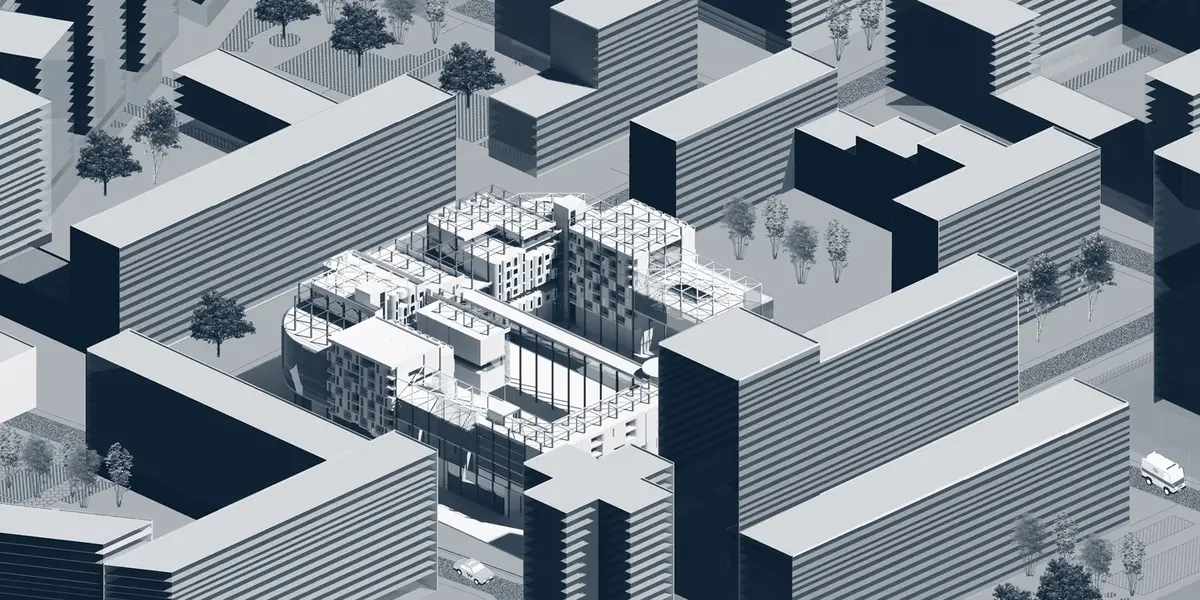
What if a residential building refused to hoard its ground floor for lobbies and parking, and instead gave it entirely to the neighborhood? Hustle Hub proposes exactly that: a housing complex in Moscow's ZILART district where the base of the building operates as an open public precinct of cafés, kindergartens, sports zones, and children's play areas. The rest of the structure stacks private living above this civic foundation, connected by glazed corridors and elevated walkways that keep residents visually and physically linked to the communal life below.
The project is the work of Екатерина Ефимова, who developed the proposal as a new typology for urban residential architecture. Sited within ZILART, a district known for its mix of modern residential blocks and cultural venues, the Hustle Hub concept leverages the area's existing density and pedestrian movement to argue that housing can be a social catalyst rather than a retreat from the city.
A Terrace Between Private and Public
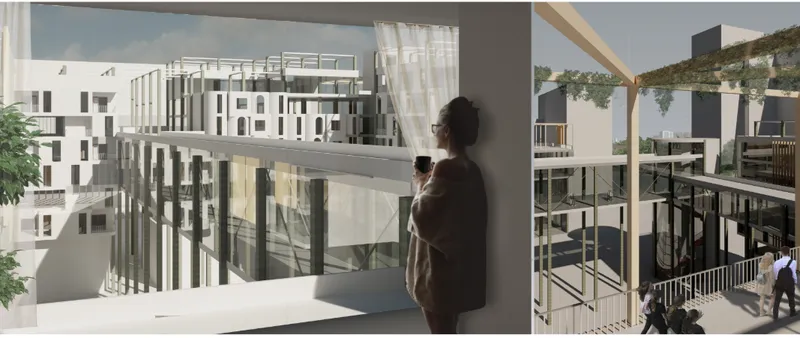
The rendered terrace view captures the tone Ефимова sets for the entire project: a resident stands with a cup of coffee behind a layer of vertical screening, occupying a threshold that is neither fully interior nor fully exposed. The screening filters light and sightlines without closing them off, establishing the principle of spatial transparency that runs through every floor of the complex. It is a quiet image, but it communicates the core argument: privacy and community are not opposites when architecture mediates between them carefully.
Glass Volumes as Connective Tissue
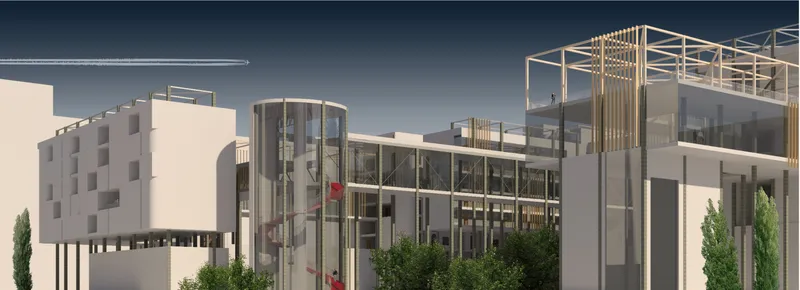
The exterior rendering reveals the project's massing strategy under a dramatic sky. Flanking residential blocks, finished in solid, repetitive facades, frame a central volume defined by floor-to-ceiling glass and vertical louvers. These glazed connectors are the building's circulatory system: they house elevated walkways, atriums, and shared activity zones that allow visual dialogue between floors. The louvered glass surfaces expose movement and life inside the building, turning internal circulation into a kind of urban spectacle visible from the courtyard and the street.
The compositional logic is deliberate. Solid residential masses provide acoustic and thermal insulation for private units, while the transparent intermediary zones channel natural light deep into the plan and broadcast social activity outward. The result is an architectural rhythm that alternates between domestic quiet and collective energy, a cadence Ефимова ties to the mixed-use character of the ZILART district itself.
Section: Reading the Social Gradient Floor by Floor
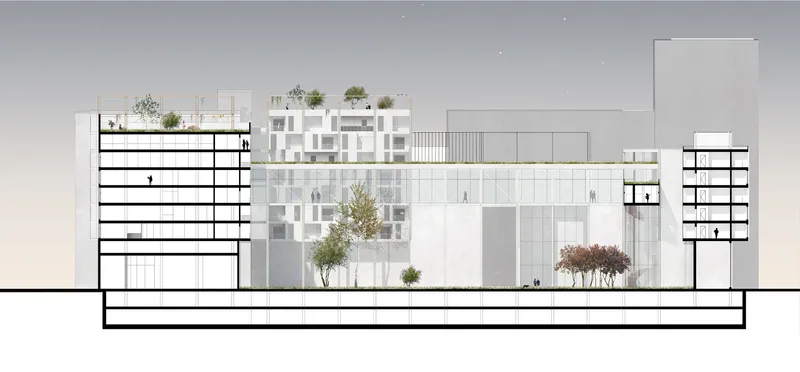
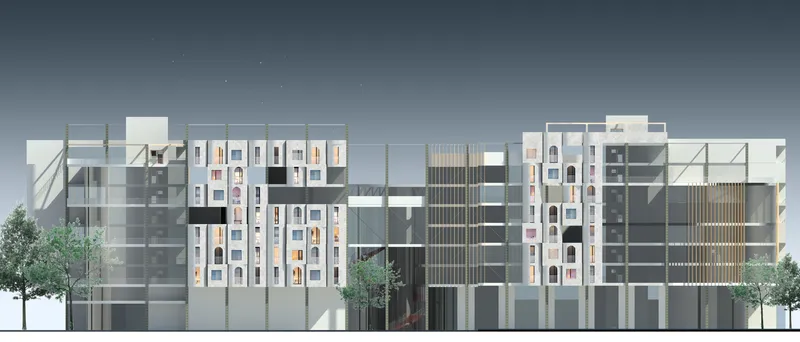
The building section cuts through the complex to expose its layered social logic. At ground level, public amenities occupy the full footprint: child development rooms, cafés, recreational spaces, and flexible meeting pockets sit at grade, directly accessible from the surrounding streets. Above, residential floors are organized around interior circulation paths that remain visible through the glazed connectors. Rooftop trees indicate planted terraces at the top of the structure, adding a green cap that tempers the building's urban scale. The section makes legible what the renders only suggest: that the project is organized as a gradient from fully public at the base to increasingly private as one ascends.
The elevation drawing reinforces this reading from the outside. Variegated window patterns across the residential facades signal the diversity of unit types behind them, while vertical screening elements between trees at lower levels mediate the transition between the sidewalk and the building's interior. The layered facade avoids monotony without resorting to decorative excess; instead, the variation emerges from programmatic difference, each zone expressing its function through aperture size, rhythm, and material treatment.
Compact Units Around a Central Courtyard
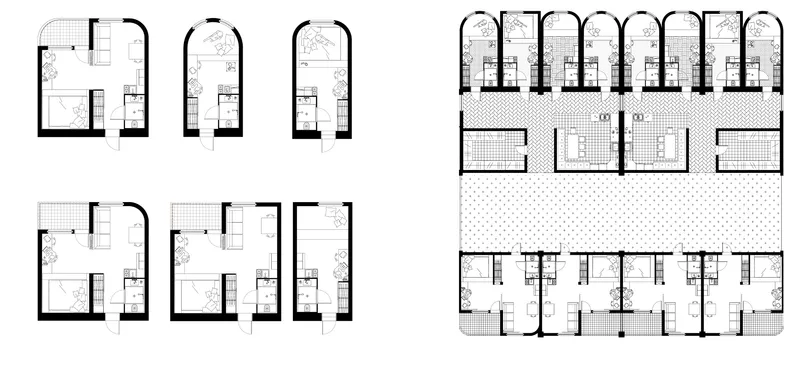
The floor plans reveal how tightly the residential units are organized to free up collective space. Compact apartments with curved interior walls wrap around a central courtyard, the project's primary open-air amenity. The curved walls are not merely aesthetic; they soften transitions between rooms and reduce wasted corridor area within small footprints. The courtyard itself functions as both a social plaza and a sheltered micro-climate zone, designed for year-round use in Moscow's demanding seasons. Visual continuity between indoor and outdoor zones is maintained through the glazed ground-floor perimeter, so that even the courtyard reads as an extension of the building's public program.
Why This Project Matters
Hustle Hub confronts a real tension in contemporary housing: the desire for community in buildings that, by default, engineer isolation. By surrendering the entire ground floor to public program and threading transparent connectors through the residential mass, Ефимова proposes a model where density becomes a social asset rather than a spatial burden. The architectural moves are straightforward, but their aggregation produces something rare: a housing block that actively generates neighborhood identity.
The project also demonstrates that typological innovation does not require formal extravagance. The facades are modular and restrained, the plans are efficient, and the materials (glass, louvered screens, solid masonry volumes) are standard. What distinguishes Hustle Hub is the organizational intelligence behind these elements, the decision to treat transparency, connectivity, and programmatic integration as the primary design drivers. For the ZILART district, already a testing ground for new modes of urban living, this proposal suggests the next logical step: housing that performs as infrastructure for collective life.
View the Full Project
About the Designers
Designer: Екатерина Ефимова
Enter a Design Competition on uni.xyz
uni.xyz runs architecture and design competitions year-round that reward proposals with spatial conviction and real site intelligence.
Project credits: Hustle Hub – Moscow ZILART by Екатерина Ефимова.


Popular Articles
Popular articles from the community


graciastudio Turns a Viewless Tijuana Lot Inward Around a Courtyard of Concrete, Timber and Trees
In Tijuana, Jorge Gracia's GA2 House stacks a timber-clad private floor over exposed concrete and replaces a missing view with a planted interior patio.


Aquadapt: An Underwater Habitat That Rewrites Its Rooms by the Hour
Curved modules ring the seabed while one shell shifts from breakfast room to cinema, farm and football pitch as residents' needs change.

ETEH Reworks the Shared Spaces of São Domingos School in Brazil Around Timber, Color and Hanging Plants
At São Domingos School in Brazil, 436 m² of hall, refectory and library are recast with timber joinery, a yellow and blue code and trailing greenery.

Opera on the Sea: Driftwood Logic Shapes a Timber Opera House on Estonia's Coast
Trevor Orgill's opera house translates the entangled drift of floating timber into a civic building where wood, water, and music converge.

Similar Reads
You might also enjoy these articles
Yenisei Monitoring Center: A Sun-and-Moon Sphere Anchors a Research Campus on Siberia's Great River
In Krasnoyarsk, shifting square blocks, a glazed central sphere and descending window rhythms turn river science into a public spectacle on the Yenisei.
Andretta Artist's Village: A Node-Based Masterplan That Lets the Hills Write the Plan
A cultural landscape strategy for Palampur's artist colony threads studios, residences and stages along a porous spine shaped by the Dhauladhar terrain.
Street Children Rehabilitation Center: A Brick Campus That Eases Children From Street to Safety
A low-rise courtyard campus where learning streets, uthans and shaded verandahs stage a gradual passage from street into protective, family-scale life.

The NEON Culture: A Field of Pavilions Built for the 24-Hour City
Smaran Alva spreads galleries, stages, clubs and markets across a varied site, treating light, sound and ramped movement as the real building materials.

Explore Hustle Hub Competitions
Discover active competitions in this discipline

Challenge to reimagine the Iron Throne

Photograph architecture without architects

Illustrate the lost glory of Angkor Wat - Render Challenge

Design challenge to reuse E-waste
Comments (0)
Please login or sign up to add comments
No comments yet. Be the first to comment!