
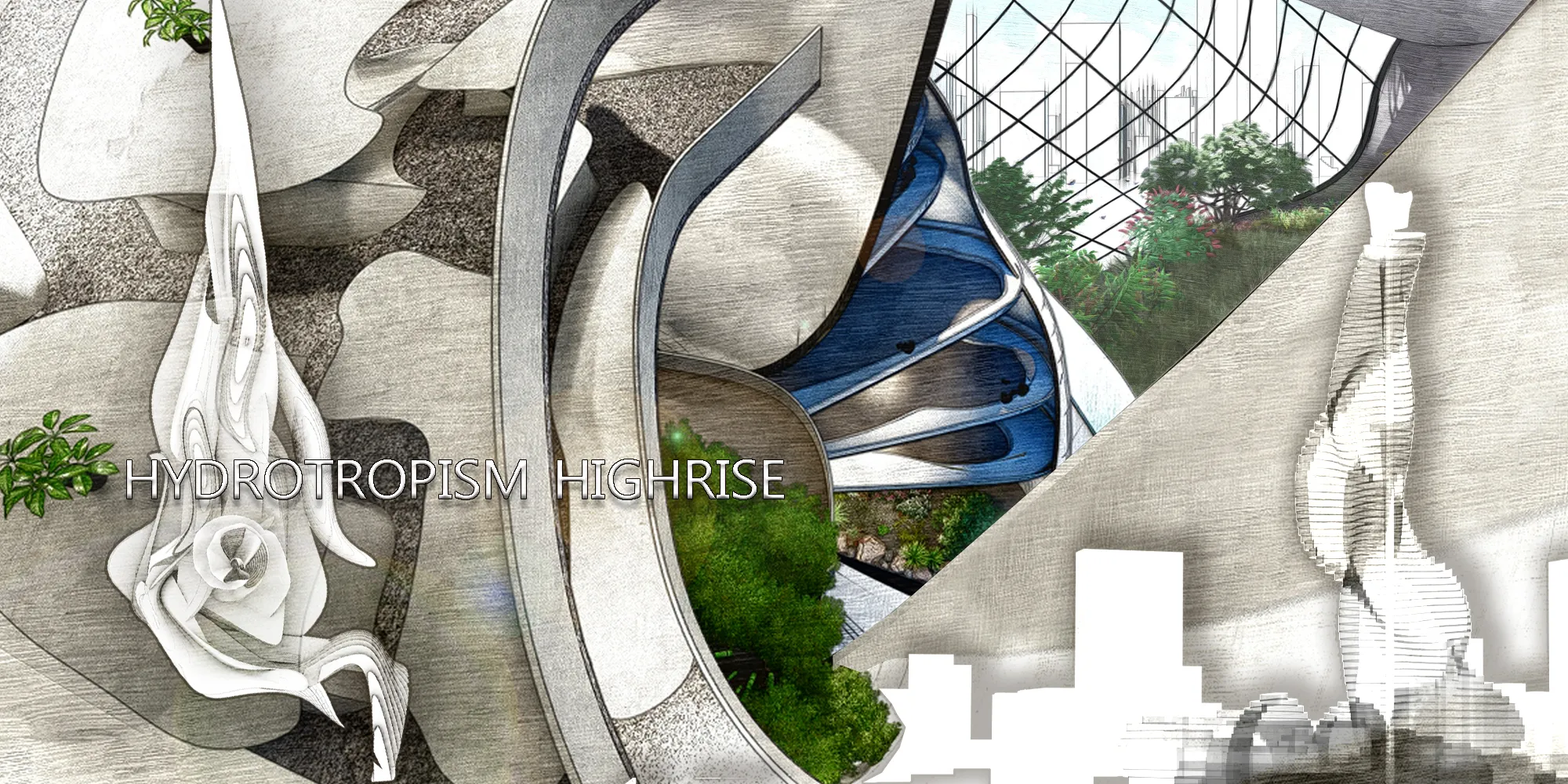
Hydrotropism Highrise
Live and Learn

The idea of a university that contains living quarters is not unfamiliar, but they were always in a separate building. If we were to combine them, many complex problems that have to do with their program’s differences would make it hard to construct. This project is an attempt to generate a solution for the merging of resident housing and the university on a vertical stack. This project will adapt to the nature of the site and provide a blend between interior and exterior along with the diverse programs of the resident living space and the university.
The concept of this project is to open a possible way for the social sciences department to study a community of people that live in a tower for a long period of time. Considering the past year’s quarantine experience, it can be hard to live in a contained space. The majority of this hardship results from the purpose of the building is only focused on residential. Now, with the addition of the university other concepts of building programs may be redefined.
This project intends to create a way to emerge to the site without any impact on the existing site’s natural condition. The tower would adapt to urban growth while adding creative ways to solve future problems such as inefficient electricity, water pollution, and pandemic. Using nature to redefine the building’s formation. The architectural details and form were determined by the flow of air and water. The final outcome is the result of many iterations but concludes in three of the major changes. The first change where the building takes on a twist-shaped in order to counter the wind force as well as navigate it around the building’s skin for natural air to circulate. The second change refines the shape to adapt to the programs. In the third major change, the shape is shifted according to the flow of the water on the skin of the building.
The materials for this project were selected based on how well they maintain their structural integrity over time as well as the impact they have on the environment as they decline. The skin of the building will consist of glass and steel panels for easy maintenance and sustainable reasons. Steel is by far the most reliable metal material that will be suggestively used in this project. It may not be a biodegradable material, but it is a strong material that is reusable. If it is reasonable, the materials used to construct the building may be recycled materials. The glass surface of this project may take on changes for solar absorbable technology once successfully developed and tested.
Singapore at large is also surrounded by water so water is something that should be taken into consideration. This project will target the future risk to the existing river such as pollution or rising sea level by offering different ways the building would interact with the riverside. The ground levels are submersible with the addition of a dugout gathering area for flood management. The configures of the ground entry’s circulation contain various ways residents and pedestrians can enter the building. It can be entered from our site’s road-facing façade, the subway station system of Singapore, or from the riverside using a boat.
Both sun and wind studies were selected because of the major impact that they have on tall structures. A series of forms were generated. The transformation in-between forms were made from the result of making the interaction between the building and nature a priority. The glaze cuts out of the skin were for the purpose of framing the existing site’s view and providing the interior with healthy sunlight. Research on water technology was done in order to implement their use in the building. Water will take part as an energy source to generate the water filter that will cycle down the shape of the building and back into the river. During this cycle, the water will take part in cooling the building, creating unique landscapes such as an artificial stream, pond, and waterfall for the resident. It will also be a supply for green energy studies within the university’s programs. One such as a self-sufficient garden. One of the features that were implemented after the sun study was the lightwell. The lightwell not only allows natural lighting for greeneries but also helps clean the air from air-borne diseases such as common flu, colds, etc.
The university and residential living area are all featured with the public balconies along the lightwell. The purpose of this feature is to be a social activates space for the tower’s residents. This space may contain commercial businesses to help to provide indoor activities within the tower. It may also contain a community garden for fruits and vegetables. This common space can also be used by the university for events or social study observation.
The two diverse programs of the building will meet together through the unified goal of lessening the environmental impact. The university will function at the lower levels with a focus on science and medical, agriculture, and green technology. The housing above will aid students in long-term research and further hands-on experience as they study the way nature is incorporated into the building. The building is also adaptable to pandemic outbreaks where quarantine is a requirement. Implement a detachable curtain to create space for quarantine purposes is one of the suggestive ideas for every room within the building.
This project will expand along the riverside to manipulate and protect the waterbody. Once a strong relationship is established, a migration inland will be the next target of this project. As for the tower expansion possibility, the different additional programs can be made possible in form of attaching vines using a similar visual concept of the ground level.
This project is aiming for natural sustainability growth over time. The project will modify the existing green technology that it has in order to transform from reducing the impact to refinish the nature that it has alternated. While the people who live within it will be secured with healthy living conditions and untroubled by future natural disasters or pandemic outbreaks.



Popular Articles
Popular articles from the community


The Earth Pod: 3D Printed Homes for Resilient Refugee Communities
The Earth Pod reimagines refugee housing through 3D printed homes made from clay, combining resilience, self-sufficiency, and rapid shelter.

Conexión: Biophilic Design Reimagines High-Rise Living in Hong Kong
Conexión reimagines high-rise living in Hong Kong through biophilic design, green facades, shared spaces, daylight, water and nature within.

Hill & Cross Opera: Sculptural Opera House Architecture Shaped by Tallinn’s Landscape and Identity
Hill & Cross Opera reimagines opera house architecture in Tallinn through its sculptural hill, civic plaza, glass wave and a luminous cross.

The Musturak Paradise: Senior Living Architecture for a Connected Future in Temara, Morocco
The Musturak Paradise reimagines senior living architecture in Temara via private homes, social spaces, culture, community, and shared care.

Similar Reads
You might also enjoy these articles

Day and Night Park: A Time-Based Urban Newsstand in Beijing
A temporary urban newsstand in Beijing blending travel, light, and reading through poetic colors, compact form, and community-focused design.

Modernist Patio Renovation in El Masnou, Barcelona by Oliver Segura Arquitectura + Cebrià Arquitectura
Modernist patio renovation blending tradition and innovation with a movable pool, leveled floors, and Catalan materials in El Masnou.

Alto Residencial Coop: Cooperative Housing Development in Santiago de Compostela by Carbajo Barrios Arquitectos
A linear cooperative housing complex blending white volumes and perforated metal façades, enhancing community living, natural light, privacy, and urban integration.
Vil Genis School by BPA ARCHITECTURE – Massy, France
Vil Genis School in Massy, France, features sustainable design, south-facing classrooms, community integration, accessible spaces, and modern educational architecture.

Explore High Rise Building Competitions
Discover active competitions in this discipline




Challenge to reimagine the Iron Throne


Photograph architecture without architects


Illustrate the lost glory of Angkor Wat - Render Challenge


Design challenge to reuse E-waste
Comments (0)
Please login or sign up to add comments
No comments yet. Be the first to comment!