
Hyunjoon Yoo Architects Anchor a Fragmented Coastal Village into Busan's Rocky Shoreline
Wind Fence 2 scatters white volumes across a promontory in Gijang-gun, channeling sea breezes and framing the South Korean coastline.


Perched on a volcanic promontory where Busan's eastern coast meets turquoise water, Wind Fence 2 by Hyunjoon Yoo Architects reads less like a single building and more like a small settlement that has been weathering salt air for decades. The 495 m² project is an extension of the original Wind Fence, and its name is literal: the sea here is, first and foremost, a space of wind, and the architecture's fragmented massing is shaped by that elemental fact. Each volume is angled, shifted, or stepped to negotiate gusts off the bay while carving protected pockets of outdoor life between the pieces.
What makes the project worth studying is not a single heroic gesture but the opposite: a refusal to consolidate. The mixed-use program, which includes cafes, shops, and residential quarters, is distributed across a cluster of pavilions connected by bridges, terraces, and covered corridors. The result is a building that looks different from every direction, its silhouette shifting like rolling waves when seen from the waterfront. That was the stated ambition, to make the complex stand out when glanced at from the sea, and the architects delivered.
Massing as Breakwater


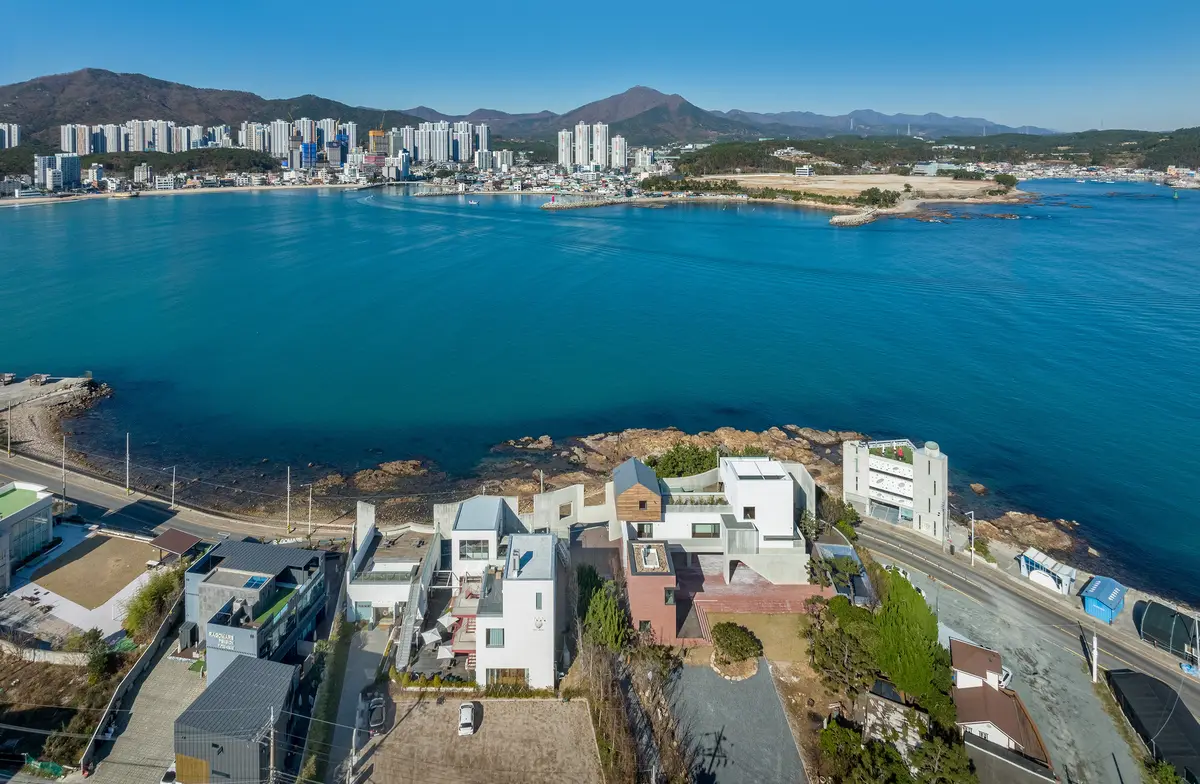
Seen from the waterline, Wind Fence 2 rises above volcanic rock outcrops as a cascade of white stucco volumes, each one slightly rotated from its neighbor. The scattering is deliberate. Rather than presenting a single wall to the prevailing sea wind, the cluster breaks the force into turbulent eddies that lose energy between the gaps. It is an architectural strategy borrowed from the logic of breakwaters and jetties, applied at a domestic scale.
The aerial views confirm how tightly the complex sits on its rocky promontory, squeezed between a coastal road and the bay. There is almost no buffer landscape; the architecture meets geology directly. That directness gives the project a fortified quality that the white surfaces and potted trees soften only partially.
A Material Palette of Layers
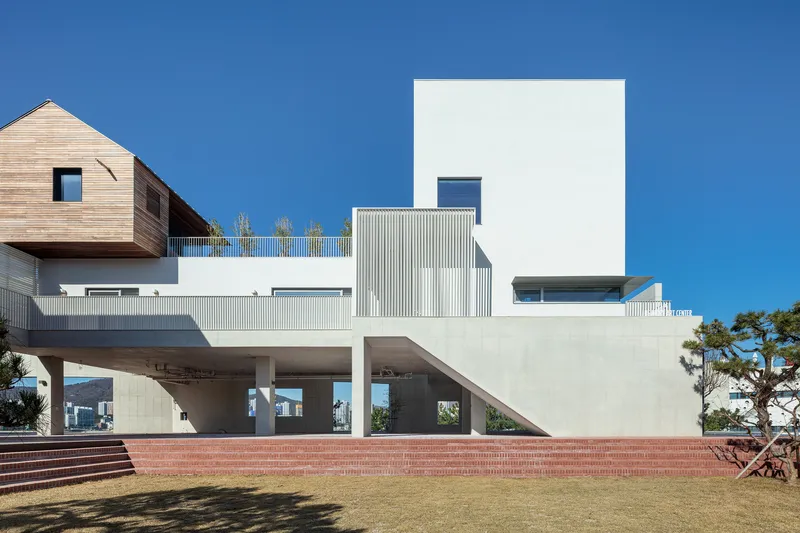

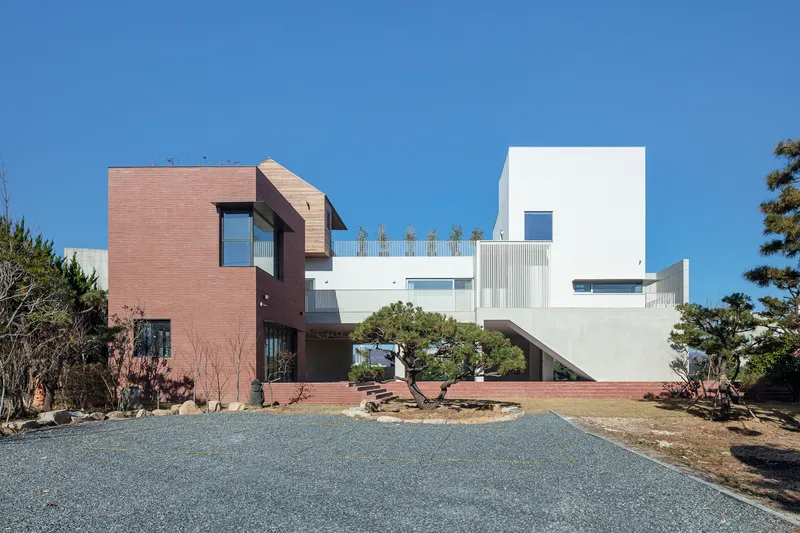
Up close, the monolithic impression dissolves into a tactile collage. A red brick platform anchors the base, its diamond-patterned retaining wall hinting at traditional Korean brickwork while performing a purely structural role. Above it, white corrugated metal panels, timber cladding, and monocouche stucco alternate from volume to volume, each material signaling a different programmatic use or structural logic. The effect is that of a village assembled over time rather than a single commission built in one pass.
The material choices are pragmatic for a coastal environment. Steel and concrete form the primary structure, engineered by SEN Engineering Group to resist the lateral loads that sea wind imposes on an exposed headland. The lighter cladding systems, metal standing-seam panels and timber, can be replaced panel by panel as salt spray takes its toll, an honest concession to maintenance that too many seaside buildings ignore.
Terraces and Thresholds
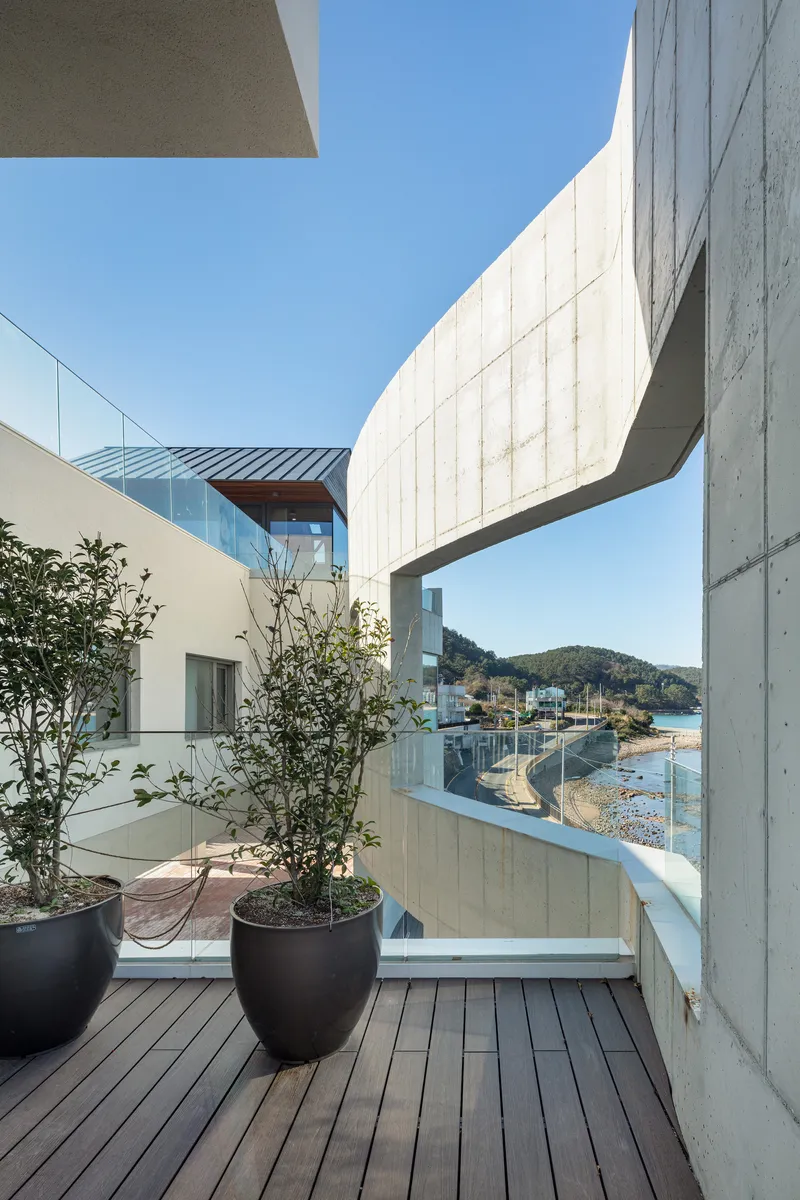

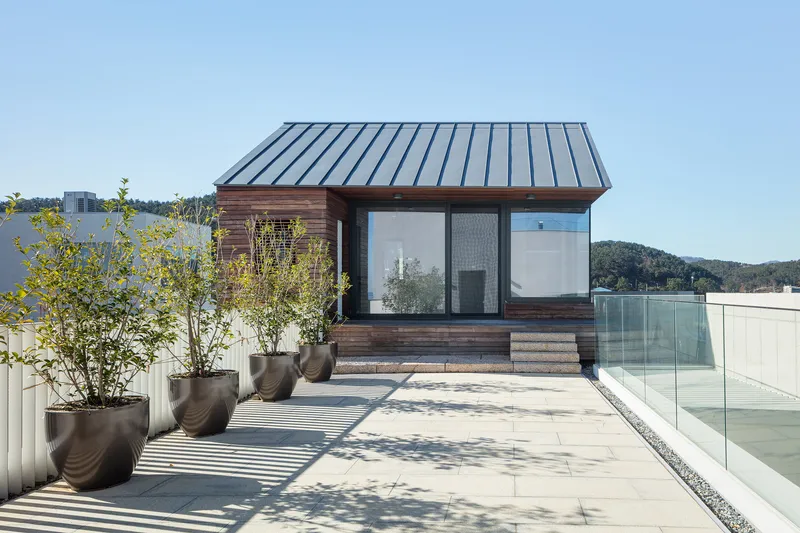
The fragmented plan generates an abundance of outdoor rooms. Rooftop terraces paved in white concrete offer unobstructed views toward the harbor, while a timber-clad pavilion with a standing-seam metal roof provides shade for moments when the sun is relentless. Potted trees are the primary landscape element up here, portable enough to rearrange and robust enough to survive wind exposure.
A deck terrace at a middle level looks out over a bridge volume that connects two of the residential wings, turning circulation into spectacle. Glass railings keep sightlines clean, and the distant coastline fills the frame beyond. These in-between spaces, the bridges, the gaps, the terraces caught in the lee of a taller volume, are where the architecture is most convincing. They prove that the fragmented massing is not a formal indulgence but a generator of microclimate.
Courtyards Carved from Concrete
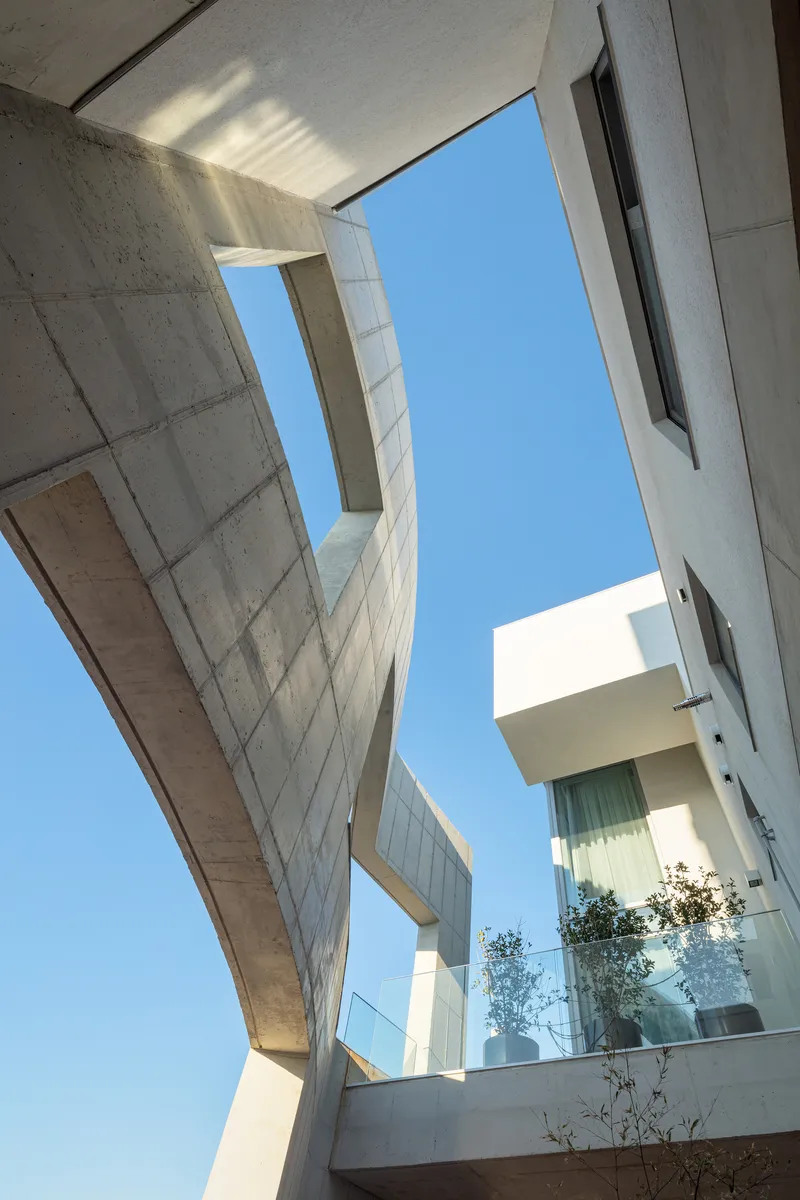

Looking straight up from the ground level courtyard, angled concrete walls frame a narrow rectangle of sky. Balcony plantings soften the edges, but the spatial sensation is unmistakably compressed and protective, a deliberate contrast to the open horizon just meters away. The architects understand that on a site this exposed, shelter is not a given; it has to be designed into every section.
At dusk, the stepping volumes read as a luminous hillside village, their white surfaces catching the last ambient light while young trees mark the transitions between public path and private threshold. The composition is picturesque in the original sense of the word: it rewards the oblique glance and changes character as you move around it.
Plans and Drawings


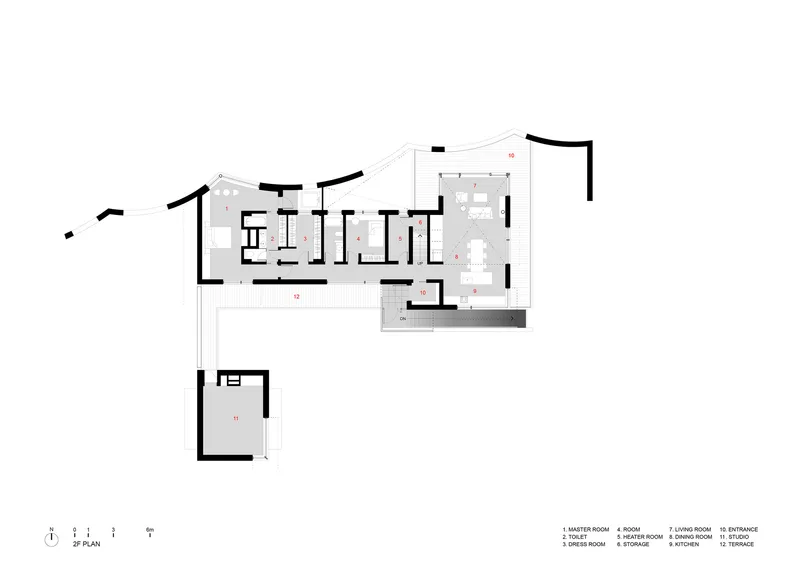


The site plan reveals the organizational logic that the photographs only hint at. Pavilions are scattered across the promontory along landscaped paths that terminate at the rim road, with pools and planted courts filling the voids between volumes. The ground floor plan shows a linear commercial bar with a terraced seating area stepping down toward a swimming pool. Upper floors shift the program to residential use: bedroom suites line angled corridors on the second level, while the third floor connects guest quarters and a library pavilion through a covered bridge.
The north elevation drawing is the most telling document. It shows how the architects used the natural slope to stagger floor levels, so that no single volume dominates the silhouette. Each fragment steps up or down by half a story, producing a roofline that echoes the irregular profile of the rocky coast below. It is a studied informality, carefully calibrated to look inevitable.
Why This Project Matters
Wind Fence 2 is a case study in how fragmentation can be a coastal design strategy rather than just an aesthetic preference. By breaking a 495 m² program into a cluster of discrete volumes, Hyunjoon Yoo Architects reduced wind load on any single surface, created sheltered outdoor rooms, and gave the complex a visual identity that registers from the water. The mixed-use program, weaving cafes, retail, and housing into one headland, keeps the settlement alive across hours and seasons, avoiding the dead-zone problem that plagues single-use resort architecture.
More broadly, the project demonstrates that working on a dramatic site does not require a dramatic form. The individual volumes are simple, almost generic boxes of steel, concrete, and cladding. The architecture lives in the relationships between them: the angled gaps, the bridged connections, the terraces that catch or deflect the breeze. It is an additive, village-scale logic that could be extended or adapted as programs evolve, and that resilience may be its most valuable lesson for coastal building anywhere.
Wind Fence 2 by Hyunjoon Yoo Architects, Gijang-gun, Busan, South Korea. 495 m², completed 2023. Photography by Kyungsub Shin.
About the Studio
Hyunjoon Yoo
Official website of Hyunjoon Yoo, one of the studios behind this project.
hyunjoonyoo.comShare Your Own Work on uni.xyz
If projects like this are the kind of work you want to make, uni.xyz is a place to publish your own, find collaborators, and enter design competitions.


Popular Articles
Popular articles from the community


The Musturak Paradise: Senior Living Architecture for a Connected Future in Temara, Morocco
The Musturak Paradise reimagines senior living architecture in Temara via private homes, social spaces, culture, community, and shared care.

The Ocean Hive: Sustainable Architecture for a Self-Sufficient Civilization at Sea
The Ocean Hive imagines sustainable architecture at sea, where modular habitats, algae, wave power and ocean waste sustain a growing colony.

Little Red Riding Hood: Architectural Design as a Journey Through Fear, Light, and Storytelling
Little Red Riding Hood reimagines the fairy tale through architectural design shaped by fear, light, scale, memory, uncertainty, and choice.

Play: Fragments of Their World
Familiar architecture becomes modular playground design, creating safe spaces where displaced children can learn, connect, imagine and play.

Similar Reads
You might also enjoy these articles

Bao Huynh Watercolor Atelier: A Serene Art Retreat in Hội An
Bao Huynh Watercolor Atelier in Hội An blends multifunctional art spaces, sustainable design, local materials, and family-friendly living in a serene environment.

Atelier Macri Concept Store Interior Design by CASE-REAL
Atelier Macri store features a "ko" counter, walnut wood details, cork displays, blending retail, gallery, and seamless customer experiences.

Manuel Vargas Izquierdo Stadium and High-Performance Sports Center: Architectural Excellence in Jalpa de Méndez
The Manuel Vargas Izquierdo Stadium blends sustainable design, inclusive sports facilities, and cultural-inspired architecture, revitalizing Jalpa de Méndez’s public spaces.

KAKR Buluh Awar Hall: Revitalizing Community and Ecology Through Bamboo Architecture
Community built bamboo hall revitalizes Buluh Awar village, empowering youth, restoring ecology, celebrating vernacular craftsmanship through sustainable architecture and culture.

Explore Wind Turbine Competitions
Discover active competitions in this discipline

Challenge to reimagine the Iron Throne

Photograph architecture without architects

Illustrate the lost glory of Angkor Wat - Render Challenge

Design challenge to reuse E-waste
Comments (0)
Please login or sign up to add comments
No comments yet. Be the first to comment!