

Ian Moore Architects Turns a 156-Year-Old Sydney Corner Shop into a Glass Brick Residence
A Victorian-era public house in Surry Hills sheds its 20th-century additions and gains a luminous three-storey steel-and-glass extension.


Buildings that survive long enough accumulate identities like sediment. The structure at this corner in Surry Hills has been a public house (1869), a fruit and vegetable shop (1921), and a neighbourhood grocery that finally shuttered during the COVID-19 pandemic. Ian Moore Architects has now stripped it back to its original brick shell, braced a facade that was leaning 300 millimeters into the street, and inserted a steel-framed domestic program that reads as something entirely new while the old walls remain firmly in charge of the corner.
What makes The Corner Store worth studying is the clarity of its conservation logic. Heritage Conservation Area rules in Sydney demand that new work be legible as new, and Moore takes that requirement as a design generator rather than a constraint. The rear addition is clad entirely in glass bricks, a material that glows from within at dusk and goes translucent by day. There is no air conditioning. Ventilation, light, and thermal comfort come from a carved-out central courtyard, ceiling fans, and insulated roof and wall assemblies. The result is a 259 square metre house that performs more like a passive climate instrument than a conventional renovation.
Old Shell, New Frame
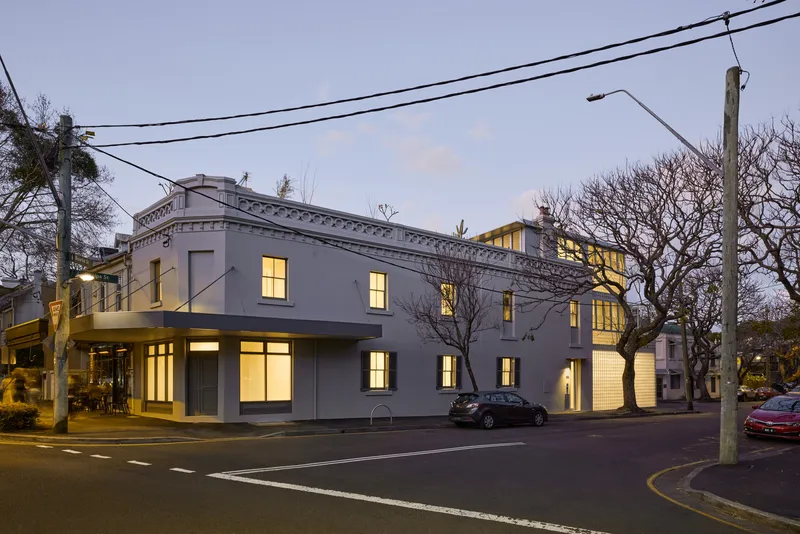


The original brick facade had physically separated from its internal cross walls and was pitching outward toward the street. Moore's first move was to thread a steel portal frame through the existing shell before any interior demolition could begin. That frame now does double duty: it stabilizes the heritage masonry and serves as the primary structure for the three-storey extension behind it. The ornamental cornice along the parapet line survived, and new windows were fabricated using the original timber templates as guides, then painted charcoal to distinguish them from the rendered walls.
From the street, the front facade reads as a carefully restored Victorian corner building. Walk around the side and the language shifts entirely: glass brick volumes wrap the corner at ground level and stack upward beside louvered aluminum openings. The junction between old and new is set back just enough to register as a deliberate articulation, not a seam that got away.
A Wall of Light

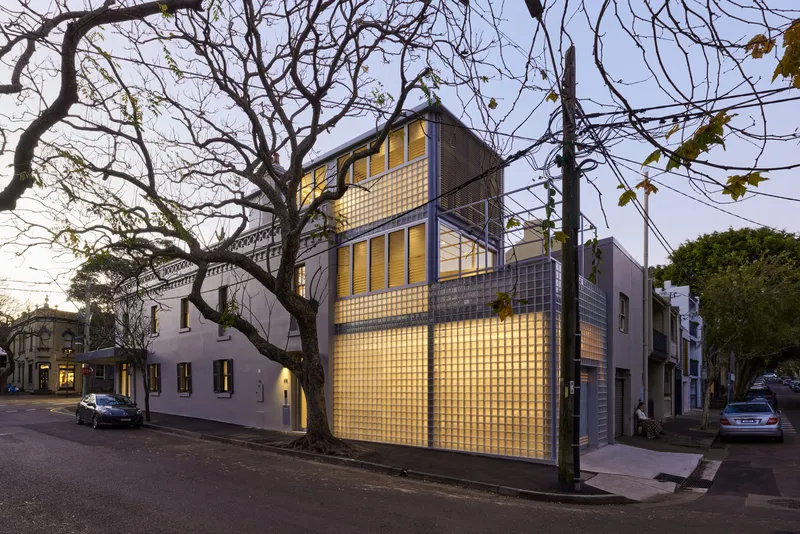

Glass bricks are often treated as a nostalgic curiosity, a relic of 1980s commercial interiors. Here they are the defining material gesture. The blocks enclose the garage at ground level, rise to form the balustrade of the terrace above, and wrap the upper bedroom volumes facing the street. During the day they filter harsh Sydney sunlight into a soft, diffused wash. At night, with interior lights on, the entire rear volume becomes a lantern, projecting a warm glow beneath the winter trees.
The effect is architectural, not decorative. Glass brick gives the extension a mass and texture that flat glazing would not, and it provides privacy on a tight urban corner without resorting to curtains or opaque screens. It also creates a genuine dialogue with the heavyweight masonry of the original building: both materials are modular, load-bearing in character, and made by hand-like processes. The old wall is opaque and rough. The new wall is translucent and precise. They share a corner.
The Courtyard as Climate Machine

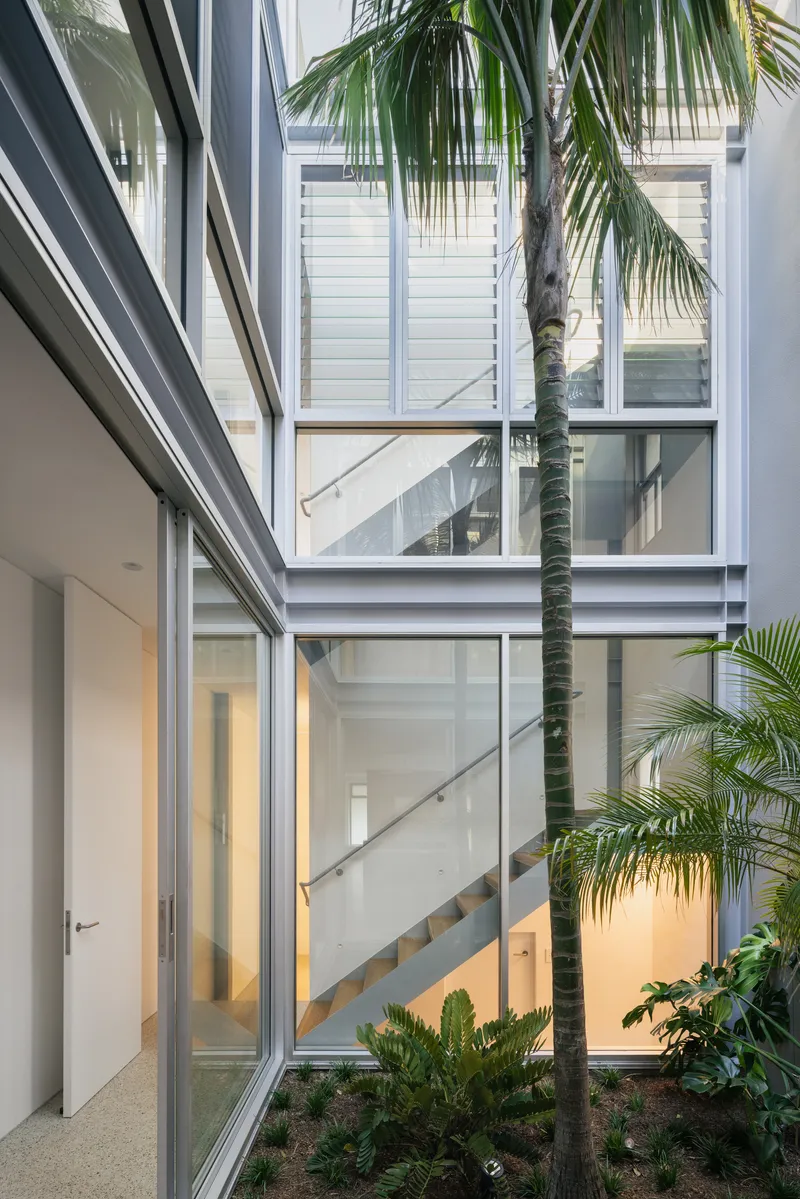

The long side of the site faces south, which in Sydney means it receives no direct sunlight from the street. Moore's solution is a courtyard cut into the centre of the plan, open to the sky, planted with a tall palm and lower grasses. The void does three things simultaneously: it brings daylight deep into the floor plates, it creates a stack effect that draws air upward through the house, and it gives every major room an outlook that isn't a party wall.
The decision to forgo air conditioning entirely is the proof that the courtyard works. Cross ventilation through louvered windows and sliding doors, combined with ceiling fans and insulated envelopes, keeps the house comfortable year round. It is a reminder that in temperate climates, the most effective cooling system is still a hole in the plan.
Living on Three Levels

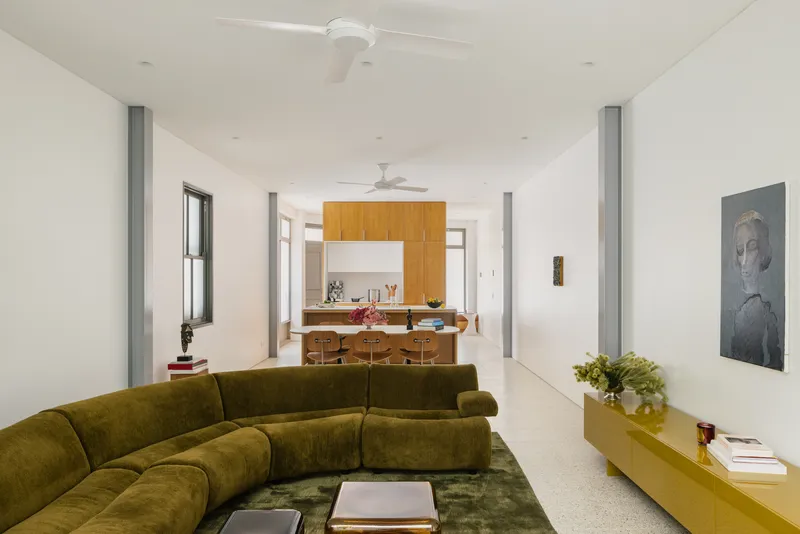
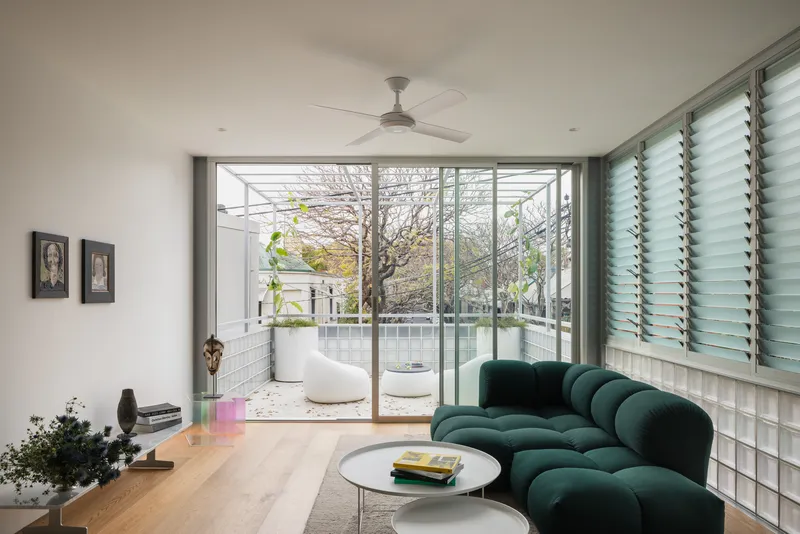
The ground floor holds the garage, a living area, and the main kitchen. An oak island kitchen with a white countertop sits beneath a ceiling fan, adjacent to a dining zone with a white oval table. The living room opens directly onto the courtyard through full-height sliding doors, and a glass brick wall at the rear filters street light without compromising privacy. Steel columns are left exposed, painted to match the palette, establishing a rhythm that carries through the house.

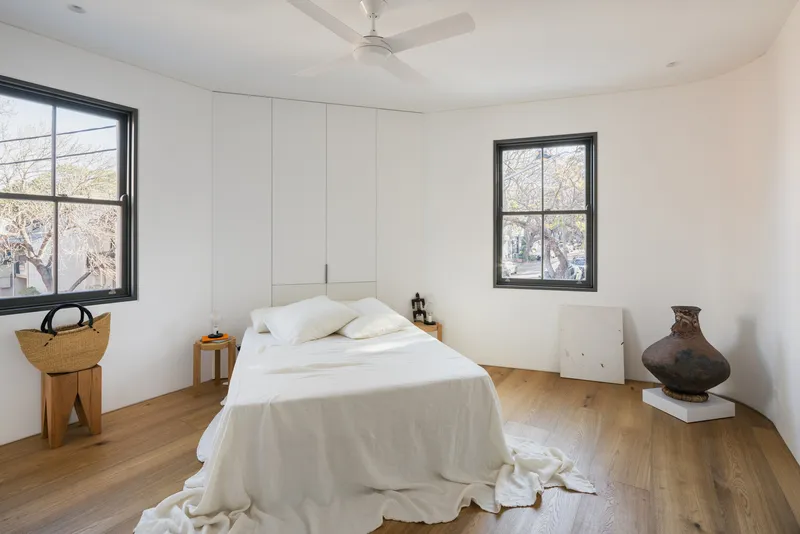
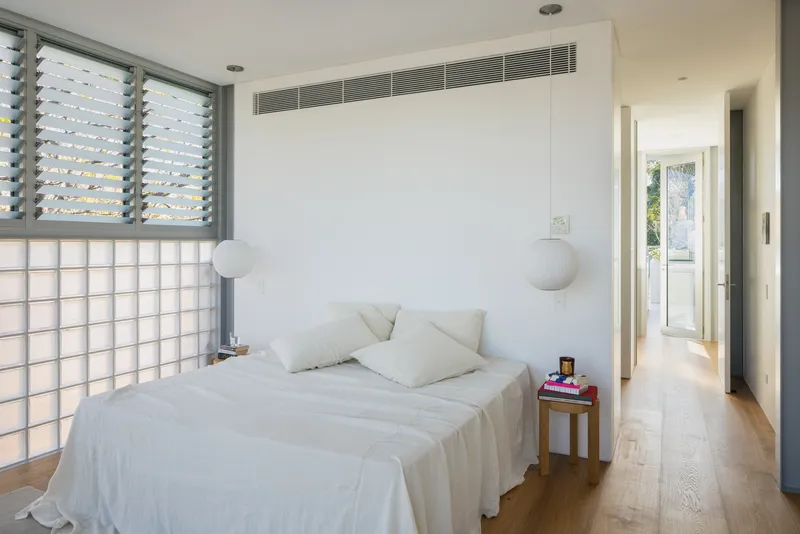
The first floor holds two bedrooms and a family room, each oriented toward either the courtyard planting or the louvered street facade. The primary bedroom occupies the top level, with access to both a terrace above the garage and a larger roof terrace with built-in planters. A discreet floor hatch leads to a basement level below grade. The plan is intentionally flexible: rooms are dimensioned to absorb different uses over decades, avoiding the brittle specificity that dates so many residential projects within a single generation.
Staircases and Circulation
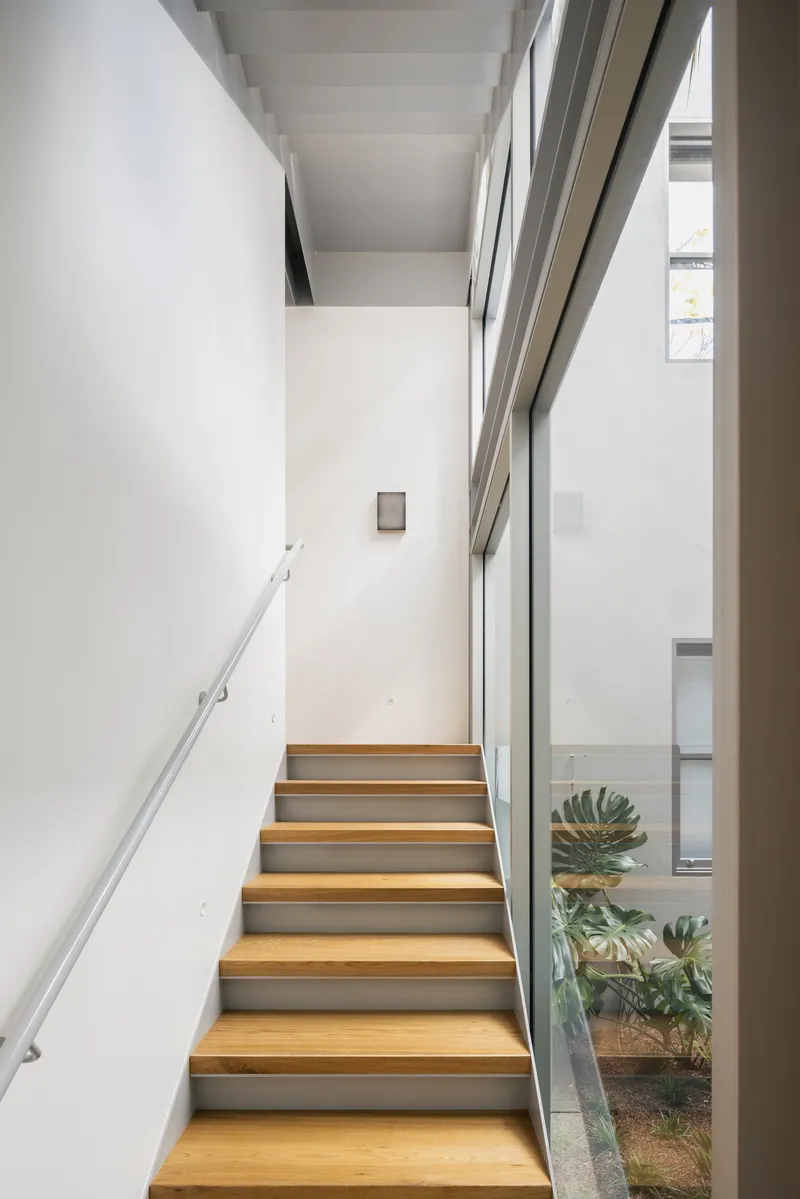

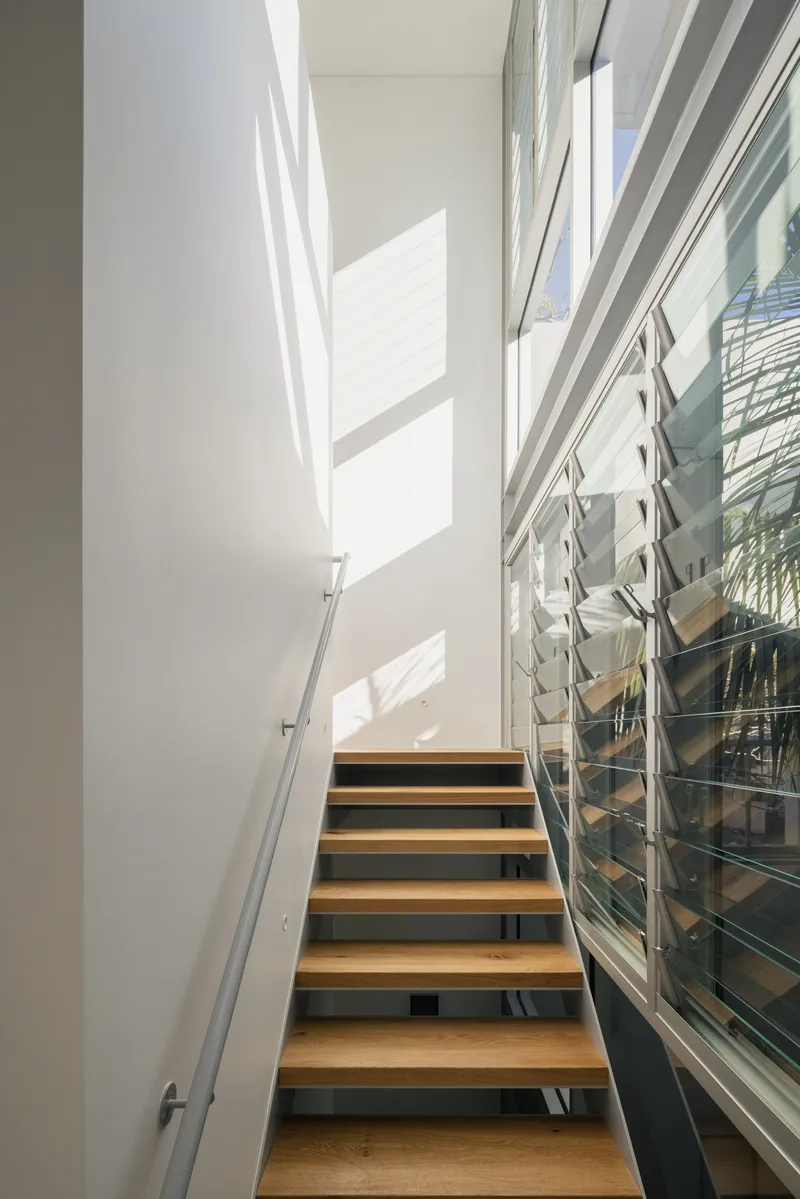
On a narrow, elongated site, the staircase becomes the primary architectural event. Moore uses a sequence of shifts in material and geometry to mark the transitions between levels. Terrazzo treads give way to timber. Metal tread plates alternate with oak cabinetry. A glazed wall alongside the main stair keeps the courtyard in view during every ascent, reinforcing the idea that the planted void is the heart of the house.
The stairwell also functions as a light well. A skylight with horizontal steel beams caps the vertical shaft, pulling daylight down through the section and reducing the reliance on artificial lighting during the day. Corridors are kept narrow and lined with full-height oak cabinetry, compressing the plan to make the courtyard-facing rooms feel generous by contrast.
Terraces and Rooftop Life
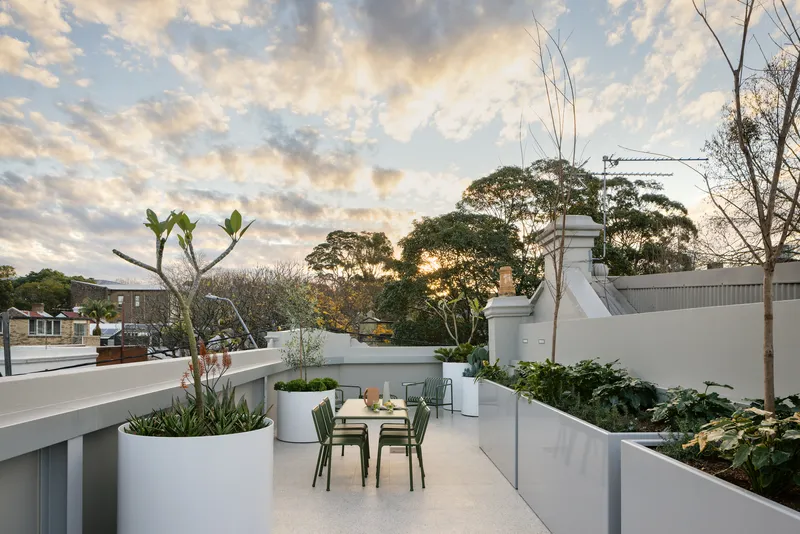

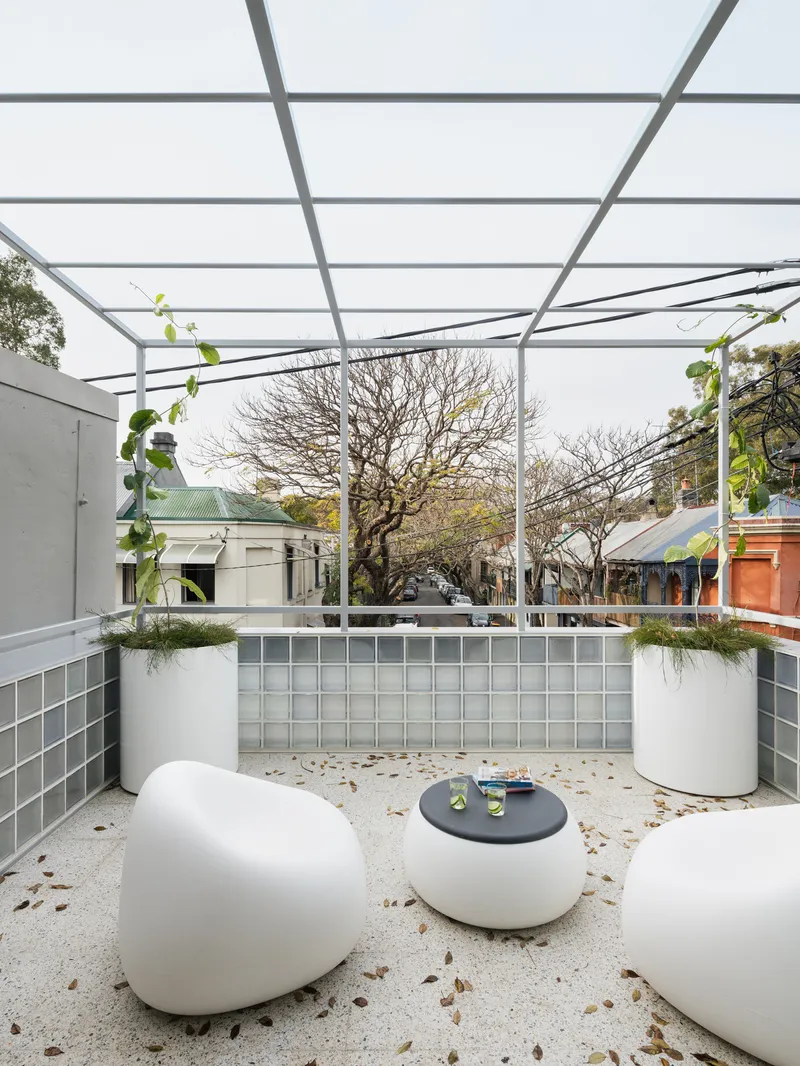
The roof terrace is the payoff for living on a tight inner-city lot. Built-in planters with mature planting soften the hard surfaces and screen neighbouring buildings. A dining table sits beneath an open sky, framed by the canopy of street trees at eye level. Below, a second terrace with a steel pergola and terrazzo floor extends the living area of the primary bedroom outward, with the glass brick parapet providing enclosure without blocking breezes.
Material Palette and Detailing


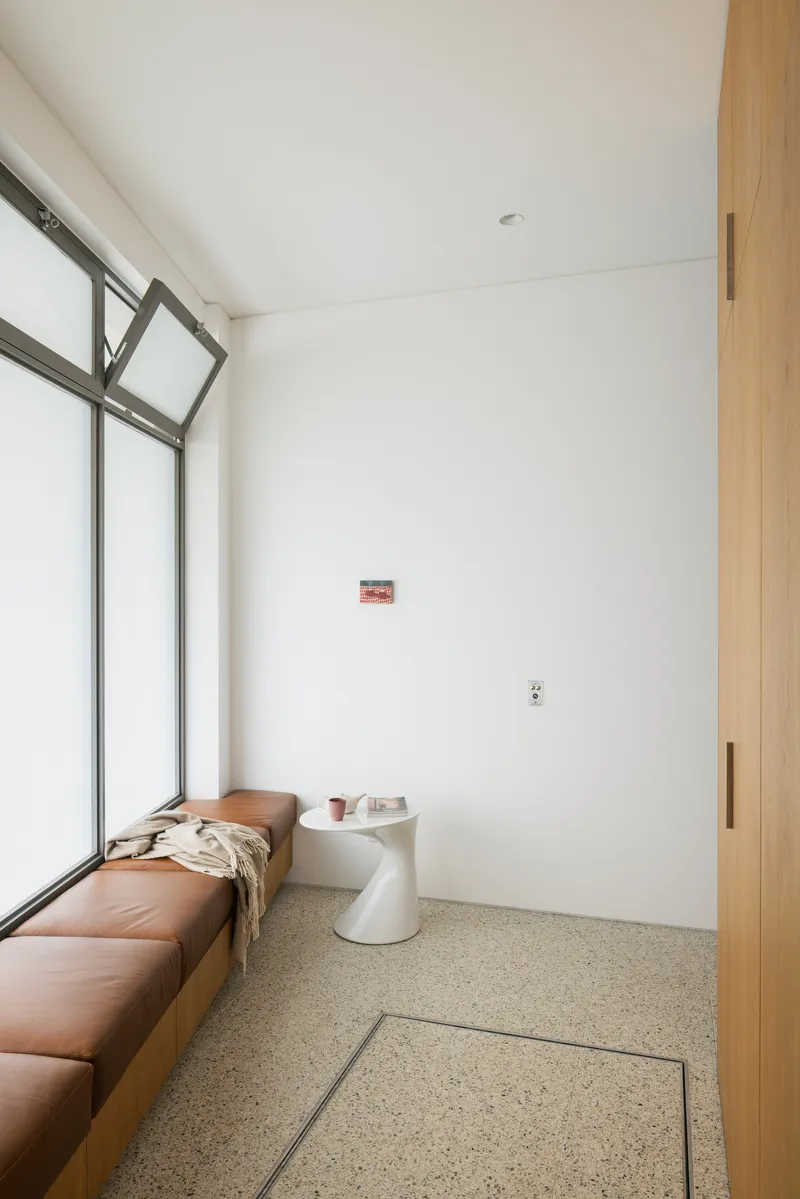
The interior palette is restrained: oak joinery, terrazzo floors, white walls, and the occasional surprise like a lime green glass wall behind the freestanding bathtub. The oak cabinetry does heavy lifting throughout, absorbing storage, concealing services, and providing warmth against the otherwise cool surfaces. Terrazzo reappears on stair treads, courtyard floors, and threshold zones, stitching the interior and exterior ground planes together.
Hardware and fixtures are deliberately minimal. Wall-mounted faucets, flush radiators, and recessed grilles keep surfaces clean. The charcoal-painted window frames establish a consistent reading line across old and new facades, unifying what could easily feel like two separate buildings. It is careful, quiet work, and it trusts the spatial sequence to carry the architecture rather than relying on material spectacle.
Plans and Drawings


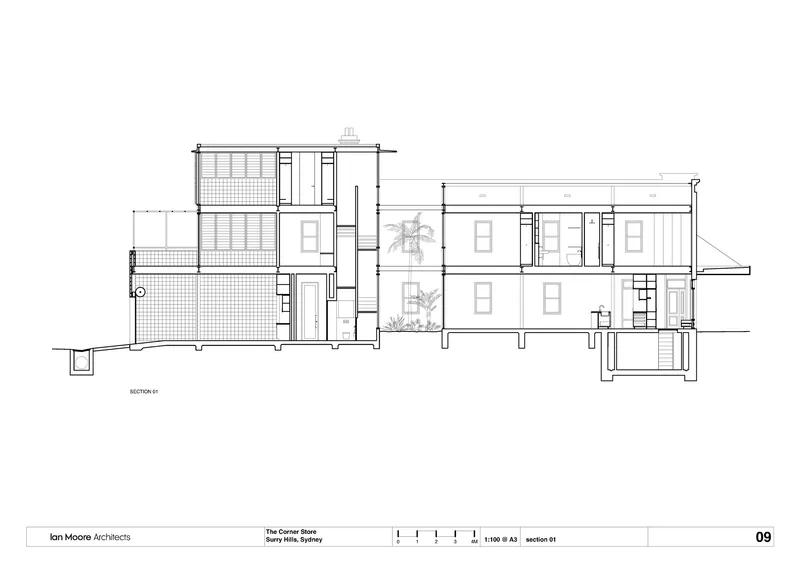


The site plan reveals the awkward geometry of the corner lot, with the building wrapping two street frontages and the courtyard carved out of the centre. Sections through the courtyard show the tall palm rising nearly the full height of the building, with the staircase zigzagging around it. The exploded isometric is particularly useful: it isolates the heritage shell from the new steel structure, making the conservation strategy legible at a glance. Floor plans confirm the linear arrangement of rooms along the long axis, with the courtyard acting as the hinge between the public-facing front and the private rear.
Why This Project Matters
The Corner Store demonstrates that heritage conservation and contemporary ambition are not competing agendas. The steel portal frame that saves the old facade also structures the new addition. The courtyard that provides passive cooling also organizes the plan. The glass bricks that differentiate new from old also create the building's most striking visual identity. Every major design decision does at least two things, and that efficiency of means is what separates a good renovation from an expedient one.
More broadly, the project offers a persuasive model for dense inner-city sites where commercial buildings have outlived their original programs. Rather than demolishing 156 years of accumulated urban character, Moore keeps the corner presence intact and builds inward and upward. The house breathes without mechanical cooling. It glows without ostentation. It occupies every square metre of its site while feeling generous. For a building that has already been a hotel, a fruit shop, and a grocery store, becoming a home seems like its most sustainable chapter yet.
The Corner Store by Ian Moore Architects. Located in Surry Hills, Sydney, Australia. 259 m². Completed in 2025. Photography by Clinton Weaver and Nick Bowers.
About the Studio
Share Your Own Work on uni.xyz
If projects like this are the kind of work you want to make, uni.xyz is a place to publish your own, find collaborators, and enter design competitions.


Popular Articles
Popular articles from the community

Temporary Home for Dogs: A Reversed Zoo Rethinks Animal Shelter Architecture
In Bucharest, a sinuous corridor and freed landscape flip the logic of containment, designing a shelter that works to make itself unnecessary.

The Amber Palace Opera: A Geological Fiction Surfaces on Tallinn's Baltic Waterfront
Pierre Brillard reimagines a Baltic legend as a public landscape, opera house, and waterfront promenade rooted in Tallinn's coastal identity.

Manzana Morphosis: Stretching Barcelona's Grid into a Living Landscape for 2050
A radical reworking of the Eixample manzana turns density into a tool for generous public space, vertical ecology, and environmental performance.

Tsunami Convergenics: Turning Catastrophic Ocean Forces into Underwater Housing Infrastructure
A speculative underwater settlement off the coast of Onagawa, Japan, treats tsunamis and typhoons as energy sources rather than threats.

Similar Reads
You might also enjoy these articles

Bao Huynh Watercolor Atelier: A Serene Art Retreat in Hội An
Bao Huynh Watercolor Atelier in Hội An blends multifunctional art spaces, sustainable design, local materials, and family-friendly living in a serene environment.

Atelier Macri Concept Store Interior Design by CASE-REAL
Atelier Macri store features a "ko" counter, walnut wood details, cork displays, blending retail, gallery, and seamless customer experiences.

Manuel Vargas Izquierdo Stadium and High-Performance Sports Center: Architectural Excellence in Jalpa de Méndez
The Manuel Vargas Izquierdo Stadium blends sustainable design, inclusive sports facilities, and cultural-inspired architecture, revitalizing Jalpa de Méndez’s public spaces.

KAKR Buluh Awar Hall: Revitalizing Community and Ecology Through Bamboo Architecture
Community built bamboo hall revitalizes Buluh Awar village, empowering youth, restoring ecology, celebrating vernacular craftsmanship through sustainable architecture and culture.

Explore Shopping Center Competitions
Discover active competitions in this discipline

Challenge to design luxury tourism on rails

VR headsets Storefront design competition

Designing a staircase for a client
Comments (0)
Please login or sign up to add comments
No comments yet. Be the first to comment!