
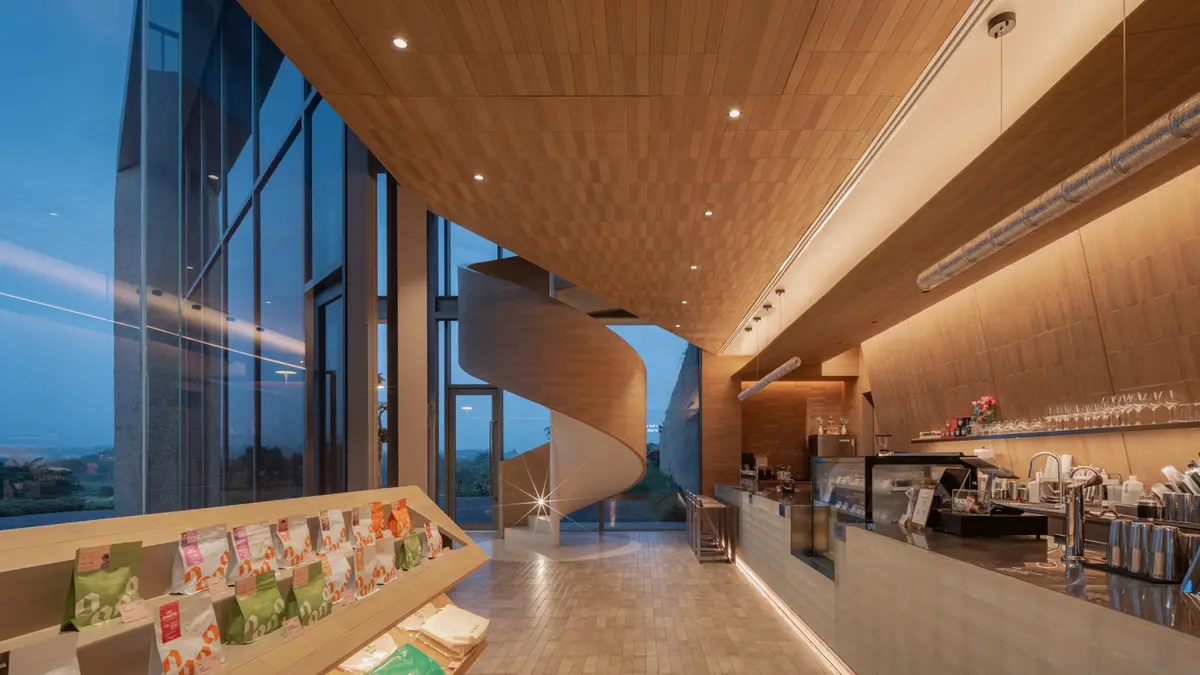
IDIN Architects Folds a Hillside into a Café and Public Viewpoint at Khao Yai
A kirigami-inspired concrete landscape in rural Thailand turns sloping terrain into a layered café with 70 percent outdoor space.


Most café architecture treats the building as an object placed on a site. IDIN Architects did the opposite at Harudot Khao Yai: they treated the site itself as the building. Sitting on a slope that drops from a main road toward a water basin ringed by the Khao Yai mountains, the 500-square-meter project operates less like a structure and more like a topographic event, a series of concrete ground planes that have been sliced, lifted, and folded to produce café spaces, terraces, staircases, and a rooftop viewpoint accessible to anyone walking by, whether they buy a latte or not.
The conceptual engine is kirigami, the Japanese art of cutting and folding a single sheet of paper. IDIN translated that logic into cast-in-place concrete: floors rise to become display walls, horizontal surfaces curl into spiral stairs, and what reads as a green roof from one angle is a walkable garden slope from another. Roughly 70 percent of the program is outdoors or semi-outdoor, a proportion that turns the project into a landscape intervention rather than a conventional building. The result is a café you inhabit the way you inhabit a hillside, moving up, across, and through shifting levels with the Khao Yai panorama always in frame.
The Folded Landscape

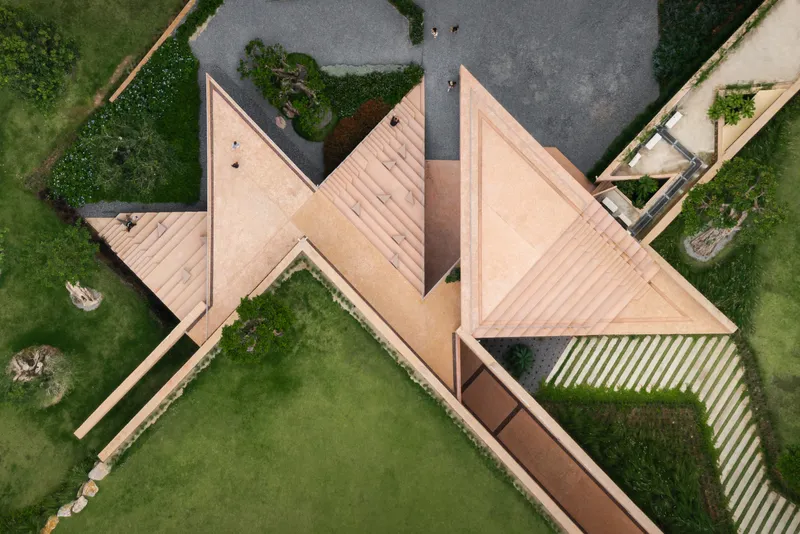
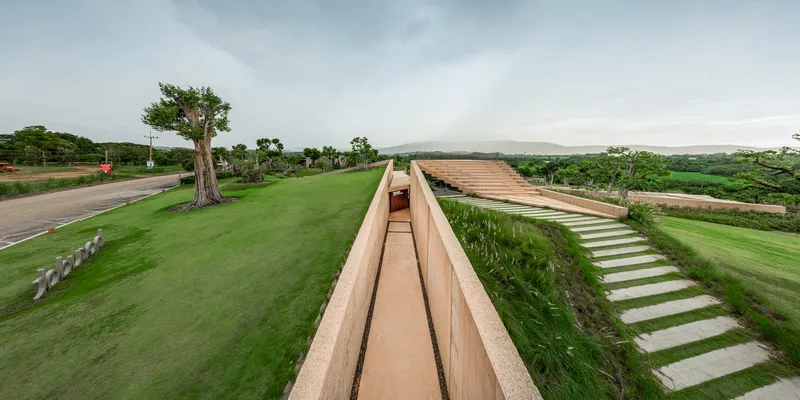
From above, the project reads as a series of angular planes fanning outward from a central courtyard, their copper-toned surfaces catching the light like facets of a geological formation. The aerial views make the kirigami logic legible: each roof plane corresponds to a fold in the ground, and the gaps between them become courtyards, stairs, and planted strips. The building occupies the hillside without flattening it, stepping down through the slope in a way that preserves the original topographic gradient.
An elevated walkway flanked by green roof slopes allows visitors to move between the road level and the upper terrace without ever entering the café itself. That public stairway is a generous move, one that transforms the project from a private commercial space into a piece of civic infrastructure for a rural Thai community that otherwise has few designed public vantage points.
Entering Through the Cut


Arrival is deliberate and compressed. Visitors pass through a narrow gap between textured concrete walls, a spatial sequence that recalls the kirigami cut before the fold. The passage is tight enough to feel bodily, with rough aggregate surfaces on one side and smooth plaster on the other creating a tactile contrast you register even at walking speed. Recessed signage and a timber door mark the threshold, but the real invitation is the glimpse of courtyard light at the end of the slot.
IDIN uses this compression-and-release tactic throughout the project. Narrow corridors open into double-height volumes. Low ceilings give way to sky. It is a well-known spatial trick, but the material consistency of cast-in-place concrete keeps it from feeling arbitrary. Every surface is part of the same folded sheet.
Concrete as Surface and Structure


The project's material vocabulary is narrow and disciplined. Cast-in-place concrete at just 10 centimeters thick does everything: it retains earth, spans between levels, provides seating, and gives the café its visual identity. But IDIN avoids monotony by varying the finish. Some surfaces are grooved. Others have been selectively chipped to expose the stone aggregate beneath the smooth skin. Columns are coated to reveal a natural clay color that shifts between light brown and gentle pink depending on the light, a tonal range the architects describe as latte-like, a fitting association for a café.
Notably, the project is the first to use SCG Low Carbon Cement LC3, a material choice that addresses the environmental cost of all that concrete. It is a pragmatic detail, not a marketing gimmick: the low-carbon mix lowers embodied energy without changing the material's structural or aesthetic performance.
Timber, Glass, and the Interior World
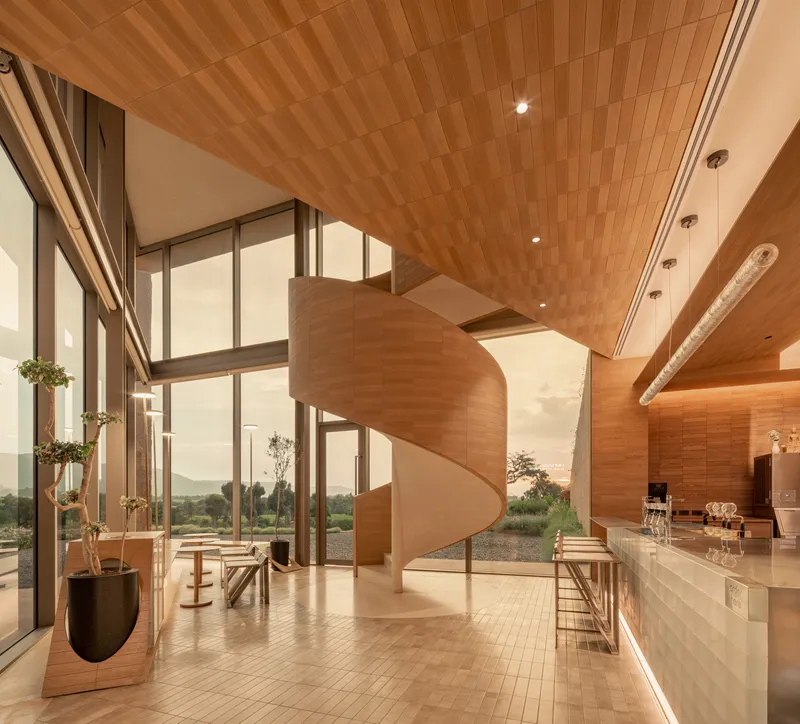


If the exterior is all mineral, the interior flips to warmth. A herringbone timber floor, a curved wood-clad volume, and a helical timber staircase introduce a domestic register that softens the concrete shell. The spiral stair is the spatial centerpiece: its tight curve rises beside floor-to-ceiling glazing, drawing evening light deep into the double-height café volume. At dusk, the warm interior glows against the cool concrete, and the building looks like a lantern set into the hillside.
The timber ceiling planes run continuously from interior to exterior, blurring the threshold in a way that reinforces the 70/30 outdoor-indoor split. You are always conscious of being partly outside, partly sheltered: the building's folded geometry produces overlapping zones of enclosure rather than hard boundaries.
The Courtyard and Stairs


A wide concrete staircase with recessed step lighting forms the courtyard's spine, rising through mature trees that were preserved during construction. The stairs are generous, almost ceremonial, and they double as informal seating. Above, a triangular skylight cuts into the folded roof, casting a wedge of light over a potted fig tree and the textured walls below. These moments of framed nature, a single tree lit from above, a twisted trunk seen through corner glazing, give the project a contemplative quality that offsets its programmatic simplicity.
Terraces and the View

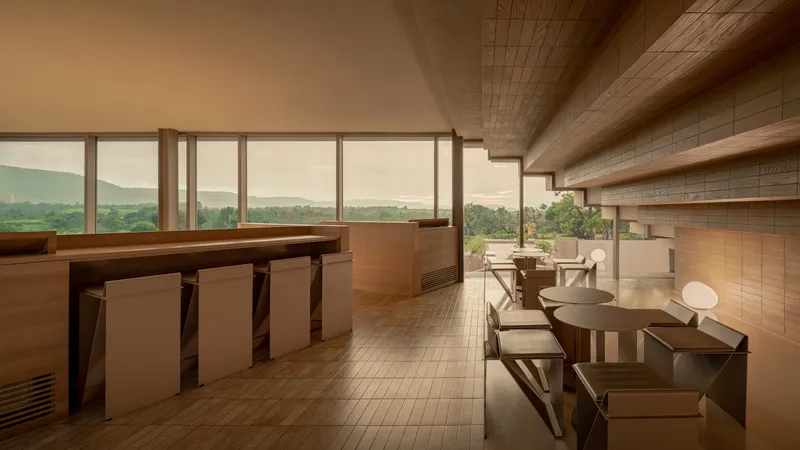

The project's ultimate payoff is the view. Upper-level seating areas open through full-height windows to the Khao Yai mountains, and covered terraces with stepped ceiling beams provide shaded platforms for lingering. The landscape does the heavy lifting here: the water basin, the golf course, the distant ridgeline. But IDIN earns the vista by making the journey to it spatial and sequential. You do not arrive at the view; you ascend to it.
Cantilevered concrete volumes with recessed glazing push the terraces outward beneath the canopy of mature trees, creating intimate outdoor rooms that feel suspended between the built and natural worlds. The detailing is restrained: thin metal balustrades, folded metal seating stools, minimal furniture. Nothing competes with the panorama.
Details and Atmosphere
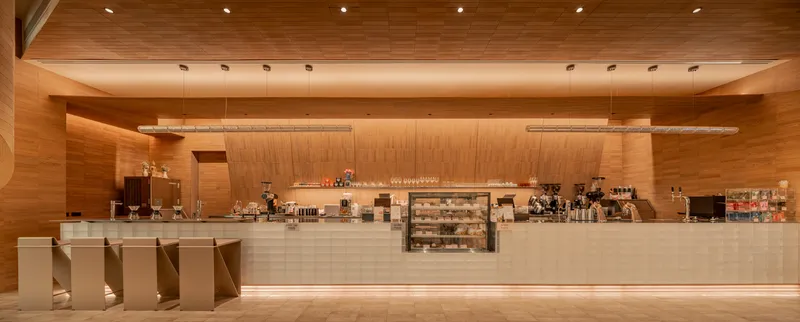


The service counter, lined with wood paneling and under-counter lighting, is one of the project's few concessions to conventional café design, and it is handled with the same material restraint as everything else. A curved timber staircase descends into the main café space past potted olive trees, a choreographed arrival that treats ordering coffee as a minor event rather than a transaction. At night, the glass-enclosed seating pavilion with pendant lights becomes its own composition, framing views of trees in the darkness beyond.
Plans and Drawings

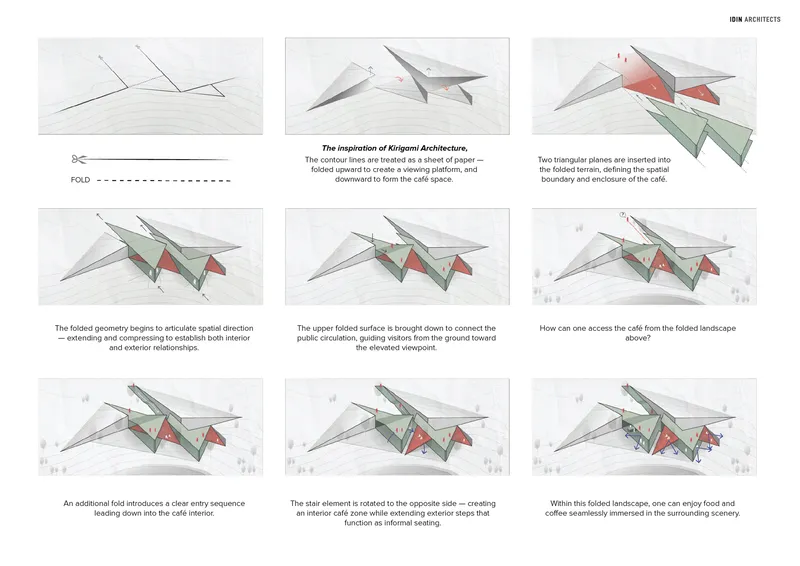
The axonometric diagrams make the kirigami logic explicit: a flat plane is sequentially cut, folded, and lifted to produce functional volumes. It is one thing to describe the concept verbally; seeing the transformation step by step clarifies how literally IDIN applied the paper-folding analogy. Each fold generates a different spatial condition: a wall, a stair, a roof, a retaining edge.
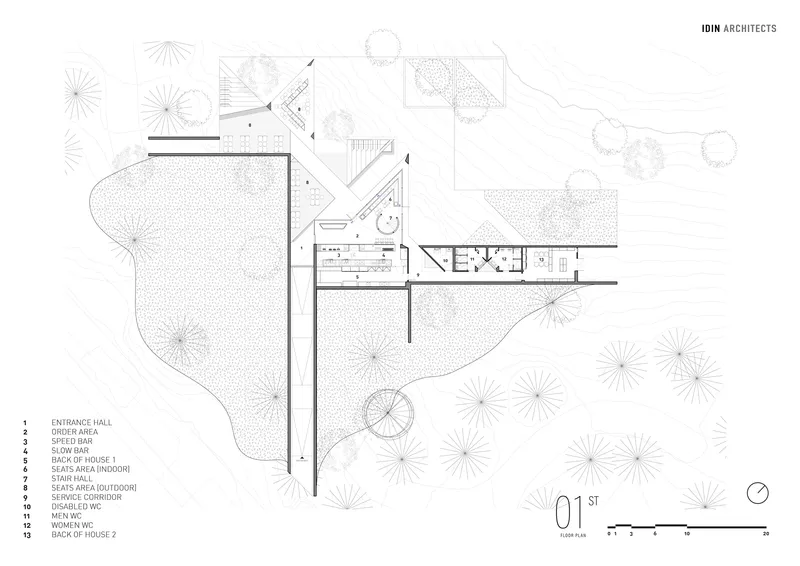
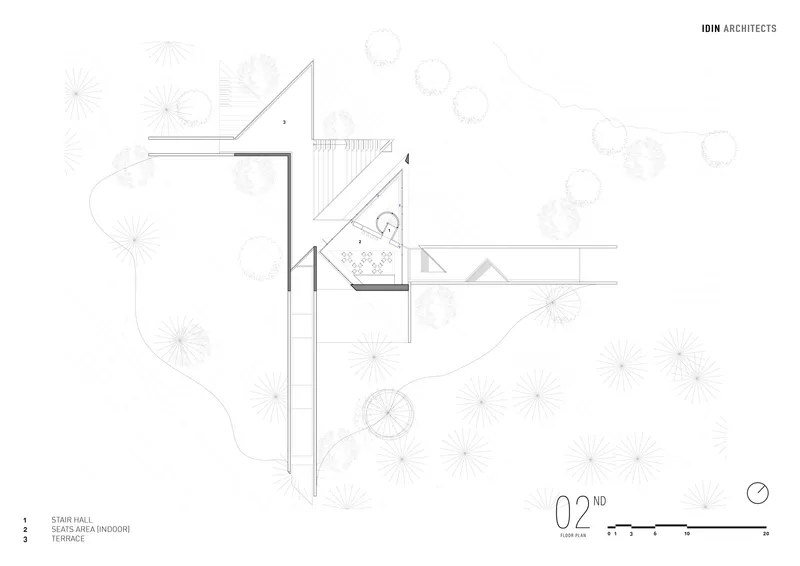

The floor plans reveal the elongated bar layout and the way angular volumes fan around the central courtyard. Tree canopies are drawn as carefully as walls, underscoring the project's landscape-first ethos. The terrace and seating zones read as extensions of the ground rather than additive rooms.


The sections are the most revealing drawings. They show the building cutting into the hillside, with terraces stepping down toward the water and interior volumes tucked beneath the folded roof planes. The relationship between the public stairway and the private café spaces is clear: they share the same structure but operate as independent circulation systems, an elegant resolution of the dual-program brief.
Why This Project Matters
Café architecture in Southeast Asia has become a genre of its own, one that often prioritizes photogenic backdrops over spatial intelligence. Harudot Khao Yai is significant because it does both. The kirigami concept is not decorative: it directly generates the plan, the section, and the material strategy. Every fold produces a functional condition, and the project's most generous gesture, the public viewpoint stairway, emerges naturally from the same topographic logic that shapes the café itself.
IDIN Architects also demonstrate something important about concrete in a tropical context. By varying finish, exposing aggregate, and adopting low-carbon cement, they turn a material often associated with brutality and thermal mass into something tactile, warm-toned, and environmentally accountable. The project proves that working with a single dominant material does not have to mean working with a single idea. It is disciplined, inventive, and generous to its site, a combination that should make other café commissions in the region look harder at what their hillsides are already doing.
Harudot Khaoyai Cafe by IDIN Architects, located in Nai Mueang, Thailand. 500 m², completed 2025. Photography by DOF Sky | Ground.
About the Studio
Share Your Own Work on uni.xyz
If projects like this are the kind of work you want to make, uni.xyz is a place to publish your own, find collaborators, and enter design competitions.


Popular Articles
Popular articles from the community


Co-Life: Senior Housing Design That Reconnects Older Adults With the City
Co-Life reimagines senior housing design through healing gardens, shared streets, workshops, and a sustainable community across generations.

Lunar Spiral: Space Architecture Shaped by the Mathematics of the Universe
Lunar Spiral reimagines space architecture through Fibonacci geometry, lunar regolith, levitating habitats, and self-sustaining Moon living.

Co-life: Sustainable Architecture for Age-Friendly Community Living
Co-life reimagines sustainable architecture for seniors through courtyards, rammed earth, shared gardens, and spaces designed for belonging.

Play: Fragments of Their World
Familiar architecture becomes modular playground design, creating safe spaces where displaced children can learn, connect, imagine and play.

Similar Reads
You might also enjoy these articles

Bao Huynh Watercolor Atelier: A Serene Art Retreat in Hội An
Bao Huynh Watercolor Atelier in Hội An blends multifunctional art spaces, sustainable design, local materials, and family-friendly living in a serene environment.

Atelier Macri Concept Store Interior Design by CASE-REAL
Atelier Macri store features a "ko" counter, walnut wood details, cork displays, blending retail, gallery, and seamless customer experiences.

Manuel Vargas Izquierdo Stadium and High-Performance Sports Center: Architectural Excellence in Jalpa de Méndez
The Manuel Vargas Izquierdo Stadium blends sustainable design, inclusive sports facilities, and cultural-inspired architecture, revitalizing Jalpa de Méndez’s public spaces.

KAKR Buluh Awar Hall: Revitalizing Community and Ecology Through Bamboo Architecture
Community built bamboo hall revitalizes Buluh Awar village, empowering youth, restoring ecology, celebrating vernacular craftsmanship through sustainable architecture and culture.

Explore Coffee Shop Competitions
Discover active competitions in this discipline

Challenge to design a portable theatre

Challenge to design a portable music platform

Challenge to design an open learning module for the elderly
Comments (0)
Please login or sign up to add comments
No comments yet. Be the first to comment!