

Immediate Post-Disaster Architectural Response: Five Modules That Rebuild Public Life, Not Just Shelter
A transportable timber arch system pairs clinic, school, aquaponic canteen, sanitation and a Calm Hall, drawing on Syrian, Haitian and Tongan vernacular.


Most disaster relief architecture answers one question: how do people survive the next few weeks? This project asks a harder one: how does a community get its ordinary life back? Instead of another tent or shelter, it proposes a kit of public buildings, including a clinic, a school, a canteen and a gathering hall. The argument is that recovery depends on restoring routine and social structure as much as on providing a roof.
Immediate Post-Disaster Architectural Response, published on uni.xyz by Marta Sienkiewicz and Kacper Czaja, targets regions hit by natural disasters and war, where destroyed infrastructure prevents normal functioning without far-reaching reconstruction. The designers frame it as a scalable, modular system that replaces critical public facilities. They tested it against three distinct crisis contexts, with each one bringing its own pressures: extreme heat, flooding, hurricanes, earthquakes or armed conflict.
Rammed Earth and Folding Screens Turn Relief Space into Civic Space

The first rendering sets the tone. It does not look like an emergency interior. Rammed earth walls, patterned folding screens, a rug and three chairs on triangular floor tiles describe a room where people can sit, talk and wait with some dignity. This matches the project's central claim that clinics and schools during reconstruction are hybrid spaces, both practical and social. Here the architecture is an active participant in recovery rather than a passive container for emergency functions.
The programme backs this up with five interrelated modules that can work alone or together. The Clinic keeps basic healthcare running. The Canteen & Aquaponics module stores and distributes food while also growing vegetables, fruit and fish, which adds a self-sustaining food loop to a field that usually depends on deliveries. The Hygienic & Sanitary Module provides drinking water, washing and sanitation, the infrastructure that prevents disease outbreaks after a disaster. Taken together, the designers call it an urban micro-system, and the term fits: it is a small piece of city, not a camp.
Paired Arched Vaults Give the School a Sense of Permanence

The school sheet shows library and classroom interiors above a section through two adjoining arched vaults with marked levels. The vault is a smart choice of form. It reads as a lasting building, which matters for children whose surroundings have just been wrecked. The designers describe the school as both a place of learning and a stabilisation environment that supports psychological recovery and frees caregivers to focus on reconstruction. The section shows how two vaults joined side by side can hold distinct zones under one continuous roof, so a reading room and a teaching space can sit next to each other without separate structures.
Wicker Swings and Louvered Shutters Borrow from the Vernacular


The two softest images reveal the project's best instinct. A sleeping corner with a hanging wicker seat, floor bedding and louvered shutters opens onto a desert view at dusk. A corridor holds wicker swings, timber shelving and skylights cut into the sloping roof, with plants catching the daylight. These are not decorative extras. The designers studied vernacular building types, including Syrian courtyard houses, Haitian timber and clay structures, and Tongan woven, raised-floor dwellings, and they fold that knowledge into a modular system. Woven seating, shaded openings and filtered top light are cultural signals as much as climate responses.
This is also where the Calm Hall earns its name. The designers describe it as a culturally adaptable communal space co-created with local inhabitants, serving as a meeting hall, event space and centre for social reintegration. Pairing a universal kit with local co-authorship is the right balance. The structure travels; the character is shaped on site by the people who will use it.
A Timber Arch Module Assembled from Footings to Extension

The axonometric sheet explains how the system works. A timber arch module is assembled in stages: foundation footings first, then the arch, roof panels and walls, and finally an extension. The designers describe the system as transportable and rapidly deployable, with a reciprocal frame logic that keeps the structure stable while leaving it flexible. Showing the sequence step by step makes the case that the arches can be built quickly and grown as needs change, which is what separates a deployable system from a one-off building.
Why This Project Matters
Humanitarian design often splits into two camps: fast but anonymous emergency kits, or careful but slow reconstruction. Sienkiewicz and Czaja try to close that gap. Their modules arrive with the logic of a deployable system but are organised around the institutions that hold a community together: care, learning, food, hygiene and assembly. The aquaponics canteen and the co-created Calm Hall in particular push relief architecture toward self-sufficiency and shared ownership instead of dependency.
The renderings make a quiet but important point: people in crisis deserve rooms with light, texture and somewhere comfortable to sit. By drawing on vernacular references from three very different regions and building them into one adaptable timber frame, the project treats cultural identity as part of the infrastructure. As climate extremes and conflict grow more frequent, that idea deserves serious attention from anyone designing for the first months after a disaster.
View the Full Project
About the Designers
Designers: Marta Sienkiewicz, Kacper Czaja
Enter a Design Competition on uni.xyz
uni.xyz runs architecture and design competitions year-round that reward proposals with spatial conviction and real site intelligence.
Project credits: Immediate Post-Disaster Architectural Response by Marta Sienkiewicz, Kacper Czaja.


Popular Articles
Popular articles from the community


GROUP A Strips a 1969 Rotterdam Harbor Headquarters to Its Frame and Wraps It in Timber Louvers
In Rotterdam's M4H harbor district, Ferro Offices reuses a 1969 frame, adds one timber storey and reaches BREEAM-NL Outstanding.

David Macias Steps a Doorless Stone and Plaster House Down a Tropical Colombian Hillside
In the humid hills of Colombia, Threshold House replaces the front door with an open void and terraces its 850 m² down the slope instead of fighting it.

longwave studio Reorganizes a 112 m² Tainan Apartment Around the Daily Routines of a Family and Two Cats
In Tainan, Taiwan, birch plywood, rust-red furniture and a freestanding plaster wall link arrival, storage, work and family life in one apartment.

David Ortega Stacks a Two-Story Mexico City Penthouse Around a Steel Stair and a Pergola-Shaded Roof Terrace
In Colonia Roma, a 300 m² penthouse uses oak joinery, a planted steel stair and a slatted roof pergola to make a new-build apartment feel like a house.

Similar Reads
You might also enjoy these articles
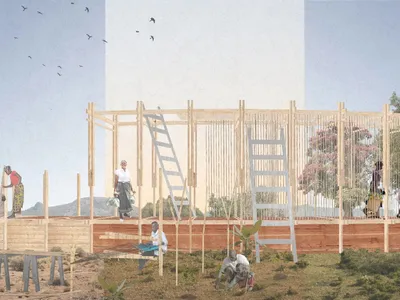
Healing Façade: A Modular Chapel System That Restores Ethiopia's Sacred Forests
Winner of the Eco-Chapel competition, this circular timber façade collects water from air to rebuild soil and reforest degraded Ethiopian landscapes.
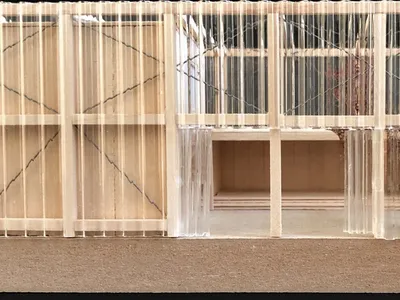
Kaffeebühnen: Where Coffee Shop Architecture Becomes a Civic Stage in Vienna
A linear sequence of timber boxes, transparent shells, and open yards turns the Viennese café tradition into a public performance space.
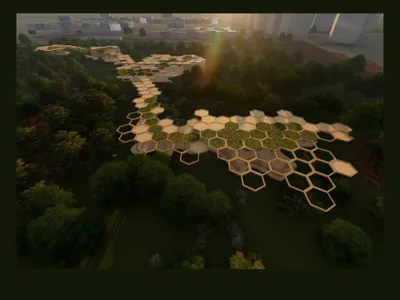
Eco Chapel: A Modular Forest Pavilion That Grows Like the Landscape It Protects
Hexagonal timber modules weave through existing trees, turning a chapel into a living system for prayer, education, and reforestation.


Urban Forest: A Vertical Ecosystem for 5,000 Workers in Singapore's Changi Business Park
Radially stacked pods and layered green decks turn a 7-acre plot into 47 acres of ecological workspace projected for 2040.

Explore Architecture Competitions
Discover active competitions in this discipline

Challenge to reimagine the Iron Throne

Photograph architecture without architects

Illustrate the lost glory of Angkor Wat - Render Challenge

Design challenge to reuse E-waste
Comments (0)
Please login or sign up to add comments
No comments yet. Be the first to comment!