

In Street: Seating Infrastructure Drawn from the Branching Logic of City Roads
Walnut wood bands at three heights turn abstracted street patterns into inclusive public furniture that doubles as urban storytelling.


What if the street itself could teach a bench how to behave? In Street takes the branching, forking geometry of urban road networks and translates it into a seating system that feels less like furniture and more like a small piece of civic infrastructure. Walnut wood bands split and converge across stainless steel supports, creating a landscape of surfaces at 16.5", 18", and 30" high, so a toddler, an elderly resident, and someone perched at a counter height can all find a place within the same structure.
The project is the work of Jingyi Wang, published on uni.xyz. It sits at the intersection of public furniture and decorative art, proposing installations that can scale from a broad plaza down to a narrow lane. Alongside the seating bands, stainless steel "information bands" carry text about city history, district identity, or local commerce, turning a rest stop into a quiet act of cultural exchange.
Street Patterns Abstracted into a Branching Plan

Seen from above, the installation reads like a transit map made physical. The plan drawing reveals how walnut bands radiate from a dense center and split outward, mimicking the way secondary streets peel away from a main artery. This is not ornamental metaphor; the branching determines where people sit, how groups cluster, and where individuals can tuck away for solitude. The varying widths of the bands also hint at hierarchy: wider sections invite shared occupation, while narrower fingers suggest a solo perch.
A Curving Assembly Held by Steel Verticals

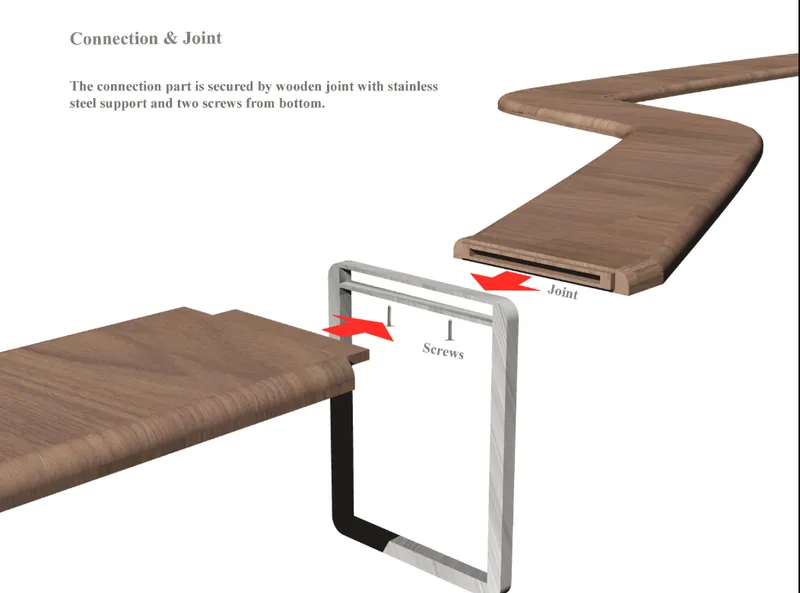
The sectional and perspective drawings expose the structural logic. Stainless steel verticals rise at irregular intervals, carrying the walnut bands at their three prescribed heights. Because the bands curve in plan, the supports must negotiate changing angles, and the detail drawing of the joint connection makes this legible: a steel bracket wraps the wood member and is secured by screws that allow slight rotational adjustment. It is a precise, repeatable connection that can accommodate the freeform geometry without bespoke fabrication for every joint.
Material choice reinforces the design's dual ambition. Walnut gives warmth and tactile grain, the kind of surface people instinctively want to touch. Stainless steel provides the corrosion resistance and load capacity needed for outdoor, high-traffic placement. Together they create a deliberate contrast: organic surface, industrial skeleton.
After Dark, Lighting Turns Furniture into Landmark

The night rendering shifts the reading of the installation entirely. Integrated lighting traces the underside of the walnut bands, casting a warm glow across the ground plane and silhouetting the people gathered around it. Red human figures emphasize the social choreography the design intends: small groups leaning on the higher bands, a child seated at the lowest level, passersby pausing because the glow signals something worth approaching. In a cultural or business district, this luminous presence converts a piece of street furniture into an after-hours anchor for public life.
Wang's proposal also accounts for constrained sites. Modular versions of the same branching system can be trimmed to fit narrow streets and pocket plazas without sacrificing the design language. Whether deployed as a large sculptural installation or a single branching segment, the formal vocabulary remains consistent, which is critical for building district identity across varied urban conditions.
Why This Project Matters
Public seating is often treated as an afterthought, selected from a catalog and bolted to the sidewalk. In Street argues for something more purposeful: furniture that carries spatial intelligence borrowed from the city itself. The three seat heights alone represent a commitment to inclusivity that most standard benches ignore. Add the information bands and integrated lighting, and the object begins to perform as a micro-institution, offering rest, knowledge, and atmosphere simultaneously.
Jingyi Wang's contribution is a reminder that the line between architecture and furniture is productive territory. When a bench starts branching like a street, it stops being an object placed in the city and becomes a small extension of it. That conceptual shift, from furniture to infrastructure, is exactly the kind of thinking public space needs more of.
View the Full Project
About the Designers
Designer: Jingyi Wang
Enter a Design Competition on uni.xyz
uni.xyz runs architecture and design competitions year-round that reward proposals with spatial conviction and real site intelligence.
Project credits: In Street by Jingyi Wang.


Popular Articles
Popular articles from the community


Cube Design Draws an Ecological Corridor Between Two Shenzhen Hills with the Nankai Building
Beside Shenzhen's container docks, the Nankai Building pairs stacked balconies with a climbing green screen to connect two hillsides across its height.

David Ortega Stacks a Two-Story Mexico City Penthouse Around a Steel Stair and a Pergola-Shaded Roof Terrace
In Colonia Roma, a 300 m² penthouse uses oak joinery, a planted steel stair and a slatted roof pergola to make a new-build apartment feel like a house.


Opera on the Sea: Driftwood Logic Shapes a Timber Opera House on Estonia's Coast
Trevor Orgill's opera house translates the entangled drift of floating timber into a civic building where wood, water, and music converge.

The Amber Palace Opera: A Geological Fiction Surfaces on Tallinn's Baltic Waterfront
Pierre Brillard reimagines a Baltic legend as a public landscape, opera house, and waterfront promenade rooted in Tallinn's coastal identity.

Similar Reads
You might also enjoy these articles

Aquadapt: An Underwater Habitat That Rewrites Its Rooms by the Hour
Curved modules ring the seabed while one shell shifts from breakfast room to cinema, farm and football pitch as residents' needs change.

Play: Fragments of Their World: Remembered Architecture Rebuilt as a Modular Playground for Refugee Camps
Tom Gardner abstracts domes, arches and towers from the homelands of displaced families into a kit of child-scaled play parts for camp settlements.
REBIRTH: A Circular Settlement Where Afghan Widows and Their Children Rebuild Life Together
A shortlisted Resile entry turns the circle into a protective ring of timber and brick, gathering homes, classrooms and gardens around a shared landscape.
The Main Dream: A Recycled Plastic Kit That Lets Refugee Children Build Their Own Playground
Thirty-centimetre interlocking cubes that connect on three axes turn play into construction, letting children author the spaces they occupy.

Explore Urban Furniture Competitions
Discover active competitions in this discipline

Design challenge to equip cities with modern furniture

Competition to design a workstation for architects

Packaging challenge - Design meets sustainability
Comments (0)
Please login or sign up to add comments
No comments yet. Be the first to comment!