
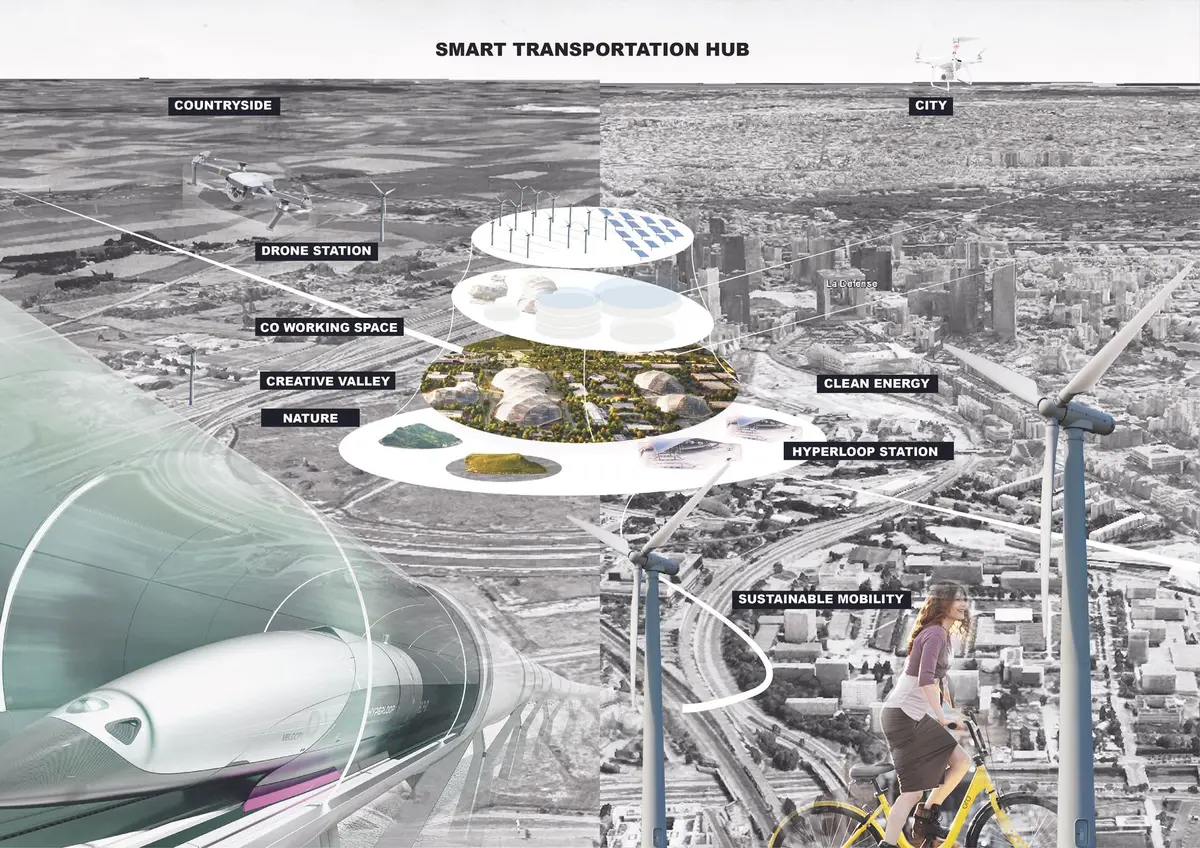
Indi Genius: Amplifying Mumbai's Indigenous Urban Systems Instead of Replacing Them
A hyperlocal urban design framework that hybridizes Mumbai's local trains and auto-rickshaws into a seamless, context-driven mobility network.


While the global discourse around urban futures fixates on Hyperloops and smart cities, one project asks a more grounded question: what if the most innovative transport system a city could build already exists in embryonic form on its streets? Indi Genius takes Mumbai's two most ubiquitous modes of movement, the local train and the auto-rickshaw, and hybridizes them into a single integrated network. The result is not a futuristic fantasy but a deeply contextual urban framework that treats the city's existing social fabric, spatial rhythms, and commuter habits as design assets rather than problems to be solved.
Designed by Cyril Clgm, Aditya Vipparti, and Aarti Chanodia, the project operates across three scales, from regional corridor planning down to the texture of a sidewalk, with the Andheri neighborhood serving as its primary testing ground. The team's 2030 vision for Mumbai prioritizes walkable mixed-use neighborhoods, green corridors, and public spaces designed for interaction over isolation, all woven together by a transport network that connects long-distance commuters with seamless last-mile solutions.
Two Systems, One Network: Hybridizing the Train and the Rickshaw
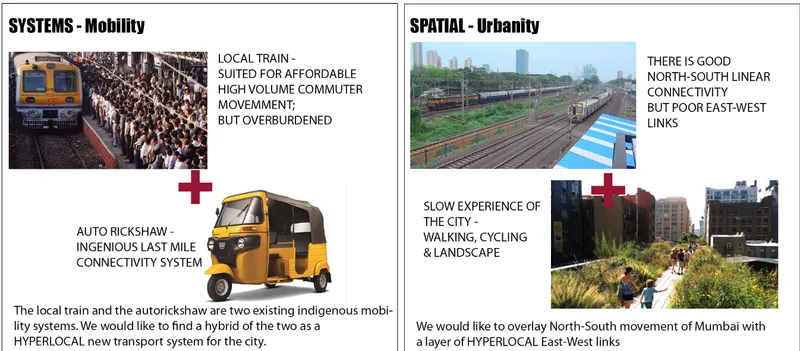
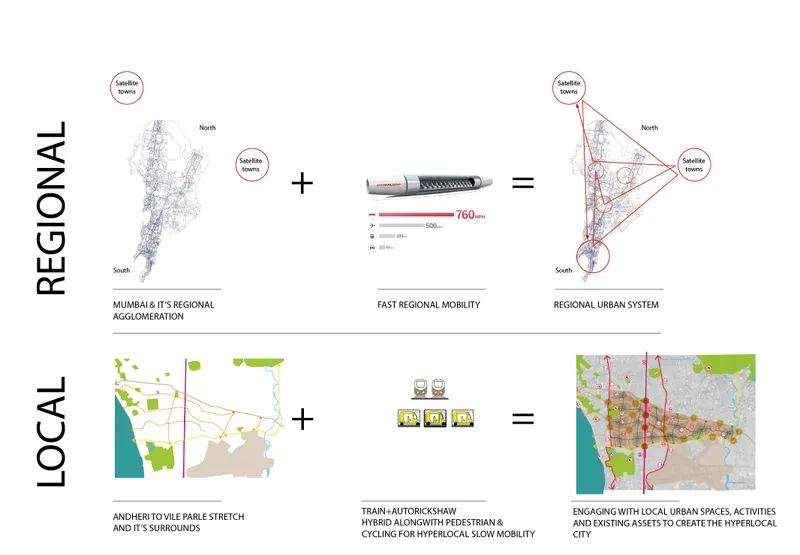
The opening diagrams lay out the project's foundational logic with striking clarity. Mumbai's local train carries millions daily along a strong north-south spine, while the auto-rickshaw fills the gaps, threading through narrow lanes to deliver commuters the final kilometers to their doors. Indi Genius recognizes these two systems not as competitors but as complementary halves of an incomplete whole. The planning diagram maps how regional rail networks can be overlaid with hybrid pedestrian and cycling systems, turning the seams between train corridors into connective tissue rather than dead zones.
The critical move here is the introduction of east-west links. Mumbai's infrastructure historically reinforces its linear north-south geography, leaving neighborhoods on either side of the rail corridor functionally disconnected. By proposing new pedestrian and cycling routes that cut perpendicular to the train lines, the team addresses a structural inequity that decades of conventional planning have failed to resolve.
A Multi-Level Transit Corridor That Layers Movement with Landscape
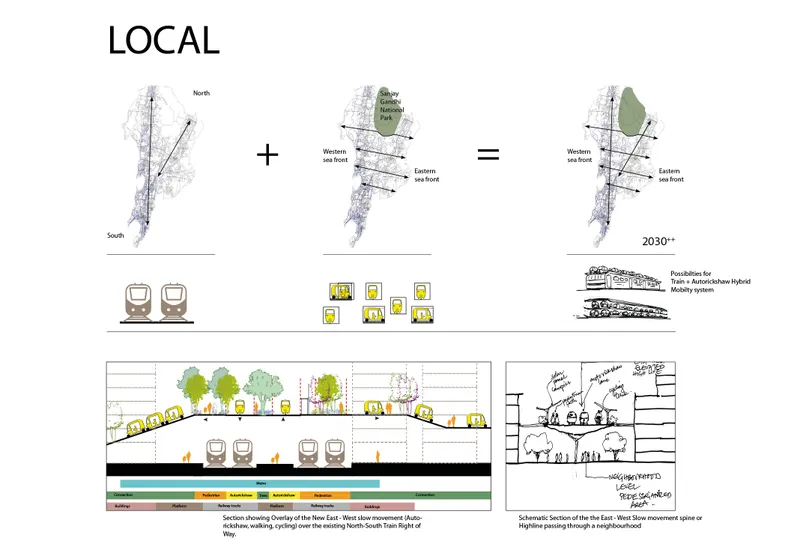
The section drawing through the proposed transit corridor is the project's most spatially ambitious moment. Train tracks, auto-rickshaw routes, tree canopy, and pedestrian paths are stacked and interwoven into a single cross-section that reads less like infrastructure and more like inhabited landscape. Trees are not decorative afterthoughts; they structure the spatial hierarchy, separating fast vehicular movement from slower pedestrian zones while contributing to the green corridor strategy that underpins the project's environmental ambitions.
What distinguishes this section from typical transit-oriented development diagrams is its refusal to privilege one mode of movement over another. The auto-rickshaw, often treated as informal or expendable in modernization schemes, occupies a defined, designed lane alongside the formal rail system. Pedestrians are not pushed to residual strips at the edges but given their own generous level. The layering creates a dense, efficient corridor that maintains human scale precisely because it takes its cues from how Mumbai already moves.
Andheri as Prototype: Overlaying a Network onto Existing Urban Fabric
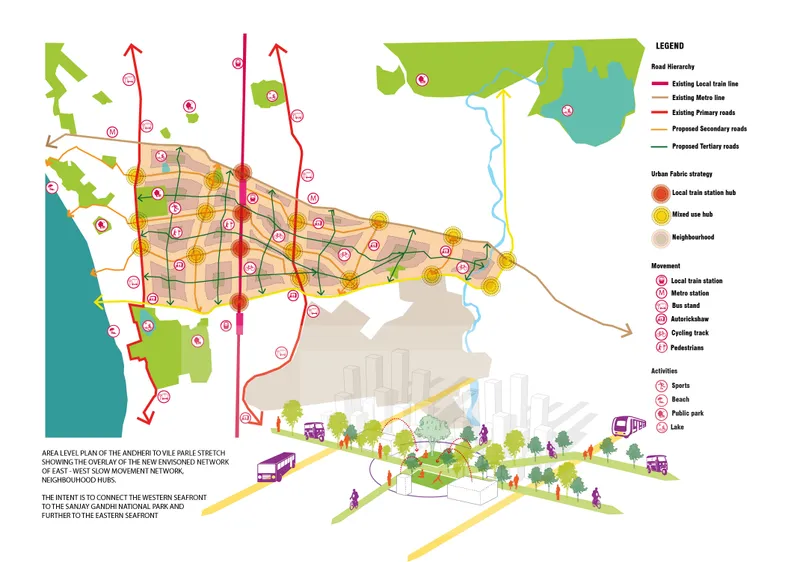
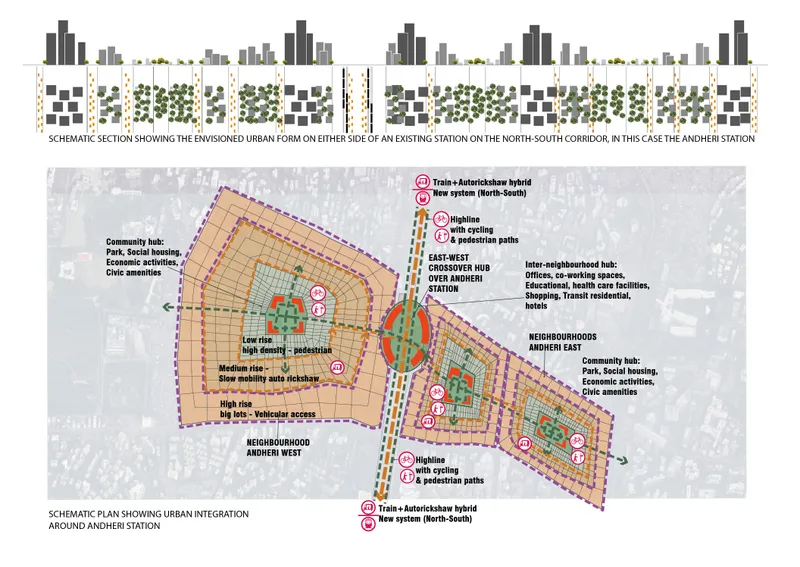
The area plan for Andheri reveals how the proposed transit network sits within the existing urban grain. Stations, routes, and neighborhood hubs are marked throughout, but the plan's strength lies in what it does not erase. The existing fabric remains legible beneath the new overlay: the irregular lot patterns, the dense residential blocks, the commercial strips. The hybrid mobility corridors, combining rickshaw paths with pedestrian and cycling routes, follow desire lines rather than imposing a grid. Community hubs bring together parks, co-working spaces, social housing, and economic activities at nodes where the new network intersects with established neighborhood life.
The schematic plan and section drawings of the integrated transit station show how these ideas resolve at the scale of a single interchange. Surrounding neighborhoods, parks, and pedestrian paths radiate outward from the station, organized into what the team calls layered density zones: low-rise pedestrian districts closest to parks and public space, medium-rise mobility zones along the hybrid corridors, and high-rise vehicular cores where the infrastructure can absorb greater intensity. This gradient allows Andheri to grow organically while maintaining the accessibility and identity that make it a functioning neighborhood rather than a generic transit node.
Why This Project Matters
Indi Genius is a rebuke to the assumption that urban progress requires demolition and replacement. By studying what Mumbai already does well, specifically the local train's massive throughput and the auto-rickshaw's granular reach, the team constructs a framework where innovation means amplification, not erasure. The project's multi-scalar approach, working simultaneously at regional, local, and human dimensions, prevents it from becoming either an abstract policy diagram or a pretty rendering with no systemic ambition.
For cities across the Global South facing similar pressures of congestion, pollution, and social disparity, the hyperlocal methodology outlined here offers a transferable principle: the most resilient urban systems are those that build on indigenous knowledge and existing patterns of use. Mumbai's genius is not something waiting to be imported from a technology lab. It is already riding in every crowded train compartment and weaving through every auto-rickshaw lane. The design challenge, as this project makes clear, is simply to give it room to grow.
View the Full Project
About the Designers
Designers: Cyril Clgm, Aditya Vipparti, Aarti Chanodia
Enter a Design Competition on uni.xyz
uni.xyz runs architecture and design competitions year-round that reward proposals with spatial conviction and real site intelligence.
Project credits: Indi Genius by Cyril Clgm, Aditya Vipparti, Aarti Chanodia.


Popular Articles
Popular articles from the community


David Ortega Stacks a Two-Story Mexico City Penthouse Around a Steel Stair and a Pergola-Shaded Roof Terrace
In Colonia Roma, a 300 m² penthouse uses oak joinery, a planted steel stair and a slatted roof pergola to make a new-build apartment feel like a house.

David Macias Steps a Doorless Stone and Plaster House Down a Tropical Colombian Hillside
In the humid hills of Colombia, Threshold House replaces the front door with an open void and terraces its 850 m² down the slope instead of fighting it.

GROUP A Strips a 1969 Rotterdam Harbor Headquarters to Its Frame and Wraps It in Timber Louvers
In Rotterdam's M4H harbor district, Ferro Offices reuses a 1969 frame, adds one timber storey and reaches BREEAM-NL Outstanding.

LT2A and OPEN Architectes Thread a Brick and Glass High School Through a Wooded Belgian Campus
In Braine-l'Alleud, a 3,000 m² wing for Collège Cardinal Mercier pairs pale brick with a glazed colonnade, deferring to a small chapel and a dense wood.

Similar Reads
You might also enjoy these articles


Aquadapt: An Underwater Habitat That Rewrites Its Rooms by the Hour
Curved modules ring the seabed while one shell shifts from breakfast room to cinema, farm and football pitch as residents' needs change.

Play: Fragments of Their World: Remembered Architecture Rebuilt as a Modular Playground for Refugee Camps
Tom Gardner abstracts domes, arches and towers from the homelands of displaced families into a kit of child-scaled play parts for camp settlements.
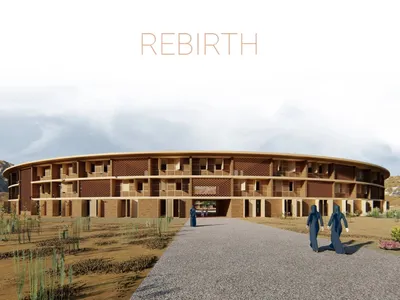
REBIRTH: A Circular Settlement Where Afghan Widows and Their Children Rebuild Life Together
A shortlisted Resile entry turns the circle into a protective ring of timber and brick, gathering homes, classrooms and gardens around a shared landscape.
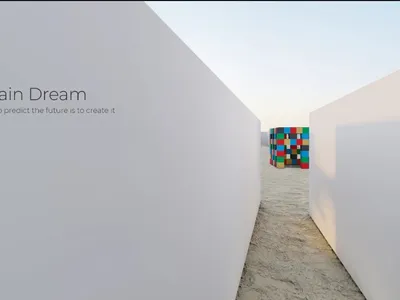
The Main Dream: A Recycled Plastic Kit That Lets Refugee Children Build Their Own Playground
Thirty-centimetre interlocking cubes that connect on three axes turn play into construction, letting children author the spaces they occupy.

Comments (0)
Please login or sign up to add comments
No comments yet. Be the first to comment!