
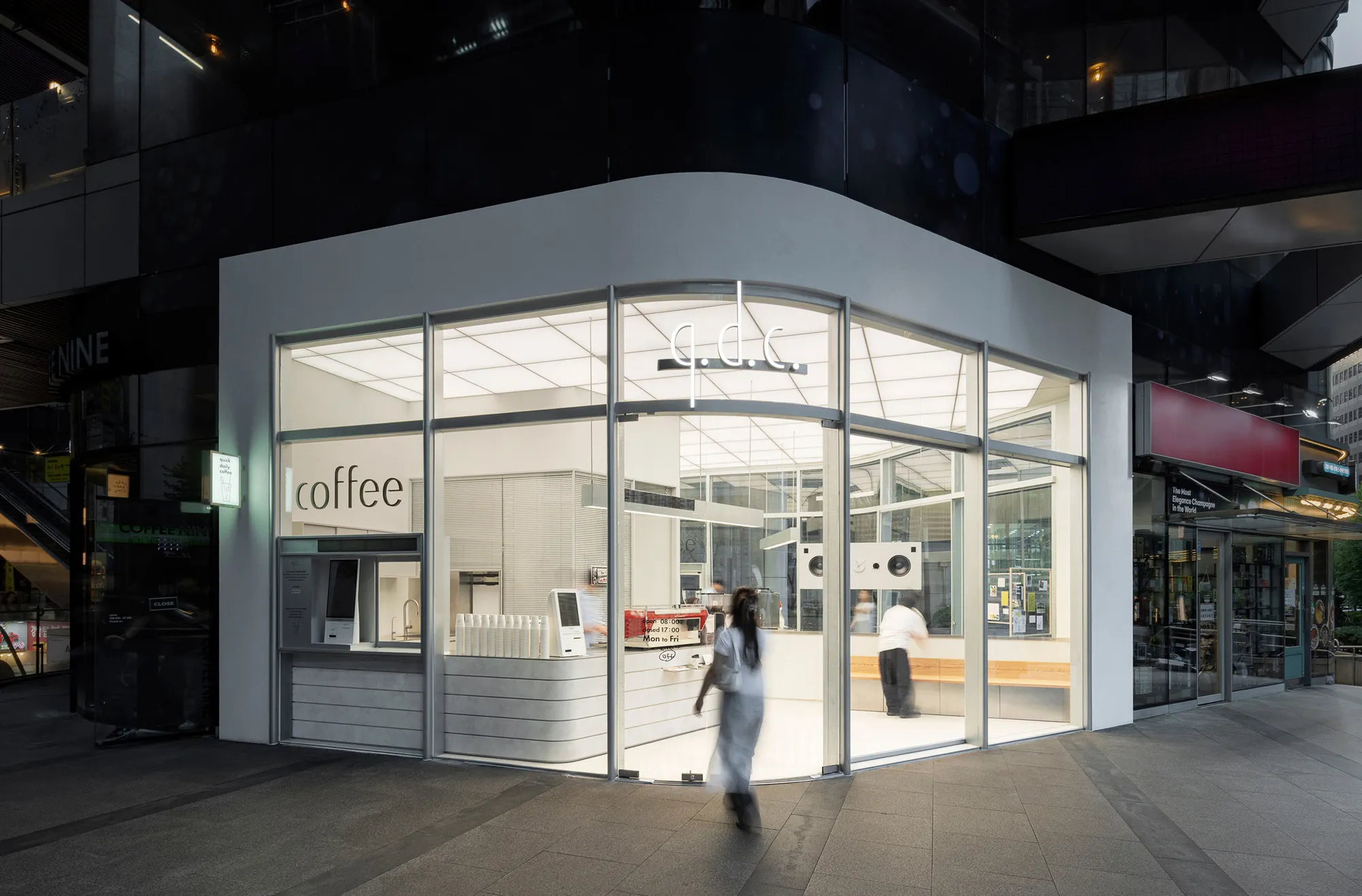
Indiesalon Fits a 31-Square-Metre Office Ritual into a Gangnam Corner Café
A glass pavilion in Seoul's Seocho-dong reinterprets the daily coffee run as a workplace ceremony in red oak and stainless steel.


In the dense office blocks of Gangnam's Seocho-dong district, coffee is less a leisure act than a clock pulse. Indiesalon, the Seoul practice led by Seokjoon Jang, designed Gangnam q.d.c around that reality. The name itself borrows from medical Latin: "q.d." means "once a day," here recast as Quick Daily Coffee. At just 31 square metres, the café is not trying to be a third place. It is a second office, a pressurized capsule of clarity slotted into a corner site beneath a raised plaza, where every surface and detail echoes the rhythms of white-collar routine.
What makes the project worth studying is the discipline of its conceit. Indiesalon didn't simply miniaturize a café. They built an interior language that speaks fluent workplace: storage drawers that look like filing cabinets, handles shaped like paper clips, a floating clock that doubles as a speaker. The aluminium curtain wall drops to ground level, turning the entire footprint into a lit vitrine against the evening foot traffic. It is a project where constraint produces wit rather than compromise.
A Glass Pavilion Under a Concrete Canopy
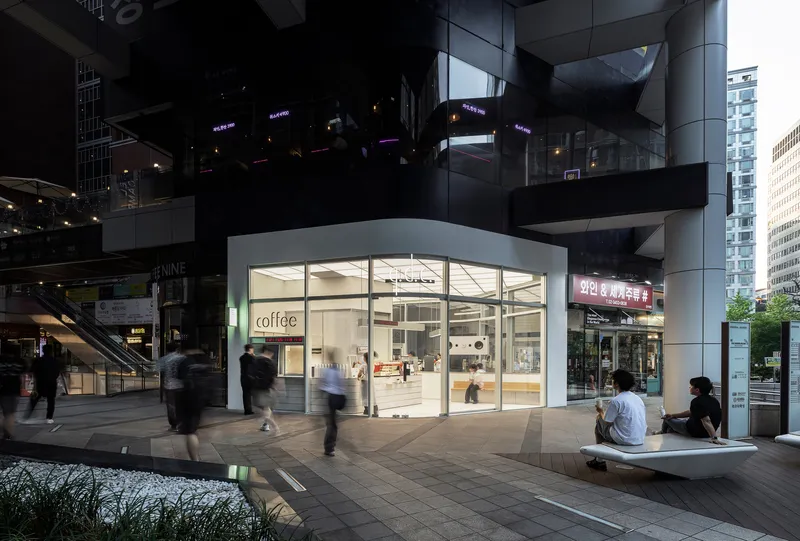
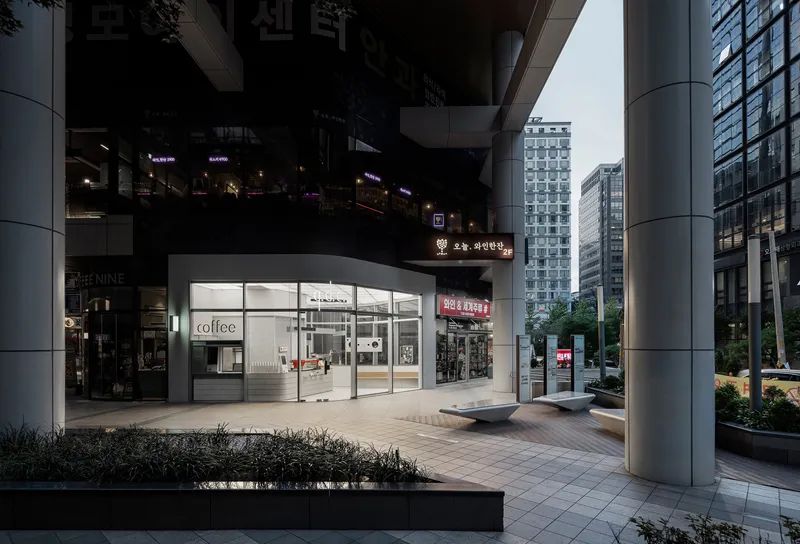
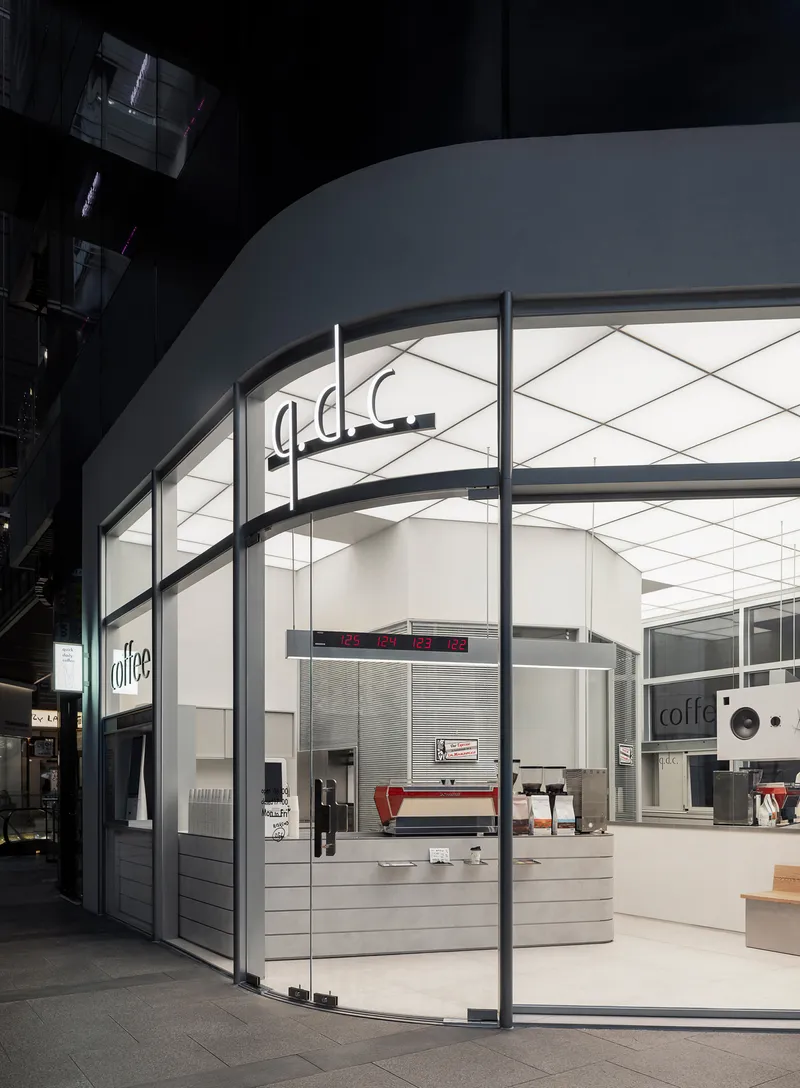
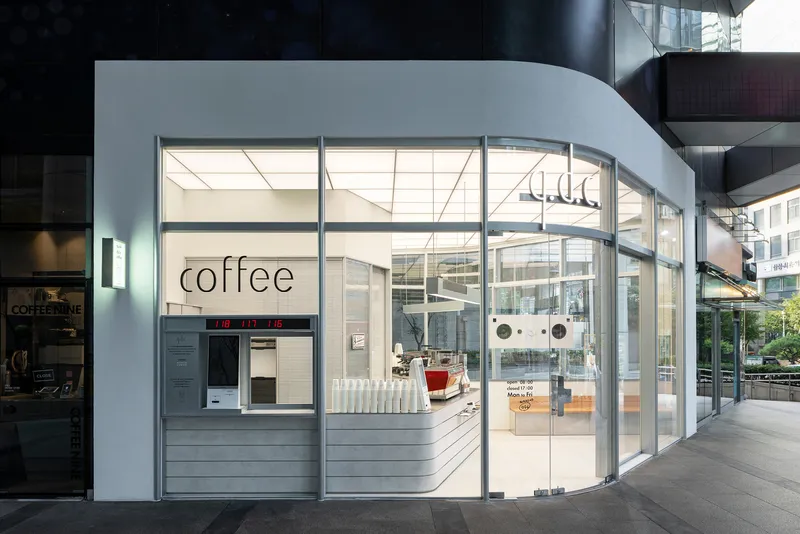
The café occupies a corner beneath a heavy raised plaza structure, and the contrast is the whole story. Cylindrical columns frame a curved glass pavilion that reads more as a display case than a building. Indiesalon extended the aluminium curtain wall to the ground, eliminating any solid base and allowing the illuminated interior to project outward at dusk. Pedestrians move past what is essentially a lantern, catching glimpses of the counter, the ceiling grid, and the red accent of the espresso machine.
The curved storefront is not a generic radius. Each aluminium frame was customized with rounded edges rather than the standard rectangular profile, softening the industrial material just enough to register as intentional warmth without tipping into decorative territory. Glass sliding doors can open the entire front elevation to the street, collapsing the boundary between café and sidewalk and letting the outdoor seating function as a genuine extension of the interior.
Ceiling as Protagonist
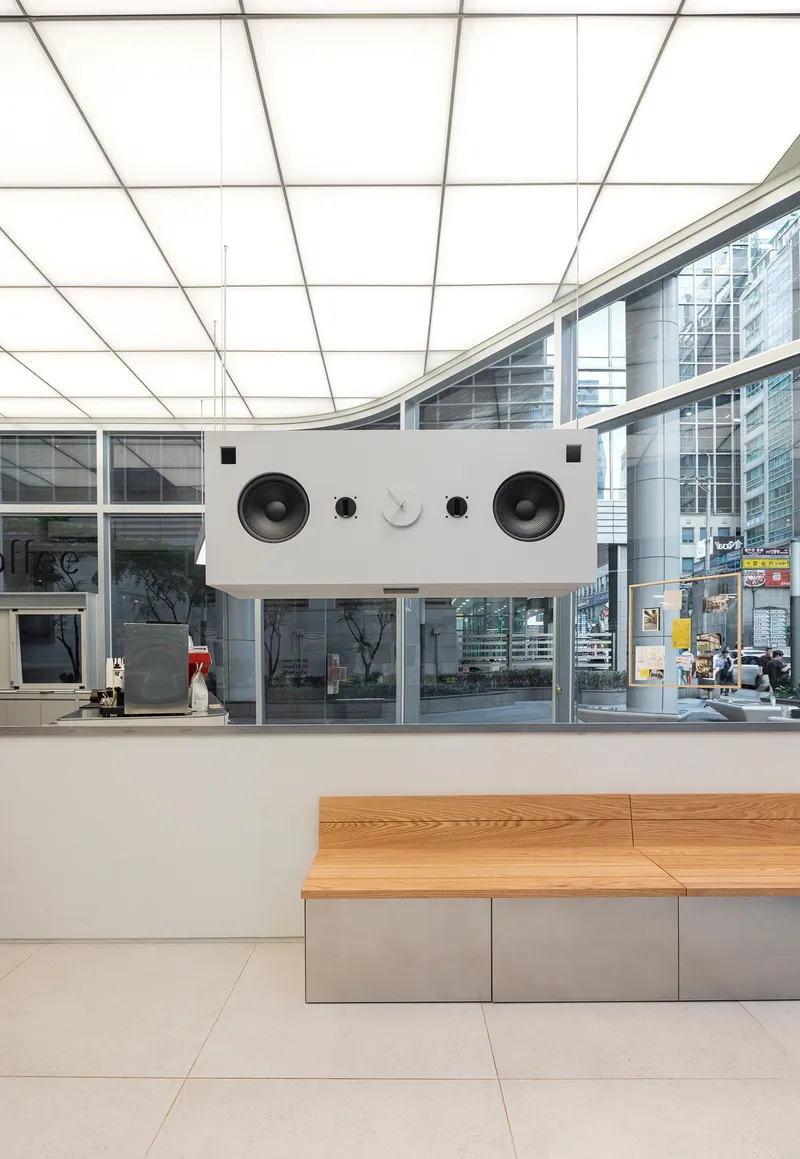
In a room this small, the ceiling does the heavy lifting. Indiesalon installed a Barrisol membrane behind a geometric grid of LED panels, creating a luminous surface that pushes the perceived height of the space far beyond what the section suggests. The grid pattern is precise and even, referencing the fluorescent tube grids of a conventional office ceiling but replacing their deadening uniformity with a warm, diffused glow. The effect is both familiar and subtly uncanny, which is exactly the register the entire project occupies.
Mirrored surfaces along the walls amplify the ceiling's light, bouncing it laterally so the 31-square-metre room feels open rather than compressed. It is a classic small-space trick, but the execution here avoids the cheap funhouse feeling mirrors often produce because the reflections are controlled by the horizontal banding of the counter and wall panels.
Counter and Service Wall
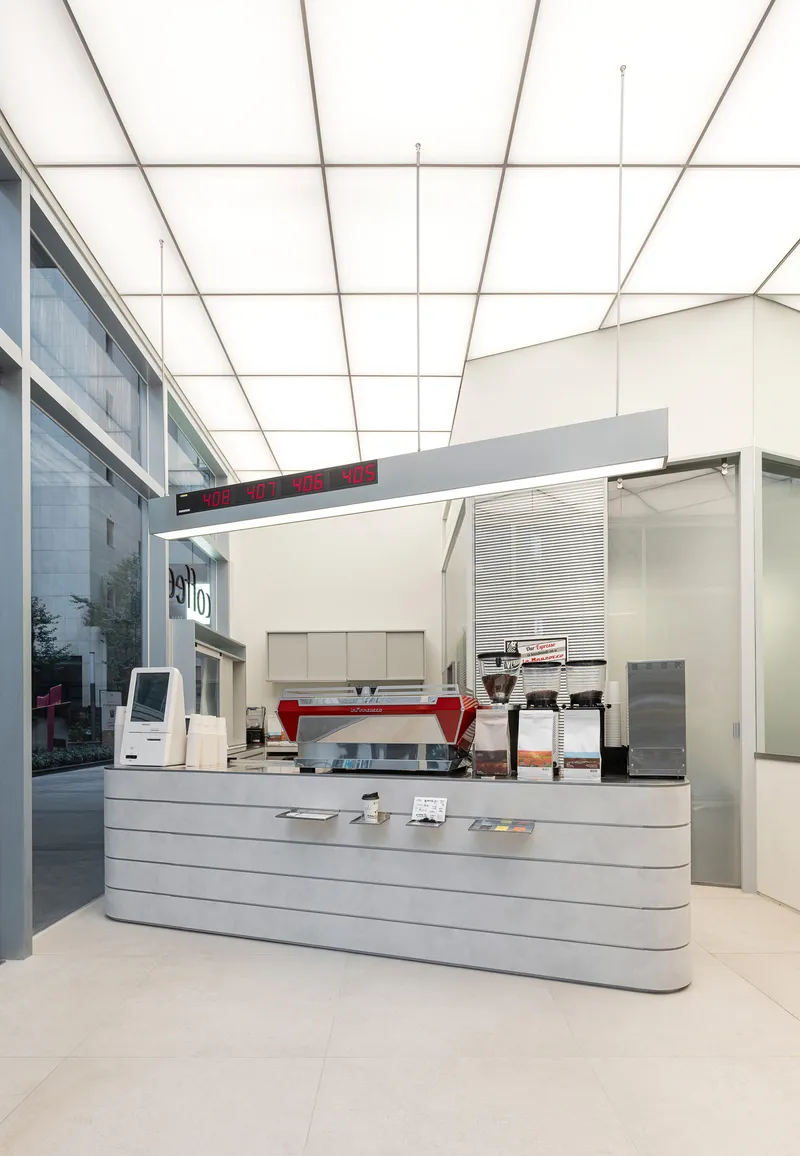
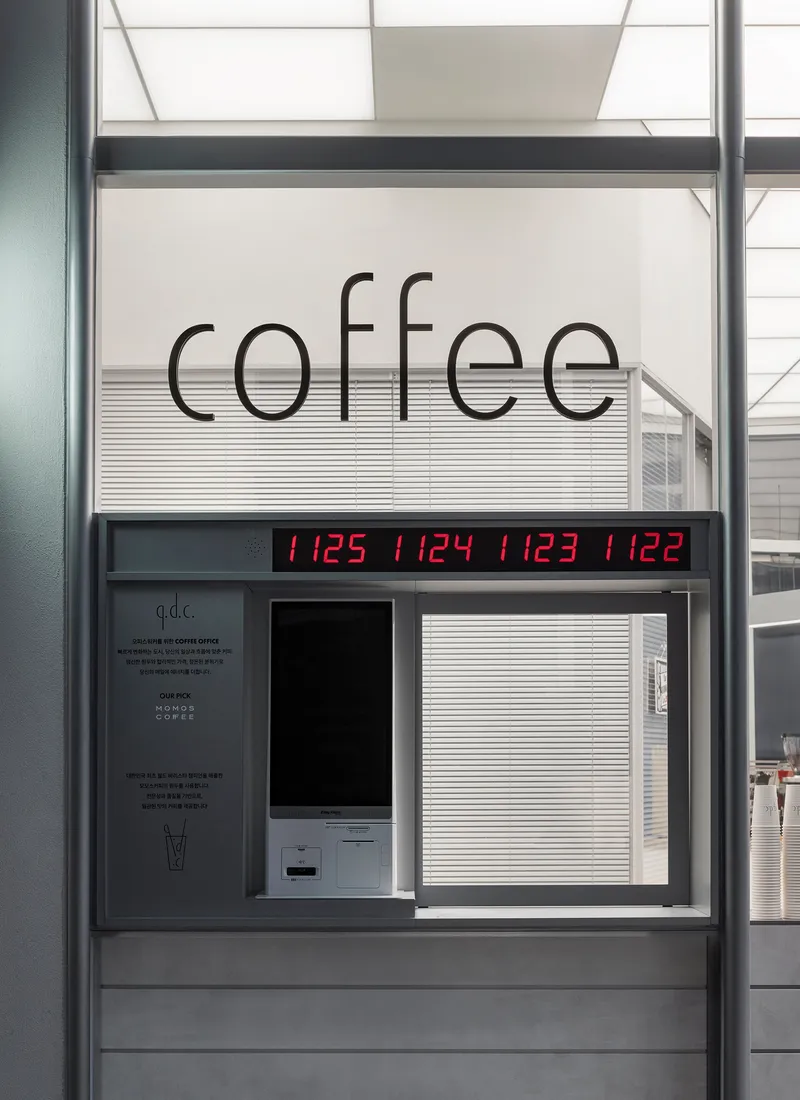
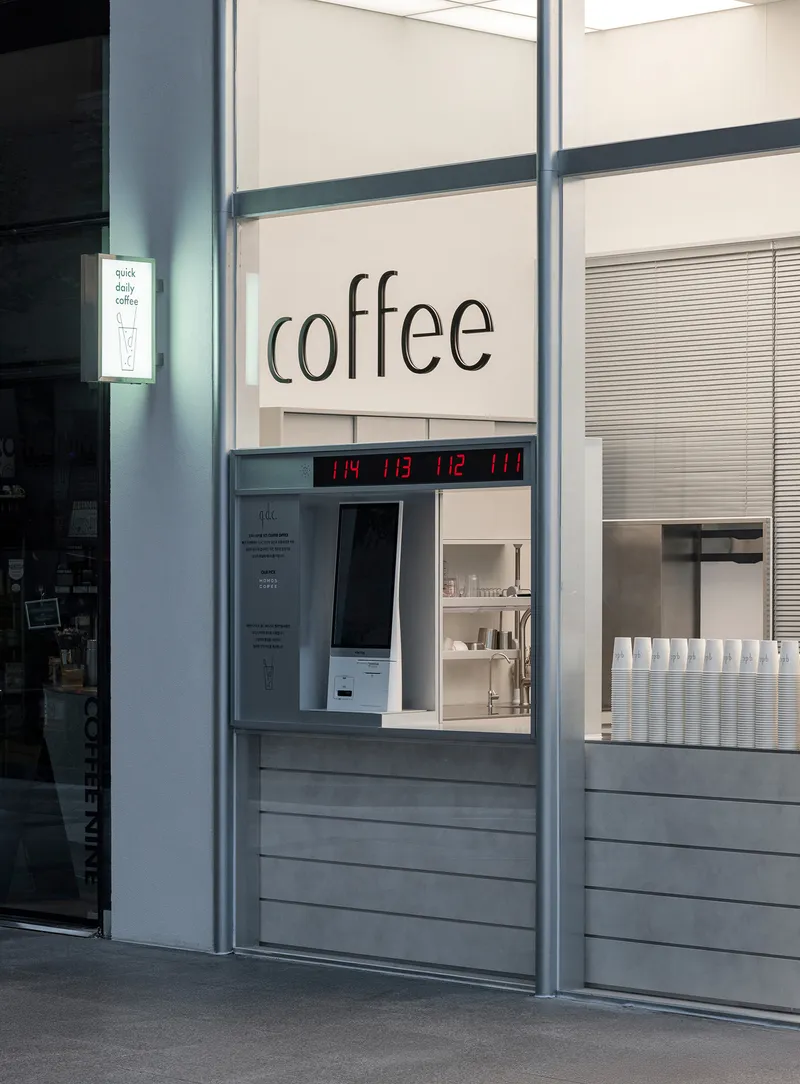
The service counter runs along the depth of the space, constructed in red oak with a horizontal ribbed profile that gives it a tactile grain against the stainless steel and glass surrounding it. Behind the counter, system racks are integrated directly into the joinery, so the espresso machine, grinders, and ordering kiosk sit flush within a single continuous assembly. Nothing is freestanding. In a room where every centimetre is accountable, loose equipment would read as clutter.
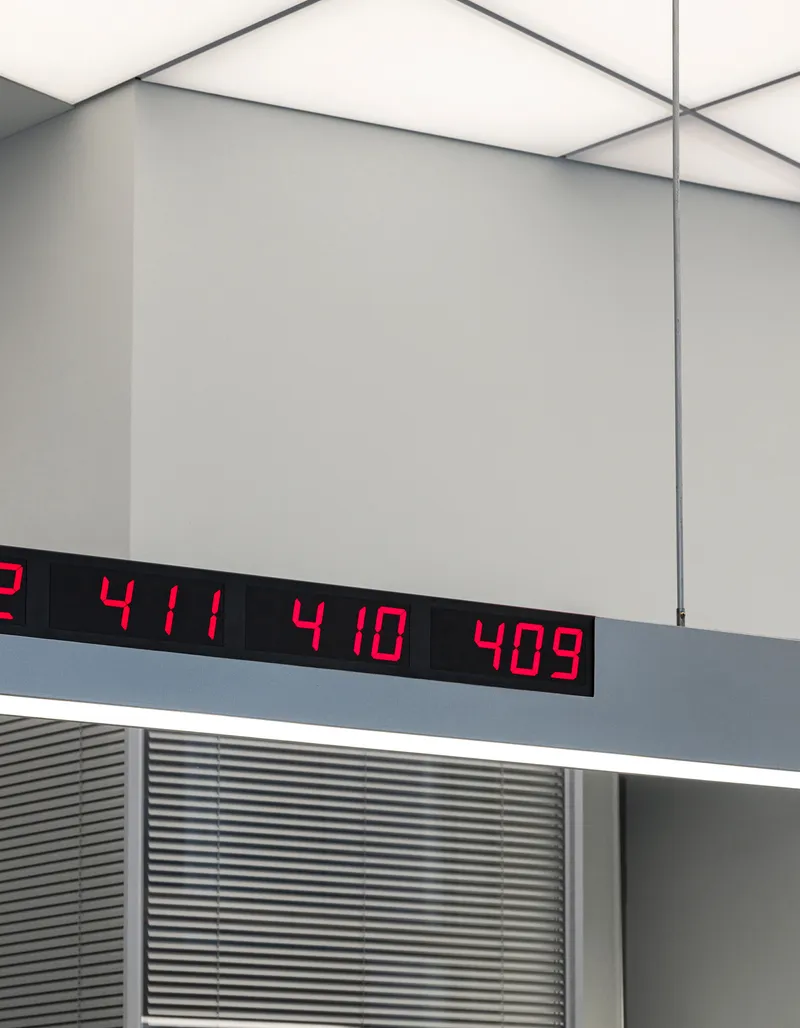
The service window on the exterior wall pairs a digital clock display with an automated ordering screen, and an LED queue system tells waiting customers their place in line. It is a detail borrowed from hospital or government service counters, repurposed here with enough design polish to feel intentional. The red digital numerals against the gray soffit are a small piece of graphic bravery in an otherwise restrained palette.
Workplace Details, Rewritten
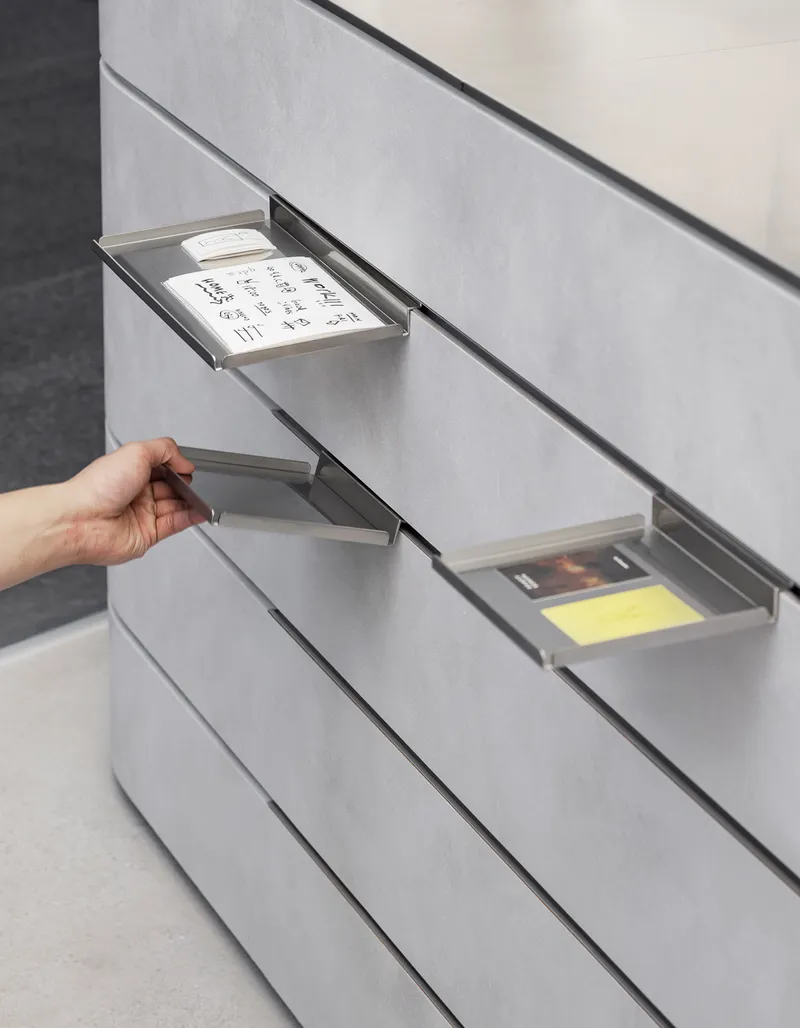
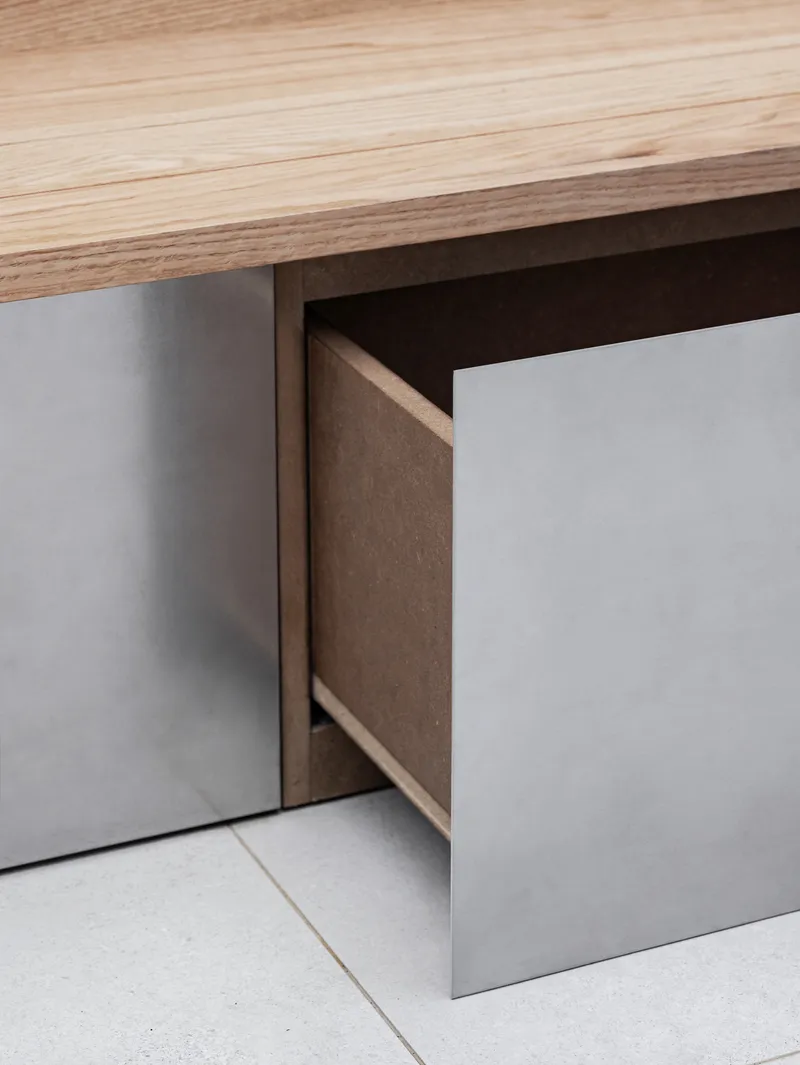
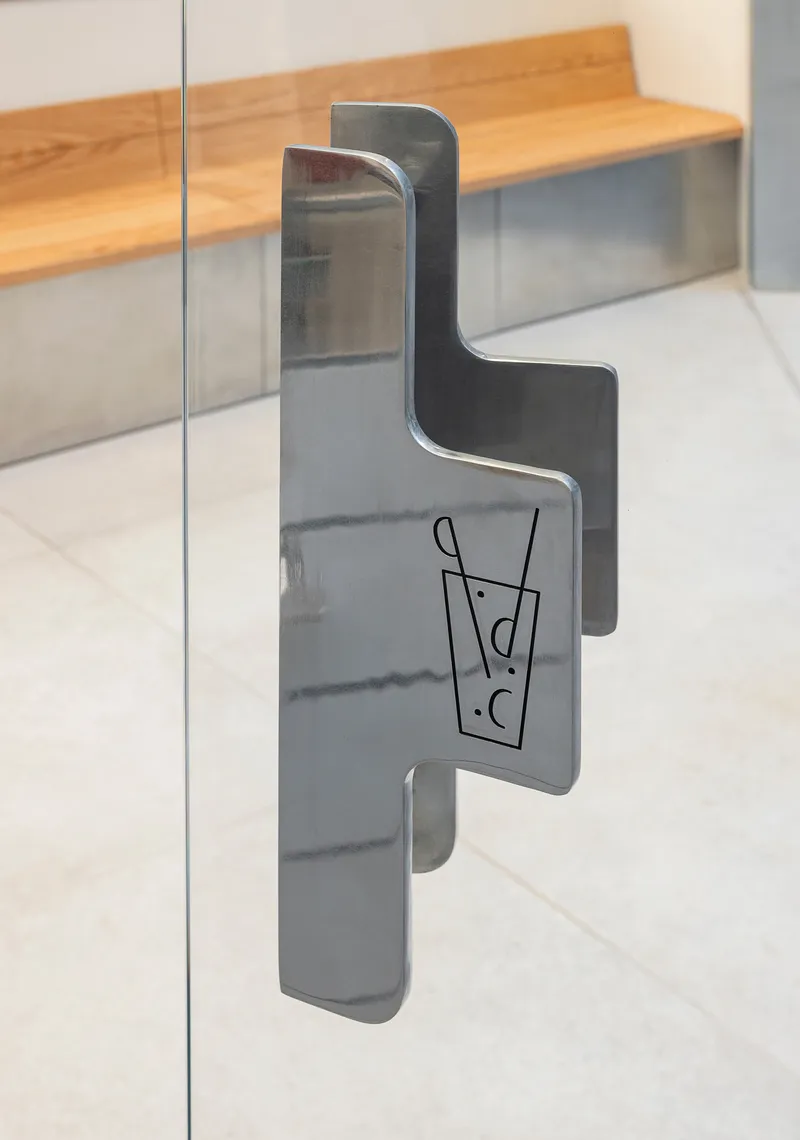
The most inventive aspect of q.d.c lives in its hardware and joinery details. Storage units along the walls are proportioned and finished to resemble the cabinetry of a meeting room, with recessed drawers that pull out to reveal paper inserts, like filing trays reimagined for sugar packets and napkins. Door pulls are etched with beverage icons and shaped to recall paper clips, a small visual joke that doesn't overstay its welcome. These are not gratuitous references. They build a consistent world in which the café genuinely inhabits the mental space of the offices around it.
The gray laminate base cabinets beneath the red oak countertop could pass for any corporate kitchenette, and that is the point. Indiesalon is not mocking office culture; they are acknowledging it and then subtly elevating it through material warmth and precision detailing. The result is a space that feels like an inside joke shared between the café and every worker who steps in before a 9 a.m. meeting.
Transparency and Threshold
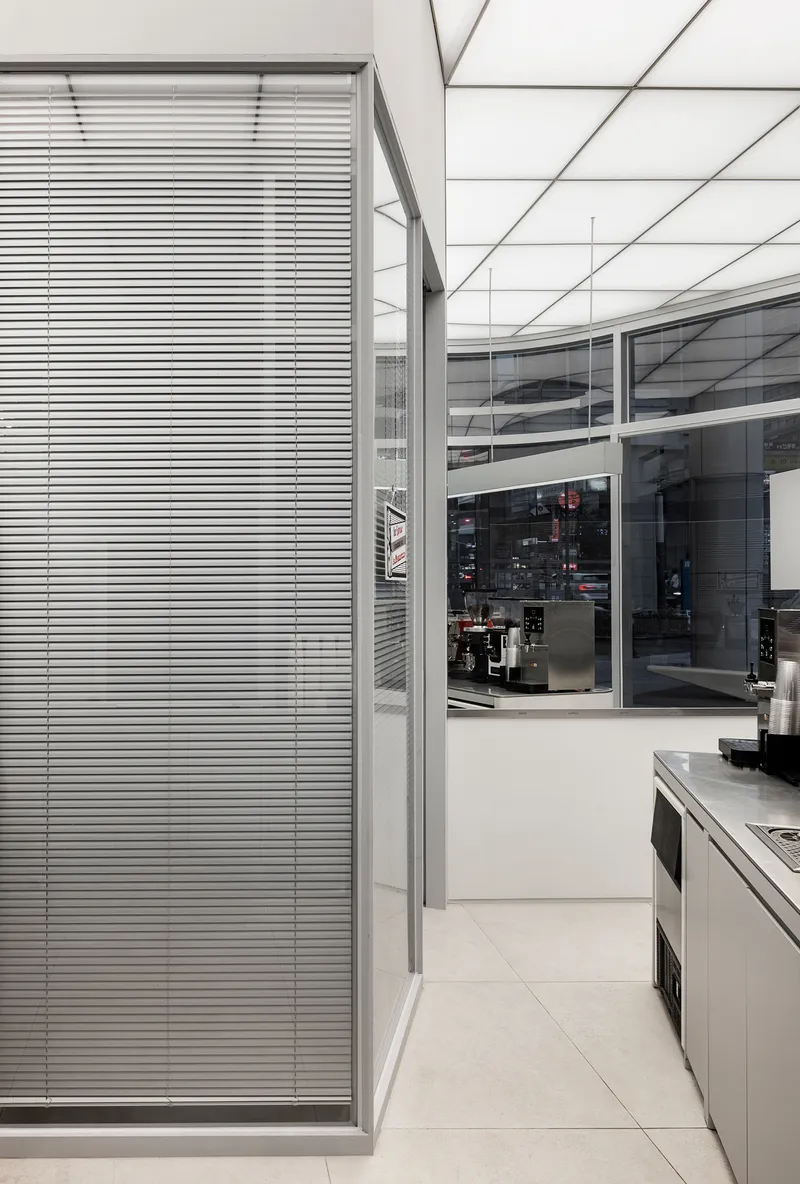
Horizontal metal blinds along the interior glass walls create a layered sense of depth that the tiny floor plate would otherwise deny. Looking through them toward the street, you get the sensation of peering through a Venetian blind in a corner office, which is surely deliberate. The blinds also manage daylight when the sliding doors are closed, filtering southern exposure without requiring curtains or tinted glass.
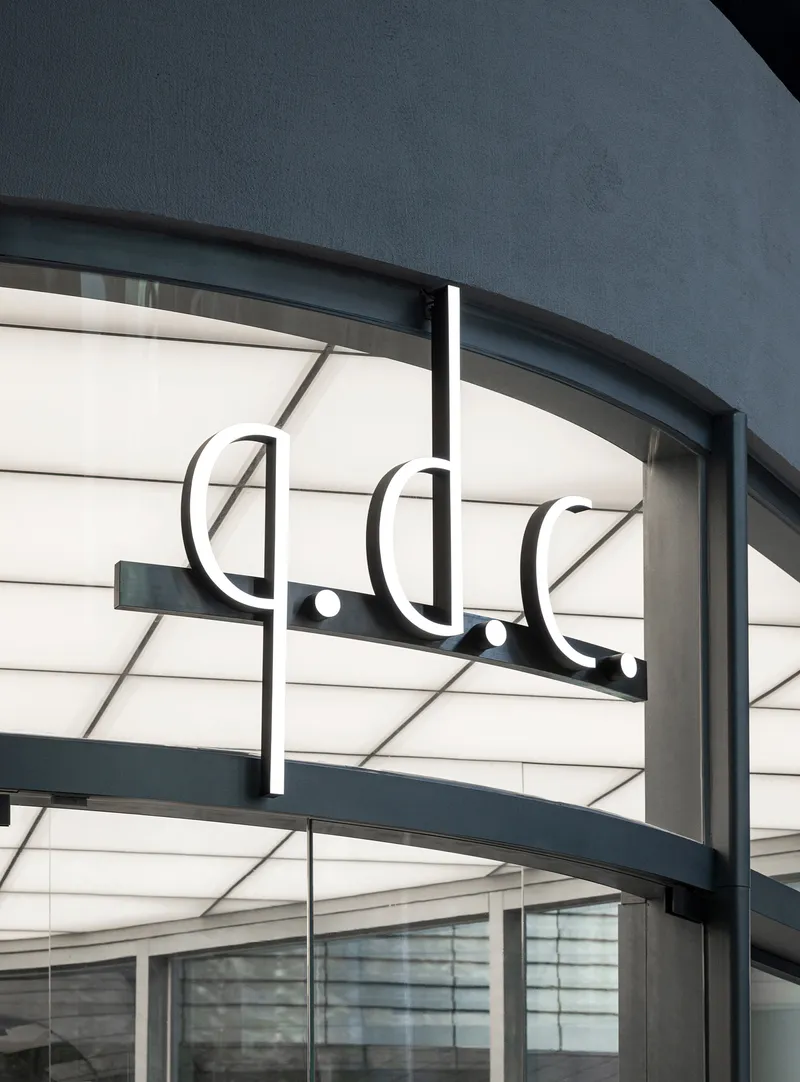
At the storefront canopy, horizontal banding details and backlit signage wrap the curve with a typographic precision that signals the brand without screaming it. The signage panel on the adjacent wall is mounted against a textured gray surface that provides enough contrast to read cleanly at pedestrian speed. It is modest, legible branding that respects the urban context rather than competing with it.
Night Presence
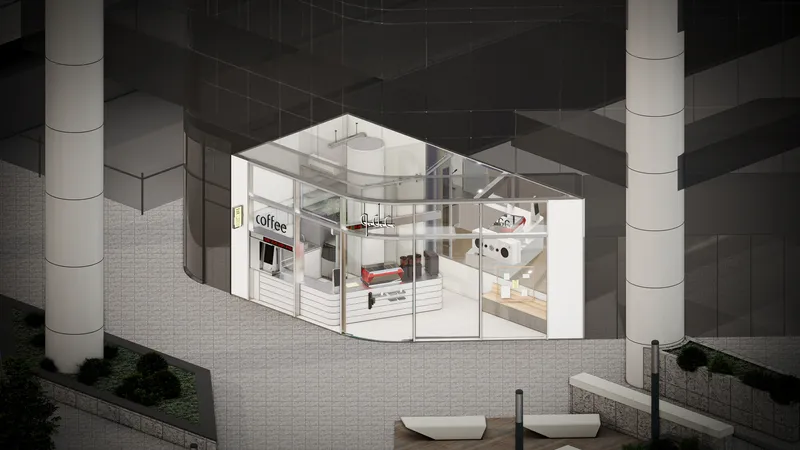
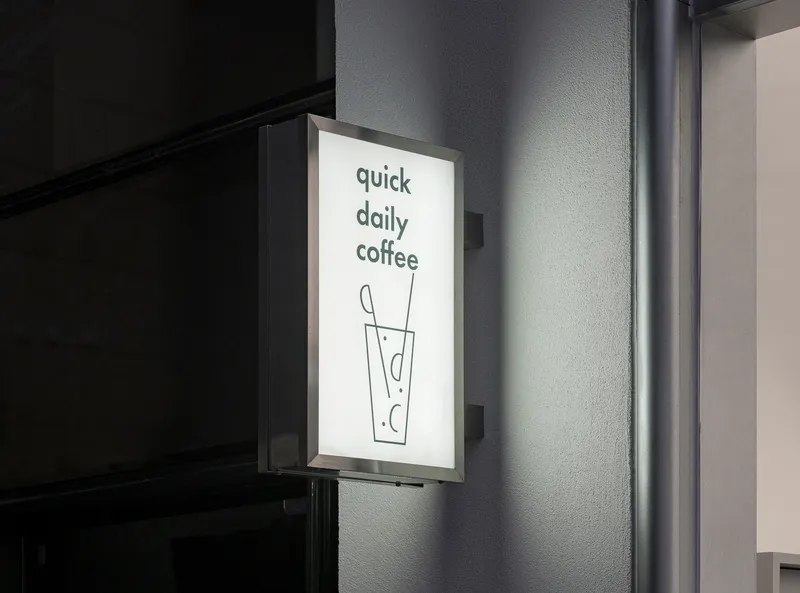
From above, the aerial view reveals just how exposed the interior is. The glass walls turn the entire plan into an open diagram: counter, brew area, seating zones are all legible from a single glance. At night the café becomes a piece of urban lighting, its Barrisol ceiling and mirrored walls projecting a warm glow into a streetscape otherwise defined by concrete soffits and utilitarian signage. The backlit wall-mounted signage panel on the exterior anchors the brand identity at a distance, drawing the eye before the coffee smell can.
Plans and Drawings
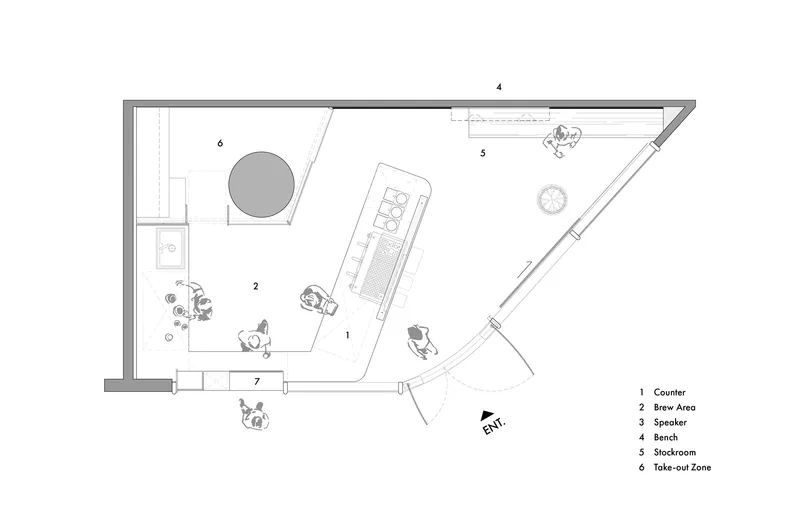
The floor plan confirms what the photographs suggest: the angled perimeter walls are not a design affectation but a direct response to the corner site geometry. The counter wraps the longest available wall, the brew station sits at the crux of the angle, and seating is pushed to the glazed perimeter where it serves double duty as an outdoor waiting area when the doors slide open. At 31 square metres, every zone is within arm's reach of every other zone, and the plan makes that proximity feel organized rather than cramped.
Why This Project Matters
Micro-commercial projects rarely get the attention they deserve because the discipline required to design them well is easy to overlook. Gangnam q.d.c is a case study in how a coherent concept, carried through from naming to hardware detailing, can make 31 square metres feel like a complete architectural statement. Indiesalon treated this café not as a fitout but as a building, giving its aluminium frames custom profiles and its storage drawers the logic of furniture rather than cabinetry.
More broadly, the project asks a useful question about the relationship between work and rest in Asian megacities. Instead of selling escape, q.d.c sells continuity: a space that mirrors the office world just enough to keep you in rhythm while offering better light, better materials, and better coffee. That is a proposition grounded in real observation of how people actually use cafés in Gangnam's commercial core, and it is more honest, and more architecturally productive, than another plywood-and-pothos retreat fantasy.
Gangnam q.d.c, designed by Indiesalon (lead architect: Seokjoon Jang), Seocho-dong, Seoul, South Korea. 31 m². Completed 2025.
About the Studio
Share Your Own Work on uni.xyz
If projects like this are the kind of work you want to make, uni.xyz is a place to publish your own, find collaborators, and enter design competitions.




Popular Articles
Popular articles from the community


Lunar Spiral: Space Architecture Shaped by the Mathematics of the Universe
Lunar Spiral reimagines space architecture through Fibonacci geometry, lunar regolith, levitating habitats, and self-sustaining Moon living.

Hill & Cross Opera: Sculptural Opera House Architecture Shaped by Tallinn’s Landscape and Identity
Hill & Cross Opera reimagines opera house architecture in Tallinn through its sculptural hill, civic plaza, glass wave and a luminous cross.

The Musturak Paradise: Senior Living Architecture for a Connected Future in Temara, Morocco
The Musturak Paradise reimagines senior living architecture in Temara via private homes, social spaces, culture, community, and shared care.

Riyadh For All: Intergenerational Urban Design for Active Aging in Rabat
Riyadh For All reimagines urban design in Rabat with intergenerational co-living, adaptive courtyards, and Moroccan cultural exchange today.


Similar Reads
You might also enjoy these articles

Bao Huynh Watercolor Atelier: A Serene Art Retreat in Hội An
Bao Huynh Watercolor Atelier in Hội An blends multifunctional art spaces, sustainable design, local materials, and family-friendly living in a serene environment.

Atelier Macri Concept Store Interior Design by CASE-REAL
Atelier Macri store features a "ko" counter, walnut wood details, cork displays, blending retail, gallery, and seamless customer experiences.

Manuel Vargas Izquierdo Stadium and High-Performance Sports Center: Architectural Excellence in Jalpa de Méndez
The Manuel Vargas Izquierdo Stadium blends sustainable design, inclusive sports facilities, and cultural-inspired architecture, revitalizing Jalpa de Méndez’s public spaces.

KAKR Buluh Awar Hall: Revitalizing Community and Ecology Through Bamboo Architecture
Community built bamboo hall revitalizes Buluh Awar village, empowering youth, restoring ecology, celebrating vernacular craftsmanship through sustainable architecture and culture.

Explore Office Building Competitions
Discover active competitions in this discipline



Challenge to design a portable theatre


Challenge to design a portable music platform


Challenge to design an open learning module for the elderly
Comments (0)
Please login or sign up to add comments
No comments yet. Be the first to comment!